4
STRATEGY
DEVELOPMENT IN
INTERNATIONA TRADE
Chapter
INTRODUCTION
Many companies seem to do very
well without a formal business
strategy. International operations very
often start with direct exports. These
are initiated by the indispensable
enterpreneural vision of top
management and the excellent
salesmanship of a few international
export managers, resulting in
immediate and atrractive financial
returns.
ADD A FOOTER 2
Good reasons for starting the
development of an international
business stratery are the following:
• IMPROVED
COMMUNICATION
• GLOBALIZATON OF MARKET
• FOLLOW THE COMPETITION
• AVAILABILTY OF MARKET
INFORMATION
• CREATIVE
ENTERPRENEURSHIP
ADD A FOOTER 3
Value chain describes the entire range of the activities that necessary to
bring the product or a service from the setting up level, through different
levels of production ( involving a combination of physical transformation and
different service utilization ) , delivery, to final the customer, and doing away
with it after using it.
4.1 THE FIRM AS A VALUE CHAIN
4
ADD A FOOTER
Value shows the total value and is made up of
value activities and values margin.
Values activities
- Are distinct activities from
physical and technological
point of view, develop by the
firm. These are the stones with
the help of ehich s firm creates
a valuable product for its
buyers.
Values margin
- The values margin can be
measured in different ways.
- The value chains of suppliers and
distributors also include a value
margin, whose separate
identification is important in order to
understand a firm’s cost position
sources , because the margin is a
part of the total cost born by the
buyer.
ADD A FOOTER 5
Values can be classified in two broad
categories, according to Michael Porter:
…
6
ADD A FOOTER
•MAIN ACTIVITIES
•SUPPORT
ACTIVITIES
7
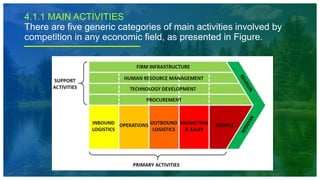
4.1.1 MAIN ACTIVITIES
There are five generic categories of main activities involved by
competition in any economic field, as presented in Figure.
• Inbound Logistics
• Operations
• Outbound Logistics
• Marketing Sales
• Service
ADD A FOOTER 8
9
ADD A FOOTER
Procurement refers to the to the purchasing function. Among
purchased materials one can mention: raw materials, auxiliary
production materials and other consumable articles, as well as
assets such as equipment, laboratory installations, office devices
and buildings.
• Technology Development
• Human Resources Management
• Firm Infrastructure
4.1.2 SUPPORT ACTIVITIES
Types of activities
• DIRECT
• INDIRECT
• QUALITY ASSURING
Competitive advantages results from the firm’s ability to
perform the required activities, either a lower costs, or in ways
able to create value for the client and that allow the firm to ask
for a higher price.
Competitive advantages require that the value chain of a firm
to be rather a system that a collection of separate parts. A firm
is profitable if its value is higher than the total cost of
performing all activities.
The difference between value chains of competitors
are main source of competitive advantage. Looking for
sustainable competitive advantage, the firm should not
limit only to its own value chain, but it also should have
in view the value chains suppliers, contributors, and,
finally, of its customer.
13
ADD A FOOTER
Multinational have located subsidiary business in other
countries for many years. In recent years, this trend has
gathered pace as part of globalization. There are specific
reasons why businesses might want to locate overseas
international location.
4.2 INTERNATIONAL BUSINESS
LOCATIONS
14
ADD A FOOTER
Some Reasons for International
Location
• HISTORICAL SERVICE
• ACCESS TO MARKETS
• ACCESS TORAW MATERIALS
• ACCESS TO LABOR
• TAX AVOIDANCE
• LOCAL INCENTIVE
Some Problems of International Trade
15
ADD A FOOTER
Risk and uncertainties associated wih
international trade include the following; for
some companies,this risks are managed better
by having international offices, factos and so
on.
• Currency fluctuations
• Exchange controls
• Political instability and unrest
• Tariffs and other restrictive practices
• Language and cultural barriers UK firms
have an advantage that English is
widely spoken around the world
• Differences in ethical approaches
Factors Influencing Location
Factors influencing plant location:
1. Nature of the Product
2. Volume of Production
3. Basic Managerial Polies and Decision
4. Nature of Plant Location
5. Type of Industry Process
17
ADD A FOOTER
7. Nature of Machines
8. Climate
9. Nature of Materials
10.Type of Machine
11. Human Factor and Working Conditions
12. Characteristics of the Building
6. Types of Methods of Production
(1) Job Order Production
(2) Batch Production, and
(3) Mass Production
18
ADD A FOOTER
Product layout is also called as production lines or
assembly lines. They are designed and laid out in
such a way that only a few products are capable of
being manufactured as assembled. Materials flow
through the various facilities. They use special
machines to perform specific operations to
produce only one product at one time.
4.2.1 Production Layout
19
ADD A FOOTER
• The skills required of the workers is low
• Supervision is minimal
• Training needs are small
• Precautions to be taken are
• Constant check on the process needs to be performed so that quality is
assured.
• Corrective measures have to be implemented immediately to avoid
rejections, since, the quantites that get manufactured will be continuous.
• Check for the behavioral attitude of the worker.
Using special machines and implementing standardizatiobn in
operationshave many advantages which are listed below.
20
ADD A FOOTER
A value chain analysis, providing both qualitative and quantitative
background information, is to be undertaken for all cases studies
(products) included in the project before an economic analysis is
undertaken. Source of information for this analysis may include
secondary data, published or unpublished literature, surveys,
focus groups, and rapud appraisal.
4.3 VALUE CHAIN ANALYSIS
21
ADD A FOOTER
The value chain analysis will include
the following stages:
• PRODUCTION
• PROCESSING
• TRANSPORTATION
• FINAL CONSUMPTION
• REGULATIONS
• MARKET STRUCTURE
• DATA AVAILABILITY
22
ADD A FOOTER
End of Chapter Discussion

strategy development in international TRADE

  • 1.
  • 2.
    INTRODUCTION Many companies seemto do very well without a formal business strategy. International operations very often start with direct exports. These are initiated by the indispensable enterpreneural vision of top management and the excellent salesmanship of a few international export managers, resulting in immediate and atrractive financial returns. ADD A FOOTER 2
  • 3.
    Good reasons forstarting the development of an international business stratery are the following: • IMPROVED COMMUNICATION • GLOBALIZATON OF MARKET • FOLLOW THE COMPETITION • AVAILABILTY OF MARKET INFORMATION • CREATIVE ENTERPRENEURSHIP ADD A FOOTER 3
  • 4.
    Value chain describesthe entire range of the activities that necessary to bring the product or a service from the setting up level, through different levels of production ( involving a combination of physical transformation and different service utilization ) , delivery, to final the customer, and doing away with it after using it. 4.1 THE FIRM AS A VALUE CHAIN 4 ADD A FOOTER
  • 5.
    Value shows thetotal value and is made up of value activities and values margin. Values activities - Are distinct activities from physical and technological point of view, develop by the firm. These are the stones with the help of ehich s firm creates a valuable product for its buyers. Values margin - The values margin can be measured in different ways. - The value chains of suppliers and distributors also include a value margin, whose separate identification is important in order to understand a firm’s cost position sources , because the margin is a part of the total cost born by the buyer. ADD A FOOTER 5
  • 6.
    Values can beclassified in two broad categories, according to Michael Porter: … 6 ADD A FOOTER •MAIN ACTIVITIES •SUPPORT ACTIVITIES
  • 7.
    7 4.1.1 MAIN ACTIVITIES Thereare five generic categories of main activities involved by competition in any economic field, as presented in Figure.
  • 8.
    • Inbound Logistics •Operations • Outbound Logistics • Marketing Sales • Service ADD A FOOTER 8
  • 9.
    9 ADD A FOOTER Procurementrefers to the to the purchasing function. Among purchased materials one can mention: raw materials, auxiliary production materials and other consumable articles, as well as assets such as equipment, laboratory installations, office devices and buildings. • Technology Development • Human Resources Management • Firm Infrastructure 4.1.2 SUPPORT ACTIVITIES
  • 10.
    Types of activities •DIRECT • INDIRECT • QUALITY ASSURING
  • 11.
    Competitive advantages resultsfrom the firm’s ability to perform the required activities, either a lower costs, or in ways able to create value for the client and that allow the firm to ask for a higher price. Competitive advantages require that the value chain of a firm to be rather a system that a collection of separate parts. A firm is profitable if its value is higher than the total cost of performing all activities.
  • 12.
    The difference betweenvalue chains of competitors are main source of competitive advantage. Looking for sustainable competitive advantage, the firm should not limit only to its own value chain, but it also should have in view the value chains suppliers, contributors, and, finally, of its customer.
  • 13.
    13 ADD A FOOTER Multinationalhave located subsidiary business in other countries for many years. In recent years, this trend has gathered pace as part of globalization. There are specific reasons why businesses might want to locate overseas international location. 4.2 INTERNATIONAL BUSINESS LOCATIONS
  • 14.
    14 ADD A FOOTER SomeReasons for International Location • HISTORICAL SERVICE • ACCESS TO MARKETS • ACCESS TORAW MATERIALS • ACCESS TO LABOR • TAX AVOIDANCE • LOCAL INCENTIVE
  • 15.
    Some Problems ofInternational Trade 15 ADD A FOOTER Risk and uncertainties associated wih international trade include the following; for some companies,this risks are managed better by having international offices, factos and so on. • Currency fluctuations • Exchange controls • Political instability and unrest • Tariffs and other restrictive practices • Language and cultural barriers UK firms have an advantage that English is widely spoken around the world • Differences in ethical approaches
  • 16.
    Factors Influencing Location Factorsinfluencing plant location: 1. Nature of the Product 2. Volume of Production 3. Basic Managerial Polies and Decision 4. Nature of Plant Location 5. Type of Industry Process
  • 17.
    17 ADD A FOOTER 7.Nature of Machines 8. Climate 9. Nature of Materials 10.Type of Machine 11. Human Factor and Working Conditions 12. Characteristics of the Building 6. Types of Methods of Production (1) Job Order Production (2) Batch Production, and (3) Mass Production
  • 18.
    18 ADD A FOOTER Productlayout is also called as production lines or assembly lines. They are designed and laid out in such a way that only a few products are capable of being manufactured as assembled. Materials flow through the various facilities. They use special machines to perform specific operations to produce only one product at one time. 4.2.1 Production Layout
  • 19.
    19 ADD A FOOTER •The skills required of the workers is low • Supervision is minimal • Training needs are small • Precautions to be taken are • Constant check on the process needs to be performed so that quality is assured. • Corrective measures have to be implemented immediately to avoid rejections, since, the quantites that get manufactured will be continuous. • Check for the behavioral attitude of the worker. Using special machines and implementing standardizatiobn in operationshave many advantages which are listed below.
  • 20.
    20 ADD A FOOTER Avalue chain analysis, providing both qualitative and quantitative background information, is to be undertaken for all cases studies (products) included in the project before an economic analysis is undertaken. Source of information for this analysis may include secondary data, published or unpublished literature, surveys, focus groups, and rapud appraisal. 4.3 VALUE CHAIN ANALYSIS
  • 21.
    21 ADD A FOOTER Thevalue chain analysis will include the following stages: • PRODUCTION • PROCESSING • TRANSPORTATION • FINAL CONSUMPTION • REGULATIONS • MARKET STRUCTURE • DATA AVAILABILITY
  • 22.
    22 ADD A FOOTER Endof Chapter Discussion