MEMBERS:
SARABILLO
BUSTAMANTE
GALAGAR
MONTERO
KEY TAKEAWAYS
•Mercantilism was the dominant economic system from the 16th century to the
18th century.
•Mercantilism was based on the idea that a nation's wealth and power were best
served by increasing exports and reducing imports.
•It's characterized by the belief that global wealth was static and that a nation's
economic health relied heavily on its supply of capital.
•Due to the nationalistic nature of mercantilism, nations frequently used military
might to protect local markets and supply sources.
•Mercantilism was replaced by free-trade economic theory in the mid-18th
century.
MERCANTILISM
UNDERSTANDING MERCANTILISM
Mercantilism was a form of economic nationalism that sought
to increase the prosperity and power of a nation through restrictive
trade practices. Its goal was to increase the supply of a state's gold
and silver with exports rather than to deplete it through imports. It
also sought to support domestic employment.
Mercantilism centered on the interests of merchants and
producers (such as England's East India Company and the Dutch
East India Company) and protected their activities, as necessary.
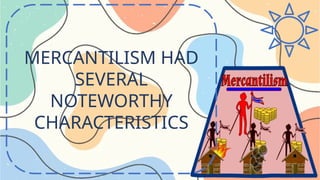
MERCANTILISM HAD
SEVERAL
NOTEWORTHY
CHARACTERISTICS
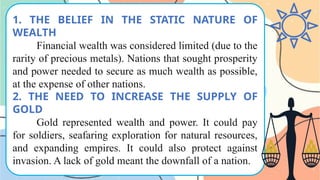
1. THE BELIEF IN THE STATIC NATURE OF
WEALTH
Financial wealth was considered limited (due to the
rarity of precious metals). Nations that sought prosperity
and power needed to secure as much wealth as possible,
at the expense of other nations.
2. THE NEED TO INCREASE THE SUPPLY OF
GOLD
Gold represented wealth and power. It could pay
for soldiers, seafaring exploration for natural resources,
and expanding empires. It could also protect against
invasion. A lack of gold meant the downfall of a nation.
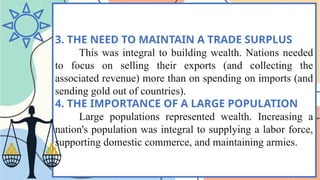
3. THE NEED TO MAINTAIN A TRADE SURPLUS
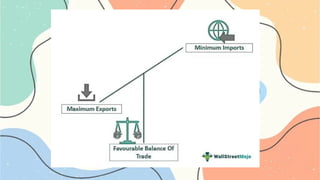
This was integral to building wealth. Nations needed
to focus on selling their exports (and collecting the
associated revenue) more than on spending on imports (and
sending gold out of countries).
4. THE IMPORTANCE OF A LARGE POPULATION
Large populations represented wealth. Increasing a
nation's population was integral to supplying a labor force,
supporting domestic commerce, and maintaining armies.
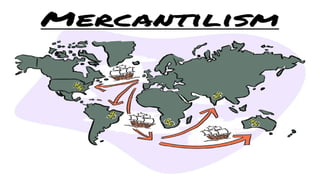
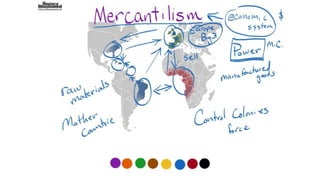
5. THE USE OF COLONIES TO SUPPORT
WEALTH
Some nations needed colonies for raw materials, a
labor supply, and a way to keep wealth within its
control (by selling colonies the products their raw
materials helped to produce). Essentially, colonies
increased a nation's wealth-building power and
national security.
6. THE USE OF PROTECTIONISM
Protecting a nation's ability to build and maintain
trade surpluses encompassed prohibiting colonies
from trading with other nations and imposing tariffs
on imported goods.
HISTORY OF MERCANTILISM
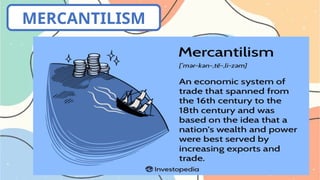
First seen in Europe during the 1500s, mercantilism was based
on the idea that a nation's wealth and power were best served by
increasing exports and limiting imports.
Mercantilism replaced the feudal economic system in Western
Europe. At the time, England was the epicenter of the British Empire
but had relatively few natural resources.
To grow its wealth, England introduced fiscal policies that
discouraged colonists from buying foreign products and created
incentives to buy only British goods. For example, the Sugar Act of
1764 raised duties on foreign refined sugar and molasses imported by
the colonies. This increased taxation was meant to give British sugar
growers in the West Indies a monopoly on the colonial market.
Similarly, the Navigation Act of 1651 forbade foreign vessels
from trading along the British coast and required colonial exports to
first pass through British control before being redistributed
throughout Europe.
Programs like these resulted in a favorable balance of trade
that increased Great Britain's national wealth.
Under mercantilism, nations frequently engaged their military
might to ensure that local markets and supply sources were protected.
Mercantilists also believed that a nation's economic health could
be measured by its ownership of precious metals, such as gold or
silver. Their levels tended to rise with increased new home
construction, increased agricultural output, and a strong merchant
fleet that serviced additional markets with goods and raw materials.
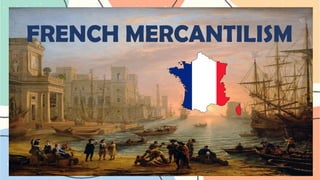
FRENCH MERCANTILISM
FRENCH MERCANTILISM
Arguably the most influential proponent of mercantilism, French
Controller General of Finance Jean-Baptiste Colbert (1619-1683)
studied foreign-trade economic theories. He was uniquely positioned
to execute on mercantilist ideas. A devout monarchist, Colbert called
for an economic strategy that protected the French crown from a
rising Dutch mercantile class.
Colbert also increased the size of the French navy, on the belief
that France had to control its trade routes to increase its wealth.
Although his practices ultimately proved unsuccessful, his ideas were
hugely popular. Ultimately, they became overshadowed by the theory
of free-market economics
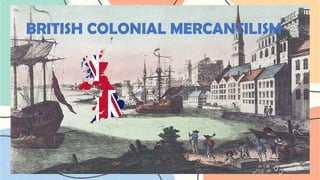
BRITISH COLONIAL MERCANTILISM
The British colonies were subject to the direct and indirect
effects of mercantilist policy at home. Here are several examples:
•CONTROLLED production and trade: Mercantilism led to the
adoption of far-reaching trade restrictions, which stunted the growth
and freedom of colonial businesses.
•THE EXPANSION OF THE SLAVE TRADE: Trade became
triangulated between the British Empire, its colonies, and foreign
markets. This fostered the development of the slave trade in many
colonies, including America. The colonies provided rum, cotton, and
other products demanded by African imperialists. In turn, slaves were
returned to America or the West Indies and traded for sugar and
molasses.
•INFLATION AND TAXATION: The British government
demanded that trading be conducted using gold and
silver bullion, ever seeking a positive balance of trade. The
colonies often had insufficient bullion left over to circulate in
their own markets, so they issued paper currency to replace it.
Mismanagement of printed currency resulted in inflationary
periods. Additionally, since Great Britain was in a near-
constant state of war, heavy taxation was needed to prop up its
army and navy. The combination of taxes and inflation caused
great colonial discontent.
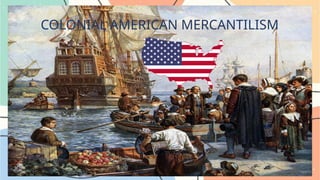
COLONIAL AMERICAN MERCANTILISM
Defenders of mercantilism argued that it created
stronger economies by marrying the concerns of
colonies with those of their founding countries. In
theory, when British colonists created their own
products and obtained others by trading with their
founding nation, they remained independent from the
influence of hostile nations.
Meanwhile, Great Britain benefited from receiving
large amounts of raw material from the colonists that
was necessary for a productive manufacturing sector.
Critics of mercantilism believed the restriction on international trade increased
expenses, because all imports, regardless of product origin, had to be shipped by
British ships. This radically spiked the costs of goods for the colonists, who
believed the disadvantages of this system outweighed the benefits of affiliating
with Great Britain.
After a costly war with France, the British Empire, hungry to replenish
revenue, raised taxes on colonists, who rebelled by boycotting British products,
consequently slashing imports by a full one-third. This was followed by the
Boston Tea Party in 1773, where Boston colonists disguised as Indians raided
three British ships. They emptied several hundred chests of tea into the harbor to
protest British taxes on tea and the monopoly granted to the East India Company.
To reinforce its mercantilist control, Great Britain pushed harder against the
colonies. This resulted in the Revolutionary War.
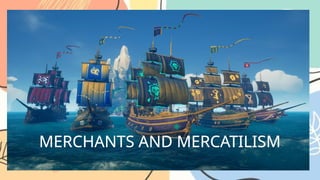
MERCHANTS AND MERCATILISM
By the early 16th century, European financial theorists
understood the importance of the merchant class in generating
wealth. Cities and countries with goods to sell thrived in
the late middle ages.
Consequently, many believed the state should allow its
leading merchants to create exclusive government-controlled
monopolies and cartels. Governments used regulations,
subsidies, and (if needed) military force to protect these
monopolistic corporations from domestic and foreign
competition.
Citizens could invest money in mercantilist
corporations in exchange for ownership and limited
liability in their royal charters. These citizens were
granted shares of the company profit. In essence,
these were the first traded corporate stocks.
The most famous and powerful mercantilist
corporations were Britain's East India Company and
the Dutch East India Company. For more than 250
years, the British East India Company maintained the
exclusive, royally granted right to conduct trade
between Britain, India, and China. Its trade routes
were protected by the Royal Navy.
MERCANTILISM VS. IMPERIALISM
Mercantilist governments manipulate a nation's
economy to create favorable trade balances. Imperialism
uses a combination of military force and mass
immigration to foist mercantilism on less-developed
regions. Military campaigns forced inhabitants to follow
the dominant countries' laws. One of the most powerful
examples of the relationship between mercantilism and
imperialism is Britain's establishment of the American
colonies.
MERCANTILISM VS. IMPERIALISM
Mercantilist governments manipulate a nation's
economy to create favorable trade balances. Imperialism
uses a combination of military force and mass
immigration to foist mercantilism on less-developed
regions. Military campaigns forced inhabitants to follow
the dominant countries' laws. One of the most powerful
examples of the relationship between mercantilism and
imperialism is Britain's establishment of the American
colonies.
MERCANTILISM VS. CAPITALISM
Capitalism provides several advantages
over mercantilism for individuals, businesses, and
nations. With capitalism's free-trade system,
individuals benefit from a greater choice of affordable
goods. On the other hand, mercantilism restricts
imports and reduces the choices available to
consumers. Fewer imports mean less competition and
higher prices.
Mercantilist countries engaged in warfare
frequently to control resources. Nations operating under
a free-trade system prospered by engaging in mutually
beneficial trade relations.
In his seminal book The Wealth of Nations,
legendary economist Adam Smith argued that free trade
enabled businesses to specialize in producing the goods
that they could manufacture most efficiently. This led to
higher productivity and greater economic growth.
MERCANTILISM TODAY
Today, mercantilism is deemed outdated. The disaster of
World War II underscored the potential danger of nationalistic
policies. It also prodded the world toward global trading and
relationships as a way to combat them.
However, it is hard to escape mercantilism. For example,
after the war, barriers to trade were still used to protect locally
entrenched industries. The United States adopted a
protectionist trade policy toward Japan and negotiated
voluntary export restrictions with the Japanese government,
which limited Japanese exports to the United States.
Today, Russia and China still use a mercantilist system because it
partners so well with their forms of government. They have relied
heavily on their ability to control foreign trade, their balance of
payments, and foreign reserves. They have also sought to make their
exports relatively more attractive with lower pricing.
Due to the effects of globalization, many nations and their people
suffer from feeling that they've lost wealth, control, and prestige. This
has made the nationalism that is part of mercantilism more appealing.
It helped bring to power the likes of Donald Trump in the U.S.
and Narendra Modi in India.
In 2018, President Trump imposed tariffs on Chinese imports,
launching a trade war that exists to this day.
WHAT WERE THE MAIN BELIEFS OF
MERCANTILISM?
Mercantilism's original foundation included beliefs
that the world had limited wealth in the form of gold and
silver; that nations had to build their stores of gold at the
expense of others; that colonies were important for
supplying labor and trading partners; that armies and
navies were crucial to protecting trade practices; and that
protectionism was required to guarantee trade surpluses.
WHAT'S THE DIFFERENCE BETWEEN CAPITALISM
AND MERCANTILISM?
One difference is the role that the state plays.
Capitalism calls for a minimum of government
intervention and ownership of capital, trade, and
industry by private entities and individuals.
Mercantilism involves state control and regulation.
Capitalism is said to promote individual freedom.
Mercantilism is said to suppress it.
IS MERCANTILISM STILL USED TODAY?
Yes, to some extent it exists in
certain countries whose governments
seek to maintain control over property
ownership, trade, and the creation of
wealth.
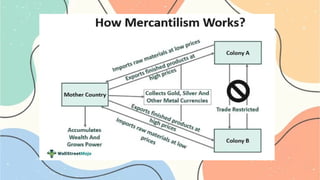
Example 1
The mother nation A imports coffee beans and varieties of tea leaves from its
colonies Nation B and C, at a comparatively cheaper rate. Though nations B
and C know that the deal will lead to a considerable loss, they still agree to
continue with it as they require military support from the mother country.
Moreover, the mother nation has restricted the two colonies from interacting
or trading with each other.
Nation A not only received huge profits by manufacturing and selling
finished products to its colonies, but it also empowered itself in terms of
precious metals it received in return. On the other hand, colonists suffered
losses by losing resources and wealth continuously while paying tariffs on
imported manufactured goods.
Example 2
The mercantilistic trade policy changed over time, even after its end in the
18th century. Here is an example of one of its modern forms, Techno-
nationalism, also known as a new strain of mercantilist thinking.
Much like the classic mercantilism theory, where national power and
wealth were interconnected, techno-nationalism connects technological
advancements to national security and economic growth.
Many countries are adopting this policy to gain a competitive advantage in
geopolitics and international trade. For instance, China has forbidden all its
government institutions and agencies from using computers and software
imported from foreign nations. Similarly, the United States and Russia are
exploring techno-nationalism to counterbalance China’s aggressive state-centric
capitalism.
for

FIN20 MERCANTALISM .pptx

  • 2.
  • 4.
    KEY TAKEAWAYS •Mercantilism wasthe dominant economic system from the 16th century to the 18th century. •Mercantilism was based on the idea that a nation's wealth and power were best served by increasing exports and reducing imports. •It's characterized by the belief that global wealth was static and that a nation's economic health relied heavily on its supply of capital. •Due to the nationalistic nature of mercantilism, nations frequently used military might to protect local markets and supply sources. •Mercantilism was replaced by free-trade economic theory in the mid-18th century.
  • 5.
  • 9.
    UNDERSTANDING MERCANTILISM Mercantilism wasa form of economic nationalism that sought to increase the prosperity and power of a nation through restrictive trade practices. Its goal was to increase the supply of a state's gold and silver with exports rather than to deplete it through imports. It also sought to support domestic employment. Mercantilism centered on the interests of merchants and producers (such as England's East India Company and the Dutch East India Company) and protected their activities, as necessary.
  • 10.
  • 11.
    1. THE BELIEFIN THE STATIC NATURE OF WEALTH Financial wealth was considered limited (due to the rarity of precious metals). Nations that sought prosperity and power needed to secure as much wealth as possible, at the expense of other nations. 2. THE NEED TO INCREASE THE SUPPLY OF GOLD Gold represented wealth and power. It could pay for soldiers, seafaring exploration for natural resources, and expanding empires. It could also protect against invasion. A lack of gold meant the downfall of a nation.
  • 12.
    3. THE NEEDTO MAINTAIN A TRADE SURPLUS This was integral to building wealth. Nations needed to focus on selling their exports (and collecting the associated revenue) more than on spending on imports (and sending gold out of countries). 4. THE IMPORTANCE OF A LARGE POPULATION Large populations represented wealth. Increasing a nation's population was integral to supplying a labor force, supporting domestic commerce, and maintaining armies.
  • 13.
    5. THE USEOF COLONIES TO SUPPORT WEALTH Some nations needed colonies for raw materials, a labor supply, and a way to keep wealth within its control (by selling colonies the products their raw materials helped to produce). Essentially, colonies increased a nation's wealth-building power and national security. 6. THE USE OF PROTECTIONISM Protecting a nation's ability to build and maintain trade surpluses encompassed prohibiting colonies from trading with other nations and imposing tariffs on imported goods.
  • 14.
  • 15.
    First seen inEurope during the 1500s, mercantilism was based on the idea that a nation's wealth and power were best served by increasing exports and limiting imports. Mercantilism replaced the feudal economic system in Western Europe. At the time, England was the epicenter of the British Empire but had relatively few natural resources. To grow its wealth, England introduced fiscal policies that discouraged colonists from buying foreign products and created incentives to buy only British goods. For example, the Sugar Act of 1764 raised duties on foreign refined sugar and molasses imported by the colonies. This increased taxation was meant to give British sugar growers in the West Indies a monopoly on the colonial market.
  • 16.
    Similarly, the NavigationAct of 1651 forbade foreign vessels from trading along the British coast and required colonial exports to first pass through British control before being redistributed throughout Europe. Programs like these resulted in a favorable balance of trade that increased Great Britain's national wealth. Under mercantilism, nations frequently engaged their military might to ensure that local markets and supply sources were protected. Mercantilists also believed that a nation's economic health could be measured by its ownership of precious metals, such as gold or silver. Their levels tended to rise with increased new home construction, increased agricultural output, and a strong merchant fleet that serviced additional markets with goods and raw materials.
  • 17.
  • 18.
    Arguably the mostinfluential proponent of mercantilism, French Controller General of Finance Jean-Baptiste Colbert (1619-1683) studied foreign-trade economic theories. He was uniquely positioned to execute on mercantilist ideas. A devout monarchist, Colbert called for an economic strategy that protected the French crown from a rising Dutch mercantile class. Colbert also increased the size of the French navy, on the belief that France had to control its trade routes to increase its wealth. Although his practices ultimately proved unsuccessful, his ideas were hugely popular. Ultimately, they became overshadowed by the theory of free-market economics
  • 19.
  • 20.
    The British colonieswere subject to the direct and indirect effects of mercantilist policy at home. Here are several examples: •CONTROLLED production and trade: Mercantilism led to the adoption of far-reaching trade restrictions, which stunted the growth and freedom of colonial businesses. •THE EXPANSION OF THE SLAVE TRADE: Trade became triangulated between the British Empire, its colonies, and foreign markets. This fostered the development of the slave trade in many colonies, including America. The colonies provided rum, cotton, and other products demanded by African imperialists. In turn, slaves were returned to America or the West Indies and traded for sugar and molasses.
  • 21.
    •INFLATION AND TAXATION:The British government demanded that trading be conducted using gold and silver bullion, ever seeking a positive balance of trade. The colonies often had insufficient bullion left over to circulate in their own markets, so they issued paper currency to replace it. Mismanagement of printed currency resulted in inflationary periods. Additionally, since Great Britain was in a near- constant state of war, heavy taxation was needed to prop up its army and navy. The combination of taxes and inflation caused great colonial discontent.
  • 22.
  • 23.
    Defenders of mercantilismargued that it created stronger economies by marrying the concerns of colonies with those of their founding countries. In theory, when British colonists created their own products and obtained others by trading with their founding nation, they remained independent from the influence of hostile nations. Meanwhile, Great Britain benefited from receiving large amounts of raw material from the colonists that was necessary for a productive manufacturing sector.
  • 24.
    Critics of mercantilismbelieved the restriction on international trade increased expenses, because all imports, regardless of product origin, had to be shipped by British ships. This radically spiked the costs of goods for the colonists, who believed the disadvantages of this system outweighed the benefits of affiliating with Great Britain. After a costly war with France, the British Empire, hungry to replenish revenue, raised taxes on colonists, who rebelled by boycotting British products, consequently slashing imports by a full one-third. This was followed by the Boston Tea Party in 1773, where Boston colonists disguised as Indians raided three British ships. They emptied several hundred chests of tea into the harbor to protest British taxes on tea and the monopoly granted to the East India Company. To reinforce its mercantilist control, Great Britain pushed harder against the colonies. This resulted in the Revolutionary War.
  • 25.
  • 26.
    By the early16th century, European financial theorists understood the importance of the merchant class in generating wealth. Cities and countries with goods to sell thrived in the late middle ages. Consequently, many believed the state should allow its leading merchants to create exclusive government-controlled monopolies and cartels. Governments used regulations, subsidies, and (if needed) military force to protect these monopolistic corporations from domestic and foreign competition.
  • 27.
    Citizens could investmoney in mercantilist corporations in exchange for ownership and limited liability in their royal charters. These citizens were granted shares of the company profit. In essence, these were the first traded corporate stocks. The most famous and powerful mercantilist corporations were Britain's East India Company and the Dutch East India Company. For more than 250 years, the British East India Company maintained the exclusive, royally granted right to conduct trade between Britain, India, and China. Its trade routes were protected by the Royal Navy.
  • 28.
    MERCANTILISM VS. IMPERIALISM Mercantilistgovernments manipulate a nation's economy to create favorable trade balances. Imperialism uses a combination of military force and mass immigration to foist mercantilism on less-developed regions. Military campaigns forced inhabitants to follow the dominant countries' laws. One of the most powerful examples of the relationship between mercantilism and imperialism is Britain's establishment of the American colonies.
  • 29.
    MERCANTILISM VS. IMPERIALISM Mercantilistgovernments manipulate a nation's economy to create favorable trade balances. Imperialism uses a combination of military force and mass immigration to foist mercantilism on less-developed regions. Military campaigns forced inhabitants to follow the dominant countries' laws. One of the most powerful examples of the relationship between mercantilism and imperialism is Britain's establishment of the American colonies.
  • 30.
    MERCANTILISM VS. CAPITALISM Capitalismprovides several advantages over mercantilism for individuals, businesses, and nations. With capitalism's free-trade system, individuals benefit from a greater choice of affordable goods. On the other hand, mercantilism restricts imports and reduces the choices available to consumers. Fewer imports mean less competition and higher prices.
  • 31.
    Mercantilist countries engagedin warfare frequently to control resources. Nations operating under a free-trade system prospered by engaging in mutually beneficial trade relations. In his seminal book The Wealth of Nations, legendary economist Adam Smith argued that free trade enabled businesses to specialize in producing the goods that they could manufacture most efficiently. This led to higher productivity and greater economic growth.
  • 32.
    MERCANTILISM TODAY Today, mercantilismis deemed outdated. The disaster of World War II underscored the potential danger of nationalistic policies. It also prodded the world toward global trading and relationships as a way to combat them. However, it is hard to escape mercantilism. For example, after the war, barriers to trade were still used to protect locally entrenched industries. The United States adopted a protectionist trade policy toward Japan and negotiated voluntary export restrictions with the Japanese government, which limited Japanese exports to the United States.
  • 33.
    Today, Russia andChina still use a mercantilist system because it partners so well with their forms of government. They have relied heavily on their ability to control foreign trade, their balance of payments, and foreign reserves. They have also sought to make their exports relatively more attractive with lower pricing. Due to the effects of globalization, many nations and their people suffer from feeling that they've lost wealth, control, and prestige. This has made the nationalism that is part of mercantilism more appealing. It helped bring to power the likes of Donald Trump in the U.S. and Narendra Modi in India. In 2018, President Trump imposed tariffs on Chinese imports, launching a trade war that exists to this day.
  • 34.
    WHAT WERE THEMAIN BELIEFS OF MERCANTILISM? Mercantilism's original foundation included beliefs that the world had limited wealth in the form of gold and silver; that nations had to build their stores of gold at the expense of others; that colonies were important for supplying labor and trading partners; that armies and navies were crucial to protecting trade practices; and that protectionism was required to guarantee trade surpluses.
  • 35.
    WHAT'S THE DIFFERENCEBETWEEN CAPITALISM AND MERCANTILISM? One difference is the role that the state plays. Capitalism calls for a minimum of government intervention and ownership of capital, trade, and industry by private entities and individuals. Mercantilism involves state control and regulation. Capitalism is said to promote individual freedom. Mercantilism is said to suppress it.
  • 36.
    IS MERCANTILISM STILLUSED TODAY? Yes, to some extent it exists in certain countries whose governments seek to maintain control over property ownership, trade, and the creation of wealth.
  • 37.
    Example 1 The mothernation A imports coffee beans and varieties of tea leaves from its colonies Nation B and C, at a comparatively cheaper rate. Though nations B and C know that the deal will lead to a considerable loss, they still agree to continue with it as they require military support from the mother country. Moreover, the mother nation has restricted the two colonies from interacting or trading with each other. Nation A not only received huge profits by manufacturing and selling finished products to its colonies, but it also empowered itself in terms of precious metals it received in return. On the other hand, colonists suffered losses by losing resources and wealth continuously while paying tariffs on imported manufactured goods.
  • 38.
    Example 2 The mercantilistictrade policy changed over time, even after its end in the 18th century. Here is an example of one of its modern forms, Techno- nationalism, also known as a new strain of mercantilist thinking. Much like the classic mercantilism theory, where national power and wealth were interconnected, techno-nationalism connects technological advancements to national security and economic growth. Many countries are adopting this policy to gain a competitive advantage in geopolitics and international trade. For instance, China has forbidden all its government institutions and agencies from using computers and software imported from foreign nations. Similarly, the United States and Russia are exploring techno-nationalism to counterbalance China’s aggressive state-centric capitalism.
  • 39.