The Strategy
Development in
International
Business
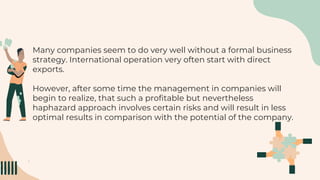
Many companies seem to do very well without a formal business
strategy. International operation very often start with direct
exports.
However, after some time the management in companies will
begin to realize, that such a profitable but nevertheless
haphazard approach involves certain risks and will result in less
optimal results in comparison with the potential of the company.
.
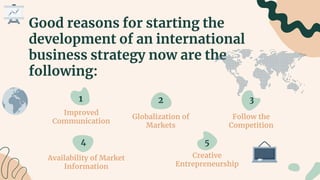
Good reasons for starting the
development of an international
business strategy now are the
following:
Availability of Market
Information
Creative
Entrepreneurship
Improved
Communication
Globalization of
Markets
Follow the
Competition
1 2 3
4 5
What is the Value Chain?
 Porter’s definition includes all activities to
design, produce, market, deliver, and support
the product/services.
 The Value Chain is concentrating on the
activities starting with raw materials till the
conversion into final goods or services.
 Two Categories:
 Main Activities (Inbound Logistics, operations,
Outbound Logistics, Marketing Sales, Services)
 Support Activities (Technology Development,
Human Resources Management, Firm
Infratructure)
Main Activities
 Inbound Logistic: include the receiving,
warehousing and inventory control of input
materials.
 Operations: are the value-creating activities
that transform the inputs into the final
product.
 Outbound Logistics: are the activities required
to get the finished product to the customer,
including warehousing, order fulfillment,etc.
 Marketing and Sales: are those activities
associated with getting buyers to purchase the
product, including channel selection,
advertising, pricing, etc.
 Services: activities are those that maintain and
enhance the product’s value including
customer support, repair services, etc.
Support Activities
 Technology Development: includes research
and development, process automation, and
other technology development used to
support the value-chain activities.
 Human Resources Management: the activities
associated with recruiting, development, and
compensation of employees.
 Firm Infrastructure: includes activities such as
finance, legal, quality management, etc.
Types of Activities
With in every category of main and support
activities there are three type of activities that play a
different role in the strategic competitive
advantage:
● Direct Activities - involved in creating value for
the buyer, such as assembling ones,
components processing, etc.
● Indirect: possible direct ativities contiuously,
such as maintaining ones, planning sales of
staff, etc.
● Quality Assuring: assuring the other activities
quality, such as supervision ones, inspecting,
testing, revision, checking, and etc.
Value Chain Analysis
 Used to identify sources of competitive
advantage
 Specifically:
- Opportunities to secure cost
advantages
- Opportunities to create
product/service differentiation
 Includes the value-creating activities of
all industry participants.
Value Chain analysis is very important
element that allows the following
characteristics observation:
 It studies competitiveness nature and determinants,
having a special contribution to the orientation towards
inter-connected group of firms;
 Concentrating on all chain links ( not only on production)
and on all activities in every link helps to identify activities
that are responsible of incomes growing and those that
contribute to their decrease;
 As a result of these differences referring to the nature of
income along various links within he chain, deciding
people obtain clear information, necessary to formulate
correct strategies and to take proper decisions. Thus,
according to these decisions one can improve tha activity
in a chain link in order to generate higher incomes;
 With the help of this analyses one can prove that even if a
firm is competitive, its connection t the world economy
can require a certain concentration on macro-policies and
institutional relations.
International
Business Locations
Multinationals have located subsidiary
businesses in other countries for many
years. In recent years, this trend has
gathered pace as part of globalization.
There are specific reasons why businesses
might want to locate overseas international
location.
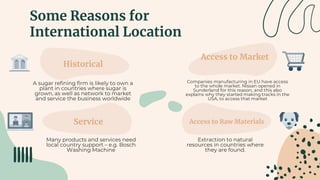
Some Reasons for
International Location
Historical
A sugar refining firm is likely to own a
plant in countries where sugar is
grown, as well as network to market
and service the business worldwide
Access to Market
Companies manufacturing in EU have access
to the whole market. Nissan opened in
Sunderland for this reason, and this also
explains why they started making tracks in the
USA, to access that market
Service
Many products and services need
local country support – e.g. Bosch
Washing Machine
Access to Raw Materials
Extraction to natural
resources in countries where
they are found.
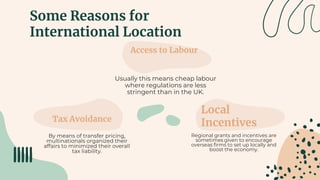
Some Reasons for
International Location
Access to Labour
Usually this means cheap labour
where regulations are less
stringent than in the UK.
Tax Avoidance
By means of transfer pricing,
multinationals organized their
affairs to minimized their overall
tax liability.
Local
Incentives
Regional grants and incentives are
sometimes given to encourage
overseas firms to set up locally and
boost the economy.
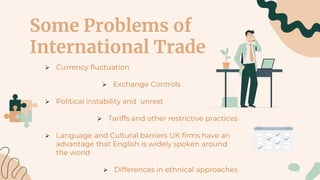
Some Problems of
International Trade
Risk and uncertainties associated with
international trade include the following; for
some companies, these risk are managed better
by having international offices, factories and so
on.
Some Problems of
International Trade
 Currency fluctuation
 Exchange Controls
 Political instability and unrest
 Tariffs and other restrictive practices
 Language and Cultural barriers UK firms have an
advantage that English is widely spoken around
the world
 Differences in ethnical approaches
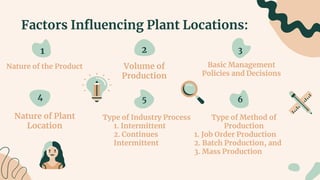
Factors Influencing Plant Locations:
Nature of Plant
Location
Nature of the Product Volume of
Production
Basic Management
Policies and Decisions
1 2 3
4 5 6
Type of Method of
Production
1. Job Order Production
2. Batch Production, and
3. Mass Production
Type of Industry Process
1. Intermittent
2. Continues
Intermittent
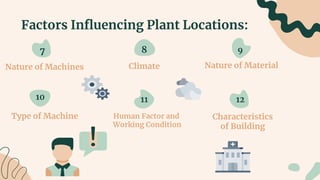
Factors Influencing Plant Locations:
Type of Machine
Nature of Machines Climate Nature of Material
7 8 9
10 11 12
Characteristics
of Building
Human Factor and
Working Condition
Product Layout
Product Layout is also called as production lines or
assembly lines. They are designed and laid out in such way
that only few products are capable of being manufactured
or assembled.
Materials flow through the various facilities . These use special
machines to perform specific operations to produce only one
product at one time. Using special machines and implementing
standardization in operations have many advantages which is
listed in the next slide.
Advantages of Using Special Machines and
Implementing Standardization in Operation
*The skill required is low
*Supervision is minimal
*Training needs are small
- Pre cautions to be taken are
*Constant Check on the processes needs to be performed so that quality is assured.
*Check for the behavioral attitude of the worker
Value Chain
Analysis and Risk
Analysis
A value chain analysis process,
providing both qualitative and
quantitative background
information, is to be taken for all
case studies (products) included
in the project before an
economic analysis is undertaken.
Source of information for this
analysis may include secondary
data, published or unpublished
literature, surveys, focus groups,
and rapid appraisal.
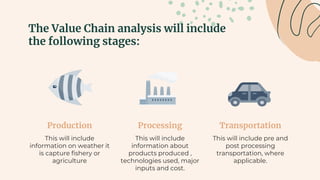
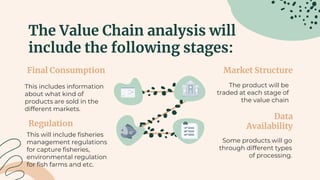
The Value Chain analysis will include
the following stages:
Production
This will include
information on weather it
is capture fishery or
agriculture
Processing
This will include
information about
products produced ,
technologies used, major
inputs and cost.
Transportation
This will include pre and
post processing
transportation, where
applicable.
The Value Chain analysis will
include the following stages:
This includes information
about what kind of
products are sold in the
different markets.
Final Consumption
The product will be
traded at each stage of
the value chain
Market Structure
Some products will go
through different types
of processing.
Data
Availability
This will include fisheries
management regulations
for capture fisheries,
environmental regulation
for fish farms and etc.
Regulation
Risk Analysis
Risk analysis is the process
of defining and analysing
the dangers to individuals,
businesses and
government agencies
posed by potential natural
and human caused adverse
events. A risk analysis
report can be either
quantitative or qualitative.
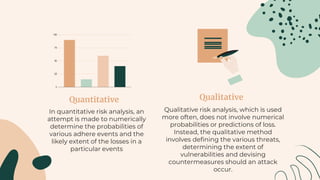
Quantitative
In quantitative risk analysis, an
attempt is made to numerically
determine the probabilities of
various adhere events and the
likely extent of the losses in a
particular events
Qualitative
Qualitative risk analysis, which is used
more often, does not involve numerical
probabilities or predictions of loss.
Instead, the qualitative method
involves defining the various threats,
determining the extent of
vulnerabilities and devising
countermeasures should an attack
occur.
There may be some terminology and
definition differences related to risk
analysis, risk assessment, and business
impact analysis. Although several
definition are possible and can overlap,
for purpose of this article, please consider
the following definition:
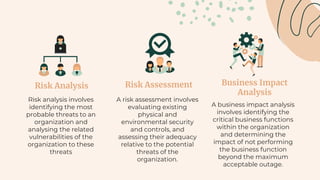
Risk Analysis
Risk analysis involves
identifying the most
probable threats to an
organization and
analysing the related
vulnerabilities of the
organization to these
threats
Risk Assessment
A risk assessment involves
evaluating existing
physical and
environmental security
and controls, and
assessing their adequacy
relative to the potential
threats of the
organization.
Business Impact
Analysis
A business impact analysis
involves identifying the
critical business functions
within the organization
and determining the
impact of not performing
the business function
beyond the maximum
acceptable outage.
Risk Analysis Process
Regardless of the prevention
techniques employed, possible
threats that could arise inside or
outside the organization need to
be assessed.
Although the exact nature of
potential disasters or their resulting
consequences are difficult to
determine, it is beneficial to perform
a comprehensive risk assessment of
all threats that can realistically occur
to the organization.
Regardless of the type of threat the
goals of business recovery planning are
to ensure safety of customers,
employees and other personnel during
and following a disaster.
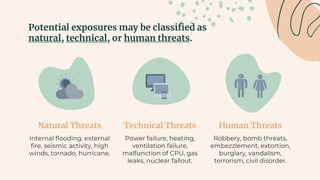
Natural Threats
Internal flooding, external
fire, seismic activity, high
winds, tornado, hurricane.
Technical Threats
Power failure, heating,
ventilation failure,
malfunction of CPU, gas
leaks, nuclear fallout.
Human Threats
Robbery, bomb threats,
embezzlement, extortion,
burglary, vandalism,
terrorism, civil disorder.
Potential exposures may be classified as
natural, technical, or human threats.
The Impact can be rated as:
0 - No impact or interruption in
operations.
1 - Noticeable impact,
interruption, in operation for up
to 8 hours.
2 – Damage to equipment and
facilities, interruption in
operations for 8 – 48 hours.
3 – Major damage to the
equipment and facilities,
interruption in operation for
more than 48 hours. All main
office and computer centre
functions must be relocated.
The planning process
should identify and
measure the likelihood
of all potential risk and
the impact on the
organization if the treat
occurred. To do this,
each department be
analyze separately
Certain assumptions may be necessary to uniformly apply ratings
to each potential threat. Following are typical assumptions that can
be used during the risk assessment process:
 Although range impact could range between 1 and 3 for
any facilities given a specific set of circumstances,
ratings applied should reflect anticipated, likely or
expected impact on each area.
 Each potential threat should be assumed to be
“localized” to the facility being rated.
 Although one potential threat could lead to another
potential threat, no domino effect should be assumed.
 If the result of the threat would not warrant movement
to an alternate site, the impact should be rated no
higher than a “2”.
 The risk assessment should be performed by facility.
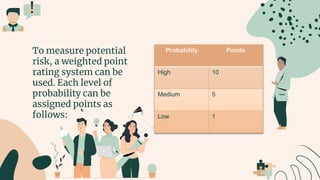
To measure potential
risk, a weighted point
rating system can be
used. Each level of
probability can be
assigned points as
follows:
Probability Points
High 10
Medium 5
Low 1
Consideration in analyzing risk include:
1. Investigating the frequency of particular types of disaster.
2. Determining the degree of predictability of the disaster.
3. Analysing the speed of onset of the disaster.
4. Determining the amount of forewarning associated with
the disasters.
5. Estimating the duration of the disaster.
6. Considering the impact of a disaster based on two
scenarios;
a. Vital records are destroyed
b. Vital records are not destroyed
Consideration in analyzing risk include:
7. Identifying the consequences of a disaster, such as;
a. Personnel availability
b. Personnel injuries
c. Loss of operating capability
d. Loss of assets
e. Facility damage
8. Determining the existing and required redundancy levels
throughout the organization to accommodate critical system
and functions, including:
Consideration in analyzing risk include:
a. Hardware
b. Information
c. Communication
d. Personnel
e. Services
9. Estimating potential losses for each business function based
on the financial and service impact and the length of time the
organization can operate without this business function.
10. Determining the cost of contingency planning
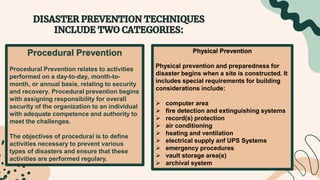
Procedural Prevention
Procedural Prevention relates to activities
performed on a day-to-day, month-to-
month, or annual basis, relating to security
and recovery. Procedural prevention begins
with assigning responsibility for overall
security of the organization to an individual
with adequate competence and authority to
meet the challenges.
The objectives of procedural is to define
activities necessary to prevent various
types of disasters and ensure that these
activities are performed regulary.
Physical Prevention
Physical prevention and preparedness for
disaster begins when a site is constructed. It
includes special requirements for building
considerations include:
 computer area
 fire detection and extinguishing systems
 record(s) protection
 air conditioning
 heating and ventilation
 electrical supply anf UPS Systems
 emergency procedures
 vault storage area(s)
 archival system
ISSURANCE
CONSIDERATION
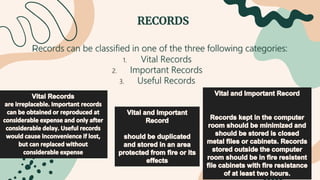
RECORDS
Records can be classified in one of the three following categories:
1. Vital Records
2. Important Records
3. Useful Records
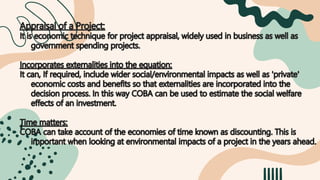
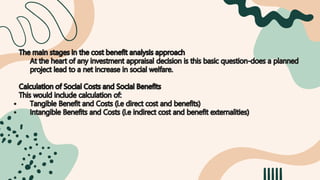
COST BENEFITS
ANALYSIS
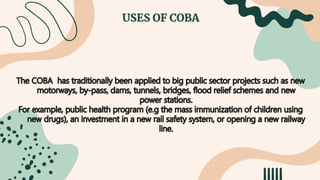
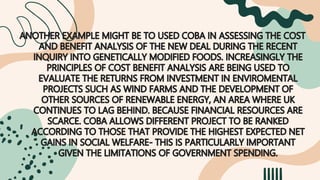
USES OF COBA
EVALUATION: CRITICISM OF
COBA
Revealed Preference Valuing the
Benefits from a Project
Cost Benefit Analysis in Practice:
Heathrow Terminal
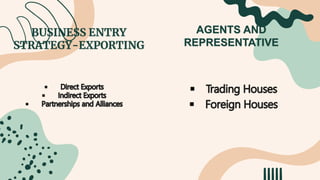
BUSINESS ENTRY
STRATEGY-EXPORTING
AGENTS AND
REPRESENTATIVE
LICENSING, INVESTMENT
FINRA LICENSING BREAKDOWN
INFORMATION FOR INVESTORS
INFORMATION FOR APPLICANTS
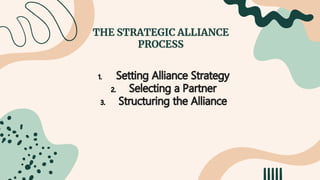
THE STRATEGIC ALLIANCE
PROCESS
REACHING A BORDER AUDIENCE
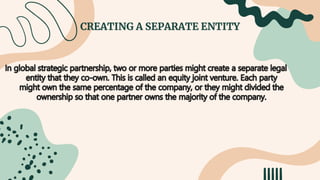
CREATING A SEPARATE ENTITY
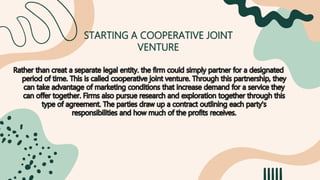
STARTING A COOPERATIVE JOINT
VENTURE
INVESTING IN A GLOBAL
STRATEGIC PARTNERSHIP
ADVANTAGES OF THE GLOBAL
STRATEGIC ALLIANCE
DISADVANATGES OF THE
GLOBAL STRATEGIC
ALLIANCE
MODULE-3-Strategy-Dev-in-Intel-BUs.pptx

MODULE-3-Strategy-Dev-in-Intel-BUs.pptx

  • 1.
  • 2.
    Many companies seemto do very well without a formal business strategy. International operation very often start with direct exports. However, after some time the management in companies will begin to realize, that such a profitable but nevertheless haphazard approach involves certain risks and will result in less optimal results in comparison with the potential of the company. .
  • 3.
    Good reasons forstarting the development of an international business strategy now are the following: Availability of Market Information Creative Entrepreneurship Improved Communication Globalization of Markets Follow the Competition 1 2 3 4 5
  • 4.
    What is theValue Chain?  Porter’s definition includes all activities to design, produce, market, deliver, and support the product/services.  The Value Chain is concentrating on the activities starting with raw materials till the conversion into final goods or services.  Two Categories:  Main Activities (Inbound Logistics, operations, Outbound Logistics, Marketing Sales, Services)  Support Activities (Technology Development, Human Resources Management, Firm Infratructure)
  • 5.
    Main Activities  InboundLogistic: include the receiving, warehousing and inventory control of input materials.  Operations: are the value-creating activities that transform the inputs into the final product.  Outbound Logistics: are the activities required to get the finished product to the customer, including warehousing, order fulfillment,etc.  Marketing and Sales: are those activities associated with getting buyers to purchase the product, including channel selection, advertising, pricing, etc.  Services: activities are those that maintain and enhance the product’s value including customer support, repair services, etc.
  • 6.
    Support Activities  TechnologyDevelopment: includes research and development, process automation, and other technology development used to support the value-chain activities.  Human Resources Management: the activities associated with recruiting, development, and compensation of employees.  Firm Infrastructure: includes activities such as finance, legal, quality management, etc.
  • 7.
    Types of Activities Within every category of main and support activities there are three type of activities that play a different role in the strategic competitive advantage: ● Direct Activities - involved in creating value for the buyer, such as assembling ones, components processing, etc. ● Indirect: possible direct ativities contiuously, such as maintaining ones, planning sales of staff, etc. ● Quality Assuring: assuring the other activities quality, such as supervision ones, inspecting, testing, revision, checking, and etc.
  • 8.
    Value Chain Analysis Used to identify sources of competitive advantage  Specifically: - Opportunities to secure cost advantages - Opportunities to create product/service differentiation  Includes the value-creating activities of all industry participants.
  • 9.
    Value Chain analysisis very important element that allows the following characteristics observation:  It studies competitiveness nature and determinants, having a special contribution to the orientation towards inter-connected group of firms;  Concentrating on all chain links ( not only on production) and on all activities in every link helps to identify activities that are responsible of incomes growing and those that contribute to their decrease;  As a result of these differences referring to the nature of income along various links within he chain, deciding people obtain clear information, necessary to formulate correct strategies and to take proper decisions. Thus, according to these decisions one can improve tha activity in a chain link in order to generate higher incomes;  With the help of this analyses one can prove that even if a firm is competitive, its connection t the world economy can require a certain concentration on macro-policies and institutional relations.
  • 10.
  • 11.
    Multinationals have locatedsubsidiary businesses in other countries for many years. In recent years, this trend has gathered pace as part of globalization. There are specific reasons why businesses might want to locate overseas international location.
  • 12.
    Some Reasons for InternationalLocation Historical A sugar refining firm is likely to own a plant in countries where sugar is grown, as well as network to market and service the business worldwide Access to Market Companies manufacturing in EU have access to the whole market. Nissan opened in Sunderland for this reason, and this also explains why they started making tracks in the USA, to access that market Service Many products and services need local country support – e.g. Bosch Washing Machine Access to Raw Materials Extraction to natural resources in countries where they are found.
  • 13.
    Some Reasons for InternationalLocation Access to Labour Usually this means cheap labour where regulations are less stringent than in the UK. Tax Avoidance By means of transfer pricing, multinationals organized their affairs to minimized their overall tax liability. Local Incentives Regional grants and incentives are sometimes given to encourage overseas firms to set up locally and boost the economy.
  • 14.
    Some Problems of InternationalTrade Risk and uncertainties associated with international trade include the following; for some companies, these risk are managed better by having international offices, factories and so on.
  • 15.
    Some Problems of InternationalTrade  Currency fluctuation  Exchange Controls  Political instability and unrest  Tariffs and other restrictive practices  Language and Cultural barriers UK firms have an advantage that English is widely spoken around the world  Differences in ethnical approaches
  • 16.
    Factors Influencing PlantLocations: Nature of Plant Location Nature of the Product Volume of Production Basic Management Policies and Decisions 1 2 3 4 5 6 Type of Method of Production 1. Job Order Production 2. Batch Production, and 3. Mass Production Type of Industry Process 1. Intermittent 2. Continues Intermittent
  • 17.
    Factors Influencing PlantLocations: Type of Machine Nature of Machines Climate Nature of Material 7 8 9 10 11 12 Characteristics of Building Human Factor and Working Condition
  • 18.
    Product Layout Product Layoutis also called as production lines or assembly lines. They are designed and laid out in such way that only few products are capable of being manufactured or assembled. Materials flow through the various facilities . These use special machines to perform specific operations to produce only one product at one time. Using special machines and implementing standardization in operations have many advantages which is listed in the next slide.
  • 19.
    Advantages of UsingSpecial Machines and Implementing Standardization in Operation *The skill required is low *Supervision is minimal *Training needs are small - Pre cautions to be taken are *Constant Check on the processes needs to be performed so that quality is assured. *Check for the behavioral attitude of the worker
  • 20.
  • 21.
    A value chainanalysis process, providing both qualitative and quantitative background information, is to be taken for all case studies (products) included in the project before an economic analysis is undertaken. Source of information for this analysis may include secondary data, published or unpublished literature, surveys, focus groups, and rapid appraisal.
  • 22.
    The Value Chainanalysis will include the following stages: Production This will include information on weather it is capture fishery or agriculture Processing This will include information about products produced , technologies used, major inputs and cost. Transportation This will include pre and post processing transportation, where applicable.
  • 23.
    The Value Chainanalysis will include the following stages: This includes information about what kind of products are sold in the different markets. Final Consumption The product will be traded at each stage of the value chain Market Structure Some products will go through different types of processing. Data Availability This will include fisheries management regulations for capture fisheries, environmental regulation for fish farms and etc. Regulation
  • 24.
  • 25.
    Risk analysis isthe process of defining and analysing the dangers to individuals, businesses and government agencies posed by potential natural and human caused adverse events. A risk analysis report can be either quantitative or qualitative.
  • 26.
    Quantitative In quantitative riskanalysis, an attempt is made to numerically determine the probabilities of various adhere events and the likely extent of the losses in a particular events Qualitative Qualitative risk analysis, which is used more often, does not involve numerical probabilities or predictions of loss. Instead, the qualitative method involves defining the various threats, determining the extent of vulnerabilities and devising countermeasures should an attack occur.
  • 27.
    There may besome terminology and definition differences related to risk analysis, risk assessment, and business impact analysis. Although several definition are possible and can overlap, for purpose of this article, please consider the following definition:
  • 28.
    Risk Analysis Risk analysisinvolves identifying the most probable threats to an organization and analysing the related vulnerabilities of the organization to these threats Risk Assessment A risk assessment involves evaluating existing physical and environmental security and controls, and assessing their adequacy relative to the potential threats of the organization. Business Impact Analysis A business impact analysis involves identifying the critical business functions within the organization and determining the impact of not performing the business function beyond the maximum acceptable outage.
  • 29.
    Risk Analysis Process Regardlessof the prevention techniques employed, possible threats that could arise inside or outside the organization need to be assessed. Although the exact nature of potential disasters or their resulting consequences are difficult to determine, it is beneficial to perform a comprehensive risk assessment of all threats that can realistically occur to the organization. Regardless of the type of threat the goals of business recovery planning are to ensure safety of customers, employees and other personnel during and following a disaster.
  • 30.
    Natural Threats Internal flooding,external fire, seismic activity, high winds, tornado, hurricane. Technical Threats Power failure, heating, ventilation failure, malfunction of CPU, gas leaks, nuclear fallout. Human Threats Robbery, bomb threats, embezzlement, extortion, burglary, vandalism, terrorism, civil disorder. Potential exposures may be classified as natural, technical, or human threats.
  • 31.
    The Impact canbe rated as: 0 - No impact or interruption in operations. 1 - Noticeable impact, interruption, in operation for up to 8 hours. 2 – Damage to equipment and facilities, interruption in operations for 8 – 48 hours. 3 – Major damage to the equipment and facilities, interruption in operation for more than 48 hours. All main office and computer centre functions must be relocated. The planning process should identify and measure the likelihood of all potential risk and the impact on the organization if the treat occurred. To do this, each department be analyze separately
  • 32.
    Certain assumptions maybe necessary to uniformly apply ratings to each potential threat. Following are typical assumptions that can be used during the risk assessment process:  Although range impact could range between 1 and 3 for any facilities given a specific set of circumstances, ratings applied should reflect anticipated, likely or expected impact on each area.  Each potential threat should be assumed to be “localized” to the facility being rated.  Although one potential threat could lead to another potential threat, no domino effect should be assumed.  If the result of the threat would not warrant movement to an alternate site, the impact should be rated no higher than a “2”.  The risk assessment should be performed by facility.
  • 33.
    To measure potential risk,a weighted point rating system can be used. Each level of probability can be assigned points as follows: Probability Points High 10 Medium 5 Low 1
  • 34.
    Consideration in analyzingrisk include: 1. Investigating the frequency of particular types of disaster. 2. Determining the degree of predictability of the disaster. 3. Analysing the speed of onset of the disaster. 4. Determining the amount of forewarning associated with the disasters. 5. Estimating the duration of the disaster. 6. Considering the impact of a disaster based on two scenarios; a. Vital records are destroyed b. Vital records are not destroyed
  • 35.
    Consideration in analyzingrisk include: 7. Identifying the consequences of a disaster, such as; a. Personnel availability b. Personnel injuries c. Loss of operating capability d. Loss of assets e. Facility damage 8. Determining the existing and required redundancy levels throughout the organization to accommodate critical system and functions, including:
  • 36.
    Consideration in analyzingrisk include: a. Hardware b. Information c. Communication d. Personnel e. Services 9. Estimating potential losses for each business function based on the financial and service impact and the length of time the organization can operate without this business function. 10. Determining the cost of contingency planning
  • 38.
    Procedural Prevention Procedural Preventionrelates to activities performed on a day-to-day, month-to- month, or annual basis, relating to security and recovery. Procedural prevention begins with assigning responsibility for overall security of the organization to an individual with adequate competence and authority to meet the challenges. The objectives of procedural is to define activities necessary to prevent various types of disasters and ensure that these activities are performed regulary. Physical Prevention Physical prevention and preparedness for disaster begins when a site is constructed. It includes special requirements for building considerations include:  computer area  fire detection and extinguishing systems  record(s) protection  air conditioning  heating and ventilation  electrical supply anf UPS Systems  emergency procedures  vault storage area(s)  archival system
  • 42.
  • 45.
    RECORDS Records can beclassified in one of the three following categories: 1. Vital Records 2. Important Records 3. Useful Records
  • 47.
  • 49.
  • 53.
  • 54.
    Revealed Preference Valuingthe Benefits from a Project
  • 55.
    Cost Benefit Analysisin Practice: Heathrow Terminal
  • 56.
  • 57.
  • 58.
  • 59.
  • 60.
  • 61.
  • 62.
  • 63.
  • 64.
  • 65.
    INVESTING IN AGLOBAL STRATEGIC PARTNERSHIP
  • 66.
    ADVANTAGES OF THEGLOBAL STRATEGIC ALLIANCE
  • 67.
    DISADVANATGES OF THE GLOBALSTRATEGIC ALLIANCE