Business as a transformation process

All organisations are involved in some form of transformation process. They take inputs
such as land, labour, capital and entrepreneurship and turn them into outputs such as
physical goods and intangible services. In many cases the output of a business is a
combination of goods and services; for example in a restaurant you are buying a meal
but also the environment and the service. The aim of all organisations is to add value i.e.
to create outputs that are worth more than the inputs. In many cases the value of inputs
is measured in financial terms in which case we say that organisations aim to make a
profit. A profit occurs when the revenue generated by sales exceeds the costs of
providing the product. In the case of non profit organisations such as schools and
hospitals, other indicators are used to measure the value added. League tables of
schools' performances, for example, might measure exam results and compare the
grades achieved by students with their levels of achievement when they joined the school
to measure the progress.


The nature of the transformation process obviously differs enormously from business to
business. For example, it may involve manufacturing or providing services, it may be
capital or labour intensive or be based on a single site or multi site. However whatever
the nature of the business managers are constantly looking for new ways of adding value
either by providing benefits and products that customers are willing to pay more for or by
combining resources more efficiently to reduce costs.


To increase efficiency managers are always seeking ways of producing more with the
same level of inputs or producing the same amount with less inputs. This can be achieved
in a variety of ways: changing working practices, investing in new technology, motivating
and inspiring staff more effectively and changing the way items are produced. For
example, an important development in manufacturing in the last twenty years is known
as lean production. This seeks to reduce wastage at all stages of the production process.
It includes Just in Time production in which items are produced to order rather than in
advance. This reduces stock levels because materials are only ordered and used when
needed - they do not wait around in stock. Similarly finished goods are made to order
and despatched immediately rather than being produced and then waiting for someone to
buy them. Just in time production therefore removes the costs involved in storing and
protecting stock. Lean production also includes a technique known as kaizen which aims
to use the knowledge of employees to find ways of continuously improving the way things
are done. Small, incremental changes are used to reduce costs on an ongoing basis.
Adding value can also occur by generating outputs that customers are willing to pay more
for. In marketing the role of the brand has become even more important in recent years
as firms attempt to get customers to identify with particular values, a lifestyle and a set
of aspirations. Through effective branding items can be sold for more. Just think of a
basic, plain T shirt and the effect on the price that can be charged if you add a particular
brand name or logo to it. Think Prada, think Armani, think Gucci and you can see the
value of a brand. Also the design features of a product can generate benefits that
customers will pay more for (think of Dysons vacuum cleaners, Duralit toasters and
Jimmy Choo shoes) as well as factors such as the speed of delivery (1 hour opticians and
photo processing), convenience (think home delivery) and flexibility (think top restaurant
compared to a fast food chain).


Organisations are continually reviewing what they provide and how they provide it to try
and add more value. Given ongoing changes in the competitive environment with new
competitors, new demands and new technologies adding value is a dynamic process. Your
parents probably bought a CD and played it at home on a CD player. You download and
listen on an iPod. The world of music provision and retailing has changed radically forcing
organisations such as EMI to rethink their business model. Your parents probably went to
a travel agent to book their holiday with a package holiday company. You go online and
tailor make your own holiday. They probably went on holiday mainly within their own
country or to relatively few locations overseas. You travel the world.


Organisations operate in a restless world and managers need to be looking constantly at
the business environment to identify changes that could be of value to them or could
possibly harm them. Interestingly any change will have different effects on different
organisations. The banning of smoking in public places may damage sales of tobacco but
boost sales on patches to help you give up smoking, for example. Later on we will
examine the external environment of business in more detail but first we examine the
different forms of business that exist and the internal activities that occur within an
organisation.
For example, why not start with:


   •   AOL www.corp.aol.com/whoweare/mission.shtml
   •   Ford www.ford.co.uk/ie/corporateinfo
   •   Google www.google.com/corporate/tenthings.html
   •   Greenpeace www.greenpeace.org/international/about/our-mission
   •   McAfee www.mcafee.com/uk/about/mission_statement.html


Objectives

Whilst a mission statement may show the general purpose of the business and indeed
may inspire those who read it, it does not itself necessarily provide much practical use to
managers. A firm's mission really needs to be turned into something more focused and
less general i.e. the managers need to set out the firm's objectives. Objectives are
specific targets. They set out precisely what a firm wants to achieve by a given time. For
example, "to be the best sports goods business in the world" might be the mission
statement of a firm whereas to "increase market share by 20% in 5 years" is an
objective.


To be effective an objective should be SMART; this means it should be:


   •   Specific: i.e. managers must clearly define what the focus is
   •   Measurable so that a target can be set and reviewed
   •   Agreed so that those who set it and those who have to achieve it agree to it.
       There is little point forcing a target on someone - if they do not accept it they will
       be unlikely to work very hard to make it happen
   •   Realistic so it is achievable rather than being a target that everyone knows cannot
       be hit. Unrealistic targets tend to be demoralising and can do more harm than
       good
   •   Time specific meaning that there is a clear time horizon by which the target
       should be achieved


Typical business objectives focus on profits, growth, market share and cash flow.
Increasingly firms are also including objectives that relate to social responsibility focusing
on areas such as their contribution to the community, the support given to suppliers and
targets to reduce any negative impact on the environment. In recent years there has
been a growth in the interest of firms and their customers, employees and partners in
Corporate Social Responsibility (CSR). CSR focuses on the role of a business as a citizen
within society and considers the impact of an organisation on society as a whole.
Companies that behave socially responsibly accept obligations to society over and above
their legal requirements; they do not do the bare minimum because they see the value of
doing more than this and working with others. For example, socially responsibility might
include:


           o   Aiming to ensure a good quality of working life for employees
           o   Enabling employees to have a positive work/life balance
           o   Minimising the adverse impact of your activities on the environment
           o   Investing in the local community
           o   Helping disadvantaged groups
           o   Treating suppliers with respect


Business and the environment

The business transformation process does not take place in a vacuum. Firms operate in a
particular context and they are influenced by and are able to influence this environment.


The business environment can be divided into:


   •   The micro-environment: this the involves individuals or organisations that a firm
       deals with on a regular basis. For example, suppliers, distributors, competitors,
       customers and employees are all members of the micro-environment. These
       groups are stakeholders of the business. They all have a direct interest in the
       activities of the firm and are clearly affected by its actions. Managers regularly
       interact with others in the micro-environment and their decisions have a direct
       effect on them e.g. a decision to expand may mean an increase in supplies, an
       increase in overtime, more deliveries and greater profits. At the same time these
       stakeholder groups can have a direct impact on the firm. Labour shortages in the
       local labour market may make it more expensive to recruit, competitors launching
       new products may take away market share and changes in customer tastes may
       require a rethinking of the marketing strategy. Delays by suppliers may lead to
       cash-flow problems and problems with distributors may hit sales. The micro
       environment therefore plays a critical role in the success and behaviour of a
       business.
•   The macro-environment. This involves factors outside of the direct control of the
       business. These macro-factors such as the economy, government policy and
       social change can have a significant effect on a firm's success but the relationship
       is fairly one way. A change in the exchange rate can affect the ability of a firm to
       sell abroad; for example, the pound rose in value to nearly 2 dollars in 2007
       making UK exports expensive in America. The increasing interest in healthy eating
       has boosted organic sales. The ageing population has increased demand for
       healthcare resources. However, whilst these macro factors can fundamentally
       change the environment of an organisation one individual business can rarely do
       much on its own to shape them. One firm is unlikely to be able to influence
       government taxation policy or new legislation, for example. The macro-
       environment can be analysed using PESTEL analysis which is outlined later.


Analysing the micro-environment

The micro-environment consists of stakeholder groups that a firm has regular dealings
with. The way these relationships develop can affect the costs, quality and overall
success of a business. Issues in the micro-environment include:


   •   Suppliers: can they provide high quality products at a good price? Can they do
       this reliably in the volumes required? Have they got the flexibility to respond to a
       firm's demands? What is the bargaining power of these suppliers? How dependent
       is the firm on them? Does their approach to their staff and resources fit with your
       ethics? Firms must decide on issues such as who to use to supply them, on the
       responsibility it takes for these suppliers and on the terms and conditions it
       adopts. Some firms take quite an aggressive attitude towards their suppliers by
       trying to push down the prices and delay payments. Others view the relationship
       more as a partnership in which they are working together with suppliers and that
       by helping each other both can benefit. The importance of suppliers can be seen if
       things go wrong. In 2000 Ford's image was damaged when tyres on its Explorer
       vehicles started exploding. These tyres were produced by Bridgestone and the
       supplier ended up re-calling over 6.5 million tyres. In 2007 Sony batteries in
       several Dell laptops caught fire which caused a terrible public relations issue for
       the computer manufacturer and led to over 4 million laptop batteries being
       recalled.


   •   Distributors: often getting products to the end customers can be a major issue for
       firms. Imagine you sell shampoo - what you need to sell this is to get it on the
       shelves in the leading chemists and supermarkets but this means moving
someone else's products off the shelves! So the challenge is to get stores to stock
    your products; this may be achieved by good negotiating skills and offering
    appropriate incentives. The distributors used will determine the final price of the
    product and how it is presented to the end customer. When selling via retailers,
    for example, the retailer has control over where the products are displayed, how
    they are priced and how much they are promoted in-store. You can also gain a
    competitive advantage by using changing distribution channels. Banks, insurance
    companies, holiday firms, hotels and many others businesses have seen the
    opportunities created by the internet. Direct Line insurance, Dell computers and
    Amazon have reduced costs by selling direct. Some firms such as Betterware and
    Avon have used alternative distribution channels to their competitors by selling
    door to door; Ann Summers' products have sold well via parties.


•   Customers: customers are obviously the key to sales. Managers must monitor
    customer needs and try to anticipate how these will develop so that they can
    meet these requirements effectively now and in the future. To help understand
    their customers firms are increasingly trying to gather information on them
    through mechanisms such as loyalty cards. By gathering data on shopping
    patterns and matching this to data on the individual shoppers firms can build up
    detailed pictures of their buyers and then offer them appropriate deals. Many
    firms are also trying to develop relationships with customers to help ensure they
    come back time and time again. Loyalty cards, frequent flyer programmes and
    frequent shopper incentives are all aimed at rewarding customers who buy a
    firm's product regularly. Newsletters, email lists and recommendations to online
    shoppers of what else they might be interested in are all ways of trying to build a
    relationship with customers. Of course, potential buyers usually have many
    choices and so may be able to use their bargaining power in relation to firms. The
    growth of the internet has enabled customers to search quickly for alternatives
    and compare deals more easily; this puts pressure on firms to provide better
    value for money or they will lose their customers.


•   Competition: the success and behaviour of any business will depend on the
    degree of competition in its market. In some markets one firm is dominant. This
    is called a monopoly. Technically in the UK a monopoly exists when a firm has a
    market share of over 25%. If you are in a monopoly position this may allow you
    to exploit the consumer with relatively high prices (assuming your position is
    protected in some way) and you may be able to offer an inferior service if
    customers have no other choices. In other markets a few firms dominate; this
type of market structure is called an oligopoly. In oligopolistic markets there is a
        high degree of interdependence and so firms will think carefully how their rivals
        might react to any actions they take. This can lead to an emphasis on non price
        competition; a price change is relatively easy to imitate and so firms may rely
        more on methods such as branding or product development. Oligopolies exist in
        many markets in the UK such as insurance, banking, car manufacturing,
        supermarkets. In more competitive markets where there are many firms
        providing similar products customers have more choice; this may put downward
        pressure on prices and means that excellent customer service is essential


Porter's Five Forces analysis of market structure

The competitive structure of an industry can be analysed using Porter's five forces.


This model attempts to analyse the attractiveness of an industry by considering five
forces within a market.


According to Porter (1980) the likelihood of firms making profits in a given industry
depends on five factors:


1. The likelihood of new entry i.e. the extent to which barriers to entry exist. The
more difficult it is for other firms to enter a market the more likely it is that existing firms
can make relatively high profits.


The likelihood of entering a market would be lower if:


    •   the entry costs are high e.g. if heavy investment is required in marketing or
        equipment
    •   there are major advantages to firms that have been operating in the industry
        already in terms of their experience and understanding of how the market works
        (this is known as the "learning effect")
    •   government policy prevents entry or makes it more difficult; for example,
        protectionist measures may mean a tax is placed on foreign products or there is a
        limit to the number of overseas goods that can be sold. This would make it
        difficult for a foreign firm to enter a market
    •   the existing brands have a high level of loyalty
    •   the existing firms may react aggressively to any new entrant e.g. with a price war
•   the existing firms have control of the supplies .e.g. entering the diamond industry
        might be difficult because the majority of known sources of diamonds are
        controlled by companies such as De Beers.


2. The power of buyers.


The stronger the power of buyers in an industry the more likely it is that they will be able
to force down prices and reduce the profits of firms that provide the product.


Buyer power will be higher if:


    •   there are a few, big buyers so each one is very important to the firm
    •   the buyers can easily switch to other providers so the provider needs to provide a
        high quality service at a good price
    •   the buyers are in position to take over the firm. If they have the resources to buy
        the provider this threat can lead to a better service because they have real
        negotiating power


3. The power of suppliers.


The stronger the power of suppliers in an industry the more difficult it is for firms within
that sector to make a profit because suppliers can determine the terms and conditions on
which business is conducted.


Suppliers will be more powerful if:


    •   there are relatively few of them (so the buyer has few alternatives)
    •   switching to another supplier is difficult and/or expensive
    •   the supplier can threaten to buy the existing firms so is in a strong negotiating
        position


4. The degree of rivalry


This measures the degree of competition between existing firms. The higher the degree
of rivalry the more difficult it is for existing firms to generate high profits.


Rivalry will be higher if:


    •   there are a large number of similar sized firms (rather than a few dominant firms)
        all competing with each other for customers
•   the costs of leaving the industry are high e.g. because of high levels of
       investment. This means that existing firms will fight hard to survive because they
       cannot easily transfer their resources elsewhere
   •   the level of capacity utilisation. If there are high levels of capacity being
       underutilised the existing firms will be very competitive to try and win sales to
       boost their own demand
   •   the market is shrinking so firms are fighting for their share of falling sales
   •   there is little brand loyalty so customer are likely to switch easily between
       products


5. The substitute threat.


This measures the ease with which buyers can switch to another product that does the
same thing e.g. aluminium cans rather than glass or plastic bottles. The ease of switching
depends on what costs would be involved (e.g. transferring all your data to a new
database system and retraining staff could be expensive) and how similar customers
perceive the alternatives to be.


Using Porter's analysis firms are likely to generate higher returns if the industry:


   •   Is difficult to enter
   •   There is limited rivalry
   •   Buyers are relatively weak
   •   Suppliers are relatively weak
   •   There are few substitutes.


On the other hands returns are likely to be low if:


   •   The industry is easy to enter
   •   There is a high degree of rivalry between firms within the industry
   •   Buyers are strong
   •   Suppliers are strong
   •   It is easy to switch to alternatives


The implication of Porter's analysis for managers is that they should examine these five
factors before choosing an industry to move into. They should also consider ways of
changing the five factors to make them more favourable.


For example:
•   if firms merge together this can reduce the degree of rivalry . This has happened
       a great deal in industries such as automobiles, pharmaceuticals and banking
       where firms have joined together to remove competitors
   •   if firms buy up distributors (this is called forward vertical integration) they can
       gain more control over buyers
   •   if firms differentiate their product perhaps by trying to generate some form of
       Unique Selling Proposition (USP) that makes it stand out from the competition.
       This lies at the heart of many marketing and brand building activities. Coca Cola,
       for example, has fought hard to promote itself as "the real thing"; everything else
       is just imitation!
   •   if they react aggressively to a firm that enters its market this may deter potential
       entrants in the future


The five forces will change over time as market conditions alter. For example, more
information is available nowadays to enable customers to compare offerings and prices;
this gives buyers more power. The opening up of world markets (for example through the
efforts of the World Trade Organisation to reduce protectionist measures that limit trade
and the expansion of the European Union enabling free trade between more countries)
has led to much more rivalry in markets in recent years. In North America, for example,
the sales of Japanese firms such as Toyota have gradually been reducing the market
share of American producers such as General Motors as consumers have more choice.
Meanwhile, the success of the internet has made it easier for producers to enter many
markets such as finance, book retailing and clothes retailing; the ability to start selling
online has reduced a major barrier to entry which was the investment required to set up
a network of shops. As ever the business world is not static and the conditions in any
industry will always be changing. As this happens the various elements of the five forces
are always shifting requiring established firms and potential entrants to review their
strategies


PESTEL analysis of the macro-environment

There are many factors in the macro-environment that will effect the decisions of the
managers of any organisation. Tax changes, new laws, trade barriers, demographic
change and government policy changes are all examples of macro change. To help
analyse these factors managers can categorise them using the PESTEL model. This
classification distinguishes between:


   •   Political factors. These refer to government policy such as the degree of
       intervention in the economy. What goods and services does a government want to
provide? To what extent does it believe in subsidising firms? What are its priorities
       in terms of business support? Political decisions can impact on many vital areas
       for business such as the education of the workforce, the health of the nation and
       the quality of the infrastructure of the economy such as the road and rail system.


   •   Economic factors. These include interest rates, taxation changes, economic
       growth, inflation and exchange rates. As you will see throughout the "Foundations
       of Economics" book economic change can have a major impact on a firm's
       behaviour. For example:


          - higher interest rates may deter investment because it costs more to borrow
          - a strong currency may make exporting more difficult because it may raise the
price in terms of foreign currency
          - inflation may provoke higher wage demands from employees and raise costs
          - higher national income growth may boost demand for a firm's products


   •   Social factors. Changes in social trends can impact on the demand for a firm's
       products and the availability and willingness of individuals to work. In the UK, for
       example, the population has been ageing. This has increased the costs for firms
       who are committed to pension payments for their employees because their staff
       are living longer. It also means some firms such as Asda have started to recruit
       older employees to tap into this growing labour pool. The ageing population also
       has impact on demand: for example, demand for sheltered accommodation and
       medicines has increased whereas demand for toys is falling.


   •   Technological factors: new technologies create new products and new processes.
       MP3 players, computer games, online gambling and high definition TVs are all
       new markets created by technological advances. Online shopping, bar coding and
       computer aided design are all improvements to the way we do business as a
       result of better technology. Technology can reduce costs, improve quality and
       lead to innovation. These developments can benefit consumers as well as the
       organisations providing the products.


   •   Environmental factors: environmental factors include the weather and climate
       change. Changes in temperature can impact on many industries including
       farming, tourism and insurance. With major climate changes occurring due to
       global warming and with greater environmental awareness this external factor is
       becoming a significant issue for firms to consider. The growing desire to protect
       the environment is having an impact on many industries such as the travel and
transportation industries (for example, more taxes being placed on air travel and
       the success of hybrid cars) and the general move towards more environmentally
       friendly products and processes is affecting demand patterns and creating
       business opportunities.


   •   Legal factors: these are related to the legal environment in which firms operate.
       In recent years in the UK there have been many significant legal changes that
       have affected firms' behaviour. The introduction of age discrimination and
       disability discrimination legislation, an increase in the minimum wage and greater
       requirements for firms to recycle are examples of relatively recent laws that affect
       an organisation's actions. Legal changes can affect a firm's costs (e.g. if new
       systems and procedures have to be developed) and demand (e.g. if the law
       affects the likelihood of customers buying the good or using the service).


Different categories of law include:


   •   consumer laws; these are designed to protect customers against unfair practices
       such as misleading descriptions of the product
   •   competition laws; these are aimed at protecting small firms against bullying by
       larger firms and ensuring customers are not exploited by firms with monopoly
       power
   •   employment laws; these cover areas such as redundancy, dismissal, working
       hours and minimum wages. They aim to protect employees against the abuse of
       power by managers
   •   health and safety legislation; these laws are aimed at ensuring the workplace is
       as safe as is reasonably practical. They cover issues such as training, reporting
       accidents and the appropriate provision of safety equipment


Typical PESTEL factors to consider include:

Factor              Could include:
Political           e.g. EU enlargement, the euro, international trade, taxation policy
Economic            e.g. interest rates, exchange rates, national income, inflation,
                    unemployment, Stock Market
Social              e.g. ageing population, attitudes to work, income distribution
Technological       e.g. innovation, new product development, rate of technological
                    obsolescence
Environmental       e.g. global warming, environmental issues
Legal               e.g. competition law, health and safety, employment law
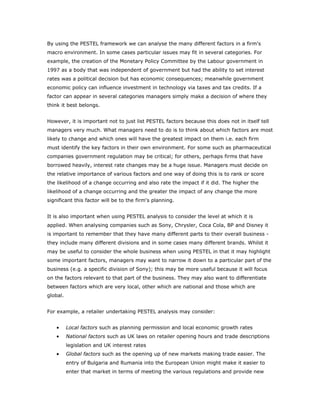
By using the PESTEL framework we can analyse the many different factors in a firm's
macro environment. In some cases particular issues may fit in several categories. For
example, the creation of the Monetary Policy Committee by the Labour government in
1997 as a body that was independent of government but had the ability to set interest
rates was a political decision but has economic consequences; meanwhile government
economic policy can influence investment in technology via taxes and tax credits. If a
factor can appear in several categories managers simply make a decision of where they
think it best belongs.


However, it is important not to just list PESTEL factors because this does not in itself tell
managers very much. What managers need to do is to think about which factors are most
likely to change and which ones will have the greatest impact on them i.e. each firm
must identify the key factors in their own environment. For some such as pharmaceutical
companies government regulation may be critical; for others, perhaps firms that have
borrowed heavily, interest rate changes may be a huge issue. Managers must decide on
the relative importance of various factors and one way of doing this is to rank or score
the likelihood of a change occurring and also rate the impact if it did. The higher the
likelihood of a change occurring and the greater the impact of any change the more
significant this factor will be to the firm's planning.


It is also important when using PESTEL analysis to consider the level at which it is
applied. When analysing companies such as Sony, Chrysler, Coca Cola, BP and Disney it
is important to remember that they have many different parts to their overall business -
they include many different divisions and in some cases many different brands. Whilst it
may be useful to consider the whole business when using PESTEL in that it may highlight
some important factors, managers may want to narrow it down to a particular part of the
business (e.g. a specific division of Sony); this may be more useful because it will focus
on the factors relevant to that part of the business. They may also want to differentiate
between factors which are very local, other which are national and those which are
global.


For example, a retailer undertaking PESTEL analysis may consider:


    •     Local factors such as planning permission and local economic growth rates
    •     National factors such as UK laws on retailer opening hours and trade descriptions
          legislation and UK interest rates
    •     Global factors such as the opening up of new markets making trade easier. The
          entry of Bulgaria and Rumania into the European Union might make it easier to
          enter that market in terms of meeting the various regulations and provide new
expansion opportunities. It might also change the labour force within the UK and
       recruitment opportunities.


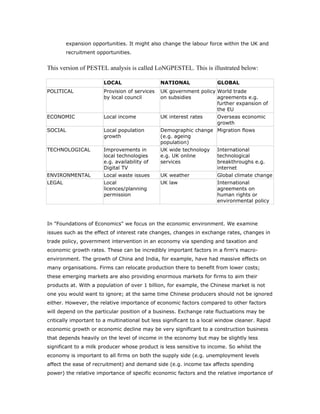
This version of PESTEL analysis is called LoNGPESTEL. This is illustrated below:

                       LOCAL                   NATIONAL               GLOBAL
POLITICAL              Provision of services   UK government policy World trade
                       by local council        on subsidies         agreements e.g.
                                                                    further expansion of
                                                                    the EU
ECONOMIC               Local income            UK interest rates    Overseas economic
                                                                    growth
SOCIAL                 Local population        Demographic change Migration flows
                       growth                  (e.g. ageing
                                               population)
TECHNOLOGICAL          Improvements in         UK wide technology   International
                       local technologies      e.g. UK online       technological
                       e.g. availability of    services             breakthroughs e.g.
                       Digital TV                                   internet
ENVIRONMENTAL          Local waste issues      UK weather           Global climate change
LEGAL                  Local                   UK law               International
                       licences/planning                            agreements on
                       permission                                   human rights or
                                                                    environmental policy


In "Foundations of Economics" we focus on the economic environment. We examine
issues such as the effect of interest rate changes, changes in exchange rates, changes in
trade policy, government intervention in an economy via spending and taxation and
economic growth rates. These can be incredibly important factors in a firm's macro-
environment. The growth of China and India, for example, have had massive effects on
many organisations. Firms can relocate production there to benefit from lower costs;
these emerging markets are also providing enormous markets for firms to aim their
products at. With a population of over 1 billion, for example, the Chinese market is not
one you would want to ignore; at the same time Chinese producers should not be ignored
either. However, the relative importance of economic factors compared to other factors
will depend on the particular position of a business. Exchange rate fluctuations may be
critically important to a multinational but less significant to a local window cleaner. Rapid
economic growth or economic decline may be very significant to a construction business
that depends heavily on the level of income in the economy but may be slightly less
significant to a milk producer whose product is less sensitive to income. So whilst the
economy is important to all firms on both the supply side (e.g. unemployment levels
affect the ease of recruitment) and demand side (e.g. income tax affects spending
power) the relative importance of specific economic factors and the relative importance of
the economy compared to, say, regulation or social trends will vary. Whilst we hope this
book provides a good insight into the economy and the possible effects of economic
change on a business these must be considered in the light of other macro and micro
factors that influence a firms' decisions and success.


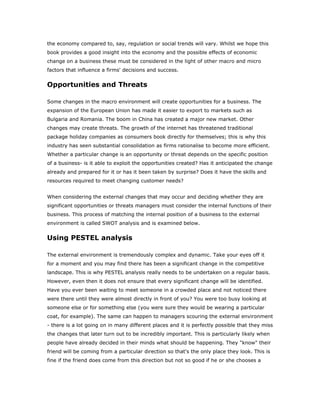
Opportunities and Threats

Some changes in the macro environment will create opportunities for a business. The
expansion of the European Union has made it easier to export to markets such as
Bulgaria and Romania. The boom in China has created a major new market. Other
changes may create threats. The growth of the internet has threatened traditional
package holiday companies as consumers book directly for themselves; this is why this
industry has seen substantial consolidation as firms rationalise to become more efficient.
Whether a particular change is an opportunity or threat depends on the specific position
of a business- is it able to exploit the opportunities created? Has it anticipated the change
already and prepared for it or has it been taken by surprise? Does it have the skills and
resources required to meet changing customer needs?


When considering the external changes that may occur and deciding whether they are
significant opportunities or threats managers must consider the internal functions of their
business. This process of matching the internal position of a business to the external
environment is called SWOT analysis and is examined below.


Using PESTEL analysis

The external environment is tremendously complex and dynamic. Take your eyes off it
for a moment and you may find there has been a significant change in the competitive
landscape. This is why PESTEL analysis really needs to be undertaken on a regular basis.
However, even then it does not ensure that every significant change will be identified.
Have you ever been waiting to meet someone in a crowded place and not noticed there
were there until they were almost directly in front of you? You were too busy looking at
someone else or for something else (you were sure they would be wearing a particular
coat, for example). The same can happen to managers scouring the external environment
- there is a lot going on in many different places and it is perfectly possible that they miss
the changes that later turn out to be incredibly important. This is particularly likely when
people have already decided in their minds what should be happening. They "know" their
friend will be coming from a particular direction so that's the only place they look. This is
fine if the friend does come from this direction but not so good if he or she chooses a
different route. When using PESTEL analysis managers must be prepared to look all
around them and question their assumptions!


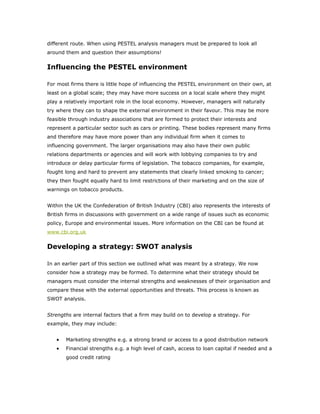
Influencing the PESTEL environment

For most firms there is little hope of influencing the PESTEL environment on their own, at
least on a global scale; they may have more success on a local scale where they might
play a relatively important role in the local economy. However, managers will naturally
try where they can to shape the external environment in their favour. This may be more
feasible through industry associations that are formed to protect their interests and
represent a particular sector such as cars or printing. These bodies represent many firms
and therefore may have more power than any individual firm when it comes to
influencing government. The larger organisations may also have their own public
relations departments or agencies and will work with lobbying companies to try and
introduce or delay particular forms of legislation. The tobacco companies, for example,
fought long and hard to prevent any statements that clearly linked smoking to cancer;
they then fought equally hard to limit restrictions of their marketing and on the size of
warnings on tobacco products.


Within the UK the Confederation of British Industry (CBI) also represents the interests of
British firms in discussions with government on a wide range of issues such as economic
policy, Europe and environmental issues. More information on the CBI can be found at
www.cbi.org.uk


Developing a strategy: SWOT analysis

In an earlier part of this section we outlined what was meant by a strategy. We now
consider how a strategy may be formed. To determine what their strategy should be
managers must consider the internal strengths and weaknesses of their organisation and
compare these with the external opportunities and threats. This process is known as
SWOT analysis.


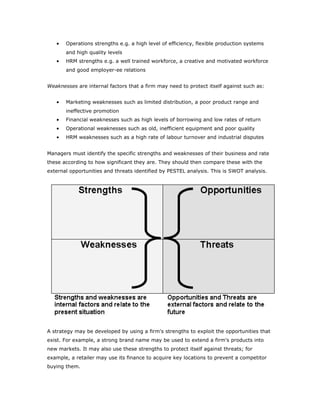
Strengths are internal factors that a firm may build on to develop a strategy. For
example, they may include:


   •   Marketing strengths e.g. a strong brand or access to a good distribution network
   •   Financial strengths e.g. a high level of cash, access to loan capital if needed and a
       good credit rating
•   Operations strengths e.g. a high level of efficiency, flexible production systems
       and high quality levels
   •   HRM strengths e.g. a well trained workforce, a creative and motivated workforce
       and good employer-ee relations


Weaknesses are internal factors that a firm may need to protect itself against such as:


   •   Marketing weaknesses such as limited distribution, a poor product range and
       ineffective promotion
   •   Financial weaknesses such as high levels of borrowing and low rates of return
   •   Operational weaknesses such as old, inefficient equipment and poor quality
   •   HRM weaknesses such as a high rate of labour turnover and industrial disputes


Managers must identify the specific strengths and weaknesses of their business and rate
these according to how significant they are. They should then compare these with the
external opportunities and threats identified by PESTEL analysis. This is SWOT analysis.


A strategy may be developed by using a firm's strengths to exploit the opportunities that
exist. For example, a strong brand name may be used to extend a firm's products into
new markets. It may also use these strengths to protect itself against threats; for
example, a retailer may use its finance to acquire key locations to prevent a competitor
buying them.
A firm may also want to protect itself against its weaknesses. For example, it may try to
find alternative suppliers to reduce an over-reliance on a particular one; it may invest in
a rebranding exercise to reposition itself.


Undertaking a SWOT analysis effectively is not as easy as it may seem. First managers
have to correctly identify what all the relevant factors are and how important each one is.
Too often managers have their own perspective on a situation and therefore may only
see what they want to see (as with PESTEL analysis). This is known as "perceptual
filtering". Kodak's managers spent several years watching other camera manufacturers
when they should have been watching consumer electronics firms such as Sony who were
developing digital cameras.


Secondly, managers need to work out the most appropriate strategy that combines the
strengths and opportunities and actually implement the plan successfully. Putting a plan
into action can be more difficult than coming up with it in the first place due to resistance
from staff or unexpected problems getting things done.


It is also important to undertake this type of analysis regularly because the competitive
landscape and the internal situation will be constantly changing.


The importance of strategy should not be underestimated. Changing the price of an item,
changing the distribution strategy and investing in new equipment are all important
decisions but if you are fighting in the wrong market with the wrong products then the
details are almost irrelevant. The strategy sets out where and how the battles will be
fought and a good strategy is essential to business success. This involves an
understanding not only of what happens within the firm but also the ability to forecast
changes in the external environment and their significance successfully.


As the internal and external environments change so must a firm's strategy to maintain
an appropriate fit. In "Foundations of Economics" you will read about all kinds of
economic factors that can change; these will alter a firm's playing field and the rules of
the game. This in turn means that managers need to consider carefully what team they
pick and how they decide to play the match. i.e as the economy changes the strategy
may need to change as well.
Strategy

To achieve an objective, managers must develop a suitable strategy. A strategy is a long
term plan setting out how an objective will be reached. For example, if the objective is to
reduce costs, the strategy could involve relocating or reducing the labour force. If the
objective is to boost revenue, the strategy may be to launch new products or to invest in
a big promotional campaign.


A strategy will usually:


   •   Involve relatively large sums of money
   •   Be relatively difficult to reverse. Once you have started to pursue a particular
       strategy it may not be easy switch resources in another direction
   •   Be relatively high risk. If you get the strategy wrong this could be costly in many
       ways for the business
   •   Set out the markets the firm wants to compete in, the products it wants to offer
       and how it wants to compete (e.g. by focusing on low cost or by differentiating its
       offering)


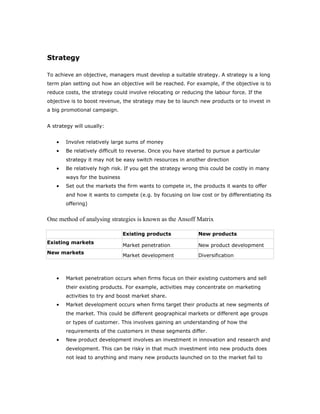
One method of analysing strategies is known as the Ansoff Matrix

                               Existing products             New products
Existing markets
                               Market penetration            New product development
New markets
                               Market development            Diversification


   •   Market penetration occurs when firms focus on their existing customers and sell
       their existing products. For example, activities may concentrate on marketing
       activities to try and boost market share.
   •   Market development occurs when firms target their products at new segments of
       the market. This could be different geographical markets or different age groups
       or types of customer. This involves gaining an understanding of how the
       requirements of the customers in these segments differ.
   •   New product development involves an investment in innovation and research and
       development. This can be risky in that much investment into new products does
       not lead to anything and many new products launched on to the market fail to
survive. However this sort of strategy is important in industries where there is
       constant product development such as consumer electronics.
   •   Diversification occurs when firms move into completely new areas with new
       products. Over the years, for example, Nokia has transformed itself from a paper
       company to a communications business. 3M has moved from mining to adhesives.
       Diversification can be very risky from a management perspective because it is
       dealing with unfamiliar resources, challenges and decisions. However it may be
       important to keep the business successful as conditions change. Timpsons is an
       interesting business in the UK that has moved into new sectors (from shoe repair
       to key cutting, engraving to watch repair) as a way of maintaining sales.


Organisations are often made up of several different business units (e.g. they operate in
different markets and in different regions) and the strategies adopted by each of these
may well differ.

Strategy

  • 1.
    Business as atransformation process All organisations are involved in some form of transformation process. They take inputs such as land, labour, capital and entrepreneurship and turn them into outputs such as physical goods and intangible services. In many cases the output of a business is a combination of goods and services; for example in a restaurant you are buying a meal but also the environment and the service. The aim of all organisations is to add value i.e. to create outputs that are worth more than the inputs. In many cases the value of inputs is measured in financial terms in which case we say that organisations aim to make a profit. A profit occurs when the revenue generated by sales exceeds the costs of providing the product. In the case of non profit organisations such as schools and hospitals, other indicators are used to measure the value added. League tables of schools' performances, for example, might measure exam results and compare the grades achieved by students with their levels of achievement when they joined the school to measure the progress. The nature of the transformation process obviously differs enormously from business to business. For example, it may involve manufacturing or providing services, it may be capital or labour intensive or be based on a single site or multi site. However whatever the nature of the business managers are constantly looking for new ways of adding value either by providing benefits and products that customers are willing to pay more for or by combining resources more efficiently to reduce costs. To increase efficiency managers are always seeking ways of producing more with the same level of inputs or producing the same amount with less inputs. This can be achieved in a variety of ways: changing working practices, investing in new technology, motivating and inspiring staff more effectively and changing the way items are produced. For example, an important development in manufacturing in the last twenty years is known as lean production. This seeks to reduce wastage at all stages of the production process. It includes Just in Time production in which items are produced to order rather than in advance. This reduces stock levels because materials are only ordered and used when needed - they do not wait around in stock. Similarly finished goods are made to order and despatched immediately rather than being produced and then waiting for someone to buy them. Just in time production therefore removes the costs involved in storing and protecting stock. Lean production also includes a technique known as kaizen which aims to use the knowledge of employees to find ways of continuously improving the way things are done. Small, incremental changes are used to reduce costs on an ongoing basis.
  • 2.
    Adding value canalso occur by generating outputs that customers are willing to pay more for. In marketing the role of the brand has become even more important in recent years as firms attempt to get customers to identify with particular values, a lifestyle and a set of aspirations. Through effective branding items can be sold for more. Just think of a basic, plain T shirt and the effect on the price that can be charged if you add a particular brand name or logo to it. Think Prada, think Armani, think Gucci and you can see the value of a brand. Also the design features of a product can generate benefits that customers will pay more for (think of Dysons vacuum cleaners, Duralit toasters and Jimmy Choo shoes) as well as factors such as the speed of delivery (1 hour opticians and photo processing), convenience (think home delivery) and flexibility (think top restaurant compared to a fast food chain). Organisations are continually reviewing what they provide and how they provide it to try and add more value. Given ongoing changes in the competitive environment with new competitors, new demands and new technologies adding value is a dynamic process. Your parents probably bought a CD and played it at home on a CD player. You download and listen on an iPod. The world of music provision and retailing has changed radically forcing organisations such as EMI to rethink their business model. Your parents probably went to a travel agent to book their holiday with a package holiday company. You go online and tailor make your own holiday. They probably went on holiday mainly within their own country or to relatively few locations overseas. You travel the world. Organisations operate in a restless world and managers need to be looking constantly at the business environment to identify changes that could be of value to them or could possibly harm them. Interestingly any change will have different effects on different organisations. The banning of smoking in public places may damage sales of tobacco but boost sales on patches to help you give up smoking, for example. Later on we will examine the external environment of business in more detail but first we examine the different forms of business that exist and the internal activities that occur within an organisation.
  • 3.
    For example, whynot start with: • AOL www.corp.aol.com/whoweare/mission.shtml • Ford www.ford.co.uk/ie/corporateinfo • Google www.google.com/corporate/tenthings.html • Greenpeace www.greenpeace.org/international/about/our-mission • McAfee www.mcafee.com/uk/about/mission_statement.html Objectives Whilst a mission statement may show the general purpose of the business and indeed may inspire those who read it, it does not itself necessarily provide much practical use to managers. A firm's mission really needs to be turned into something more focused and less general i.e. the managers need to set out the firm's objectives. Objectives are specific targets. They set out precisely what a firm wants to achieve by a given time. For example, "to be the best sports goods business in the world" might be the mission statement of a firm whereas to "increase market share by 20% in 5 years" is an objective. To be effective an objective should be SMART; this means it should be: • Specific: i.e. managers must clearly define what the focus is • Measurable so that a target can be set and reviewed • Agreed so that those who set it and those who have to achieve it agree to it. There is little point forcing a target on someone - if they do not accept it they will be unlikely to work very hard to make it happen • Realistic so it is achievable rather than being a target that everyone knows cannot be hit. Unrealistic targets tend to be demoralising and can do more harm than good • Time specific meaning that there is a clear time horizon by which the target should be achieved Typical business objectives focus on profits, growth, market share and cash flow. Increasingly firms are also including objectives that relate to social responsibility focusing on areas such as their contribution to the community, the support given to suppliers and
  • 4.
    targets to reduceany negative impact on the environment. In recent years there has been a growth in the interest of firms and their customers, employees and partners in Corporate Social Responsibility (CSR). CSR focuses on the role of a business as a citizen within society and considers the impact of an organisation on society as a whole. Companies that behave socially responsibly accept obligations to society over and above their legal requirements; they do not do the bare minimum because they see the value of doing more than this and working with others. For example, socially responsibility might include: o Aiming to ensure a good quality of working life for employees o Enabling employees to have a positive work/life balance o Minimising the adverse impact of your activities on the environment o Investing in the local community o Helping disadvantaged groups o Treating suppliers with respect Business and the environment The business transformation process does not take place in a vacuum. Firms operate in a particular context and they are influenced by and are able to influence this environment. The business environment can be divided into: • The micro-environment: this the involves individuals or organisations that a firm deals with on a regular basis. For example, suppliers, distributors, competitors, customers and employees are all members of the micro-environment. These groups are stakeholders of the business. They all have a direct interest in the activities of the firm and are clearly affected by its actions. Managers regularly interact with others in the micro-environment and their decisions have a direct effect on them e.g. a decision to expand may mean an increase in supplies, an increase in overtime, more deliveries and greater profits. At the same time these stakeholder groups can have a direct impact on the firm. Labour shortages in the local labour market may make it more expensive to recruit, competitors launching new products may take away market share and changes in customer tastes may require a rethinking of the marketing strategy. Delays by suppliers may lead to cash-flow problems and problems with distributors may hit sales. The micro environment therefore plays a critical role in the success and behaviour of a business.
  • 5.
    • The macro-environment. This involves factors outside of the direct control of the business. These macro-factors such as the economy, government policy and social change can have a significant effect on a firm's success but the relationship is fairly one way. A change in the exchange rate can affect the ability of a firm to sell abroad; for example, the pound rose in value to nearly 2 dollars in 2007 making UK exports expensive in America. The increasing interest in healthy eating has boosted organic sales. The ageing population has increased demand for healthcare resources. However, whilst these macro factors can fundamentally change the environment of an organisation one individual business can rarely do much on its own to shape them. One firm is unlikely to be able to influence government taxation policy or new legislation, for example. The macro- environment can be analysed using PESTEL analysis which is outlined later. Analysing the micro-environment The micro-environment consists of stakeholder groups that a firm has regular dealings with. The way these relationships develop can affect the costs, quality and overall success of a business. Issues in the micro-environment include: • Suppliers: can they provide high quality products at a good price? Can they do this reliably in the volumes required? Have they got the flexibility to respond to a firm's demands? What is the bargaining power of these suppliers? How dependent is the firm on them? Does their approach to their staff and resources fit with your ethics? Firms must decide on issues such as who to use to supply them, on the responsibility it takes for these suppliers and on the terms and conditions it adopts. Some firms take quite an aggressive attitude towards their suppliers by trying to push down the prices and delay payments. Others view the relationship more as a partnership in which they are working together with suppliers and that by helping each other both can benefit. The importance of suppliers can be seen if things go wrong. In 2000 Ford's image was damaged when tyres on its Explorer vehicles started exploding. These tyres were produced by Bridgestone and the supplier ended up re-calling over 6.5 million tyres. In 2007 Sony batteries in several Dell laptops caught fire which caused a terrible public relations issue for the computer manufacturer and led to over 4 million laptop batteries being recalled. • Distributors: often getting products to the end customers can be a major issue for firms. Imagine you sell shampoo - what you need to sell this is to get it on the shelves in the leading chemists and supermarkets but this means moving
  • 6.
    someone else's productsoff the shelves! So the challenge is to get stores to stock your products; this may be achieved by good negotiating skills and offering appropriate incentives. The distributors used will determine the final price of the product and how it is presented to the end customer. When selling via retailers, for example, the retailer has control over where the products are displayed, how they are priced and how much they are promoted in-store. You can also gain a competitive advantage by using changing distribution channels. Banks, insurance companies, holiday firms, hotels and many others businesses have seen the opportunities created by the internet. Direct Line insurance, Dell computers and Amazon have reduced costs by selling direct. Some firms such as Betterware and Avon have used alternative distribution channels to their competitors by selling door to door; Ann Summers' products have sold well via parties. • Customers: customers are obviously the key to sales. Managers must monitor customer needs and try to anticipate how these will develop so that they can meet these requirements effectively now and in the future. To help understand their customers firms are increasingly trying to gather information on them through mechanisms such as loyalty cards. By gathering data on shopping patterns and matching this to data on the individual shoppers firms can build up detailed pictures of their buyers and then offer them appropriate deals. Many firms are also trying to develop relationships with customers to help ensure they come back time and time again. Loyalty cards, frequent flyer programmes and frequent shopper incentives are all aimed at rewarding customers who buy a firm's product regularly. Newsletters, email lists and recommendations to online shoppers of what else they might be interested in are all ways of trying to build a relationship with customers. Of course, potential buyers usually have many choices and so may be able to use their bargaining power in relation to firms. The growth of the internet has enabled customers to search quickly for alternatives and compare deals more easily; this puts pressure on firms to provide better value for money or they will lose their customers. • Competition: the success and behaviour of any business will depend on the degree of competition in its market. In some markets one firm is dominant. This is called a monopoly. Technically in the UK a monopoly exists when a firm has a market share of over 25%. If you are in a monopoly position this may allow you to exploit the consumer with relatively high prices (assuming your position is protected in some way) and you may be able to offer an inferior service if customers have no other choices. In other markets a few firms dominate; this
  • 7.
    type of marketstructure is called an oligopoly. In oligopolistic markets there is a high degree of interdependence and so firms will think carefully how their rivals might react to any actions they take. This can lead to an emphasis on non price competition; a price change is relatively easy to imitate and so firms may rely more on methods such as branding or product development. Oligopolies exist in many markets in the UK such as insurance, banking, car manufacturing, supermarkets. In more competitive markets where there are many firms providing similar products customers have more choice; this may put downward pressure on prices and means that excellent customer service is essential Porter's Five Forces analysis of market structure The competitive structure of an industry can be analysed using Porter's five forces. This model attempts to analyse the attractiveness of an industry by considering five forces within a market. According to Porter (1980) the likelihood of firms making profits in a given industry depends on five factors: 1. The likelihood of new entry i.e. the extent to which barriers to entry exist. The more difficult it is for other firms to enter a market the more likely it is that existing firms can make relatively high profits. The likelihood of entering a market would be lower if: • the entry costs are high e.g. if heavy investment is required in marketing or equipment • there are major advantages to firms that have been operating in the industry already in terms of their experience and understanding of how the market works (this is known as the "learning effect") • government policy prevents entry or makes it more difficult; for example, protectionist measures may mean a tax is placed on foreign products or there is a limit to the number of overseas goods that can be sold. This would make it difficult for a foreign firm to enter a market • the existing brands have a high level of loyalty • the existing firms may react aggressively to any new entrant e.g. with a price war
  • 8.
    • the existing firms have control of the supplies .e.g. entering the diamond industry might be difficult because the majority of known sources of diamonds are controlled by companies such as De Beers. 2. The power of buyers. The stronger the power of buyers in an industry the more likely it is that they will be able to force down prices and reduce the profits of firms that provide the product. Buyer power will be higher if: • there are a few, big buyers so each one is very important to the firm • the buyers can easily switch to other providers so the provider needs to provide a high quality service at a good price • the buyers are in position to take over the firm. If they have the resources to buy the provider this threat can lead to a better service because they have real negotiating power 3. The power of suppliers. The stronger the power of suppliers in an industry the more difficult it is for firms within that sector to make a profit because suppliers can determine the terms and conditions on which business is conducted. Suppliers will be more powerful if: • there are relatively few of them (so the buyer has few alternatives) • switching to another supplier is difficult and/or expensive • the supplier can threaten to buy the existing firms so is in a strong negotiating position 4. The degree of rivalry This measures the degree of competition between existing firms. The higher the degree of rivalry the more difficult it is for existing firms to generate high profits. Rivalry will be higher if: • there are a large number of similar sized firms (rather than a few dominant firms) all competing with each other for customers
  • 9.
    • the costs of leaving the industry are high e.g. because of high levels of investment. This means that existing firms will fight hard to survive because they cannot easily transfer their resources elsewhere • the level of capacity utilisation. If there are high levels of capacity being underutilised the existing firms will be very competitive to try and win sales to boost their own demand • the market is shrinking so firms are fighting for their share of falling sales • there is little brand loyalty so customer are likely to switch easily between products 5. The substitute threat. This measures the ease with which buyers can switch to another product that does the same thing e.g. aluminium cans rather than glass or plastic bottles. The ease of switching depends on what costs would be involved (e.g. transferring all your data to a new database system and retraining staff could be expensive) and how similar customers perceive the alternatives to be. Using Porter's analysis firms are likely to generate higher returns if the industry: • Is difficult to enter • There is limited rivalry • Buyers are relatively weak • Suppliers are relatively weak • There are few substitutes. On the other hands returns are likely to be low if: • The industry is easy to enter • There is a high degree of rivalry between firms within the industry • Buyers are strong • Suppliers are strong • It is easy to switch to alternatives The implication of Porter's analysis for managers is that they should examine these five factors before choosing an industry to move into. They should also consider ways of changing the five factors to make them more favourable. For example:
  • 10.
    • if firms merge together this can reduce the degree of rivalry . This has happened a great deal in industries such as automobiles, pharmaceuticals and banking where firms have joined together to remove competitors • if firms buy up distributors (this is called forward vertical integration) they can gain more control over buyers • if firms differentiate their product perhaps by trying to generate some form of Unique Selling Proposition (USP) that makes it stand out from the competition. This lies at the heart of many marketing and brand building activities. Coca Cola, for example, has fought hard to promote itself as "the real thing"; everything else is just imitation! • if they react aggressively to a firm that enters its market this may deter potential entrants in the future The five forces will change over time as market conditions alter. For example, more information is available nowadays to enable customers to compare offerings and prices; this gives buyers more power. The opening up of world markets (for example through the efforts of the World Trade Organisation to reduce protectionist measures that limit trade and the expansion of the European Union enabling free trade between more countries) has led to much more rivalry in markets in recent years. In North America, for example, the sales of Japanese firms such as Toyota have gradually been reducing the market share of American producers such as General Motors as consumers have more choice. Meanwhile, the success of the internet has made it easier for producers to enter many markets such as finance, book retailing and clothes retailing; the ability to start selling online has reduced a major barrier to entry which was the investment required to set up a network of shops. As ever the business world is not static and the conditions in any industry will always be changing. As this happens the various elements of the five forces are always shifting requiring established firms and potential entrants to review their strategies PESTEL analysis of the macro-environment There are many factors in the macro-environment that will effect the decisions of the managers of any organisation. Tax changes, new laws, trade barriers, demographic change and government policy changes are all examples of macro change. To help analyse these factors managers can categorise them using the PESTEL model. This classification distinguishes between: • Political factors. These refer to government policy such as the degree of intervention in the economy. What goods and services does a government want to
  • 11.
    provide? To whatextent does it believe in subsidising firms? What are its priorities in terms of business support? Political decisions can impact on many vital areas for business such as the education of the workforce, the health of the nation and the quality of the infrastructure of the economy such as the road and rail system. • Economic factors. These include interest rates, taxation changes, economic growth, inflation and exchange rates. As you will see throughout the "Foundations of Economics" book economic change can have a major impact on a firm's behaviour. For example: - higher interest rates may deter investment because it costs more to borrow - a strong currency may make exporting more difficult because it may raise the price in terms of foreign currency - inflation may provoke higher wage demands from employees and raise costs - higher national income growth may boost demand for a firm's products • Social factors. Changes in social trends can impact on the demand for a firm's products and the availability and willingness of individuals to work. In the UK, for example, the population has been ageing. This has increased the costs for firms who are committed to pension payments for their employees because their staff are living longer. It also means some firms such as Asda have started to recruit older employees to tap into this growing labour pool. The ageing population also has impact on demand: for example, demand for sheltered accommodation and medicines has increased whereas demand for toys is falling. • Technological factors: new technologies create new products and new processes. MP3 players, computer games, online gambling and high definition TVs are all new markets created by technological advances. Online shopping, bar coding and computer aided design are all improvements to the way we do business as a result of better technology. Technology can reduce costs, improve quality and lead to innovation. These developments can benefit consumers as well as the organisations providing the products. • Environmental factors: environmental factors include the weather and climate change. Changes in temperature can impact on many industries including farming, tourism and insurance. With major climate changes occurring due to global warming and with greater environmental awareness this external factor is becoming a significant issue for firms to consider. The growing desire to protect the environment is having an impact on many industries such as the travel and
  • 12.
    transportation industries (forexample, more taxes being placed on air travel and the success of hybrid cars) and the general move towards more environmentally friendly products and processes is affecting demand patterns and creating business opportunities. • Legal factors: these are related to the legal environment in which firms operate. In recent years in the UK there have been many significant legal changes that have affected firms' behaviour. The introduction of age discrimination and disability discrimination legislation, an increase in the minimum wage and greater requirements for firms to recycle are examples of relatively recent laws that affect an organisation's actions. Legal changes can affect a firm's costs (e.g. if new systems and procedures have to be developed) and demand (e.g. if the law affects the likelihood of customers buying the good or using the service). Different categories of law include: • consumer laws; these are designed to protect customers against unfair practices such as misleading descriptions of the product • competition laws; these are aimed at protecting small firms against bullying by larger firms and ensuring customers are not exploited by firms with monopoly power • employment laws; these cover areas such as redundancy, dismissal, working hours and minimum wages. They aim to protect employees against the abuse of power by managers • health and safety legislation; these laws are aimed at ensuring the workplace is as safe as is reasonably practical. They cover issues such as training, reporting accidents and the appropriate provision of safety equipment Typical PESTEL factors to consider include: Factor Could include: Political e.g. EU enlargement, the euro, international trade, taxation policy Economic e.g. interest rates, exchange rates, national income, inflation, unemployment, Stock Market Social e.g. ageing population, attitudes to work, income distribution Technological e.g. innovation, new product development, rate of technological obsolescence Environmental e.g. global warming, environmental issues Legal e.g. competition law, health and safety, employment law
  • 13.
    By using thePESTEL framework we can analyse the many different factors in a firm's macro environment. In some cases particular issues may fit in several categories. For example, the creation of the Monetary Policy Committee by the Labour government in 1997 as a body that was independent of government but had the ability to set interest rates was a political decision but has economic consequences; meanwhile government economic policy can influence investment in technology via taxes and tax credits. If a factor can appear in several categories managers simply make a decision of where they think it best belongs. However, it is important not to just list PESTEL factors because this does not in itself tell managers very much. What managers need to do is to think about which factors are most likely to change and which ones will have the greatest impact on them i.e. each firm must identify the key factors in their own environment. For some such as pharmaceutical companies government regulation may be critical; for others, perhaps firms that have borrowed heavily, interest rate changes may be a huge issue. Managers must decide on the relative importance of various factors and one way of doing this is to rank or score the likelihood of a change occurring and also rate the impact if it did. The higher the likelihood of a change occurring and the greater the impact of any change the more significant this factor will be to the firm's planning. It is also important when using PESTEL analysis to consider the level at which it is applied. When analysing companies such as Sony, Chrysler, Coca Cola, BP and Disney it is important to remember that they have many different parts to their overall business - they include many different divisions and in some cases many different brands. Whilst it may be useful to consider the whole business when using PESTEL in that it may highlight some important factors, managers may want to narrow it down to a particular part of the business (e.g. a specific division of Sony); this may be more useful because it will focus on the factors relevant to that part of the business. They may also want to differentiate between factors which are very local, other which are national and those which are global. For example, a retailer undertaking PESTEL analysis may consider: • Local factors such as planning permission and local economic growth rates • National factors such as UK laws on retailer opening hours and trade descriptions legislation and UK interest rates • Global factors such as the opening up of new markets making trade easier. The entry of Bulgaria and Rumania into the European Union might make it easier to enter that market in terms of meeting the various regulations and provide new
  • 14.
    expansion opportunities. Itmight also change the labour force within the UK and recruitment opportunities. This version of PESTEL analysis is called LoNGPESTEL. This is illustrated below: LOCAL NATIONAL GLOBAL POLITICAL Provision of services UK government policy World trade by local council on subsidies agreements e.g. further expansion of the EU ECONOMIC Local income UK interest rates Overseas economic growth SOCIAL Local population Demographic change Migration flows growth (e.g. ageing population) TECHNOLOGICAL Improvements in UK wide technology International local technologies e.g. UK online technological e.g. availability of services breakthroughs e.g. Digital TV internet ENVIRONMENTAL Local waste issues UK weather Global climate change LEGAL Local UK law International licences/planning agreements on permission human rights or environmental policy In "Foundations of Economics" we focus on the economic environment. We examine issues such as the effect of interest rate changes, changes in exchange rates, changes in trade policy, government intervention in an economy via spending and taxation and economic growth rates. These can be incredibly important factors in a firm's macro- environment. The growth of China and India, for example, have had massive effects on many organisations. Firms can relocate production there to benefit from lower costs; these emerging markets are also providing enormous markets for firms to aim their products at. With a population of over 1 billion, for example, the Chinese market is not one you would want to ignore; at the same time Chinese producers should not be ignored either. However, the relative importance of economic factors compared to other factors will depend on the particular position of a business. Exchange rate fluctuations may be critically important to a multinational but less significant to a local window cleaner. Rapid economic growth or economic decline may be very significant to a construction business that depends heavily on the level of income in the economy but may be slightly less significant to a milk producer whose product is less sensitive to income. So whilst the economy is important to all firms on both the supply side (e.g. unemployment levels affect the ease of recruitment) and demand side (e.g. income tax affects spending power) the relative importance of specific economic factors and the relative importance of
  • 15.
    the economy comparedto, say, regulation or social trends will vary. Whilst we hope this book provides a good insight into the economy and the possible effects of economic change on a business these must be considered in the light of other macro and micro factors that influence a firms' decisions and success. Opportunities and Threats Some changes in the macro environment will create opportunities for a business. The expansion of the European Union has made it easier to export to markets such as Bulgaria and Romania. The boom in China has created a major new market. Other changes may create threats. The growth of the internet has threatened traditional package holiday companies as consumers book directly for themselves; this is why this industry has seen substantial consolidation as firms rationalise to become more efficient. Whether a particular change is an opportunity or threat depends on the specific position of a business- is it able to exploit the opportunities created? Has it anticipated the change already and prepared for it or has it been taken by surprise? Does it have the skills and resources required to meet changing customer needs? When considering the external changes that may occur and deciding whether they are significant opportunities or threats managers must consider the internal functions of their business. This process of matching the internal position of a business to the external environment is called SWOT analysis and is examined below. Using PESTEL analysis The external environment is tremendously complex and dynamic. Take your eyes off it for a moment and you may find there has been a significant change in the competitive landscape. This is why PESTEL analysis really needs to be undertaken on a regular basis. However, even then it does not ensure that every significant change will be identified. Have you ever been waiting to meet someone in a crowded place and not noticed there were there until they were almost directly in front of you? You were too busy looking at someone else or for something else (you were sure they would be wearing a particular coat, for example). The same can happen to managers scouring the external environment - there is a lot going on in many different places and it is perfectly possible that they miss the changes that later turn out to be incredibly important. This is particularly likely when people have already decided in their minds what should be happening. They "know" their friend will be coming from a particular direction so that's the only place they look. This is fine if the friend does come from this direction but not so good if he or she chooses a
  • 16.
    different route. Whenusing PESTEL analysis managers must be prepared to look all around them and question their assumptions! Influencing the PESTEL environment For most firms there is little hope of influencing the PESTEL environment on their own, at least on a global scale; they may have more success on a local scale where they might play a relatively important role in the local economy. However, managers will naturally try where they can to shape the external environment in their favour. This may be more feasible through industry associations that are formed to protect their interests and represent a particular sector such as cars or printing. These bodies represent many firms and therefore may have more power than any individual firm when it comes to influencing government. The larger organisations may also have their own public relations departments or agencies and will work with lobbying companies to try and introduce or delay particular forms of legislation. The tobacco companies, for example, fought long and hard to prevent any statements that clearly linked smoking to cancer; they then fought equally hard to limit restrictions of their marketing and on the size of warnings on tobacco products. Within the UK the Confederation of British Industry (CBI) also represents the interests of British firms in discussions with government on a wide range of issues such as economic policy, Europe and environmental issues. More information on the CBI can be found at www.cbi.org.uk Developing a strategy: SWOT analysis In an earlier part of this section we outlined what was meant by a strategy. We now consider how a strategy may be formed. To determine what their strategy should be managers must consider the internal strengths and weaknesses of their organisation and compare these with the external opportunities and threats. This process is known as SWOT analysis. Strengths are internal factors that a firm may build on to develop a strategy. For example, they may include: • Marketing strengths e.g. a strong brand or access to a good distribution network • Financial strengths e.g. a high level of cash, access to loan capital if needed and a good credit rating
  • 17.
    • Operations strengths e.g. a high level of efficiency, flexible production systems and high quality levels • HRM strengths e.g. a well trained workforce, a creative and motivated workforce and good employer-ee relations Weaknesses are internal factors that a firm may need to protect itself against such as: • Marketing weaknesses such as limited distribution, a poor product range and ineffective promotion • Financial weaknesses such as high levels of borrowing and low rates of return • Operational weaknesses such as old, inefficient equipment and poor quality • HRM weaknesses such as a high rate of labour turnover and industrial disputes Managers must identify the specific strengths and weaknesses of their business and rate these according to how significant they are. They should then compare these with the external opportunities and threats identified by PESTEL analysis. This is SWOT analysis. A strategy may be developed by using a firm's strengths to exploit the opportunities that exist. For example, a strong brand name may be used to extend a firm's products into new markets. It may also use these strengths to protect itself against threats; for example, a retailer may use its finance to acquire key locations to prevent a competitor buying them.
  • 18.
    A firm mayalso want to protect itself against its weaknesses. For example, it may try to find alternative suppliers to reduce an over-reliance on a particular one; it may invest in a rebranding exercise to reposition itself. Undertaking a SWOT analysis effectively is not as easy as it may seem. First managers have to correctly identify what all the relevant factors are and how important each one is. Too often managers have their own perspective on a situation and therefore may only see what they want to see (as with PESTEL analysis). This is known as "perceptual filtering". Kodak's managers spent several years watching other camera manufacturers when they should have been watching consumer electronics firms such as Sony who were developing digital cameras. Secondly, managers need to work out the most appropriate strategy that combines the strengths and opportunities and actually implement the plan successfully. Putting a plan into action can be more difficult than coming up with it in the first place due to resistance from staff or unexpected problems getting things done. It is also important to undertake this type of analysis regularly because the competitive landscape and the internal situation will be constantly changing. The importance of strategy should not be underestimated. Changing the price of an item, changing the distribution strategy and investing in new equipment are all important decisions but if you are fighting in the wrong market with the wrong products then the details are almost irrelevant. The strategy sets out where and how the battles will be fought and a good strategy is essential to business success. This involves an understanding not only of what happens within the firm but also the ability to forecast changes in the external environment and their significance successfully. As the internal and external environments change so must a firm's strategy to maintain an appropriate fit. In "Foundations of Economics" you will read about all kinds of economic factors that can change; these will alter a firm's playing field and the rules of the game. This in turn means that managers need to consider carefully what team they pick and how they decide to play the match. i.e as the economy changes the strategy may need to change as well.
  • 19.
    Strategy To achieve anobjective, managers must develop a suitable strategy. A strategy is a long term plan setting out how an objective will be reached. For example, if the objective is to reduce costs, the strategy could involve relocating or reducing the labour force. If the objective is to boost revenue, the strategy may be to launch new products or to invest in a big promotional campaign. A strategy will usually: • Involve relatively large sums of money • Be relatively difficult to reverse. Once you have started to pursue a particular strategy it may not be easy switch resources in another direction • Be relatively high risk. If you get the strategy wrong this could be costly in many ways for the business • Set out the markets the firm wants to compete in, the products it wants to offer and how it wants to compete (e.g. by focusing on low cost or by differentiating its offering) One method of analysing strategies is known as the Ansoff Matrix Existing products New products Existing markets Market penetration New product development New markets Market development Diversification • Market penetration occurs when firms focus on their existing customers and sell their existing products. For example, activities may concentrate on marketing activities to try and boost market share. • Market development occurs when firms target their products at new segments of the market. This could be different geographical markets or different age groups or types of customer. This involves gaining an understanding of how the requirements of the customers in these segments differ. • New product development involves an investment in innovation and research and development. This can be risky in that much investment into new products does not lead to anything and many new products launched on to the market fail to
  • 20.
    survive. However thissort of strategy is important in industries where there is constant product development such as consumer electronics. • Diversification occurs when firms move into completely new areas with new products. Over the years, for example, Nokia has transformed itself from a paper company to a communications business. 3M has moved from mining to adhesives. Diversification can be very risky from a management perspective because it is dealing with unfamiliar resources, challenges and decisions. However it may be important to keep the business successful as conditions change. Timpsons is an interesting business in the UK that has moved into new sectors (from shoe repair to key cutting, engraving to watch repair) as a way of maintaining sales. Organisations are often made up of several different business units (e.g. they operate in different markets and in different regions) and the strategies adopted by each of these may well differ.