1
Is there a need for strategic
planning in PM?
PM was (is) used
but
not recognized as core -
competency. Why?
2
• viewed as simply a scheduling tool for workers
• Executives failed to recognize true benefits
• Executives were fearful about need to decentralize
authority (diminish their power & authority)
Which company exhibited
better project management?
3
Target
Stock Price
Actual
Stock Price
Target
Stock Price
Actual
Stock Price
Behavior in different time
Factor Growth / Favorable Time Recession Time
Strategic Focus
Organizational Focus
Management Focus
Sponsorship
Training Emphasis
Risk Analysis
Team Building
Changes in mgmt. style
Changes in culture
4
Behavior in different time
Factor Growth / Favorable Time Recession Time
Strategic Focus Short term Long term
Organizational Focus Internal, secure power,
control, authority
External – Get closer to
customer
Management Focus Manage people, profit Manage work, deliverable,
customer service
Sponsorship Not so active Active
Training Emphasis Quantitative Behavior, Qualitative
Risk Analysis Minimal efforts Maximum focus
Team Building Functional Teams Cross functional teams
Changes in mgmt. style Slow speed Fast speed
Changes in culture Slow speed Fast speed
5
Group Exercise
• COEP is evaluating to launch e-Mtech (1 year )
in Project Management to offer
students/working professionals across the
globe. 1st of it’s kind program to be launched
by Jun-2020. Do project planning in small
teams and suggest what should be done to
roll it out as per desired schedule? (Major
activities & estimated time)
6
Questions
• Will this project be successful?
• Will it attract desired number of participants?
• Will it break-even?
7
If your answer is
• Yes – relax, have a cup of tea and enjoy rest of
evening the way you like it
• No – be attentive, engage and take active part
in remaining discussions.
• Why Yes? Why No?
8
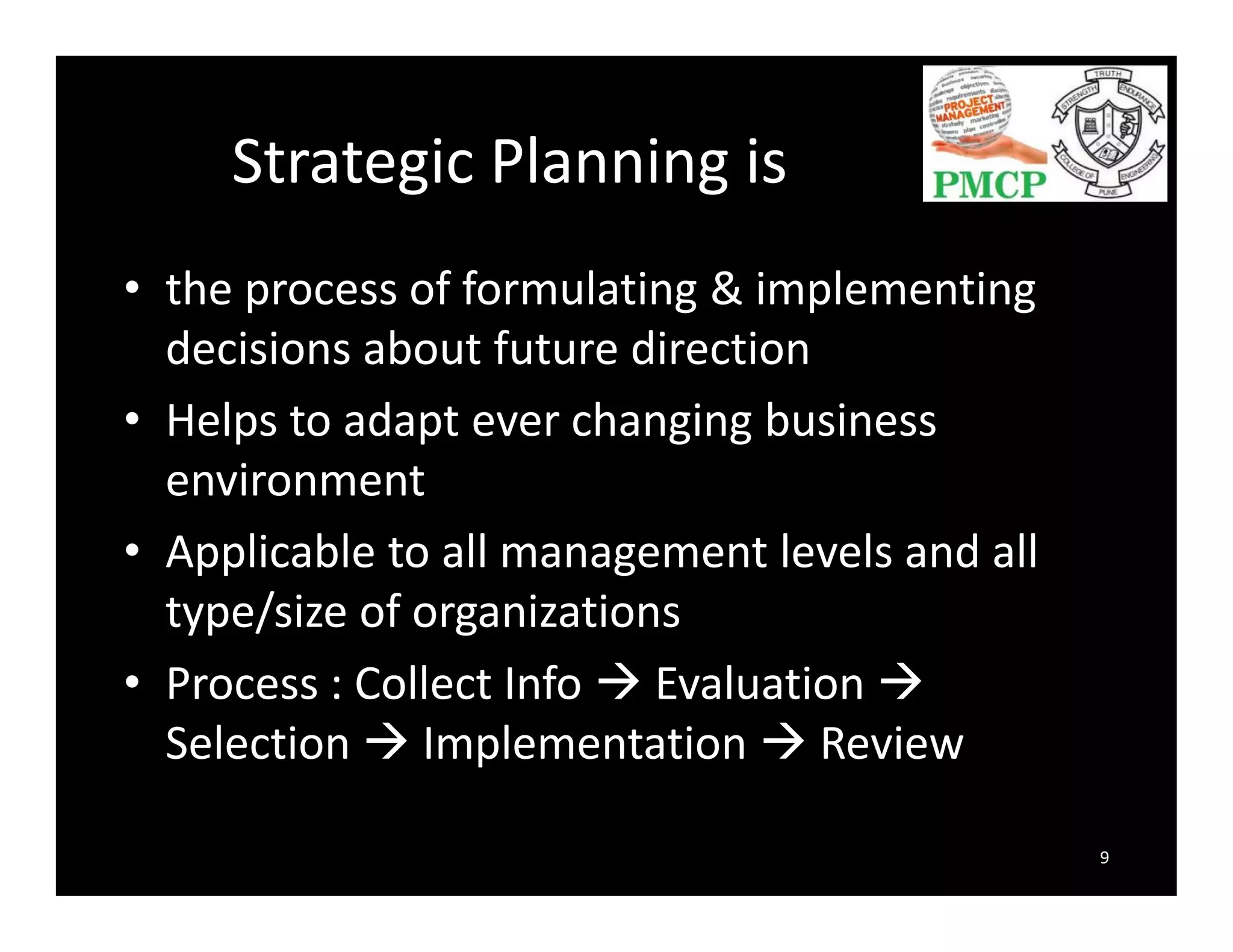
Strategic Planning is
• the process of formulating & implementing
decisions about future direction
• Helps to adapt ever changing business
environment
• Applicable to all management levels and all
type/size of organizations
• Process : Collect Info  Evaluation 
Selection  Implementation  Review
9
Reasons to perform strategic
planning
Your
competitive
advantage
Competitor’s
competitive
advantage
Strengthen
Minimize
10
First step is always
• Perform
gap analysis
– Speed to market
– Cost competitiveness
– Quality competitiveness
11
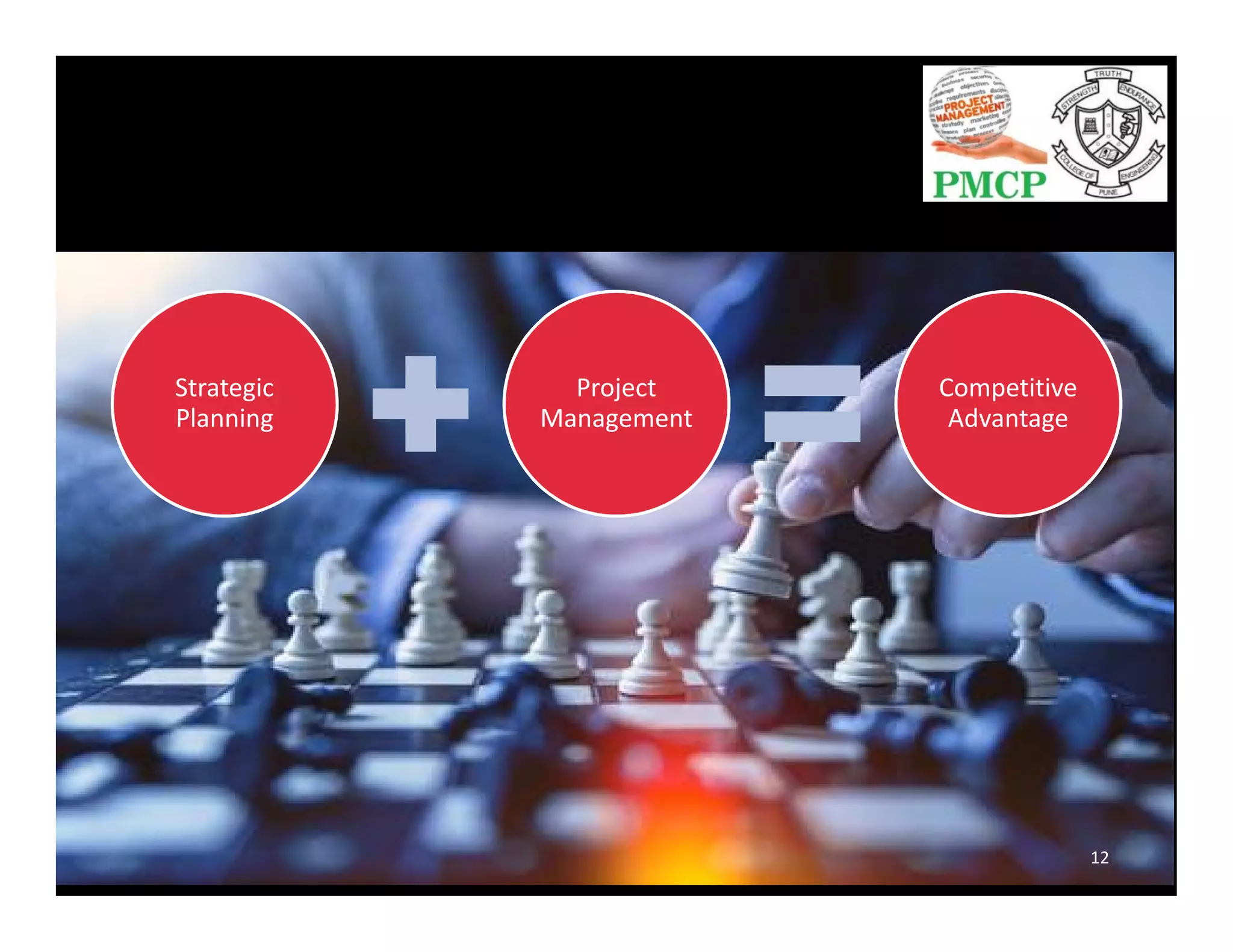
Strategic
Planning
Project
Management
Competitive
Advantage
12
Simple PM methodology
Project
Defining
SOW
Specs
WBS
Timing
Spending
Curve
Resumes
Policies
Procedures
Proj. Org.
Responsibility
matrices
Base line
Matrices
13
Technical Functional Financial
Monitoring & Control
Project
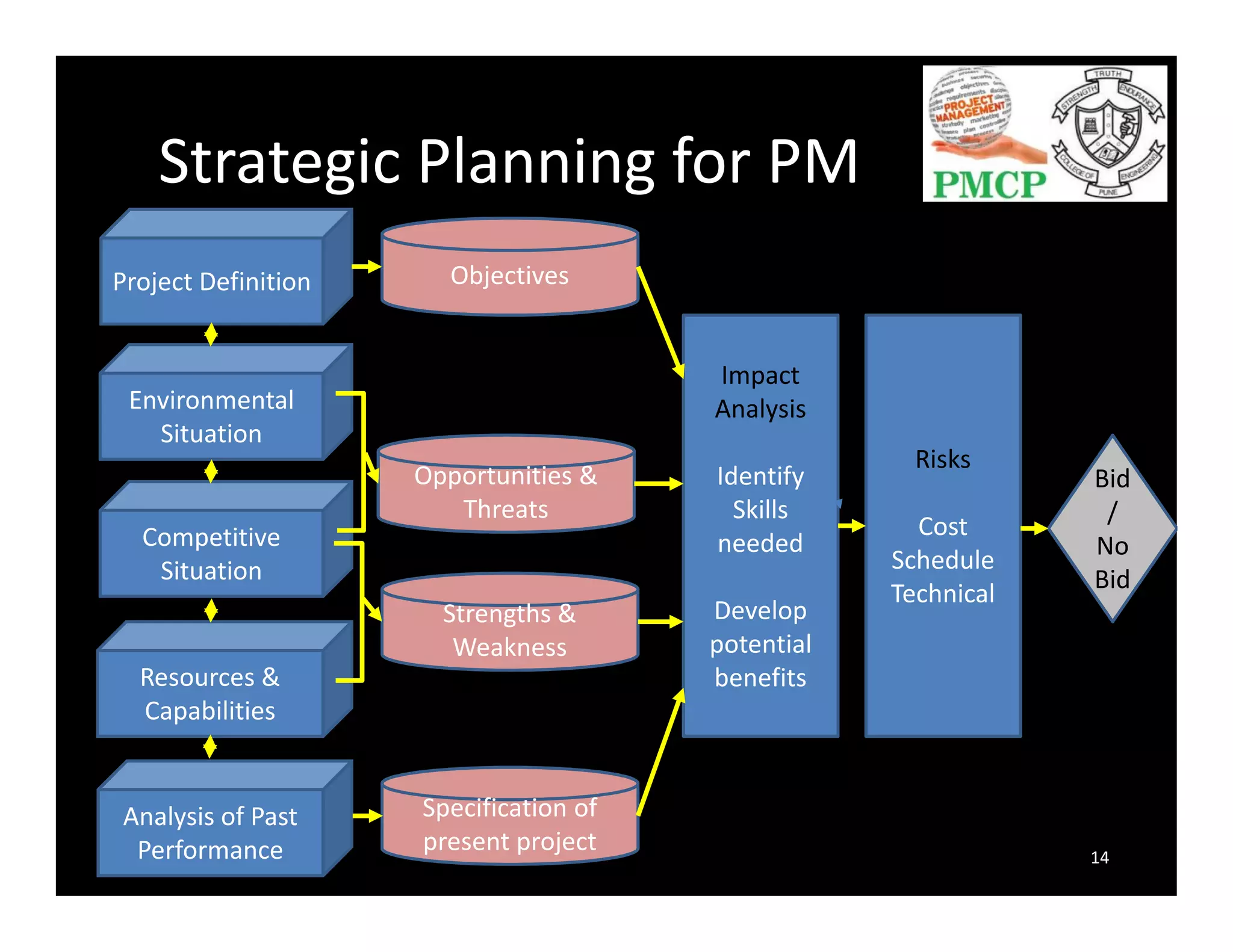
Strategic Planning for PM
14
Project Definition
Environmental
Situation
Competitive
Situation
Resources &
Capabilities
Analysis of Past
Performance
Objectives
Opportunities &
Threats
Strengths &
Weakness
Specification of
present project
Impact
Analysis
Identify
Skills
needed
Develop
potential
benefits
Risks
Cost
Schedule
Technical
Bid
/
No
Bid
• Vision, mission, objectives
• Size of the market
• Risks
• Capital requirements
• Market position on price
• Expected competitive response
• Regulatory climate
• Degree of social acceptance
• Human factors
15
• Competitive advantage
• Technical superiority
• Business attractiveness
• Competitive positioning
• Opportunities for market positioning
• Supply Chain management
• Financial capabilities
• Operations management
• Customer relationship management
16
• Resources & capabilities
• Market opportunities & Threats
• Internal strengths & weaknesses (R & D,
Manufacturing, Financial, HR etc.)
17
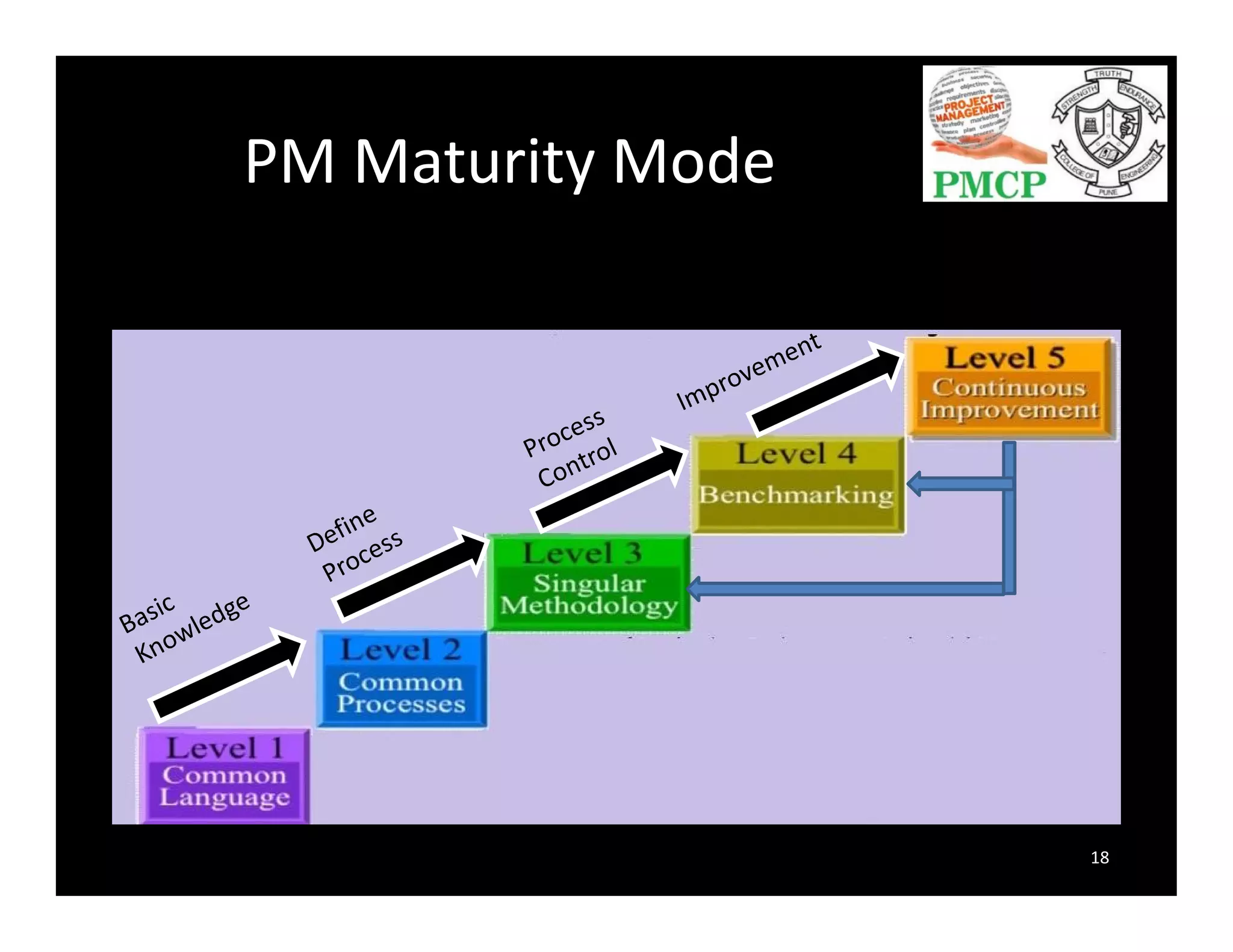
PM Maturity Mode
18
Level – 1 – Recognize
importance (Initial)
• Use of project management only some time
• “Lip service” support to PM
• Small pockets of interest in PM
• No attempt to recognize benefits of PM
• Self interest before company’s interest
• No investment or support for PM training &
education
19
Action to achieve Level 1
• Training & education in PM
• Encourage training / hiring of certified
management professionals
• Begin communicating in common PM
language
• Recognize & start using tools
• Develop understanding of PMBOK and other
standards
20
Level – 2 Processes (Managed)
• Recognizes benefits of PM
• Organizational Support at all levels
• Recognizes need for cost control
• Recognizes need for Processes/Methods, but
resistance to new methods
• Believe what we already have works well
21
Actions to achieve Level-2
• Culture that supports behavioral and
quantitative side of PM
• Recognize PM’s benefits for long term also
• Develop process/methods to achieve
repetitive success
• Develop PM curriculum
22
Level – 3 – Singular method
(Defined)
• Committed to PM
• Integrated processes
• Cultural support to PM, co-operative
• Management support is visible
• But still - Don’t fix if it isn’t broken
• Resistance to integration
• Resistance to shared accountability
23
Actions to achieve Level-3
• Integrate all processes in to single method
with demonstrated success execution
• Develop support for shared accountability
• Encourage acceptance of culture that supports
multiple reporting
• Move from fragmented culture to single co-
operative culture
24
Level – 4 – Benchmarking
(Measured)
• Establish PMO or centre of excellence
• Interest in benchmarking
• Recognize its benefits
• Not invented here syndrome
• Doesn’t apply to us
• Wrong industry to benchmark
• Fearful of what result will be
25
Actions to achieve Level-4
• Dedication to benchmarking
• Decide what to benchmark and against whom
• Quantitative & qualitative benchmarking
26
Level – 5 – Improvements
(Optimized)
• Lessons learned
• Knowledge Transfer
• COE/PO mentorship
• Strategic planning for PM
27
Road Ahead - PM Maturity
Model
• A brief session on Maturity Model followed by
• Self assessment comprising 200+ questions to
find out current maturity level and gaps
• Suggest structured action plan to achieve
Level-5 in few months to few years time
28
Do you need to work on PM
Maturity Model?
• Scope creep in every project
• End date set before scope is agreed
• Detailed project plans are not available
• Emphasize on deadline more than milestones,
quality
• Date driven instead of requirement driven
• Pressure to cut estimates low to win contract
• Hidden agendas
• Budget & schedules are not co-ordinated
• Filter information from reports due to fear
29
30
Thank you, keep
communicating!
31

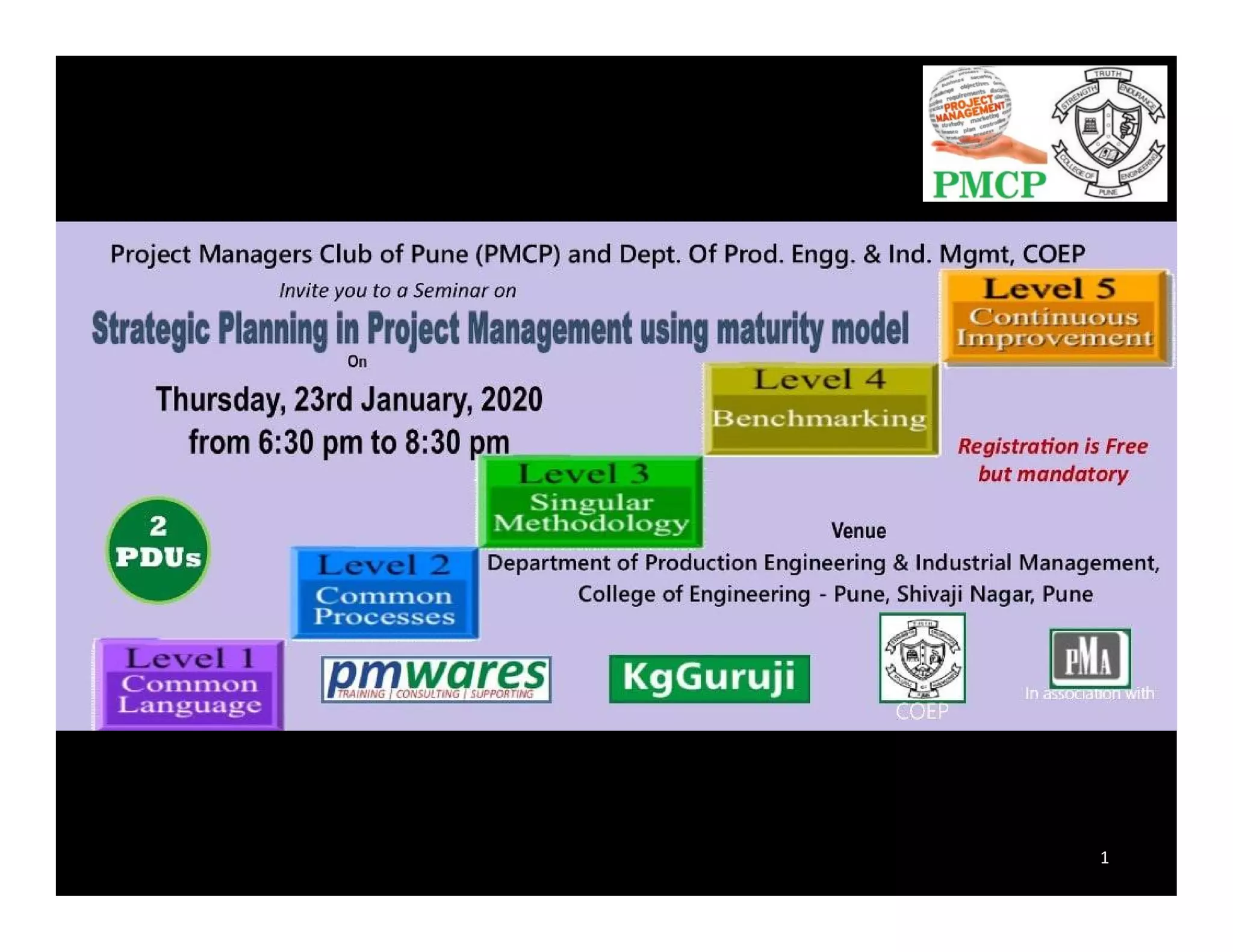
Strategic Planning in project Management using Maturity Model

  • 1.
  • 2.
    Is there aneed for strategic planning in PM? PM was (is) used but not recognized as core - competency. Why? 2 • viewed as simply a scheduling tool for workers • Executives failed to recognize true benefits • Executives were fearful about need to decentralize authority (diminish their power & authority)
  • 3.
    Which company exhibited betterproject management? 3 Target Stock Price Actual Stock Price Target Stock Price Actual Stock Price
  • 4.
    Behavior in differenttime Factor Growth / Favorable Time Recession Time Strategic Focus Organizational Focus Management Focus Sponsorship Training Emphasis Risk Analysis Team Building Changes in mgmt. style Changes in culture 4
  • 5.
    Behavior in differenttime Factor Growth / Favorable Time Recession Time Strategic Focus Short term Long term Organizational Focus Internal, secure power, control, authority External – Get closer to customer Management Focus Manage people, profit Manage work, deliverable, customer service Sponsorship Not so active Active Training Emphasis Quantitative Behavior, Qualitative Risk Analysis Minimal efforts Maximum focus Team Building Functional Teams Cross functional teams Changes in mgmt. style Slow speed Fast speed Changes in culture Slow speed Fast speed 5
  • 6.
    Group Exercise • COEPis evaluating to launch e-Mtech (1 year ) in Project Management to offer students/working professionals across the globe. 1st of it’s kind program to be launched by Jun-2020. Do project planning in small teams and suggest what should be done to roll it out as per desired schedule? (Major activities & estimated time) 6
  • 7.
    Questions • Will thisproject be successful? • Will it attract desired number of participants? • Will it break-even? 7
  • 8.
    If your answeris • Yes – relax, have a cup of tea and enjoy rest of evening the way you like it • No – be attentive, engage and take active part in remaining discussions. • Why Yes? Why No? 8
  • 9.
    Strategic Planning is •the process of formulating & implementing decisions about future direction • Helps to adapt ever changing business environment • Applicable to all management levels and all type/size of organizations • Process : Collect Info  Evaluation  Selection  Implementation  Review 9
  • 10.
    Reasons to performstrategic planning Your competitive advantage Competitor’s competitive advantage Strengthen Minimize 10
  • 11.
    First step isalways • Perform gap analysis – Speed to market – Cost competitiveness – Quality competitiveness 11
  • 12.
  • 13.
    Simple PM methodology Project Defining SOW Specs WBS Timing Spending Curve Resumes Policies Procedures Proj.Org. Responsibility matrices Base line Matrices 13 Technical Functional Financial Monitoring & Control Project
  • 14.
    Strategic Planning forPM 14 Project Definition Environmental Situation Competitive Situation Resources & Capabilities Analysis of Past Performance Objectives Opportunities & Threats Strengths & Weakness Specification of present project Impact Analysis Identify Skills needed Develop potential benefits Risks Cost Schedule Technical Bid / No Bid
  • 15.
    • Vision, mission,objectives • Size of the market • Risks • Capital requirements • Market position on price • Expected competitive response • Regulatory climate • Degree of social acceptance • Human factors 15
  • 16.
    • Competitive advantage •Technical superiority • Business attractiveness • Competitive positioning • Opportunities for market positioning • Supply Chain management • Financial capabilities • Operations management • Customer relationship management 16
  • 17.
    • Resources &capabilities • Market opportunities & Threats • Internal strengths & weaknesses (R & D, Manufacturing, Financial, HR etc.) 17
  • 18.
  • 19.
    Level – 1– Recognize importance (Initial) • Use of project management only some time • “Lip service” support to PM • Small pockets of interest in PM • No attempt to recognize benefits of PM • Self interest before company’s interest • No investment or support for PM training & education 19
  • 20.
    Action to achieveLevel 1 • Training & education in PM • Encourage training / hiring of certified management professionals • Begin communicating in common PM language • Recognize & start using tools • Develop understanding of PMBOK and other standards 20
  • 21.
    Level – 2Processes (Managed) • Recognizes benefits of PM • Organizational Support at all levels • Recognizes need for cost control • Recognizes need for Processes/Methods, but resistance to new methods • Believe what we already have works well 21
  • 22.
    Actions to achieveLevel-2 • Culture that supports behavioral and quantitative side of PM • Recognize PM’s benefits for long term also • Develop process/methods to achieve repetitive success • Develop PM curriculum 22
  • 23.
    Level – 3– Singular method (Defined) • Committed to PM • Integrated processes • Cultural support to PM, co-operative • Management support is visible • But still - Don’t fix if it isn’t broken • Resistance to integration • Resistance to shared accountability 23
  • 24.
    Actions to achieveLevel-3 • Integrate all processes in to single method with demonstrated success execution • Develop support for shared accountability • Encourage acceptance of culture that supports multiple reporting • Move from fragmented culture to single co- operative culture 24
  • 25.
    Level – 4– Benchmarking (Measured) • Establish PMO or centre of excellence • Interest in benchmarking • Recognize its benefits • Not invented here syndrome • Doesn’t apply to us • Wrong industry to benchmark • Fearful of what result will be 25
  • 26.
    Actions to achieveLevel-4 • Dedication to benchmarking • Decide what to benchmark and against whom • Quantitative & qualitative benchmarking 26
  • 27.
    Level – 5– Improvements (Optimized) • Lessons learned • Knowledge Transfer • COE/PO mentorship • Strategic planning for PM 27
  • 28.
    Road Ahead -PM Maturity Model • A brief session on Maturity Model followed by • Self assessment comprising 200+ questions to find out current maturity level and gaps • Suggest structured action plan to achieve Level-5 in few months to few years time 28
  • 29.
    Do you needto work on PM Maturity Model? • Scope creep in every project • End date set before scope is agreed • Detailed project plans are not available • Emphasize on deadline more than milestones, quality • Date driven instead of requirement driven • Pressure to cut estimates low to win contract • Hidden agendas • Budget & schedules are not co-ordinated • Filter information from reports due to fear 29
  • 30.
  • 31.