Strategic Management
Submitted by:
Aditya Khare Aditya Thakare Cheena Pasrija Joydeepta Biswas
Indian Luggage Industry
Contents
• Overview
• Industry Analysis – PEST
• Porter’s Analysis
• VIP – Company Analysis
• VIP – SWOT Analysis
• VIP – Competitor Analysis
• Issues
• Recommendations and Implications
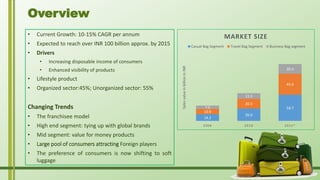
• Current Growth: 10-15% CAGR per annum
• Expected to reach over INR 100 billion approx. by 2015
• Drivers
• Increasing disposable income of consumers
• Enhanced visibility of products
• Lifestyle product
• Organized sector:45%; Unorganized sector: 55%
Changing Trends
• The franchisee model
• High end segment: tying up with global brands
• Mid segment: value for money products
• Large pool of consumers attracting Foreign players
• The preference of consumers is now shifting to soft
luggage
Overview
14.2
26.0
54.7
10.9
20.3
43.4
7.0
11.5
20.3
2006 2010 2015*
SalesvalueinbillioninINR
MARKET SIZE
Casual Bag Segment Travel Bag Segment Business Bag segment
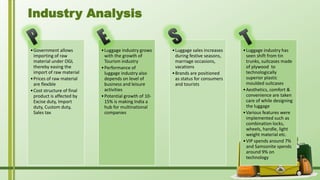
•Government allows
importing of raw
material under OGL
thereby easing the
import of raw material
•Prices of raw material
are flexible
•Cost structure of final
product is affected by
Excise duty, Import
duty, Custom duty,
Sales tax
•Luggage industry grows
with the growth of
Tourism industry
•Performance of
luggage industry also
depends on level of
business and leisure
activities
•Potential growth of 10-
15% is making India a
hub for multinational
companies
•Luggage sales increases
during festive seasons,
marriage occasions,
vacations
•Brands are positioned
as status for consumers
and tourists
•Luggage industry has
seen shift from tin
trunks, suitcases made
of plywood to
technologically
superior plastic
moulded suitcases
•Aesthetics, comfort &
convenience are taken
care of while designing
the luggage
•Various features were
implemented such as
combination locks,
wheels, handle, light
weight material etc.
•VIP spends around 7%
and Samsonite spends
around 9% on
technology
Industry Analysis
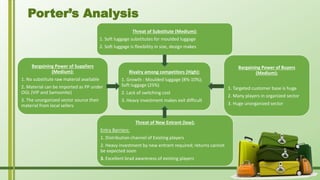
Rivalry among competitors (High):
1. Growth : Moulded luggage (8%-10%);
Soft luggage (25%)
2. Lack of switching cost
3. Heavy investment makes exit difficult
Threat of Substitute (Medium):
1. Soft luggage substitutes for moulded luggage
2. Soft luggage is flexibility in size, design makes
Bargaining Power of Buyers
(Medium):
1. Targeted customer base is huge
2. Many players in organized sector
3. Huge unorganized sector
Threat of New Entrant (low):
Entry Barriers:
1. Distribution channel of Existing players
2. Heavy investment by new entrant required; returns cannot
be expected soon
3. Excellent brad awareness of existing players
Bargaining Power of Suppliers
(Medium):
1. No substitute raw material available
2. Material can be imported as PP under
OGL (VIP and Samsonite)
3. The unorganized sector source their
material from local sellers
Porter’s Analysis
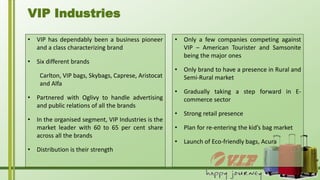
• VIP has dependably been a business pioneer
and a class characterizing brand
• Six different brands
Carlton, VIP bags, Skybags, Caprese, Aristocat
and Alfa
• Partnered with Oglivy to handle advertising
and public relations of all the brands
• In the organised segment, VIP Industries is the
market leader with 60 to 65 per cent share
across all the brands
• Distribution is their strength
VIP Industries
• Only a few companies competing against
VIP – American Tourister and Samsonite
being the major ones
• Only brand to have a presence in Rural and
Semi-Rural market
• Gradually taking a step forward in E-
commerce sector
• Strong retail presence
• Plan for re-entering the kid’s bag market
• Launch of Eco-friendly bags, Acura
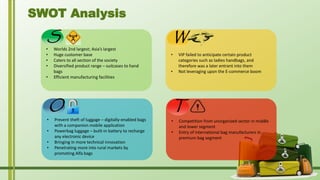
• Prevent theft of luggage – digitally-enabled bags
with a companion mobile application
• Powerbag luggage – built-in battery to recharge
any electronic device
• Bringing in more technical innovation
• Penetrating more into rural markets by
promoting Alfa bags
• Worlds 2nd largest; Asia’s largest
• Huge customer base
• Caters to all section of the society
• Diversified product range – suitcases to hand
bags
• Efficient manufacturing facilities
• VIP failed to anticipate certain product
categories such as ladies handbags, and
therefore was a later entrant into them
• Not leveraging upon the E-commerce boom
• Competition from unorganized sector in middle
and lower segment
• Entry of international bag manufacturers in
premium bag segment
T
W
O
S
SWOT Analysis
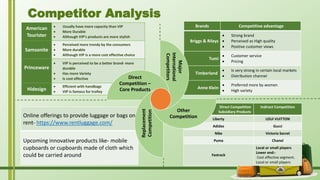
American
Tourister
 Usually have more capacity than VIP
 More Durable
 Although VIP’s products are more stylish
Samsonite
 Perceived more trendy by the consumers
 More durable
 Although VIP is a more cost effective choice
Princeware
 VIP is perceived to be a better brand- more
durable
 Has more Variety
 Is cost effective
Hidesign
 Efficient with handbags
 VIP is famous for trolley
Online offerings to provide luggage or bags on
rent- https://www.rentluggage.com/
Upcoming innovative products like- mobile
cupboards or cupboards made of cloth which
could be carried around
Direct Competition
Subsidiary Products
Indirect Competition
Liberty LOUI VUITTON
Adidas Gucci
Nike Victoria Secret
Puma Chanel
Fastrack
Local or small players
Lower end:-
Cost effective segment.
Local or small players
Brands Competitive advantage
Briggs & Rileys
 Strong brand
 Perceived as High quality
 Positive customer views
Tumi
 Customer service
 Pricing
Timberland
 Is very strong in certain local markets
 Distribution channel
Anne Klein
 Preferred more by women
 High variety
Major
International
Competitors
Other
Competition
Replacement
Competition
Direct
Competition –
Core Products
Competitor Analysis
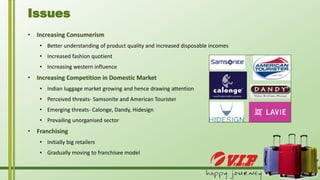
• Increasing Consumerism
• Better understanding of product quality and increased disposable incomes
• Increased fashion quotient
• Increasing western influence
• Increasing Competition in Domestic Market
• Indian luggage market growing and hence drawing attention
• Perceived threats- Samsonite and American Tourister
• Emerging threats- Calonge, Dandy, Hidesign
• Prevailing unorganised sector
• Franchising
• Initially big retailers
• Gradually moving to franchisee model
Issues
Recommendations and Implications
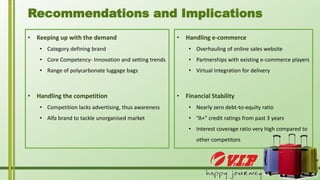
• Keeping up with the demand
• Category defining brand
• Core Competency- Innovation and setting trends
• Range of polycarbonate luggage bags
• Handling the competition
• Competition lacks advertising, thus awareness
• Alfa brand to tackle unorganised market
• Handling e-commerce
• Overhauling of online sales website
• Partnerships with existing e-commerce players
• Virtual Integration for delivery
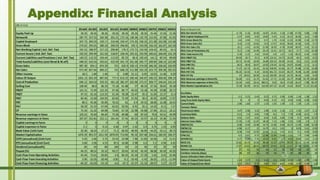
• Financial Stability
• Nearly zero debt-to-equity ratio
• “A+” credit ratings from past 3 years
• Interest coverage ratio very high compared to
other competitors
Appendix: Financial Analysis
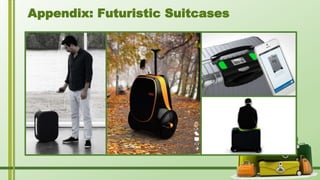
Appendix: Futuristic Suitcases

Strategic Management: Indian Luggage Industry

  • 1.
    Strategic Management Submitted by: AdityaKhare Aditya Thakare Cheena Pasrija Joydeepta Biswas Indian Luggage Industry
  • 2.
    Contents • Overview • IndustryAnalysis – PEST • Porter’s Analysis • VIP – Company Analysis • VIP – SWOT Analysis • VIP – Competitor Analysis • Issues • Recommendations and Implications
  • 3.
    • Current Growth:10-15% CAGR per annum • Expected to reach over INR 100 billion approx. by 2015 • Drivers • Increasing disposable income of consumers • Enhanced visibility of products • Lifestyle product • Organized sector:45%; Unorganized sector: 55% Changing Trends • The franchisee model • High end segment: tying up with global brands • Mid segment: value for money products • Large pool of consumers attracting Foreign players • The preference of consumers is now shifting to soft luggage Overview 14.2 26.0 54.7 10.9 20.3 43.4 7.0 11.5 20.3 2006 2010 2015* SalesvalueinbillioninINR MARKET SIZE Casual Bag Segment Travel Bag Segment Business Bag segment
  • 4.
    •Government allows importing ofraw material under OGL thereby easing the import of raw material •Prices of raw material are flexible •Cost structure of final product is affected by Excise duty, Import duty, Custom duty, Sales tax •Luggage industry grows with the growth of Tourism industry •Performance of luggage industry also depends on level of business and leisure activities •Potential growth of 10- 15% is making India a hub for multinational companies •Luggage sales increases during festive seasons, marriage occasions, vacations •Brands are positioned as status for consumers and tourists •Luggage industry has seen shift from tin trunks, suitcases made of plywood to technologically superior plastic moulded suitcases •Aesthetics, comfort & convenience are taken care of while designing the luggage •Various features were implemented such as combination locks, wheels, handle, light weight material etc. •VIP spends around 7% and Samsonite spends around 9% on technology Industry Analysis
  • 5.
    Rivalry among competitors(High): 1. Growth : Moulded luggage (8%-10%); Soft luggage (25%) 2. Lack of switching cost 3. Heavy investment makes exit difficult Threat of Substitute (Medium): 1. Soft luggage substitutes for moulded luggage 2. Soft luggage is flexibility in size, design makes Bargaining Power of Buyers (Medium): 1. Targeted customer base is huge 2. Many players in organized sector 3. Huge unorganized sector Threat of New Entrant (low): Entry Barriers: 1. Distribution channel of Existing players 2. Heavy investment by new entrant required; returns cannot be expected soon 3. Excellent brad awareness of existing players Bargaining Power of Suppliers (Medium): 1. No substitute raw material available 2. Material can be imported as PP under OGL (VIP and Samsonite) 3. The unorganized sector source their material from local sellers Porter’s Analysis
  • 6.
    • VIP hasdependably been a business pioneer and a class characterizing brand • Six different brands Carlton, VIP bags, Skybags, Caprese, Aristocat and Alfa • Partnered with Oglivy to handle advertising and public relations of all the brands • In the organised segment, VIP Industries is the market leader with 60 to 65 per cent share across all the brands • Distribution is their strength VIP Industries • Only a few companies competing against VIP – American Tourister and Samsonite being the major ones • Only brand to have a presence in Rural and Semi-Rural market • Gradually taking a step forward in E- commerce sector • Strong retail presence • Plan for re-entering the kid’s bag market • Launch of Eco-friendly bags, Acura
  • 7.
    • Prevent theftof luggage – digitally-enabled bags with a companion mobile application • Powerbag luggage – built-in battery to recharge any electronic device • Bringing in more technical innovation • Penetrating more into rural markets by promoting Alfa bags • Worlds 2nd largest; Asia’s largest • Huge customer base • Caters to all section of the society • Diversified product range – suitcases to hand bags • Efficient manufacturing facilities • VIP failed to anticipate certain product categories such as ladies handbags, and therefore was a later entrant into them • Not leveraging upon the E-commerce boom • Competition from unorganized sector in middle and lower segment • Entry of international bag manufacturers in premium bag segment T W O S SWOT Analysis
  • 8.
    American Tourister  Usually havemore capacity than VIP  More Durable  Although VIP’s products are more stylish Samsonite  Perceived more trendy by the consumers  More durable  Although VIP is a more cost effective choice Princeware  VIP is perceived to be a better brand- more durable  Has more Variety  Is cost effective Hidesign  Efficient with handbags  VIP is famous for trolley Online offerings to provide luggage or bags on rent- https://www.rentluggage.com/ Upcoming innovative products like- mobile cupboards or cupboards made of cloth which could be carried around Direct Competition Subsidiary Products Indirect Competition Liberty LOUI VUITTON Adidas Gucci Nike Victoria Secret Puma Chanel Fastrack Local or small players Lower end:- Cost effective segment. Local or small players Brands Competitive advantage Briggs & Rileys  Strong brand  Perceived as High quality  Positive customer views Tumi  Customer service  Pricing Timberland  Is very strong in certain local markets  Distribution channel Anne Klein  Preferred more by women  High variety Major International Competitors Other Competition Replacement Competition Direct Competition – Core Products Competitor Analysis
  • 9.
    • Increasing Consumerism •Better understanding of product quality and increased disposable incomes • Increased fashion quotient • Increasing western influence • Increasing Competition in Domestic Market • Indian luggage market growing and hence drawing attention • Perceived threats- Samsonite and American Tourister • Emerging threats- Calonge, Dandy, Hidesign • Prevailing unorganised sector • Franchising • Initially big retailers • Gradually moving to franchisee model Issues
  • 10.
    Recommendations and Implications •Keeping up with the demand • Category defining brand • Core Competency- Innovation and setting trends • Range of polycarbonate luggage bags • Handling the competition • Competition lacks advertising, thus awareness • Alfa brand to tackle unorganised market • Handling e-commerce • Overhauling of online sales website • Partnerships with existing e-commerce players • Virtual Integration for delivery • Financial Stability • Nearly zero debt-to-equity ratio • “A+” credit ratings from past 3 years • Interest coverage ratio very high compared to other competitors
  • 12.
  • 13.