Text + Images + Data: A More
Complete Way to Convey
Results of Scientific Research
Carol Tenopir
University of Tennessee
ctenopir@utk.edu
web.utk.edu/~tenopir/
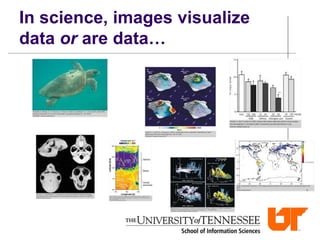
In science, images visualize
data or are data…
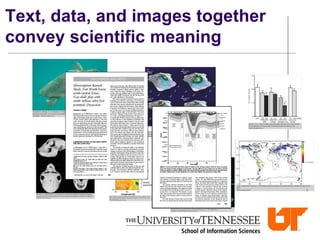
Text, data, and images together
convey scientific meaning
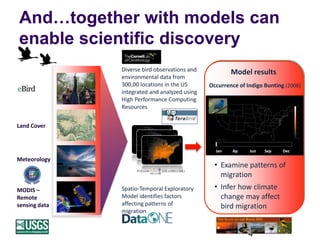
Spatio-Temporal Exploratory
Model identifies factors
affecting patterns of
migration
Diverse bird observations and
environmental data from
300,00 locations in the US
integrated and analyzed using
High Performance Computing
Resources
Land Cover
Meteorology
MODIS –
Remote
sensing data
• Examine patterns of
migration
• Infer how climate
change may affect
bird migration
Model results
Occurrence of Indigo Bunting (2008)
Jan Sep DecJunAp
r
And…together with models can
enable scientific discovery
4
Granularity in the Journal World
Granularity=
Divisible: Made up of conveniently
small and independent parts
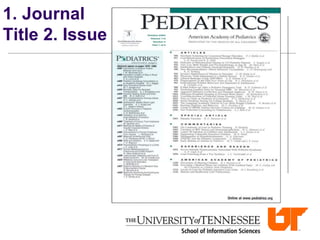
1. Journal
Title 2. Issue
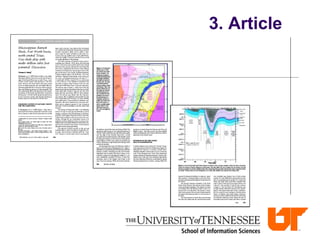
3. Article
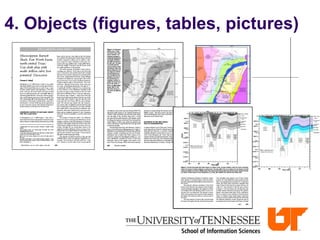
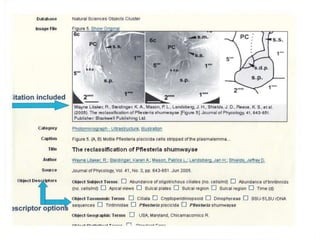
4. Objects (figures, tables, pictures)
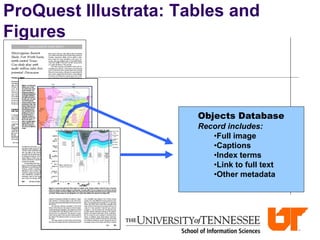
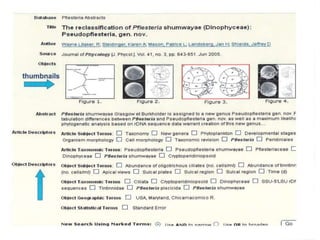
ProQuest Illustrata: Tables and
Figures
Objects Database
Record includes:
•Full image
•Captions
•Index terms
•Link to full text
•Other metadata
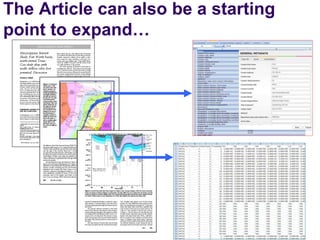
The Article can also be a starting
point to expand…
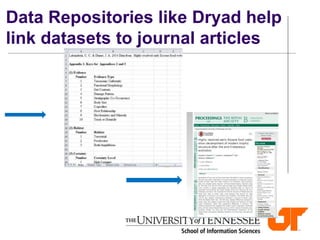
Data Repositories like Dryad help
link datasets to journal articles
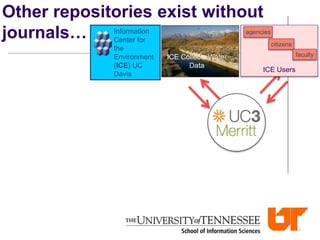
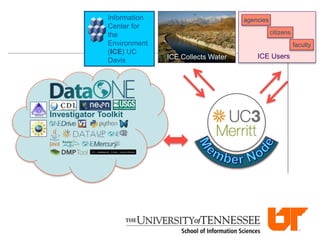
ICE Collectors
ICE Users
Information
Center for
the
Environment
(ICE) UC
Davis
ICE Collects Water
Data
ICE Users
agencies
citizens
faculty
Other repositories exist without
journals…
ICE Collectors
ICE Users
Information
Center for
the
Environment
(ICE) UC
Davis ICE Collects Water
Data
ICE Users
agencies
citizens
faculty
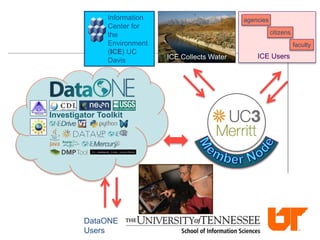
Investigator Toolkit
ICE Collectors
ICE Users
DataONE
Users
Information
Center for
the
Environment
(ICE) UC
Davis ICE Collects Water
Data
ICE Users
agencies
citizens
faculty
Investigator Toolkit
Reading patterns may vary
with purpose …
 Sometimes you need an entire article
or most of one (catching up or writing)
 Sometimes you need just a part like a
paragraph or picture (teaching or to
check a fact)
 Sometimes you need citations or data
beyond the article (research)
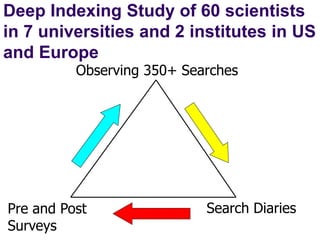
Deep Indexing Study of 60 scientists
in 7 universities and 2 institutes in US
and Europe
Observing 350+ Searches
Pre and Post
Surveys
Search Diaries
What scientists currently do
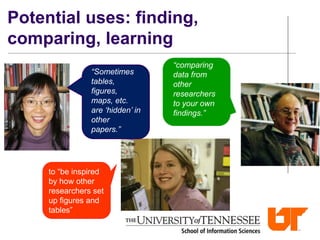
to “be inspired
by how other
researchers set
up figures and
tables”
Potential uses: finding,
comparing, learning
“Sometimes
tables,
figures,
maps, etc.
are ‘hidden’ in
other
papers.”
“comparing
data from
other
researchers
to your own
findings.”
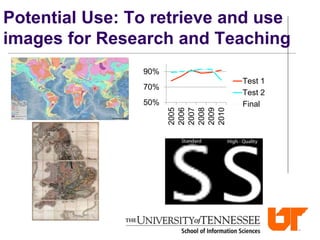
Potential Use: To retrieve and use
images for Research and Teaching
50%
70%
90%
2005
2006
2007
2008
2009
2010
Test 1
Test 2
Final
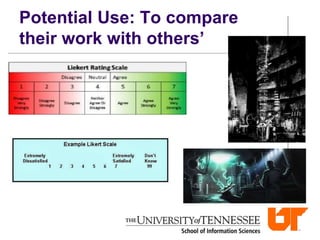
Potential Use: To compare
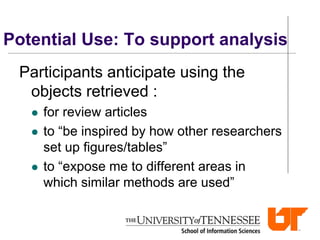
their work with others’
Potential Use: To support analysis
Participants anticipate using the
objects retrieved :
 for review articles
 to “be inspired by how other researchers
set up figures/tables”
 to “expose me to different areas in
which similar methods are used”
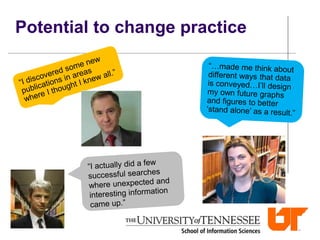
Potential to change practice
Suggestions for Success
 Images must be of high quality with
ability to enlarge thumbnail images
 The context of the whole article is very
important—in fact it may be dangerous
to see images without the context
 Allow table contents to be searchable
and support extraction of data from
tables
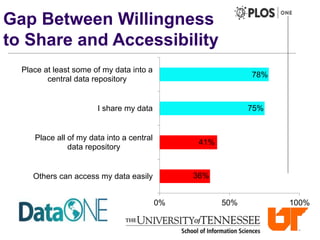
36%
41%
75%
78%
0% 50% 100%
Others can access my data easily
Place all of my data into a central
data repository
I share my data
Place at least some of my data into a
central data repository
Gap Between Willingness
to Share and Accessibility
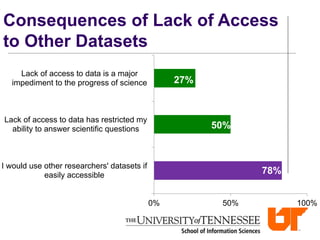
0% 50% 100%
I would use other researchers' datasets if
easily accessible
Lack of access to data has restricted my
ability to answer scientific questions
Lack of access to data is a major
impediment to the progress of science
78%
84%
50%
27%
50%
Consequences of Lack of Access
to Other Datasets
In conclusion…
 Providing access to visual material can help
scientists in many ways
 Sometimes scientists need just a part of an
article and systems that help them find parts
 Sometimes they need to read an entire article
 Sometimes they need data (and many are
willing to share)
 Think at many levels of granularity—journal
issues AND whole articles AND parts of
articles AND extensions to articles such as
data
Thank you
Carol Tenopir
ctenopir@utk.edu

Text+Images+Data: A More Complex Way to Convey Results of Scientific Research

  • 1.
    Text + Images+ Data: A More Complete Way to Convey Results of Scientific Research Carol Tenopir University of Tennessee ctenopir@utk.edu web.utk.edu/~tenopir/
  • 2.
    In science, imagesvisualize data or are data…
  • 3.
    Text, data, andimages together convey scientific meaning
  • 4.
    Spatio-Temporal Exploratory Model identifiesfactors affecting patterns of migration Diverse bird observations and environmental data from 300,00 locations in the US integrated and analyzed using High Performance Computing Resources Land Cover Meteorology MODIS – Remote sensing data • Examine patterns of migration • Infer how climate change may affect bird migration Model results Occurrence of Indigo Bunting (2008) Jan Sep DecJunAp r And…together with models can enable scientific discovery 4
  • 5.
    Granularity in theJournal World Granularity= Divisible: Made up of conveniently small and independent parts
  • 6.
  • 7.
  • 8.
    4. Objects (figures,tables, pictures)
  • 9.
    ProQuest Illustrata: Tablesand Figures Objects Database Record includes: •Full image •Captions •Index terms •Link to full text •Other metadata
  • 10.
    The Article canalso be a starting point to expand…
  • 11.
    Data Repositories likeDryad help link datasets to journal articles
  • 12.
    ICE Collectors ICE Users Information Centerfor the Environment (ICE) UC Davis ICE Collects Water Data ICE Users agencies citizens faculty Other repositories exist without journals…
  • 13.
    ICE Collectors ICE Users Information Centerfor the Environment (ICE) UC Davis ICE Collects Water Data ICE Users agencies citizens faculty Investigator Toolkit
  • 14.
    ICE Collectors ICE Users DataONE Users Information Centerfor the Environment (ICE) UC Davis ICE Collects Water Data ICE Users agencies citizens faculty Investigator Toolkit
  • 15.
    Reading patterns mayvary with purpose …  Sometimes you need an entire article or most of one (catching up or writing)  Sometimes you need just a part like a paragraph or picture (teaching or to check a fact)  Sometimes you need citations or data beyond the article (research)
  • 16.
    Deep Indexing Studyof 60 scientists in 7 universities and 2 institutes in US and Europe Observing 350+ Searches Pre and Post Surveys Search Diaries
  • 17.
  • 18.
    to “be inspired byhow other researchers set up figures and tables” Potential uses: finding, comparing, learning “Sometimes tables, figures, maps, etc. are ‘hidden’ in other papers.” “comparing data from other researchers to your own findings.”
  • 19.
    Potential Use: Toretrieve and use images for Research and Teaching 50% 70% 90% 2005 2006 2007 2008 2009 2010 Test 1 Test 2 Final
  • 20.
    Potential Use: Tocompare their work with others’
  • 21.
    Potential Use: Tosupport analysis Participants anticipate using the objects retrieved :  for review articles  to “be inspired by how other researchers set up figures/tables”  to “expose me to different areas in which similar methods are used”
  • 22.
  • 23.
    Suggestions for Success Images must be of high quality with ability to enlarge thumbnail images  The context of the whole article is very important—in fact it may be dangerous to see images without the context  Allow table contents to be searchable and support extraction of data from tables
  • 26.
    36% 41% 75% 78% 0% 50% 100% Otherscan access my data easily Place all of my data into a central data repository I share my data Place at least some of my data into a central data repository Gap Between Willingness to Share and Accessibility
  • 27.
    0% 50% 100% Iwould use other researchers' datasets if easily accessible Lack of access to data has restricted my ability to answer scientific questions Lack of access to data is a major impediment to the progress of science 78% 84% 50% 27% 50% Consequences of Lack of Access to Other Datasets
  • 28.
    In conclusion…  Providingaccess to visual material can help scientists in many ways  Sometimes scientists need just a part of an article and systems that help them find parts  Sometimes they need to read an entire article  Sometimes they need data (and many are willing to share)  Think at many levels of granularity—journal issues AND whole articles AND parts of articles AND extensions to articles such as data
  • 29.