Creative Visualization
in Chemistry
Prof. Jonathan P. Bowen
Birmingham City University
& Museophile Limited
United Kingdom
www.jpbowen.com
Introduction
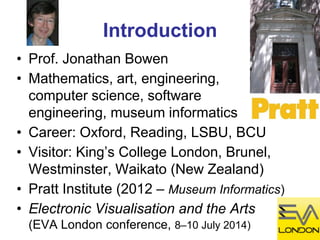
• Prof. Jonathan Bowen
• Mathematics, art, engineering,
computer science, software
engineering, museum informatics
• Career: Oxford, Reading, LSBU, BCU
• Visitor: King’s College London, Brunel,
Westminster, Waikato (New Zealand)
• Pratt Institute (2012 – Museum Informatics)
• Electronic Visualisation and the Arts
(EVA London conference, 8–10 July 2014)
Patterns
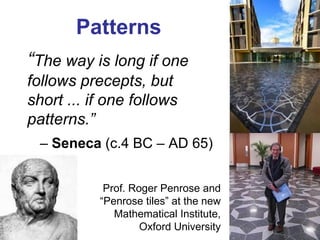
“The way is long if one
follows precepts, but
short ... if one follows
patterns.”
– Seneca (c.4 BC – AD 65)
Prof. Roger Penrose and
“Penrose tiles” at the new
Mathematical Institute,
Oxford University
The Sceptical Chymist
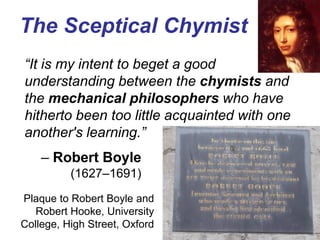
“It is my intent to beget a good
understanding between the chymists and
the mechanical philosophers who have
hitherto been too little acquainted with one
another's learning.”
– Robert Boyle
(1627–1691)
Plaque to Robert Boyle and
Robert Hooke, University
College, High Street, Oxford
Why chemistry?
• E. J. Bowen FRS (1898–1980)
– Physical chemist, Oxford
• H. J. M. Bowen (1929–2001)
– Analytical chemist
• [J. P. Bowen (b. 1956)]
• A. M. Bowen (b. 1986)
– Biophysical chemist
– Doctorate in Chemistry, Oxford (2013)
Photograph in
the National
Portrait
Gallery,
London
Structure of chlorophyll a
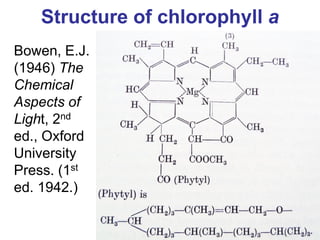
Bowen, E.J.
(1946) The
Chemical
Aspects of
Light, 2nd
ed., Oxford
University
Press. (1st
ed. 1942.)
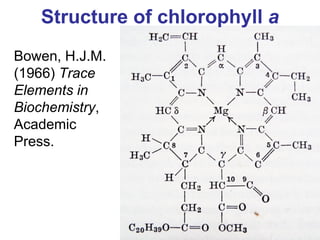
Structure of chlorophyll a
Bowen, H.J.M.
(1966) Trace
Elements in
Biochemistry,
Academic
Press.
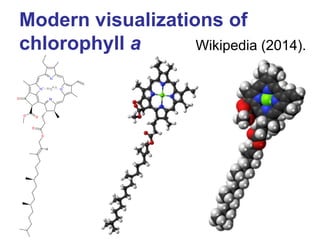
Modern visualizations of
chlorophyll a Wikipedia (2014).
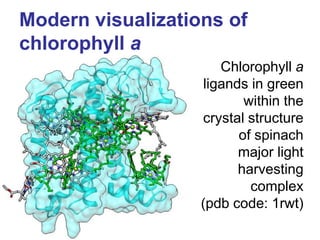
Modern visualizations of
chlorophyll a
Chlorophyll a
ligands in green
within the
crystal structure
of spinach
major light
harvesting
complex
(pdb code: 1rwt)
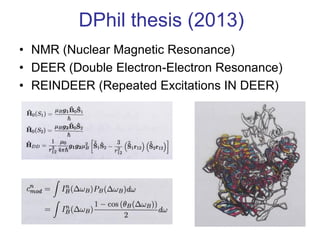
DPhil thesis (2013)
• NMR (Nuclear Magnetic Resonance)
• DEER (Double Electron-Electron Resonance)
• REINDEER (Repeated Excitations IN DEER)
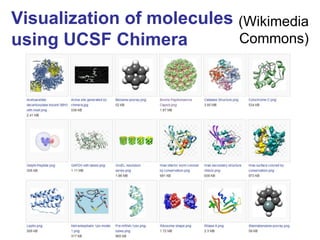
Visualization of molecules
using UCSF Chimera
(Wikimedia
Commons)
EVA London paper
• Karl Harrison
– IT support in Department of Chemistry, Oxford
– Artwork on covers of chemistry journals
• Electronic Visualisation and the Arts (EVA)
London conference: www.eva-london.org
• 2013 paper on “Electronic Visualisation in
Chemistry: From Alchemy to Art”
(Harrison and Bowen × 2).
ewic.bcs.org/content/ConWebDoc/51042
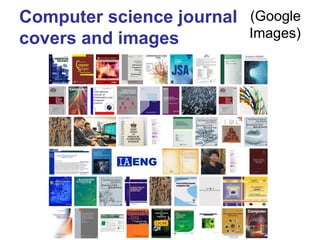
Computer science journal
covers and images
(Google
Images)
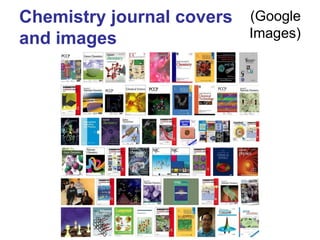
Chemistry journal covers
and images
(Google
Images)
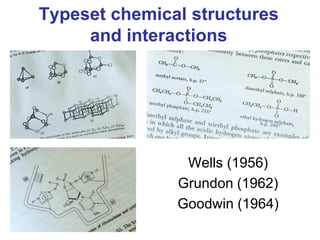
Typeset chemical structures
and interactions
Wells (1956)
Grundon (1962)
Goodwin (1964)
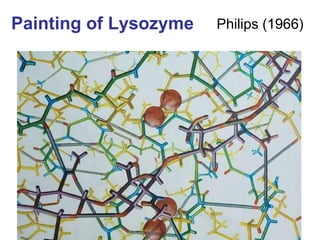
Painting of Lysozyme Philips (1966)
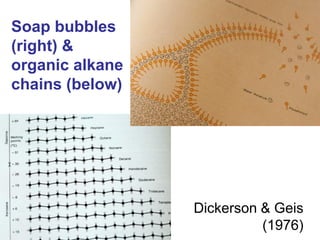
Soap bubbles
(right) &
organic alkane
chains (below)
Dickerson & Geis
(1976)
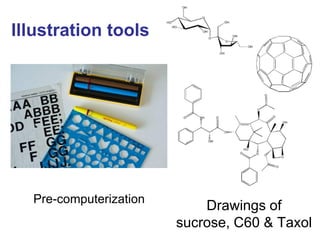
Illustration tools
Drawings of
sucrose, C60 & Taxol
Pre-computerization
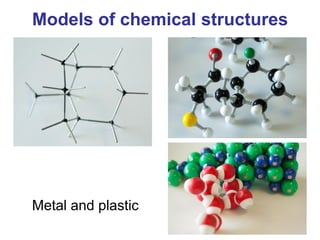
Models of chemical structures
Metal and plastic
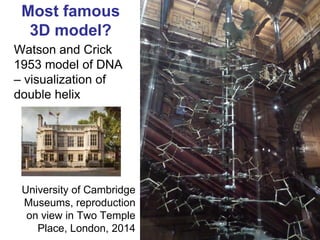
Most famous
3D model?
Watson and Crick
1953 model of DNA
– visualization of
double helix
University of Cambridge
Museums, reproduction
on view in Two Temple
Place, London, 2014
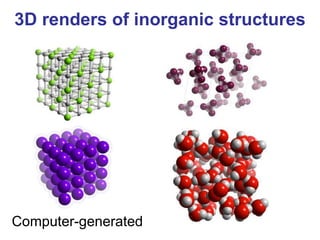
3D renders of inorganic structures
Computer-generated
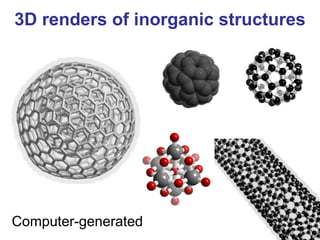
3D renders of inorganic structures
Computer-generated
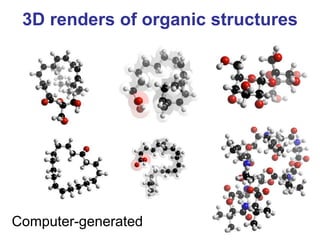
3D renders of organic structures
Computer-generated
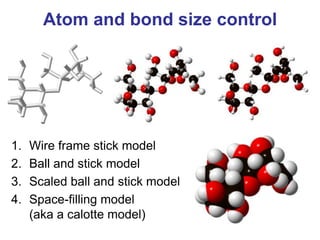
Atom and bond size control
1. Wire frame stick model
2. Ball and stick model
3. Scaled ball and stick model
4. Space-filling model
(aka a calotte model)
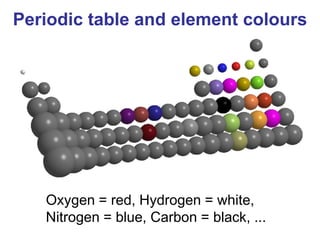
Periodic table and element colours
Oxygen = red, Hydrogen = white,
Nitrogen = blue, Carbon = black, ...
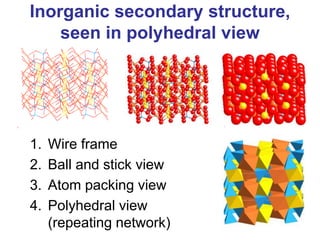
Inorganic secondary structure,
seen in polyhedral view
1. Wire frame
2. Ball and stick view
3. Atom packing view
4. Polyhedral view
(repeating network)
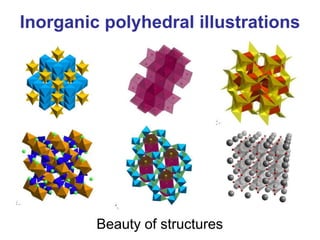
Inorganic polyhedral illustrations
Beauty of structures
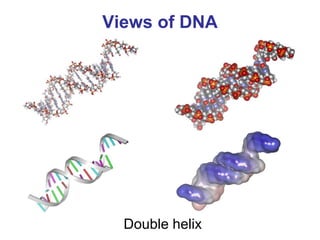
Views of DNA
Double helix
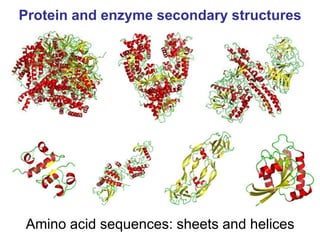
Protein and enzyme secondary structures
Amino acid sequences: sheets and helices
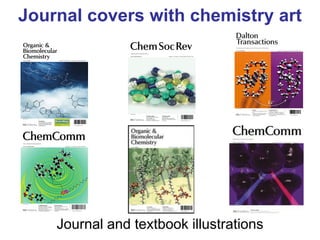
Journal covers with chemistry art
Journal and textbook illustrations
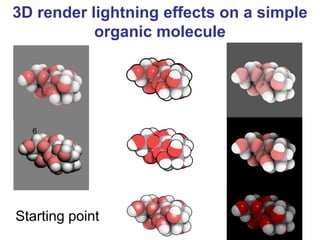
3D render lightning effects on a simple
organic molecule
Starting point
6
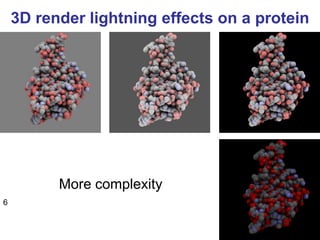
3D render lightning effects on a protein
More complexity
6
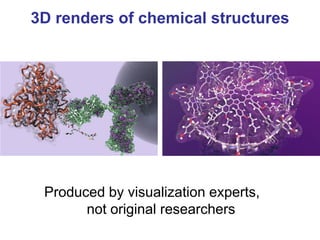
3D renders of chemical structures
Produced by visualization experts,
not original researchers
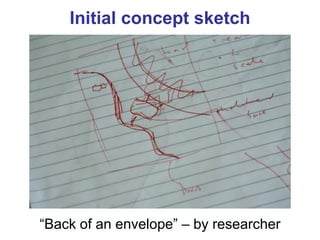
Initial concept sketch
“Back of an envelope” – by researcher
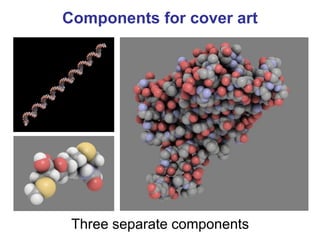
Components for cover art
Three separate components
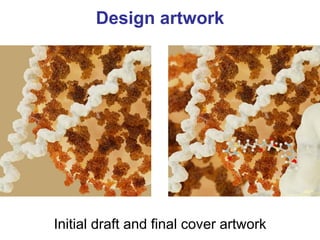
Design artwork
Initial draft and final cover artwork
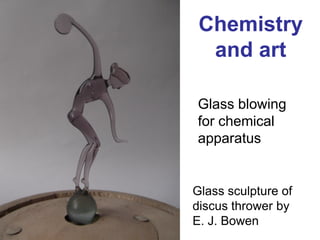
Chemistry
and art
Glass blowing
for chemical
apparatus
Glass sculpture of
discus thrower by
E. J. Bowen
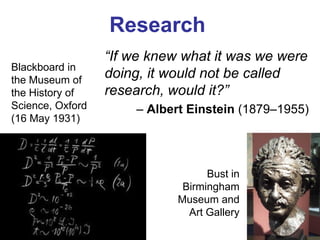
Research
“If we knew what it was we were
doing, it would not be called
research, would it?”
– Albert Einstein (1879–1955)
Bust in
Birmingham
Museum and
Art Gallery
Blackboard in
the Museum of
the History of
Science, Oxford
(16 May 1931)
EVA London conference
• Electronic Visualisation and the Arts (EVA)
London conference: www.eva-london.org
• 2013 paper on “Electronic Visualisation in
Chemistry: From Alchemy to Art”
(Harrison and Bowen × 2).
ewic.bcs.org/content/ConWebDoc/51042
• Next conference: British Computer Society
offices, Southampton Street, Covent Garden,
central London, 8–10 July 2014
• 2014 paper with Tula Giannini on
“Digitalism: The New Realism”
The end!
Prof. Jonathan Bowen
(FBCS, FRSA)
jonathan.bowen@bcu.ac.uk
www.jpbowen.com

Creative Visualisation in Chemistry

  • 1.
    Creative Visualization in Chemistry Prof.Jonathan P. Bowen Birmingham City University & Museophile Limited United Kingdom www.jpbowen.com
  • 2.
    Introduction • Prof. JonathanBowen • Mathematics, art, engineering, computer science, software engineering, museum informatics • Career: Oxford, Reading, LSBU, BCU • Visitor: King’s College London, Brunel, Westminster, Waikato (New Zealand) • Pratt Institute (2012 – Museum Informatics) • Electronic Visualisation and the Arts (EVA London conference, 8–10 July 2014)
  • 3.
    Patterns “The way islong if one follows precepts, but short ... if one follows patterns.” – Seneca (c.4 BC – AD 65) Prof. Roger Penrose and “Penrose tiles” at the new Mathematical Institute, Oxford University
  • 4.
    The Sceptical Chymist “Itis my intent to beget a good understanding between the chymists and the mechanical philosophers who have hitherto been too little acquainted with one another's learning.” – Robert Boyle (1627–1691) Plaque to Robert Boyle and Robert Hooke, University College, High Street, Oxford
  • 5.
    Why chemistry? • E.J. Bowen FRS (1898–1980) – Physical chemist, Oxford • H. J. M. Bowen (1929–2001) – Analytical chemist • [J. P. Bowen (b. 1956)] • A. M. Bowen (b. 1986) – Biophysical chemist – Doctorate in Chemistry, Oxford (2013) Photograph in the National Portrait Gallery, London
  • 6.
    Structure of chlorophylla Bowen, E.J. (1946) The Chemical Aspects of Light, 2nd ed., Oxford University Press. (1st ed. 1942.)
  • 7.
    Structure of chlorophylla Bowen, H.J.M. (1966) Trace Elements in Biochemistry, Academic Press.
  • 8.
  • 9.
    Modern visualizations of chlorophylla Chlorophyll a ligands in green within the crystal structure of spinach major light harvesting complex (pdb code: 1rwt)
  • 10.
    DPhil thesis (2013) •NMR (Nuclear Magnetic Resonance) • DEER (Double Electron-Electron Resonance) • REINDEER (Repeated Excitations IN DEER)
  • 11.
    Visualization of molecules usingUCSF Chimera (Wikimedia Commons)
  • 12.
    EVA London paper •Karl Harrison – IT support in Department of Chemistry, Oxford – Artwork on covers of chemistry journals • Electronic Visualisation and the Arts (EVA) London conference: www.eva-london.org • 2013 paper on “Electronic Visualisation in Chemistry: From Alchemy to Art” (Harrison and Bowen × 2). ewic.bcs.org/content/ConWebDoc/51042
  • 13.
    Computer science journal coversand images (Google Images)
  • 14.
    Chemistry journal covers andimages (Google Images)
  • 15.
    Typeset chemical structures andinteractions Wells (1956) Grundon (1962) Goodwin (1964)
  • 16.
    Painting of LysozymePhilips (1966)
  • 17.
    Soap bubbles (right) & organicalkane chains (below) Dickerson & Geis (1976)
  • 18.
    Illustration tools Drawings of sucrose,C60 & Taxol Pre-computerization
  • 19.
    Models of chemicalstructures Metal and plastic
  • 20.
    Most famous 3D model? Watsonand Crick 1953 model of DNA – visualization of double helix University of Cambridge Museums, reproduction on view in Two Temple Place, London, 2014
  • 21.
    3D renders ofinorganic structures Computer-generated
  • 22.
    3D renders ofinorganic structures Computer-generated
  • 23.
    3D renders oforganic structures Computer-generated
  • 24.
    Atom and bondsize control 1. Wire frame stick model 2. Ball and stick model 3. Scaled ball and stick model 4. Space-filling model (aka a calotte model)
  • 25.
    Periodic table andelement colours Oxygen = red, Hydrogen = white, Nitrogen = blue, Carbon = black, ...
  • 26.
    Inorganic secondary structure, seenin polyhedral view 1. Wire frame 2. Ball and stick view 3. Atom packing view 4. Polyhedral view (repeating network)
  • 27.
  • 28.
  • 29.
    Protein and enzymesecondary structures Amino acid sequences: sheets and helices
  • 30.
    Journal covers withchemistry art Journal and textbook illustrations
  • 31.
    3D render lightningeffects on a simple organic molecule Starting point 6
  • 32.
    3D render lightningeffects on a protein More complexity 6
  • 33.
    3D renders ofchemical structures Produced by visualization experts, not original researchers
  • 34.
    Initial concept sketch “Backof an envelope” – by researcher
  • 35.
    Components for coverart Three separate components
  • 36.
    Design artwork Initial draftand final cover artwork
  • 37.
    Chemistry and art Glass blowing forchemical apparatus Glass sculpture of discus thrower by E. J. Bowen
  • 38.
    Research “If we knewwhat it was we were doing, it would not be called research, would it?” – Albert Einstein (1879–1955) Bust in Birmingham Museum and Art Gallery Blackboard in the Museum of the History of Science, Oxford (16 May 1931)
  • 39.
    EVA London conference •Electronic Visualisation and the Arts (EVA) London conference: www.eva-london.org • 2013 paper on “Electronic Visualisation in Chemistry: From Alchemy to Art” (Harrison and Bowen × 2). ewic.bcs.org/content/ConWebDoc/51042 • Next conference: British Computer Society offices, Southampton Street, Covent Garden, central London, 8–10 July 2014 • 2014 paper with Tula Giannini on “Digitalism: The New Realism”
  • 40.
    The end! Prof. JonathanBowen (FBCS, FRSA) jonathan.bowen@bcu.ac.uk www.jpbowen.com