An Overview of The
Stress Strain Curve
Omar Bin Mahfodh, B.Eng.
1
What Is Stress Strain Curve
• Stress Strain Curve will provide the engineer with information about
the response of the material under stress. The response is
represented in terms of strain (increase in length).
• Why is important?
• It helps the engineer to pick the right material for the application
2
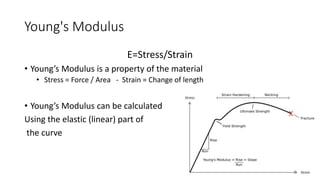
Young's Modulus
E=Stress/Strain
• Young’s Modulus is a property of the material
• Stress = Force / Area - Strain = Change of length
• Young’s Modulus can be calculated
Using the elastic (linear) part of
the curve
3
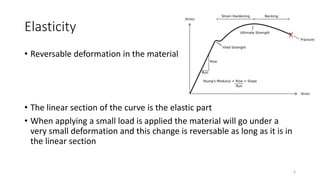
Elasticity
• Reversable deformation in the material
• The linear section of the curve is the elastic part
• When applying a small load is applied the material will go under a
very small deformation and this change is reversable as long as it is in
the linear section
4
Strength
• The maximum stress a material can withstand in elastic region
What happens when we go over the maximum strength?
• Material will go to plastic deformation, plastic is partially or fully
irreversible
5
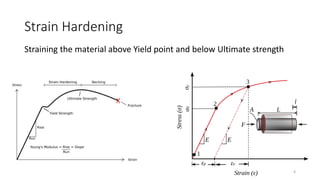
Strain Hardening
Straining the material above Yield point and below Ultimate strength
6
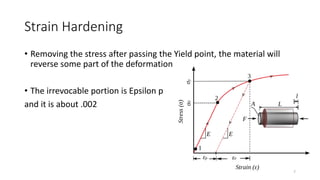
Strain Hardening
• Removing the stress after passing the Yield point, the material will
reverse some part of the deformation
• The irrevocable portion is Epsilon p
and it is about .002
7
Strain Hardening
• The dashed line from point 3 in the figure shows us that the elastic
region got longer, this means that the
same material can withstand more
more stress in the elastic region.
8
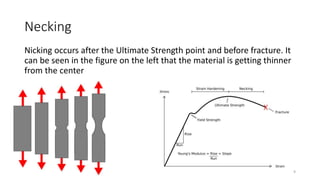
Necking
Nicking occurs after the Ultimate Strength point and before fracture. It
can be seen in the figure on the left that the material is getting thinner
from the center
9
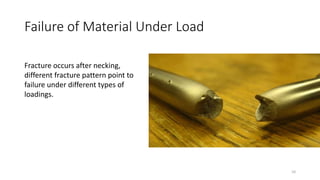
Failure of Material Under Load
Fracture occurs after necking,
different fracture pattern point to
failure under different types of
loadings.
10
Safety Factor
• Engineers always consider a safety factor when designing
• Basic formula is Safety Factor = Material Strength / Working Stress
• A safety factor is different depends on the application
11

Strain strain curve

  • 1.
    An Overview ofThe Stress Strain Curve Omar Bin Mahfodh, B.Eng. 1
  • 2.
    What Is StressStrain Curve • Stress Strain Curve will provide the engineer with information about the response of the material under stress. The response is represented in terms of strain (increase in length). • Why is important? • It helps the engineer to pick the right material for the application 2
  • 3.
    Young's Modulus E=Stress/Strain • Young’sModulus is a property of the material • Stress = Force / Area - Strain = Change of length • Young’s Modulus can be calculated Using the elastic (linear) part of the curve 3
  • 4.
    Elasticity • Reversable deformationin the material • The linear section of the curve is the elastic part • When applying a small load is applied the material will go under a very small deformation and this change is reversable as long as it is in the linear section 4
  • 5.
    Strength • The maximumstress a material can withstand in elastic region What happens when we go over the maximum strength? • Material will go to plastic deformation, plastic is partially or fully irreversible 5
  • 6.
    Strain Hardening Straining thematerial above Yield point and below Ultimate strength 6
  • 7.
    Strain Hardening • Removingthe stress after passing the Yield point, the material will reverse some part of the deformation • The irrevocable portion is Epsilon p and it is about .002 7
  • 8.
    Strain Hardening • Thedashed line from point 3 in the figure shows us that the elastic region got longer, this means that the same material can withstand more more stress in the elastic region. 8
  • 9.
    Necking Nicking occurs afterthe Ultimate Strength point and before fracture. It can be seen in the figure on the left that the material is getting thinner from the center 9
  • 10.
    Failure of MaterialUnder Load Fracture occurs after necking, different fracture pattern point to failure under different types of loadings. 10
  • 11.
    Safety Factor • Engineersalways consider a safety factor when designing • Basic formula is Safety Factor = Material Strength / Working Stress • A safety factor is different depends on the application 11