3.1415926535
INDEX
 Definition of pi
 Approximations of pi
 Circle and pi
 Knowledge of pi in different ancient
civilizations
i. Great pyramid of Giza
ii. Babylonian and Egyptian pi
iii. Pi in India
 Bibliography
Definition of pi
 π is commonly defined as the ratio of
a circle's circumference C to its diameter d
 The ratio C/d is constant, regardless of the
circle's size.
 This definition of π is not universal, because
it is only valid in flat geometry and is not valid
in curved geometries. For this reason, some
mathematicians prefer definitions of π based
on calculus or trigonometry that do not rely
on the circle. One such definition is: π is
twice the smallest positive x for
which cosine(x) equals 0.
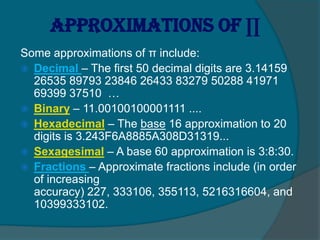
Approximations of ∏
Some approximations of π include:
 Decimal – The first 50 decimal digits are 3.14159
26535 89793 23846 26433 83279 50288 41971
69399 37510 …
 Binary – 11.00100100001111 ....
 Hexadecimal – The base 16 approximation to 20
digits is 3.243F6A8885A308D31319...
 Sexagesimal – A base 60 approximation is 3:8:30.
 Fractions – Approximate fractions include (in order
of increasing
accuracy) 227, 333106, 355113, 5216316604, and
10399333102.
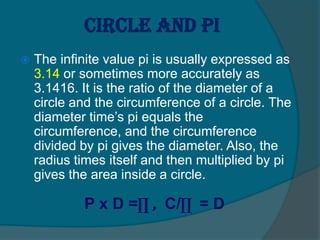
Circle and pi
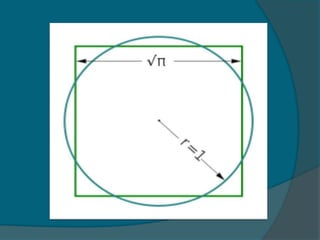
 The infinite value pi is usually expressed as
3.14 or sometimes more accurately as
3.1416. It is the ratio of the diameter of a
circle and the circumference of a circle. The
diameter time’s pi equals the
circumference, and the circumference
divided by pi gives the diameter. Also, the
radius times itself and then multiplied by pi
gives the area inside a circle.
P x D =∏ , C/∏ = D
Knowledge of pi in different
ancient civilizations
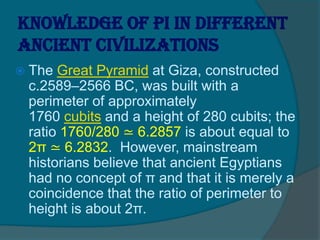
 The Great Pyramid at Giza, constructed
c.2589–2566 BC, was built with a
perimeter of approximately
1760 cubits and a height of 280 cubits; the
ratio 1760/280 ≃ 6.2857 is about equal to
2π ≃ 6.2832. However, mainstream
historians believe that ancient Egyptians
had no concept of π and that it is merely a
coincidence that the ratio of perimeter to
height is about 2π.
Babylonian and Egyptian pi
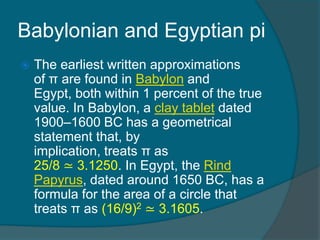
 The earliest written approximations
of π are found in Babylon and
Egypt, both within 1 percent of the true
value. In Babylon, a clay tablet dated
1900–1600 BC has a geometrical
statement that, by
implication, treats π as
25/8 ≃ 3.1250. In Egypt, the Rind
Papyrus, dated around 1650 BC, has a
formula for the area of a circle that
treats π as (16/9)2 ≃ 3.1605.
Pi in India
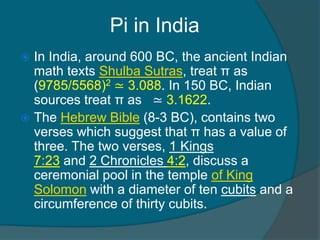
 In India, around 600 BC, the ancient Indian
math texts Shulba Sutras, treat π as
(9785/5568)2 ≃ 3.088. In 150 BC, Indian
sources treat π as ≃ 3.1622.
 The Hebrew Bible (8-3 BC), contains two
verses which suggest that π has a value of
three. The two verses, 1 Kings
7:23 and 2 Chronicles 4:2, discuss a
ceremonial pool in the temple of King
Solomon with a diameter of ten cubits and a
circumference of thirty cubits.
Bibliography
 Wikipedia/pi
 Google.com
 Encyclopedia /DK books
 Ask.com/pi
Pi

Pi

  • 2.
  • 3.
    INDEX  Definition ofpi  Approximations of pi  Circle and pi  Knowledge of pi in different ancient civilizations i. Great pyramid of Giza ii. Babylonian and Egyptian pi iii. Pi in India  Bibliography
  • 4.
    Definition of pi π is commonly defined as the ratio of a circle's circumference C to its diameter d  The ratio C/d is constant, regardless of the circle's size.  This definition of π is not universal, because it is only valid in flat geometry and is not valid in curved geometries. For this reason, some mathematicians prefer definitions of π based on calculus or trigonometry that do not rely on the circle. One such definition is: π is twice the smallest positive x for which cosine(x) equals 0.
  • 6.
    Approximations of ∏ Someapproximations of π include:  Decimal – The first 50 decimal digits are 3.14159 26535 89793 23846 26433 83279 50288 41971 69399 37510 …  Binary – 11.00100100001111 ....  Hexadecimal – The base 16 approximation to 20 digits is 3.243F6A8885A308D31319...  Sexagesimal – A base 60 approximation is 3:8:30.  Fractions – Approximate fractions include (in order of increasing accuracy) 227, 333106, 355113, 5216316604, and 10399333102.
  • 7.
    Circle and pi The infinite value pi is usually expressed as 3.14 or sometimes more accurately as 3.1416. It is the ratio of the diameter of a circle and the circumference of a circle. The diameter time’s pi equals the circumference, and the circumference divided by pi gives the diameter. Also, the radius times itself and then multiplied by pi gives the area inside a circle. P x D =∏ , C/∏ = D
  • 8.
    Knowledge of piin different ancient civilizations  The Great Pyramid at Giza, constructed c.2589–2566 BC, was built with a perimeter of approximately 1760 cubits and a height of 280 cubits; the ratio 1760/280 ≃ 6.2857 is about equal to 2π ≃ 6.2832. However, mainstream historians believe that ancient Egyptians had no concept of π and that it is merely a coincidence that the ratio of perimeter to height is about 2π.
  • 9.
    Babylonian and Egyptianpi  The earliest written approximations of π are found in Babylon and Egypt, both within 1 percent of the true value. In Babylon, a clay tablet dated 1900–1600 BC has a geometrical statement that, by implication, treats π as 25/8 ≃ 3.1250. In Egypt, the Rind Papyrus, dated around 1650 BC, has a formula for the area of a circle that treats π as (16/9)2 ≃ 3.1605.
  • 10.
    Pi in India In India, around 600 BC, the ancient Indian math texts Shulba Sutras, treat π as (9785/5568)2 ≃ 3.088. In 150 BC, Indian sources treat π as ≃ 3.1622.  The Hebrew Bible (8-3 BC), contains two verses which suggest that π has a value of three. The two verses, 1 Kings 7:23 and 2 Chronicles 4:2, discuss a ceremonial pool in the temple of King Solomon with a diameter of ten cubits and a circumference of thirty cubits.
  • 11.
    Bibliography  Wikipedia/pi  Google.com Encyclopedia /DK books  Ask.com/pi