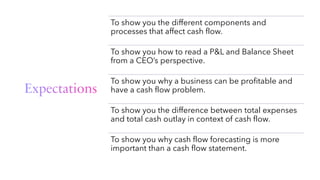
Expectations
To show you the different components and
processes that affect cash flow.
To show you how to read a P&L and Balance Sheet
from a CEO’s perspective.
To show you why a business can be profitable and
have a cash flow problem.

To show you the difference between total expenses
and total cash outlay in context of cash flow.
To show you why cash flow forecasting is more
important than a cash flow statement.
My “War Stories”
(aka “Teachable Moments”)
1st Profound Lesson Learned As a CEO of a $40M Business:
embezzled
My “War Stories”
(aka “Teachable Moments”)
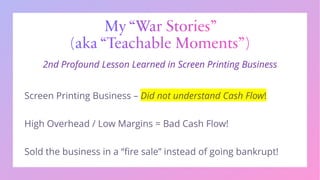
2nd Profound Lesson Learned in Screen Printing Business
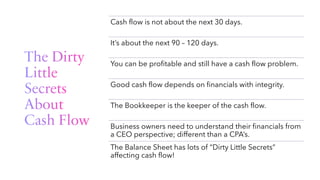
The Dirty
Little
Secrets
About
Cash Flow
Cash flow is not about the next 30 days.
It’s about the next 90 – 120 days.
You can be profitable and still have a cash flow problem.
Good cash flow depends on financials with integrity.
The Bookkeeper is the keeper of the cash flow.
Business owners need to understand their financials from
a CEO perspective; different than a CPA’s.
The Balance Sheet has lots of “Dirty Little Secrets”
affecting cash flow!
Key “PLAYERS” in the Cash Flow Arena
▪
▪
▪
▪
▪
▪
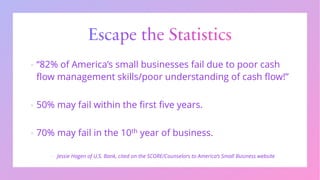
Escape the Statistics
▪ “82% of America’s small businesses fail due to poor cash
flow management skills/poor understanding of cash flow!”
▪ 50% may fail within the first five years.
▪ 70% may fail in the 10th year of business.
▪ Jessie Hagen of U.S. Bank, cited on the SCORE/Counselors to America’s Small Business website
What Does Cash Flow
Mean to You?
Cash Flow is the
movement of money
into and out of a
business.
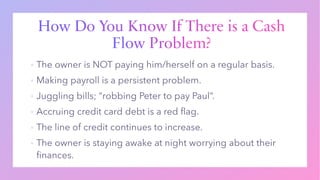
How Do You Know If There is a Cash
Flow Problem?
▪
▪
▪
▪
▪
▪
The Bookkeeper is the Keeper of the Cash Flow
It’s a business function that is given the least amount of attention.
This person is responsible for following the $ in to the business (A/R), and for
following the $ out of the business (A/P).
The financial reports are based on the accuracy of the bookkeeper’s
activities.
Simply put:
The Bookkeeper’s role is to record the
day-to-day financial transactions.
Always follow the
$....
Be sure the bookkeeper is doing
monthly bank reconciliations for:
1. All Bank Statements
2. All Credit Card Statements
3. All Loan Statements
4. All Lines of Credit Statements
Numbers
With
Integrity……
Bookkeeper to provide Reconciliation
reports.
Balance Sheet – Look there for end of
month balances for bank accounts, loan
statements, and credit card balances.
Do not CO_MINGLE personal and
business money.
Protect Your Money
▪ Does the owner sign their own checks?
▪ Is online banking used to pay bills?
▪ Does the owner review monthly bank
and credit card statements?
▪ What checks and balances has the
bookkeeper put into place to be
accountable?
CPA’s….
Their Main Purpose is
Tax Compliance.
CPAs …
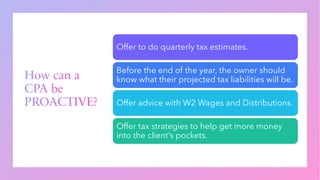
How can a
CPA be
PROACTIVE?
Offer to do quarterly tax estimates.
Before the end of the year, the owner should
know what their projected tax liabilities will be.
Offer advice with W2 Wages and Distributions.
Offer tax strategies to help get more money
into the client’s pockets.
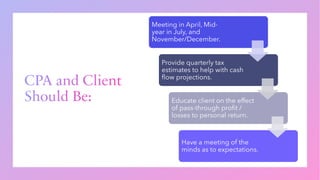
CPA and Client
Should Be:
Meeting in April, Mid-
year in July, and
November/December.
Provide quarterly tax
estimates to help with cash
flow projections.
Educate client on the effect
of pass-through profit /
losses to personal return.
Have a meeting of the
minds as to expectations.
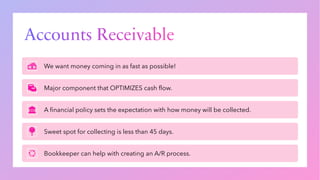
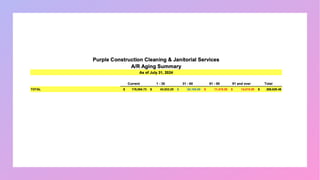
Accounts Receivable
We want money coming in as fast as possible!
Major component that OPTIMIZES cash flow.
A financial policy sets the expectation with how money will be collected.
Sweet spot for collecting is less than 45 days.
Bookkeeper can help with creating an A/R process.
Ask For Money
Owed
▪
▪
▪
▪
▪
▪
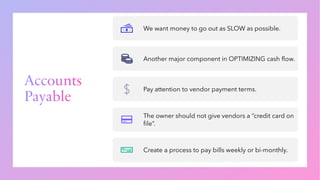
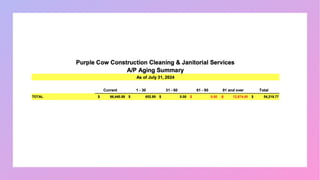
Accounts
Payable
We want money to go out as SLOW as possible.
Another major component in OPTIMIZING cash flow.
Pay attention to vendor payment terms.
The owner should not give vendors a “credit card on
file”.
Create a process to pay bills weekly or bi-monthly.
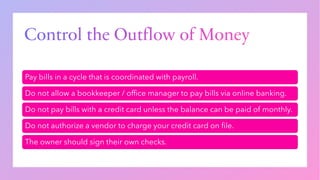
Control the Outflow of Money
Pay bills in a cycle that is coordinated with payroll.
Do not allow a bookkeeper / office manager to pay bills via online banking.
Do not pay bills with a credit card unless the balance can be paid of monthly.
Do not authorize a vendor to charge your credit card on file.
The owner should sign their own checks.
What is the best place to
see how much money is
currently available to pay
bills?
▪ Is it the online bank account?
▪ Is it the profit and loss statement?
▪ Is it the balance sheet?
▪ Is it the check book register?
▪ Is it from memory?
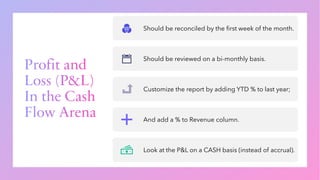
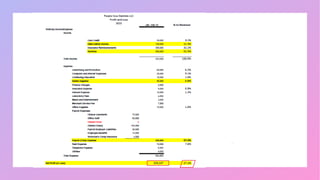
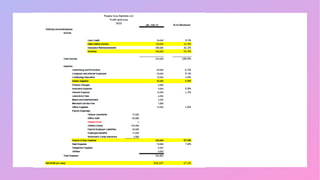
Profit and
Loss (P&L)
In the Cash
Flow Arena
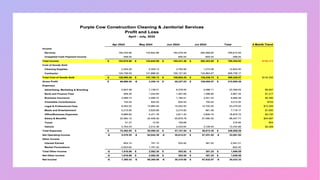
Should be reconciled by the first week of the month.
Should be reviewed on a bi-monthly basis.
Customize the report by adding YTD % to last year;
And add a % to Revenue column.
Look at the P&L on a CASH basis (instead of accrual).
The Owner
Needs to Know
Their Numbers.
P&L Statement
▪ The owner needs to know what their
financial story is.
▪ What is the Cost of Goods & to Revenue?
▪ What is the Payroll % to Revenue?
▪ What is the Net Profit % to Revenue?
▪ The Bookkeeper should create the Chart
of Accounts to be viewed as a REPORT
CARD.
Tax Strategies VS Cash Flow Strategies
Cash Flow Consultant
Goal is to maximize
net profits for
better CASH FLOW
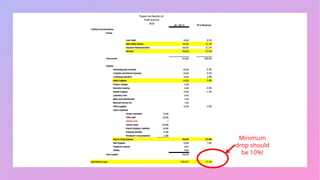
Minimum
drop should
be 10%!
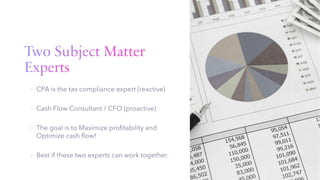
Two Subject Matter
Experts
▪
▪
▪
▪
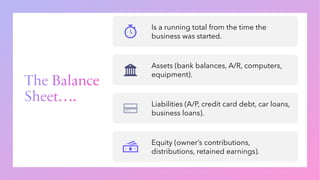
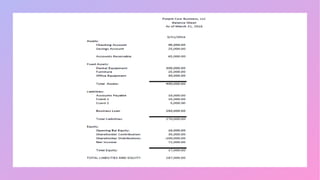
The Balance
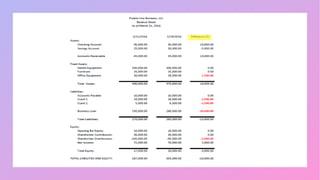
Sheet….
Is a running total from the time the
business was started.
Assets (bank balances, A/R, computers,
equipment).
Liabilities (A/P, credit card debt, car loans,
business loans).
Equity (owner’s contributions,
distributions, retained earnings).
Why the
Balance
Sheet is
Important?
There are lots of “dirty little secrets” on this
statement!
It records money coming in and out of the
business that has little to do with profitability.
It’s one of the most misunderstood financial
document by a business owner.
Always print the balance sheet on an accrual
basis.
Debt Servicing
▪
▪
▪
▪
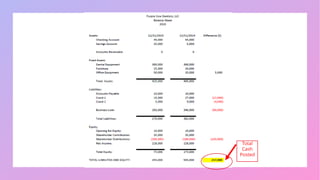
Now let’s look at what
$ is posted on the
Balance Sheet…..
▪ What is the change in the cash
position (cash reserves)?
▪ Fixed asset purchases.
▪ Loan payments.
▪ Credit card activity.
▪ Owner distributions / contributions.
Total
Cash
Posted
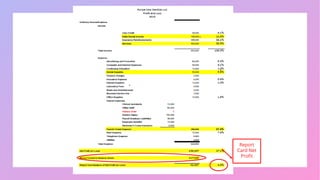
Report
Card Net
Profit
Cash Flow
Forecasting
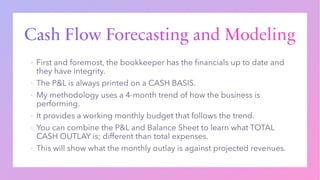
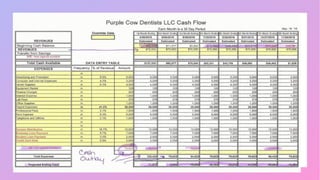
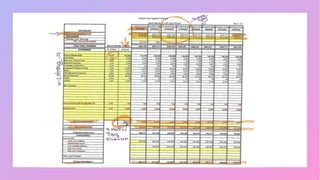
Cash Flow Forecasting and Modeling
▪
▪
▪
▪
▪
▪
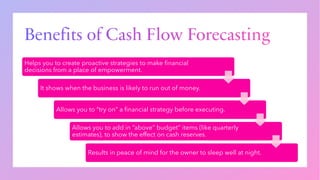
Benefits of Cash Flow Forecasting
Helps you to create proactive strategies to make financial
decisions from a place of empowerment.
It shows when the business is likely to run out of money.
Allows you to “try on” a financial strategy before executing.
Allows you to add in “above” budget” items (like quarterly
estimates), to show the effect on cash reserves.
Results in peace of mind for the owner to sleep well at night.
“What if?”
Empowerment & Peace of Mind
Trusted Financial Advisors
It take a team of subject matter experts!
▪
▪
▪
▪
▪
▪
▪
What can you do to add
value to the services you
are providing?
Cash Flow Secrets Every Upskilled CPA Should Know

Cash Flow Secrets Every Upskilled CPA Should Know

  • 5.
    Expectations To show youthe different components and processes that affect cash flow. To show you how to read a P&L and Balance Sheet from a CEO’s perspective. To show you why a business can be profitable and have a cash flow problem. To show you the difference between total expenses and total cash outlay in context of cash flow. To show you why cash flow forecasting is more important than a cash flow statement.
  • 6.
    My “War Stories” (aka“Teachable Moments”) 1st Profound Lesson Learned As a CEO of a $40M Business: embezzled
  • 7.
    My “War Stories” (aka“Teachable Moments”) 2nd Profound Lesson Learned in Screen Printing Business
  • 8.
    The Dirty Little Secrets About Cash Flow Cashflow is not about the next 30 days. It’s about the next 90 – 120 days. You can be profitable and still have a cash flow problem. Good cash flow depends on financials with integrity. The Bookkeeper is the keeper of the cash flow. Business owners need to understand their financials from a CEO perspective; different than a CPA’s. The Balance Sheet has lots of “Dirty Little Secrets” affecting cash flow!
  • 9.
    Key “PLAYERS” inthe Cash Flow Arena ▪ ▪ ▪ ▪ ▪ ▪
  • 10.
    Escape the Statistics ▪“82% of America’s small businesses fail due to poor cash flow management skills/poor understanding of cash flow!” ▪ 50% may fail within the first five years. ▪ 70% may fail in the 10th year of business. ▪ Jessie Hagen of U.S. Bank, cited on the SCORE/Counselors to America’s Small Business website
  • 11.
    What Does CashFlow Mean to You? Cash Flow is the movement of money into and out of a business.
  • 12.
    How Do YouKnow If There is a Cash Flow Problem? ▪ ▪ ▪ ▪ ▪ ▪
  • 14.
    The Bookkeeper isthe Keeper of the Cash Flow It’s a business function that is given the least amount of attention. This person is responsible for following the $ in to the business (A/R), and for following the $ out of the business (A/P). The financial reports are based on the accuracy of the bookkeeper’s activities. Simply put: The Bookkeeper’s role is to record the day-to-day financial transactions.
  • 15.
    Always follow the $.... Besure the bookkeeper is doing monthly bank reconciliations for: 1. All Bank Statements 2. All Credit Card Statements 3. All Loan Statements 4. All Lines of Credit Statements
  • 16.
    Numbers With Integrity…… Bookkeeper to provideReconciliation reports. Balance Sheet – Look there for end of month balances for bank accounts, loan statements, and credit card balances. Do not CO_MINGLE personal and business money.
  • 17.
    Protect Your Money ▪Does the owner sign their own checks? ▪ Is online banking used to pay bills? ▪ Does the owner review monthly bank and credit card statements? ▪ What checks and balances has the bookkeeper put into place to be accountable?
  • 19.
  • 21.
  • 22.
    How can a CPAbe PROACTIVE? Offer to do quarterly tax estimates. Before the end of the year, the owner should know what their projected tax liabilities will be. Offer advice with W2 Wages and Distributions. Offer tax strategies to help get more money into the client’s pockets.
  • 23.
    CPA and Client ShouldBe: Meeting in April, Mid- year in July, and November/December. Provide quarterly tax estimates to help with cash flow projections. Educate client on the effect of pass-through profit / losses to personal return. Have a meeting of the minds as to expectations.
  • 25.
    Accounts Receivable We wantmoney coming in as fast as possible! Major component that OPTIMIZES cash flow. A financial policy sets the expectation with how money will be collected. Sweet spot for collecting is less than 45 days. Bookkeeper can help with creating an A/R process.
  • 27.
  • 29.
    Accounts Payable We want moneyto go out as SLOW as possible. Another major component in OPTIMIZING cash flow. Pay attention to vendor payment terms. The owner should not give vendors a “credit card on file”. Create a process to pay bills weekly or bi-monthly.
  • 30.
    Control the Outflowof Money Pay bills in a cycle that is coordinated with payroll. Do not allow a bookkeeper / office manager to pay bills via online banking. Do not pay bills with a credit card unless the balance can be paid of monthly. Do not authorize a vendor to charge your credit card on file. The owner should sign their own checks.
  • 32.
    What is thebest place to see how much money is currently available to pay bills? ▪ Is it the online bank account? ▪ Is it the profit and loss statement? ▪ Is it the balance sheet? ▪ Is it the check book register? ▪ Is it from memory?
  • 34.
    Profit and Loss (P&L) Inthe Cash Flow Arena Should be reconciled by the first week of the month. Should be reviewed on a bi-monthly basis. Customize the report by adding YTD % to last year; And add a % to Revenue column. Look at the P&L on a CASH basis (instead of accrual).
  • 35.
    The Owner Needs toKnow Their Numbers.
  • 36.
    P&L Statement ▪ Theowner needs to know what their financial story is. ▪ What is the Cost of Goods & to Revenue? ▪ What is the Payroll % to Revenue? ▪ What is the Net Profit % to Revenue? ▪ The Bookkeeper should create the Chart of Accounts to be viewed as a REPORT CARD.
  • 38.
    Tax Strategies VSCash Flow Strategies Cash Flow Consultant Goal is to maximize net profits for better CASH FLOW
  • 40.
  • 41.
  • 43.
    The Balance Sheet…. Is arunning total from the time the business was started. Assets (bank balances, A/R, computers, equipment). Liabilities (A/P, credit card debt, car loans, business loans). Equity (owner’s contributions, distributions, retained earnings).
  • 45.
    Why the Balance Sheet is Important? Thereare lots of “dirty little secrets” on this statement! It records money coming in and out of the business that has little to do with profitability. It’s one of the most misunderstood financial document by a business owner. Always print the balance sheet on an accrual basis.
  • 47.
  • 50.
    Now let’s lookat what $ is posted on the Balance Sheet….. ▪ What is the change in the cash position (cash reserves)? ▪ Fixed asset purchases. ▪ Loan payments. ▪ Credit card activity. ▪ Owner distributions / contributions.
  • 51.
  • 52.
  • 53.
  • 55.
    Cash Flow Forecastingand Modeling ▪ ▪ ▪ ▪ ▪ ▪
  • 59.
    Benefits of CashFlow Forecasting Helps you to create proactive strategies to make financial decisions from a place of empowerment. It shows when the business is likely to run out of money. Allows you to “try on” a financial strategy before executing. Allows you to add in “above” budget” items (like quarterly estimates), to show the effect on cash reserves. Results in peace of mind for the owner to sleep well at night.
  • 60.
  • 61.
    Trusted Financial Advisors Ittake a team of subject matter experts! ▪ ▪ ▪ ▪ ▪ ▪ ▪ What can you do to add value to the services you are providing?