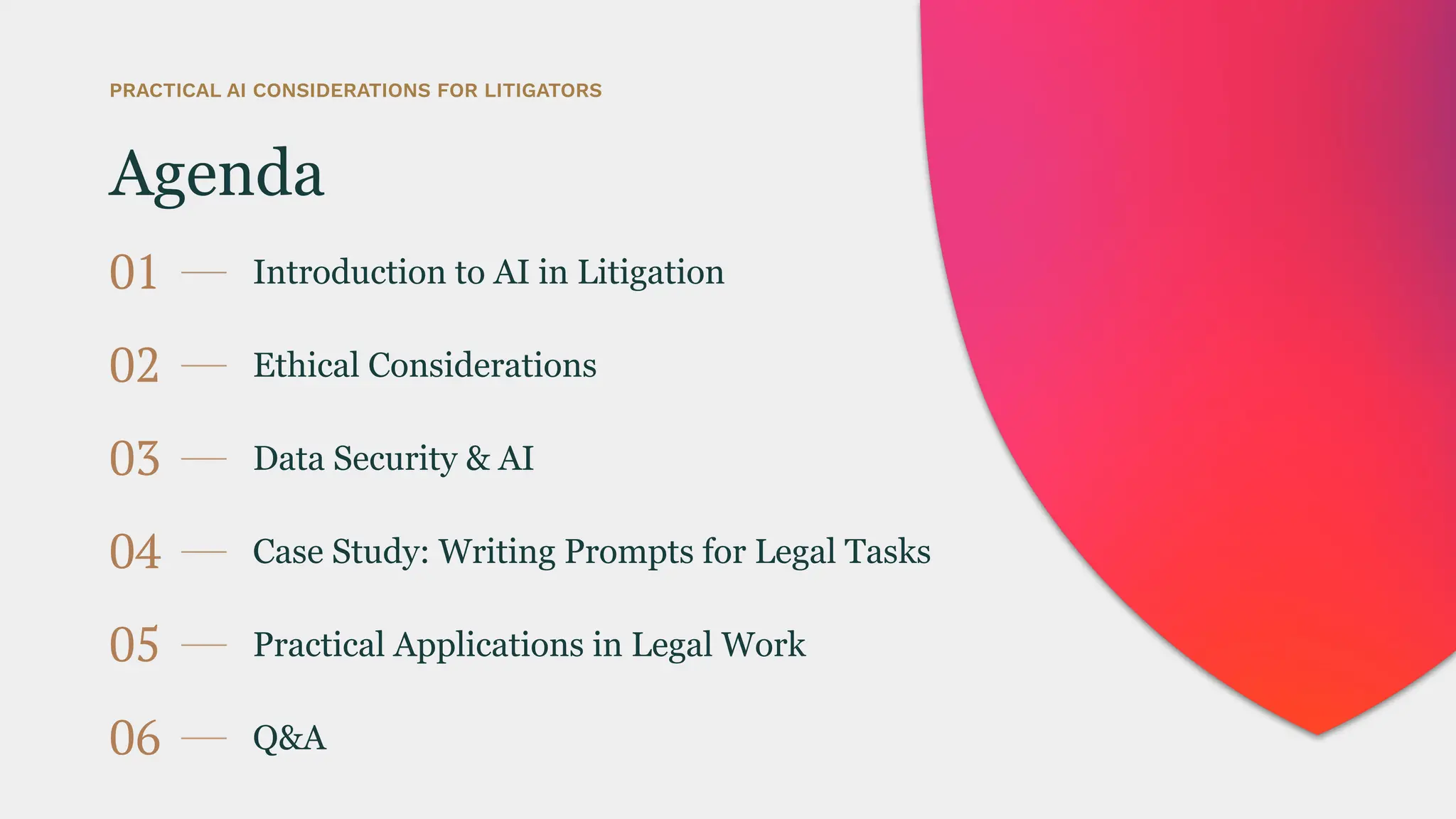
Agenda
01 Introduction to AI in Litigation
PRACTICAL AI CONSIDERATIONS FOR LITIGATORS
02 Ethical Considerations
03 Data Security & AI
04 Case Study: Writing Prompts for Legal Tasks
05 Practical Applications in Legal Work
06 Q&A
Intro:
AI in Litigation
MARCH 2023 | PRIVATE & CONFIDENTIAL
● AI is a computer system trained on large amounts of data that
can recognize patterns, process language, and generate responses
to accomplish specific tasks.
● AI doesn't "think" like humans - it predicts patterns based on its
training. It cannot truly understand or reason like humans do
● AI systems should be used to enhance, not replace, human
decision-making. It requires clear context and guidance to provide
relevant, accurate responses.
● AI can be trained on user data. Always check the Terms and
Conditions for any AI before inputting sensitive information.
● General AI vs Legal AI: General AI is not designed to handle
industry-specific tasks. Even something simple, like a correctly
formatted transcript could confuse it.
Artificial Intelligence is changing the world at scale and rapidly.
But most people don’t know how it works. Here are the
headlines:
What is AI?
PRACTICAL AI CONSIDERATIONS FOR LITIGATORS
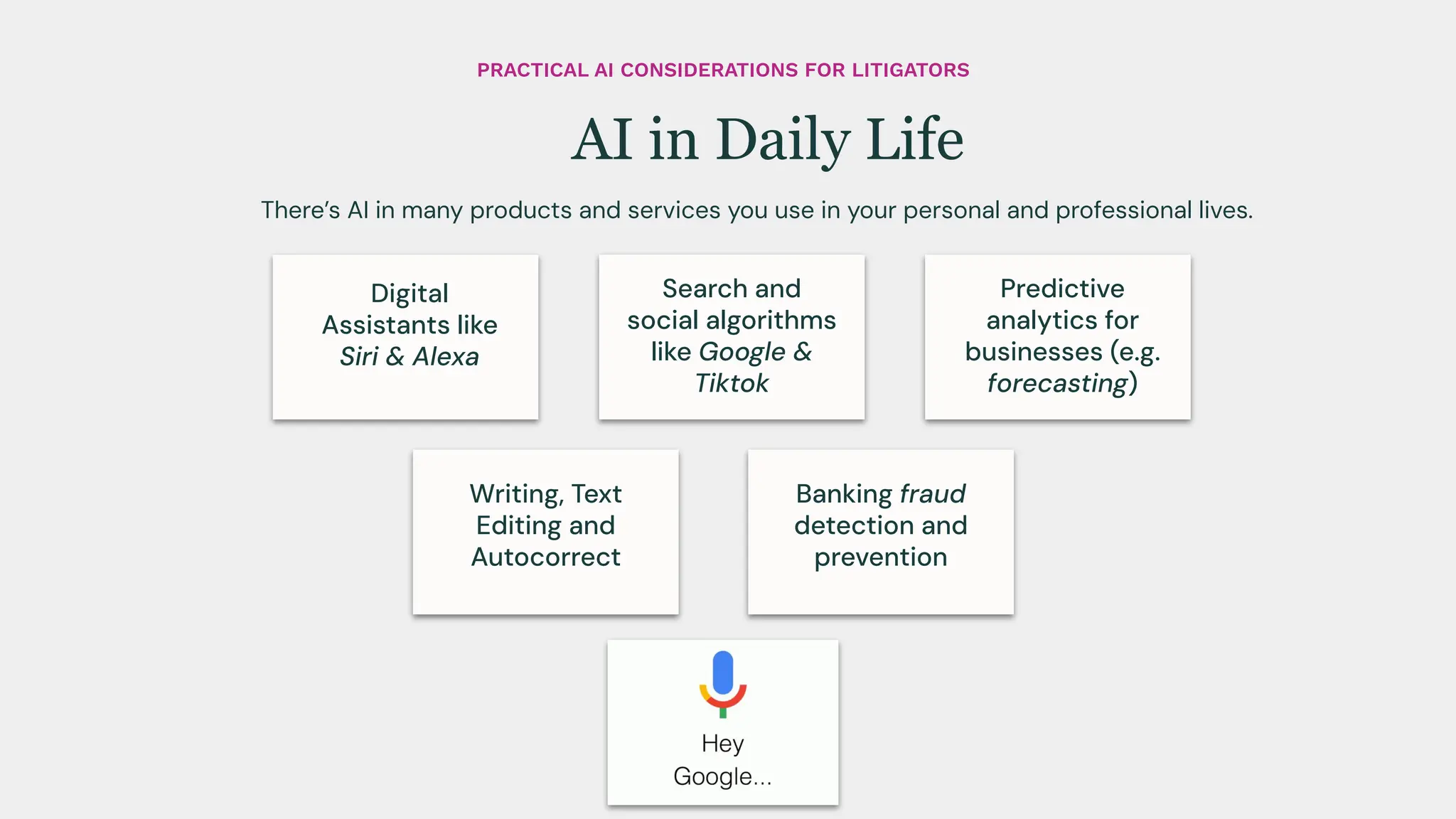
There’s AI in many products and services you use in your personal and professional lives.
AI in Daily Life
Digital
Assistants like
Siri & Alexa
Predictive
analytics for
businesses (e.g.
forecasting)
Writing, Text
Editing and
Autocorrect
PRACTICAL AI CONSIDERATIONS FOR LITIGATORS
Search and
social algorithms
like Google &
Tiktok
Banking fraud
detection and
prevention
● E-Discovery: AI-powered document review and analysis
● Legal Research: Faster case law and statute searching
● Contract Generation and Analysis: Identifying key
clauses and potential risks
● Predictive Analytics: Case outcome prediction and
strategy development
● Transcript Analysis: Transcript summaries and
interrogation
Artificial Intelligence is transforming various aspects of
litigation, from document review to case strategy.
AI in Litigation
PRACTICAL AI CONSIDERATIONS FOR LITIGATORS
AI does not replace attorneys.
It enhances their expertise by reducing manual work,
thus freeing up time to focus on analysis, strategy
and tactics. It makes the best attorneys even better.
PRACTICAL AI CONSIDERATIONS FOR LITIGATORS
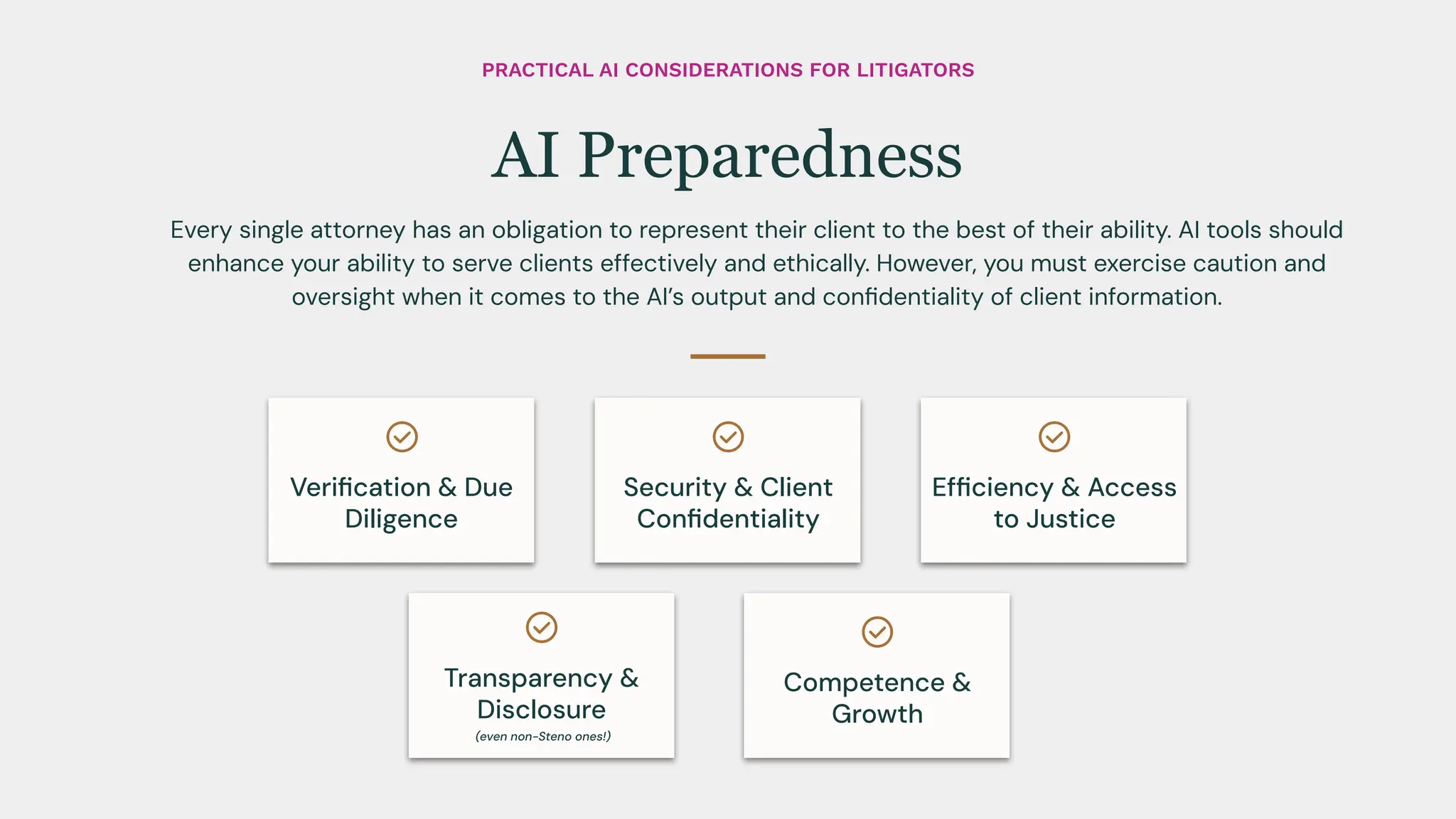
Every single attorney has an obligation to represent their client to the best of their ability. AI tools should
enhance your ability to serve clients effectively and ethically. However, you must exercise caution and
oversight when it comes to the AI’s output and confidentiality of client information.
AI Preparedness
Verification & Due
Diligence
Security & Client
Confidentiality
Competence &
Growth
Efficiency & Access
to Justice
Transparency &
Disclosure
(even non-Steno ones!)
PRACTICAL AI CONSIDERATIONS FOR LITIGATORS
Ethical Considerations
MARCH 2023 | PRIVATE & CONFIDENTIAL
● This duty requires lawyers to exercise the “legal knowledge, skill,
thoroughness and preparation reasonably necessary for the
representation,” as well as to understand “the benefits and risks
associated” with the technologies used to deliver legal services to clients.
● Lawyers may ordinarily achieve the requisite level of competency by
engaging in self-study, associating with another competent lawyer, or
consulting with an individual who has sufficient expertise in the relevant
field.
Model Rule 1.1 obligates lawyers to provide competent
representation to clients.
ABA Model Rule 1.1
PRACTICAL AI CONSIDERATIONS FOR LITIGATORS
Source: American Bar Association
● The duty asks for a reasonable understanding, not full technical
competence.
● Lawyers can draw on the expertise of those who can provide
guidance.
● The duty is not static and relies on the attorney to pro actively remain
aware and vigilant.
Further the ABA’s recent opinion of July 29, 2024 reminds attorneys
that they have a duty of competence in using generative AI under
Model Rule 1.1 which requires both legal and technical competence.
ABA Model Rule 1.1
PRACTICAL AI CONSIDERATIONS FOR LITIGATORS
Data, Security & AI
MARCH 2023 | PRIVATE & CONFIDENTIAL
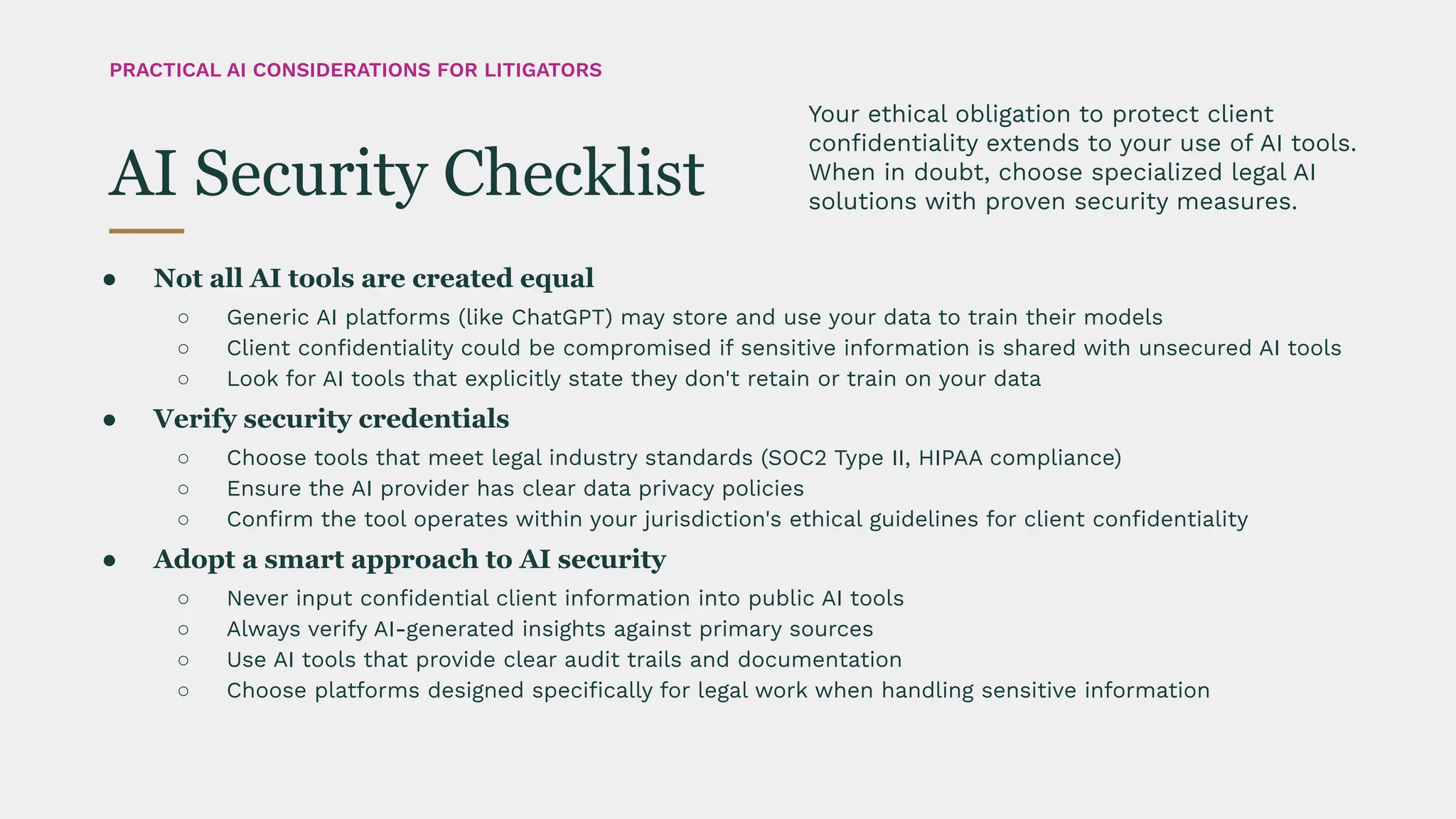
● Not all AI tools are created equal
○ Generic AI platforms (like ChatGPT) may store and use your data to train their models
○ Client confidentiality could be compromised if sensitive information is shared with unsecured AI tools
○ Look for AI tools that explicitly state they don't retain or train on your data
● Verify security credentials
○ Choose tools that meet legal industry standards (SOC2 Type II, HIPAA compliance)
○ Ensure the AI provider has clear data privacy policies
○ Confirm the tool operates within your jurisdiction's ethical guidelines for client confidentiality
● Adopt a smart approach to AI security
○ Never input confidential client information into public AI tools
○ Always verify AI-generated insights against primary sources
○ Use AI tools that provide clear audit trails and documentation
○ Choose platforms designed specifically for legal work when handling sensitive information
Your ethical obligation to protect client
confidentiality extends to your use of AI tools.
When in doubt, choose specialized legal AI
solutions with proven security measures.
AI Security Checklist
PRACTICAL AI CONSIDERATIONS FOR LITIGATORS
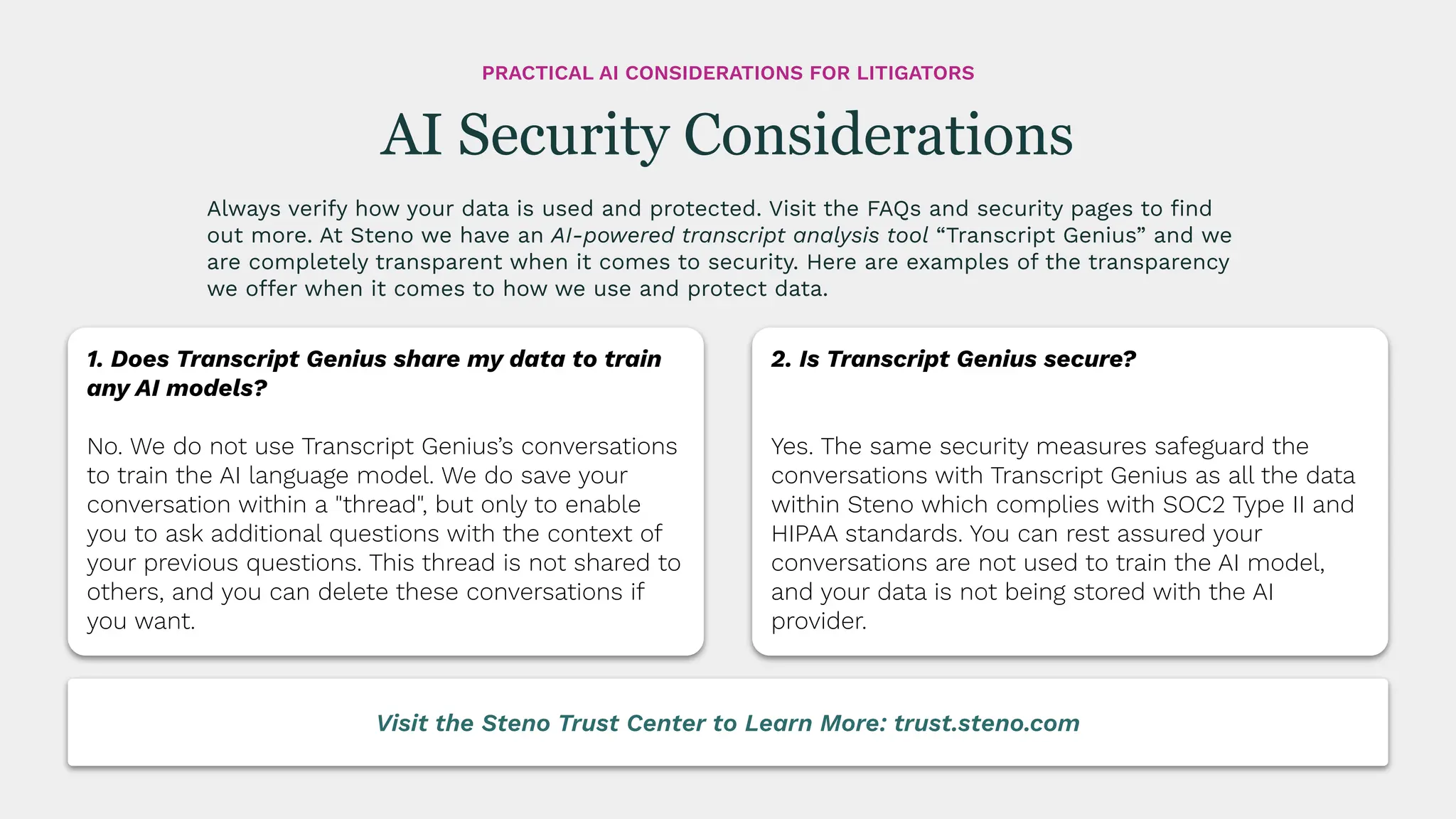
Always verify how your data is used and protected. Visit the FAQs and security pages to find
out more. At Steno we have an AI-powered transcript analysis tool “Transcript Genius” and we
are completely transparent when it comes to security. Here are examples of the transparency
we offer when it comes to how we use and protect data.
AI Security Considerations
PRACTICAL AI CONSIDERATIONS FOR LITIGATORS
1. Does Transcript Genius share my data to train
any AI models?
No. We do not use Transcript Genius’s conversations
to train the AI language model. We do save your
conversation within a "thread", but only to enable
you to ask additional questions with the context of
your previous questions. This thread is not shared to
others, and you can delete these conversations if
you want.
2. Is Transcript Genius secure?
Yes. The same security measures safeguard the
conversations with Transcript Genius as all the data
within Steno which complies with SOC2 Type II and
HIPAA standards. You can rest assured your
conversations are not used to train the AI model,
and your data is not being stored with the AI
provider.
Visit the Steno Trust Center to Learn More: trust.steno.com
Case Study:
Writing AI Prompts
MARCH 2023 | PRIVATE & CONFIDENTIAL
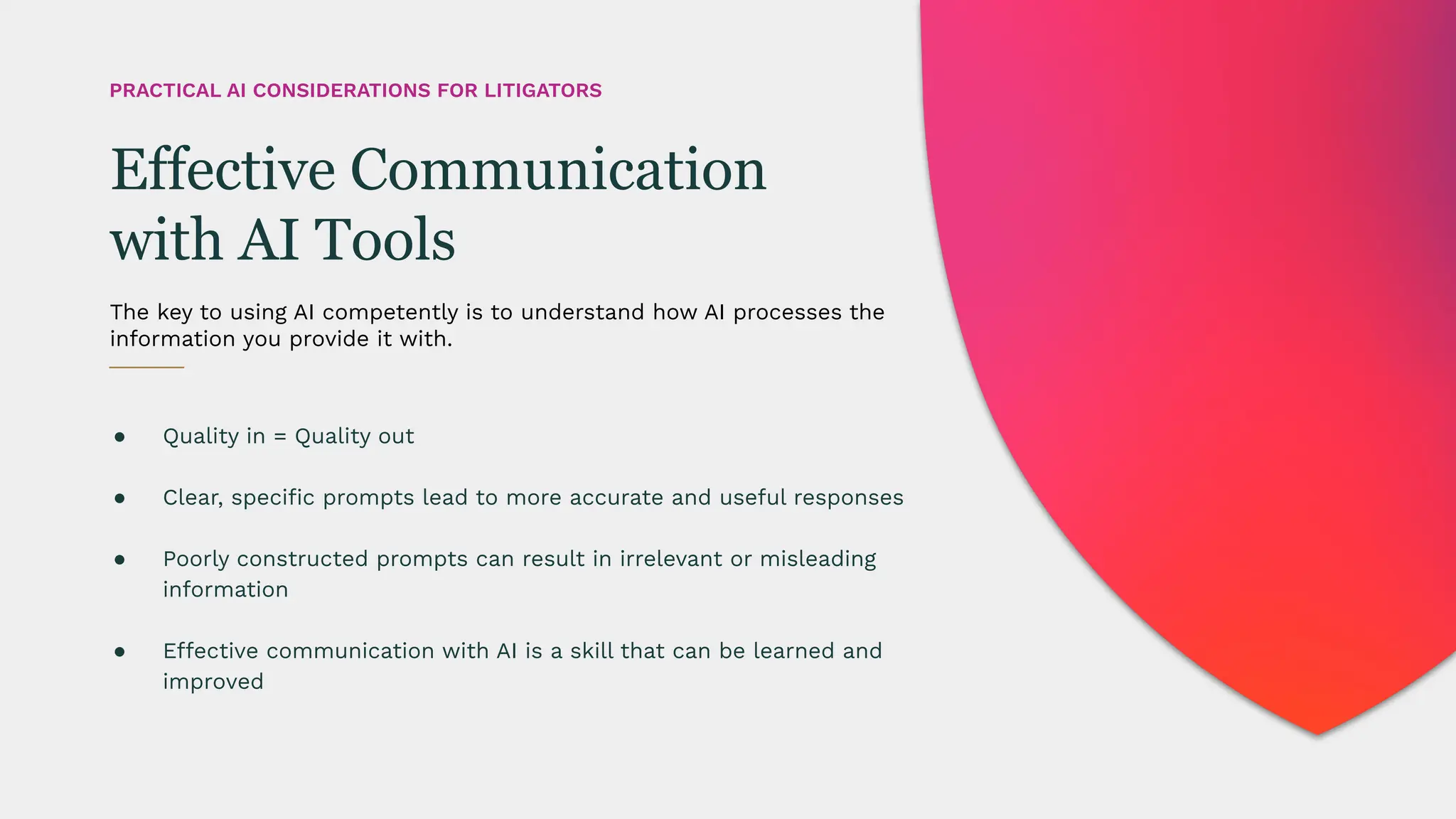
● Quality in = Quality out
● Clear, specific prompts lead to more accurate and useful responses
● Poorly constructed prompts can result in irrelevant or misleading
information
● Effective communication with AI is a skill that can be learned and
improved
The key to using AI competently is to understand how AI processes the
information you provide it with.
Effective Communication
with AI Tools
PRACTICAL AI CONSIDERATIONS FOR LITIGATORS
● A prompt is the input or question given to an AI system
● It guides the AI's response and output
● Can range from simple questions to complex
instructions
● The foundation of interaction with AI tools
Every time you ask AI to do something, you are
“prompting” it. The messages you send it are called
“prompts”.
What is a Prompt?
PRACTICAL AI CONSIDERATIONS FOR LITIGATORS
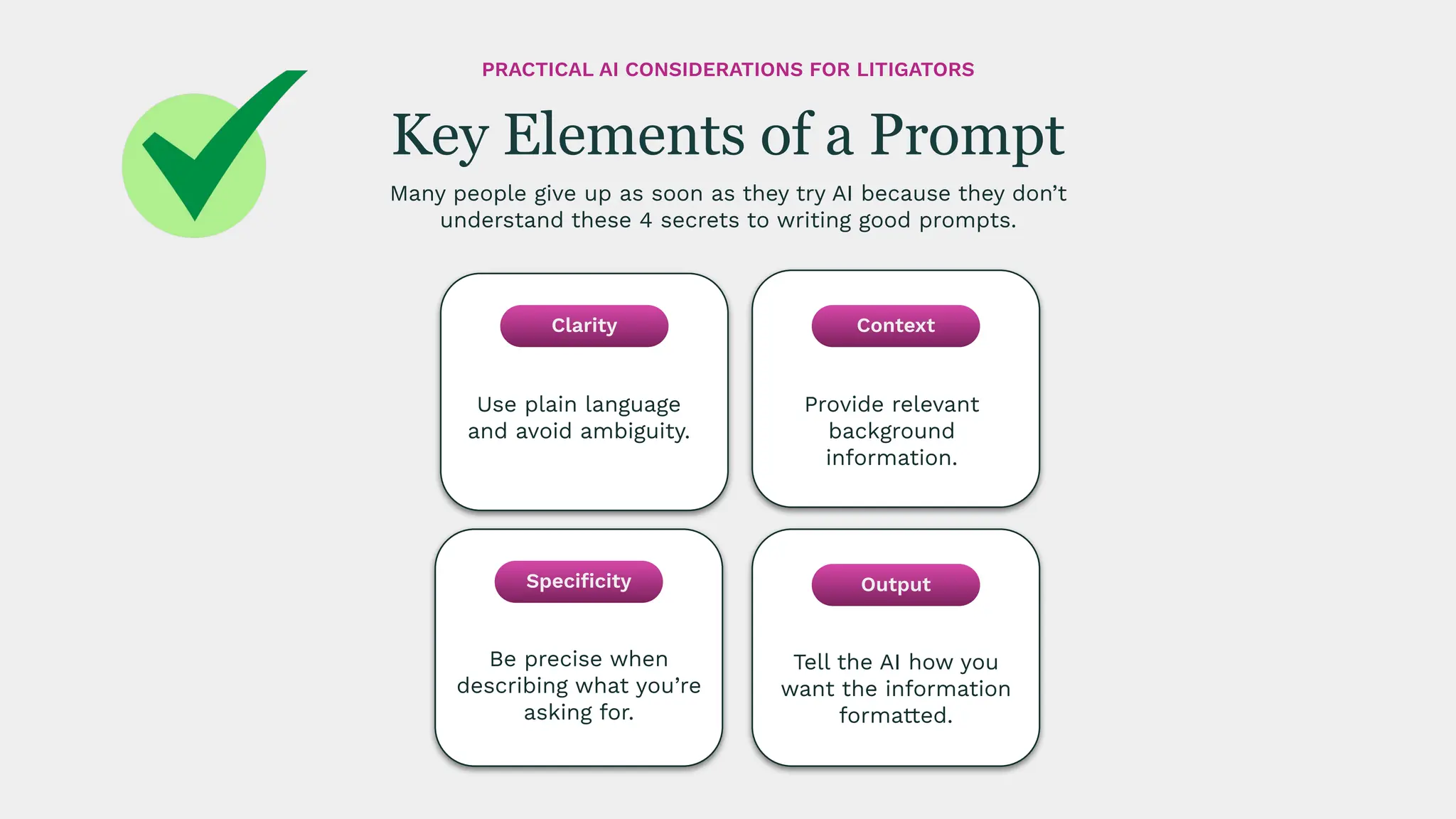
Provide relevant
background
information.
Tell the AI how you
want the information
formatted.
Be precise when
describing what you’re
asking for.
Use plain language
and avoid ambiguity.
Many people give up as soon as they try AI because they don’t
understand these 4 secrets to writing good prompts.
Key Elements of a Prompt
PRACTICAL AI CONSIDERATIONS FOR LITIGATORS
Clarity
Specificity
Context
Output
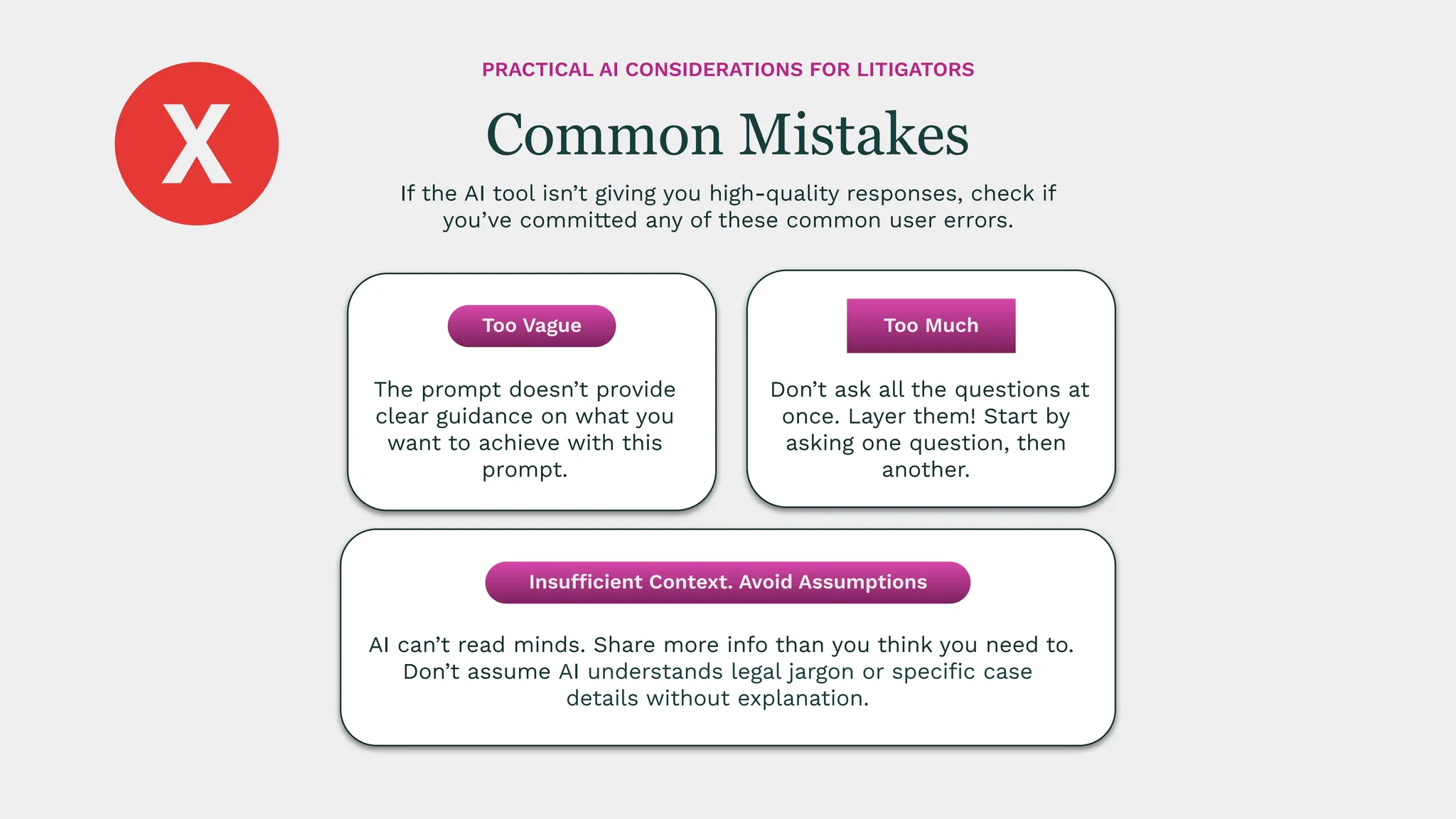
Don’t ask all the questions at
once. Layer them! Start by
asking one question, then
another.
AI can’t read minds. Share more info than you think you need to.
Don’t assume AI understands legal jargon or specific case
details without explanation.
The prompt doesn’t provide
clear guidance on what you
want to achieve with this
prompt.
If the AI tool isn’t giving you high-quality responses, check if
you’ve committed any of these common user errors.
Common Mistakes
PRACTICAL AI CONSIDERATIONS FOR LITIGATORS
Too Vague
Insufficient Context. Avoid Assumptions
Too Much
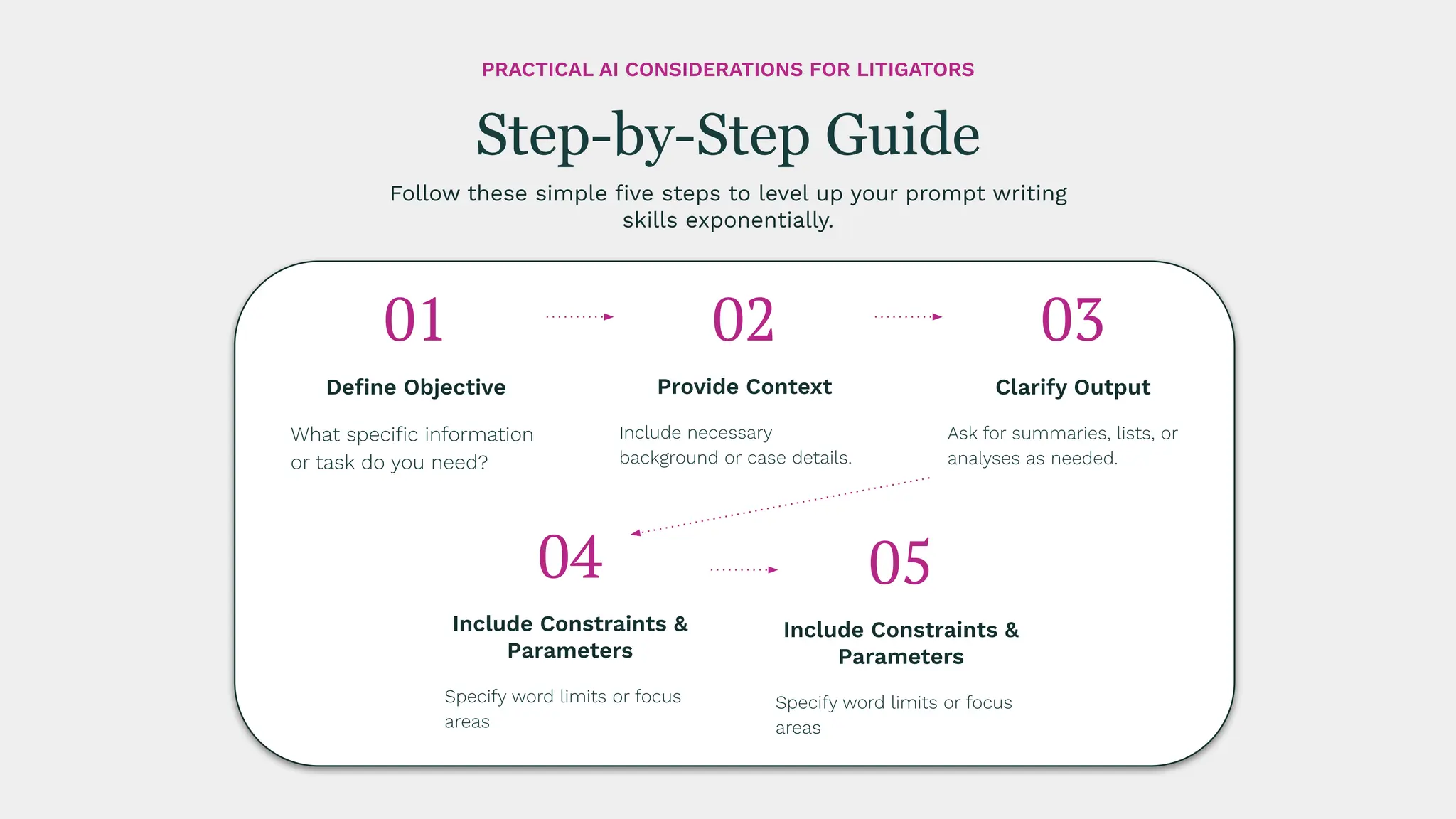
Clarify Output
Ask for summaries, lists, or
analyses as needed.
Provide Context
Include necessary
background or case details.
Include Constraints &
Parameters
Specify word limits or focus
areas
Define Objective
What specific information
or task do you need?
01 02 03
04
Follow these simple five steps to level up your prompt writing
skills exponentially.
Step-by-Step Guide
PRACTICAL AI CONSIDERATIONS FOR LITIGATORS
Include Constraints &
Parameters
Specify word limits or focus
areas
05
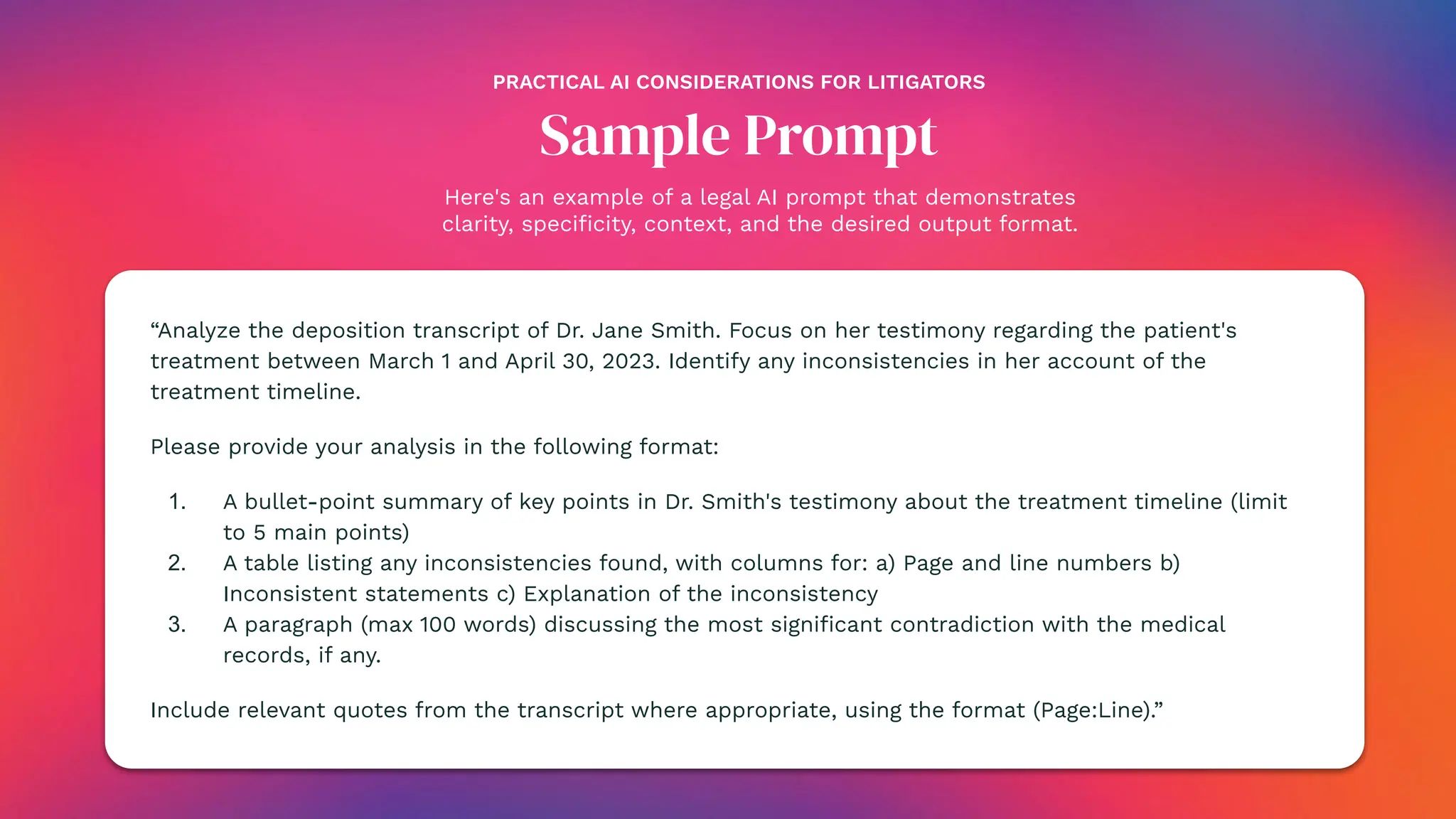
Here's an example of a legal AI prompt that demonstrates
clarity, specificity, context, and the desired output format.
Sample Prompt
“Analyze the deposition transcript of Dr. Jane Smith. Focus on her testimony regarding the patient's
treatment between March 1 and April 30, 2023. Identify any inconsistencies in her account of the
treatment timeline.
Please provide your analysis in the following format:
1. A bullet-point summary of key points in Dr. Smith's testimony about the treatment timeline (limit
to 5 main points)
2. A table listing any inconsistencies found, with columns for: a) Page and line numbers b)
Inconsistent statements c) Explanation of the inconsistency
3. A paragraph (max 100 words) discussing the most significant contradiction with the medical
records, if any.
Include relevant quotes from the transcript where appropriate, using the format (Page:Line).”
PRACTICAL AI CONSIDERATIONS FOR LITIGATORS
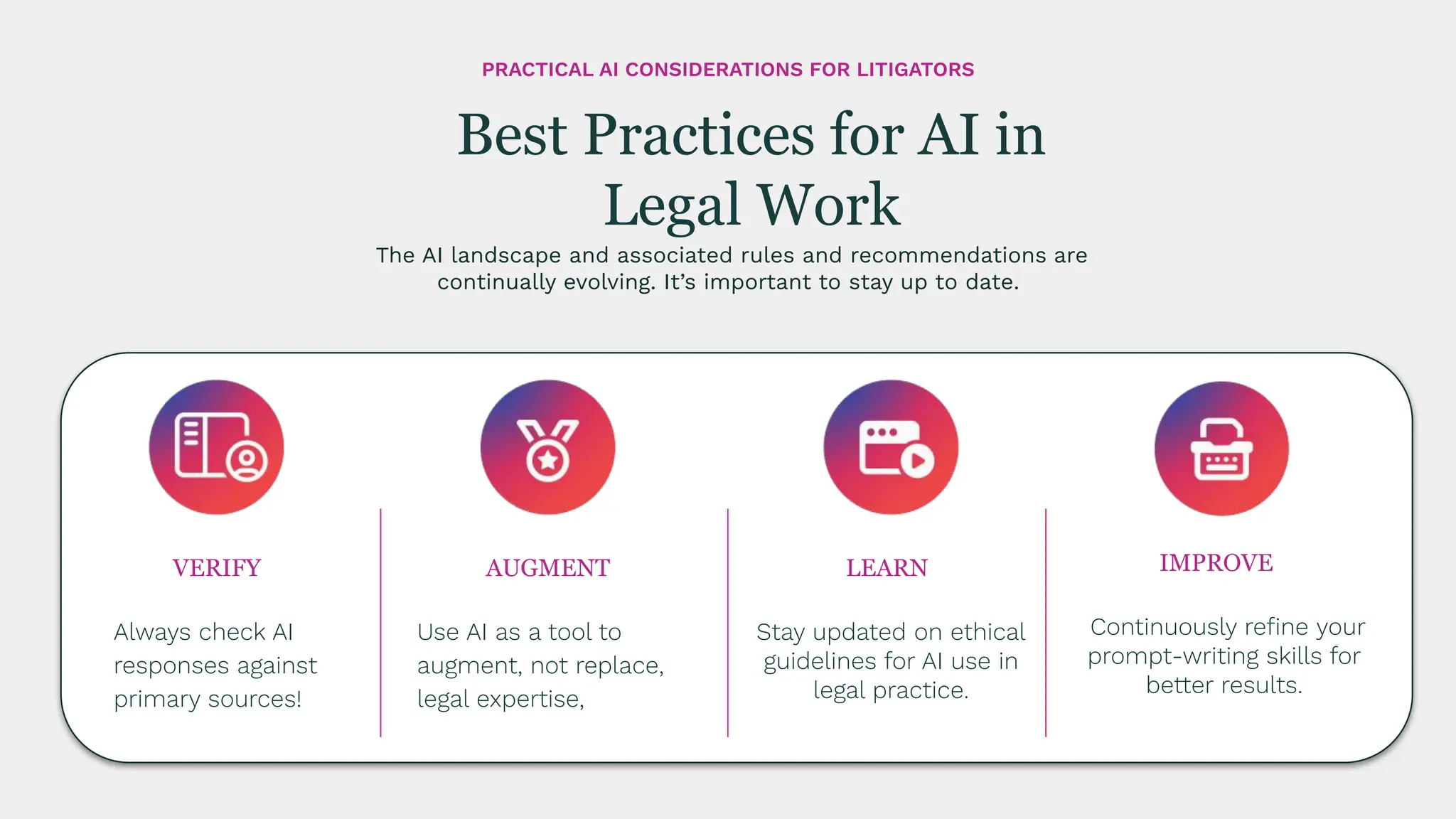
Always check AI
responses against
primary sources!
VERIFY
The AI landscape and associated rules and recommendations are
continually evolving. It’s important to stay up to date.
Best Practices for AI in
Legal Work
PRACTICAL AI CONSIDERATIONS FOR LITIGATORS
Use AI as a tool to
augment, not replace,
legal expertise,
AUGMENT
Stay updated on ethical
guidelines for AI use in
legal practice.
LEARN
Continuously refine your
prompt-writing skills for
better results.
IMPROVE
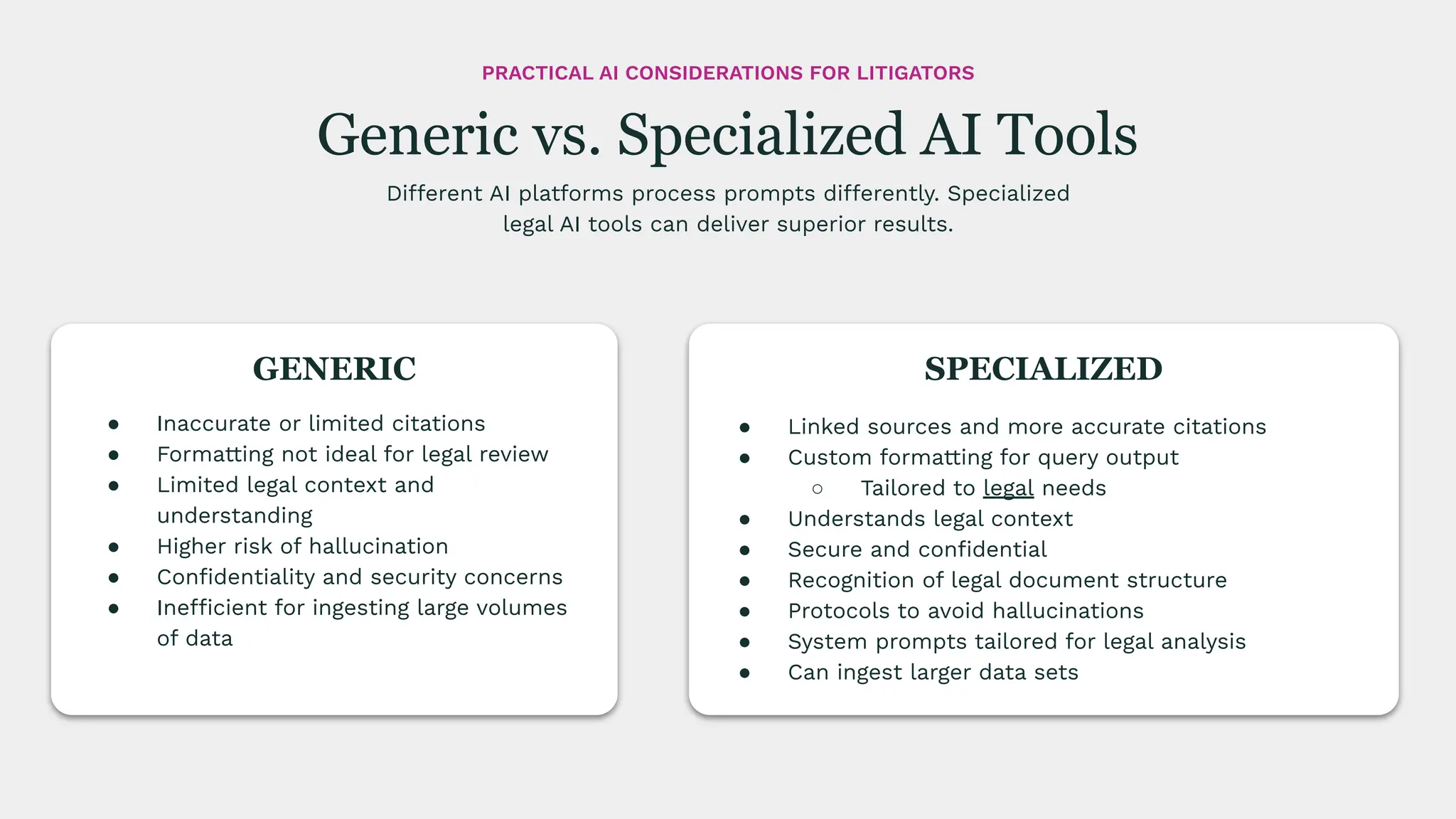
Different AI platforms process prompts differently. Specialized
legal AI tools can deliver superior results.
Generic vs. Specialized AI Tools
PRACTICAL AI CONSIDERATIONS FOR LITIGATORS
● Inaccurate or limited citations
● Formatting not ideal for legal review
● Limited legal context and
understanding
● Higher risk of hallucination
● Confidentiality and security concerns
● Inefficient for ingesting large volumes
of data
GENERIC SPECIALIZED
● Linked sources and more accurate citations
● Custom formatting for query output
○ Tailored to legal needs
● Understands legal context
● Secure and confidential
● Recognition of legal document structure
● Protocols to avoid hallucinations
● System prompts tailored for legal analysis
● Can ingest larger data sets
Practical Application:
Prompt Writing in Action
with Transcript Genius
Q&A
Questions? Reach out to concierge@steno.com
Thank You
Questions? Reach out to concierge@steno.com

AI for Paralegals: Everything You Need to Know (and How to Use It Safely)

  • 5.
    Agenda 01 Introduction toAI in Litigation PRACTICAL AI CONSIDERATIONS FOR LITIGATORS 02 Ethical Considerations 03 Data Security & AI 04 Case Study: Writing Prompts for Legal Tasks 05 Practical Applications in Legal Work 06 Q&A
  • 6.
    Intro: AI in Litigation MARCH2023 | PRIVATE & CONFIDENTIAL
  • 7.
    ● AI isa computer system trained on large amounts of data that can recognize patterns, process language, and generate responses to accomplish specific tasks. ● AI doesn't "think" like humans - it predicts patterns based on its training. It cannot truly understand or reason like humans do ● AI systems should be used to enhance, not replace, human decision-making. It requires clear context and guidance to provide relevant, accurate responses. ● AI can be trained on user data. Always check the Terms and Conditions for any AI before inputting sensitive information. ● General AI vs Legal AI: General AI is not designed to handle industry-specific tasks. Even something simple, like a correctly formatted transcript could confuse it. Artificial Intelligence is changing the world at scale and rapidly. But most people don’t know how it works. Here are the headlines: What is AI? PRACTICAL AI CONSIDERATIONS FOR LITIGATORS
  • 8.
    There’s AI inmany products and services you use in your personal and professional lives. AI in Daily Life Digital Assistants like Siri & Alexa Predictive analytics for businesses (e.g. forecasting) Writing, Text Editing and Autocorrect PRACTICAL AI CONSIDERATIONS FOR LITIGATORS Search and social algorithms like Google & Tiktok Banking fraud detection and prevention
  • 9.
    ● E-Discovery: AI-powereddocument review and analysis ● Legal Research: Faster case law and statute searching ● Contract Generation and Analysis: Identifying key clauses and potential risks ● Predictive Analytics: Case outcome prediction and strategy development ● Transcript Analysis: Transcript summaries and interrogation Artificial Intelligence is transforming various aspects of litigation, from document review to case strategy. AI in Litigation PRACTICAL AI CONSIDERATIONS FOR LITIGATORS
  • 10.
    AI does notreplace attorneys. It enhances their expertise by reducing manual work, thus freeing up time to focus on analysis, strategy and tactics. It makes the best attorneys even better. PRACTICAL AI CONSIDERATIONS FOR LITIGATORS
  • 11.
    Every single attorneyhas an obligation to represent their client to the best of their ability. AI tools should enhance your ability to serve clients effectively and ethically. However, you must exercise caution and oversight when it comes to the AI’s output and confidentiality of client information. AI Preparedness Verification & Due Diligence Security & Client Confidentiality Competence & Growth Efficiency & Access to Justice Transparency & Disclosure (even non-Steno ones!) PRACTICAL AI CONSIDERATIONS FOR LITIGATORS
  • 12.
    Ethical Considerations MARCH 2023| PRIVATE & CONFIDENTIAL
  • 13.
    ● This dutyrequires lawyers to exercise the “legal knowledge, skill, thoroughness and preparation reasonably necessary for the representation,” as well as to understand “the benefits and risks associated” with the technologies used to deliver legal services to clients. ● Lawyers may ordinarily achieve the requisite level of competency by engaging in self-study, associating with another competent lawyer, or consulting with an individual who has sufficient expertise in the relevant field. Model Rule 1.1 obligates lawyers to provide competent representation to clients. ABA Model Rule 1.1 PRACTICAL AI CONSIDERATIONS FOR LITIGATORS Source: American Bar Association
  • 14.
    ● The dutyasks for a reasonable understanding, not full technical competence. ● Lawyers can draw on the expertise of those who can provide guidance. ● The duty is not static and relies on the attorney to pro actively remain aware and vigilant. Further the ABA’s recent opinion of July 29, 2024 reminds attorneys that they have a duty of competence in using generative AI under Model Rule 1.1 which requires both legal and technical competence. ABA Model Rule 1.1 PRACTICAL AI CONSIDERATIONS FOR LITIGATORS
  • 15.
    Data, Security &AI MARCH 2023 | PRIVATE & CONFIDENTIAL
  • 16.
    ● Not allAI tools are created equal ○ Generic AI platforms (like ChatGPT) may store and use your data to train their models ○ Client confidentiality could be compromised if sensitive information is shared with unsecured AI tools ○ Look for AI tools that explicitly state they don't retain or train on your data ● Verify security credentials ○ Choose tools that meet legal industry standards (SOC2 Type II, HIPAA compliance) ○ Ensure the AI provider has clear data privacy policies ○ Confirm the tool operates within your jurisdiction's ethical guidelines for client confidentiality ● Adopt a smart approach to AI security ○ Never input confidential client information into public AI tools ○ Always verify AI-generated insights against primary sources ○ Use AI tools that provide clear audit trails and documentation ○ Choose platforms designed specifically for legal work when handling sensitive information Your ethical obligation to protect client confidentiality extends to your use of AI tools. When in doubt, choose specialized legal AI solutions with proven security measures. AI Security Checklist PRACTICAL AI CONSIDERATIONS FOR LITIGATORS
  • 17.
    Always verify howyour data is used and protected. Visit the FAQs and security pages to find out more. At Steno we have an AI-powered transcript analysis tool “Transcript Genius” and we are completely transparent when it comes to security. Here are examples of the transparency we offer when it comes to how we use and protect data. AI Security Considerations PRACTICAL AI CONSIDERATIONS FOR LITIGATORS 1. Does Transcript Genius share my data to train any AI models? No. We do not use Transcript Genius’s conversations to train the AI language model. We do save your conversation within a "thread", but only to enable you to ask additional questions with the context of your previous questions. This thread is not shared to others, and you can delete these conversations if you want. 2. Is Transcript Genius secure? Yes. The same security measures safeguard the conversations with Transcript Genius as all the data within Steno which complies with SOC2 Type II and HIPAA standards. You can rest assured your conversations are not used to train the AI model, and your data is not being stored with the AI provider. Visit the Steno Trust Center to Learn More: trust.steno.com
  • 18.
    Case Study: Writing AIPrompts MARCH 2023 | PRIVATE & CONFIDENTIAL
  • 19.
    ● Quality in= Quality out ● Clear, specific prompts lead to more accurate and useful responses ● Poorly constructed prompts can result in irrelevant or misleading information ● Effective communication with AI is a skill that can be learned and improved The key to using AI competently is to understand how AI processes the information you provide it with. Effective Communication with AI Tools PRACTICAL AI CONSIDERATIONS FOR LITIGATORS
  • 20.
    ● A promptis the input or question given to an AI system ● It guides the AI's response and output ● Can range from simple questions to complex instructions ● The foundation of interaction with AI tools Every time you ask AI to do something, you are “prompting” it. The messages you send it are called “prompts”. What is a Prompt? PRACTICAL AI CONSIDERATIONS FOR LITIGATORS
  • 21.
    Provide relevant background information. Tell theAI how you want the information formatted. Be precise when describing what you’re asking for. Use plain language and avoid ambiguity. Many people give up as soon as they try AI because they don’t understand these 4 secrets to writing good prompts. Key Elements of a Prompt PRACTICAL AI CONSIDERATIONS FOR LITIGATORS Clarity Specificity Context Output
  • 22.
    Don’t ask allthe questions at once. Layer them! Start by asking one question, then another. AI can’t read minds. Share more info than you think you need to. Don’t assume AI understands legal jargon or specific case details without explanation. The prompt doesn’t provide clear guidance on what you want to achieve with this prompt. If the AI tool isn’t giving you high-quality responses, check if you’ve committed any of these common user errors. Common Mistakes PRACTICAL AI CONSIDERATIONS FOR LITIGATORS Too Vague Insufficient Context. Avoid Assumptions Too Much
  • 23.
    Clarify Output Ask forsummaries, lists, or analyses as needed. Provide Context Include necessary background or case details. Include Constraints & Parameters Specify word limits or focus areas Define Objective What specific information or task do you need? 01 02 03 04 Follow these simple five steps to level up your prompt writing skills exponentially. Step-by-Step Guide PRACTICAL AI CONSIDERATIONS FOR LITIGATORS Include Constraints & Parameters Specify word limits or focus areas 05
  • 24.
    Here's an exampleof a legal AI prompt that demonstrates clarity, specificity, context, and the desired output format. Sample Prompt “Analyze the deposition transcript of Dr. Jane Smith. Focus on her testimony regarding the patient's treatment between March 1 and April 30, 2023. Identify any inconsistencies in her account of the treatment timeline. Please provide your analysis in the following format: 1. A bullet-point summary of key points in Dr. Smith's testimony about the treatment timeline (limit to 5 main points) 2. A table listing any inconsistencies found, with columns for: a) Page and line numbers b) Inconsistent statements c) Explanation of the inconsistency 3. A paragraph (max 100 words) discussing the most significant contradiction with the medical records, if any. Include relevant quotes from the transcript where appropriate, using the format (Page:Line).” PRACTICAL AI CONSIDERATIONS FOR LITIGATORS
  • 25.
    Always check AI responsesagainst primary sources! VERIFY The AI landscape and associated rules and recommendations are continually evolving. It’s important to stay up to date. Best Practices for AI in Legal Work PRACTICAL AI CONSIDERATIONS FOR LITIGATORS Use AI as a tool to augment, not replace, legal expertise, AUGMENT Stay updated on ethical guidelines for AI use in legal practice. LEARN Continuously refine your prompt-writing skills for better results. IMPROVE
  • 26.
    Different AI platformsprocess prompts differently. Specialized legal AI tools can deliver superior results. Generic vs. Specialized AI Tools PRACTICAL AI CONSIDERATIONS FOR LITIGATORS ● Inaccurate or limited citations ● Formatting not ideal for legal review ● Limited legal context and understanding ● Higher risk of hallucination ● Confidentiality and security concerns ● Inefficient for ingesting large volumes of data GENERIC SPECIALIZED ● Linked sources and more accurate citations ● Custom formatting for query output ○ Tailored to legal needs ● Understands legal context ● Secure and confidential ● Recognition of legal document structure ● Protocols to avoid hallucinations ● System prompts tailored for legal analysis ● Can ingest larger data sets
  • 27.
    Practical Application: Prompt Writingin Action with Transcript Genius
  • 29.
    Q&A Questions? Reach outto concierge@steno.com
  • 30.
    Thank You Questions? Reachout to concierge@steno.com