







Stop Being Lazy and Test Your Software!
Laura Frank
Software Engineer, Codeship
0.7.0
Codeship
ImageLayers
Panamax
Berlin
Agenda
Continuous Delivery
Why Do We Test?
Testing with Docker Compose
Faster Testing with Docker
Why Do We Test?
Motivations and frustrations
Testing software has been a
practice since the very
first machines were used
for computing.
The women who
programmed the ENIAC to
calculate trajectories
periodically checked the
results with a correct,
hand-computed table.
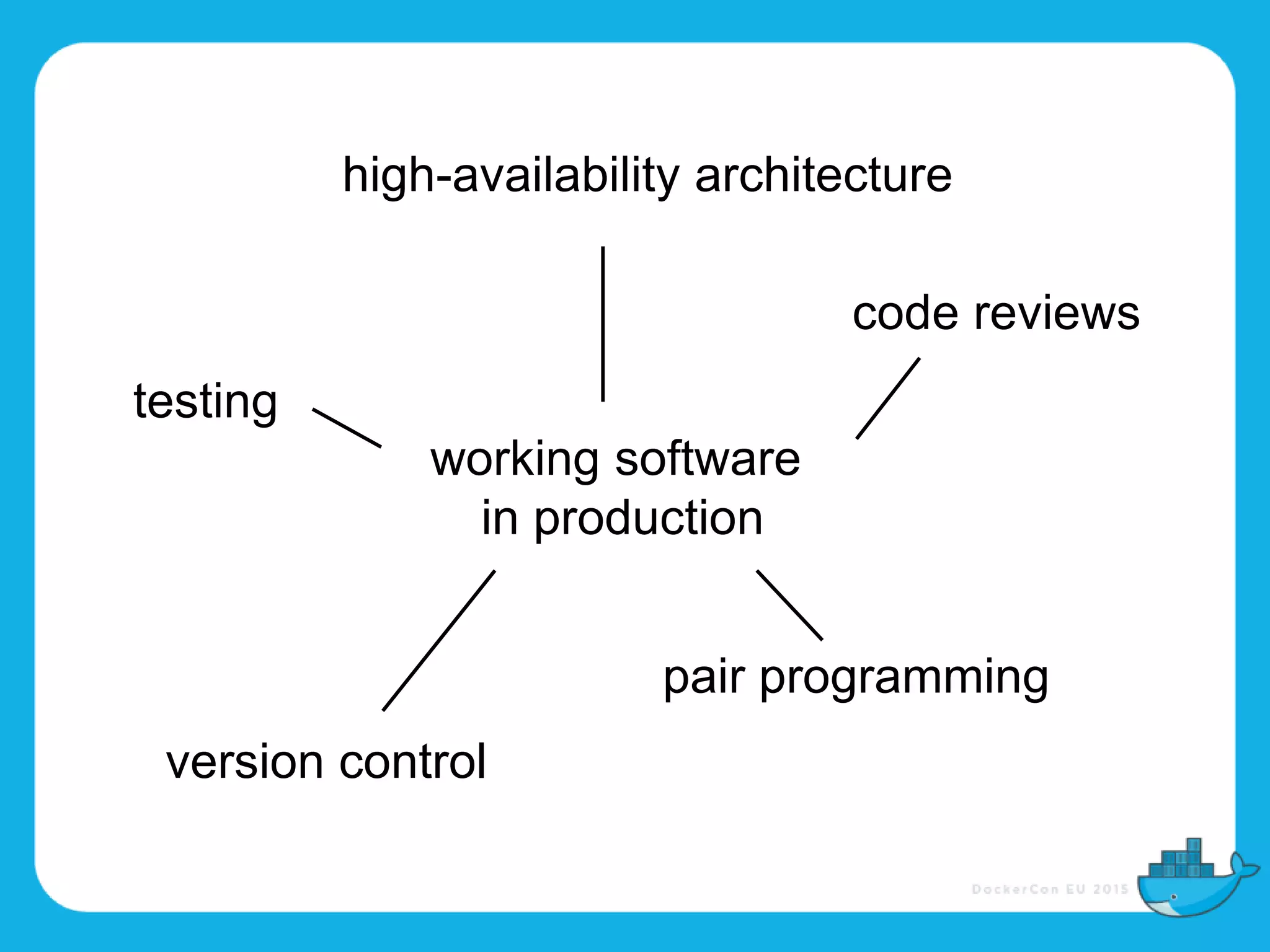
working software
in production
testing
code reviews
version control
pair programming
high-availability architecture
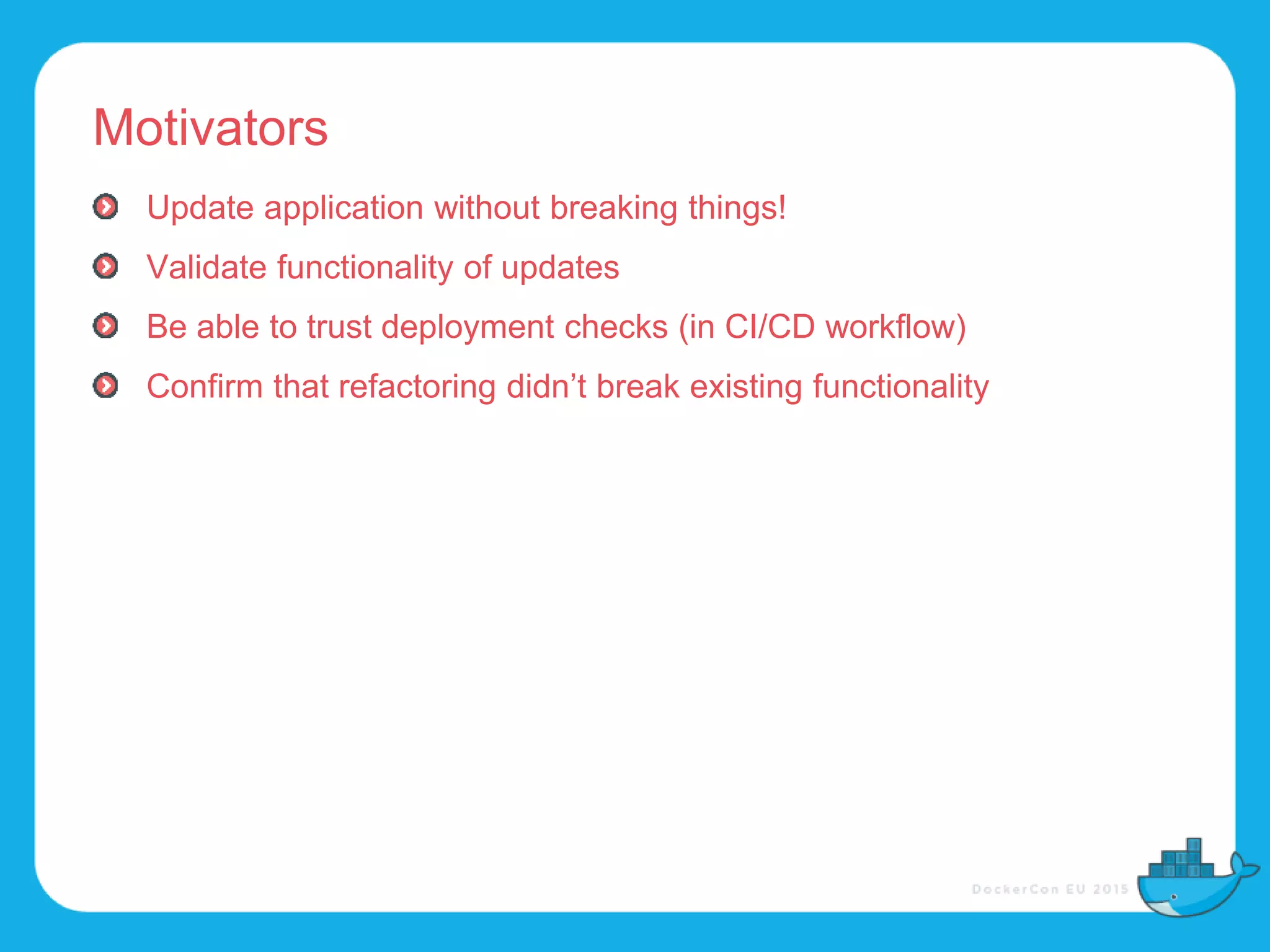
Motivators
Update application without breaking things!
Validate functionality of updates
Be able to trust deployment checks (in CI/CD workflow)
Confirm that refactoring didn’t break existing functionality
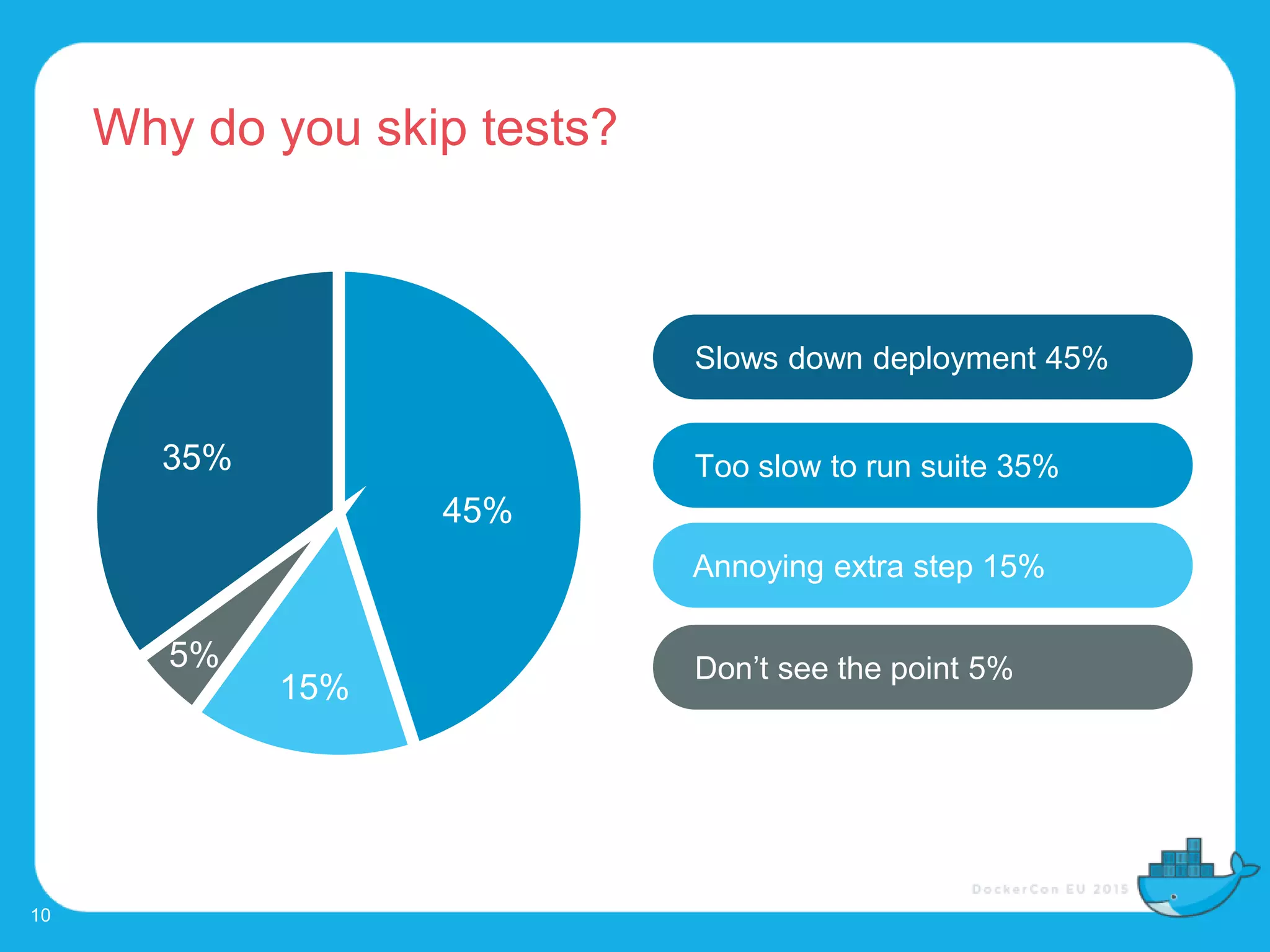
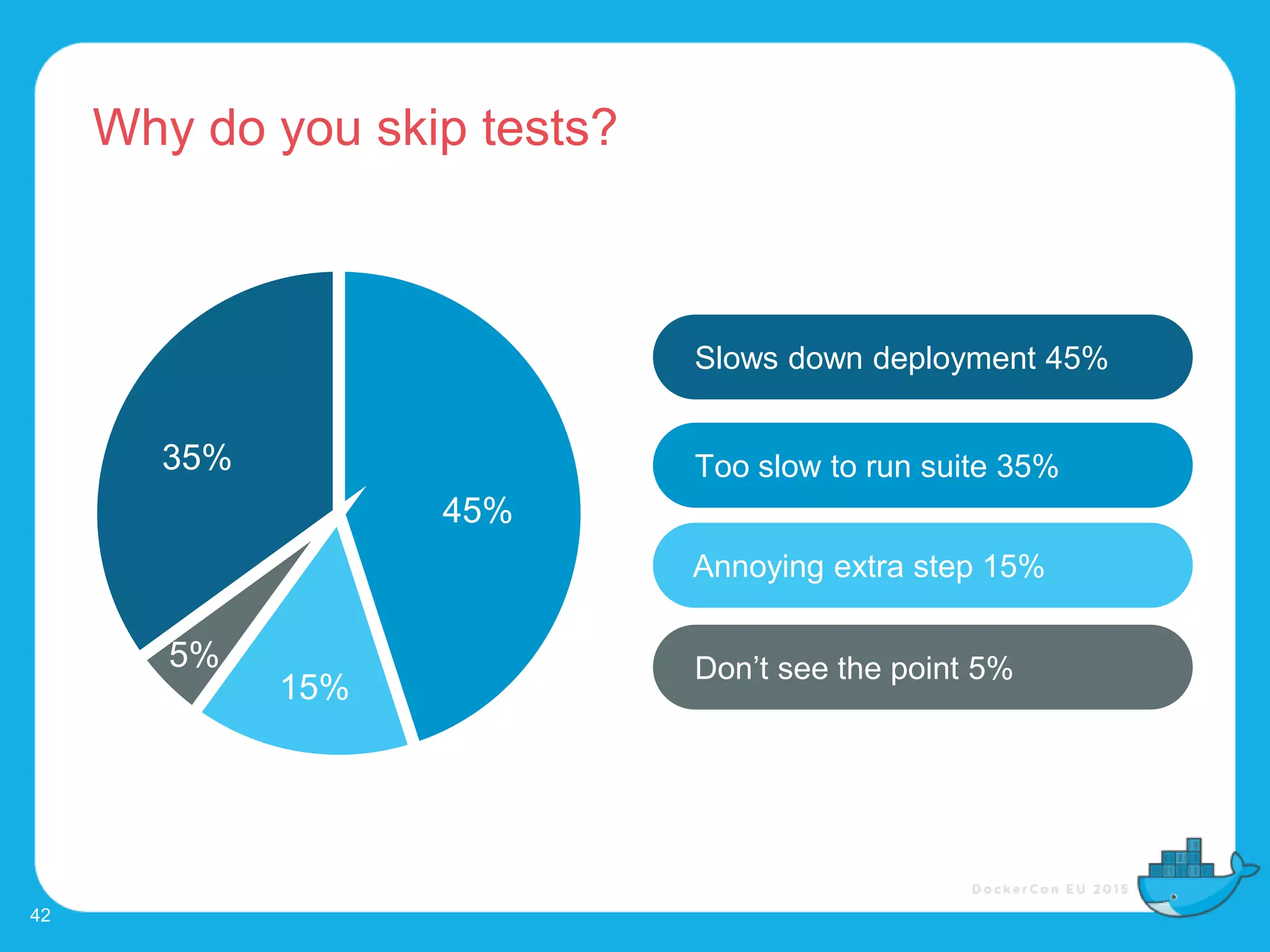
Why do you skip tests?
45%
15%
5%
35% Too slow to run suite 35%
Annoying extra step 15%
Don’t see the point 5%
Slows down deployment 45%
10
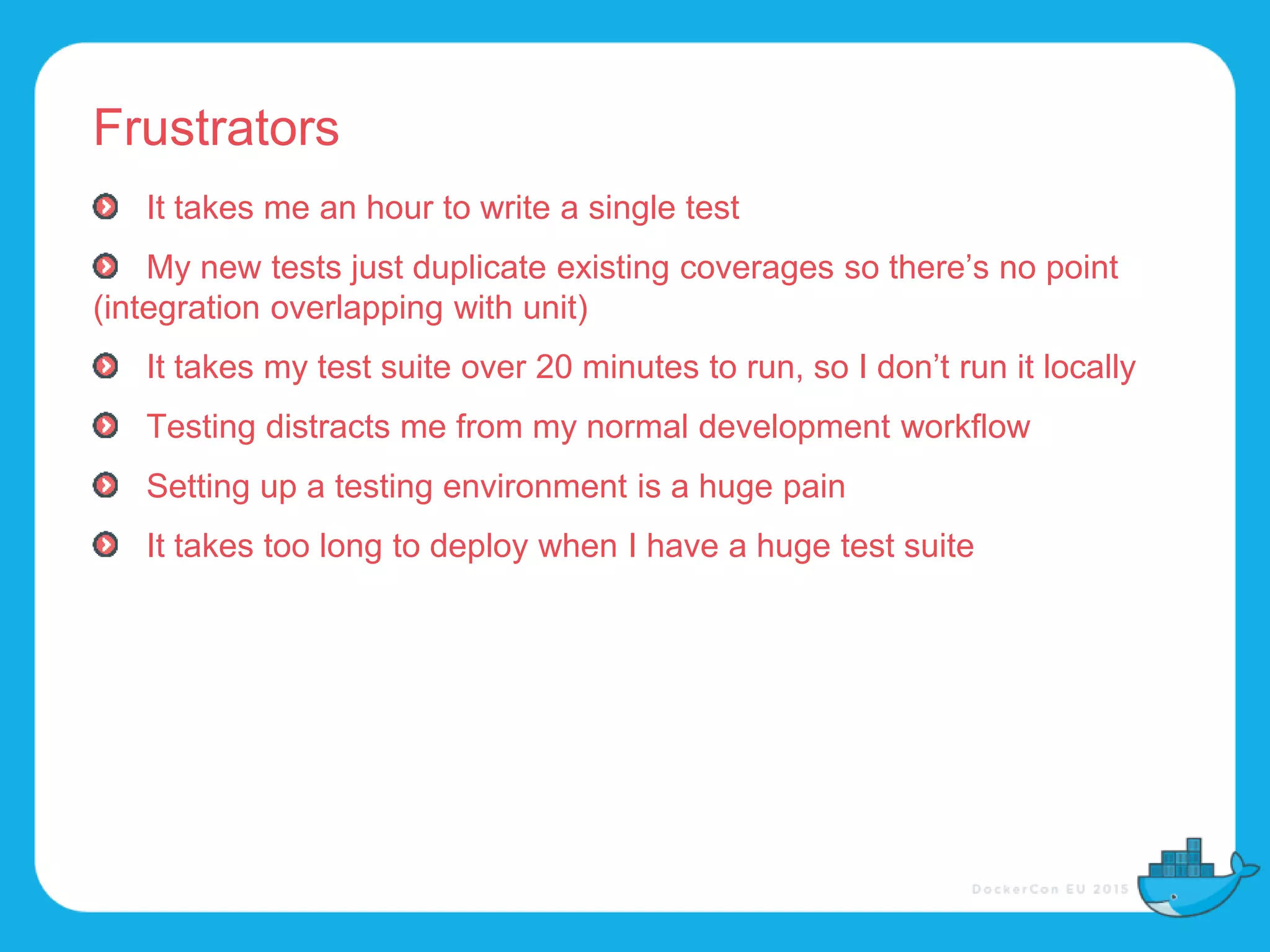
Frustrators
It takes me an hour to write a single test
My new tests just duplicate existing coverages so there’s no point
(integration overlapping with unit)
It takes my test suite over 20 minutes to run, so I don’t run it locally
Testing distracts me from my normal development workflow
Setting up a testing environment is a huge pain
It takes too long to deploy when I have a huge test suite
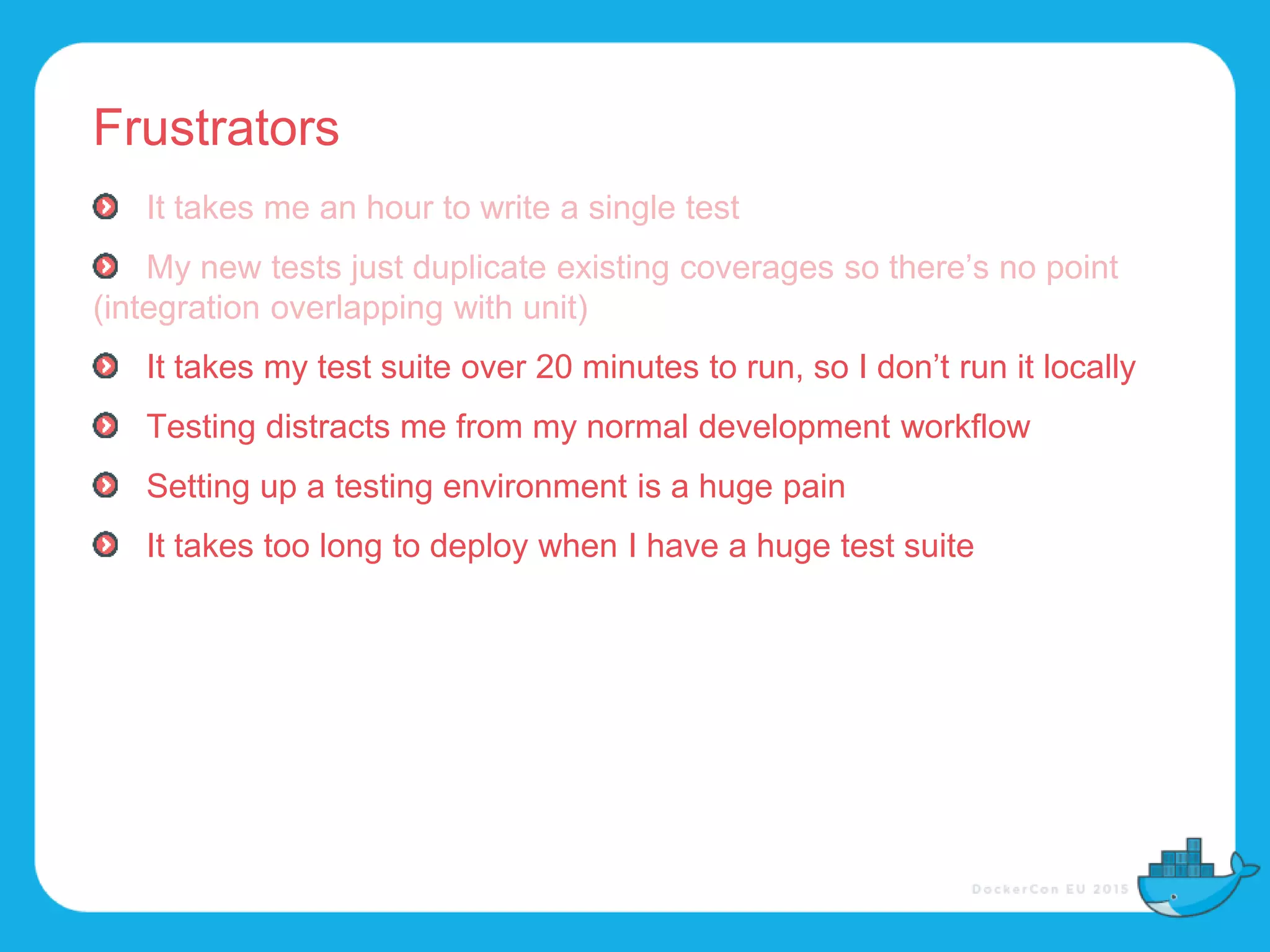
Frustrators
It takes me an hour to write a single test
My new tests just duplicate existing coverages so there’s no point
(integration overlapping with unit)
It takes my test suite over 20 minutes to run, so I don’t run it locally
Testing distracts me from my normal development workflow
Setting up a testing environment is a huge pain
It takes too long to deploy when I have a huge test suite
Using Docker can alleviate
some frustrations
associated with testing.
Testing with Docker
Compose
It’s easy, I promise
Docker and testing are a great pair.
❌ ✔
With Docker Compose, it is incredibly
easy to create consistent,
reproducible environments.
❌ ✔
Many of us already use
Docker Compose to set
up dev environments.
…But we stop there.
Use your Docker Compose
environment for testing
as well.
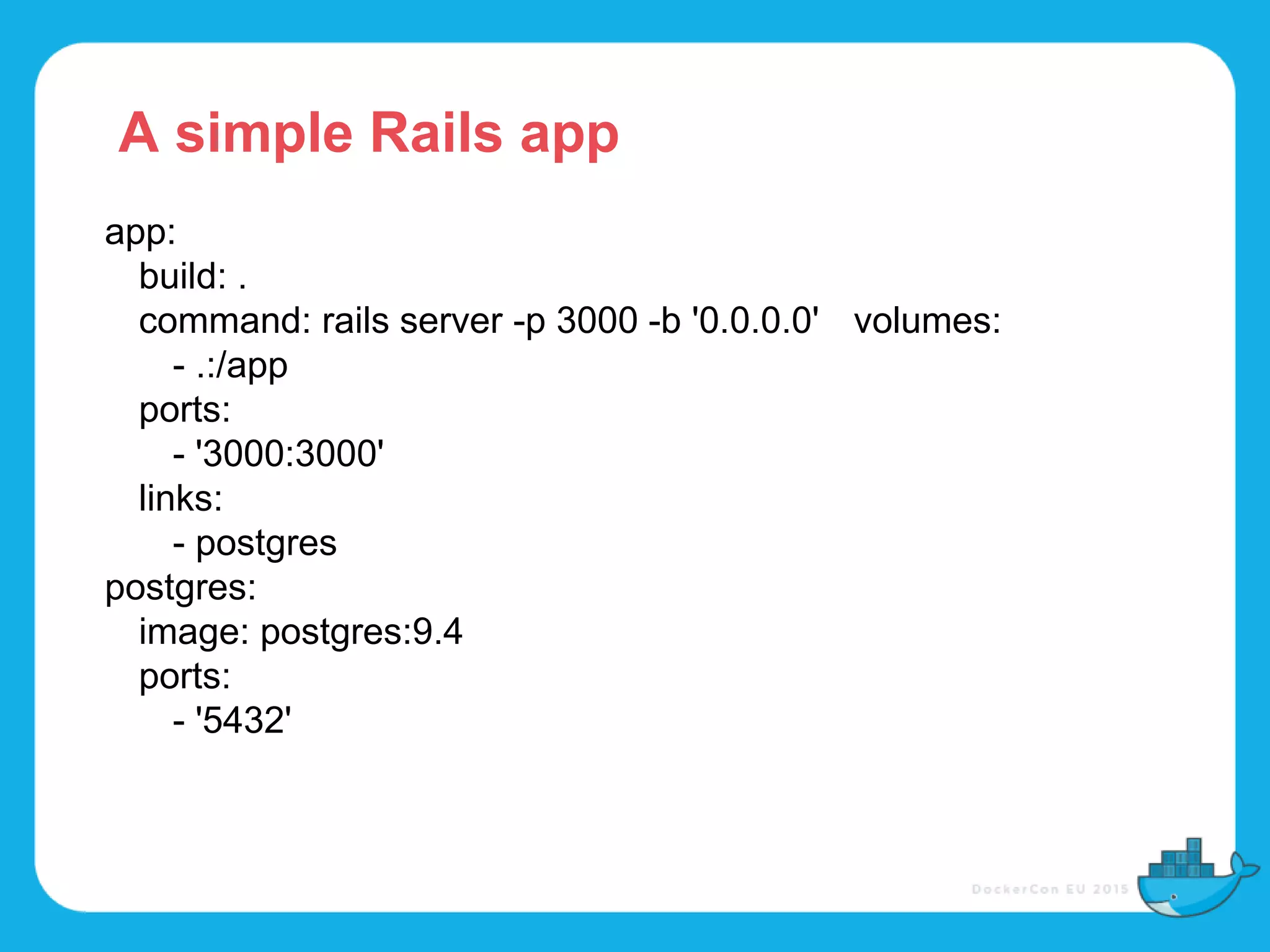
app:
build: .
command: rails server -p 3000 -b '0.0.0.0' volumes:
- .:/app
ports:
- '3000:3000'
links:
- postgres
postgres:
image: postgres:9.4
ports:
- '5432'
A simple Rails app
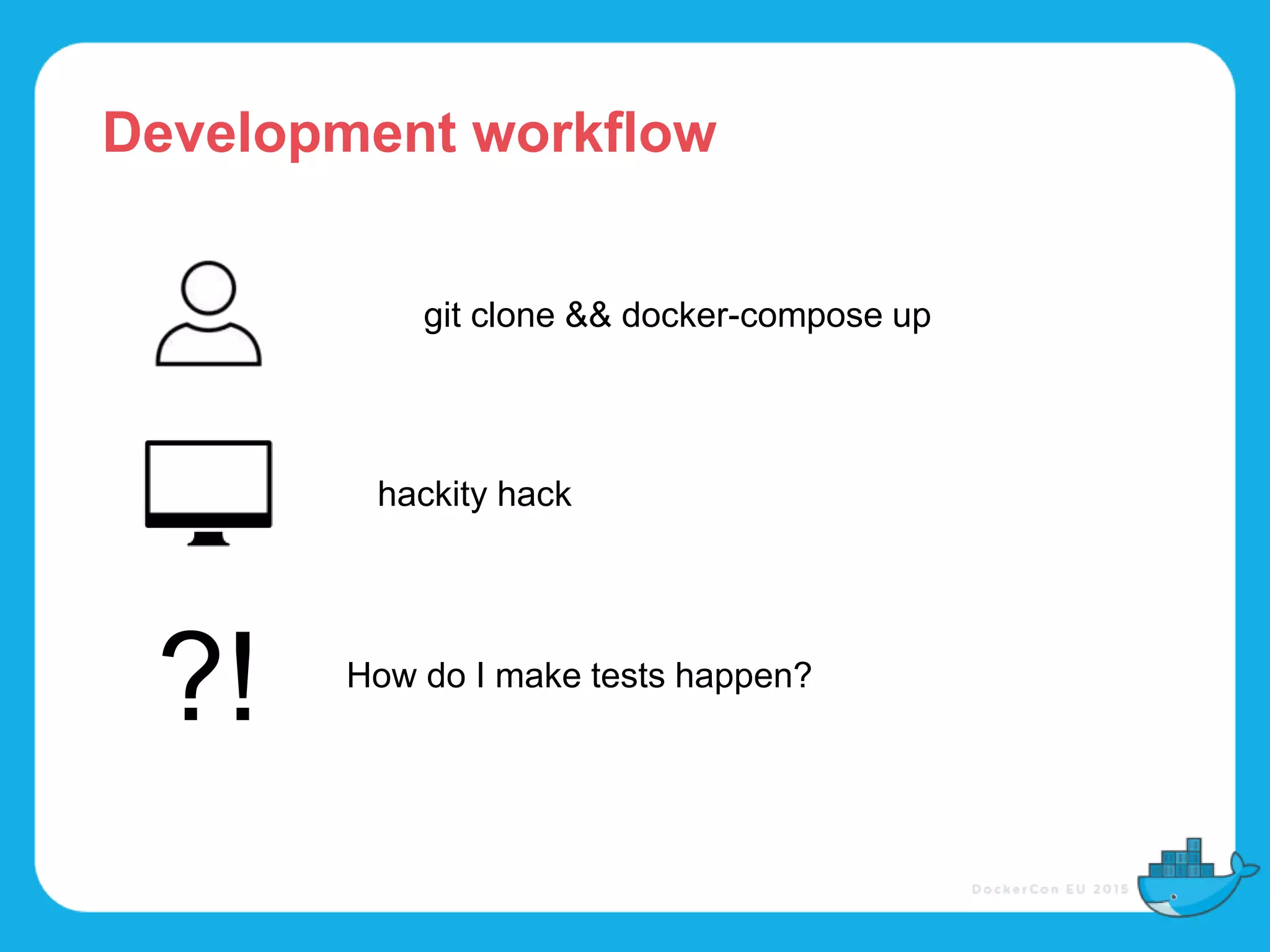
?!
git clone && docker-compose up
hackity hack
How do I make tests happen?
Development workflow
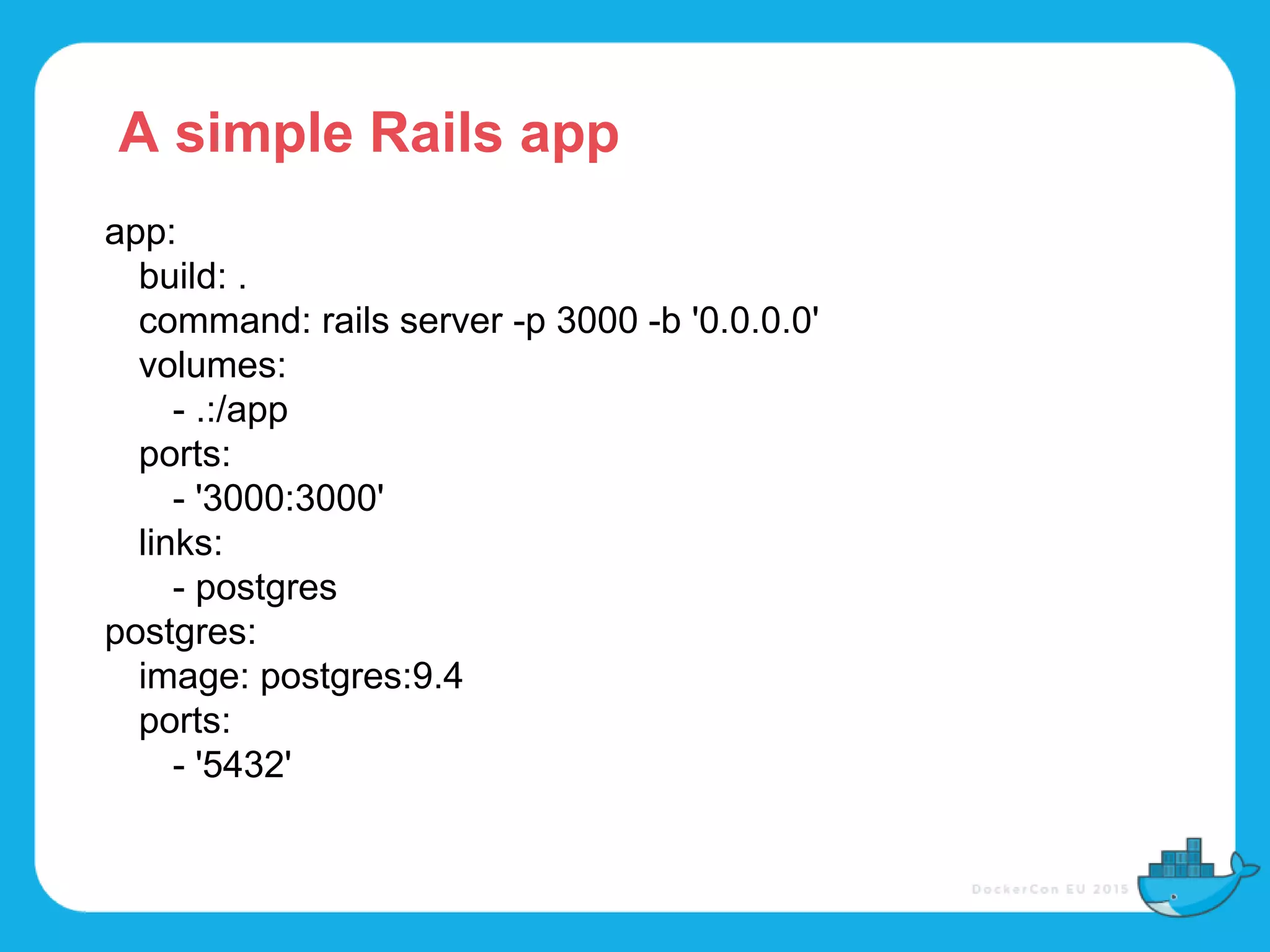
app:
build: .
command: rails server -p 3000 -b '0.0.0.0'
volumes:
- .:/app
ports:
- '3000:3000'
links:
- postgres
postgres:
image: postgres:9.4
ports:
- '5432'
A simple Rails app
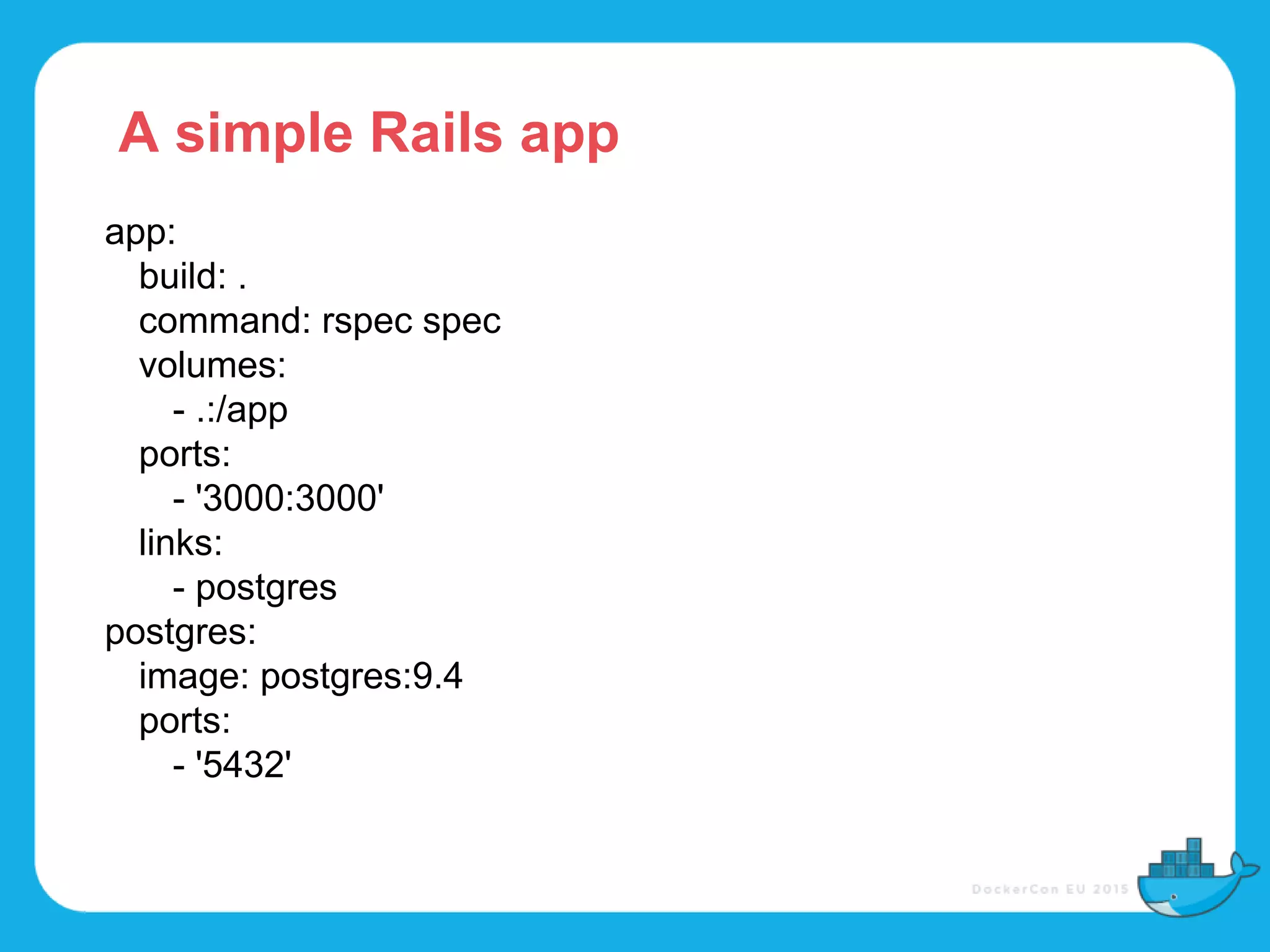
app:
build: .
command: rspec spec
volumes:
- .:/app
ports:
- '3000:3000'
links:
- postgres
postgres:
image: postgres:9.4
ports:
- '5432'
A simple Rails app
In most cases, we need to
do a bit of setup
before running tests.
You can run one-off
commands against a service
with Docker Compose.
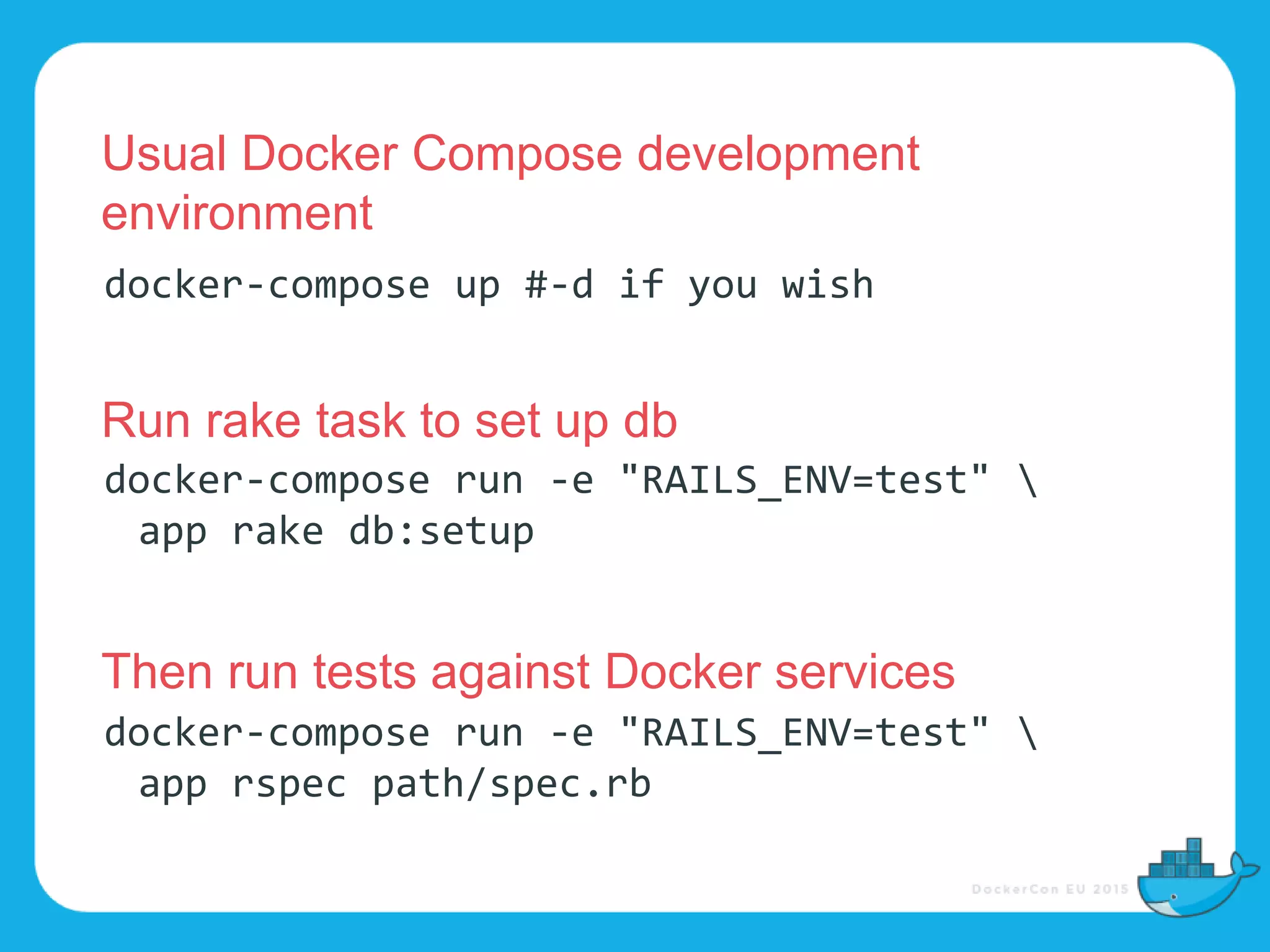
docker-compose run -e "RAILS_ENV=test" 
app rake db:setup
docker-compose run -e "RAILS_ENV=test" 
app rspec path/spec.rb
docker-compose up #-d if you wish
Usual Docker Compose development
environment
Run rake task to set up db
Then run tests against Docker services
Docker delivers a
predictable, reproducible
testing environment. Period.
Continuous Integration,
Testing, and Docker
Fail fast and not in production!
Continuous integration and
testing go hand in hand.
👯
Relying on CI/CD without
adequate test coverage
is not a great idea.
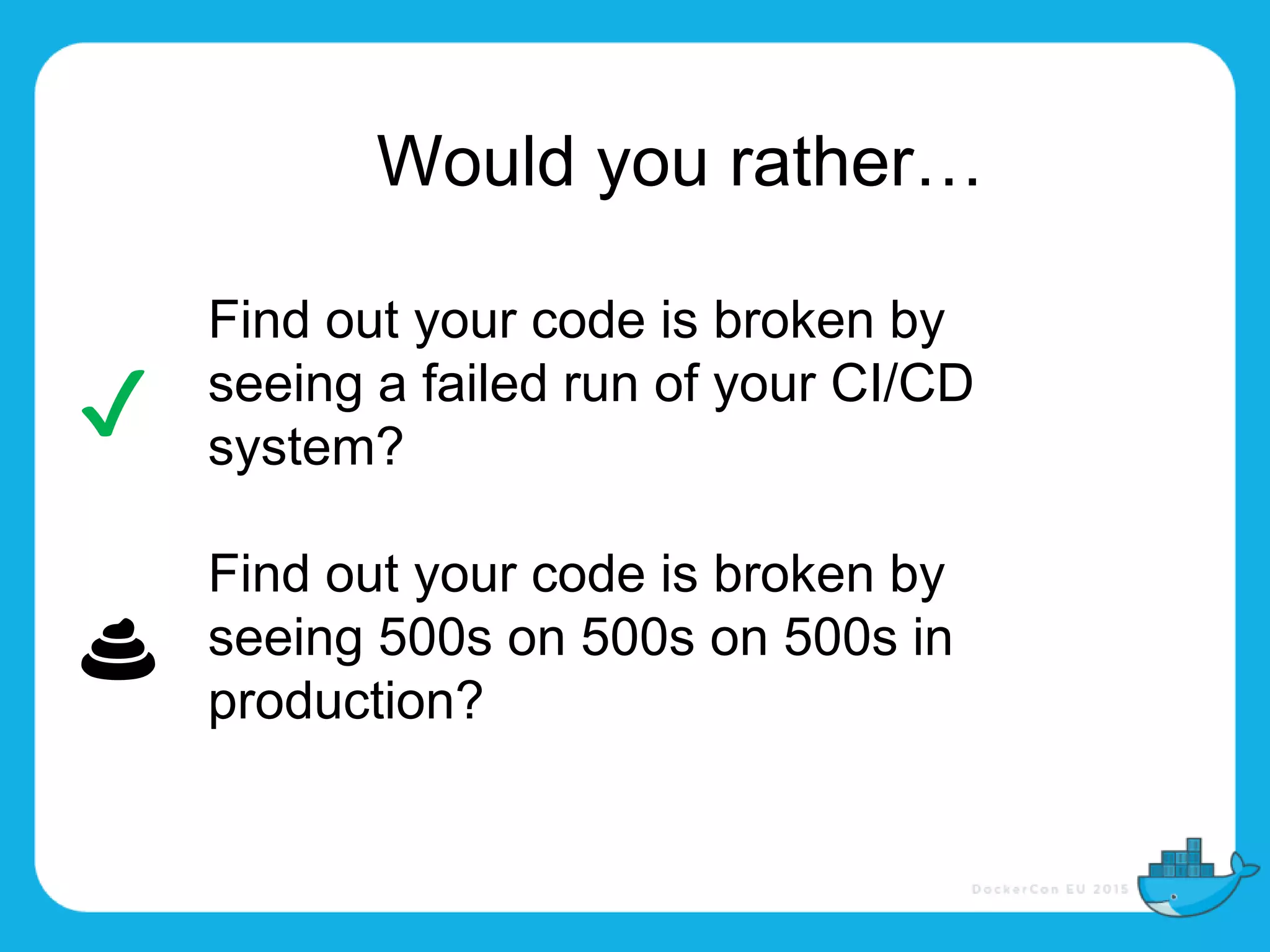
Would you rather…
Find out your code is broken by
seeing a failed run of your CI/CD
system?
Find out your code is broken by
seeing 500s on 500s on 500s in
production?
✔
💩
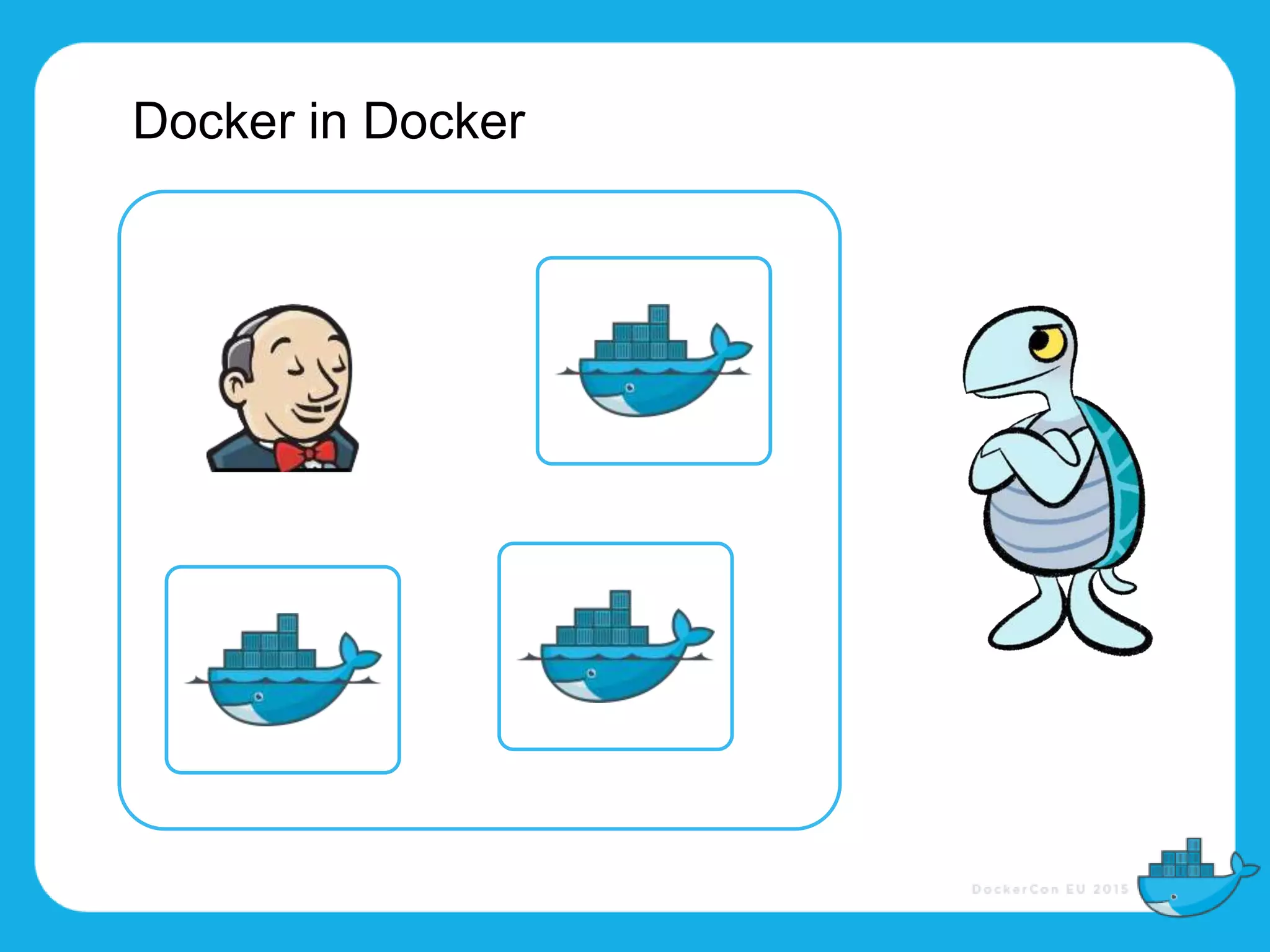
What about running tests
like this…
…inside a container?
A word of warning!
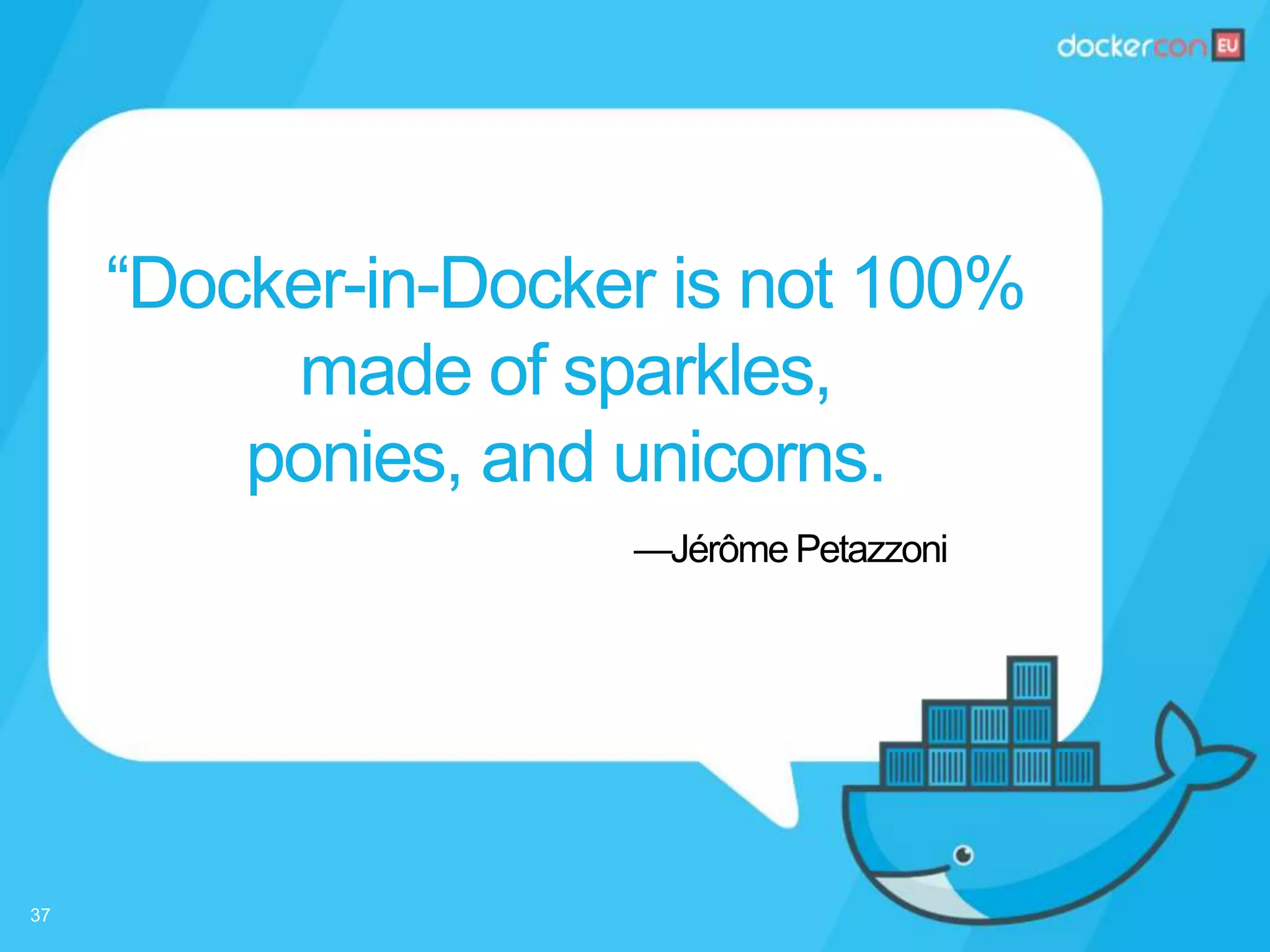
—Jérôme Petazzoni
“Docker-in-Docker is not 100%
made of sparkles,
ponies, and unicorns.
37
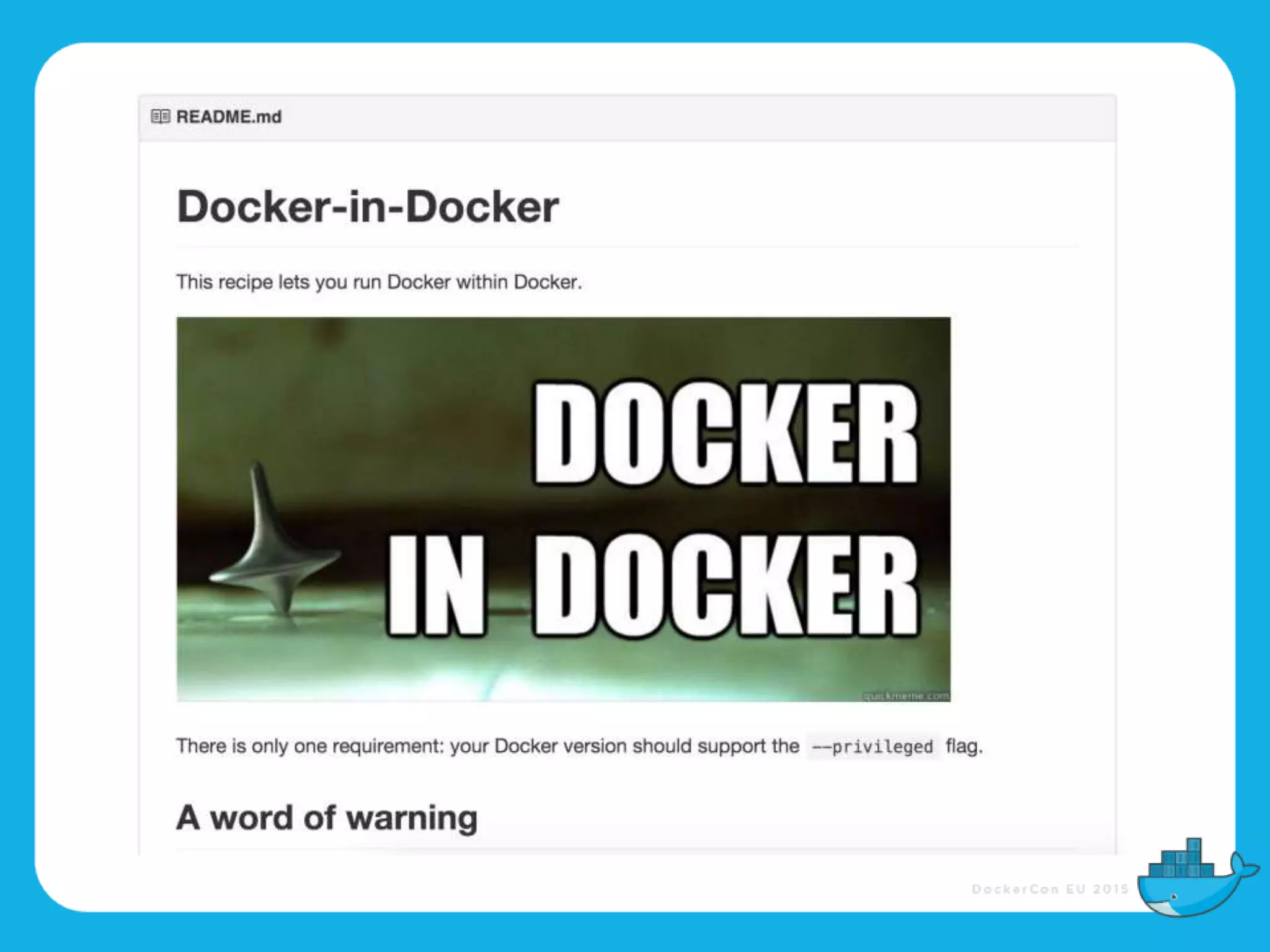
Docker in Docker
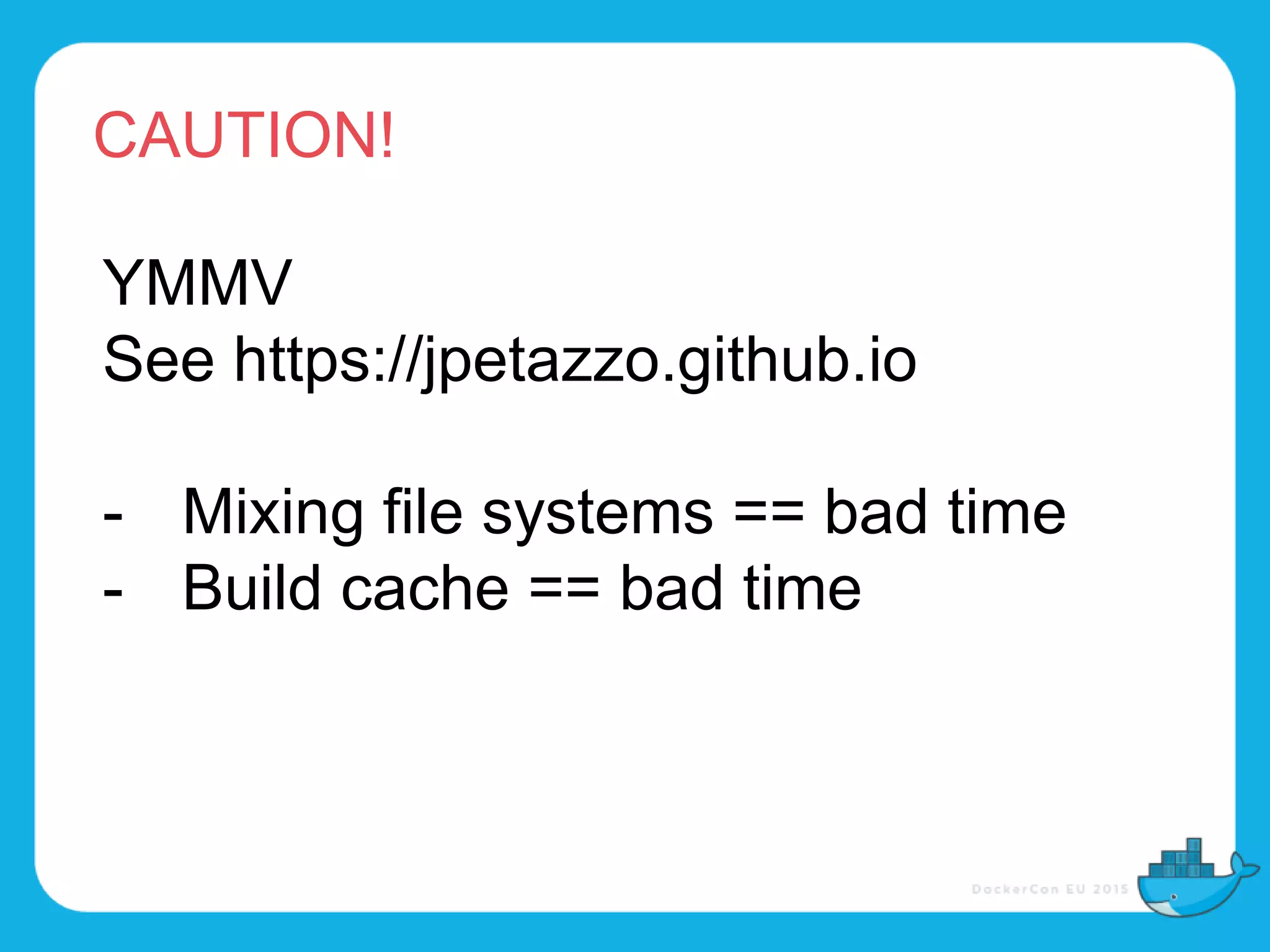
CAUTION!
YMMV
See https://jpetazzo.github.io
- Mixing file systems == bad time
- Build cache == bad time
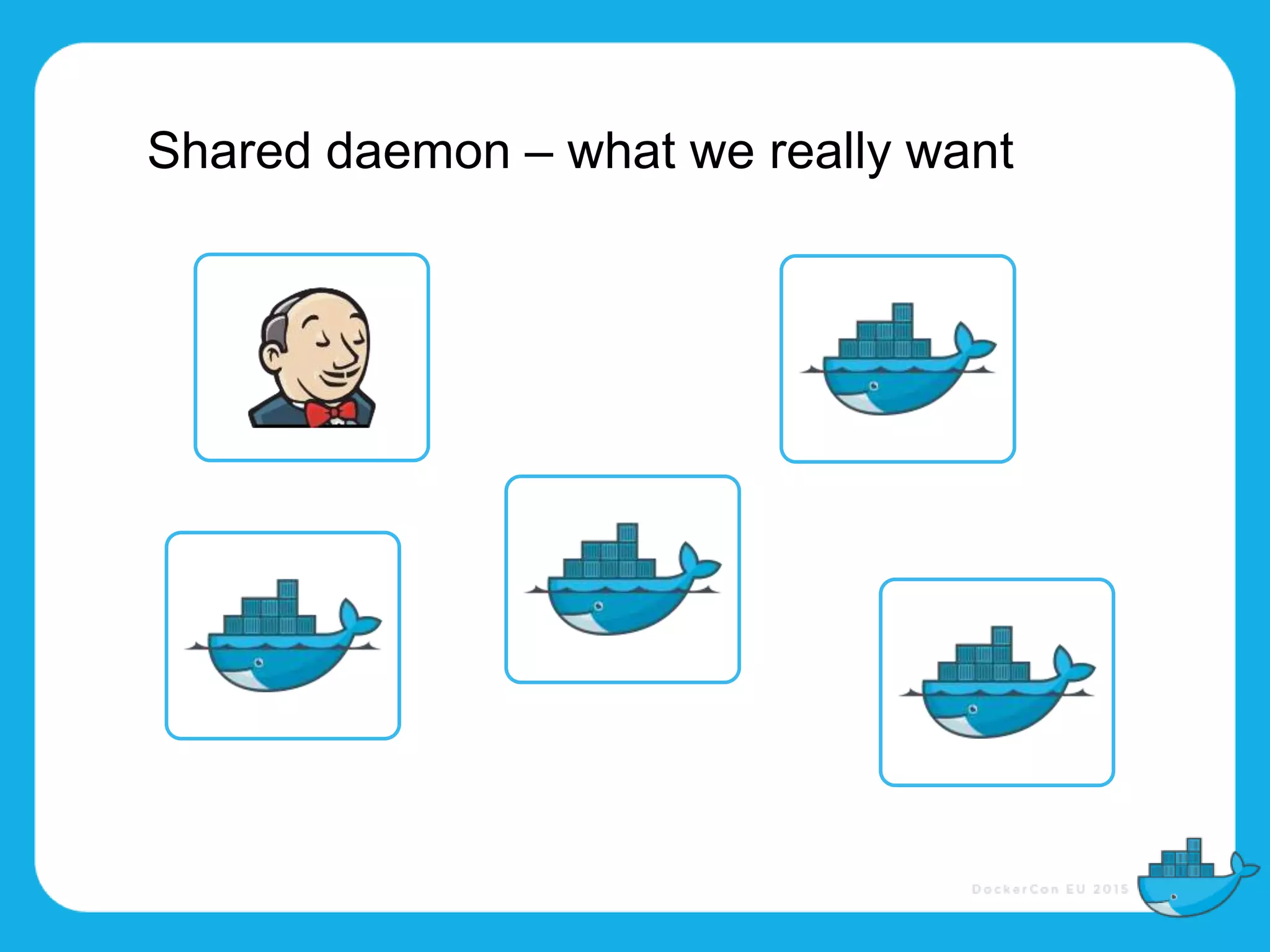
Shared daemon – what we really want
Parallel Testing with
Docker
Break it up.
Why do you skip tests?
45%
15%
5%
35% Too slow to run suite 35%
Annoying extra step 15%
Don’t see the point 5%
Slows down deployment 45%
42
When developing, it’s easy
to think of a container as
a small VM that runs a
specific workload.
✔
But if we change our thinking
to treat containers as just
processes, then we can do
some pretty cool stuff.
✔
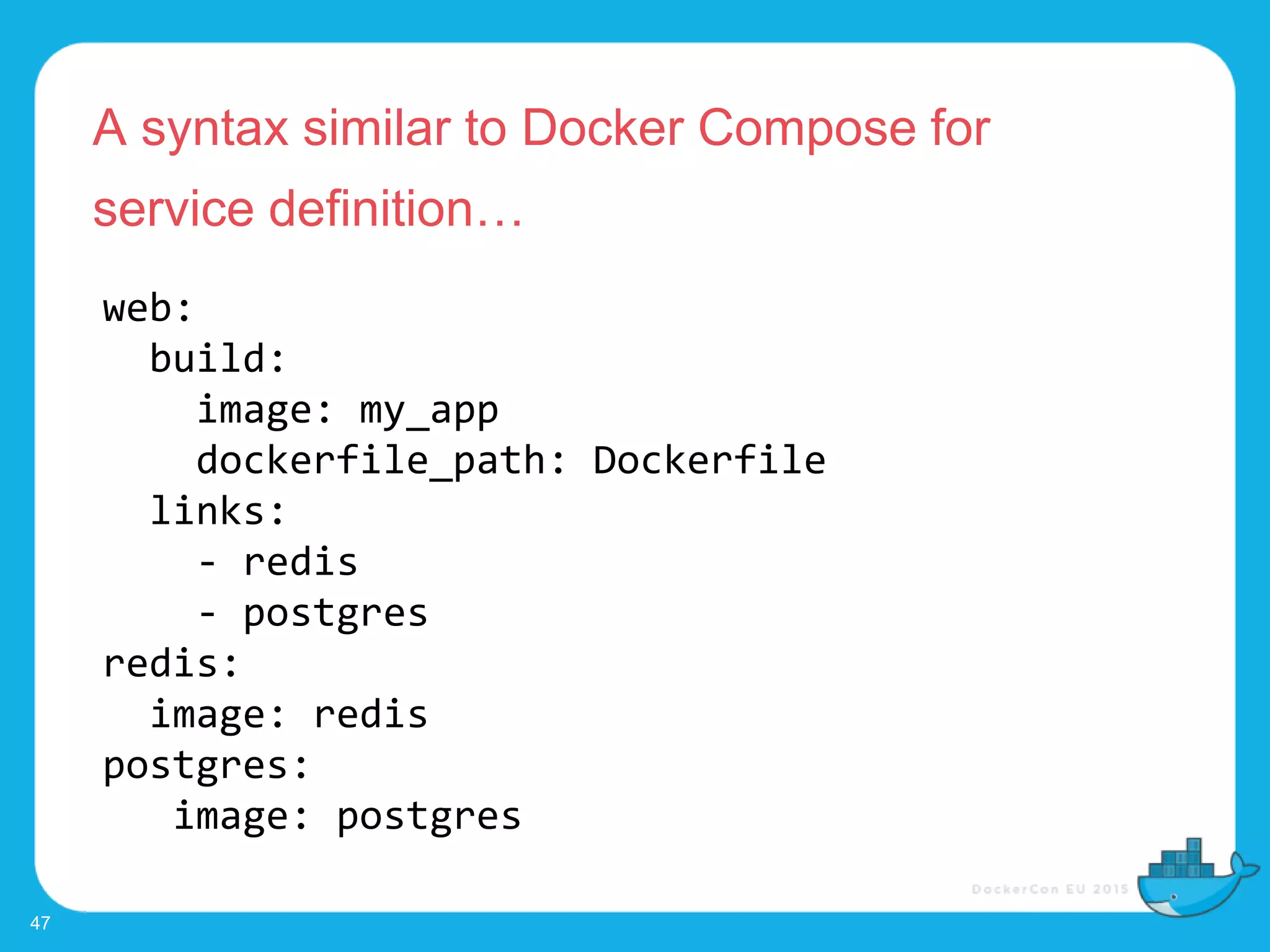
A syntax similar to Docker Compose for
service definition…
47
web:
build:
image: my_app
dockerfile_path: Dockerfile
links:
- redis
- postgres
redis:
image: redis
postgres:
image: postgres
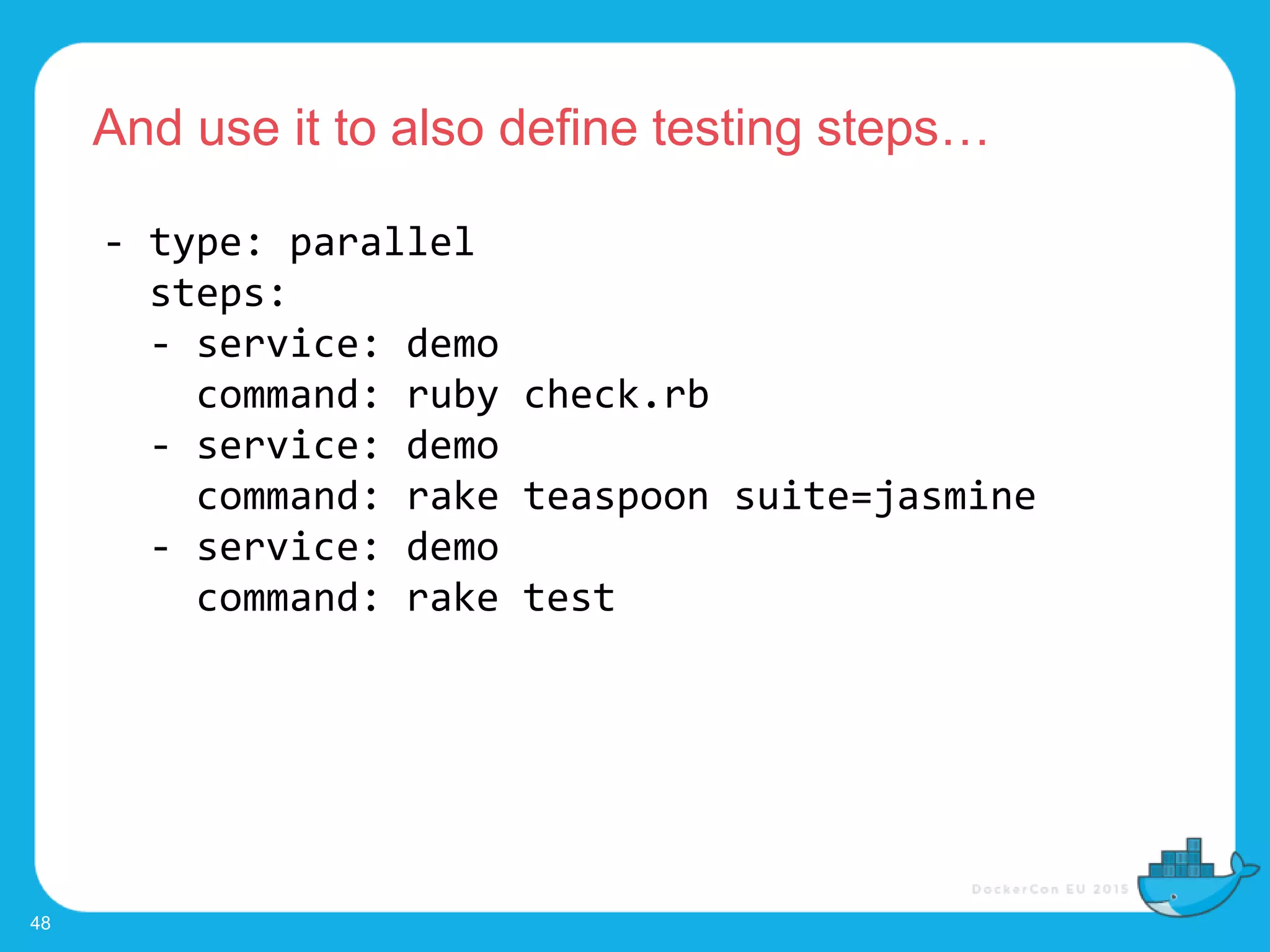
And use it to also define testing steps…
48
- type: parallel
steps:
- service: demo
command: ruby check.rb
- service: demo
command: rake teaspoon suite=jasmine
- service: demo
command: rake test
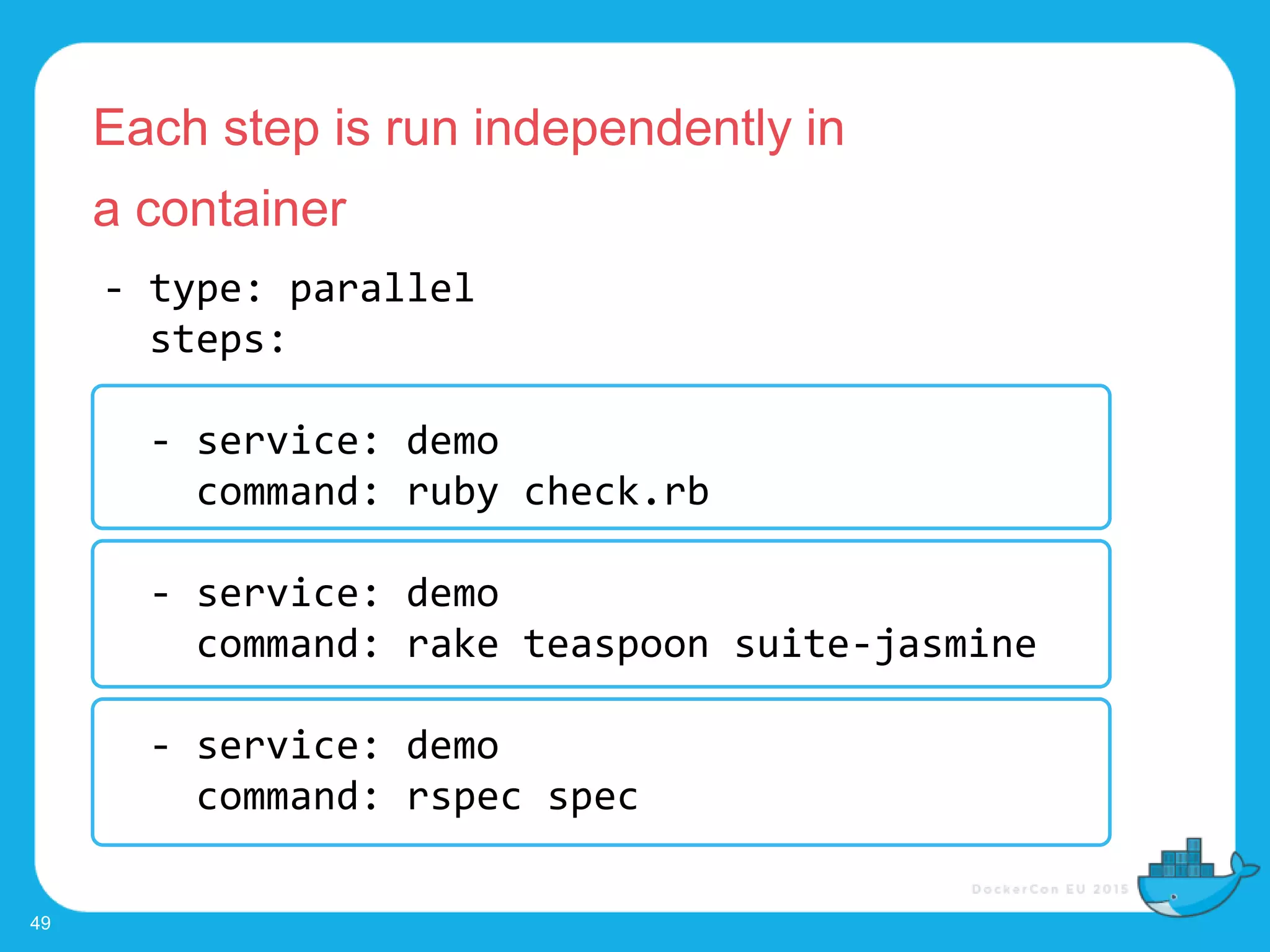
- type: parallel
steps:
- service: demo
command: ruby check.rb
- service: demo
command: rake teaspoon suite-jasmine
- service: demo
command: rspec spec
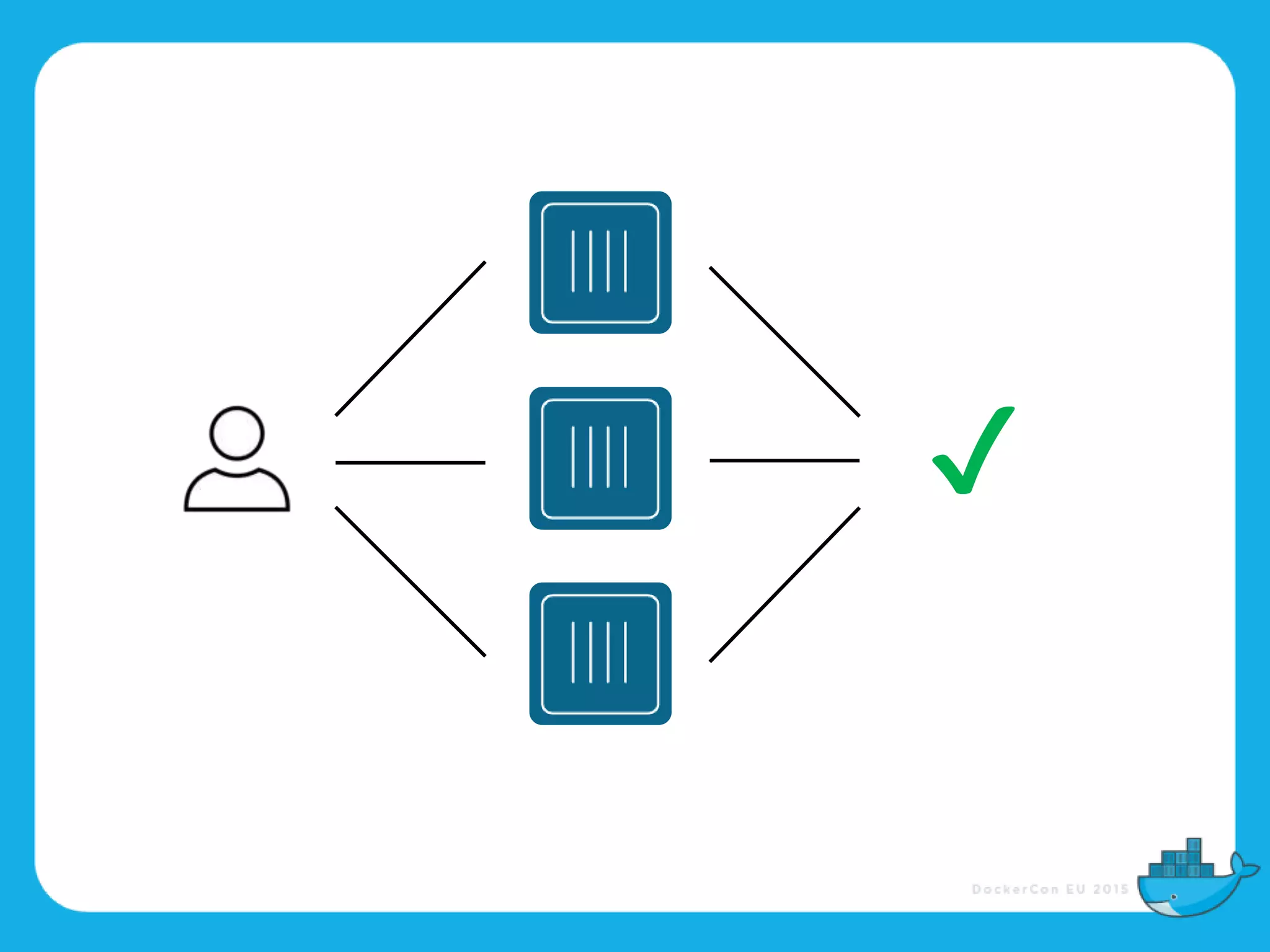
Each step is run independently in
a container
49
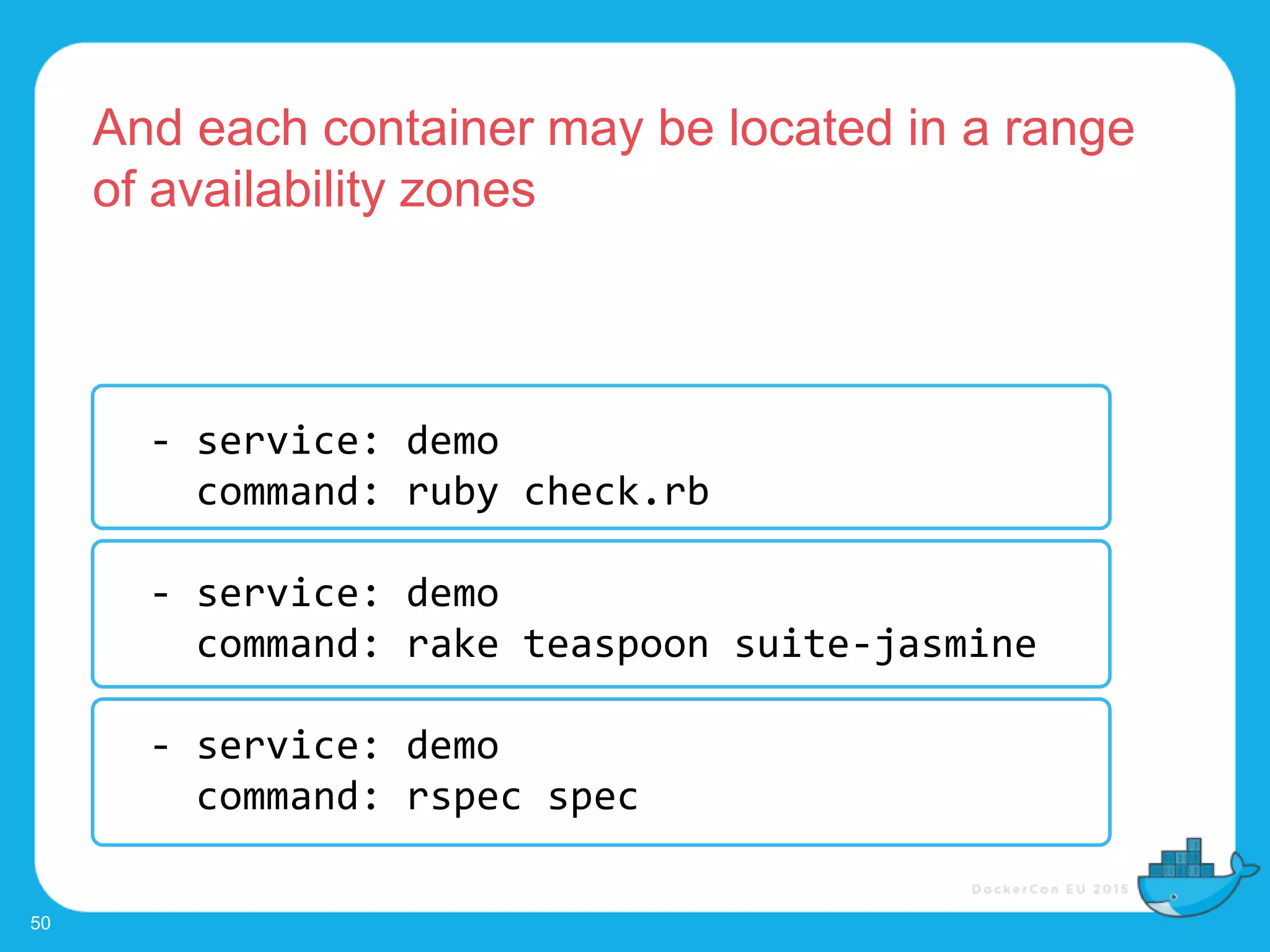
- service: demo
command: ruby check.rb
- service: demo
command: rake teaspoon suite-jasmine
- service: demo
command: rspec spec
And each container may be located in a range
of availability zones
50
Docker makes this possible by
providing the means to create
a predictable, reproducible
testing environment.
Resources
#keepshipping
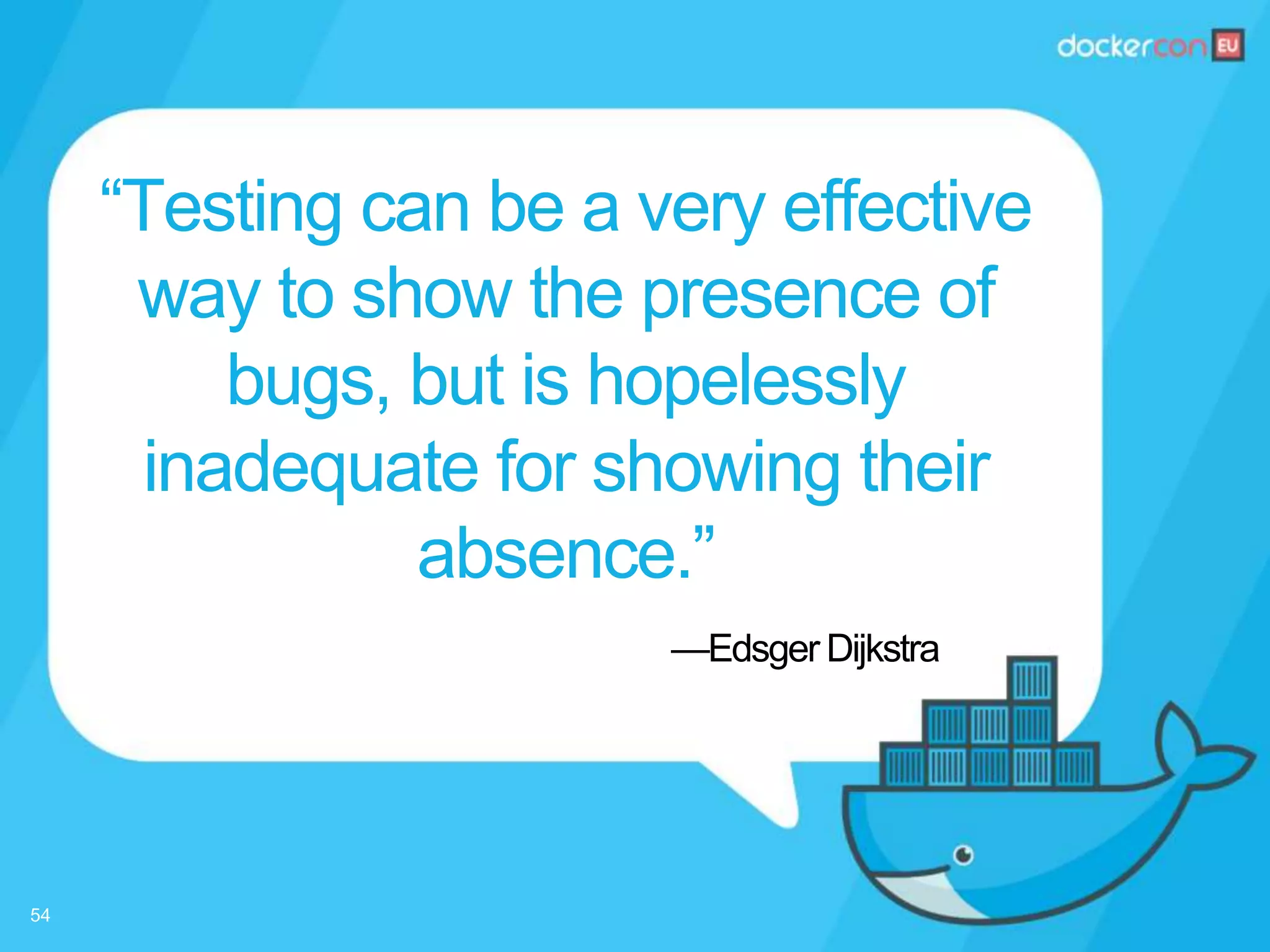
—Edsger Dijkstra
“Testing can be a very effective
way to show the presence of
bugs, but is hopelessly
inadequate for showing their
absence.”
54
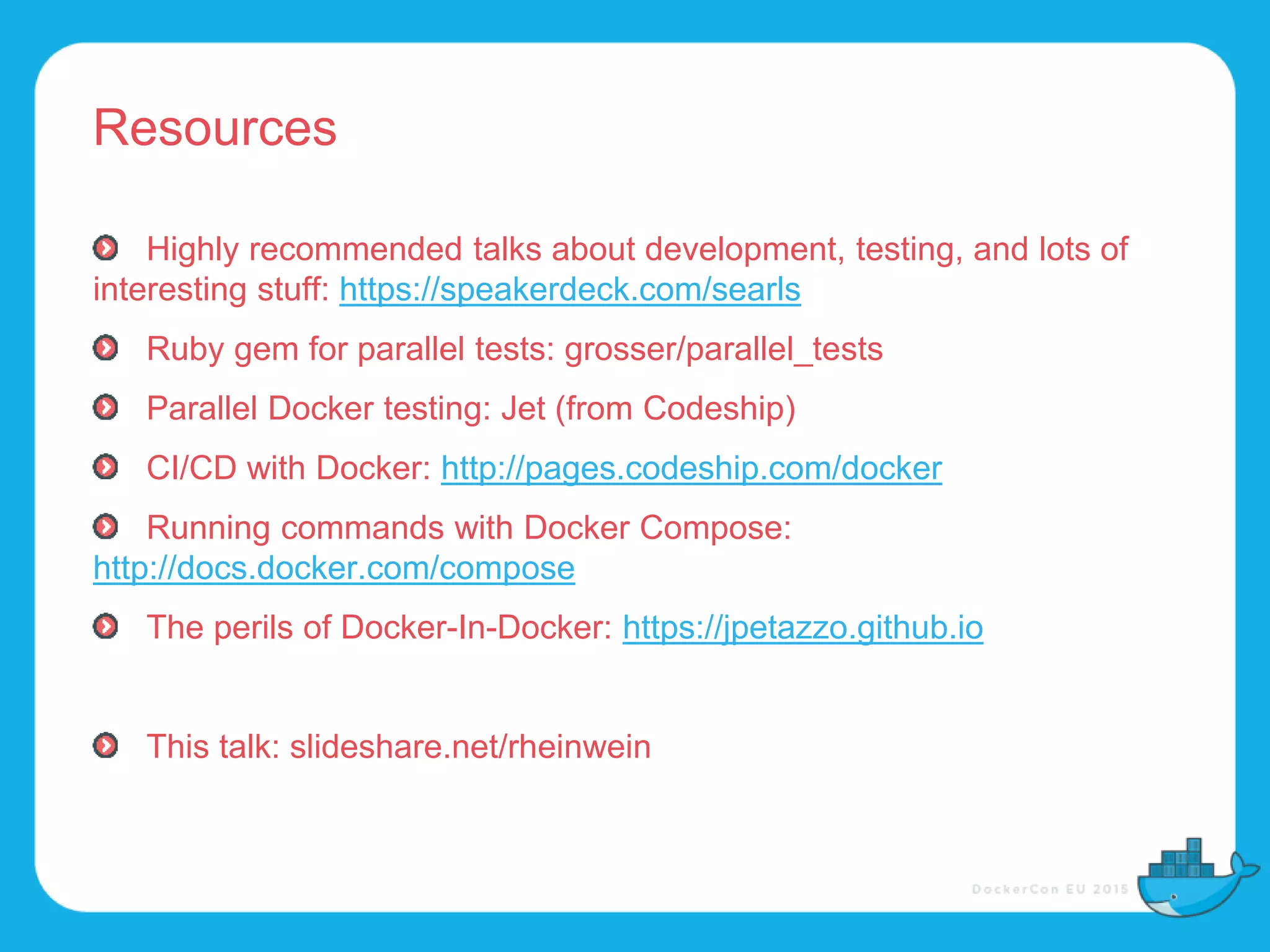
Resources
Highly recommended talks about development, testing, and lots of
interesting stuff: https://speakerdeck.com/searls
Ruby gem for parallel tests: grosser/parallel_tests
Parallel Docker testing: Jet (from Codeship)
CI/CD with Docker: http://pages.codeship.com/docker
Running commands with Docker Compose:
http://docs.docker.com/compose
The perils of Docker-In-Docker: https://jpetazzo.github.io
This talk: slideshare.net/rheinwein
Testing does not
guarantee that
our software works.
We test to know
when our software is
definitely broken.
Thank you!
Laura Frank
@rhein_wein
laura@codeship.com

DockerCon EU 2015: Stop Being Lazy and Test Your Software!

  • 1.
    Stop Being Lazyand Test Your Software! Laura Frank Software Engineer, Codeship
  • 2.
  • 3.
    Agenda Continuous Delivery Why DoWe Test? Testing with Docker Compose Faster Testing with Docker
  • 4.
    Why Do WeTest? Motivations and frustrations
  • 5.
    Testing software hasbeen a practice since the very first machines were used for computing.
  • 7.
    The women who programmedthe ENIAC to calculate trajectories periodically checked the results with a correct, hand-computed table.
  • 8.
    working software in production testing codereviews version control pair programming high-availability architecture
  • 9.
    Motivators Update application withoutbreaking things! Validate functionality of updates Be able to trust deployment checks (in CI/CD workflow) Confirm that refactoring didn’t break existing functionality
  • 10.
    Why do youskip tests? 45% 15% 5% 35% Too slow to run suite 35% Annoying extra step 15% Don’t see the point 5% Slows down deployment 45% 10
  • 11.
    Frustrators It takes mean hour to write a single test My new tests just duplicate existing coverages so there’s no point (integration overlapping with unit) It takes my test suite over 20 minutes to run, so I don’t run it locally Testing distracts me from my normal development workflow Setting up a testing environment is a huge pain It takes too long to deploy when I have a huge test suite
  • 12.
    Frustrators It takes mean hour to write a single test My new tests just duplicate existing coverages so there’s no point (integration overlapping with unit) It takes my test suite over 20 minutes to run, so I don’t run it locally Testing distracts me from my normal development workflow Setting up a testing environment is a huge pain It takes too long to deploy when I have a huge test suite
  • 13.
    Using Docker canalleviate some frustrations associated with testing.
  • 14.
  • 15.
    Docker and testingare a great pair. ❌ ✔
  • 16.
    With Docker Compose,it is incredibly easy to create consistent, reproducible environments. ❌ ✔
  • 17.
    Many of usalready use Docker Compose to set up dev environments.
  • 18.
  • 19.
    Use your DockerCompose environment for testing as well.
  • 20.
    app: build: . command: railsserver -p 3000 -b '0.0.0.0' volumes: - .:/app ports: - '3000:3000' links: - postgres postgres: image: postgres:9.4 ports: - '5432' A simple Rails app
  • 21.
    ?! git clone &&docker-compose up hackity hack How do I make tests happen? Development workflow
  • 22.
    app: build: . command: railsserver -p 3000 -b '0.0.0.0' volumes: - .:/app ports: - '3000:3000' links: - postgres postgres: image: postgres:9.4 ports: - '5432' A simple Rails app
  • 23.
    app: build: . command: rspecspec volumes: - .:/app ports: - '3000:3000' links: - postgres postgres: image: postgres:9.4 ports: - '5432' A simple Rails app
  • 25.
    In most cases,we need to do a bit of setup before running tests.
  • 26.
    You can runone-off commands against a service with Docker Compose.
  • 27.
    docker-compose run -e"RAILS_ENV=test" app rake db:setup docker-compose run -e "RAILS_ENV=test" app rspec path/spec.rb docker-compose up #-d if you wish Usual Docker Compose development environment Run rake task to set up db Then run tests against Docker services
  • 29.
    Docker delivers a predictable,reproducible testing environment. Period.
  • 30.
    Continuous Integration, Testing, andDocker Fail fast and not in production!
  • 31.
  • 32.
    Relying on CI/CDwithout adequate test coverage is not a great idea.
  • 33.
    Would you rather… Findout your code is broken by seeing a failed run of your CI/CD system? Find out your code is broken by seeing 500s on 500s on 500s in production? ✔ 💩
  • 34.
    What about runningtests like this… …inside a container?
  • 35.
    A word ofwarning!
  • 37.
    —Jérôme Petazzoni “Docker-in-Docker isnot 100% made of sparkles, ponies, and unicorns. 37
  • 38.
  • 39.
    CAUTION! YMMV See https://jpetazzo.github.io - Mixingfile systems == bad time - Build cache == bad time
  • 40.
    Shared daemon –what we really want
  • 41.
  • 42.
    Why do youskip tests? 45% 15% 5% 35% Too slow to run suite 35% Annoying extra step 15% Don’t see the point 5% Slows down deployment 45% 42
  • 43.
    When developing, it’seasy to think of a container as a small VM that runs a specific workload.
  • 44.
  • 45.
    But if wechange our thinking to treat containers as just processes, then we can do some pretty cool stuff.
  • 46.
  • 47.
    A syntax similarto Docker Compose for service definition… 47 web: build: image: my_app dockerfile_path: Dockerfile links: - redis - postgres redis: image: redis postgres: image: postgres
  • 48.
    And use itto also define testing steps… 48 - type: parallel steps: - service: demo command: ruby check.rb - service: demo command: rake teaspoon suite=jasmine - service: demo command: rake test
  • 49.
    - type: parallel steps: -service: demo command: ruby check.rb - service: demo command: rake teaspoon suite-jasmine - service: demo command: rspec spec Each step is run independently in a container 49
  • 50.
    - service: demo command:ruby check.rb - service: demo command: rake teaspoon suite-jasmine - service: demo command: rspec spec And each container may be located in a range of availability zones 50
  • 52.
    Docker makes thispossible by providing the means to create a predictable, reproducible testing environment.
  • 53.
  • 54.
    —Edsger Dijkstra “Testing canbe a very effective way to show the presence of bugs, but is hopelessly inadequate for showing their absence.” 54
  • 55.
    Resources Highly recommended talksabout development, testing, and lots of interesting stuff: https://speakerdeck.com/searls Ruby gem for parallel tests: grosser/parallel_tests Parallel Docker testing: Jet (from Codeship) CI/CD with Docker: http://pages.codeship.com/docker Running commands with Docker Compose: http://docs.docker.com/compose The perils of Docker-In-Docker: https://jpetazzo.github.io This talk: slideshare.net/rheinwein
  • 56.
    Testing does not guaranteethat our software works.
  • 57.
    We test toknow when our software is definitely broken.
  • 58.

Editor's Notes

  • #7 Jean
  • #15 We all agree that testing is necessary, but we often skip it