MODULE 3
THE NEXT BIG THING
Lesson 3.2
Stocks, Bonds & Mutual Funds
What is investing?
Investing is purchasing a financial product or other
item of value with an expectation of favorable
returns.
What is the purpose of investing?
The purpose of investing is to save money in order
to improve financial well-being.
Stocks, Bonds & Mutual Funds
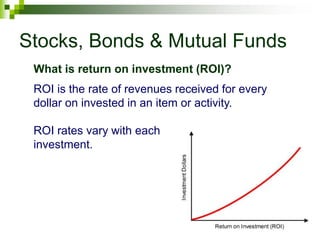
ROI is the rate of revenues received for every
dollar on invested in an item or activity.
ROI rates vary with each
investment.
What is return on investment (ROI)?
Stocks, Bonds & Mutual Funds
Stock is an instrument that signifies ownership in a
corporation and represents claim on a share of a
corporation’s assets and profits.
Stocks are typically riskier and long-term
investments.
What are stocks?
Stocks, Bonds & Mutual Funds
Bonds are interest-bearing certificates used as a
way for government or business to raise money.
The bondholder lends money to the bond issuer
for a set amount of time and interest. When the
bonds are “sold” back to the issuer, the interest
earned is given to the bondholder.
Bonds are typically low-risk and good for short-
term investments.
What are bonds?
Stocks, Bonds & Mutual Funds
Mutual funds are open-ended investments that are
professionally managed and consist of a variety of
investment instruments including stocks, bonds,
options, commodities, and money market
securities.
Diversification provides greater safety and reduces
risk.
Mutual funds are long-term investments.
What are mutual funds?
Stocks, Bonds & Mutual Funds
Real estate is a piece of land and any buildings or
structures on it.
Real estate is a long-term investment.
What is real estate?
Stocks, Bonds & Mutual Funds
Collectibles are items which have value due to its
rarity and desirability, such as antiques, coins,
cars, and art.
Collectibles are long-term investments.
What are collectibles?
Stocks, Bonds & Mutual Funds
Precious metals are natural metals that have
value, such as gold, silver, platinum, and
palladium.
Precious metals are long-term investments.
What are precious metals?
Stocks, Bonds & Mutual Funds
Do all investments offer a guaranteed positive
return on investment (ROI)?
NO! Although some investments are more likely
to have a positive return on investment.
Stocks, Bonds & Mutual Funds
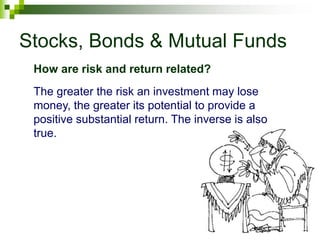
The greater the risk an investment may lose
money, the greater its potential to provide a
positive substantial return. The inverse is also
true.
How are risk and return related?
Stocks, Bonds & Mutual Funds
• Age
• Risk tolerance
• Investment goals
What factors determine the degree of risk
investors take?
Stocks, Bonds & Mutual Funds
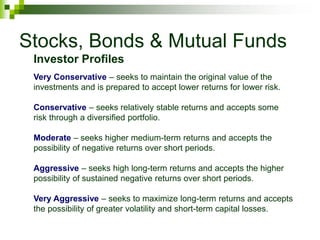
Very Conservative – seeks to maintain the original value of the
investments and is prepared to accept lower returns for lower risk.
Conservative – seeks relatively stable returns and accepts some
risk through a diversified portfolio.
Moderate – seeks higher medium-term returns and accepts the
possibility of negative returns over short periods.
Aggressive – seeks high long-term returns and accepts the higher
possibility of sustained negative returns over short periods.
Very Aggressive – seeks to maximize long-term returns and accepts
the possibility of greater volatility and short-term capital losses.
Investor Profiles
Stocks, Bonds & Mutual Funds
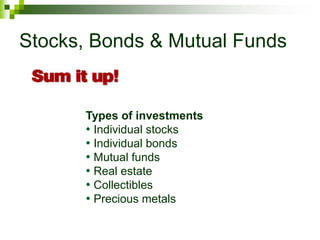
Types of investments
• Individual stocks
• Individual bonds
• Mutual funds
• Real estate
• Collectibles
• Precious metals
Piggy
Bank
Savings
Account
Individual
Bonds
Mutual
Funds
Individual
Stocks
Real
Estate
Collect-
ibles
Precious
Metals
Do you need a
minimum amount of
money to start/buy
it?
Can you get initial
money back?
Does it pay interest?
Can someone steal
it?
Is it professionally
managed?
Is it easy to access
the money?
Best for Long-Term
or Short-Term
Goals?
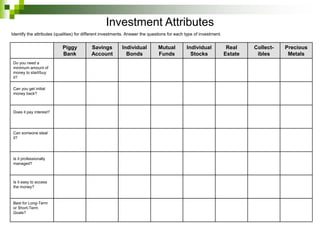
Identify the attributes (qualities) for different investments. Answer the questions for each type of investment.
Investment Attributes
Piggy
Bank
Savings
Account
Individual
Bonds
Mutual
Funds
Individual
Stocks
Real
Estate
Collect-
ibles
Precious
Metals
Do you need a
minimum amount of
money to start/buy
it?
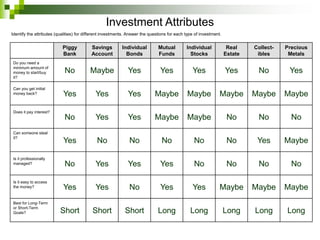
No Maybe Yes Yes Yes Yes No Yes
Can you get initial
money back? Yes Yes Yes Maybe Maybe Maybe Maybe Maybe
Does it pay interest?
No Yes Yes Maybe Maybe No No No
Can someone steal
it?
Yes No No No No No Yes Maybe
Is it professionally
managed? No Yes Yes Yes No No No No
Is it easy to access
the money? Yes Yes No Yes Yes Maybe Maybe Maybe
Best for Long-Term
or Short-Term
Goals? Short Short Short Long Long Long Long Long
Identify the attributes (qualities) for different investments. Answer the questions for each type of investment.
Investment Attributes
Stocks, Bonds & Mutual Funds
Uma will be retiring in five years. She needs a
low-risk place to put her money that will earn
interest. Where might she invest? Why?
Bonds would be a good place for her retirement
monies. They are typically low-risk and still pay
interest.
Stocks, Bonds & Mutual Funds
Skip will be retiring in 38 years. He has an
emergency fund that could support him for
nine months if something were to happen.
Skip wants his money to work for him and he
is not scared of market fluctuations. Where
might he invest? Why?
Stocks and/or mutual funds would be good options.
Typically, stocks and mutual funds perform well over
time and outperform other investments.
Stocks, Bonds & Mutual Funds
Imogene needs to start an emergency fund.
Where might she invest? Why?
A savings account in a bank would be a good option
for her. It is a low-risk investment, easily accessible
and it earns interest.
Stocks, Bonds & Mutual Funds
Anne is saving for a new car. She wants to
buy the car in three years. Where might she
invest? Why?
A savings account in a bank would be a good option
for her. She would earn interest, and it is a low-risk
investment.
Stocks, Bonds & Mutual Funds
There are different types of investments and
all have different ROI.
The greater the risk on an investment, the
greater the possibility of high returns and also
negative returns.
The type of investment should align with your
investment profile.

StocksBondsMutualFunds.ppt

  • 1.
    MODULE 3 THE NEXTBIG THING Lesson 3.2 Stocks, Bonds & Mutual Funds
  • 2.
    Stocks, Bonds &Mutual Funds What is investing? Investing is purchasing a financial product or other item of value with an expectation of favorable returns. What is the purpose of investing? The purpose of investing is to save money in order to improve financial well-being.
  • 3.
    Stocks, Bonds &Mutual Funds ROI is the rate of revenues received for every dollar on invested in an item or activity. ROI rates vary with each investment. What is return on investment (ROI)?
  • 4.
    Stocks, Bonds &Mutual Funds Stock is an instrument that signifies ownership in a corporation and represents claim on a share of a corporation’s assets and profits. Stocks are typically riskier and long-term investments. What are stocks?
  • 5.
    Stocks, Bonds &Mutual Funds Bonds are interest-bearing certificates used as a way for government or business to raise money. The bondholder lends money to the bond issuer for a set amount of time and interest. When the bonds are “sold” back to the issuer, the interest earned is given to the bondholder. Bonds are typically low-risk and good for short- term investments. What are bonds?
  • 6.
    Stocks, Bonds &Mutual Funds Mutual funds are open-ended investments that are professionally managed and consist of a variety of investment instruments including stocks, bonds, options, commodities, and money market securities. Diversification provides greater safety and reduces risk. Mutual funds are long-term investments. What are mutual funds?
  • 7.
    Stocks, Bonds &Mutual Funds Real estate is a piece of land and any buildings or structures on it. Real estate is a long-term investment. What is real estate?
  • 8.
    Stocks, Bonds &Mutual Funds Collectibles are items which have value due to its rarity and desirability, such as antiques, coins, cars, and art. Collectibles are long-term investments. What are collectibles?
  • 9.
    Stocks, Bonds &Mutual Funds Precious metals are natural metals that have value, such as gold, silver, platinum, and palladium. Precious metals are long-term investments. What are precious metals?
  • 10.
    Stocks, Bonds &Mutual Funds Do all investments offer a guaranteed positive return on investment (ROI)? NO! Although some investments are more likely to have a positive return on investment.
  • 11.
    Stocks, Bonds &Mutual Funds The greater the risk an investment may lose money, the greater its potential to provide a positive substantial return. The inverse is also true. How are risk and return related?
  • 12.
    Stocks, Bonds &Mutual Funds • Age • Risk tolerance • Investment goals What factors determine the degree of risk investors take?
  • 13.
    Stocks, Bonds &Mutual Funds Very Conservative – seeks to maintain the original value of the investments and is prepared to accept lower returns for lower risk. Conservative – seeks relatively stable returns and accepts some risk through a diversified portfolio. Moderate – seeks higher medium-term returns and accepts the possibility of negative returns over short periods. Aggressive – seeks high long-term returns and accepts the higher possibility of sustained negative returns over short periods. Very Aggressive – seeks to maximize long-term returns and accepts the possibility of greater volatility and short-term capital losses. Investor Profiles
  • 14.
    Stocks, Bonds &Mutual Funds Types of investments • Individual stocks • Individual bonds • Mutual funds • Real estate • Collectibles • Precious metals
  • 15.
    Piggy Bank Savings Account Individual Bonds Mutual Funds Individual Stocks Real Estate Collect- ibles Precious Metals Do you needa minimum amount of money to start/buy it? Can you get initial money back? Does it pay interest? Can someone steal it? Is it professionally managed? Is it easy to access the money? Best for Long-Term or Short-Term Goals? Identify the attributes (qualities) for different investments. Answer the questions for each type of investment. Investment Attributes
  • 16.
    Piggy Bank Savings Account Individual Bonds Mutual Funds Individual Stocks Real Estate Collect- ibles Precious Metals Do you needa minimum amount of money to start/buy it? No Maybe Yes Yes Yes Yes No Yes Can you get initial money back? Yes Yes Yes Maybe Maybe Maybe Maybe Maybe Does it pay interest? No Yes Yes Maybe Maybe No No No Can someone steal it? Yes No No No No No Yes Maybe Is it professionally managed? No Yes Yes Yes No No No No Is it easy to access the money? Yes Yes No Yes Yes Maybe Maybe Maybe Best for Long-Term or Short-Term Goals? Short Short Short Long Long Long Long Long Identify the attributes (qualities) for different investments. Answer the questions for each type of investment. Investment Attributes
  • 17.
    Stocks, Bonds &Mutual Funds Uma will be retiring in five years. She needs a low-risk place to put her money that will earn interest. Where might she invest? Why? Bonds would be a good place for her retirement monies. They are typically low-risk and still pay interest.
  • 18.
    Stocks, Bonds &Mutual Funds Skip will be retiring in 38 years. He has an emergency fund that could support him for nine months if something were to happen. Skip wants his money to work for him and he is not scared of market fluctuations. Where might he invest? Why? Stocks and/or mutual funds would be good options. Typically, stocks and mutual funds perform well over time and outperform other investments.
  • 19.
    Stocks, Bonds &Mutual Funds Imogene needs to start an emergency fund. Where might she invest? Why? A savings account in a bank would be a good option for her. It is a low-risk investment, easily accessible and it earns interest.
  • 20.
    Stocks, Bonds &Mutual Funds Anne is saving for a new car. She wants to buy the car in three years. Where might she invest? Why? A savings account in a bank would be a good option for her. She would earn interest, and it is a low-risk investment.
  • 21.
    Stocks, Bonds &Mutual Funds There are different types of investments and all have different ROI. The greater the risk on an investment, the greater the possibility of high returns and also negative returns. The type of investment should align with your investment profile.