Stocks,
Soups and
Sauces
Overview:
This lesson covers the skills,
knowledge, and attitudes
required to prepare various
stocks, sauces, and soup in a
commercial kitchen or
catering operation.
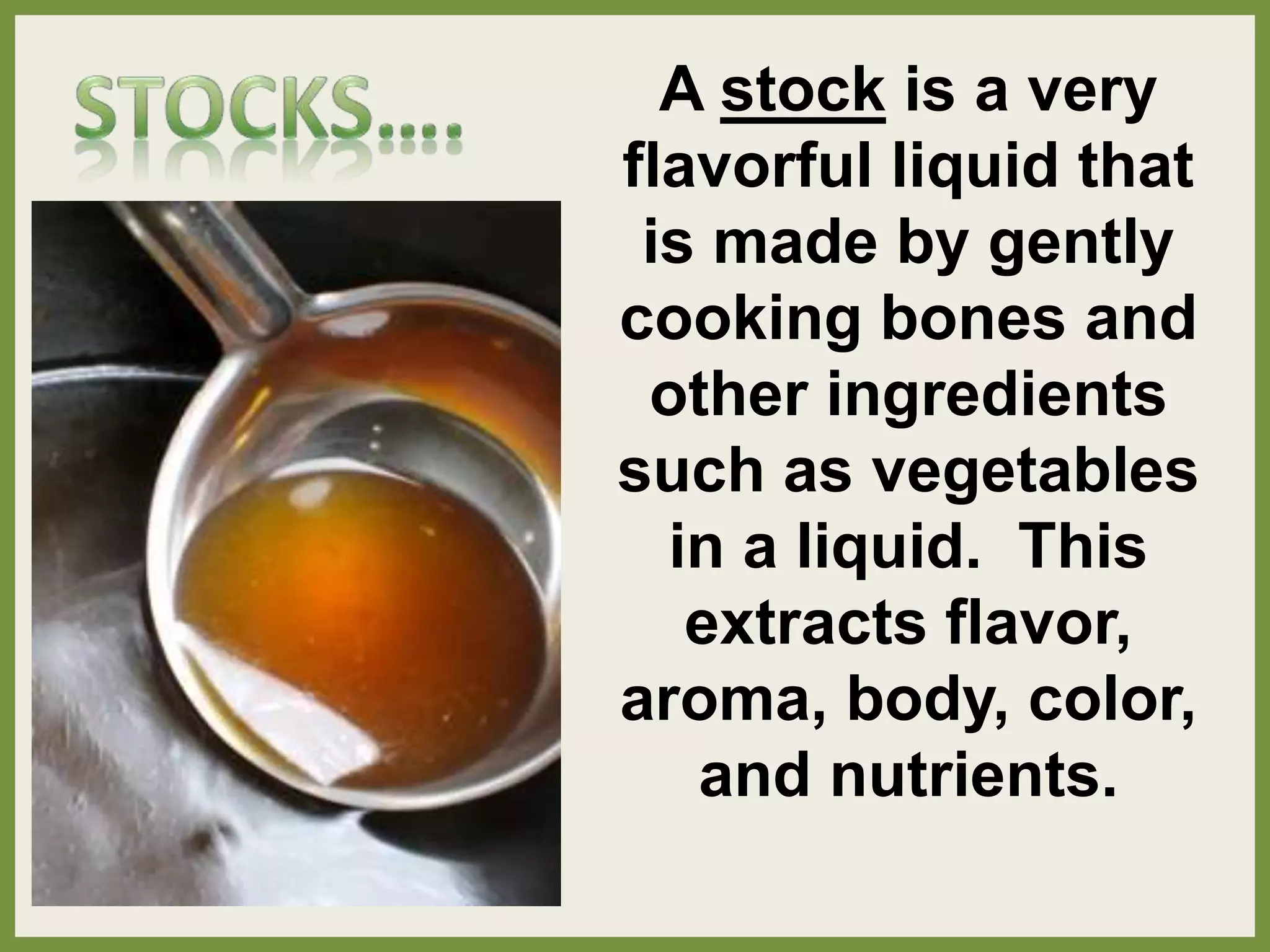
A stock is a very
flavorful liquid that
is made by gently
cooking bones and
other ingredients
such as vegetables
in a liquid. This
extracts flavor,
aroma, body, color,
and nutrients.
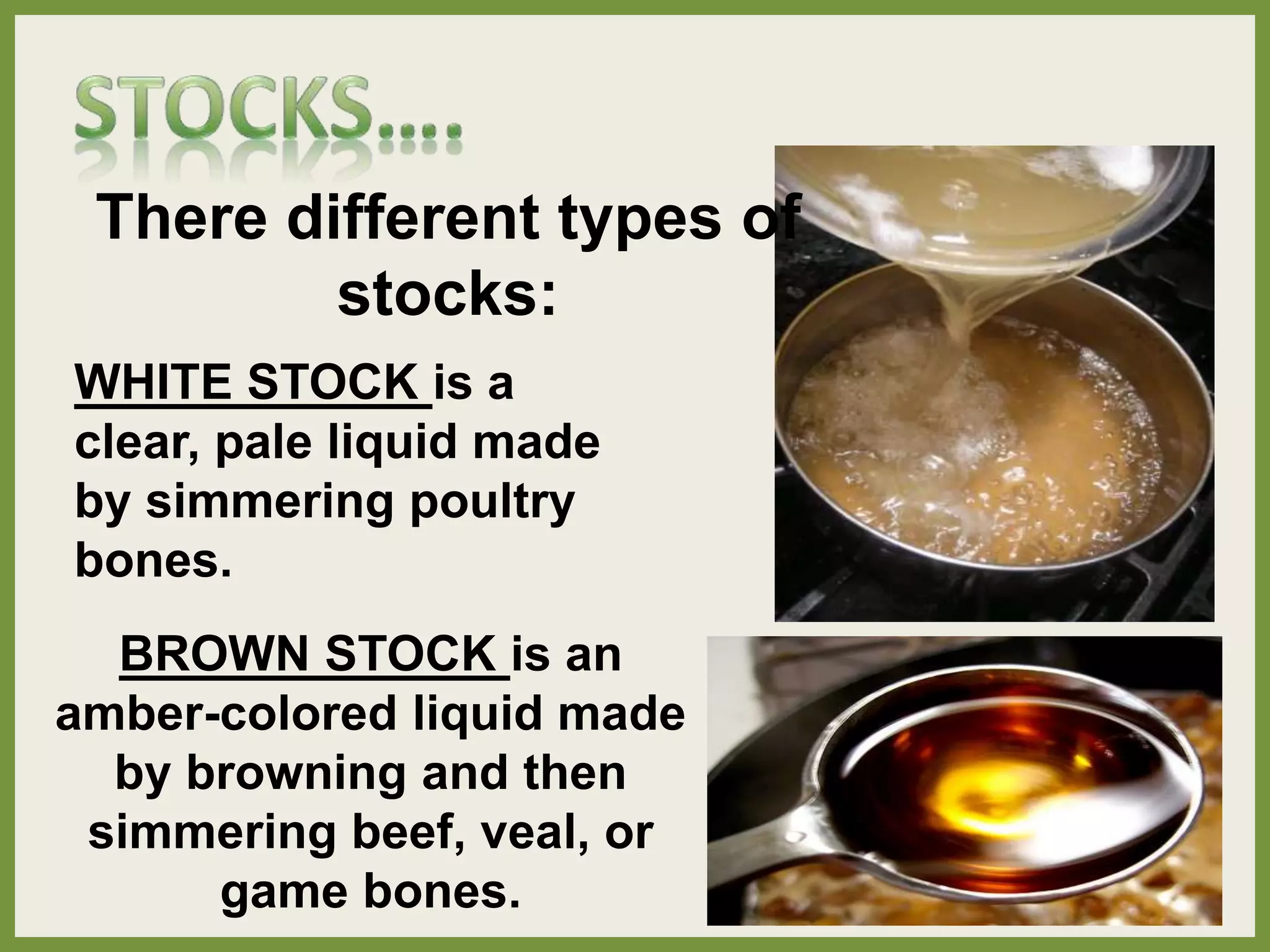
WHITE STOCK is a
clear, pale liquid made
by simmering poultry
bones.
BROWN STOCK is an
amber-colored liquid made
by browning and then
simmering beef, veal, or
game bones.
There different types of
stocks:
FUMET (foo-MAY) is a
very flavorful, light-
colored stock made with
fish bones.
COURT BOUILLON
(court boo-YON) is a
very aromatic vegetable
broth, and is used for
poaching fish or
vegetables.
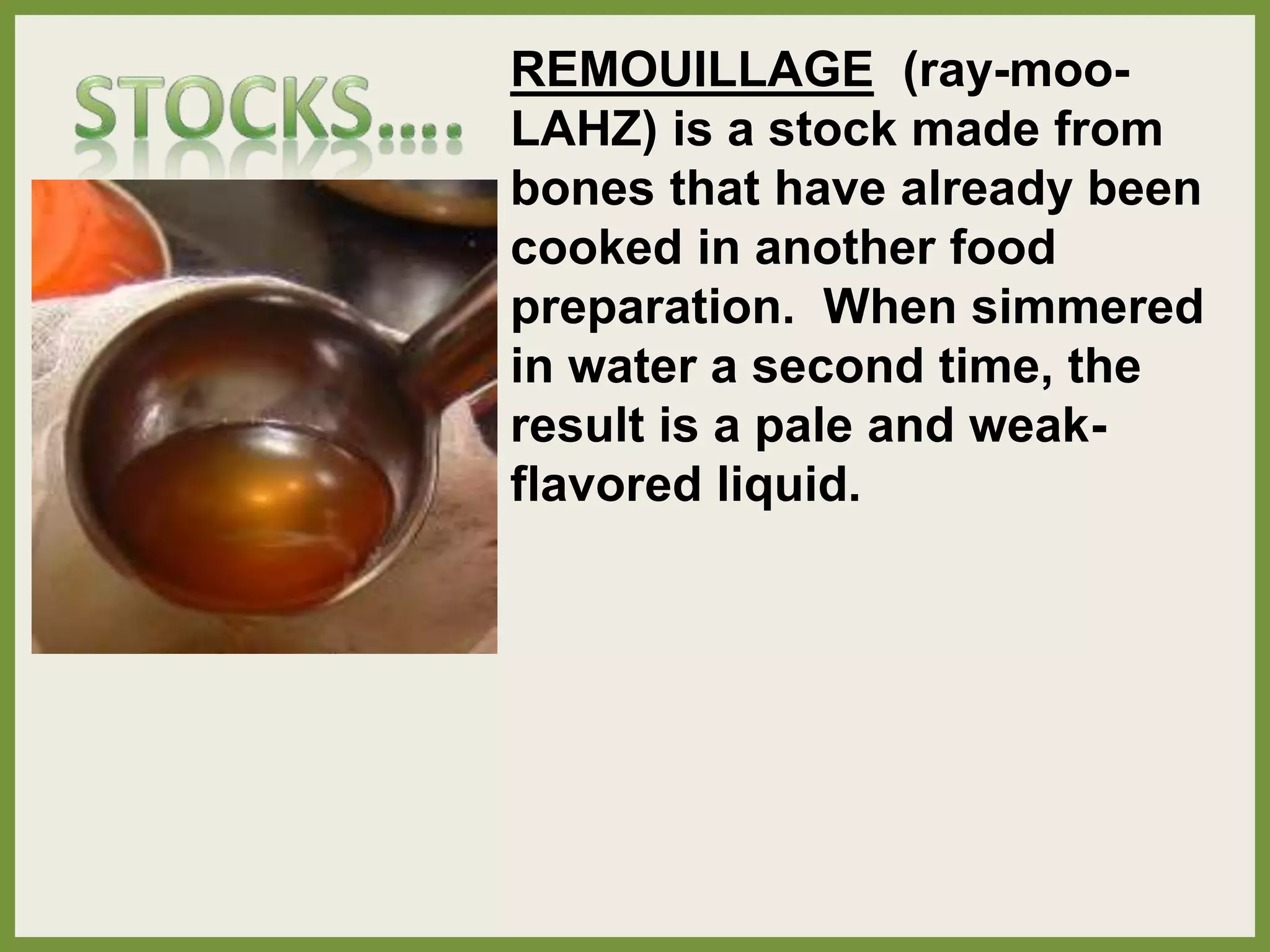
REMOUILLAGE (ray-moo-
LAHZ) is a stock made from
bones that have already been
cooked in another food
preparation. When simmered
in water a second time, the
result is a pale and weak-
flavored liquid.
All stocks contain four parts:
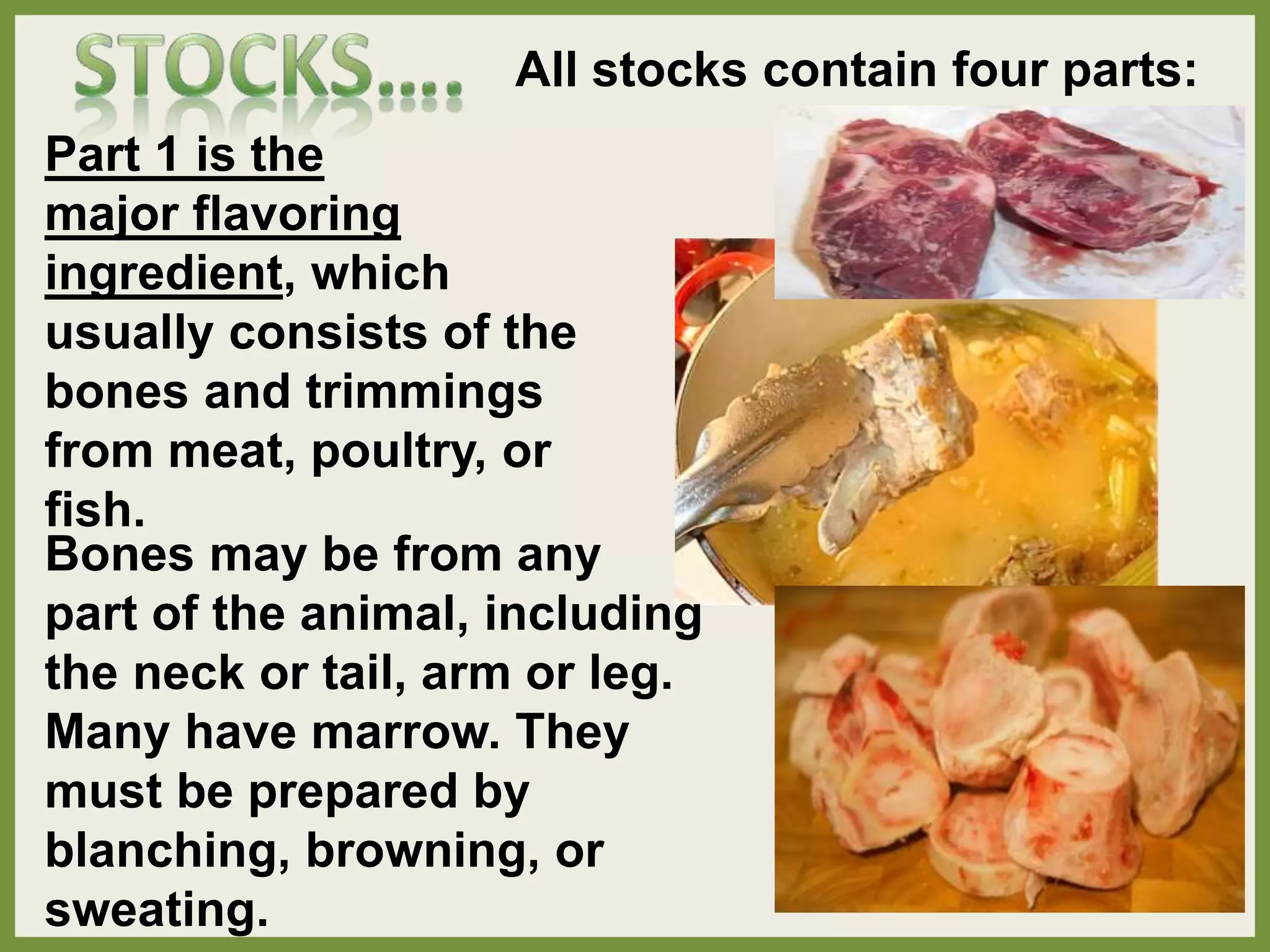
Part 1 is the
major flavoring
ingredient, which
usually consists of the
bones and trimmings
from meat, poultry, or
fish.
Bones may be from any
part of the animal, including
the neck or tail, arm or leg.
Many have marrow. They
must be prepared by
blanching, browning, or
sweating.
All stocks contain four parts:
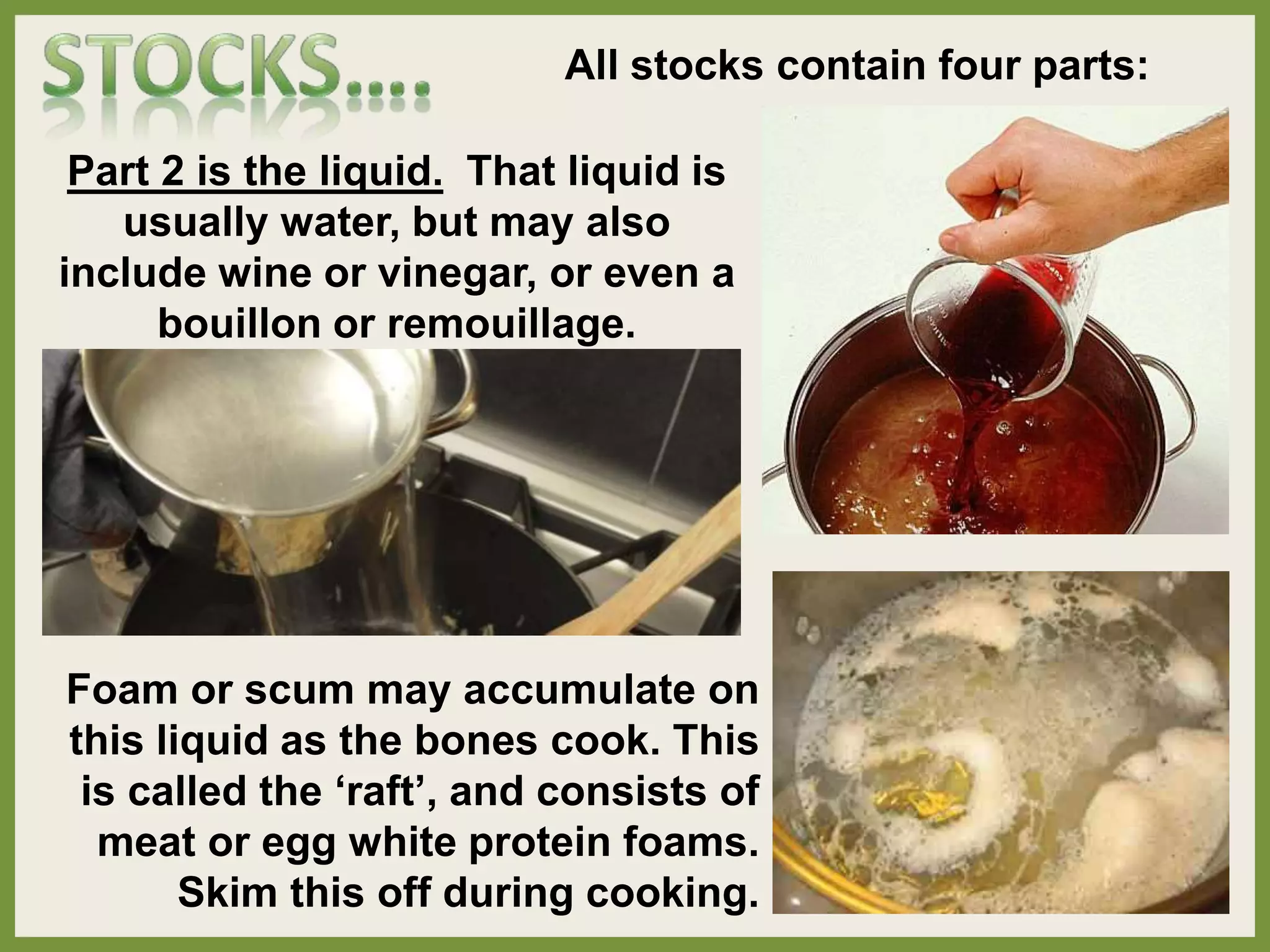
Part 2 is the liquid. That liquid is
usually water, but may also
include wine or vinegar, or even a
bouillon or remouillage.
Foam or scum may accumulate on
this liquid as the bones cook. This
is called the ‘raft’, and consists of
meat or egg white protein foams.
Skim this off during cooking.
All stocks contain four parts:
Part 3 is the mirepoix
(meer-PWAH).
The standard mirepoix is
50% onions, 25% carrots,
and 25% celery… all
chopped in small pieces
when simmering time is
short, and large pieces
when simmering time is
an hour or longer.
A ‘white’ mirepoix, for white stock or a fumet, may have
mushrooms substituted for the carrots.
All stocks contain four parts:
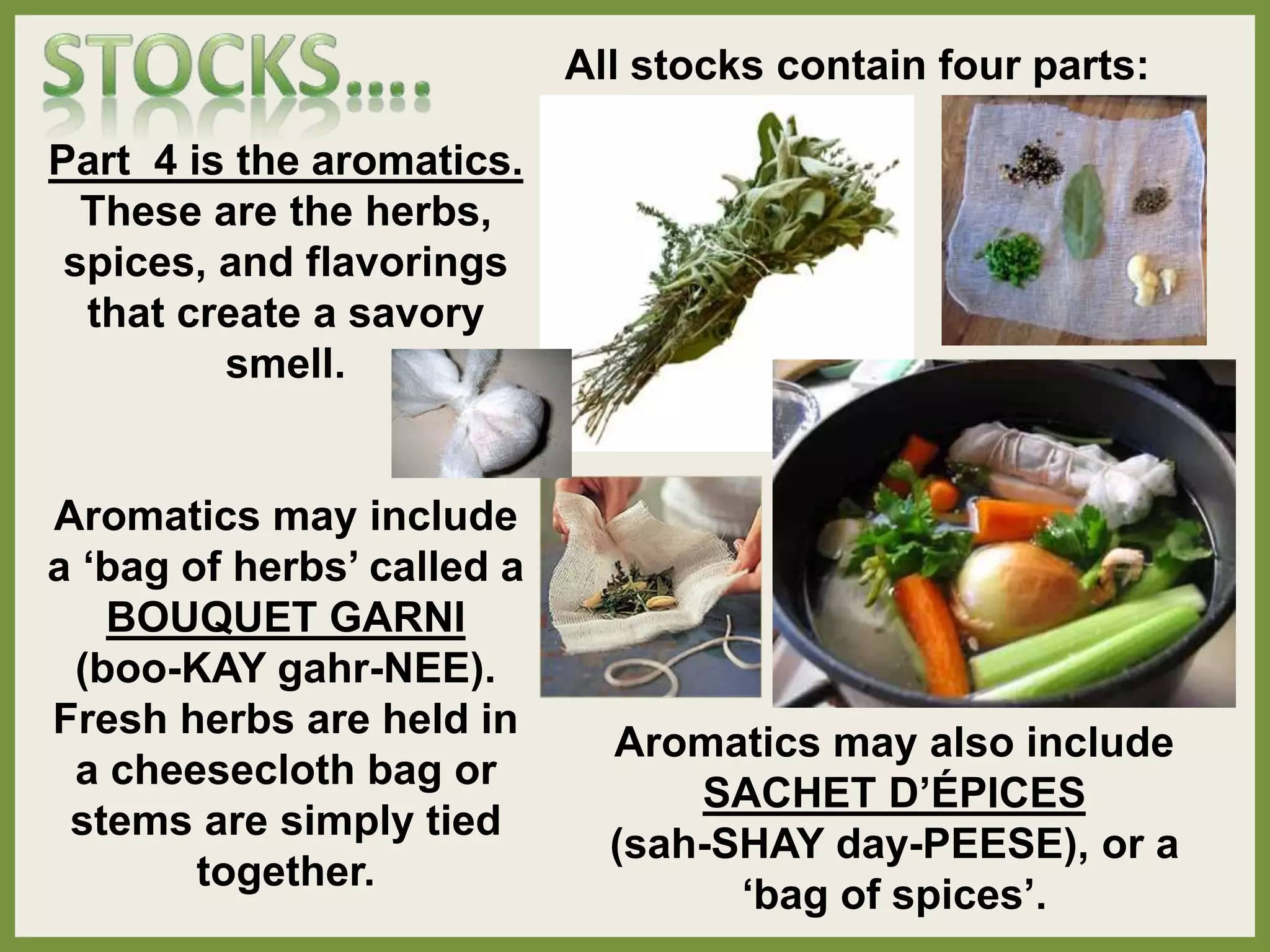
Part 4 is the aromatics.
These are the herbs,
spices, and flavorings
that create a savory
smell.
Aromatics may include
a ‘bag of herbs’ called a
BOUQUET GARNI
(boo-KAY gahr-NEE).
Fresh herbs are held in
a cheesecloth bag or
stems are simply tied
together.
Aromatics may also include
SACHET D’ÉPICES
(sah-SHAY day-PEESE), or a
‘bag of spices’.
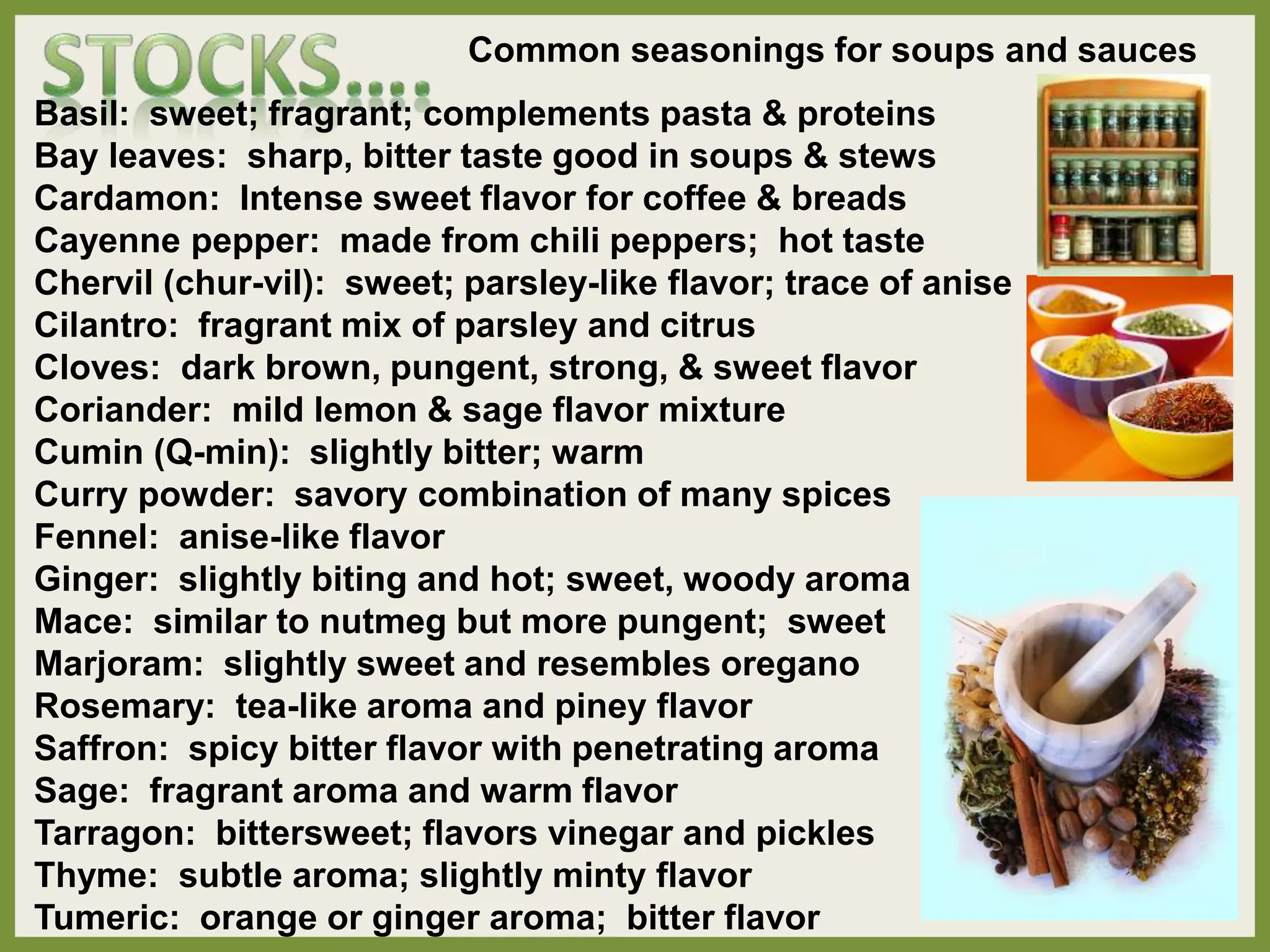
Basil: sweet; fragrant; complements pasta & proteins
Bay leaves: sharp, bitter taste good in soups & stews
Cardamon: Intense sweet flavor for coffee & breads
Cayenne pepper: made from chili peppers; hot taste
Chervil (chur-vil): sweet; parsley-like flavor; trace of anise
Cilantro: fragrant mix of parsley and citrus
Cloves: dark brown, pungent, strong, & sweet flavor
Coriander: mild lemon & sage flavor mixture
Cumin (Q-min): slightly bitter; warm
Curry powder: savory combination of many spices
Fennel: anise-like flavor
Ginger: slightly biting and hot; sweet, woody aroma
Mace: similar to nutmeg but more pungent; sweet
Marjoram: slightly sweet and resembles oregano
Rosemary: tea-like aroma and piney flavor
Saffron: spicy bitter flavor with penetrating aroma
Sage: fragrant aroma and warm flavor
Tarragon: bittersweet; flavors vinegar and pickles
Thyme: subtle aroma; slightly minty flavor
Tumeric: orange or ginger aroma; bitter flavor
Common seasonings for soups and sauces
Guidelines for preparing stock
1. Follow the correct procedures for cooling and storing
stock and make sure that any stock you use is flavorful
and wholesome.
2. Follow the cooking time for stock. The following are
approximate cooking time for different stocks; the time
will vary according to numerous factors such as
ingredients quality, volume and cooking temperature.
White beef stock - 8 to 10 hours
White and brown Veal Game stock – 6 to 8 hours
White poultry and Game Bird Stocks – 3 to 4 hours
Fish Stock – 45 minutes to 1 hour
Vegetables Stock – 45 minutes to 1 hour, depending on
the specific ingredients and the size of vegetables cut
3. The stock ingredients are boiled
starting with cold water. This promotes
the extraction of protein which may be
sealed in by hot water.
4. Stocks are simmered gently, with
small bubbles at the bottom but not
breaking at the surface. If a stock is
boiled, it will be cloudy.
5. Salt is not usually added to a stock,
as this causes it to become too salty,
since most stocks are preserved to
make soup and sauces.
6. Meat is added to the stock before
the vegetables and the ―scum‖ that
rises to the surface is skimmed off
before further ingredients are added.
Stocks, sometimes made in large
quantities, must be cooled down
quickly before refrigeration. Divide it
into smaller portions, place the
container into an ice-water bath, and
stir often.
As the stock cools or
after it has been
refrigerated, fat
hardens on the
surface.
Lift or scrape away this fat for
better nutrition and better color.
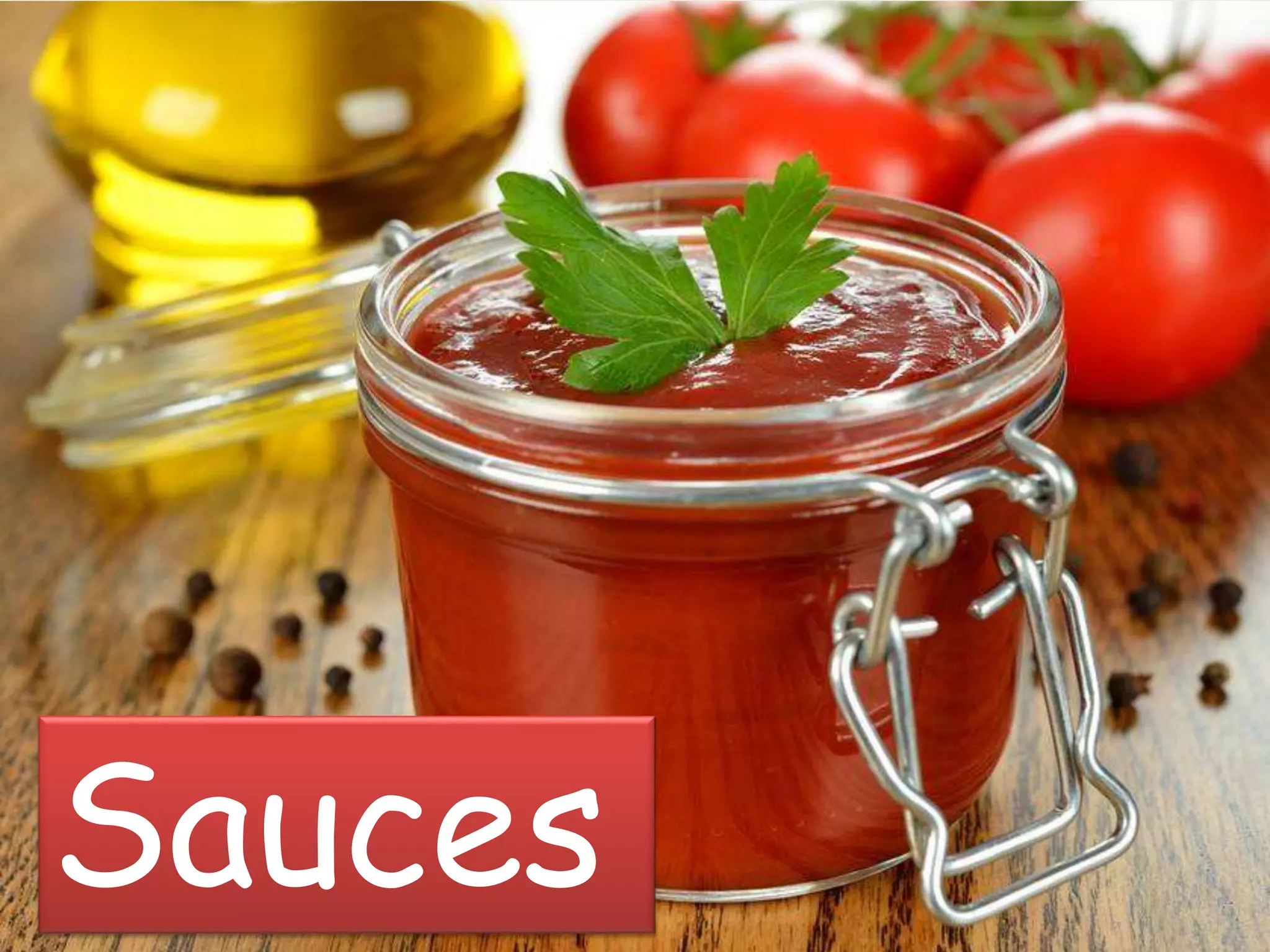
Sauces
Sauces
One of the important
components of a dish is the sauce.
Sauces serve a particular function
in the composition of a dish.
These enhance the taste of
the food to be served as well
as add moisture or succulence
to food that are cooked dry.
Sauce is a flavorful liquid, usually
thickened that is used to season,
flavor and enhance other foods. It
adds:
1.Moistness
2. Flavor
3. Richness
4. Appearance (color and shine)
5. Appeal
Variation of Sauces
Hot sauce- made just before
they are to be used
Cold sauce- cooked ahead of
time, then cooled, covered
and placed in the refrigerator
to chill
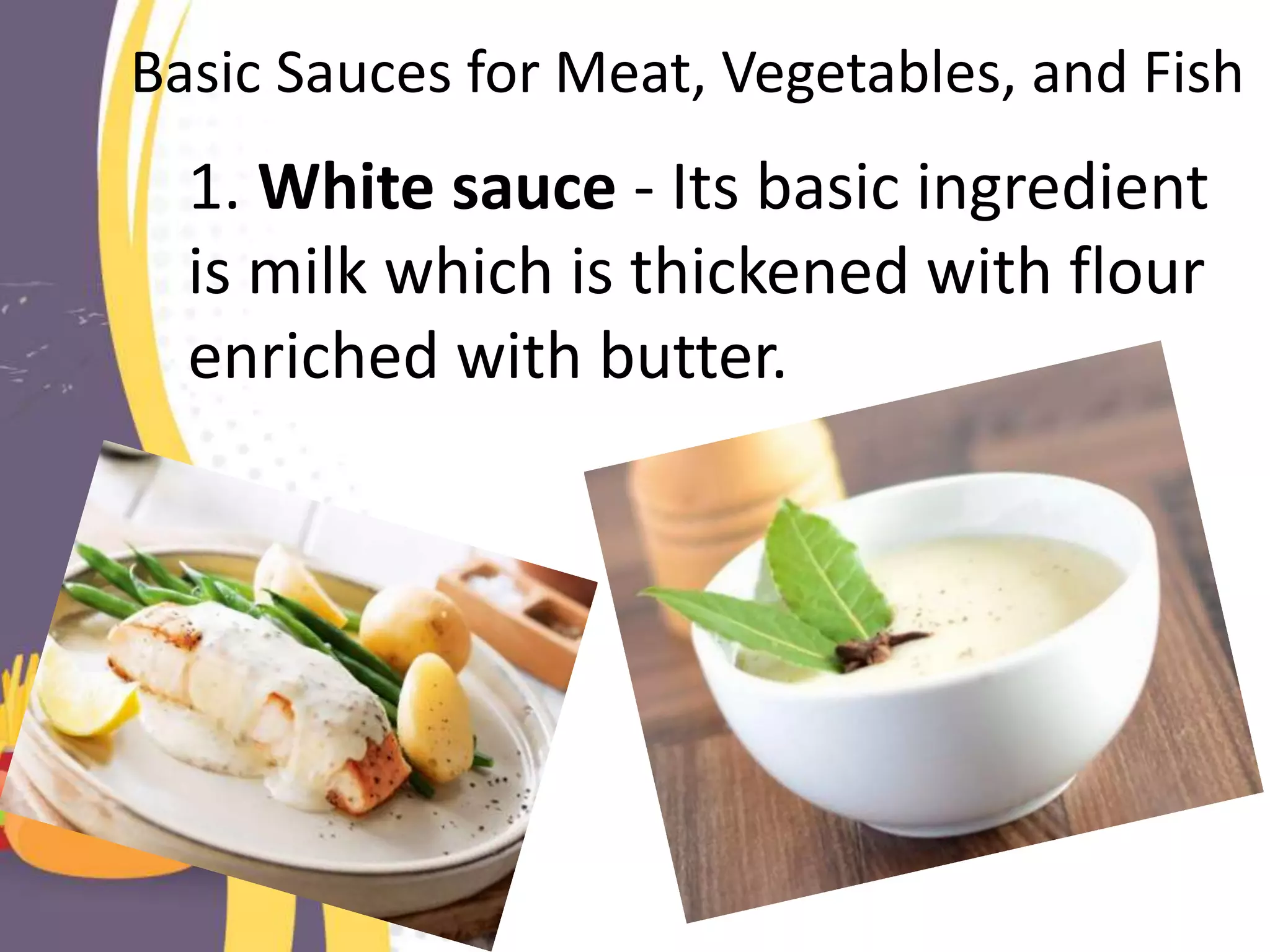
Basic Sauces for Meat, Vegetables, and Fish
1. White sauce - Its basic ingredient
is milk which is thickened with flour
enriched with butter.
2. Veloute sauce- Its chief
ingredients are veal, chicken and
fish broth, thickened with blonde
roux.
3. Hollandaise – It is a rich
emulsified sauce made from
butter, egg yolks, lemon juice and
cayenne.
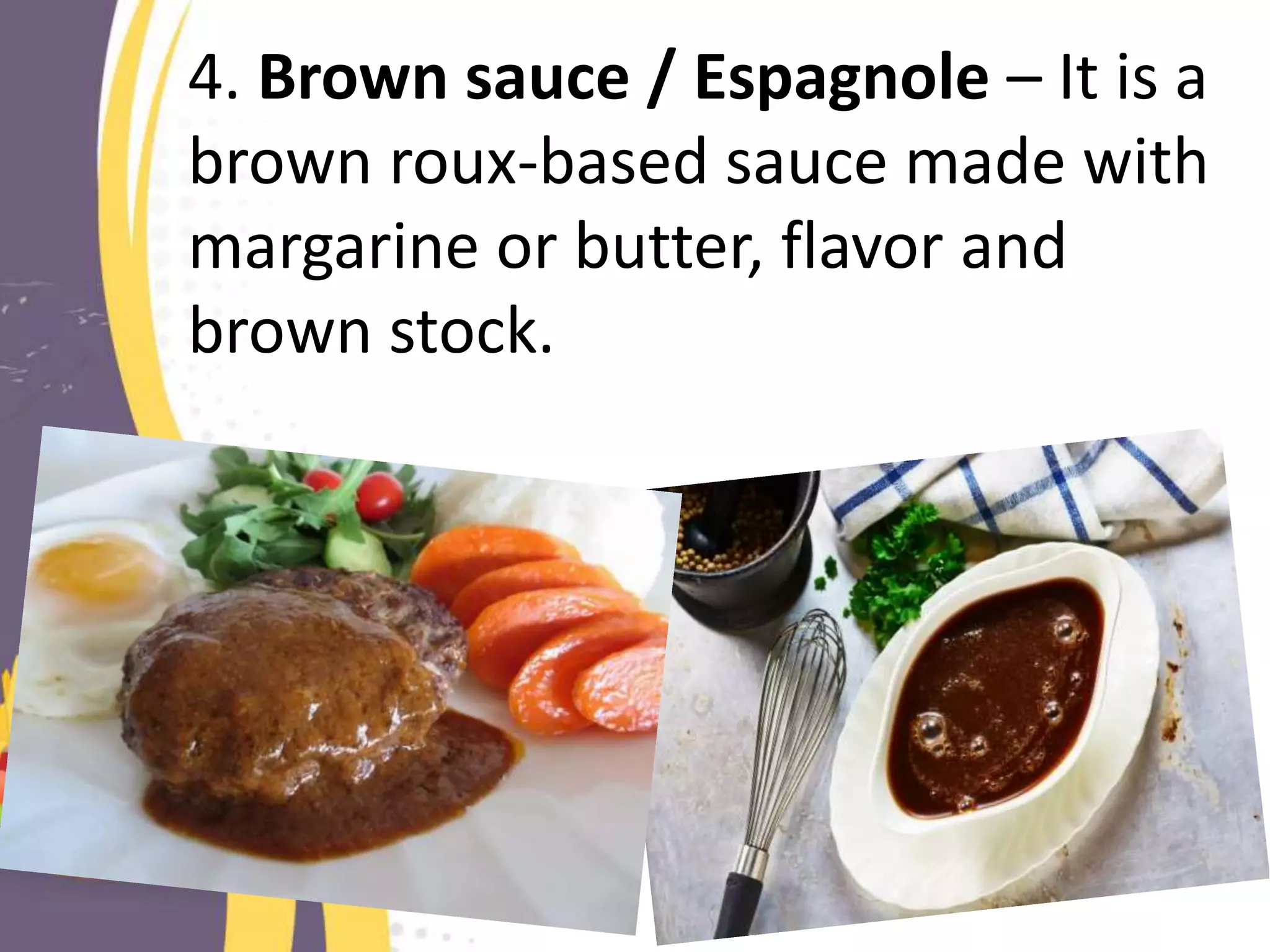
4. Brown sauce / Espagnole – It is a
brown roux-based sauce made with
margarine or butter, flavor and
brown stock.
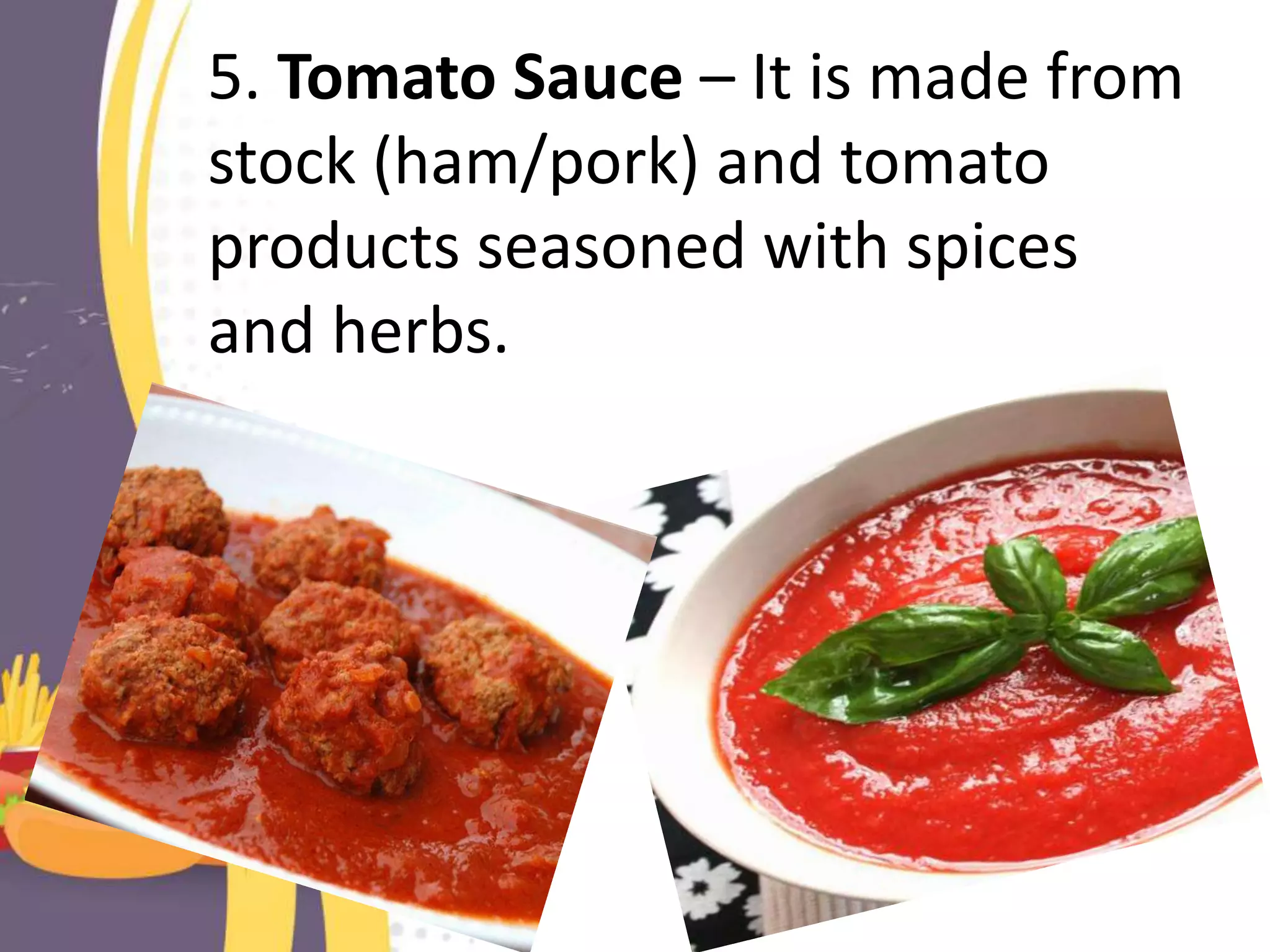
5. Tomato Sauce – It is made from
stock (ham/pork) and tomato
products seasoned with spices
and herbs.
Thickening agent – thickens sauce
to the right consistency. The sauce
must be thick enough to cling
lightly to the food.
Starch granules are separated in
two ways:
Mixing the starch with fat.
Example: ROUX
Mixing the starch with a cold
liquid. Example: SLURRY
Roux – is a cooked mixture of
equal parts by weight of fat and
flour.
Fat
A. Clarified butter: Using clarified
butter results to finest sauces
because of its flavor.
B. Margarine: Used as a
substitute for butter because of
its lower cost.
C. Animal fat: Chicken fat, beef
drippings and lard.
D. Vegetable oil and shortening:
Can be used for roux, but it adds
no flavor.
Hygienic Principles and Practices in
Sauce Making
1.Make sure all equipment is
perfectly clean.
2. Hold sauce no longer than 1 ½
hours. Make only enough to serve in
this time, and discard any that is left
over.
3. Never mix an old batch of
sauce with a new batch.
Basic Finishing Techniques in Sauce
Making
Liaison mixture of egg yolks and cream
added to sauce to give extra richness and
smoothness.
Heavy cream- added to give flavor and
richness to sauce
Butter - Add softened butter to hot
sauce and swirl until it melts. Serve
immediately to prevent separation of
butter. Butter gives extra shine and
smoothness to the sauce.
Soup
Ingredients of soup
• Meat (chicken, beef, pork, lamb, fish)
• Salt
• Pepper
• Vegetables
• Onion • Butter
• Garlic • Cream
• Water
• Eggs
• Cornstarch
• Garnishes (slices of lemon, egg, shredded vegetables,
pimiento strips)
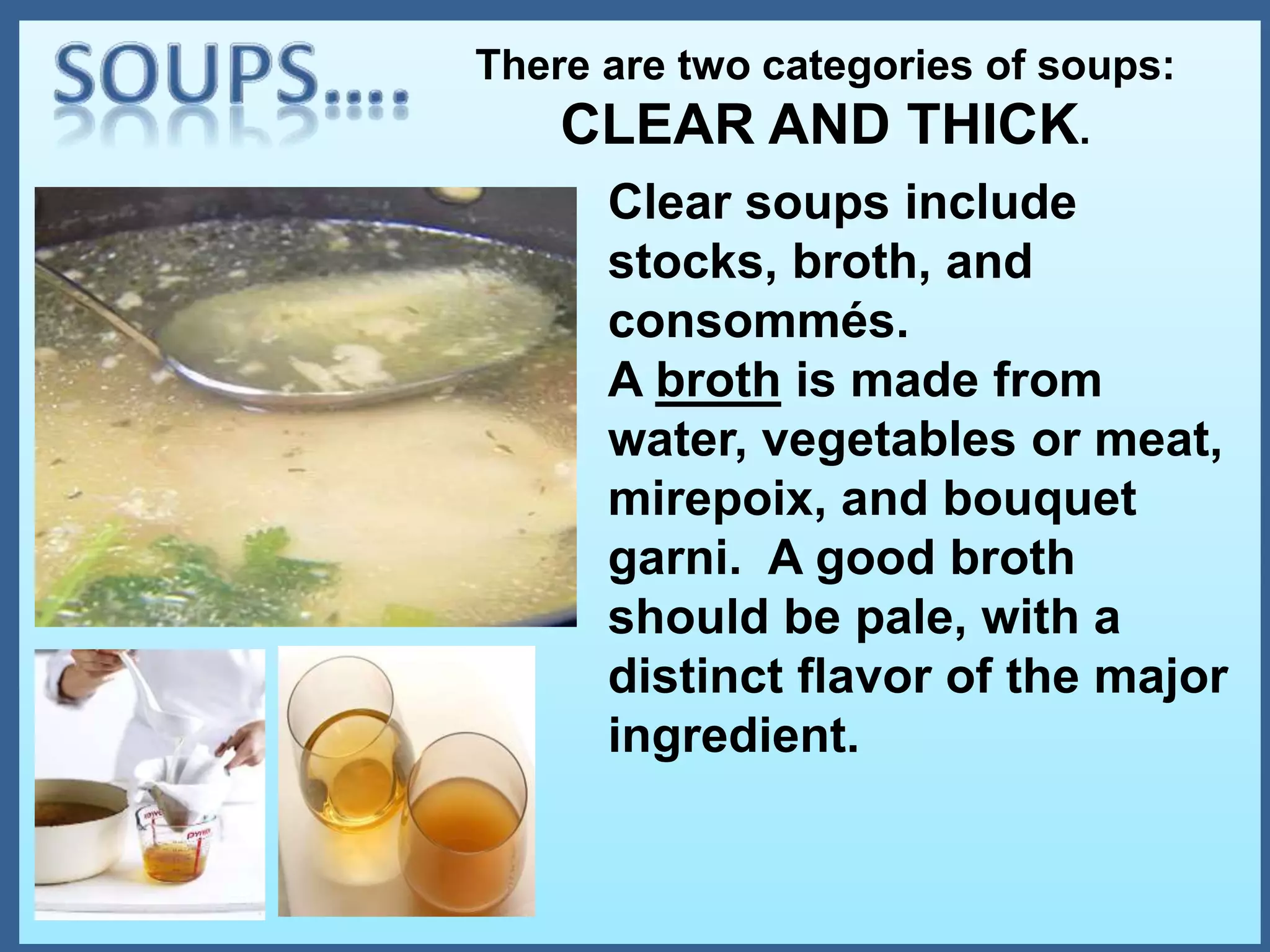
There are two categories of soups:
CLEAR AND THICK.
Clear soups include
stocks, broth, and
consommés.
A broth is made from
water, vegetables or meat,
mirepoix, and bouquet
garni. A good broth
should be pale, with a
distinct flavor of the major
ingredient.
A basic consommé
consists of some
combination of meat,
mirepoix, a tomato
product, seasonings,
egg white, and/or
oignon brûlé (oy-
NYON broo-LAY).
The oignon brûlé is an
onion that has been
burned by grilling it,
holding it over an open
flame, or pressing it onto a
hot skillet to brown the
outside and intensify it’s
flavor.
The second category of soups is THICK
SOUPS which include cream soups, pureé
soups, bisques, chowders, and specialty
soups.
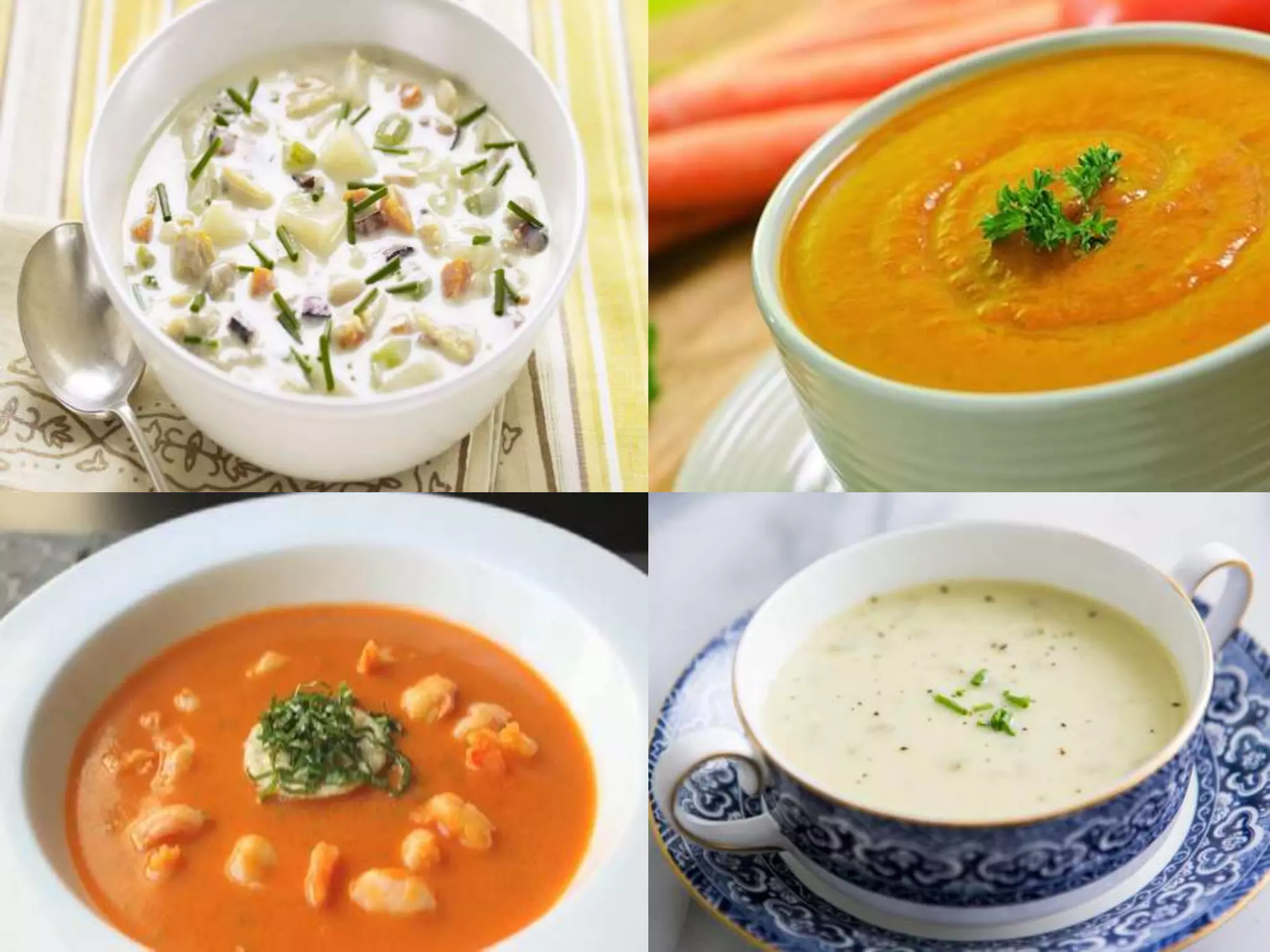
A cream soup is made with a thickener, the most
common of which is called a roux (roo); a fat and
flour mixture.
 Sauté the main flavoring ingredient in a
small amount of butter or oil.
 Add flour and cook briefly to eliminate the
starchy taste.
 Add the stock and vegetables; simmer ‘til
tender.
 Add cream; heat; garnish; serve. If you are
adding pre-cooked vegetables, you may
eliminate the stock.
 Boiling cream soups breaks down the milk
fat, causing the soup to become thin and
watery.
A purée soup is thickened by the starch found in the
main ingredient. The starch is released when the
ingredient is puréed. The main ingredient may be
cooked and puréed prior to adding it to the liquid OR
the finished soup can be puréed in a food processor
blender prior to serving.
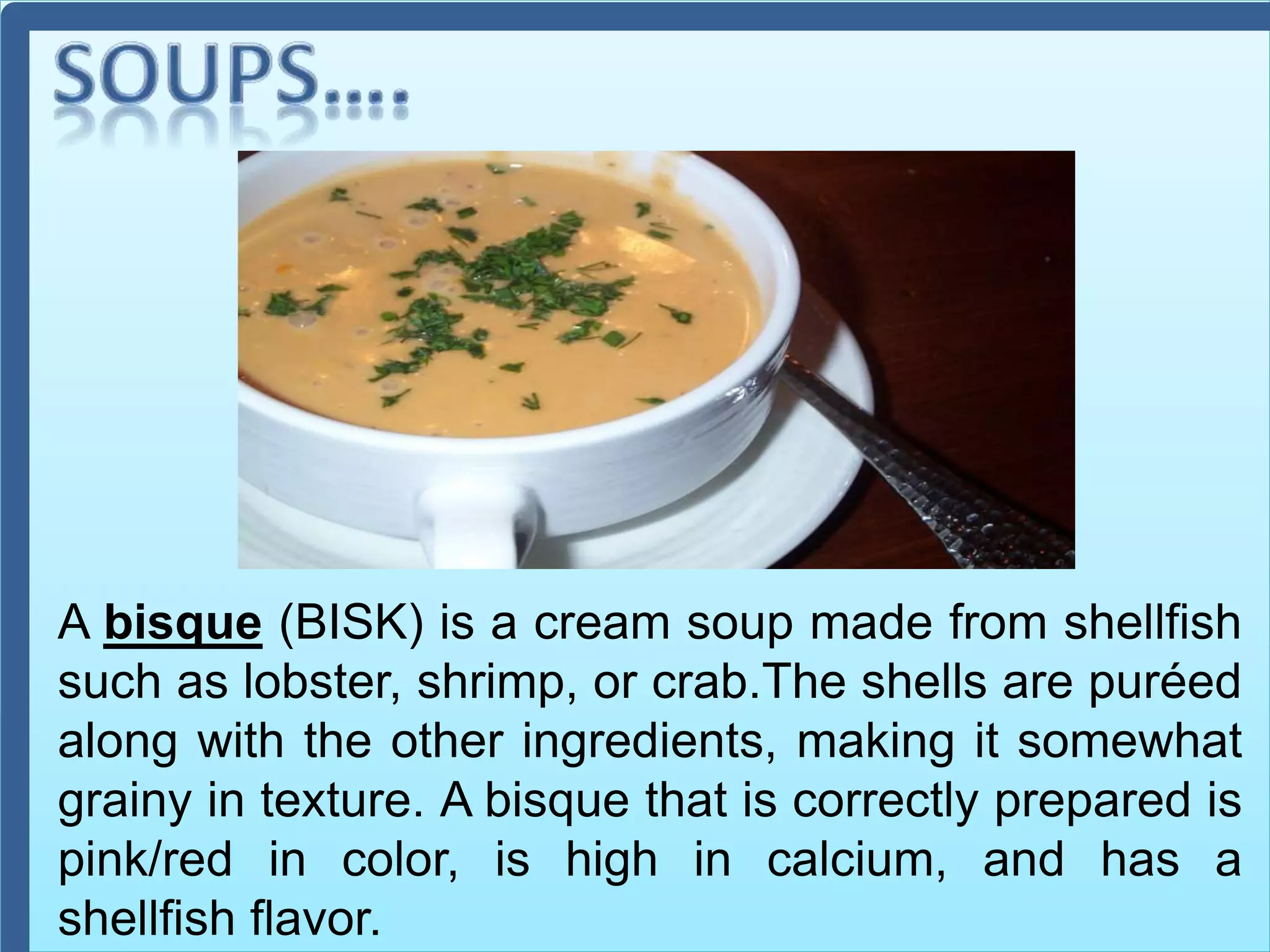
A bisque (BISK) is a cream soup made from shellfish
such as lobster, shrimp, or crab.The shells are puréed
along with the other ingredients, making it somewhat
grainy in texture. A bisque that is correctly prepared is
pink/red in color, is high in calcium, and has a
shellfish flavor.
A chowder is a very hearty soup, usually creamed, and with
large chunks of ingredients.
New England Clam Chowder has a cream base; Manhattan
Clam Chowder has a tomato base.
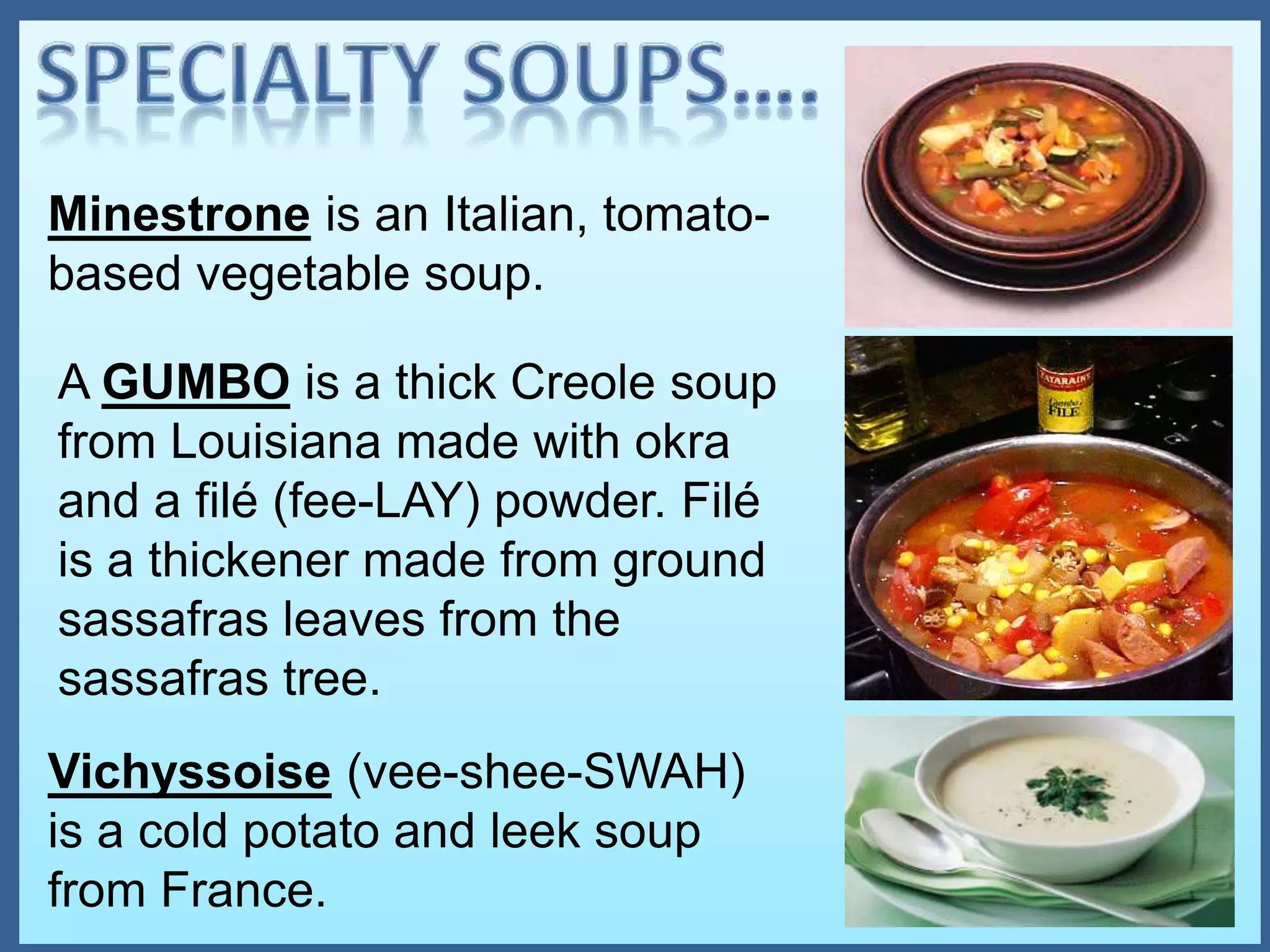
Minestrone is an Italian, tomato-
based vegetable soup.
Vichyssoise (vee-shee-SWAH)
is a cold potato and leek soup
from France.
A GUMBO is a thick Creole soup
from Louisiana made with okra
and a filé (fee-LAY) powder. Filé
is a thickener made from ground
sassafras leaves from the
sassafras tree.
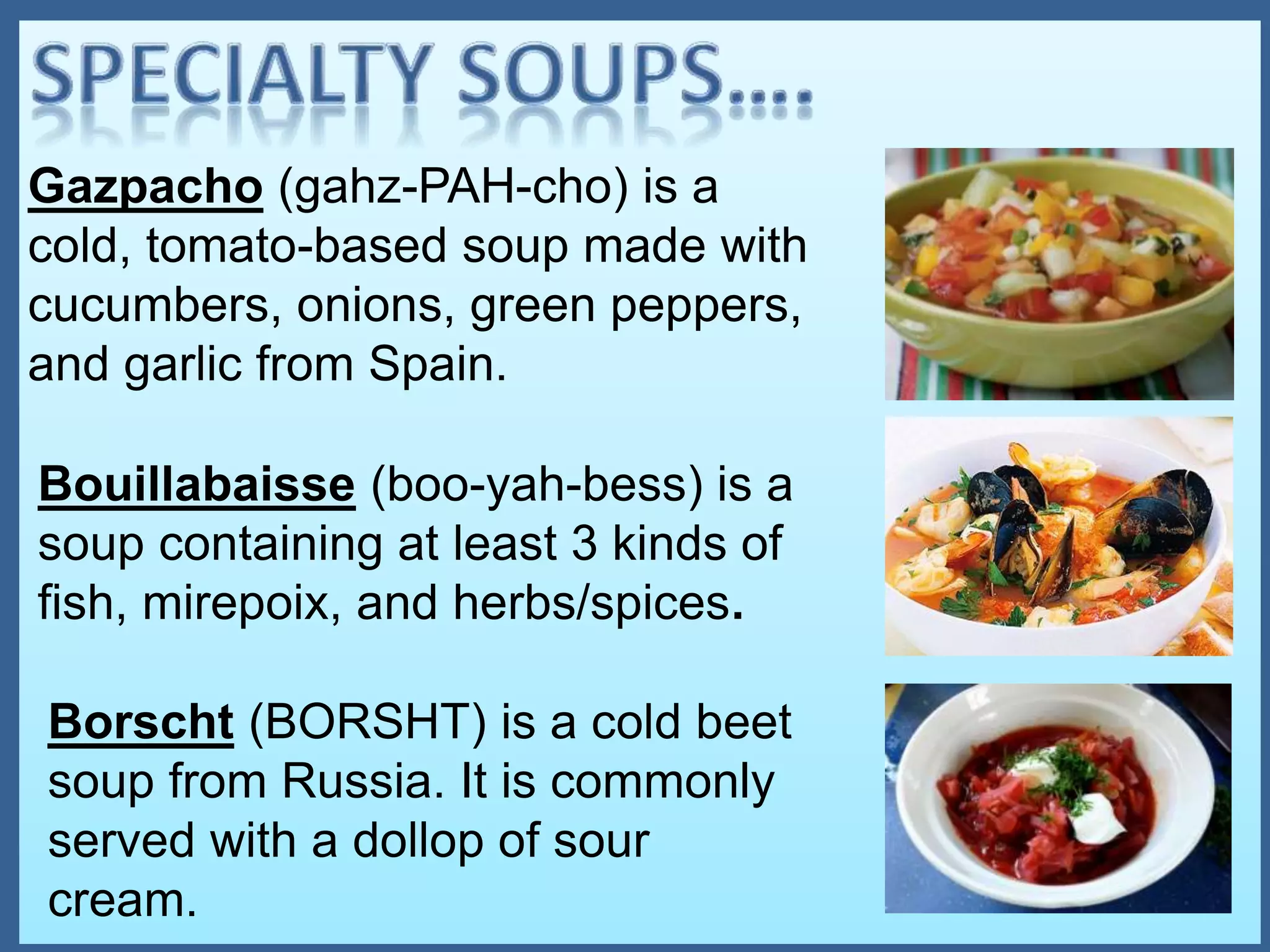
Gazpacho (gahz-PAH-cho) is a
cold, tomato-based soup made with
cucumbers, onions, green peppers,
and garlic from Spain.
Bouillabaisse (boo-yah-bess) is a
soup containing at least 3 kinds of
fish, mirepoix, and herbs/spices.
Borscht (BORSHT) is a cold beet
soup from Russia. It is commonly
served with a dollop of sour
cream.
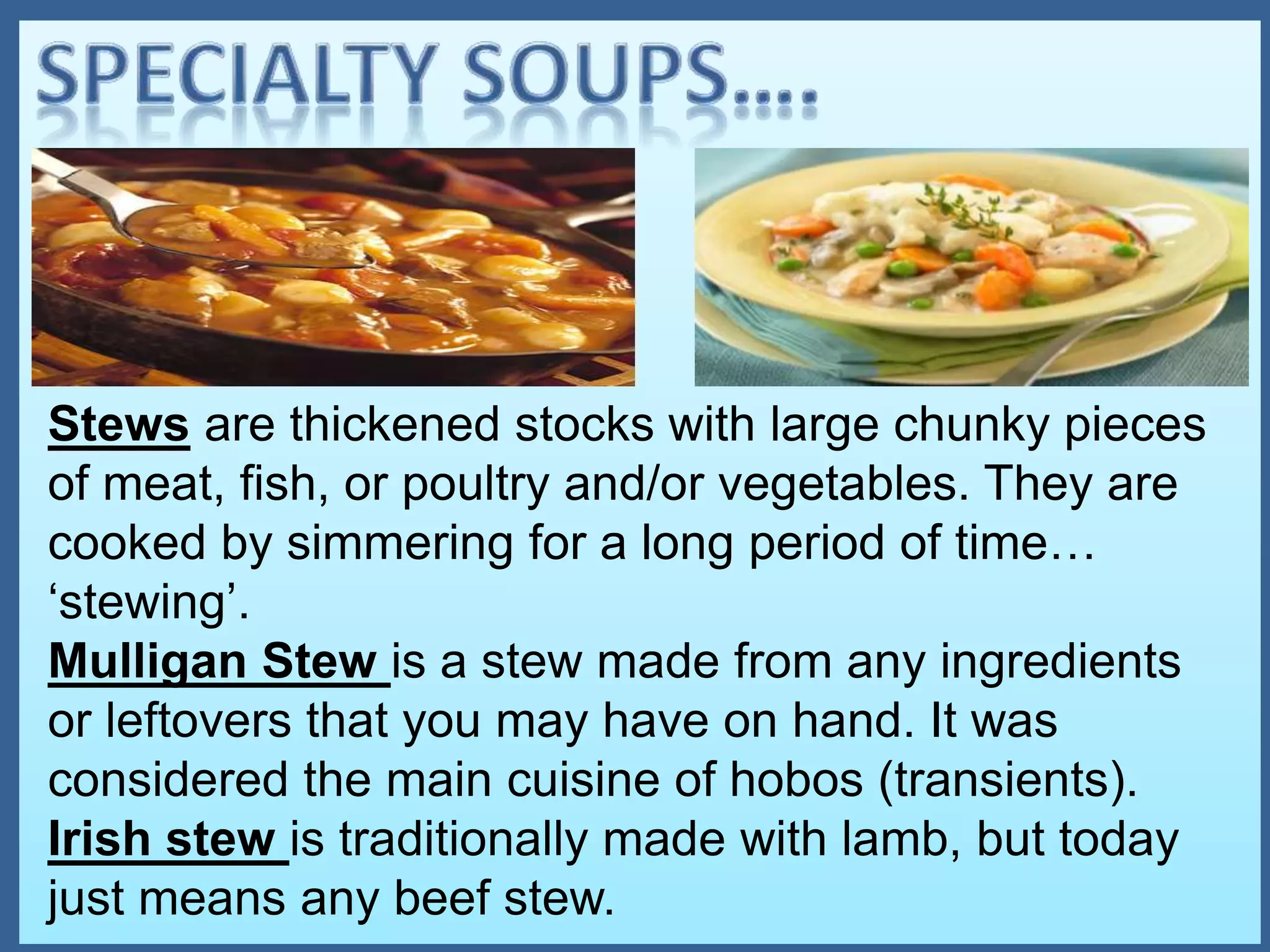
Stews are thickened stocks with large chunky pieces
of meat, fish, or poultry and/or vegetables. They are
cooked by simmering for a long period of time…
‘stewing’.
Mulligan Stew is a stew made from any ingredients
or leftovers that you may have on hand. It was
considered the main cuisine of hobos (transients).
Irish stew is traditionally made with lamb, but today
just means any beef stew.
IDENTIFICATION:
1. It is a stock with clear, pale liquid
made by simmering poultry bones.
2. What kind of stock that is very
flavorful, light-colored stock made with
fish bones.
3. It is an amber-colored liquid made
by browning and then simmering beef,
veal, or game bones.
4. is a very aromatic vegetable broth,
and is used for poaching fish or
vegetables.
5. It is a flavorful liquid, usually
thickened that is used to season, flavor
and enhance other foods.
6. Its chief ingredients are veal, chicken
and fish broth, thickened with blonde
roux.
7. It is a rich emulsified sauce made from
butter, egg yolks, lemon juice and
cayenne.
8. Its basic ingredient is milk which is
thickened with flour enriched with
butter.
9. is a very flavorful liquid that is made
by gently cooking bones and other
ingredients such as vegetables in a
liquid.
10. It is a cream soup made from
shellfish such as lobster, shrimp, or
crab.
11. It is a very hearty soup, usually
creamed, and with large chunks of
ingredients.
12. It is made with a thickener, the
most common of which is called a
roux.
13. It is thickened by the starch found in
the main ingredient.
14. is an onion that has been burned by
grilling it, holding it over an open flame,
or pressing it onto a hot skillet to brown
the outside and intensify it’s flavor.
15. It is composed of 50% onions, 25%
carrots and 25% celery.
Italy Louisiana France
Russia Philippines India
1. Minestrone 6. Ginataan
2. Vichyssoise
3. Gazpacho
4. Gumbo
5.Borscht
Enumeration:
Give the FOUR
ingredients found in a
sotck.
1. White stock
2. Fumet
3. Brown stock
4. Court bouillon
5. Sauce
6. Veloute sauce
7. Hollandaise
8. White sauce
9. Stock
10.Bisque
11.Chowder
12.Creamy soup
13.Pureee soup
14.Oignon brule
15.mirepiox
1.Italy
2.France
3.Spain
4.Louissana
5.Russia
6.Philippines
7.Main ingreidient
8.Liquid
9.Mirepoix
10.aromatics
Stocks, soups and sauces

Stocks, soups and sauces

  • 1.
  • 2.
    Overview: This lesson coversthe skills, knowledge, and attitudes required to prepare various stocks, sauces, and soup in a commercial kitchen or catering operation.
  • 3.
    A stock isa very flavorful liquid that is made by gently cooking bones and other ingredients such as vegetables in a liquid. This extracts flavor, aroma, body, color, and nutrients.
  • 4.
    WHITE STOCK isa clear, pale liquid made by simmering poultry bones. BROWN STOCK is an amber-colored liquid made by browning and then simmering beef, veal, or game bones. There different types of stocks:
  • 5.
    FUMET (foo-MAY) isa very flavorful, light- colored stock made with fish bones. COURT BOUILLON (court boo-YON) is a very aromatic vegetable broth, and is used for poaching fish or vegetables.
  • 6.
    REMOUILLAGE (ray-moo- LAHZ) isa stock made from bones that have already been cooked in another food preparation. When simmered in water a second time, the result is a pale and weak- flavored liquid.
  • 7.
    All stocks containfour parts: Part 1 is the major flavoring ingredient, which usually consists of the bones and trimmings from meat, poultry, or fish. Bones may be from any part of the animal, including the neck or tail, arm or leg. Many have marrow. They must be prepared by blanching, browning, or sweating.
  • 8.
    All stocks containfour parts: Part 2 is the liquid. That liquid is usually water, but may also include wine or vinegar, or even a bouillon or remouillage. Foam or scum may accumulate on this liquid as the bones cook. This is called the ‘raft’, and consists of meat or egg white protein foams. Skim this off during cooking.
  • 9.
    All stocks containfour parts: Part 3 is the mirepoix (meer-PWAH). The standard mirepoix is 50% onions, 25% carrots, and 25% celery… all chopped in small pieces when simmering time is short, and large pieces when simmering time is an hour or longer. A ‘white’ mirepoix, for white stock or a fumet, may have mushrooms substituted for the carrots.
  • 10.
    All stocks containfour parts: Part 4 is the aromatics. These are the herbs, spices, and flavorings that create a savory smell. Aromatics may include a ‘bag of herbs’ called a BOUQUET GARNI (boo-KAY gahr-NEE). Fresh herbs are held in a cheesecloth bag or stems are simply tied together. Aromatics may also include SACHET D’ÉPICES (sah-SHAY day-PEESE), or a ‘bag of spices’.
  • 11.
    Basil: sweet; fragrant;complements pasta & proteins Bay leaves: sharp, bitter taste good in soups & stews Cardamon: Intense sweet flavor for coffee & breads Cayenne pepper: made from chili peppers; hot taste Chervil (chur-vil): sweet; parsley-like flavor; trace of anise Cilantro: fragrant mix of parsley and citrus Cloves: dark brown, pungent, strong, & sweet flavor Coriander: mild lemon & sage flavor mixture Cumin (Q-min): slightly bitter; warm Curry powder: savory combination of many spices Fennel: anise-like flavor Ginger: slightly biting and hot; sweet, woody aroma Mace: similar to nutmeg but more pungent; sweet Marjoram: slightly sweet and resembles oregano Rosemary: tea-like aroma and piney flavor Saffron: spicy bitter flavor with penetrating aroma Sage: fragrant aroma and warm flavor Tarragon: bittersweet; flavors vinegar and pickles Thyme: subtle aroma; slightly minty flavor Tumeric: orange or ginger aroma; bitter flavor Common seasonings for soups and sauces
  • 12.
    Guidelines for preparingstock 1. Follow the correct procedures for cooling and storing stock and make sure that any stock you use is flavorful and wholesome. 2. Follow the cooking time for stock. The following are approximate cooking time for different stocks; the time will vary according to numerous factors such as ingredients quality, volume and cooking temperature. White beef stock - 8 to 10 hours White and brown Veal Game stock – 6 to 8 hours White poultry and Game Bird Stocks – 3 to 4 hours Fish Stock – 45 minutes to 1 hour Vegetables Stock – 45 minutes to 1 hour, depending on the specific ingredients and the size of vegetables cut
  • 13.
    3. The stockingredients are boiled starting with cold water. This promotes the extraction of protein which may be sealed in by hot water. 4. Stocks are simmered gently, with small bubbles at the bottom but not breaking at the surface. If a stock is boiled, it will be cloudy.
  • 14.
    5. Salt isnot usually added to a stock, as this causes it to become too salty, since most stocks are preserved to make soup and sauces. 6. Meat is added to the stock before the vegetables and the ―scum‖ that rises to the surface is skimmed off before further ingredients are added.
  • 16.
    Stocks, sometimes madein large quantities, must be cooled down quickly before refrigeration. Divide it into smaller portions, place the container into an ice-water bath, and stir often. As the stock cools or after it has been refrigerated, fat hardens on the surface. Lift or scrape away this fat for better nutrition and better color.
  • 17.
  • 18.
    Sauces One of theimportant components of a dish is the sauce. Sauces serve a particular function in the composition of a dish. These enhance the taste of the food to be served as well as add moisture or succulence to food that are cooked dry.
  • 19.
    Sauce is aflavorful liquid, usually thickened that is used to season, flavor and enhance other foods. It adds: 1.Moistness 2. Flavor 3. Richness 4. Appearance (color and shine) 5. Appeal
  • 20.
    Variation of Sauces Hotsauce- made just before they are to be used Cold sauce- cooked ahead of time, then cooled, covered and placed in the refrigerator to chill
  • 21.
    Basic Sauces forMeat, Vegetables, and Fish 1. White sauce - Its basic ingredient is milk which is thickened with flour enriched with butter.
  • 22.
    2. Veloute sauce-Its chief ingredients are veal, chicken and fish broth, thickened with blonde roux.
  • 23.
    3. Hollandaise –It is a rich emulsified sauce made from butter, egg yolks, lemon juice and cayenne.
  • 24.
    4. Brown sauce/ Espagnole – It is a brown roux-based sauce made with margarine or butter, flavor and brown stock.
  • 25.
    5. Tomato Sauce– It is made from stock (ham/pork) and tomato products seasoned with spices and herbs.
  • 26.
    Thickening agent –thickens sauce to the right consistency. The sauce must be thick enough to cling lightly to the food.
  • 27.
    Starch granules areseparated in two ways: Mixing the starch with fat. Example: ROUX Mixing the starch with a cold liquid. Example: SLURRY
  • 28.
    Roux – isa cooked mixture of equal parts by weight of fat and flour.
  • 29.
    Fat A. Clarified butter:Using clarified butter results to finest sauces because of its flavor.
  • 30.
    B. Margarine: Usedas a substitute for butter because of its lower cost.
  • 31.
    C. Animal fat:Chicken fat, beef drippings and lard.
  • 32.
    D. Vegetable oiland shortening: Can be used for roux, but it adds no flavor.
  • 33.
    Hygienic Principles andPractices in Sauce Making 1.Make sure all equipment is perfectly clean. 2. Hold sauce no longer than 1 ½ hours. Make only enough to serve in this time, and discard any that is left over. 3. Never mix an old batch of sauce with a new batch.
  • 34.
    Basic Finishing Techniquesin Sauce Making Liaison mixture of egg yolks and cream added to sauce to give extra richness and smoothness. Heavy cream- added to give flavor and richness to sauce Butter - Add softened butter to hot sauce and swirl until it melts. Serve immediately to prevent separation of butter. Butter gives extra shine and smoothness to the sauce.
  • 37.
  • 38.
    Ingredients of soup •Meat (chicken, beef, pork, lamb, fish) • Salt • Pepper • Vegetables • Onion • Butter • Garlic • Cream • Water • Eggs • Cornstarch • Garnishes (slices of lemon, egg, shredded vegetables, pimiento strips)
  • 39.
    There are twocategories of soups: CLEAR AND THICK. Clear soups include stocks, broth, and consommés. A broth is made from water, vegetables or meat, mirepoix, and bouquet garni. A good broth should be pale, with a distinct flavor of the major ingredient.
  • 40.
    A basic consommé consistsof some combination of meat, mirepoix, a tomato product, seasonings, egg white, and/or oignon brûlé (oy- NYON broo-LAY). The oignon brûlé is an onion that has been burned by grilling it, holding it over an open flame, or pressing it onto a hot skillet to brown the outside and intensify it’s flavor.
  • 41.
    The second categoryof soups is THICK SOUPS which include cream soups, pureé soups, bisques, chowders, and specialty soups. A cream soup is made with a thickener, the most common of which is called a roux (roo); a fat and flour mixture.
  • 42.
     Sauté themain flavoring ingredient in a small amount of butter or oil.  Add flour and cook briefly to eliminate the starchy taste.  Add the stock and vegetables; simmer ‘til tender.  Add cream; heat; garnish; serve. If you are adding pre-cooked vegetables, you may eliminate the stock.  Boiling cream soups breaks down the milk fat, causing the soup to become thin and watery.
  • 43.
    A purée soupis thickened by the starch found in the main ingredient. The starch is released when the ingredient is puréed. The main ingredient may be cooked and puréed prior to adding it to the liquid OR the finished soup can be puréed in a food processor blender prior to serving.
  • 44.
    A bisque (BISK)is a cream soup made from shellfish such as lobster, shrimp, or crab.The shells are puréed along with the other ingredients, making it somewhat grainy in texture. A bisque that is correctly prepared is pink/red in color, is high in calcium, and has a shellfish flavor.
  • 45.
    A chowder isa very hearty soup, usually creamed, and with large chunks of ingredients. New England Clam Chowder has a cream base; Manhattan Clam Chowder has a tomato base.
  • 46.
    Minestrone is anItalian, tomato- based vegetable soup. Vichyssoise (vee-shee-SWAH) is a cold potato and leek soup from France. A GUMBO is a thick Creole soup from Louisiana made with okra and a filé (fee-LAY) powder. Filé is a thickener made from ground sassafras leaves from the sassafras tree.
  • 47.
    Gazpacho (gahz-PAH-cho) isa cold, tomato-based soup made with cucumbers, onions, green peppers, and garlic from Spain. Bouillabaisse (boo-yah-bess) is a soup containing at least 3 kinds of fish, mirepoix, and herbs/spices. Borscht (BORSHT) is a cold beet soup from Russia. It is commonly served with a dollop of sour cream.
  • 48.
    Stews are thickenedstocks with large chunky pieces of meat, fish, or poultry and/or vegetables. They are cooked by simmering for a long period of time… ‘stewing’. Mulligan Stew is a stew made from any ingredients or leftovers that you may have on hand. It was considered the main cuisine of hobos (transients). Irish stew is traditionally made with lamb, but today just means any beef stew.
  • 51.
    IDENTIFICATION: 1. It isa stock with clear, pale liquid made by simmering poultry bones. 2. What kind of stock that is very flavorful, light-colored stock made with fish bones. 3. It is an amber-colored liquid made by browning and then simmering beef, veal, or game bones.
  • 52.
    4. is avery aromatic vegetable broth, and is used for poaching fish or vegetables. 5. It is a flavorful liquid, usually thickened that is used to season, flavor and enhance other foods. 6. Its chief ingredients are veal, chicken and fish broth, thickened with blonde roux.
  • 53.
    7. It isa rich emulsified sauce made from butter, egg yolks, lemon juice and cayenne. 8. Its basic ingredient is milk which is thickened with flour enriched with butter. 9. is a very flavorful liquid that is made by gently cooking bones and other ingredients such as vegetables in a liquid.
  • 54.
    10. It isa cream soup made from shellfish such as lobster, shrimp, or crab. 11. It is a very hearty soup, usually creamed, and with large chunks of ingredients. 12. It is made with a thickener, the most common of which is called a roux.
  • 55.
    13. It isthickened by the starch found in the main ingredient. 14. is an onion that has been burned by grilling it, holding it over an open flame, or pressing it onto a hot skillet to brown the outside and intensify it’s flavor. 15. It is composed of 50% onions, 25% carrots and 25% celery.
  • 56.
    Italy Louisiana France RussiaPhilippines India 1. Minestrone 6. Ginataan 2. Vichyssoise 3. Gazpacho 4. Gumbo 5.Borscht
  • 57.
  • 60.
    1. White stock 2.Fumet 3. Brown stock 4. Court bouillon 5. Sauce 6. Veloute sauce 7. Hollandaise 8. White sauce 9. Stock 10.Bisque 11.Chowder 12.Creamy soup 13.Pureee soup 14.Oignon brule 15.mirepiox
  • 61.