Stocks, Sauces, and Soups
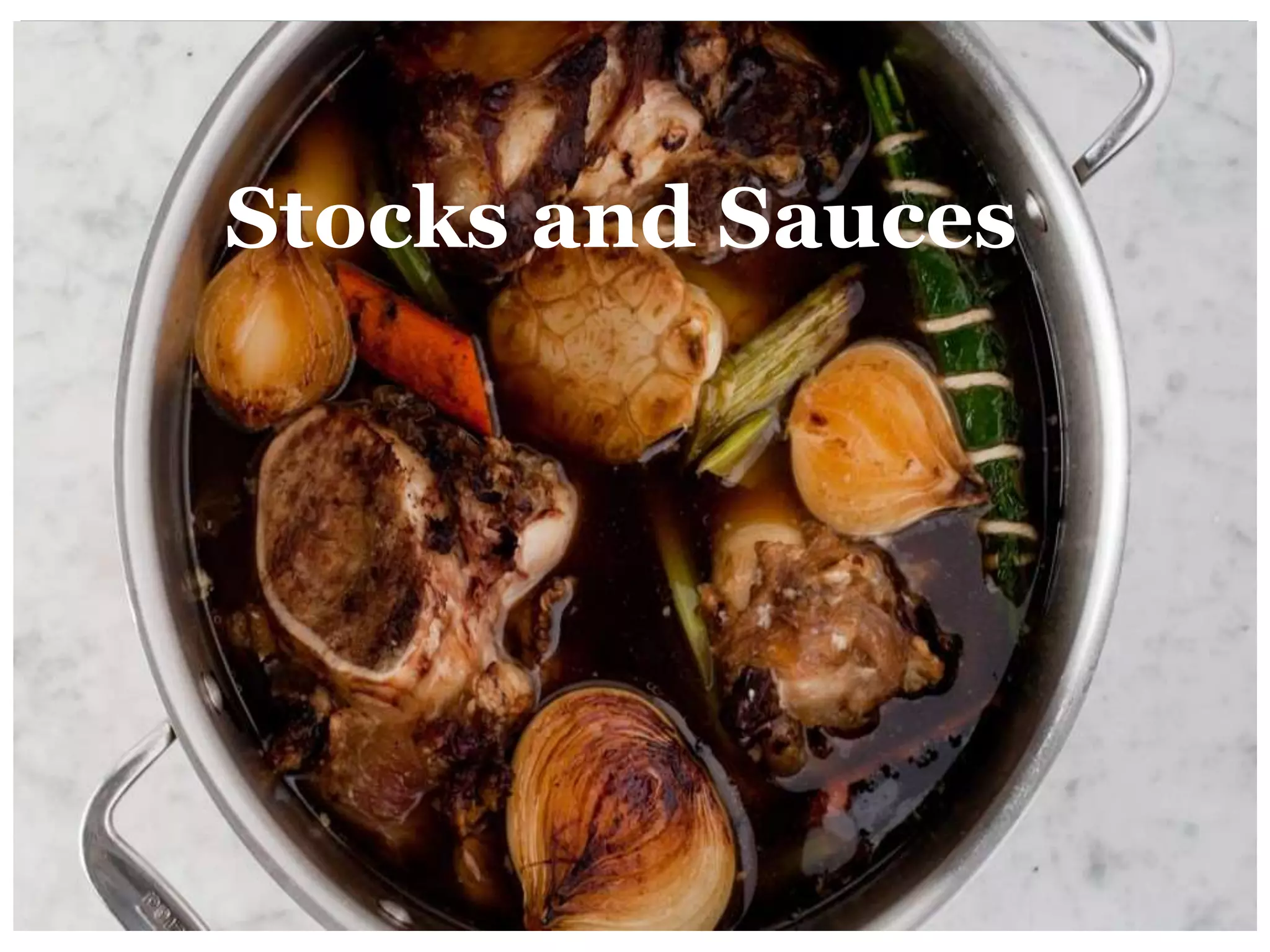
Stocks and Sauces
The Essential Parts of Stock
 A major flavoring ingredient
 A liquid, most likely water
 Mirepoix
 Aromatics
 Most important qualities to a stock are:
 Clarity
 Flavor
 Body
What is Mirepoix
 French word that refers to the mixture of coarsely
chopped onions, carrots, and celery that provide a flavor
base to stocks.
 Percentages:
 50% onions
 25% carrots
 25% celery
 Different types of Mirepoix
 White mirepoix – sub parsnips, additional onions, leeks and
mushrooms
 The Holy Trinity – Cajun mirepoix – onion, green bell pepper, and
celery
Aromatics
 Bouquet garni: “bag of herbs,” bundle of fresh herbs,
such as thyme, parsleys stems, and bay leaf
 Sachet d’espices: the same herbs with the addition
of black peppercorns tied in a cheesecloth bag.
 Aromatics are not added into the stock until the
stock has an hour to two hours left to simmer
 Side note: if you are straining the stock your herbs and spices
do not need to be placed in a bag.
Types of Stock
 White Stock – chicken bones
 Brown Stock – beef or veal bones
 Fumet – fish stock
 Court Bouillon – water containing herbs and spices
(used for cooking fish)
 Glace – stock reduction
 Remouillage – second stock
 Jus – unthickened juice from a roast
 Vegetable Stock
Question
 What is the difference between a stock and a broth?
Beef Stock (brown stock)
 http://www.marthastewart.com/950209/brown-
beef-stock#950209
 Brown stock is roasted poultry, beef or fish bones
with roasted vegetables and tomato paste. Pan is
deglazed with red wine.
Chicken Stock (White stock)
 http://www.marthastewart.com/950207/basic-
chicken-stock#950207
 Simmering poultry, beef or fish bones with onion,
celery and carrots
Vegetable Stock
 http://www.marthastewart.com/949654/vegetable-
stock
 Any leftover vegetable scraps can basically be made
into a vegetable stock.
 For a specific intense flavor of a particular vegetable,
use more of that vegetable.
Preparing Bones
 Blanching
 Browning
 Sweating
Preparing Ingredients for Stock
 Mirepoix should be cut to size suited for the type of
stock
 Bouquet garni or sachet d’epices can be added to the
simmering stock.
Stock Ratio/Recipe
 Chicken, beef, veal, and game stock: 8# of bones to
6qt water, 1# mirepoix
 Fish/shellfish stock or fumet: 11# bones or shells to
6qt water, 1# mirepoix
 Vegetable stock: 4# vegetables, 4qt water, ¾#
mirepoix
Cooling Stock
 Separate stock into smaller portions
 Use ice bath
 Ice wand
 Blast chiller
 What is the time frame for cooling?
To Degrease or Not to Degrease?
 Degreasing is the process of removing the fat that
has cooled and hardened from the surface of the
stock
Question
 What are the four important parts of stock?
The Mother Sauces and Their Offspring
What is a Sauce?
What is a Sauce?
 A sauce is a liquid or semisolid product that is used
in preparing other foods.
 Saucier: a cook who specializes in making sauces
 Grand/Mother sauces: the basis for most other
sauces.
Why are sauces important?
 A sauce adds:
 Moistness
 Flavor
 Richness
 Appearance
 Interest and appetite appeal
The Structure of a Sauce
 Liquid
 A liquid ingredient (stocks) provide the body or base of most
sauces
 Thickening Agents
 Starches are the most commonly used thickening agents
 Other Flavoring Ingredients
 Most of the hundreds of sauces listed in the standard
repertoires are made by adding one or more flavoring
ingredients in one of the five mother sauces
Grand/Mother Sauces
 Bechamel (BAY-shah-MELL) – made from milk and
white roux
 Veloute (veh-loo-TAY) – veal, chicken, or fish stock
and white or blonde roux
 Brown/Espagnole (ess-spah-NYOL) – brown stock
and brown roux
 Tomato – stock and tomatoes
 Hollandaise (HALL-en-daze) – and emulsion made
from eggs, butter, and lemon
What is a Roux?
What is a Roux?
 Roux (roo) – a cooked mixture of equal parts by
weight of fat and flour
 Fat used:
 Clarified butter
 Margarine
 Animal fats
 Vegetable oil/shortening
 Flour
 Bread flour or all purpose
Types of Roux
 White roux: cooked for a short period of time, just
enough to cook out the raw flavor of the flour
 Blond roux: (pale roux) cooked longer, until roux
begins to turn slightly dark in color
 Brown roux: cooked until light brown in color and a
nutty aroma
Roux Procedure
 Melt fat
 Add correct amount of flour and stir until fat and
flour are thoroughly mixed
 Cook to required degree for white, blond, or brown
roux
 Cook in a small saute pan
 Cool before adding to stock or other liquid, because
it will cause lumps
 Liquid may be hot or cooled, but not ice cold. It will
cause the fat to set back up.
Other Thickening Agents
 Beurre manie (burr mahnyay) soft butter and flour
worked together
 Whitewash – thin mixture of flour and water
 Cornstarch (slurry) – mixture of cold water and
cornstarch
 Arrowroot – expensive and used like cornstarch
 Bread crumbs – will thicken liquid quickly because it
is already cooked
 Vegetable purees, ground nuts, and other solids
Egg Yolks and Cream Liaison
 Egg yolks have a slight power to thicken due to
coagulation
 Pure egg yolks coagulate at 140*F
 To increase this temperature, heavy cream is added
to the yolks to raise their cooking temperature to
180*F
 Liaison: binding agent made from cream and eggs
 Primarily used to give richness of flavor and smoothness of
texture to a sauce
Finishing Techniques
 Reducing
 Straining
 Deglazing
 Enriching with butter or cream
 Monter au beurre (mohn tay oh burr)
 Seasoning
 Salt
 Lemon juice
 Pepper
 Sherry
 Madeira
Small Sauces
Small Sauces
Small Sauces
Small Sauces
Small Sauces
Quality Testing
 Consistency and body
 No lumps
 Flavor
 No starchy flavor
 Proper seasoning
 Appearance
 Smooth with good shine

stocks sauces and soups.pptx

  • 1.
    Stocks, Sauces, andSoups Stocks and Sauces
  • 2.
    The Essential Partsof Stock  A major flavoring ingredient  A liquid, most likely water  Mirepoix  Aromatics  Most important qualities to a stock are:  Clarity  Flavor  Body
  • 3.
    What is Mirepoix French word that refers to the mixture of coarsely chopped onions, carrots, and celery that provide a flavor base to stocks.  Percentages:  50% onions  25% carrots  25% celery  Different types of Mirepoix  White mirepoix – sub parsnips, additional onions, leeks and mushrooms  The Holy Trinity – Cajun mirepoix – onion, green bell pepper, and celery
  • 4.
    Aromatics  Bouquet garni:“bag of herbs,” bundle of fresh herbs, such as thyme, parsleys stems, and bay leaf  Sachet d’espices: the same herbs with the addition of black peppercorns tied in a cheesecloth bag.  Aromatics are not added into the stock until the stock has an hour to two hours left to simmer  Side note: if you are straining the stock your herbs and spices do not need to be placed in a bag.
  • 5.
    Types of Stock White Stock – chicken bones  Brown Stock – beef or veal bones  Fumet – fish stock  Court Bouillon – water containing herbs and spices (used for cooking fish)  Glace – stock reduction  Remouillage – second stock  Jus – unthickened juice from a roast  Vegetable Stock
  • 6.
    Question  What isthe difference between a stock and a broth?
  • 7.
    Beef Stock (brownstock)  http://www.marthastewart.com/950209/brown- beef-stock#950209  Brown stock is roasted poultry, beef or fish bones with roasted vegetables and tomato paste. Pan is deglazed with red wine.
  • 8.
    Chicken Stock (Whitestock)  http://www.marthastewart.com/950207/basic- chicken-stock#950207  Simmering poultry, beef or fish bones with onion, celery and carrots
  • 9.
    Vegetable Stock  http://www.marthastewart.com/949654/vegetable- stock Any leftover vegetable scraps can basically be made into a vegetable stock.  For a specific intense flavor of a particular vegetable, use more of that vegetable.
  • 10.
    Preparing Bones  Blanching Browning  Sweating
  • 11.
    Preparing Ingredients forStock  Mirepoix should be cut to size suited for the type of stock  Bouquet garni or sachet d’epices can be added to the simmering stock.
  • 12.
    Stock Ratio/Recipe  Chicken,beef, veal, and game stock: 8# of bones to 6qt water, 1# mirepoix  Fish/shellfish stock or fumet: 11# bones or shells to 6qt water, 1# mirepoix  Vegetable stock: 4# vegetables, 4qt water, ¾# mirepoix
  • 13.
    Cooling Stock  Separatestock into smaller portions  Use ice bath  Ice wand  Blast chiller  What is the time frame for cooling?
  • 14.
    To Degrease orNot to Degrease?  Degreasing is the process of removing the fat that has cooled and hardened from the surface of the stock
  • 15.
    Question  What arethe four important parts of stock?
  • 16.
    The Mother Saucesand Their Offspring
  • 17.
    What is aSauce?
  • 18.
    What is aSauce?  A sauce is a liquid or semisolid product that is used in preparing other foods.  Saucier: a cook who specializes in making sauces  Grand/Mother sauces: the basis for most other sauces.
  • 19.
    Why are saucesimportant?
  • 20.
    Why are saucesimportant?  A sauce adds:  Moistness  Flavor  Richness  Appearance  Interest and appetite appeal
  • 21.
    The Structure ofa Sauce  Liquid  A liquid ingredient (stocks) provide the body or base of most sauces  Thickening Agents  Starches are the most commonly used thickening agents  Other Flavoring Ingredients  Most of the hundreds of sauces listed in the standard repertoires are made by adding one or more flavoring ingredients in one of the five mother sauces
  • 22.
    Grand/Mother Sauces  Bechamel(BAY-shah-MELL) – made from milk and white roux  Veloute (veh-loo-TAY) – veal, chicken, or fish stock and white or blonde roux  Brown/Espagnole (ess-spah-NYOL) – brown stock and brown roux  Tomato – stock and tomatoes  Hollandaise (HALL-en-daze) – and emulsion made from eggs, butter, and lemon
  • 23.
    What is aRoux?
  • 24.
    What is aRoux?  Roux (roo) – a cooked mixture of equal parts by weight of fat and flour  Fat used:  Clarified butter  Margarine  Animal fats  Vegetable oil/shortening  Flour  Bread flour or all purpose
  • 25.
    Types of Roux White roux: cooked for a short period of time, just enough to cook out the raw flavor of the flour  Blond roux: (pale roux) cooked longer, until roux begins to turn slightly dark in color  Brown roux: cooked until light brown in color and a nutty aroma
  • 26.
    Roux Procedure  Meltfat  Add correct amount of flour and stir until fat and flour are thoroughly mixed  Cook to required degree for white, blond, or brown roux  Cook in a small saute pan  Cool before adding to stock or other liquid, because it will cause lumps  Liquid may be hot or cooled, but not ice cold. It will cause the fat to set back up.
  • 27.
    Other Thickening Agents Beurre manie (burr mahnyay) soft butter and flour worked together  Whitewash – thin mixture of flour and water  Cornstarch (slurry) – mixture of cold water and cornstarch  Arrowroot – expensive and used like cornstarch  Bread crumbs – will thicken liquid quickly because it is already cooked  Vegetable purees, ground nuts, and other solids
  • 28.
    Egg Yolks andCream Liaison  Egg yolks have a slight power to thicken due to coagulation  Pure egg yolks coagulate at 140*F  To increase this temperature, heavy cream is added to the yolks to raise their cooking temperature to 180*F  Liaison: binding agent made from cream and eggs  Primarily used to give richness of flavor and smoothness of texture to a sauce
  • 29.
    Finishing Techniques  Reducing Straining  Deglazing  Enriching with butter or cream  Monter au beurre (mohn tay oh burr)  Seasoning  Salt  Lemon juice  Pepper  Sherry  Madeira
  • 30.
  • 31.
  • 32.
  • 33.
  • 34.
  • 35.
    Quality Testing  Consistencyand body  No lumps  Flavor  No starchy flavor  Proper seasoning  Appearance  Smooth with good shine