Quarter 3. Prepare Stocks, Soups
and Sauces
Poultry and Game Dishes
1
2
Lesson 1. Prepare Stocks,
Sauces and Soups (SSS)
Outcome 1. Prepare
Stocks for Required
Menu Items
3
OBJECTIVES
❖Use ingredients and flavouring according
to enterprise standards.
❖Produce variety of stocks according to
enterprise standards.
4
CONTENT
➢ Principles of preparing stocks.
➢ Classification of stocks.
➢ Ingredients in preparing stocks.
➢ Types and uses of convenience
products.
5
CONTENT
➢ Methods of preparing stocks.
➢ Suggested Projects
a. white stock
b. Brown stock
What is the difference between
STOCKS and BROTH?
6
Stocks and Broth
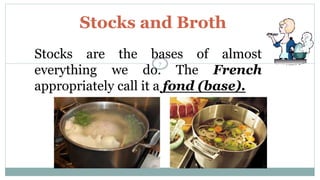
Stocks are the bases of almost
everything we do. The French
appropriately call it a fond (base).
7
Stock is the thin liquid produced by
simmering raw ingredients: solids are
removed, leaving a thin, highly
flavoured liquid. This yields classic
stock as made from beef, veal, chicken,
fish and vegetables.
Broth differs in that it is a basic soup
where the solid pieces of flavouring
meat or fish, along with some
vegetables, remain.
8
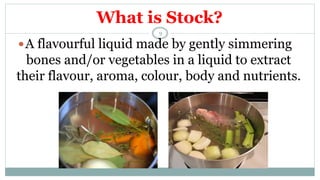
What is Stock?
A flavourful liquid made by gently simmering
bones and/or vegetables in a liquid to extract
their flavour, aroma, colour, body and nutrients.
9
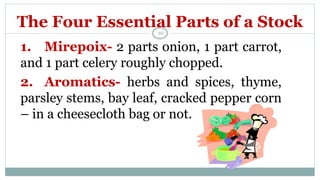
The Four Essential Parts of a Stock
1. Mirepoix- 2 parts onion, 1 part carrot,
and 1 part celery roughly chopped.
2. Aromatics- herbs and spices, thyme,
parsley stems, bay leaf, cracked pepper corn
– in a cheesecloth bag or not.
10
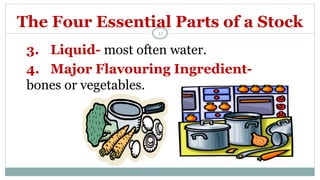
The Four Essential Parts of a Stock
3. Liquid- most often water.
4. Major Flavouring Ingredient-
bones or vegetables.
11
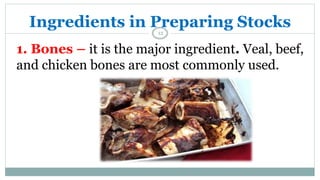
Ingredients in Preparing Stocks
1. Bones – it is the major ingredient. Veal, beef,
and chicken bones are most commonly used.
12
The flavour of the stock comes from the
cartilage and connective tissue in the bones
which gets converted into gelatine that thickens
the liquid.
13
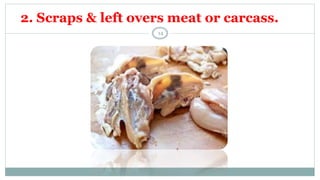
2. Scraps & left overs meat or carcass.
14
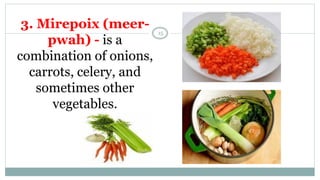
3. Mirepoix (meer-
pwah) - is a
combination of onions,
carrots, celery, and
sometimes other
vegetables.
15
4. Acid ingredients – Acid help dissolve
connective tissue. (Lemon, vinegar, tomato
products)
16
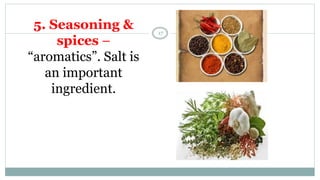
5. Seasoning &
spices –
“aromatics”. Salt is
an important
ingredient.
17
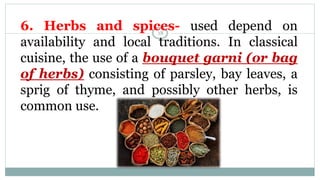
6. Herbs and spices- used depend on
availability and local traditions. In classical
cuisine, the use of a bouquet garni (or bag
of herbs) consisting of parsley, bay leaves, a
sprig of thyme, and possibly other herbs, is
common use.
18
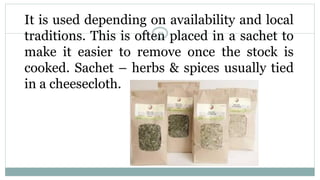
It is used depending on availability and local
traditions. This is often placed in a sachet to
make it easier to remove once the stock is
cooked. Sachet – herbs & spices usually tied
in a cheesecloth.
19
Ingredients proportion:
a.Bones – 50%
b.Mirepoix – 10%
c.Water – 100%
20
21
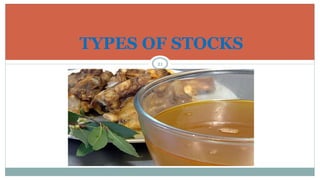
TYPES OF STOCKS
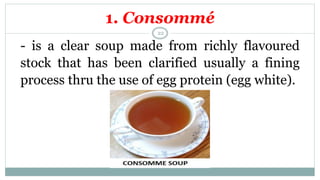
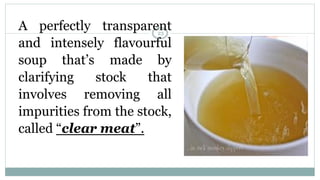
1. Consommé
- is a clear soup made from richly flavoured
stock that has been clarified usually a fining
process thru the use of egg protein (egg white).
22
A perfectly transparent
and intensely flavourful
soup that’s made by
clarifying stock that
involves removing all
impurities from the stock,
called “clear meat”.
23
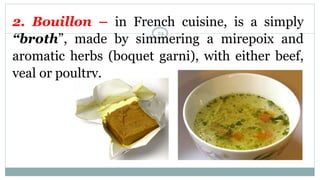
2. Bouillon – in French cuisine, is a simply
“broth”, made by simmering a mirepoix and
aromatic herbs (boquet garni), with either beef,
veal or poultry.
24
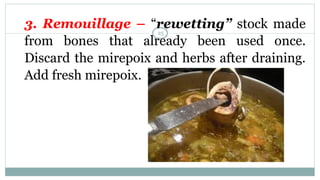
3. Remouillage – “rewetting” stock made
from bones that already been used once.
Discard the mirepoix and herbs after draining.
Add fresh mirepoix.
25
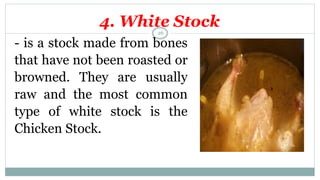
- is a stock made from bones
that have not been roasted or
browned. They are usually
raw and the most common
type of white stock is the
Chicken Stock.
4. White Stock
26
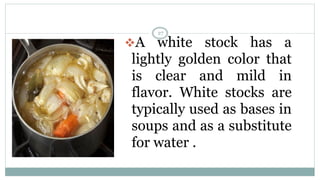
❖A white stock has a
lightly golden color that
is clear and mild in
flavor. White stocks are
typically used as bases in
soups and as a substitute
for water .
27
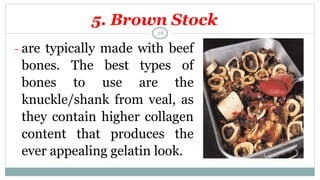
- are typically made with beef
bones. The best types of
bones to use are the
knuckle/shank from veal, as
they contain higher collagen
content that produces the
ever appealing gelatin look.
5. Brown Stock
28
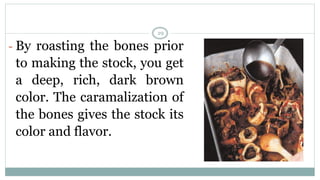
- By roasting the bones prior
to making the stock, you get
a deep, rich, dark brown
color. The caramalization of
the bones gives the stock its
color and flavor.
29
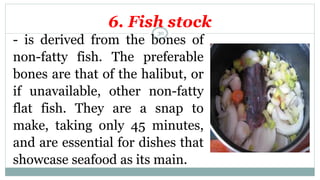
6. Fish stock
- is derived from the bones of
non-fatty fish. The preferable
bones are that of the halibut, or
if unavailable, other non-fatty
flat fish. They are a snap to
make, taking only 45 minutes,
and are essential for dishes that
showcase seafood as its main.
30
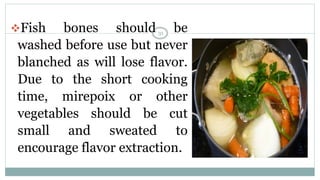
❖Fish bones should be
washed before use but never
blanched as will lose flavor.
Due to the short cooking
time, mirepoix or other
vegetables should be cut
small and sweated to
encourage flavor extraction.
31
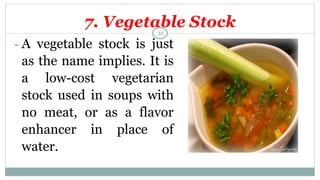
7. Vegetable Stock
- A vegetable stock is just
as the name implies. It is
a low-cost vegetarian
stock used in soups with
no meat, or as a flavor
enhancer in place of
water.
32
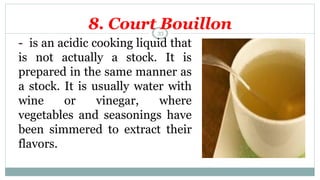
8. Court Bouillon
- is an acidic cooking liquid that
is not actually a stock. It is
prepared in the same manner as
a stock. It is usually water with
wine or vinegar, where
vegetables and seasonings have
been simmered to extract their
flavors.
33
Preparing Stock
A few basic rules are commonly
recommended for preparing
stock:
1. The stock ingredients are
simmered starting with cold
water. This promotes the
extraction of collagen, which may
be sealed in by hot water.
34
Preparing Stock
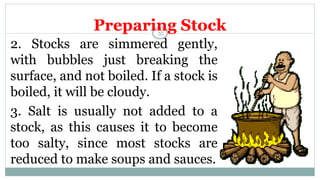
2. Stocks are simmered gently,
with bubbles just breaking the
surface, and not boiled. If a stock is
boiled, it will be cloudy.
3. Salt is usually not added to a
stock, as this causes it to become
too salty, since most stocks are
reduced to make soups and sauces.
35
4. Meat is added to a stock
before vegetables, and the
"scum" that rises to the surface
is skimmed off before further
ingredients are added.
5. Stocks can be frozen and
kept indefinitely but are better
fresh
36
6. If the cook wants to remove
the fat, after the stock is
finished it is cooled and the
fat, which floats, separates and
solidifies into globs within the
stock, which can be removed
with ease.
37
7. The refrigerator shelf life
of a stock is three to four
days, but the stock can be
boiled at the end of this
period and the life extended
another three to four days.
Stock can be kept for
extended periods in this
manner.
38

EDITED.LO1.Prepare Stocks for Required Menu001.pdf

  • 1.
    Quarter 3. PrepareStocks, Soups and Sauces Poultry and Game Dishes 1
  • 2.
    2 Lesson 1. PrepareStocks, Sauces and Soups (SSS) Outcome 1. Prepare Stocks for Required Menu Items
  • 3.
    3 OBJECTIVES ❖Use ingredients andflavouring according to enterprise standards. ❖Produce variety of stocks according to enterprise standards.
  • 4.
    4 CONTENT ➢ Principles ofpreparing stocks. ➢ Classification of stocks. ➢ Ingredients in preparing stocks. ➢ Types and uses of convenience products.
  • 5.
    5 CONTENT ➢ Methods ofpreparing stocks. ➢ Suggested Projects a. white stock b. Brown stock
  • 6.
    What is thedifference between STOCKS and BROTH? 6
  • 7.
    Stocks and Broth Stocksare the bases of almost everything we do. The French appropriately call it a fond (base). 7
  • 8.
    Stock is thethin liquid produced by simmering raw ingredients: solids are removed, leaving a thin, highly flavoured liquid. This yields classic stock as made from beef, veal, chicken, fish and vegetables. Broth differs in that it is a basic soup where the solid pieces of flavouring meat or fish, along with some vegetables, remain. 8
  • 9.
    What is Stock? Aflavourful liquid made by gently simmering bones and/or vegetables in a liquid to extract their flavour, aroma, colour, body and nutrients. 9
  • 10.
    The Four EssentialParts of a Stock 1. Mirepoix- 2 parts onion, 1 part carrot, and 1 part celery roughly chopped. 2. Aromatics- herbs and spices, thyme, parsley stems, bay leaf, cracked pepper corn – in a cheesecloth bag or not. 10
  • 11.
    The Four EssentialParts of a Stock 3. Liquid- most often water. 4. Major Flavouring Ingredient- bones or vegetables. 11
  • 12.
    Ingredients in PreparingStocks 1. Bones – it is the major ingredient. Veal, beef, and chicken bones are most commonly used. 12
  • 13.
    The flavour ofthe stock comes from the cartilage and connective tissue in the bones which gets converted into gelatine that thickens the liquid. 13
  • 14.
    2. Scraps &left overs meat or carcass. 14
  • 15.
    3. Mirepoix (meer- pwah)- is a combination of onions, carrots, celery, and sometimes other vegetables. 15
  • 16.
    4. Acid ingredients– Acid help dissolve connective tissue. (Lemon, vinegar, tomato products) 16
  • 17.
    5. Seasoning & spices– “aromatics”. Salt is an important ingredient. 17
  • 18.
    6. Herbs andspices- used depend on availability and local traditions. In classical cuisine, the use of a bouquet garni (or bag of herbs) consisting of parsley, bay leaves, a sprig of thyme, and possibly other herbs, is common use. 18
  • 19.
    It is useddepending on availability and local traditions. This is often placed in a sachet to make it easier to remove once the stock is cooked. Sachet – herbs & spices usually tied in a cheesecloth. 19
  • 20.
    Ingredients proportion: a.Bones –50% b.Mirepoix – 10% c.Water – 100% 20
  • 21.
  • 22.
    1. Consommé - isa clear soup made from richly flavoured stock that has been clarified usually a fining process thru the use of egg protein (egg white). 22
  • 23.
    A perfectly transparent andintensely flavourful soup that’s made by clarifying stock that involves removing all impurities from the stock, called “clear meat”. 23
  • 24.
    2. Bouillon –in French cuisine, is a simply “broth”, made by simmering a mirepoix and aromatic herbs (boquet garni), with either beef, veal or poultry. 24
  • 25.
    3. Remouillage –“rewetting” stock made from bones that already been used once. Discard the mirepoix and herbs after draining. Add fresh mirepoix. 25
  • 26.
    - is astock made from bones that have not been roasted or browned. They are usually raw and the most common type of white stock is the Chicken Stock. 4. White Stock 26
  • 27.
    ❖A white stockhas a lightly golden color that is clear and mild in flavor. White stocks are typically used as bases in soups and as a substitute for water . 27
  • 28.
    - are typicallymade with beef bones. The best types of bones to use are the knuckle/shank from veal, as they contain higher collagen content that produces the ever appealing gelatin look. 5. Brown Stock 28
  • 29.
    - By roastingthe bones prior to making the stock, you get a deep, rich, dark brown color. The caramalization of the bones gives the stock its color and flavor. 29
  • 30.
    6. Fish stock -is derived from the bones of non-fatty fish. The preferable bones are that of the halibut, or if unavailable, other non-fatty flat fish. They are a snap to make, taking only 45 minutes, and are essential for dishes that showcase seafood as its main. 30
  • 31.
    ❖Fish bones shouldbe washed before use but never blanched as will lose flavor. Due to the short cooking time, mirepoix or other vegetables should be cut small and sweated to encourage flavor extraction. 31
  • 32.
    7. Vegetable Stock -A vegetable stock is just as the name implies. It is a low-cost vegetarian stock used in soups with no meat, or as a flavor enhancer in place of water. 32
  • 33.
    8. Court Bouillon -is an acidic cooking liquid that is not actually a stock. It is prepared in the same manner as a stock. It is usually water with wine or vinegar, where vegetables and seasonings have been simmered to extract their flavors. 33
  • 34.
    Preparing Stock A fewbasic rules are commonly recommended for preparing stock: 1. The stock ingredients are simmered starting with cold water. This promotes the extraction of collagen, which may be sealed in by hot water. 34
  • 35.
    Preparing Stock 2. Stocksare simmered gently, with bubbles just breaking the surface, and not boiled. If a stock is boiled, it will be cloudy. 3. Salt is usually not added to a stock, as this causes it to become too salty, since most stocks are reduced to make soups and sauces. 35
  • 36.
    4. Meat isadded to a stock before vegetables, and the "scum" that rises to the surface is skimmed off before further ingredients are added. 5. Stocks can be frozen and kept indefinitely but are better fresh 36
  • 37.
    6. If thecook wants to remove the fat, after the stock is finished it is cooled and the fat, which floats, separates and solidifies into globs within the stock, which can be removed with ease. 37
  • 38.
    7. The refrigeratorshelf life of a stock is three to four days, but the stock can be boiled at the end of this period and the life extended another three to four days. Stock can be kept for extended periods in this manner. 38