What are Stocks?
• Stock is ownership in a publicly traded
company.
• Stock is a claim on the company’s
assets and earnings.
• The more stock you have, the greater
your claim an owner.
Types of Stock
• Common Stock – most common
form of stock.
• Dividends are not guaranteed
• Preferred Stock
• Fixed dividend
• Companies may customize other
“classes” of stock.
Ticker Symbols
• All securities traded on the stock
exchange have a ticker symbol
• Microsoft (MSFT)
• Southwest Airlines (LUV)
• Ford Motor Company (F)
• Google (GOOG)
Initial Public Offering (IPO)
• The first time a stock is sold to the
public
• Sold in the Primary Market
The Markets
• Primary Markets – where stocks are
created
• Secondary Markets – investors trade
previously issued stocks
• The Stock Market
• Companies are not involved in the
buying and selling of their stock.
The Exchanges
• Where Stocks are Bought and Sold
• New York Stock Exchange (NYSE)
• American Stock Exchange (AMEX)
• NASDAQ
The Indices (index)
• A collection of stocks—representative
of the stock market
• Dow Jones – 30 most significant stocks
in the stock market
• S&P 500 – 500 largest companies on the
US stock market
• NASDAQ Composite – all stocks on the
NASDAQ
How Do You Make Money in the Market?
1. Stock Price Goes Up and You Sell
• Buy low, sell high
2. Dividends
• Not all companies pay dividends
What Causes Stock Prices to Change?
• Supply and Demand
• Earnings and Expectations
• Sentiments and Attitudes
• Economic Indicators
• Follow the Leader (volume)
• Anything 
Why Invest in Stocks?
• The return on investments in the
market are 3-4 times the annual return
of inflation, savings and treasury bonds
• You can make good money in the
market
• You can loose money too……
How Should I Invest?
• What are your financial goals?
• What is your risk tolerance?
• Return rises with risk
• Do you want to actively manage your
portfolio?
• Diversify
• Don’t put all your eggs in one basket!
Where do I Start?
• Learn the Basics
• Setup a brokerage account
• Full-service vs. discount?
• The Internet provides a variety of discount
brokerage firms (do it yourself)
• Fees, commission, minimum balance
• Keep it simple as you learn
• Learn about other investment vehicles
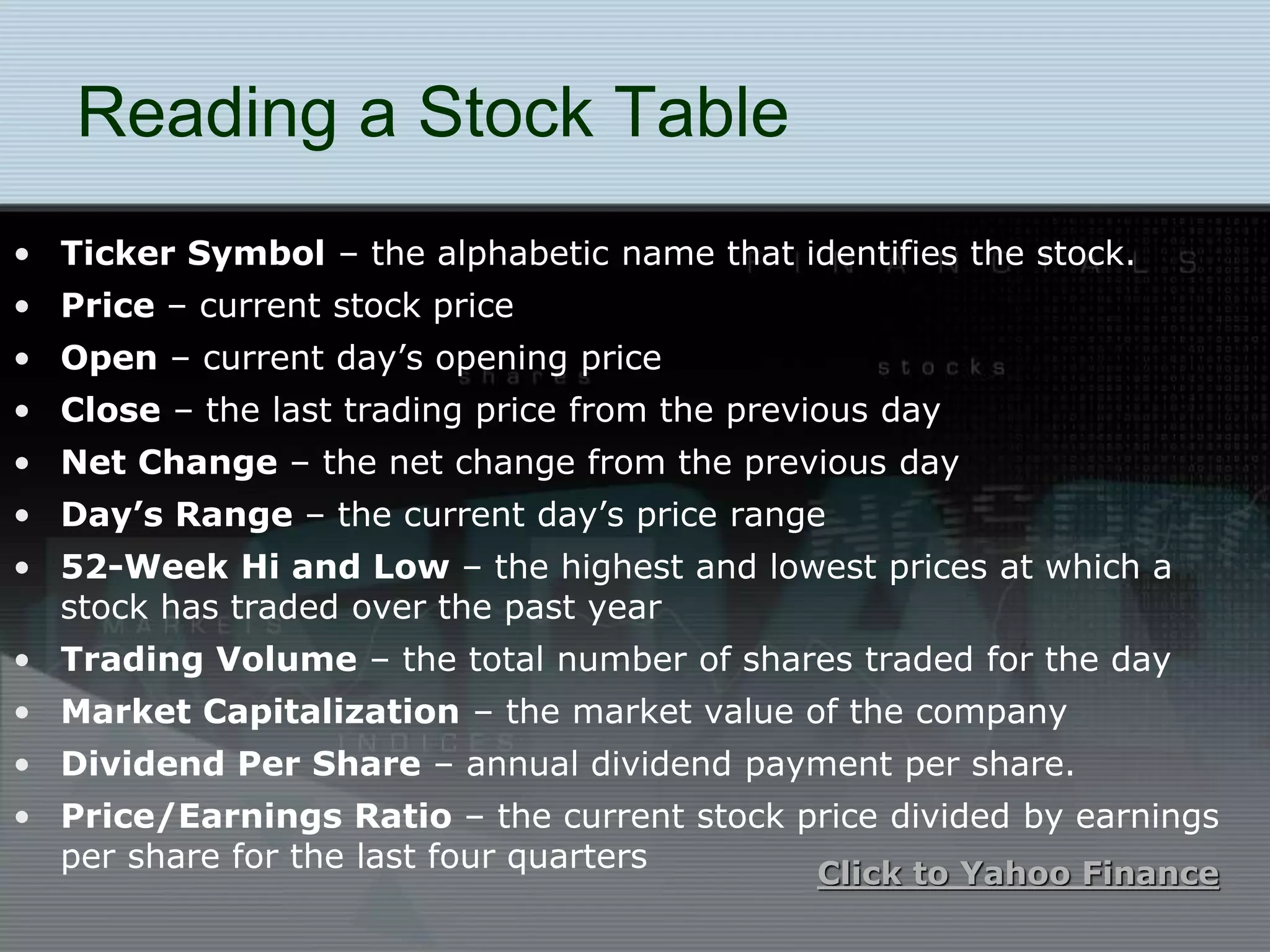
Reading a Stock Table
• Ticker Symbol – the alphabetic name that identifies the stock.
• Price – current stock price
• Open – current day’s opening price
• Close – the last trading price from the previous day
• Net Change – the net change from the previous day
• Day’s Range – the current day’s price range
• 52-Week Hi and Low – the highest and lowest prices at which a
stock has traded over the past year
• Trading Volume – the total number of shares traded for the day
• Market Capitalization – the market value of the company
• Dividend Per Share – annual dividend payment per share.
• Price/Earnings Ratio – the current stock price divided by earnings
per share for the last four quarters Click to Yahoo Finance
Bulls and Bears
• Bull Market – the economy is great
and stock prices are rising
• Bear Market –the economy is bad
and a recession is looming
Options vs. Futures
• Options give the holder the right to buy or
sell the underlying asset at expiration, a
futures contract is an obligation to fulfill the
terms of a contract.
• Options: A privilege, sold by one party to
another, that gives the buyer the right, to buy or
sell a stock at an agreed-upon price within a
certain period or on a specific date
• Futures: A financial contract obligating the buyer
to purchase an asset at a predetermined future
date and price (i.e. currency, commodities)

basic stock2.ppt

  • 1.
    What are Stocks? •Stock is ownership in a publicly traded company. • Stock is a claim on the company’s assets and earnings. • The more stock you have, the greater your claim an owner.
  • 2.
    Types of Stock •Common Stock – most common form of stock. • Dividends are not guaranteed • Preferred Stock • Fixed dividend • Companies may customize other “classes” of stock.
  • 3.
    Ticker Symbols • Allsecurities traded on the stock exchange have a ticker symbol • Microsoft (MSFT) • Southwest Airlines (LUV) • Ford Motor Company (F) • Google (GOOG)
  • 4.
    Initial Public Offering(IPO) • The first time a stock is sold to the public • Sold in the Primary Market
  • 5.
    The Markets • PrimaryMarkets – where stocks are created • Secondary Markets – investors trade previously issued stocks • The Stock Market • Companies are not involved in the buying and selling of their stock.
  • 6.
    The Exchanges • WhereStocks are Bought and Sold • New York Stock Exchange (NYSE) • American Stock Exchange (AMEX) • NASDAQ
  • 7.
    The Indices (index) •A collection of stocks—representative of the stock market • Dow Jones – 30 most significant stocks in the stock market • S&P 500 – 500 largest companies on the US stock market • NASDAQ Composite – all stocks on the NASDAQ
  • 8.
    How Do YouMake Money in the Market? 1. Stock Price Goes Up and You Sell • Buy low, sell high 2. Dividends • Not all companies pay dividends
  • 9.
    What Causes StockPrices to Change? • Supply and Demand • Earnings and Expectations • Sentiments and Attitudes • Economic Indicators • Follow the Leader (volume) • Anything 
  • 10.
    Why Invest inStocks? • The return on investments in the market are 3-4 times the annual return of inflation, savings and treasury bonds • You can make good money in the market • You can loose money too……
  • 11.
    How Should IInvest? • What are your financial goals? • What is your risk tolerance? • Return rises with risk • Do you want to actively manage your portfolio? • Diversify • Don’t put all your eggs in one basket!
  • 12.
    Where do IStart? • Learn the Basics • Setup a brokerage account • Full-service vs. discount? • The Internet provides a variety of discount brokerage firms (do it yourself) • Fees, commission, minimum balance • Keep it simple as you learn • Learn about other investment vehicles
  • 13.
    Reading a StockTable • Ticker Symbol – the alphabetic name that identifies the stock. • Price – current stock price • Open – current day’s opening price • Close – the last trading price from the previous day • Net Change – the net change from the previous day • Day’s Range – the current day’s price range • 52-Week Hi and Low – the highest and lowest prices at which a stock has traded over the past year • Trading Volume – the total number of shares traded for the day • Market Capitalization – the market value of the company • Dividend Per Share – annual dividend payment per share. • Price/Earnings Ratio – the current stock price divided by earnings per share for the last four quarters Click to Yahoo Finance
  • 14.
    Bulls and Bears •Bull Market – the economy is great and stock prices are rising • Bear Market –the economy is bad and a recession is looming
  • 15.
    Options vs. Futures •Options give the holder the right to buy or sell the underlying asset at expiration, a futures contract is an obligation to fulfill the terms of a contract. • Options: A privilege, sold by one party to another, that gives the buyer the right, to buy or sell a stock at an agreed-upon price within a certain period or on a specific date • Futures: A financial contract obligating the buyer to purchase an asset at a predetermined future date and price (i.e. currency, commodities)