Is the Stock Market and Share Market
same?
Stock market and share market essentially
mean the same thing.
Both terms describe an exchange in which
buyers and sellers of stock or shares may
trade in a market with high liquidity
SHARE :
Share is a unit issued by a company at the time of raising
fund from the market. It is a certificate issued to a person who
applies for it and is given at a value predetermined by the
company.
It is the smallest unit of ownership that may be bought or
sold on or off an exchange.
STOCK :
Stocks in the reference of stock market are the total number
of shares a person has in one company or in many companies.
STOCK MARKET
 Stocks are issued by companies in order to raise capitals
and are bought by investors in order to acquire a portion
of the company.
 A Stock market is the place where buying and selling of
stocks takes place.
 Nowadays due to internet and advanced technology
buying and selling of stocks takes place anywhere in
India and also from foreign country, there is no need to be
physical present in exchanges like NSE and BSE.
 Individuals alone can buy and sell securities.
Types of Stock Market
1. Primary Market:
 The first group of investors to whom a new issue of a security is sold.
 The primary market consists of the issuer and the first buyers of the
issue.
 The primary market can be a time more volatile than the secondary
market because it is difficult to determine the underlying value of new
issues.
2. Secondary Market:
 A market where investors purchase securities or assets from other
investors, rather than from issuing companies themselves.
 The national exchanges - such as the New York Stock Exchange and
the NASDAQ are secondary markets.
Stock Broker
 A stockbroker is person who is licensed to trade in shares.
 Brokers also have direct access to the share market and can
act as your agent in share transactions.
 For this service they charge a fee i.e. brokerage.
They can also offer additional services like advice on
shares, debentures, government bonds and listed property
trusts and non-listed investment options (cash management
trusts, property and equity trusts.
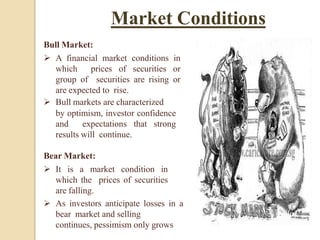
Bull Market:
 A financial market conditions in
which prices of securities or
group of securities are rising or
are expected to rise.
 Bull markets are characterized
by optimism, investor confidence
and expectations that strong
results will continue.
Bear Market:
 It is a market condition in
which the prices of securities
are falling.
 As investors anticipate losses in a
bear market and selling
continues, pessimism only grows
Market Conditions
Market Capitalization
 Market capitalization is often called
as market cap is a measurement of
the size of a business enterprise.
 It is the total dollar market value of
all of a company's outstanding
shares calculated by multiplying a
company's shares outstanding by
the current market price of one
share.
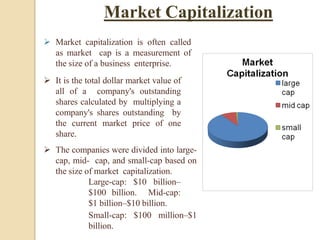
 The companies were divided into large-
cap, mid- cap, and small-cap based on
the size of market capitalization.
Large-cap: $10 billion–
$100 billion. Mid-cap:
$1 billion–$10 billion.
Small-cap: $100 million–$1
billion.
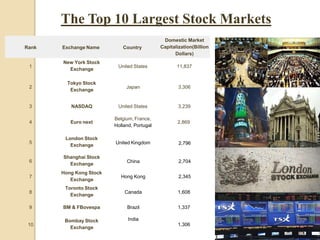
The Top 10 Largest Stock Markets
Rank Exchange Name Country
Domestic Market
Capitalization(Billion
Dollars)
1
New York Stock
Exchange
United States 11,837
2
Tokyo Stock
Exchange
Japan 3,306
3 NASDAQ United States 3,239
4 Euro next
Belgium, France,
2,869
Holland, Portugal
United Kingdom 2,796
China 2,704
Hong Kong 2,345
Canada 1,608
Brazil 1,337
India
1,306
5
London Stock
Exchange
6
7
8
Shanghai Stock
Exchange
Hong Kong Stock
Exchange
Toronto Stock
Exchange
9 BM & FBovespa
10
Bombay Stock
Exchange
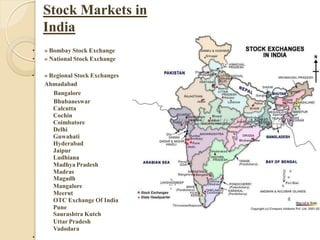
• » Bombay Stock Exchange
• » National Stock Exchange
• » Regional Stock Exchanges
Ahmadabad
Bangalore
Bhubaneswar
Calcutta
Cochin
Coimbatore
Delhi
Guwahati
Hyderabad
Jaipur
Ludhiana
Madhya Pradesh
Madras
Magadh
Mangalore
Meerut
OTC Exchange Of India
Pune
Saurashtra Kutch
Uttar Pradesh
Vadodara
•
Stock Markets in
India
Stock Exchanges in India
There are 22 stock exchanges in India. But, two of them
are biggest.
1) NSE (National stock exchange) - is the 9th largest stock
exchange in the world by market capitalization and
largest in India by daily turnover and number of trades,
for both equities and derivative trading.
2) BSE (Bombay stock exchange) - is the oldest stock
exchange in Asia with a rich heritage of over 137 years
of existence.
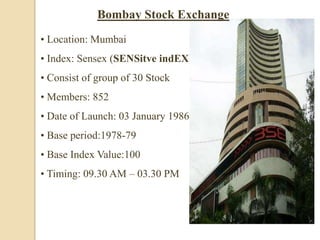
• Location: Mumbai
• Index: Sensex (SENSitve indEX)
• Consist of group of 30 Stock
• Members: 852
• Date of Launch: 03 January 1986
• Base period:1978-79
• Base Index Value:100
• Timing: 09.30 AM – 03.30 PM
Bombay Stock Exchange
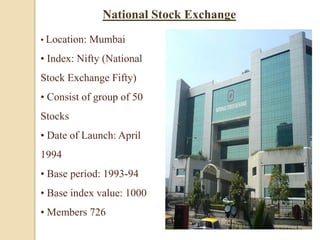
• Location: Mumbai
• Index: Nifty (National
Stock Exchange Fifty)
• Consist of group of 50
Stocks
• Date of Launch: April
1994
• Base period: 1993-94
• Base index value: 1000
• Members 726
National Stock Exchange
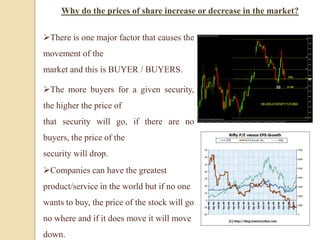
There is one major factor that causes the
movement of the
market and this is BUYER / BUYERS.
The more buyers for a given security,
the higher the price of
that security will go, if there are no
buyers, the price of the
security will drop.
Companies can have the greatest
product/service in the world but if no one
wants to buy, the price of the stock will go
no where and if it does move it will move
down.
Why do the prices of share increase or decrease in the market?
TRADING IN STOCK MARKET
 The market regulator, the Securities and Exchange
Board of India (SEBI), has made it compulsory to
open the demat account if you want to buy and sell
stocks.
 A person want to buy/sell stocks in the stock market
has to first place his/her order with a broker or can do
themselves using online trading systems.
 The stocks purchased will be sent to the your demat
account. This process is called Rolling Settlement
Cycle.
What is Demat account?
DEMAT stands for DEMATerialization. It is process in which physical
paper shares are converted into paperless (computerized) form.
In India there are two Depository organizations called NSDL (National
Securities Depository Ltd.) &CDSL (Central Depository Services India
Ltd.)
Brokers and most of Banks provides facility to open demat account.
1. ICICI Bank
2. Citi Bank
3. Bank of Baroda
Investment in Short term, Mid term and Long term trading
Short Term Trading –
Stock trading done from one week to couple of months is called short term.
Mid term Trading –
Stock trading done from one month to couple of months, say six to eight
months is called mid term trading.
Long term trading -
Stock trading done form couple of months to couple of years is called long
term trading. Companies whose fundamentals are good and have good future
plans then the stocks of these companies are used for long term trading.
Generally traders having good capital go for long term trading.
When To Invest In Particular Stock ?
Fundamental analysis refers to analyzing companies by their financial
statements found in SEC Filings, business trends, general economic
conditions and the growth prospects of company's market segment. A few
parameters which are looked upon include Price to Earnings (PE) Ratio,
Price to Book value ratio, Equity to Debt ratio.
Technical analysis studies price actions in markets through the use of
charts and quantitative techniques to attempt to forecast price trends
regardless of the company's financial prospects. A few examples include
Trend lines, Bollinger Bands, Oscillators etc.
Benefits of investing in shares
Possibility of increase in value of share
Income from dividends
Easy liquidity
Raising capital for businesses
Government capital-raising for development projects
Mobilizing savings for investment
Facilitating company growth through acquisitions
Creating investment opportunities for small investors
Barometer of the economy
STOCK MARKET.pdf

STOCK MARKET.pdf

  • 2.
    Is the StockMarket and Share Market same? Stock market and share market essentially mean the same thing. Both terms describe an exchange in which buyers and sellers of stock or shares may trade in a market with high liquidity
  • 3.
    SHARE : Share isa unit issued by a company at the time of raising fund from the market. It is a certificate issued to a person who applies for it and is given at a value predetermined by the company. It is the smallest unit of ownership that may be bought or sold on or off an exchange. STOCK : Stocks in the reference of stock market are the total number of shares a person has in one company or in many companies.
  • 4.
    STOCK MARKET  Stocksare issued by companies in order to raise capitals and are bought by investors in order to acquire a portion of the company.  A Stock market is the place where buying and selling of stocks takes place.  Nowadays due to internet and advanced technology buying and selling of stocks takes place anywhere in India and also from foreign country, there is no need to be physical present in exchanges like NSE and BSE.  Individuals alone can buy and sell securities.
  • 5.
    Types of StockMarket 1. Primary Market:  The first group of investors to whom a new issue of a security is sold.  The primary market consists of the issuer and the first buyers of the issue.  The primary market can be a time more volatile than the secondary market because it is difficult to determine the underlying value of new issues. 2. Secondary Market:  A market where investors purchase securities or assets from other investors, rather than from issuing companies themselves.  The national exchanges - such as the New York Stock Exchange and the NASDAQ are secondary markets.
  • 6.
    Stock Broker  Astockbroker is person who is licensed to trade in shares.  Brokers also have direct access to the share market and can act as your agent in share transactions.  For this service they charge a fee i.e. brokerage. They can also offer additional services like advice on shares, debentures, government bonds and listed property trusts and non-listed investment options (cash management trusts, property and equity trusts.
  • 7.
    Bull Market:  Afinancial market conditions in which prices of securities or group of securities are rising or are expected to rise.  Bull markets are characterized by optimism, investor confidence and expectations that strong results will continue. Bear Market:  It is a market condition in which the prices of securities are falling.  As investors anticipate losses in a bear market and selling continues, pessimism only grows Market Conditions
  • 8.
    Market Capitalization  Marketcapitalization is often called as market cap is a measurement of the size of a business enterprise.  It is the total dollar market value of all of a company's outstanding shares calculated by multiplying a company's shares outstanding by the current market price of one share.  The companies were divided into large- cap, mid- cap, and small-cap based on the size of market capitalization. Large-cap: $10 billion– $100 billion. Mid-cap: $1 billion–$10 billion. Small-cap: $100 million–$1 billion.
  • 9.
    The Top 10Largest Stock Markets Rank Exchange Name Country Domestic Market Capitalization(Billion Dollars) 1 New York Stock Exchange United States 11,837 2 Tokyo Stock Exchange Japan 3,306 3 NASDAQ United States 3,239 4 Euro next Belgium, France, 2,869 Holland, Portugal United Kingdom 2,796 China 2,704 Hong Kong 2,345 Canada 1,608 Brazil 1,337 India 1,306 5 London Stock Exchange 6 7 8 Shanghai Stock Exchange Hong Kong Stock Exchange Toronto Stock Exchange 9 BM & FBovespa 10 Bombay Stock Exchange
  • 10.
    • » BombayStock Exchange • » National Stock Exchange • » Regional Stock Exchanges Ahmadabad Bangalore Bhubaneswar Calcutta Cochin Coimbatore Delhi Guwahati Hyderabad Jaipur Ludhiana Madhya Pradesh Madras Magadh Mangalore Meerut OTC Exchange Of India Pune Saurashtra Kutch Uttar Pradesh Vadodara • Stock Markets in India
  • 11.
    Stock Exchanges inIndia There are 22 stock exchanges in India. But, two of them are biggest. 1) NSE (National stock exchange) - is the 9th largest stock exchange in the world by market capitalization and largest in India by daily turnover and number of trades, for both equities and derivative trading. 2) BSE (Bombay stock exchange) - is the oldest stock exchange in Asia with a rich heritage of over 137 years of existence.
  • 12.
    • Location: Mumbai •Index: Sensex (SENSitve indEX) • Consist of group of 30 Stock • Members: 852 • Date of Launch: 03 January 1986 • Base period:1978-79 • Base Index Value:100 • Timing: 09.30 AM – 03.30 PM Bombay Stock Exchange
  • 13.
    • Location: Mumbai •Index: Nifty (National Stock Exchange Fifty) • Consist of group of 50 Stocks • Date of Launch: April 1994 • Base period: 1993-94 • Base index value: 1000 • Members 726 National Stock Exchange
  • 14.
    There is onemajor factor that causes the movement of the market and this is BUYER / BUYERS. The more buyers for a given security, the higher the price of that security will go, if there are no buyers, the price of the security will drop. Companies can have the greatest product/service in the world but if no one wants to buy, the price of the stock will go no where and if it does move it will move down. Why do the prices of share increase or decrease in the market?
  • 15.
    TRADING IN STOCKMARKET  The market regulator, the Securities and Exchange Board of India (SEBI), has made it compulsory to open the demat account if you want to buy and sell stocks.  A person want to buy/sell stocks in the stock market has to first place his/her order with a broker or can do themselves using online trading systems.  The stocks purchased will be sent to the your demat account. This process is called Rolling Settlement Cycle.
  • 16.
    What is Demataccount? DEMAT stands for DEMATerialization. It is process in which physical paper shares are converted into paperless (computerized) form. In India there are two Depository organizations called NSDL (National Securities Depository Ltd.) &CDSL (Central Depository Services India Ltd.) Brokers and most of Banks provides facility to open demat account. 1. ICICI Bank 2. Citi Bank 3. Bank of Baroda
  • 17.
    Investment in Shortterm, Mid term and Long term trading Short Term Trading – Stock trading done from one week to couple of months is called short term. Mid term Trading – Stock trading done from one month to couple of months, say six to eight months is called mid term trading. Long term trading - Stock trading done form couple of months to couple of years is called long term trading. Companies whose fundamentals are good and have good future plans then the stocks of these companies are used for long term trading. Generally traders having good capital go for long term trading.
  • 18.
    When To InvestIn Particular Stock ? Fundamental analysis refers to analyzing companies by their financial statements found in SEC Filings, business trends, general economic conditions and the growth prospects of company's market segment. A few parameters which are looked upon include Price to Earnings (PE) Ratio, Price to Book value ratio, Equity to Debt ratio. Technical analysis studies price actions in markets through the use of charts and quantitative techniques to attempt to forecast price trends regardless of the company's financial prospects. A few examples include Trend lines, Bollinger Bands, Oscillators etc.
  • 19.
    Benefits of investingin shares Possibility of increase in value of share Income from dividends Easy liquidity Raising capital for businesses Government capital-raising for development projects Mobilizing savings for investment Facilitating company growth through acquisitions Creating investment opportunities for small investors Barometer of the economy