Stock exchange 
Securitisation Masterclass Sept 2006 1
Stock Exchange : 
Stock exchange is defined as 
“ A centralised market for buying and 
selling stocks, where the price is 
determined through supply and demand 
mechanisms” 
Securitisation Masterclass Sept 2006 2
Stock exchange is any body of individuals 
which is constituted for the purpose of 
Assisting 
Regulating 
Controlling 
the business of buying and selling of securities. 
Securitisation Masterclass Sept 2006 3
Functions of Stock Exchange 
• Motivates individual to save and invest funds. 
• A safe and productive channels for investment of 
savings. 
• Provides liquidity to the savings of the investors, 
by developing a secondary capital market. 
• Meeting the large capital needs of organized 
industry, trade and business. 
• Stock exchange play the role of a Barometer.
FUNCTIONS 
 It provides a trading place for securities. 
 Listing of securities 
 Distribution of new securities. 
 Mobilization of savings. 
 Flow of capital to profitable ventures. 
 Economic barometer. 
 Capital formation. 
 Motivating for improved performance.
Players in secondary market 
Client brokers 
 Floor brokers 
 Jobbers 
 Badla financiers 
 Arbitragers 
 Bulls 
 Bears 
 Stags 
 Wolves 
 Lame ducks 
 Brokers 
 FII’S 
 Merchant bankers 
 Custodians 
by Jagannath and Santosh (R.N.S.I.T
• Jobber : 
A jobber is a professional independent broker 
who deals in securities on his own behalf, he 
purchases and sells securities in his own name. 
His main job is to earn a profit due to price 
variations of securities. 
He is professional broker who carefully 
judges the worth of securities and makes a good 
forecast of their future price movements. 
Securitisation Masterclass Sept 2006 7
CHARACTERISTICS OF JOBBERS 
 He is an independent dealer in 
securities. 
 He is dealer only with the brokers 
but not with general public. 
 He is always ready to buy or sell 
securities 
 He acts as a speculator.
Tarawaniwalas : 
Tarawaniwalas is an active member of Bombay 
stock exchange, he is similar to jobber. 
He can acts as both as a broker or jobber. 
Brokers : 
He buys and sells a securities on behalf of his 
clients for a commission. 
Securitisation Masterclass Sept 2006 9
Sub-Broker : 
A sub-broker is an agent of stock 
broker, he helps the clients to buy and sell 
securities only through the broker. 
Authorised clerks : 
Authorised clerks is one who is appointed by 
a stock broker to assist him in the business of 
securities trading. 
As per the rules of the stock exchange, 
each broker can employ a specified number of 
authorised clerks to transact the securities 
trading business also called as “Assistant 
members” 
Securitisation Masterclass Sept 2006 10
Client Brokers : 
These brokers do simple brokering 
business by acting as intermediaries between the 
buyers and sellers and earn a commission for 
their services. 
Floor Brokers : 
Floor brokers refers to those authorised 
clerks and brokers who enter the trading floor 
and execute orders for their clients 
Securitisation Masterclass Sept 2006 11
Badla Financiers : 
Badla financiers are those members whose main 
function is to give finance for carry forward 
deals in specified securities in return for interest. 
• This interest rate is called Badla rate. 
• They also lend securities to brokers who have 
oversold at the time of settlement. 
Securitisation Masterclass Sept 2006 12
Arbitragers : 
Arbitragers are those who buy securities in one 
market at low prices and sell them in another 
market at an higher prices to take advantage on 
the price differences prevailing in different 
markets. 
Securitisation Masterclass Sept 2006 13
Types of Speculators : 
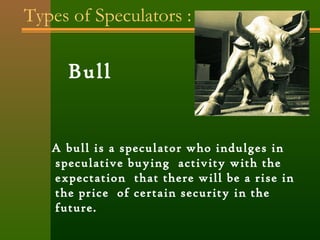
Bull 
A bull is a speculator who indulges in 
speculative buying activity with the 
expectation that there will be a rise in 
the price of certain security in the 
future.
Bear 
Bear is a speculator who indulges in 
speculative selling activity with the 
expectation that will be a fall in the 
price of certain security in the future
Bull and Bear : 
Securitisation Masterclass Sept 2006 16
Lame ducks 
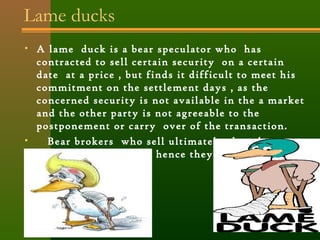
• A lame duck is a bear speculator who has 
contracted to sell certain security on a certain 
date at a price , but finds it difficult to meet his 
commitment on the settlement days , as the 
concerned security is not available in the a market 
and the other party is not agreeable to the 
postponement or carry over of the transaction. 
• Bear brokers who sell ultimately short by 
making wrong moves, hence they lose in the 
market.
stag 
A stag is a speculator who applies for a 
large number of shares in a new issue 
with the expectation of selling them to 
the public immediately after allotment 
at a premium and making profit.
Wolves : 
These are the brokers who are fast 
speculators called wolves. 
• These brokers are very quick to perceive 
changes in the trends in the market. 
• They are not generally caught in the 
wrong foot. 
Securitisation Masterclass Sept 2006 19
Method of trading in a stock exchange : 
• Choice of a broker 
• Placement of order 
• Execution of orders 
• Preparation of contract notes 
• Settlement of transactions 
Securitisation Masterclass Sept 2006 20
1. Choice of a Broker 
• Investors who want to buy or sell his securities, 
he need to transact only through the brokers. 
• They can also appoint Banker for this 
transaction, Bankers can also become a member 
of stock exchange. 
Securitisation Masterclass Sept 2006 21
2. Placement of order : 
• The next step is placing an order by 
telegram, telephone, letter, fax, in recent 
days through online. 
• Order is placed in abbreviations are : 
At Best order 
Limit order 
Immediate or cancel order 
Discretionary order 
Open order 
Securitisation Masterclass Sept 2006 22
• At best order : 
It is an order which does not specify any 
specific price, it is executed immediately at the 
best possible price. 
Eg ; The investor may place a order like this 
“ Buy 50 Reliance@ Best” 
• Limit order : 
It is an order for the purchase or sell of 
securities at a fixed price specified by the 
investor. 
Eg : “Sell 200 HCL @ Rs. 76” 
Securitisation Masterclass Sept 2006 23
• Immediate or cancel order : 
It is an order for the purchase or 
sell of securities immediately at the 
quoted prices. 
If the order could not be executed at 
the quoted prices immediately, it should 
be treated as cancelled. 
Securitisation Masterclass Sept 2006 24
Discretionary order : 
It is an order to buy or sell shares at whatever 
price the broker thinks reasonable. This is 
possible only when the investor has complete 
faith on the broker. 
Limited discretionary order : 
Traded at a specified price range or within 
the given time period as per the best judgement 
of the broker. 
Securitisation Masterclass Sept 2006 25
Stop loss order : 
It is an order to sell as soon as the price falls 
up to a particular level or to buy when the price 
rises up to a specified level. 
This is mainly to protect the investors 
against a heavy fall or rise in prices. 
Securitisation Masterclass Sept 2006 26
3. Execution of orders : 
orders are executed in the trading ring of 
a stock exchange, if the buyer order 
matches with the seller order then the 
order is executed. 
The floor of the stock exchange is 
divided into number of markets according 
to the nature of the security is called pits. 
Securitisation Masterclass Sept 2006 27
4. Preparation of contract note : 
• Once the order is executed and all the 
transaction are recorded and make ready of 
contract note and delivered to respective 
investors. 
• A contract note is a written agreement between 
the broker and the investor for the transactions 
executed and contains the details like 
Purchase/Sale of securities 
Name of the company 
Number of shares bought/sold and price 
Brokerage commission 
Securitisation Masterclass Sept 2006 28
5. Settlement of transactions : 
Finally the settlement is made by delivering the 
shares certificates along with the transfer deed. 
• The transfer deed is duly signed by the 
transferor that is seller. 
• It bears the stamp of the selling broker 
• The buyer then fills up the particulars in the 
transfer deed. 
Securitisation Masterclass Sept 2006 29
Settlement can be made from the following 
methods are : 
• Spot delivery settlement 
The delivery of securities and the payment 
is made on the contract day itself. 
• Hand delivery settlement 
With in the time stipulated in the 
agreement or 14 days from the contract date. 
• Clearing settlement 
Under this method, the delivery of 
securities and payments are cleared through the 
clearing house. 
• Special delivery settlement 
Securitisation Masterclass Sept 2006 30
Online Trading 
The information technology brought out 
revolutionary changes in the operations of stock 
exchanges in India. 
The traditional method was time 
consuming and inefficient. To overcome this 
NSE has introduced a nation wide online fully 
automated Screen Based Trading System 
(SBTS). 
All other stock exchanges also this technology 
online trading. 
Securitisation Masterclass Sept 2006 31
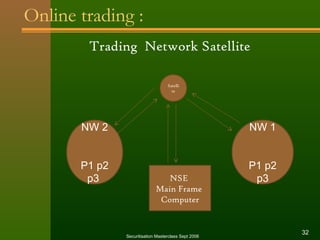
Online trading : 
Trading Network Satellite 
Satelli 
te 
Securitisation Masterclass Sept 2006 32 
NW 2 
P1 p2 
p3 
NW 1 
P1 p2 
NSE p3 
Main Frame 
Computer
Benefits of Online Trading : 
• Faster Trading 
• Accessible to all 
• Widening the market 
• Saving of time and cost 
• Fully transparent 
• No errors and frauds 
Securitisation Masterclass Sept 2006 33
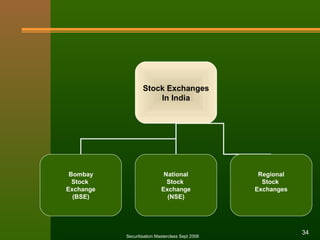
Stock Exchanges 
In India 
Securitisation Masterclass Sept 2006 34 
Bombay 
Stock 
Exchange 
(BSE) 
National 
Stock 
Exchange 
(NSE) 
Regional 
Stock 
Exchanges
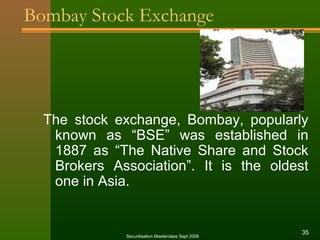
Bombay Stock Exchange 
The stock exchange, Bombay, popularly 
known as “BSE” was established in 
1887 as “The Native Share and Stock 
Brokers Association”. It is the oldest 
one in Asia. 
Securitisation Masterclass Sept 2006 35
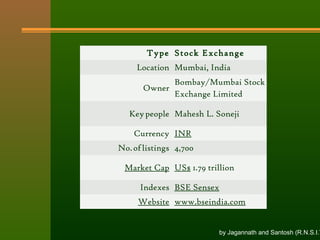
Type Stock Exchange 
Location Mumbai, India 
Owner 
Bombay/Mumbai Stock 
Exchange Limited 
Key people Mahesh L. Soneji 
Currency INR 
No. of listings 4,700 
Market Cap US$ 1.79 trillion 
Indexes BSE Sensex 
Website www.bseindia.com 
by Jagannath and Santosh (R.N.S.I.T
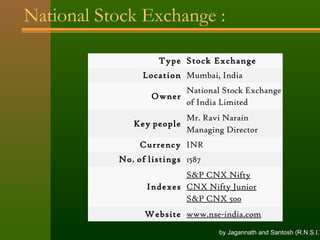
National Stock Exchange : 
Type Stock Exchange 
Location Mumbai, India 
Owner 
National Stock Exchange 
of India Limited 
Key people 
Mr. Ravi Narain 
Managing Director 
Currency INR 
No. of listings 1587 
Indexes 
S&P CNX Nifty 
CNX Nifty Junior 
S&P CNX 500 
Website www.nse-india.com 
by Jagannath and Santosh (R.N.S.I.T
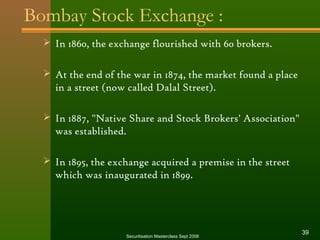
Bombay Stock Exchange : 
 In 1860, the exchange flourished with 60 brokers. 
 At the end of the war in 1874, the market found a place 
in a street (now called Dalal Street). 
 In 1887, "Native Share and Stock Brokers' Association" 
was established. 
 In 1895, the exchange acquired a premise in the street 
which was inaugurated in 1899. 
Securitisation Masterclass Sept 2006 39
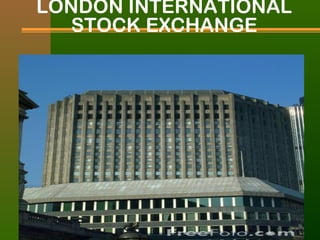
LONDON INTERNATIONAL 
STOCK EXCHANGE
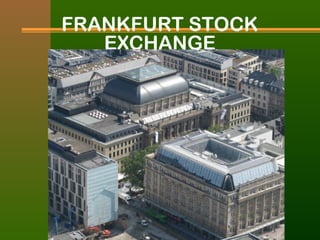
FRANKFURT STOCK 
EXCHANGE
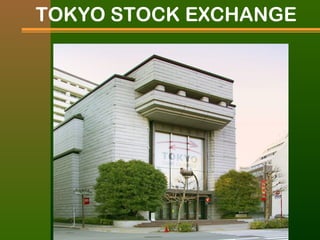
TOKYO STOCK EXCHANGE
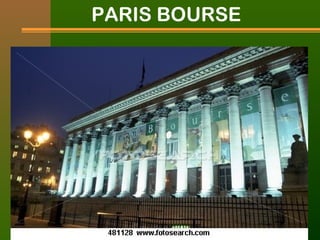
PARIS BOURSE
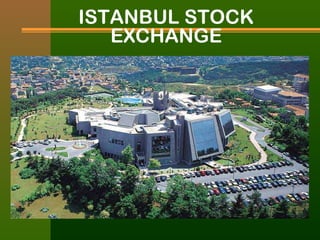
ISTANBUL STOCK 
EXCHANGE

Stock Exchange

  • 1.
    Stock exchange SecuritisationMasterclass Sept 2006 1
  • 2.
    Stock Exchange : Stock exchange is defined as “ A centralised market for buying and selling stocks, where the price is determined through supply and demand mechanisms” Securitisation Masterclass Sept 2006 2
  • 3.
    Stock exchange isany body of individuals which is constituted for the purpose of Assisting Regulating Controlling the business of buying and selling of securities. Securitisation Masterclass Sept 2006 3
  • 4.
    Functions of StockExchange • Motivates individual to save and invest funds. • A safe and productive channels for investment of savings. • Provides liquidity to the savings of the investors, by developing a secondary capital market. • Meeting the large capital needs of organized industry, trade and business. • Stock exchange play the role of a Barometer.
  • 5.
    FUNCTIONS  Itprovides a trading place for securities.  Listing of securities  Distribution of new securities.  Mobilization of savings.  Flow of capital to profitable ventures.  Economic barometer.  Capital formation.  Motivating for improved performance.
  • 6.
    Players in secondarymarket Client brokers  Floor brokers  Jobbers  Badla financiers  Arbitragers  Bulls  Bears  Stags  Wolves  Lame ducks  Brokers  FII’S  Merchant bankers  Custodians by Jagannath and Santosh (R.N.S.I.T
  • 7.
    • Jobber : A jobber is a professional independent broker who deals in securities on his own behalf, he purchases and sells securities in his own name. His main job is to earn a profit due to price variations of securities. He is professional broker who carefully judges the worth of securities and makes a good forecast of their future price movements. Securitisation Masterclass Sept 2006 7
  • 8.
    CHARACTERISTICS OF JOBBERS  He is an independent dealer in securities.  He is dealer only with the brokers but not with general public.  He is always ready to buy or sell securities  He acts as a speculator.
  • 9.
    Tarawaniwalas : Tarawaniwalasis an active member of Bombay stock exchange, he is similar to jobber. He can acts as both as a broker or jobber. Brokers : He buys and sells a securities on behalf of his clients for a commission. Securitisation Masterclass Sept 2006 9
  • 10.
    Sub-Broker : Asub-broker is an agent of stock broker, he helps the clients to buy and sell securities only through the broker. Authorised clerks : Authorised clerks is one who is appointed by a stock broker to assist him in the business of securities trading. As per the rules of the stock exchange, each broker can employ a specified number of authorised clerks to transact the securities trading business also called as “Assistant members” Securitisation Masterclass Sept 2006 10
  • 11.
    Client Brokers : These brokers do simple brokering business by acting as intermediaries between the buyers and sellers and earn a commission for their services. Floor Brokers : Floor brokers refers to those authorised clerks and brokers who enter the trading floor and execute orders for their clients Securitisation Masterclass Sept 2006 11
  • 12.
    Badla Financiers : Badla financiers are those members whose main function is to give finance for carry forward deals in specified securities in return for interest. • This interest rate is called Badla rate. • They also lend securities to brokers who have oversold at the time of settlement. Securitisation Masterclass Sept 2006 12
  • 13.
    Arbitragers : Arbitragersare those who buy securities in one market at low prices and sell them in another market at an higher prices to take advantage on the price differences prevailing in different markets. Securitisation Masterclass Sept 2006 13
  • 14.
    Types of Speculators: Bull A bull is a speculator who indulges in speculative buying activity with the expectation that there will be a rise in the price of certain security in the future.
  • 15.
    Bear Bear isa speculator who indulges in speculative selling activity with the expectation that will be a fall in the price of certain security in the future
  • 16.
    Bull and Bear: Securitisation Masterclass Sept 2006 16
  • 17.
    Lame ducks •A lame duck is a bear speculator who has contracted to sell certain security on a certain date at a price , but finds it difficult to meet his commitment on the settlement days , as the concerned security is not available in the a market and the other party is not agreeable to the postponement or carry over of the transaction. • Bear brokers who sell ultimately short by making wrong moves, hence they lose in the market.
  • 18.
    stag A stagis a speculator who applies for a large number of shares in a new issue with the expectation of selling them to the public immediately after allotment at a premium and making profit.
  • 19.
    Wolves : Theseare the brokers who are fast speculators called wolves. • These brokers are very quick to perceive changes in the trends in the market. • They are not generally caught in the wrong foot. Securitisation Masterclass Sept 2006 19
  • 20.
    Method of tradingin a stock exchange : • Choice of a broker • Placement of order • Execution of orders • Preparation of contract notes • Settlement of transactions Securitisation Masterclass Sept 2006 20
  • 21.
    1. Choice ofa Broker • Investors who want to buy or sell his securities, he need to transact only through the brokers. • They can also appoint Banker for this transaction, Bankers can also become a member of stock exchange. Securitisation Masterclass Sept 2006 21
  • 22.
    2. Placement oforder : • The next step is placing an order by telegram, telephone, letter, fax, in recent days through online. • Order is placed in abbreviations are : At Best order Limit order Immediate or cancel order Discretionary order Open order Securitisation Masterclass Sept 2006 22
  • 23.
    • At bestorder : It is an order which does not specify any specific price, it is executed immediately at the best possible price. Eg ; The investor may place a order like this “ Buy 50 Reliance@ Best” • Limit order : It is an order for the purchase or sell of securities at a fixed price specified by the investor. Eg : “Sell 200 HCL @ Rs. 76” Securitisation Masterclass Sept 2006 23
  • 24.
    • Immediate orcancel order : It is an order for the purchase or sell of securities immediately at the quoted prices. If the order could not be executed at the quoted prices immediately, it should be treated as cancelled. Securitisation Masterclass Sept 2006 24
  • 25.
    Discretionary order : It is an order to buy or sell shares at whatever price the broker thinks reasonable. This is possible only when the investor has complete faith on the broker. Limited discretionary order : Traded at a specified price range or within the given time period as per the best judgement of the broker. Securitisation Masterclass Sept 2006 25
  • 26.
    Stop loss order: It is an order to sell as soon as the price falls up to a particular level or to buy when the price rises up to a specified level. This is mainly to protect the investors against a heavy fall or rise in prices. Securitisation Masterclass Sept 2006 26
  • 27.
    3. Execution oforders : orders are executed in the trading ring of a stock exchange, if the buyer order matches with the seller order then the order is executed. The floor of the stock exchange is divided into number of markets according to the nature of the security is called pits. Securitisation Masterclass Sept 2006 27
  • 28.
    4. Preparation ofcontract note : • Once the order is executed and all the transaction are recorded and make ready of contract note and delivered to respective investors. • A contract note is a written agreement between the broker and the investor for the transactions executed and contains the details like Purchase/Sale of securities Name of the company Number of shares bought/sold and price Brokerage commission Securitisation Masterclass Sept 2006 28
  • 29.
    5. Settlement oftransactions : Finally the settlement is made by delivering the shares certificates along with the transfer deed. • The transfer deed is duly signed by the transferor that is seller. • It bears the stamp of the selling broker • The buyer then fills up the particulars in the transfer deed. Securitisation Masterclass Sept 2006 29
  • 30.
    Settlement can bemade from the following methods are : • Spot delivery settlement The delivery of securities and the payment is made on the contract day itself. • Hand delivery settlement With in the time stipulated in the agreement or 14 days from the contract date. • Clearing settlement Under this method, the delivery of securities and payments are cleared through the clearing house. • Special delivery settlement Securitisation Masterclass Sept 2006 30
  • 31.
    Online Trading Theinformation technology brought out revolutionary changes in the operations of stock exchanges in India. The traditional method was time consuming and inefficient. To overcome this NSE has introduced a nation wide online fully automated Screen Based Trading System (SBTS). All other stock exchanges also this technology online trading. Securitisation Masterclass Sept 2006 31
  • 32.
    Online trading : Trading Network Satellite Satelli te Securitisation Masterclass Sept 2006 32 NW 2 P1 p2 p3 NW 1 P1 p2 NSE p3 Main Frame Computer
  • 33.
    Benefits of OnlineTrading : • Faster Trading • Accessible to all • Widening the market • Saving of time and cost • Fully transparent • No errors and frauds Securitisation Masterclass Sept 2006 33
  • 34.
    Stock Exchanges InIndia Securitisation Masterclass Sept 2006 34 Bombay Stock Exchange (BSE) National Stock Exchange (NSE) Regional Stock Exchanges
  • 35.
    Bombay Stock Exchange The stock exchange, Bombay, popularly known as “BSE” was established in 1887 as “The Native Share and Stock Brokers Association”. It is the oldest one in Asia. Securitisation Masterclass Sept 2006 35
  • 36.
    Type Stock Exchange Location Mumbai, India Owner Bombay/Mumbai Stock Exchange Limited Key people Mahesh L. Soneji Currency INR No. of listings 4,700 Market Cap US$ 1.79 trillion Indexes BSE Sensex Website www.bseindia.com by Jagannath and Santosh (R.N.S.I.T
  • 37.
    by Jagannath andSantosh (R.N.S.I.T
  • 38.
    National Stock Exchange: Type Stock Exchange Location Mumbai, India Owner National Stock Exchange of India Limited Key people Mr. Ravi Narain Managing Director Currency INR No. of listings 1587 Indexes S&P CNX Nifty CNX Nifty Junior S&P CNX 500 Website www.nse-india.com by Jagannath and Santosh (R.N.S.I.T
  • 39.
    Bombay Stock Exchange:  In 1860, the exchange flourished with 60 brokers.  At the end of the war in 1874, the market found a place in a street (now called Dalal Street).  In 1887, "Native Share and Stock Brokers' Association" was established.  In 1895, the exchange acquired a premise in the street which was inaugurated in 1899. Securitisation Masterclass Sept 2006 39
  • 40.
  • 41.
  • 42.
  • 43.
  • 44.