BY:- KRISHNA SINGHANIA
Stock Market is a place where the trading of
company stock, both listed securities and
unlisted takes place .
Stock Exchange is an organized marketplace,
either corporation or mutual organization,
where members of the organization gather to
trade company stock or other securities .
The member may act either as agents for their
customers, or as principals for their own
accounts .
1
•Indian stock market is one of the oldest stock market in Asia .
2
•In the 1830s, trading on corporate stocks and shares in Bank
and cotton presses took place in Bombay . Trading widened
with hardly half dozen brokers during 1840 and 1850 .
3
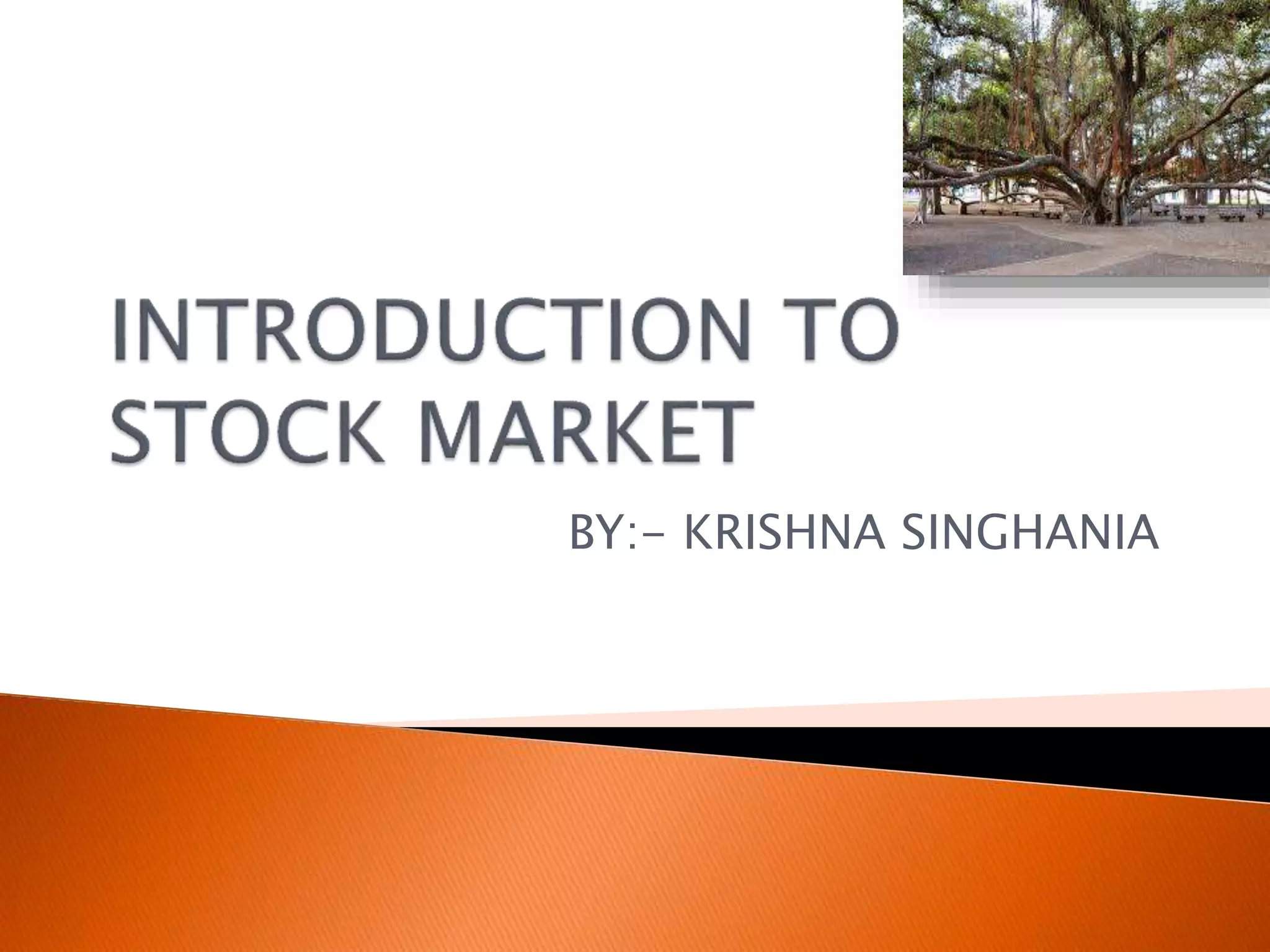
•An informal group of 22 brokers began trading under a
Banyan tree opposite the town hall of Bombay from the mid-
1850s, each investing an amount of rupee 1 .
• The informal group of stockbrokers organized
themselves as ‘The Native Share and Stockbrokers
Association’ which, in 1875, was formally
organized as B.S.E. .
4
• In 1928, the plot of land on which the BSE building
now stands at Dalal Street, Mumbai was acquired,
and a building was constructed and occupied in
1930 .
5
• Premchand Roychand(founder of BSE) was a leading
stockbroker of that time, and he assisted in setting
out traditions, convention, and procedures for the
trading of stocks at Bombay stock exchange and
they are still being followed .
6
7
•in 1956, the Government of India recognized the Bombay Stock Exchange as
the first stock exchange in the country under the securities
contracts(Regulation) Act.
8
•After the Harshad Mehta scandal there was the creation of the National Stock
Exchange (NSE), which created an electronic marketplace .NSE started
trading on 4 November 1994 .
9
•Within less than a year, NSE turnover exceeded the BSE. BSE rapidly
automated, but it never caught up with NSE spot market turnover . Roughly
after 2 years there was another scandal at BSE involving the President Mr.
Anand Rathi. Thus the BSE’s position remains at no.2 even today .
 The capital market is divided into two
segments :
1) Primary Market (Through IPO)
(Company and investor)
2) Secondary Market(Through Stock exchange)
(Investor and investor)
 BSE is an Indian stock exchange located at Dalal
Street, Mumbai, Established in 1875, the BSE is
Asia’s first stock exchange .
 It claims to be the world’s fastest stock exchange,
with a median trade speed of 6 microseconds .
 The BSE is the world’s 11th largest stock exchange
with an overall market capitalization of more than
2 dollar trillion as of july, 2017 .
 Historically an open floor trading
exchange(physically on table), the BSE switched to
an electronic trading system developed by CMC
Ltd.(Govt. company) in 1995 .(Shifted from manual)
 This amounted, screen based trading platform
called BSE on-line trading (BOLT) had a capacity of
8 million orders per day .
 Trading session time 9:15 am to 3:30 pm from
Monday to Friday .Happy holiday on Saturday and
Sunday .
 Now BSE has raised capital by issuing shares and as
on 3rd May, 2017 The BSE share which is traded in
NSE only closed with Rs. 415.75 on 4th Mar , 2020 .
 By buying shares and debentures of a company you can
become part owner and creditor of that company
respectively .
 It can act as diversification for your income base .(Side
business or income)
 Maximize your returns by taking expert advice .(Sher
khan and Motilal Oswal)
 E.g. :-If you had spent Rs. 55,000 to buy a Royal Enfield
motorcycle in the year 2000, you would now have an old,
rugged bike . If you had invested the same amount in
shares (Rs. 17.50) of Eicher Motor, your investment will
be worth Rs.5.98 crore now . (17,900.70)
 Demat is an account where your shares are
held in a dematerialized(digital) form .
 Trading account is similar to a bank account
that has to be opened with a stock exchange
registered stock broker which is used for
buying or selling shares in stock exchange .
 As an Indian investor, the two stock exchange that
you can trade in are
1)NSE 2)BSE
The two depositories with which all depository
participants are registered are
1) National Security Depository Ltd.
2)Central Depository Service Ltd. (Regulated by)
Here we can trade in Shares, Currency, Mutual
Funds, Bonds,Debentures etc. .
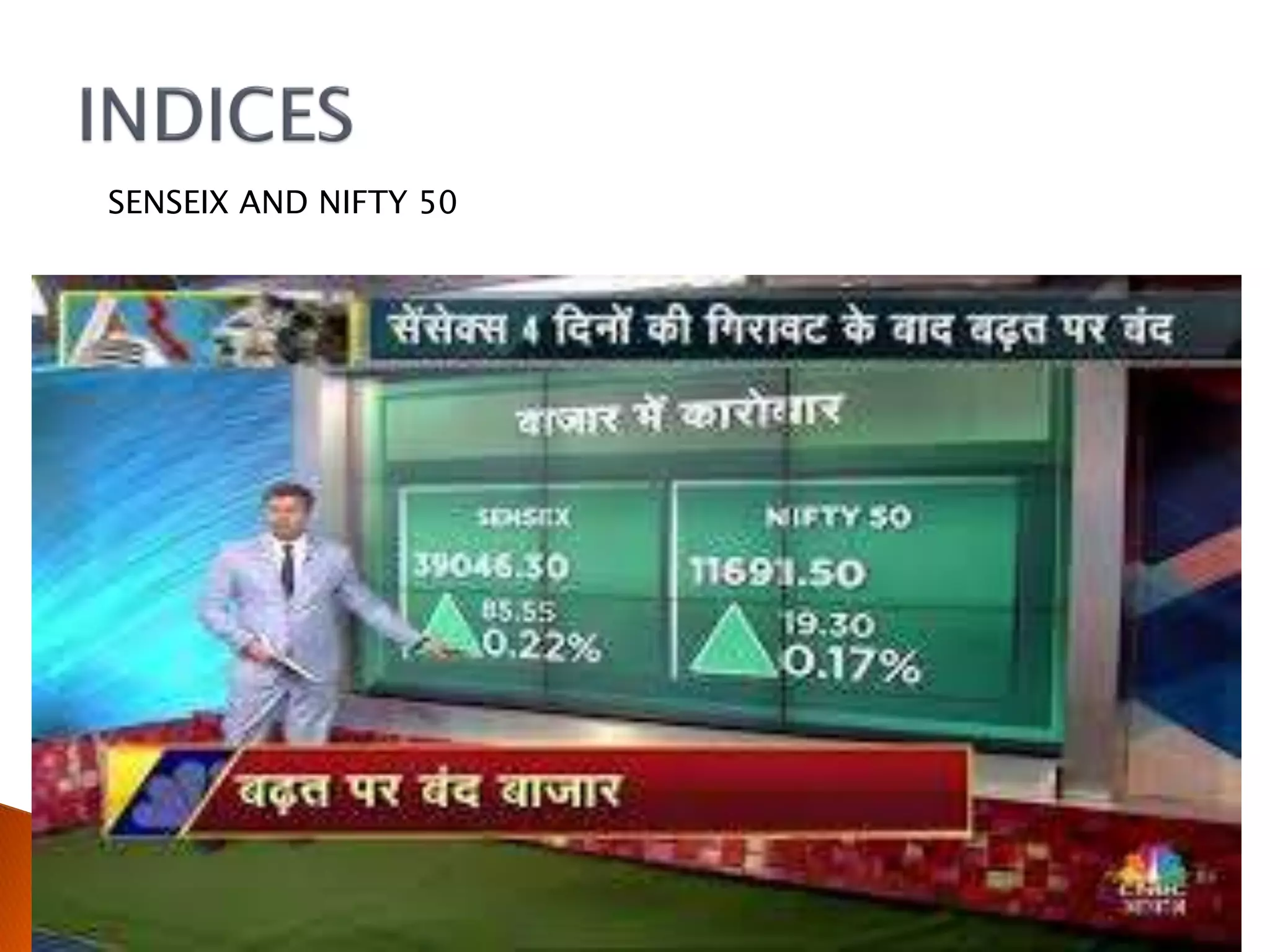
SENSEIX AND NIFTY 50
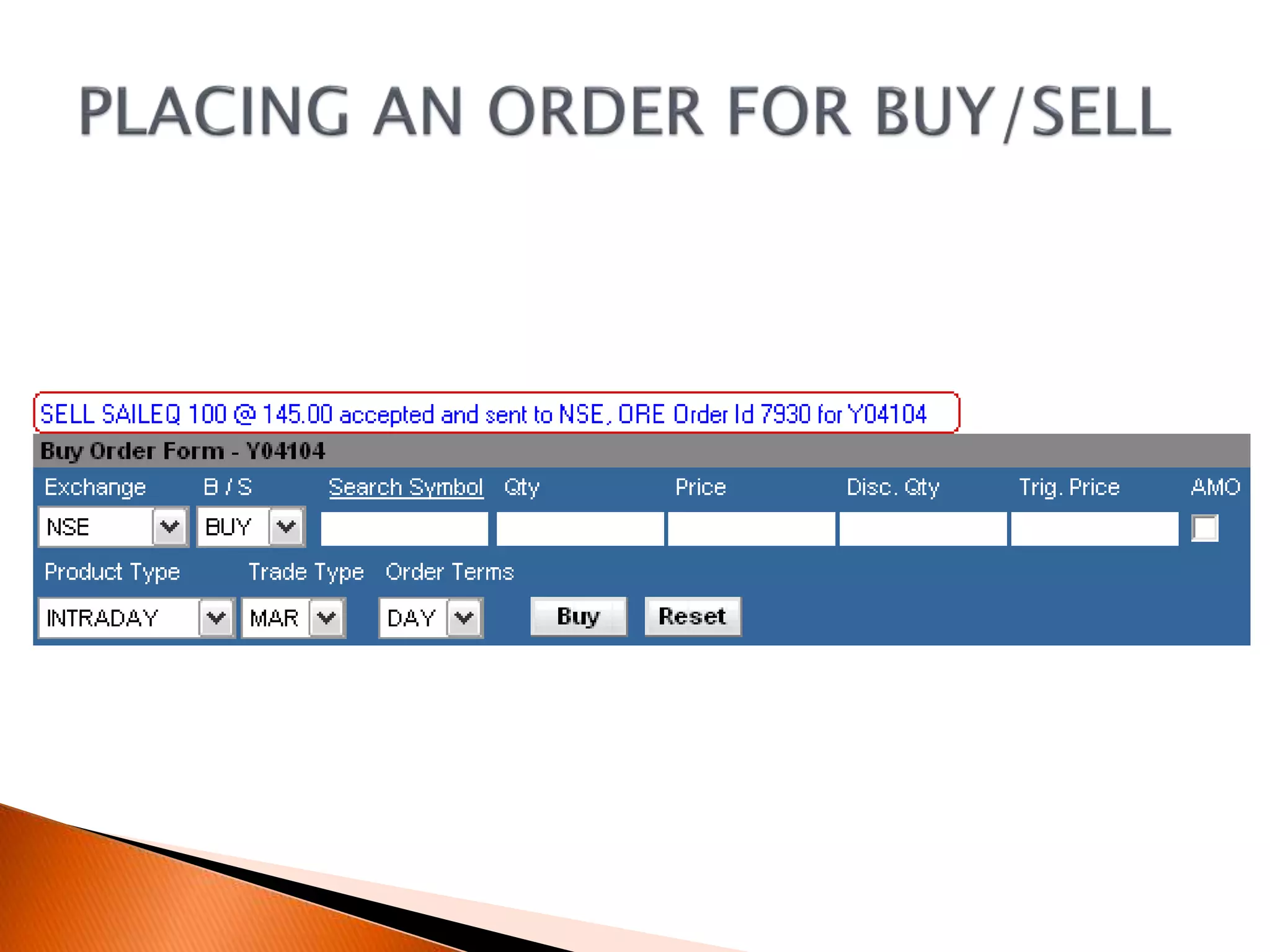
 Day Order
 Good Till Cancelled (GTC order)
 Good Till Days/Dates (GTD order)
 Limit Price Order
 Immediate or Cancelled (IOC order)
 Market Price Order
 Stop Loss Order (SL)
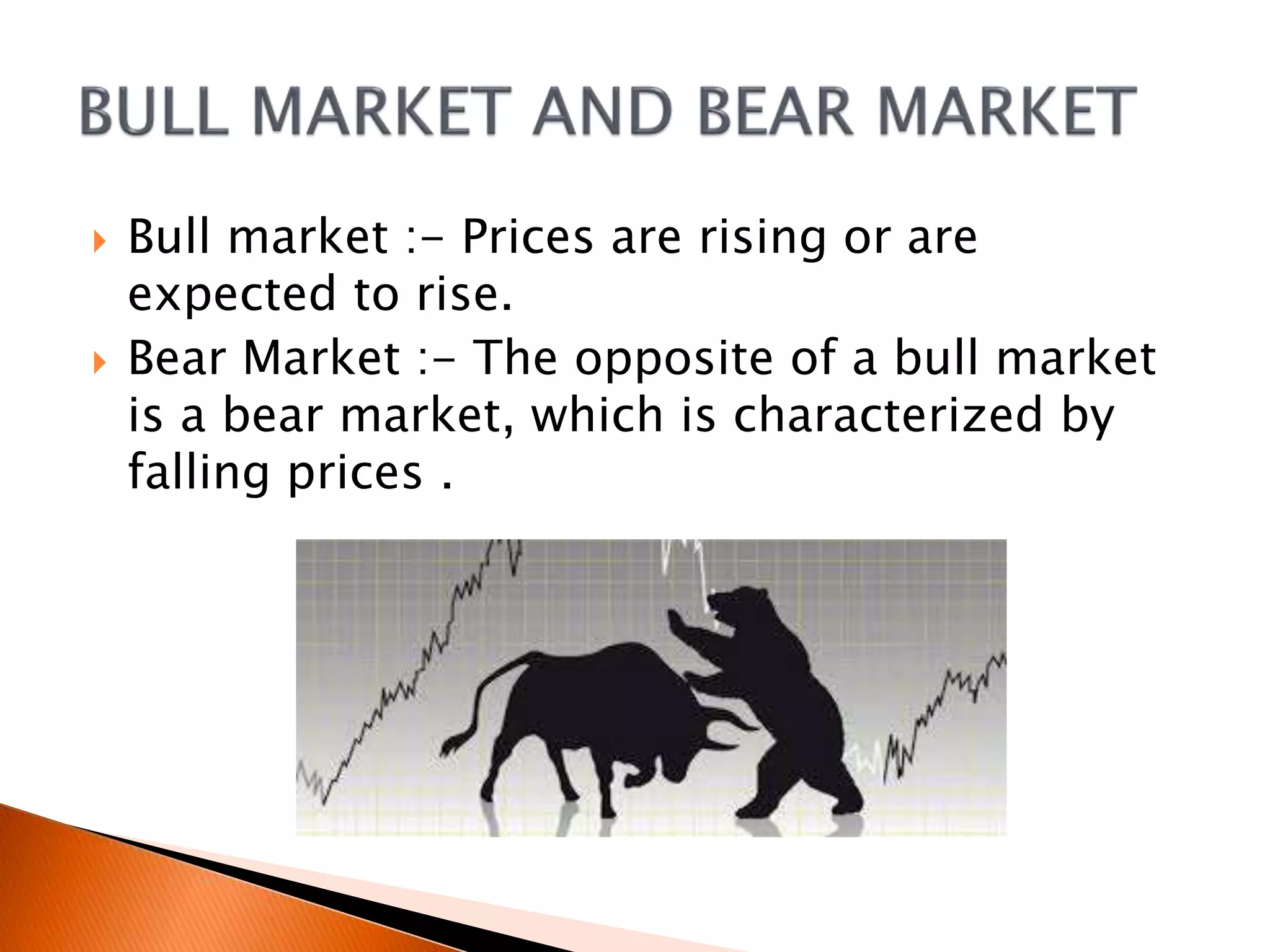
 Bull market :- Prices are rising or are
expected to rise.
 Bear Market :- The opposite of a bull market
is a bear market, which is characterized by
falling prices .
 Circuit is mechanism that curb the excess volatility or
movement in stock .
 It is the daily price range of stock/indices that is
applicable for intraday only .
 Upper circuit limit is the maximum price limit at which
share prices/indices may move in intra day .
 Lower circuit limit means the minimum price limit at
which share price/indices can move in a intra day .
 Circuit limit for indices- 10% ,15%, 20% .
 If we buy shares today and sell them after 1
day then the type of trading is called as
Delivery Trading .
 The main advantage of Delivery Trading is
that, the fear for loss of money is very less
when compared with intraday trading .
 Intra day trading deals with buying and
selling of stocks on the same day, during the
trading hours that are stipulated by the
exchange .
THANK YOU
BY KRISHNASINGHANIA

Introduction to stock market

  • 1.
  • 2.
    Stock Market isa place where the trading of company stock, both listed securities and unlisted takes place . Stock Exchange is an organized marketplace, either corporation or mutual organization, where members of the organization gather to trade company stock or other securities . The member may act either as agents for their customers, or as principals for their own accounts .
  • 3.
    1 •Indian stock marketis one of the oldest stock market in Asia . 2 •In the 1830s, trading on corporate stocks and shares in Bank and cotton presses took place in Bombay . Trading widened with hardly half dozen brokers during 1840 and 1850 . 3 •An informal group of 22 brokers began trading under a Banyan tree opposite the town hall of Bombay from the mid- 1850s, each investing an amount of rupee 1 .
  • 4.
    • The informalgroup of stockbrokers organized themselves as ‘The Native Share and Stockbrokers Association’ which, in 1875, was formally organized as B.S.E. . 4 • In 1928, the plot of land on which the BSE building now stands at Dalal Street, Mumbai was acquired, and a building was constructed and occupied in 1930 . 5 • Premchand Roychand(founder of BSE) was a leading stockbroker of that time, and he assisted in setting out traditions, convention, and procedures for the trading of stocks at Bombay stock exchange and they are still being followed . 6
  • 5.
    7 •in 1956, theGovernment of India recognized the Bombay Stock Exchange as the first stock exchange in the country under the securities contracts(Regulation) Act. 8 •After the Harshad Mehta scandal there was the creation of the National Stock Exchange (NSE), which created an electronic marketplace .NSE started trading on 4 November 1994 . 9 •Within less than a year, NSE turnover exceeded the BSE. BSE rapidly automated, but it never caught up with NSE spot market turnover . Roughly after 2 years there was another scandal at BSE involving the President Mr. Anand Rathi. Thus the BSE’s position remains at no.2 even today .
  • 6.
     The capitalmarket is divided into two segments : 1) Primary Market (Through IPO) (Company and investor) 2) Secondary Market(Through Stock exchange) (Investor and investor)
  • 7.
     BSE isan Indian stock exchange located at Dalal Street, Mumbai, Established in 1875, the BSE is Asia’s first stock exchange .  It claims to be the world’s fastest stock exchange, with a median trade speed of 6 microseconds .  The BSE is the world’s 11th largest stock exchange with an overall market capitalization of more than 2 dollar trillion as of july, 2017 .  Historically an open floor trading exchange(physically on table), the BSE switched to an electronic trading system developed by CMC Ltd.(Govt. company) in 1995 .(Shifted from manual)
  • 8.
     This amounted,screen based trading platform called BSE on-line trading (BOLT) had a capacity of 8 million orders per day .  Trading session time 9:15 am to 3:30 pm from Monday to Friday .Happy holiday on Saturday and Sunday .  Now BSE has raised capital by issuing shares and as on 3rd May, 2017 The BSE share which is traded in NSE only closed with Rs. 415.75 on 4th Mar , 2020 .
  • 9.
     By buyingshares and debentures of a company you can become part owner and creditor of that company respectively .  It can act as diversification for your income base .(Side business or income)  Maximize your returns by taking expert advice .(Sher khan and Motilal Oswal)  E.g. :-If you had spent Rs. 55,000 to buy a Royal Enfield motorcycle in the year 2000, you would now have an old, rugged bike . If you had invested the same amount in shares (Rs. 17.50) of Eicher Motor, your investment will be worth Rs.5.98 crore now . (17,900.70)
  • 10.
     Demat isan account where your shares are held in a dematerialized(digital) form .  Trading account is similar to a bank account that has to be opened with a stock exchange registered stock broker which is used for buying or selling shares in stock exchange .
  • 12.
     As anIndian investor, the two stock exchange that you can trade in are 1)NSE 2)BSE The two depositories with which all depository participants are registered are 1) National Security Depository Ltd. 2)Central Depository Service Ltd. (Regulated by) Here we can trade in Shares, Currency, Mutual Funds, Bonds,Debentures etc. .
  • 13.
  • 14.
     Day Order Good Till Cancelled (GTC order)  Good Till Days/Dates (GTD order)  Limit Price Order  Immediate or Cancelled (IOC order)  Market Price Order  Stop Loss Order (SL)
  • 15.
     Bull market:- Prices are rising or are expected to rise.  Bear Market :- The opposite of a bull market is a bear market, which is characterized by falling prices .
  • 16.
     Circuit ismechanism that curb the excess volatility or movement in stock .  It is the daily price range of stock/indices that is applicable for intraday only .  Upper circuit limit is the maximum price limit at which share prices/indices may move in intra day .  Lower circuit limit means the minimum price limit at which share price/indices can move in a intra day .  Circuit limit for indices- 10% ,15%, 20% .
  • 18.
     If webuy shares today and sell them after 1 day then the type of trading is called as Delivery Trading .  The main advantage of Delivery Trading is that, the fear for loss of money is very less when compared with intraday trading .  Intra day trading deals with buying and selling of stocks on the same day, during the trading hours that are stipulated by the exchange .
  • 19.