SECONDARY 
MARKET 
DHANANJAY KUMAR 
M.A Economics 
IIIrd Sem. 
CUB1301212003 
Central University of Bihar. 
2013-15 
Prepared By:------
Indian Financial System 
• Consists of:- 
• Financial Market 
• Financial instruments 
• Financial institution 
• Financial services
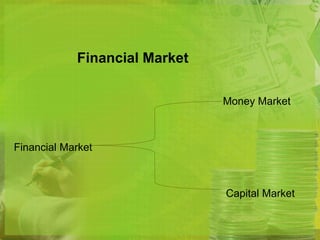
Financial Market 
Money Market 
Financial Market 
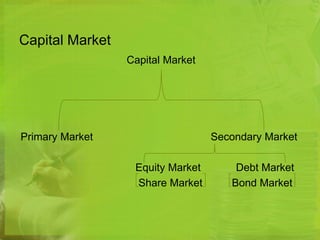
Capital Market
Capital Market 
Capital Market 
Primary Market Secondary Market 
Equity Market Debt Market 
Share Market Bond Market
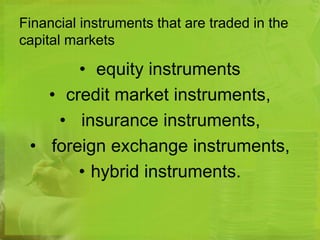
Financial instruments that are traded in the 
capital markets 
• equity instruments 
• credit market instruments, 
• insurance instruments, 
• foreign exchange instruments, 
• hybrid instruments.
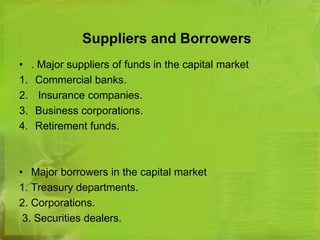
Suppliers and Borrowers 
• . Major suppliers of funds in the capital market 
1. Commercial banks. 
2. Insurance companies. 
3. Business corporations. 
4. Retirement funds. 
• Major borrowers in the capital market 
1. Treasury departments. 
2. Corporations. 
3. Securities dealers.
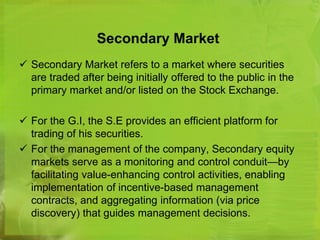
Secondary Market 
 Secondary Market refers to a market where securities 
are traded after being initially offered to the public in the 
primary market and/or listed on the Stock Exchange. 
 For the G.I, the S.E provides an efficient platform for 
trading of his securities. 
 For the management of the company, Secondary equity 
markets serve as a monitoring and control conduit—by 
facilitating value-enhancing control activities, enabling 
implementation of incentive-based management 
contracts, and aggregating information (via price 
discovery) that guides management decisions.
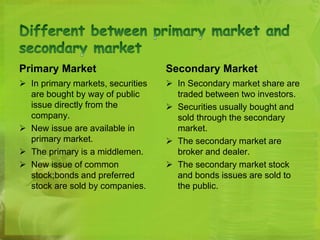
Primary Market 
 In primary markets, securities 
are bought by way of public 
issue directly from the 
company. 
 New issue are available in 
primary market. 
 The primary is a middlemen. 
 New issue of common 
stock;bonds and preferred 
stock are sold by companies. 
Secondary Market 
 In Secondary market share are 
traded between two investors. 
 Securities usually bought and 
sold through the secondary 
market. 
 The secondary market are 
broker and dealer. 
 The secondary market stock 
and bonds issues are sold to 
the public.
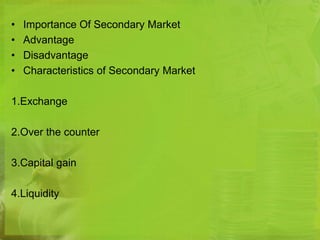
• Importance Of Secondary Market 
• Advantage 
• Disadvantage 
• Characteristics of Secondary Market 
1.Exchange 
2.Over the counter 
3.Capital gain 
4.Liquidity
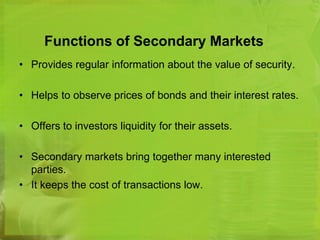
Functions of Secondary Markets 
• Provides regular information about the value of security. 
• Helps to observe prices of bonds and their interest rates. 
• Offers to investors liquidity for their assets. 
• Secondary markets bring together many interested 
parties. 
• It keeps the cost of transactions low.
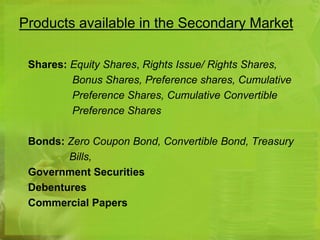
Products available in the Secondary Market 
Shares: Equity Shares, Rights Issue/ Rights Shares, 
Bonus Shares, Preference shares, Cumulative 
Preference Shares, Cumulative Convertible 
Preference Shares 
Bonds: Zero Coupon Bond, Convertible Bond, Treasury 
Bills, 
Government Securities 
Debentures 
Commercial Papers
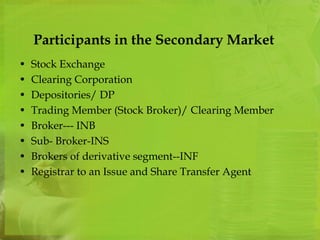
Participants in the Secondary Market 
• Stock Exchange 
• Clearing Corporation 
• Depositories/ DP 
• Trading Member (Stock Broker)/ Clearing Member 
• Broker--- INB 
• Sub- Broker-INS 
• Brokers of derivative segment--INF 
• Registrar to an Issue and Share Transfer Agent
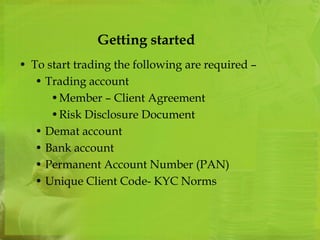
Getting started 
• To start trading the following are required – 
• Trading account 
•Member – Client Agreement 
•Risk Disclosure Document 
• Demat account 
• Bank account 
• Permanent Account Number (PAN) 
• Unique Client Code- KYC Norms
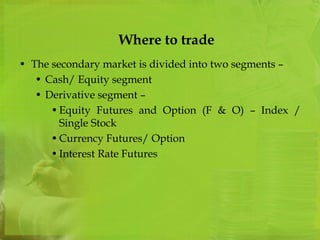
Where to trade 
• The secondary market is divided into two segments – 
• Cash/ Equity segment 
• Derivative segment – 
• Equity Futures and Option (F & O) – Index / 
Single Stock 
•Currency Futures/ Option 
• Interest Rate Futures
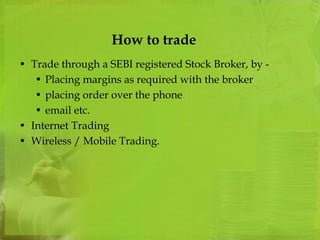
How to trade 
• Trade through a SEBI registered Stock Broker, by - 
• Placing margins as required with the broker 
• placing order over the phone 
• email etc. 
• Internet Trading 
• Wireless / Mobile Trading.
Post Trade 
• The stock broker is required to provide contract notes 
confirming the trades done within 24 hrs of executing 
the trade 
• The contract notes can either be in physical or electronic 
form
Charges by the Stock Broker 
• Brokerage charged by member broker (maximum 2.5%) 
• Service tax as stipulated 
• Securities Transaction Tax 
• Penalties arising on specific default on behalf of client 
(investor) 
• Securities Transaction Tax (STT) is a tax being levied 
on all transactions done on the stock exchanges at 
rates prescribed by the Central Government from time 
to time.
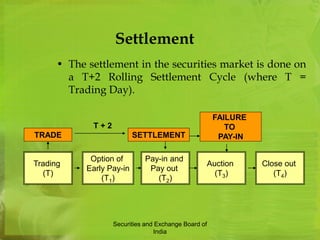
Settlement 
• The settlement in the securities market is done on 
a T+2 Rolling Settlement Cycle (where T = 
Trading Day). 
TRADE SETTLEMENT 
Securities and Exchange Board of 
India 
Trading 
(T) 
Option of 
Early Pay-in 
(T1) 
Auction 
(T3) 
Close out 
(T4) 
Pay-in and 
Pay out 
(T2) 
T + 2 
FAILURE 
TO 
PAY-IN
Settlement – Auction And - Close Out 
• Incase there is a shortage in Pay-in of shares at the time 
of settlement on T+2, the Stock Exchange purchases the 
requisite quantity in the Auction Market and gives them 
to the buying trading member. 
• If the shares could not be bought in the auction i.e. if 
shares are not offered for sale in the auction, the 
transactions are closed out as per SEBI guidelines
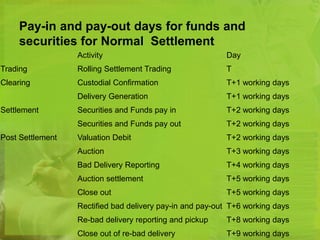
Pay-in and pay-out days for funds and 
securities for Normal Settlement 
Activity Day 
Trading Rolling Settlement Trading T 
Clearing Custodial Confirmation T+1 working days 
Delivery Generation T+1 working days 
Settlement Securities and Funds pay in T+2 working days 
Securities and Funds pay out T+2 working days 
Post Settlement Valuation Debit T+2 working days 
Auction T+3 working days 
Bad Delivery Reporting T+4 working days 
Auction settlement T+5 working days 
Close out T+5 working days 
Rectified bad delivery pay-in and pay-out T+6 working days 
Re-bad delivery reporting and pickup T+8 working days 
Close out of re-bad delivery T+9 working days
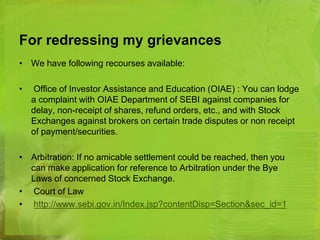
For redressing my grievances 
• We have following recourses available: 
• Office of Investor Assistance and Education (OIAE) : You can lodge 
a complaint with OIAE Department of SEBI against companies for 
delay, non-receipt of shares, refund orders, etc., and with Stock 
Exchanges against brokers on certain trade disputes or non receipt 
of payment/securities. 
• Arbitration: If no amicable settlement could be reached, then you 
can make application for reference to Arbitration under the Bye 
Laws of concerned Stock Exchange. 
• Court of Law 
• http://www.sebi.gov.in/Index.jsp?contentDisp=Section&sec_id=1
SECONDARY MARKET 
TRADING MECHANICS 
• TYPES OF ORDERS
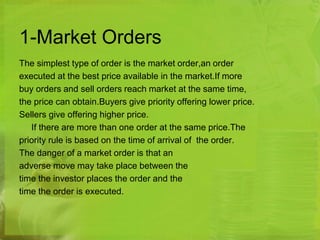
1-Market Orders 
The simplest type of order is the market order,an order 
executed at the best price available in the market.If more 
buy orders and sell orders reach market at the same time, 
the price can obtain.Buyers give priority offering lower price. 
Sellers give offering higher price. 
If there are more than one order at the same price.The 
priority rule is based on the time of arrival of the order. 
The danger of a market order is that an 
adverse move may take place between the 
time the investor places the order and the 
time the order is executed.
2-Limit Orders 
• It designates a price treshold for the execution of 
trade.It is a conditional order. 
A buy limit order indicates that the security may be 
purchased only at the designated price or lower. 
A sell limit order indicates that the security may be 
sold at the designated price or higher. 
• The danger of limit order is that it comes 
with no guarantee it will be executed at all. 
The designated price may not be obtainable.
3-Stop Order 
Stop order specifies that the order is not be 
executed until the market moves to a designated 
price at which time it becomes a market order. 
A stop order to buy specifies that the order is 
not to be executed until the market rises to a 
designated price. 
A stop order to sell specifies that the order is 
not to be executed until the market price falls 
below a designated price. 
• Two dangers of stop order: 
1-Security prices sometimes exhibit abrupt price changes. 

2-Stop order can be subject to the uncertainty of the execution price.
4-Market if Touched Orders 
• This order becomes a market order if a designated 
price is reached.However,a market-if-touched order 
to buy becomes a market order if the market falls to 
a given price.A market-if-touched order to sell beco-mes 
a market order if the market rise to a specified 
price.
5-Time Specific Order 
• Orders may be placed to buy or sell 
at the open or close of trading for the 
day that is time specific orders.
6-Size Related Orders 
For common stock,orders are also classified 
by their size. 
A round lot is typically 100 shares of a stock. 
An odd lot is defined as less than a round lot. 
A block trade is defined as an order of 10.000 shares of 
a given stock.
Stock Exchange 
• It is a place where buying and selling of Securities takes 
place. 
• Regulatory Authority : SEBI 
• trading platform provided by NSE: Electronic 
• There are 23 stock exchanges in India. 
• In India we have Bombay stock exchange , National 
stock exchange and the rest 21 are Regional stock 
exchanges.
Other 21 Regional Stock Exchanges in India 
• Bombay Stock Exchange • National Stock Exchange 
• Ahmedabad Stock Exchange • Bangalore Stock Exchange 
• Bhubaneshwar Stock Exchange • Calcutta Stock Exchange 
• Cochin Stock Exchange • Coimbatore Stock Exchange 
• Delhi Stock Exchange • Guwahati Stock Exchange 
• Hyderabad Stock Exchange • Jaipur Stock Exchange 
• Ludhiana Stock Exchange • Madhya Pradesh Stock 
Exchange 
• Madras Stock Exchange • Magadh Stock Exchange 
• Mangalore Stock Exchange • Meerut Stock Exchange 
• OTC Exchange Of India • Pune Stock Exchange 
• Saurashtra Kutch Stock Exchange• Uttar Pradesh Stock Exchange 
• Vadodara Stock Exchange
• REGULATORY AUTHORITY 
• Regulatory authority is the one which is under the 
government surveillance. 
• A few Stock Exchange companies follow the rules which 
are laid down by the government of India. 
• Example: 1) SEBI:- (Securities Exchange Board of 
India) 
• Demutualisation of stock exchanges 
• Demutualisation refers to the transition process of an 
exchange from a “mutually-owned” association to a 
company “owned by shareholders”. 
• Mutual Exchange
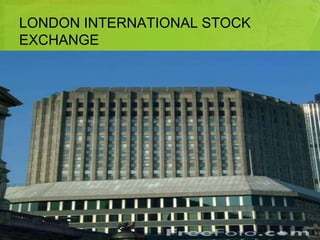
LONDON INTERNATIONAL STOCK 
EXCHANGE
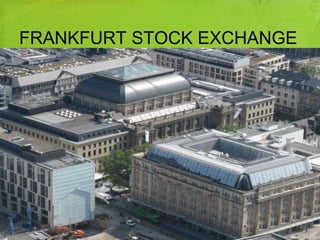
FRANKFURT STOCK EXCHANGE
PARIS BOURSE
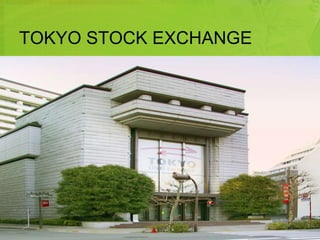
TOKYO STOCK EXCHANGE
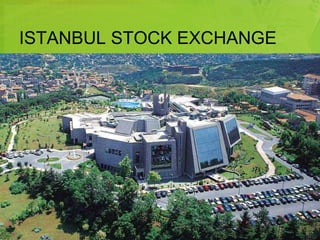
ISTANBUL STOCK EXCHANGE
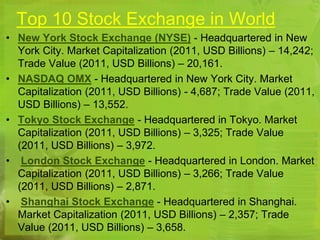
Top 10 Stock Exchange in World 
• New York Stock Exchange (NYSE) - Headquartered in New 
York City. Market Capitalization (2011, USD Billions) – 14,242; 
Trade Value (2011, USD Billions) – 20,161. 
• NASDAQ OMX - Headquartered in New York City. Market 
Capitalization (2011, USD Billions) - 4,687; Trade Value (2011, 
USD Billions) – 13,552. 
• Tokyo Stock Exchange - Headquartered in Tokyo. Market 
Capitalization (2011, USD Billions) – 3,325; Trade Value 
(2011, USD Billions) – 3,972. 
• London Stock Exchange - Headquartered in London. Market 
Capitalization (2011, USD Billions) – 3,266; Trade Value 
(2011, USD Billions) – 2,871. 
• Shanghai Stock Exchange - Headquartered in Shanghai. 
Market Capitalization (2011, USD Billions) – 2,357; Trade 
Value (2011, USD Billions) – 3,658.
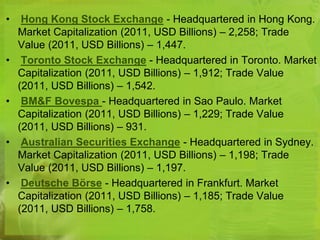
• Hong Kong Stock Exchange - Headquartered in Hong Kong. 
Market Capitalization (2011, USD Billions) – 2,258; Trade 
Value (2011, USD Billions) – 1,447. 
• Toronto Stock Exchange - Headquartered in Toronto. Market 
Capitalization (2011, USD Billions) – 1,912; Trade Value 
(2011, USD Billions) – 1,542. 
• BM&F Bovespa - Headquartered in Sao Paulo. Market 
Capitalization (2011, USD Billions) – 1,229; Trade Value 
(2011, USD Billions) – 931. 
• Australian Securities Exchange - Headquartered in Sydney. 
Market Capitalization (2011, USD Billions) – 1,198; Trade 
Value (2011, USD Billions) – 1,197. 
• Deutsche Börse - Headquartered in Frankfurt. Market 
Capitalization (2011, USD Billions) – 1,185; Trade Value 
(2011, USD Billions) – 1,758.
Stock Trading 
• Screen Based Trading 
• NEAT: National Exchange for Automated Trading 
• Placing orders with the broker. 
• Contract Note 
• details are required 
• maximum brokerage: 2.5%
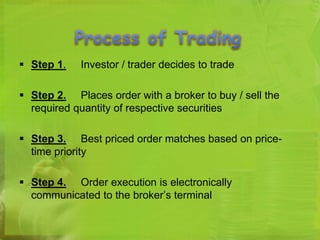
 Step 1. Investor / trader decides to trade 
 Step 2. Places order with a broker to buy / sell the 
required quantity of respective securities 
 Step 3. Best priced order matches based on price-time 
priority 
 Step 4. Order execution is electronically 
communicated to the broker’s terminal
 Step 5. Trade confirmation slip issued to the investor / 
trader by the broker 
 Step 6. Within 24 hours of trade execution, contract 
note is issued to the investor / trader by the broker 
 Step 7. Pay-in of funds and securities before T+2 day 
 Step 8. Pay-out of funds and securities on T+2 
day
SEBI Risk Management System 
 The primary focus of risk management by SEBI has 
been to address the market risks, operational risks and 
systemic risks. 
 SEBI has been continuously reviewing its policies and 
drafting risk management policies to mitigate these risks, 
thereby enhancing the level of investor protection and 
catalyzing market development.
Direct Market Access (DMA) 
• Direct Market Access (DMA) is a facility which allows 
brokers to offer clients direct access to the exchange 
trading system through the broker’s infrastructure without 
manual intervention by the broker. Some of the 
advantages offered by DMA are direct control of clients 
over orders, faster execution of client orders, reduced 
risk of errors associated with manual order entry, greater 
transparency, increased liquidity, lower impact costs for 
large orders, better audit trails and better use of hedging 
and arbitrage opportunities through the use of decision 
support tools / algorithms for trading. Presently, DMA 
facility is available for institutional investors.
Secondary maket in india

Secondary maket in india

  • 1.
    SECONDARY MARKET DHANANJAYKUMAR M.A Economics IIIrd Sem. CUB1301212003 Central University of Bihar. 2013-15 Prepared By:------
  • 2.
    Indian Financial System • Consists of:- • Financial Market • Financial instruments • Financial institution • Financial services
  • 3.
    Financial Market MoneyMarket Financial Market Capital Market
  • 4.
    Capital Market CapitalMarket Primary Market Secondary Market Equity Market Debt Market Share Market Bond Market
  • 5.
    Financial instruments thatare traded in the capital markets • equity instruments • credit market instruments, • insurance instruments, • foreign exchange instruments, • hybrid instruments.
  • 6.
    Suppliers and Borrowers • . Major suppliers of funds in the capital market 1. Commercial banks. 2. Insurance companies. 3. Business corporations. 4. Retirement funds. • Major borrowers in the capital market 1. Treasury departments. 2. Corporations. 3. Securities dealers.
  • 7.
    Secondary Market Secondary Market refers to a market where securities are traded after being initially offered to the public in the primary market and/or listed on the Stock Exchange.  For the G.I, the S.E provides an efficient platform for trading of his securities.  For the management of the company, Secondary equity markets serve as a monitoring and control conduit—by facilitating value-enhancing control activities, enabling implementation of incentive-based management contracts, and aggregating information (via price discovery) that guides management decisions.
  • 8.
    Primary Market In primary markets, securities are bought by way of public issue directly from the company.  New issue are available in primary market.  The primary is a middlemen.  New issue of common stock;bonds and preferred stock are sold by companies. Secondary Market  In Secondary market share are traded between two investors.  Securities usually bought and sold through the secondary market.  The secondary market are broker and dealer.  The secondary market stock and bonds issues are sold to the public.
  • 9.
    • Importance OfSecondary Market • Advantage • Disadvantage • Characteristics of Secondary Market 1.Exchange 2.Over the counter 3.Capital gain 4.Liquidity
  • 10.
    Functions of SecondaryMarkets • Provides regular information about the value of security. • Helps to observe prices of bonds and their interest rates. • Offers to investors liquidity for their assets. • Secondary markets bring together many interested parties. • It keeps the cost of transactions low.
  • 11.
    Products available inthe Secondary Market Shares: Equity Shares, Rights Issue/ Rights Shares, Bonus Shares, Preference shares, Cumulative Preference Shares, Cumulative Convertible Preference Shares Bonds: Zero Coupon Bond, Convertible Bond, Treasury Bills, Government Securities Debentures Commercial Papers
  • 12.
    Participants in theSecondary Market • Stock Exchange • Clearing Corporation • Depositories/ DP • Trading Member (Stock Broker)/ Clearing Member • Broker--- INB • Sub- Broker-INS • Brokers of derivative segment--INF • Registrar to an Issue and Share Transfer Agent
  • 13.
    Getting started •To start trading the following are required – • Trading account •Member – Client Agreement •Risk Disclosure Document • Demat account • Bank account • Permanent Account Number (PAN) • Unique Client Code- KYC Norms
  • 14.
    Where to trade • The secondary market is divided into two segments – • Cash/ Equity segment • Derivative segment – • Equity Futures and Option (F & O) – Index / Single Stock •Currency Futures/ Option • Interest Rate Futures
  • 15.
    How to trade • Trade through a SEBI registered Stock Broker, by - • Placing margins as required with the broker • placing order over the phone • email etc. • Internet Trading • Wireless / Mobile Trading.
  • 16.
    Post Trade •The stock broker is required to provide contract notes confirming the trades done within 24 hrs of executing the trade • The contract notes can either be in physical or electronic form
  • 17.
    Charges by theStock Broker • Brokerage charged by member broker (maximum 2.5%) • Service tax as stipulated • Securities Transaction Tax • Penalties arising on specific default on behalf of client (investor) • Securities Transaction Tax (STT) is a tax being levied on all transactions done on the stock exchanges at rates prescribed by the Central Government from time to time.
  • 18.
    Settlement • Thesettlement in the securities market is done on a T+2 Rolling Settlement Cycle (where T = Trading Day). TRADE SETTLEMENT Securities and Exchange Board of India Trading (T) Option of Early Pay-in (T1) Auction (T3) Close out (T4) Pay-in and Pay out (T2) T + 2 FAILURE TO PAY-IN
  • 19.
    Settlement – AuctionAnd - Close Out • Incase there is a shortage in Pay-in of shares at the time of settlement on T+2, the Stock Exchange purchases the requisite quantity in the Auction Market and gives them to the buying trading member. • If the shares could not be bought in the auction i.e. if shares are not offered for sale in the auction, the transactions are closed out as per SEBI guidelines
  • 20.
    Pay-in and pay-outdays for funds and securities for Normal Settlement Activity Day Trading Rolling Settlement Trading T Clearing Custodial Confirmation T+1 working days Delivery Generation T+1 working days Settlement Securities and Funds pay in T+2 working days Securities and Funds pay out T+2 working days Post Settlement Valuation Debit T+2 working days Auction T+3 working days Bad Delivery Reporting T+4 working days Auction settlement T+5 working days Close out T+5 working days Rectified bad delivery pay-in and pay-out T+6 working days Re-bad delivery reporting and pickup T+8 working days Close out of re-bad delivery T+9 working days
  • 21.
    For redressing mygrievances • We have following recourses available: • Office of Investor Assistance and Education (OIAE) : You can lodge a complaint with OIAE Department of SEBI against companies for delay, non-receipt of shares, refund orders, etc., and with Stock Exchanges against brokers on certain trade disputes or non receipt of payment/securities. • Arbitration: If no amicable settlement could be reached, then you can make application for reference to Arbitration under the Bye Laws of concerned Stock Exchange. • Court of Law • http://www.sebi.gov.in/Index.jsp?contentDisp=Section&sec_id=1
  • 22.
    SECONDARY MARKET TRADINGMECHANICS • TYPES OF ORDERS
  • 23.
    1-Market Orders Thesimplest type of order is the market order,an order executed at the best price available in the market.If more buy orders and sell orders reach market at the same time, the price can obtain.Buyers give priority offering lower price. Sellers give offering higher price. If there are more than one order at the same price.The priority rule is based on the time of arrival of the order. The danger of a market order is that an adverse move may take place between the time the investor places the order and the time the order is executed.
  • 24.
    2-Limit Orders •It designates a price treshold for the execution of trade.It is a conditional order. A buy limit order indicates that the security may be purchased only at the designated price or lower. A sell limit order indicates that the security may be sold at the designated price or higher. • The danger of limit order is that it comes with no guarantee it will be executed at all. The designated price may not be obtainable.
  • 25.
    3-Stop Order Stoporder specifies that the order is not be executed until the market moves to a designated price at which time it becomes a market order. A stop order to buy specifies that the order is not to be executed until the market rises to a designated price. A stop order to sell specifies that the order is not to be executed until the market price falls below a designated price. • Two dangers of stop order: 1-Security prices sometimes exhibit abrupt price changes. 2-Stop order can be subject to the uncertainty of the execution price.
  • 26.
    4-Market if TouchedOrders • This order becomes a market order if a designated price is reached.However,a market-if-touched order to buy becomes a market order if the market falls to a given price.A market-if-touched order to sell beco-mes a market order if the market rise to a specified price.
  • 27.
    5-Time Specific Order • Orders may be placed to buy or sell at the open or close of trading for the day that is time specific orders.
  • 28.
    6-Size Related Orders For common stock,orders are also classified by their size. A round lot is typically 100 shares of a stock. An odd lot is defined as less than a round lot. A block trade is defined as an order of 10.000 shares of a given stock.
  • 29.
    Stock Exchange •It is a place where buying and selling of Securities takes place. • Regulatory Authority : SEBI • trading platform provided by NSE: Electronic • There are 23 stock exchanges in India. • In India we have Bombay stock exchange , National stock exchange and the rest 21 are Regional stock exchanges.
  • 30.
    Other 21 RegionalStock Exchanges in India • Bombay Stock Exchange • National Stock Exchange • Ahmedabad Stock Exchange • Bangalore Stock Exchange • Bhubaneshwar Stock Exchange • Calcutta Stock Exchange • Cochin Stock Exchange • Coimbatore Stock Exchange • Delhi Stock Exchange • Guwahati Stock Exchange • Hyderabad Stock Exchange • Jaipur Stock Exchange • Ludhiana Stock Exchange • Madhya Pradesh Stock Exchange • Madras Stock Exchange • Magadh Stock Exchange • Mangalore Stock Exchange • Meerut Stock Exchange • OTC Exchange Of India • Pune Stock Exchange • Saurashtra Kutch Stock Exchange• Uttar Pradesh Stock Exchange • Vadodara Stock Exchange
  • 31.
    • REGULATORY AUTHORITY • Regulatory authority is the one which is under the government surveillance. • A few Stock Exchange companies follow the rules which are laid down by the government of India. • Example: 1) SEBI:- (Securities Exchange Board of India) • Demutualisation of stock exchanges • Demutualisation refers to the transition process of an exchange from a “mutually-owned” association to a company “owned by shareholders”. • Mutual Exchange
  • 32.
  • 33.
  • 34.
  • 35.
  • 36.
  • 37.
    Top 10 StockExchange in World • New York Stock Exchange (NYSE) - Headquartered in New York City. Market Capitalization (2011, USD Billions) – 14,242; Trade Value (2011, USD Billions) – 20,161. • NASDAQ OMX - Headquartered in New York City. Market Capitalization (2011, USD Billions) - 4,687; Trade Value (2011, USD Billions) – 13,552. • Tokyo Stock Exchange - Headquartered in Tokyo. Market Capitalization (2011, USD Billions) – 3,325; Trade Value (2011, USD Billions) – 3,972. • London Stock Exchange - Headquartered in London. Market Capitalization (2011, USD Billions) – 3,266; Trade Value (2011, USD Billions) – 2,871. • Shanghai Stock Exchange - Headquartered in Shanghai. Market Capitalization (2011, USD Billions) – 2,357; Trade Value (2011, USD Billions) – 3,658.
  • 38.
    • Hong KongStock Exchange - Headquartered in Hong Kong. Market Capitalization (2011, USD Billions) – 2,258; Trade Value (2011, USD Billions) – 1,447. • Toronto Stock Exchange - Headquartered in Toronto. Market Capitalization (2011, USD Billions) – 1,912; Trade Value (2011, USD Billions) – 1,542. • BM&F Bovespa - Headquartered in Sao Paulo. Market Capitalization (2011, USD Billions) – 1,229; Trade Value (2011, USD Billions) – 931. • Australian Securities Exchange - Headquartered in Sydney. Market Capitalization (2011, USD Billions) – 1,198; Trade Value (2011, USD Billions) – 1,197. • Deutsche Börse - Headquartered in Frankfurt. Market Capitalization (2011, USD Billions) – 1,185; Trade Value (2011, USD Billions) – 1,758.
  • 39.
    Stock Trading •Screen Based Trading • NEAT: National Exchange for Automated Trading • Placing orders with the broker. • Contract Note • details are required • maximum brokerage: 2.5%
  • 40.
     Step 1.Investor / trader decides to trade  Step 2. Places order with a broker to buy / sell the required quantity of respective securities  Step 3. Best priced order matches based on price-time priority  Step 4. Order execution is electronically communicated to the broker’s terminal
  • 41.
     Step 5.Trade confirmation slip issued to the investor / trader by the broker  Step 6. Within 24 hours of trade execution, contract note is issued to the investor / trader by the broker  Step 7. Pay-in of funds and securities before T+2 day  Step 8. Pay-out of funds and securities on T+2 day
  • 42.
    SEBI Risk ManagementSystem  The primary focus of risk management by SEBI has been to address the market risks, operational risks and systemic risks.  SEBI has been continuously reviewing its policies and drafting risk management policies to mitigate these risks, thereby enhancing the level of investor protection and catalyzing market development.
  • 43.
    Direct Market Access(DMA) • Direct Market Access (DMA) is a facility which allows brokers to offer clients direct access to the exchange trading system through the broker’s infrastructure without manual intervention by the broker. Some of the advantages offered by DMA are direct control of clients over orders, faster execution of client orders, reduced risk of errors associated with manual order entry, greater transparency, increased liquidity, lower impact costs for large orders, better audit trails and better use of hedging and arbitrage opportunities through the use of decision support tools / algorithms for trading. Presently, DMA facility is available for institutional investors.