Stereotypes & Representation
L/O: to reflect on and develop your
understanding about stereotypes
In bullet points, what have you learnt
about this exam?
• 1 min
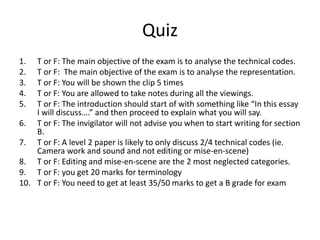
Quiz
1. T or F: The main objective of the exam is to analyse the technical codes.
2. T or F: The main objective of the exam is to analyse the representation.
3. T or F: You will be shown the clip 5 times
4. T or F: You are allowed to take notes during all the viewings.
5. T or F: The introduction should start of with something like “In this essay
I will discuss….” and then proceed to explain what you will say.
6. T or F: The invigilator will not advise you when to start writing for section
B.
7. T or F: A level 2 paper is likely to only discuss 2/4 technical codes (ie.
Camera work and sound and not editing or mise-en-scene)
8. T or F: Editing and mise-en-scene are the 2 most neglected categories.
9. T or F: you get 20 marks for terminology
10. T or F: You need to get at least 35/50 marks to get a B grade for exam
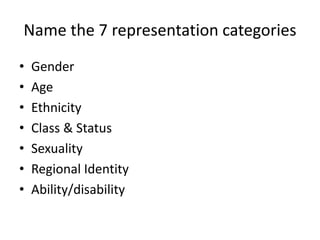
Name the 7 representation categories
• Gender
• Age
• Ethnicity
• Class & Status
• Sexuality
• Regional Identity
• Ability/disability
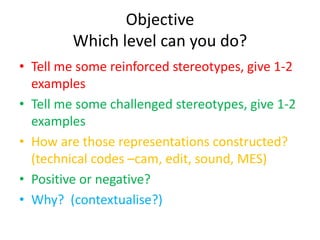
Objective
Which level can you do?
• Tell me some reinforced stereotypes, give 1-2
examples
• Tell me some challenged stereotypes, give 1-2
examples
• How are those representations constructed?
(technical codes –cam, edit, sound, MES)
• Positive or negative?
• Why? (contextualise?)
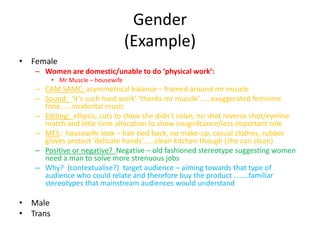
Gender
(Example)
• Female
– Women are domestic/unable to do ‘physical work’:
• Mr Muscle – housewife
– CAM SAMC: asymmetrical balance – framed around mr muscle
– Sound: ‘it’s such hard work’ ‘thanks mr muscle’……exaggerated feminine
tone……incidental music
– Editing: ellipsis, cuts to show she didn’t solve, no shot reverse shot/eyeline
match and little time allocation to show insignifcance/less important role
– MES: housewife look – hair tied back, no make-up, casual clothes, rubber
gloves protect ‘delicate hands’……clean kitchen though (she can clean)
– Positive or negative? Negative – old fashioned stereotype suggesting women
need a man to solve more strenuous jobs
– Why? (contextualise?) target audience – aiming towards that type of
audience who could relate and therefore buy the product ……..familiar
stereotypes that mainstream audiences would understand
• Male
• Trans
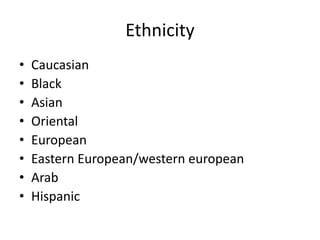
Ethnicity
• Caucasian
• Black
• Asian
• Oriental
• European
• Eastern European/western european
• Arab
• Hispanic
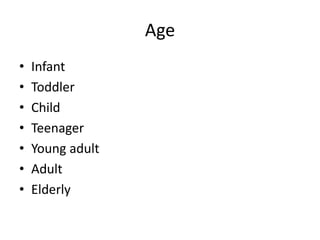
Age
• Infant
• Toddler
• Child
• Teenager
• Young adult
• Adult
• Elderly
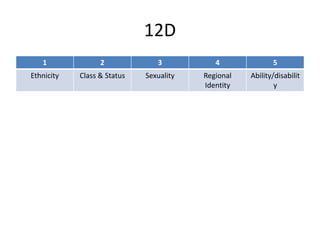
12D
1 2 3 4 5
Ethnicity Class & Status Sexuality Regional
Identity
Ability/disabilit
y
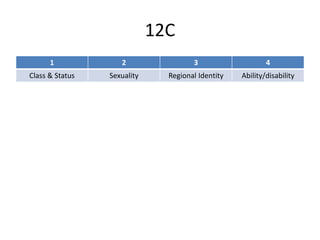
12C
1 2 3 4
Class & Status Sexuality Regional Identity Ability/disability
presentations
• Each group present your category
Class & Status
• -first decide on what the difference is between
class and status and how someone belongs to
a certain class and/or status
• (Example:
• -think of how class/status has changed over
time (context) and then decide what is
stereotypical of different class and status
Ability/disability
• -remember this could be physical and/or mental
• Physical: physical abilities (such as athlete) or
physical disabilities (such as wheelchair or deaf)
• Mental: mental abilities (such as intelligence) or
mental disabilities (such as down’s syndrome or
bipolar )
• -what is stereotypical of different groups who
have ability? Likewise groups who have a
disability?
Sexuality
• -remember sexuality is not just physical acts of
sex but extensive of relationships/behaviours
etc. ie. ‘kissing’ is sexuality
• -consider the role of: orientation, gender,
attitudes, age, ethnicity/religion, time period,
ability/disability etc. (these factors impact a
person’s sexuality)
• -what is stereotypical among different social
groups’ sexuality?
Regional Identity
• -identity determined by ‘region’ (place)
…….you are likely to get a contrast between
urban vs rural (north vs south)
• -what is stereotypical of different regions?
(east/west/north/central/south London, South
west (Cornwall/Devon/Bristol etc), Liverpool,
Birmingham, Newcastle, Essex, Yorkshire,
Scottish, Irish etc)
Extra stuff to ponder…….
Ability/disability
• Debate: ‘the undateables’
• Positive/progressive: have a space/voice
• Negative: should be integrated into
mainstream….segregated them from society for
them to gawp (morbid curosity?)
• (it’s focused around the fact they
• The bone collector – hero/intelligent/gets woman
• Finding nemo
Class & Status
• Class = born with or to class
• Has it changed?
• Aristocracy – you were born into wealth
• Now you can excel Ex richard branson/simon cowell
• Status = social status, can change no matter what class
(respect and power)
• Think of how its changed over time ……
• Happyness?
• Emmerdale?
• Skint vs made in chelsea?
Sexuality
• Orientation
• Attitude
• Gender
• Age
• Ethnicity/religion
• Time period
• Disability
Regional Identity
• Urban vs rural
• North vs south
• Geordie – geordie shore
• Essex – TOWIE,
• south west (west country) (cornwall, bath, dorset, bristol, devon) –
countryside, village, everyone knows everyone, rural, friendly, surfer, folky
• Yorkshire – flatcap, dogs, tweed, pipes, countryside, brew, intolerate,
• London – (east london vs west) (eastenders vs made in chelsea) east
london -
• Liverpool – rough, thieves, girls in hair rollers, culture – art, football,
poverty, unemployment, benefits, working class but hardworking
• Birmingham – benefits street
• Scotland – unhealthy, drinks/drugs, bad weather, historical, nationalist –
independent, aggressive, friendly, religious, - (trainspotting)
• Irish – drinking, ginger, guiness, big family, traditional,
Homework
• Revise section a terms

Stereotypes & representation

  • 1.
    Stereotypes & Representation L/O:to reflect on and develop your understanding about stereotypes
  • 2.
    In bullet points,what have you learnt about this exam? • 1 min
  • 3.
    Quiz 1. T orF: The main objective of the exam is to analyse the technical codes. 2. T or F: The main objective of the exam is to analyse the representation. 3. T or F: You will be shown the clip 5 times 4. T or F: You are allowed to take notes during all the viewings. 5. T or F: The introduction should start of with something like “In this essay I will discuss….” and then proceed to explain what you will say. 6. T or F: The invigilator will not advise you when to start writing for section B. 7. T or F: A level 2 paper is likely to only discuss 2/4 technical codes (ie. Camera work and sound and not editing or mise-en-scene) 8. T or F: Editing and mise-en-scene are the 2 most neglected categories. 9. T or F: you get 20 marks for terminology 10. T or F: You need to get at least 35/50 marks to get a B grade for exam
  • 4.
    Name the 7representation categories • Gender • Age • Ethnicity • Class & Status • Sexuality • Regional Identity • Ability/disability
  • 5.
    Objective Which level canyou do? • Tell me some reinforced stereotypes, give 1-2 examples • Tell me some challenged stereotypes, give 1-2 examples • How are those representations constructed? (technical codes –cam, edit, sound, MES) • Positive or negative? • Why? (contextualise?)
  • 6.
    Gender (Example) • Female – Womenare domestic/unable to do ‘physical work’: • Mr Muscle – housewife – CAM SAMC: asymmetrical balance – framed around mr muscle – Sound: ‘it’s such hard work’ ‘thanks mr muscle’……exaggerated feminine tone……incidental music – Editing: ellipsis, cuts to show she didn’t solve, no shot reverse shot/eyeline match and little time allocation to show insignifcance/less important role – MES: housewife look – hair tied back, no make-up, casual clothes, rubber gloves protect ‘delicate hands’……clean kitchen though (she can clean) – Positive or negative? Negative – old fashioned stereotype suggesting women need a man to solve more strenuous jobs – Why? (contextualise?) target audience – aiming towards that type of audience who could relate and therefore buy the product ……..familiar stereotypes that mainstream audiences would understand • Male • Trans
  • 7.
    Ethnicity • Caucasian • Black •Asian • Oriental • European • Eastern European/western european • Arab • Hispanic
  • 8.
    Age • Infant • Toddler •Child • Teenager • Young adult • Adult • Elderly
  • 9.
    12D 1 2 34 5 Ethnicity Class & Status Sexuality Regional Identity Ability/disabilit y
  • 10.
    12C 1 2 34 Class & Status Sexuality Regional Identity Ability/disability
  • 11.
    presentations • Each grouppresent your category
  • 12.
    Class & Status •-first decide on what the difference is between class and status and how someone belongs to a certain class and/or status • (Example: • -think of how class/status has changed over time (context) and then decide what is stereotypical of different class and status
  • 13.
    Ability/disability • -remember thiscould be physical and/or mental • Physical: physical abilities (such as athlete) or physical disabilities (such as wheelchair or deaf) • Mental: mental abilities (such as intelligence) or mental disabilities (such as down’s syndrome or bipolar ) • -what is stereotypical of different groups who have ability? Likewise groups who have a disability?
  • 14.
    Sexuality • -remember sexualityis not just physical acts of sex but extensive of relationships/behaviours etc. ie. ‘kissing’ is sexuality • -consider the role of: orientation, gender, attitudes, age, ethnicity/religion, time period, ability/disability etc. (these factors impact a person’s sexuality) • -what is stereotypical among different social groups’ sexuality?
  • 15.
    Regional Identity • -identitydetermined by ‘region’ (place) …….you are likely to get a contrast between urban vs rural (north vs south) • -what is stereotypical of different regions? (east/west/north/central/south London, South west (Cornwall/Devon/Bristol etc), Liverpool, Birmingham, Newcastle, Essex, Yorkshire, Scottish, Irish etc)
  • 16.
    Extra stuff toponder…….
  • 17.
    Ability/disability • Debate: ‘theundateables’ • Positive/progressive: have a space/voice • Negative: should be integrated into mainstream….segregated them from society for them to gawp (morbid curosity?) • (it’s focused around the fact they • The bone collector – hero/intelligent/gets woman • Finding nemo
  • 18.
    Class & Status •Class = born with or to class • Has it changed? • Aristocracy – you were born into wealth • Now you can excel Ex richard branson/simon cowell • Status = social status, can change no matter what class (respect and power) • Think of how its changed over time …… • Happyness? • Emmerdale? • Skint vs made in chelsea?
  • 19.
    Sexuality • Orientation • Attitude •Gender • Age • Ethnicity/religion • Time period • Disability
  • 20.
    Regional Identity • Urbanvs rural • North vs south • Geordie – geordie shore • Essex – TOWIE, • south west (west country) (cornwall, bath, dorset, bristol, devon) – countryside, village, everyone knows everyone, rural, friendly, surfer, folky • Yorkshire – flatcap, dogs, tweed, pipes, countryside, brew, intolerate, • London – (east london vs west) (eastenders vs made in chelsea) east london - • Liverpool – rough, thieves, girls in hair rollers, culture – art, football, poverty, unemployment, benefits, working class but hardworking • Birmingham – benefits street • Scotland – unhealthy, drinks/drugs, bad weather, historical, nationalist – independent, aggressive, friendly, religious, - (trainspotting) • Irish – drinking, ginger, guiness, big family, traditional,
  • 21.