Isomerism in polymers arises as a result of stereoisomerism in the structure of
polymers as a consequence of the polymerization reaction. This is an important
topic because of the significant effect that stereoisomerism has on many
polymer properties.
• Considerations of stereoisomerism in chain polymerizations of vinyl monomers were
recognized early [Staudinger} . However, the possibility that each of the propagation steps in
the growth of a polymer chain could give rise to stereoisomerism was not fully appreciated
until more than two decades later. Further, the synthesis of polymers with ordered
configurations in which the stereoisomerism of repeating units in the chain would show a
regular or ordered arrangement instead of a random one was essentially not considered.
• One of the major developments in the polymer field has been the elucidation of the
occurrence of stereoisomerism in polymers. More importantly, the pioneering works of
Ziegler and Natta and their coworkers led to the convenient synthesis of polymers with
highly stereoregular structures We are now doing what nature has been doing for eons.
Stereoregular polymers of different kinds are commonly found in nature; these include
natural rubber, cellulose, starch, polypeptides, and nucleic acids. Enormous commerical
applications flowed from the revolution initiated by Ziegler and Natta. These include high-
density and linear low-density polyethylenes (HDPE, LLDE), polypropene, ethene-propene
co- and terpolymers, and polymers from 1,3-dienes (
8-1 TYPES OF STEREOISOMERISM IN POLYMERS
• Stereoisomers have the same connectivity, but differ in their configurations. Configuration
is the relative orientation in space of the atoms of a stereoisomer, independent of spatial
changes that occur by rotations about single bonds.
• Cis–trans (geometric) isomers arise from different configurations of substituents on a
double bond or on a cyclic structure.
• Enantiomers arise from different configurations of substitutents on a sp3 (tetrahedral)
carbon or other atom. The term configuration should not be confused with conformation.
• Conformation refers to the different orientations of atoms and substituents in a molecule
that result from rotations around single bonds. Examples of different polymer
conformations are the fully extended planar zigzag, random coil, helical, and folded-chain
arrangements. Conformational isomers can be interconverted one into the other by bond
rotations. Configurational isomers differ in the spatial arrangements of their atoms and
substituents in a manner such that they can be interconverted only by breaking and
reforming primary chemical bonds
8-1a Monosubstituted Ethylenes
8-1a-1 Site of Steric Isomerism
Isomerism is observed in the polymerization of alkenes when one of the carbon atoms of the
double bond is monosubstituted. The polymerization of a monosubstituted ethylene, CH2=CHR
(where R is any substituent other than H), leads to polymers in which every tertiary carbon
atom in the polymer chain is a stereocenter (or stereogenic center). The stereocenter in each
repeating unit is denoted as C* in Ia and Ib. A stereocenter is an atom bearing substituents of
such identity that a hypothetical exchange of the positions of any two substituents would
convert one stereoisomer into another stereoisomer. Thus, an exchange of the R and H groups
converts Ia into Ib and vice versa.
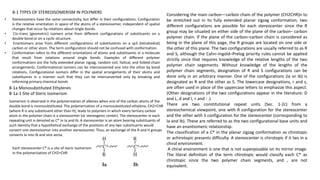
Each stereocenter C* is a site of steric isomerism
in the polymerization of CH2=CHR
Considering the main carbon—carbon chain of the polymer (CH2CHR)n to
be stretched out in its fully extended planar zigzag conformation, two
different configurations are possible for each stereocenter since the R
group may be situated on either side of the plane of the carbon– carbon
polymer chain. If the plane of the carbon–carbon chain is considered as
being in the plane of this page, the R groups are located on one side or
the other of this plane. The two configurations are usually referred to as R
and S, although the Cahn–Ingold–Prelog priority rules cannot be applied
strictly since that requires knowledge of the relative lengths of the two
polymer chain segements. Without knowledge of the lengths of the
polymer chain segments, designation of R and S configurations can be
done only in an arbitrary manner. One of the configurations (Ia or Ib) is
designated as R and the other as S. The lowercase designations, r and s,
are often used in place of the uppercase letters to emphasize this aspect.
(Other designations of the two configurations appear in the literature: D
and L, d and l, + and - .)
There are two constitutional repeat units (Sec. 1-2c) from a
stereochemical viewpoint, one with R configuration for the stereocenter
and the other with S configuration for the stereocenter (corresponding to
Ia and Ib). These are referred to as the two configurational base units and
have an enantiomeric relationship.
The classification of a C* in the planar zigzag conformation as chirotopic
or achirotopic presents difficulty. A stereocenter is chirotopic if it lies in a
chiral environment.
A chiral environment is one that is not superposable on its mirror image.
The literal definition of the term chirotopic would classify each C* as
chirotopic since the two polymer chain segments, and , are not
equivalent.
The literal definition of the term chirotopic would classify each C* as chirotopic
since the two polymer chain segments, and , are not equivalent. The
nonequivalence of the two chain segments is due to differences in length. (There
may also be differences in end groups depending on the modes of initiation and
termination.) However, classification of C* as chirotopic implies optical activity,
and this is clearly not true from a practical viewpoint. Optical activity is a short-
range phenomenon with its magnitude determined by the differences in the
groups attached to the stereocenter. The first few atoms of the two polymer chain
segments attached to C* are the same and such stereocenters do not contribute
measurably to the optical activity of the polymer. The only stereocenters with
significant optical activity are those at the ends of the polymer chain, but their
population is negligible for a high-molecular-weight polymer. The sum of
contributions from all the stereocenters is such that optical activity is below the
limits of detection. (This discussion of optical activity excludes optical activity
arising from the existence of a polymer molecule exclusively in a chiral
conformation, a very rare occurrence except for biological macromolecules.
A typical polymer in solution exists in the random-coil conformation. Many of the
conformations are chiral, but on a time-average basis there are equal numbers of
conformations of opposite rotation and the net rotation is zero.) Thus, it is more
useful to classify stereocenters such as those in Ia and Ib as achirotopic. The terms
stereocenter, chirotopic, and achirotopic will be used in this text in line with the
most recent terminology. However, other terms are found in the older literature.
C* was previously referred to as a chiral or pseudochiral center. The term
pseudochiral center is based on the same convention used to classify C* as
achirotopic instead of chirotopic. The terms asymmetric and pseudoasymmetric
center are found in much older literature. Tacticity The regularity in the
configurations of successive stereocenters determines the overall order (tacticity)
of the polymer chain. If the R groups on successive stereocenters are randomly
distributed on the two sides of the planar zigzag polymer chain, the polymer does
not have order and is termed atactic.
Two types of ordered or tactic structures or placements can occur: isotactic and
syndiotactic. An isotactic structure occurs when the stereocenter in each
repeating unit in the polymer chain has the same configuration. All the R groups
will be located on one side of the plane of the carbon–carbon polymer chain—
either all above or all below the plane of the chain. A syndiotactic polymer
structure occurs when the configurations of the stereocenters alternate from one
repeating unit to the next with the R groups located alternately on the opposite
sides of the plane of the polymer chain. These different polymer structures are
shown in Fig. 8-1.
The various polymer structures are described by three different pictorial
representations. The ones on the far left side of Fig. 8-1 show the polymer chain
in the plane of this page with the H and R groups above (triangular bonds) and
below (dotted bonds) that plane. The representations in the middle are the
corresponding Fischer projections. Verticle lines in the Fischer projections
correspond to bonds projecting behind the plane of this page; horizontal lines
represent bonds projecting in front of the plane. This is the usual convention for
Fischer projections. The configuration at each carbon atom in the polymer chain
is drawn in the Fischer projection by imagining the rotation of each carbon–
carbon bond in the polymer chain into an eclipsed conformations as opposed to
the staggered conformation that actually exists.
representations on the far right side of Fig. 8-1, recommended by IUPAC [1981], are obtained
by rotating the previous Fischer projections 90degree counterclockwise. The resulting Fischer
projections do have the advantage of showing the polymer chain going in the same direction as
the far-left representations. Their disadvantage is that one must always keep in mind that the
usual Fischer convention for horizontal (forward) and vetical (back) bonds is reversed. These
rotated Fischer projections will be used in the remainder of this chapter. The Fischer
projections show that isotactic placement corresponds to meso or m-placement for a pair of
consecutive stereocenters. Syndiotactic placement corresponds to racemo (for racemic) or r-
placement for a pair of consecutive stereocenters.
The configurational repeating unit is defined as the smallest set of configurational base units
that describe the configurational repetition in the polymer. For the isotactic polymer from a
monosubstituted ethylene, the configurational repeating unit and configurational base unit are
the same. For the syndiotactic polymer, the configurational repeating unit is a sequence of two
configurational base units, an R unit followed by an S unit or vice versa. Polymerizations that
yield tactic structures (either isotactic or syndiotactic) are termed stereoselective
polymerizations. The reader is cautioned that most of the literature uses the term
stereospecific polymerization, not stereoselective polymerization. However, the correct term is
stereoselective polymerization since a reaction is termed stereoselective if it results in the
preferential formation of one stereoisomer over another. This is what occurs in the
polymerization. A reaction is stereospecific if starting materials differing only in their
configuration are converted into stereoisomeric products. This is not what occurs in the
polymerization since the starting material does not exist in different configurations. (A
stereospecific process is necessarily stereoselective but not all stereoselective processes are
stereospecific.) Stereoselective polymerizations yielding isotactic and syndiotactic polymers are
termed isoselective and syndioselective polymerizations, respectively. The polymer structures
are termed stereoregular polymers. The terms isotactic and syndiotactic are placed before the
name of a polymer to indicate the respective tactic structures, such as isotactic polypropene
and syndiotactic polypropene. The absence of these terms denotes the atactic structure
polypropene means atactic polypropene. The prefixes it- and st- together with the formula of
the polymer, have been suggested for the same purpose: it-[CH2CH(CH3)]n and st-[CH2
CH(CH3)]n.
Both isotactic and syndiotactic polypropenes are achiral as a result of a series of mirror planes
(i.e., planes of symmetry) perpendicular to the polymer chain axis. Neither exhibits optical
activity.
8-1b Disubstituted Ethylenes
8-1b-1 1,1-Disubstituted Ethylenes
For disubstituted ethylenes, the presence and type of tacticity depends on the positions of
substitution and the identity of the substituents. In the polymerization of a 1,1-disubstituted
ethylene, CH2=CRR’ , stereoisomerism does not exist if the R and R0 groups are the same (e.g.,
isobutylene and vinylidene chloride). When R and R0 are different (e.g., -CH3 and -COOCH3 in
methyl methacrylate), stereoisomerism occurs exactly as in the case of a monosubstituted
ethylene. The methyl groups can be located all above or all below the plane of the polymer
chain (isotactic), alternately above and below (syndiotactic), or randomly (atactic). The
presence of the second substituent has no effect on the situation since steric placement of the
first substituent automatically fixes that of the second. The second substituent is isotactic if the
first is isotactic, syndiotactic if the first substituent is syndiotactic, and atactic if the first is
atactic.
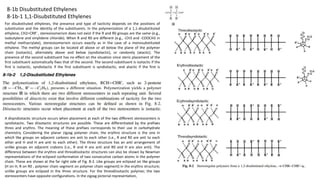
A disyndiotactic structure occurs when placement at each of the two different stereocenters is
syndiotactic. Two diisotactic structures are possible. These are differentiated by the prefixes
threo and erythro. The meaning of these prefixes corresponds to their use in carbohydrate
chemistry. Considering the planar zigzag polymer chain, the erythro structure is the one in
which like groups on adjacent carbons are anti to each other (i.e., R and R0 are anti to each
other and H and H are anti to each other). The threo structure has an anti arrangement of
unlike groups on adjacent crabons (i.e., R and H are anti and R0 and H are also anti). The
difference between the erythro and threodiisotactic structures can also be shown by Newman
representations of the eclipsed conformation of two consecutive carbon atoms in the polymer
chain. These are shown at the far right side of Fig. 8-2. Like groups are eclipsed on like groups
(H on H, R on R0 , polymer chain segment on polymer chain segment) in the erythro structure;
unlike groups are eclipsed in the threo structure. For the threodiisotactic polymer, the two
stereocenters have opposite configurations. In the zigzag pictorial representation,
Both carbon atoms of the double bond in VIII and IX are achirotopic
stereocenters. Interchange of the groups attached to one or the
other
carbon of the double bond converts VIII into IX and vice versa.
8-1e 1-Substituted and 1,4-Disubstituted 1,3-Butadienes
8-1e-1 1,2- and 3,4-Polymerizations
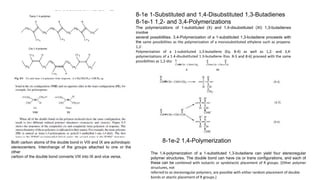
The polymerizations of 1-substituted (X) and 1,4-disubstituted (XI) 1,3-butadienes
involve
several possibilities. 3,4-Polymerization of a 1-substituted 1,3-butadiene proceeds with
the same possibilities as the polymerization of a monosubstituted ethylene such as propene.
1,2-
Polymerization of a 1-substituted 1,3-butadiene (Eq. 8-4) as well as 1,2- and 3,4-
polymerizations of a 1,4-disubstituted 1,3-butadiene (Eqs. 8-5 and 8-6) proceed with the same
possibilities as 1,2-disubstituted ethylene.
8-1e-2 1,4-Polymerization
The 1,4-polymerization of a 1-substituted 1,3-butadiene can yield four stereoregular
polymer structures. The double bond can have cis or trans configurations, and each of
these can be combined with isotactic or syndotactic placement of R groups. (Other polymer
structures, not
referred to as stereoregular polymers, are possible with either random placement of double
bonds or atactic placement of R groups.)
The all-trans–all-isotactic and all-trans–all-syndiotactic structures for the 1,4-
polymerization
of 1,3-pentadiene are shown in Fig. 8-6. In naming polymers with both types of
stereoisomerism, that due to cis–trans isomerism is named first unless it is indicated
after the prefix poly. Thus, the all-trans–all-isotactic polymer is named as transisotactic
1,4-poly(1,3-pentadiene) or isotactic poly(E-3-methylbut-1-ene-1,4-diyl).
The sp3 stereocenter (i.e., C*) in XII is chirotopic, like the case of poly(propylene oxide),
since the first couple of atoms of the two chain segments are considerably different.
The isotactic structures are optically active while the syndiotactic structures are not
optically active.
The 1,4-polymerization of 1,4-disubstituted 1,3-butadienes leads to structure (XIII),
which can exhibit tritacticity since the repeating unit contains three sites of steric
isomerism—a double bond and the carbons holding R and R’ substituents.
Several different stereoregular polymers are possible with various
combinations of ordered arrangements at the three sites. For example,
polymer XIV possesses an erythrodiisotactic arrangement of and R0 groups
and an all-trans arrangement of the double bonds. The polymer is named
transerythrodiisotactic 1,4-poly(methyl sorbate) or diisotactic poly[erythro-3-
(methoxycarbonyl)- 4-E-methylbut-1-ene-1,4-diyl].
All four diisotactic polymers (cis and trans, erythro and threo) are chiral and
possess optical activity. Each of the four disyndiotactic polymers possesses a
mirror glide plane and is achiral. For symmetric 1,4-disubstituted 1,3-butadienes
(R =R’), only the cis and transthreodiisotactic structures are chiral. Each of the
erythrodiisotactic and threodisyndiotactic polymers has a mirror glide plane.
Each of the erythrodisyndiotactic polymers has a mirror glide plane.
8-1f Other Polymers
The polymerization of the alkyne triple bond (Secs. 5-7d and 8-6c) and ring-
opening metathesis polymerization of a cycloalkene (Secs. 7-8 and 8-6a) yield
polymers containing double bonds in the polymer chain. Cis–trans isomerism is
possible analogous to the 1,4-polymerization of 1,3-dienes.
Polymers containing rings incorporated into the main chain (e.g., by double-
bondpolymerization of a cycloalkene) are also capable of exhibiting stereoisomerism.
Such polymers possess two stereocenters—the two atoms at which the polymer chain
enters and leaves each ring. Thus the polymerization of cyclopentene to
polycyclopentene [IUPAC: poly(cyclopentane- 1,2-diyl)] is considered in the same
manner as that of a 1,2-disubstituted ethylene. The four possible stereoregular
structures are shown in Fig. 8-7. The erythro polymers are those in which there is a cis
configuration of the polymer chain bonds entering and leaving each ring; the threo
polymers have a trans configuration of the polymer chain bonds entering and leaving
each ring. The threodiisotactic structure is chiral while the other three structures are
achiral. The situation is different for an asymmetric cycloalkene such as 2-
methylcyclopentene where both diisotactic structures are chiral, while both
disyndiotactic structures are achiral.
Stereochemistry_1.pptx.......,....................

Stereochemistry_1.pptx.......,....................

  • 1.
    Isomerism in polymersarises as a result of stereoisomerism in the structure of polymers as a consequence of the polymerization reaction. This is an important topic because of the significant effect that stereoisomerism has on many polymer properties. • Considerations of stereoisomerism in chain polymerizations of vinyl monomers were recognized early [Staudinger} . However, the possibility that each of the propagation steps in the growth of a polymer chain could give rise to stereoisomerism was not fully appreciated until more than two decades later. Further, the synthesis of polymers with ordered configurations in which the stereoisomerism of repeating units in the chain would show a regular or ordered arrangement instead of a random one was essentially not considered. • One of the major developments in the polymer field has been the elucidation of the occurrence of stereoisomerism in polymers. More importantly, the pioneering works of Ziegler and Natta and their coworkers led to the convenient synthesis of polymers with highly stereoregular structures We are now doing what nature has been doing for eons. Stereoregular polymers of different kinds are commonly found in nature; these include natural rubber, cellulose, starch, polypeptides, and nucleic acids. Enormous commerical applications flowed from the revolution initiated by Ziegler and Natta. These include high- density and linear low-density polyethylenes (HDPE, LLDE), polypropene, ethene-propene co- and terpolymers, and polymers from 1,3-dienes (
  • 2.
    8-1 TYPES OFSTEREOISOMERISM IN POLYMERS • Stereoisomers have the same connectivity, but differ in their configurations. Configuration is the relative orientation in space of the atoms of a stereoisomer, independent of spatial changes that occur by rotations about single bonds. • Cis–trans (geometric) isomers arise from different configurations of substituents on a double bond or on a cyclic structure. • Enantiomers arise from different configurations of substitutents on a sp3 (tetrahedral) carbon or other atom. The term configuration should not be confused with conformation. • Conformation refers to the different orientations of atoms and substituents in a molecule that result from rotations around single bonds. Examples of different polymer conformations are the fully extended planar zigzag, random coil, helical, and folded-chain arrangements. Conformational isomers can be interconverted one into the other by bond rotations. Configurational isomers differ in the spatial arrangements of their atoms and substituents in a manner such that they can be interconverted only by breaking and reforming primary chemical bonds 8-1a Monosubstituted Ethylenes 8-1a-1 Site of Steric Isomerism Isomerism is observed in the polymerization of alkenes when one of the carbon atoms of the double bond is monosubstituted. The polymerization of a monosubstituted ethylene, CH2=CHR (where R is any substituent other than H), leads to polymers in which every tertiary carbon atom in the polymer chain is a stereocenter (or stereogenic center). The stereocenter in each repeating unit is denoted as C* in Ia and Ib. A stereocenter is an atom bearing substituents of such identity that a hypothetical exchange of the positions of any two substituents would convert one stereoisomer into another stereoisomer. Thus, an exchange of the R and H groups converts Ia into Ib and vice versa. Each stereocenter C* is a site of steric isomerism in the polymerization of CH2=CHR Considering the main carbon—carbon chain of the polymer (CH2CHR)n to be stretched out in its fully extended planar zigzag conformation, two different configurations are possible for each stereocenter since the R group may be situated on either side of the plane of the carbon– carbon polymer chain. If the plane of the carbon–carbon chain is considered as being in the plane of this page, the R groups are located on one side or the other of this plane. The two configurations are usually referred to as R and S, although the Cahn–Ingold–Prelog priority rules cannot be applied strictly since that requires knowledge of the relative lengths of the two polymer chain segements. Without knowledge of the lengths of the polymer chain segments, designation of R and S configurations can be done only in an arbitrary manner. One of the configurations (Ia or Ib) is designated as R and the other as S. The lowercase designations, r and s, are often used in place of the uppercase letters to emphasize this aspect. (Other designations of the two configurations appear in the literature: D and L, d and l, + and - .) There are two constitutional repeat units (Sec. 1-2c) from a stereochemical viewpoint, one with R configuration for the stereocenter and the other with S configuration for the stereocenter (corresponding to Ia and Ib). These are referred to as the two configurational base units and have an enantiomeric relationship. The classification of a C* in the planar zigzag conformation as chirotopic or achirotopic presents difficulty. A stereocenter is chirotopic if it lies in a chiral environment. A chiral environment is one that is not superposable on its mirror image. The literal definition of the term chirotopic would classify each C* as chirotopic since the two polymer chain segments, and , are not equivalent.
  • 3.
    The literal definitionof the term chirotopic would classify each C* as chirotopic since the two polymer chain segments, and , are not equivalent. The nonequivalence of the two chain segments is due to differences in length. (There may also be differences in end groups depending on the modes of initiation and termination.) However, classification of C* as chirotopic implies optical activity, and this is clearly not true from a practical viewpoint. Optical activity is a short- range phenomenon with its magnitude determined by the differences in the groups attached to the stereocenter. The first few atoms of the two polymer chain segments attached to C* are the same and such stereocenters do not contribute measurably to the optical activity of the polymer. The only stereocenters with significant optical activity are those at the ends of the polymer chain, but their population is negligible for a high-molecular-weight polymer. The sum of contributions from all the stereocenters is such that optical activity is below the limits of detection. (This discussion of optical activity excludes optical activity arising from the existence of a polymer molecule exclusively in a chiral conformation, a very rare occurrence except for biological macromolecules. A typical polymer in solution exists in the random-coil conformation. Many of the conformations are chiral, but on a time-average basis there are equal numbers of conformations of opposite rotation and the net rotation is zero.) Thus, it is more useful to classify stereocenters such as those in Ia and Ib as achirotopic. The terms stereocenter, chirotopic, and achirotopic will be used in this text in line with the most recent terminology. However, other terms are found in the older literature. C* was previously referred to as a chiral or pseudochiral center. The term pseudochiral center is based on the same convention used to classify C* as achirotopic instead of chirotopic. The terms asymmetric and pseudoasymmetric center are found in much older literature. Tacticity The regularity in the configurations of successive stereocenters determines the overall order (tacticity) of the polymer chain. If the R groups on successive stereocenters are randomly distributed on the two sides of the planar zigzag polymer chain, the polymer does not have order and is termed atactic. Two types of ordered or tactic structures or placements can occur: isotactic and syndiotactic. An isotactic structure occurs when the stereocenter in each repeating unit in the polymer chain has the same configuration. All the R groups will be located on one side of the plane of the carbon–carbon polymer chain— either all above or all below the plane of the chain. A syndiotactic polymer structure occurs when the configurations of the stereocenters alternate from one repeating unit to the next with the R groups located alternately on the opposite sides of the plane of the polymer chain. These different polymer structures are shown in Fig. 8-1. The various polymer structures are described by three different pictorial representations. The ones on the far left side of Fig. 8-1 show the polymer chain in the plane of this page with the H and R groups above (triangular bonds) and below (dotted bonds) that plane. The representations in the middle are the corresponding Fischer projections. Verticle lines in the Fischer projections correspond to bonds projecting behind the plane of this page; horizontal lines represent bonds projecting in front of the plane. This is the usual convention for Fischer projections. The configuration at each carbon atom in the polymer chain is drawn in the Fischer projection by imagining the rotation of each carbon– carbon bond in the polymer chain into an eclipsed conformations as opposed to the staggered conformation that actually exists.
  • 4.
    representations on thefar right side of Fig. 8-1, recommended by IUPAC [1981], are obtained by rotating the previous Fischer projections 90degree counterclockwise. The resulting Fischer projections do have the advantage of showing the polymer chain going in the same direction as the far-left representations. Their disadvantage is that one must always keep in mind that the usual Fischer convention for horizontal (forward) and vetical (back) bonds is reversed. These rotated Fischer projections will be used in the remainder of this chapter. The Fischer projections show that isotactic placement corresponds to meso or m-placement for a pair of consecutive stereocenters. Syndiotactic placement corresponds to racemo (for racemic) or r- placement for a pair of consecutive stereocenters. The configurational repeating unit is defined as the smallest set of configurational base units that describe the configurational repetition in the polymer. For the isotactic polymer from a monosubstituted ethylene, the configurational repeating unit and configurational base unit are the same. For the syndiotactic polymer, the configurational repeating unit is a sequence of two configurational base units, an R unit followed by an S unit or vice versa. Polymerizations that yield tactic structures (either isotactic or syndiotactic) are termed stereoselective polymerizations. The reader is cautioned that most of the literature uses the term stereospecific polymerization, not stereoselective polymerization. However, the correct term is stereoselective polymerization since a reaction is termed stereoselective if it results in the preferential formation of one stereoisomer over another. This is what occurs in the polymerization. A reaction is stereospecific if starting materials differing only in their configuration are converted into stereoisomeric products. This is not what occurs in the polymerization since the starting material does not exist in different configurations. (A stereospecific process is necessarily stereoselective but not all stereoselective processes are stereospecific.) Stereoselective polymerizations yielding isotactic and syndiotactic polymers are termed isoselective and syndioselective polymerizations, respectively. The polymer structures are termed stereoregular polymers. The terms isotactic and syndiotactic are placed before the name of a polymer to indicate the respective tactic structures, such as isotactic polypropene and syndiotactic polypropene. The absence of these terms denotes the atactic structure polypropene means atactic polypropene. The prefixes it- and st- together with the formula of the polymer, have been suggested for the same purpose: it-[CH2CH(CH3)]n and st-[CH2 CH(CH3)]n. Both isotactic and syndiotactic polypropenes are achiral as a result of a series of mirror planes (i.e., planes of symmetry) perpendicular to the polymer chain axis. Neither exhibits optical activity.
  • 5.
    8-1b Disubstituted Ethylenes 8-1b-11,1-Disubstituted Ethylenes For disubstituted ethylenes, the presence and type of tacticity depends on the positions of substitution and the identity of the substituents. In the polymerization of a 1,1-disubstituted ethylene, CH2=CRR’ , stereoisomerism does not exist if the R and R0 groups are the same (e.g., isobutylene and vinylidene chloride). When R and R0 are different (e.g., -CH3 and -COOCH3 in methyl methacrylate), stereoisomerism occurs exactly as in the case of a monosubstituted ethylene. The methyl groups can be located all above or all below the plane of the polymer chain (isotactic), alternately above and below (syndiotactic), or randomly (atactic). The presence of the second substituent has no effect on the situation since steric placement of the first substituent automatically fixes that of the second. The second substituent is isotactic if the first is isotactic, syndiotactic if the first substituent is syndiotactic, and atactic if the first is atactic. A disyndiotactic structure occurs when placement at each of the two different stereocenters is syndiotactic. Two diisotactic structures are possible. These are differentiated by the prefixes threo and erythro. The meaning of these prefixes corresponds to their use in carbohydrate chemistry. Considering the planar zigzag polymer chain, the erythro structure is the one in which like groups on adjacent carbons are anti to each other (i.e., R and R0 are anti to each other and H and H are anti to each other). The threo structure has an anti arrangement of unlike groups on adjacent crabons (i.e., R and H are anti and R0 and H are also anti). The difference between the erythro and threodiisotactic structures can also be shown by Newman representations of the eclipsed conformation of two consecutive carbon atoms in the polymer chain. These are shown at the far right side of Fig. 8-2. Like groups are eclipsed on like groups (H on H, R on R0 , polymer chain segment on polymer chain segment) in the erythro structure; unlike groups are eclipsed in the threo structure. For the threodiisotactic polymer, the two stereocenters have opposite configurations. In the zigzag pictorial representation,
  • 8.
    Both carbon atomsof the double bond in VIII and IX are achirotopic stereocenters. Interchange of the groups attached to one or the other carbon of the double bond converts VIII into IX and vice versa. 8-1e 1-Substituted and 1,4-Disubstituted 1,3-Butadienes 8-1e-1 1,2- and 3,4-Polymerizations The polymerizations of 1-substituted (X) and 1,4-disubstituted (XI) 1,3-butadienes involve several possibilities. 3,4-Polymerization of a 1-substituted 1,3-butadiene proceeds with the same possibilities as the polymerization of a monosubstituted ethylene such as propene. 1,2- Polymerization of a 1-substituted 1,3-butadiene (Eq. 8-4) as well as 1,2- and 3,4- polymerizations of a 1,4-disubstituted 1,3-butadiene (Eqs. 8-5 and 8-6) proceed with the same possibilities as 1,2-disubstituted ethylene. 8-1e-2 1,4-Polymerization The 1,4-polymerization of a 1-substituted 1,3-butadiene can yield four stereoregular polymer structures. The double bond can have cis or trans configurations, and each of these can be combined with isotactic or syndotactic placement of R groups. (Other polymer structures, not referred to as stereoregular polymers, are possible with either random placement of double bonds or atactic placement of R groups.)
  • 9.
    The all-trans–all-isotactic andall-trans–all-syndiotactic structures for the 1,4- polymerization of 1,3-pentadiene are shown in Fig. 8-6. In naming polymers with both types of stereoisomerism, that due to cis–trans isomerism is named first unless it is indicated after the prefix poly. Thus, the all-trans–all-isotactic polymer is named as transisotactic 1,4-poly(1,3-pentadiene) or isotactic poly(E-3-methylbut-1-ene-1,4-diyl). The sp3 stereocenter (i.e., C*) in XII is chirotopic, like the case of poly(propylene oxide), since the first couple of atoms of the two chain segments are considerably different. The isotactic structures are optically active while the syndiotactic structures are not optically active. The 1,4-polymerization of 1,4-disubstituted 1,3-butadienes leads to structure (XIII), which can exhibit tritacticity since the repeating unit contains three sites of steric isomerism—a double bond and the carbons holding R and R’ substituents. Several different stereoregular polymers are possible with various combinations of ordered arrangements at the three sites. For example, polymer XIV possesses an erythrodiisotactic arrangement of and R0 groups and an all-trans arrangement of the double bonds. The polymer is named transerythrodiisotactic 1,4-poly(methyl sorbate) or diisotactic poly[erythro-3- (methoxycarbonyl)- 4-E-methylbut-1-ene-1,4-diyl]. All four diisotactic polymers (cis and trans, erythro and threo) are chiral and possess optical activity. Each of the four disyndiotactic polymers possesses a mirror glide plane and is achiral. For symmetric 1,4-disubstituted 1,3-butadienes (R =R’), only the cis and transthreodiisotactic structures are chiral. Each of the erythrodiisotactic and threodisyndiotactic polymers has a mirror glide plane. Each of the erythrodisyndiotactic polymers has a mirror glide plane. 8-1f Other Polymers The polymerization of the alkyne triple bond (Secs. 5-7d and 8-6c) and ring- opening metathesis polymerization of a cycloalkene (Secs. 7-8 and 8-6a) yield polymers containing double bonds in the polymer chain. Cis–trans isomerism is possible analogous to the 1,4-polymerization of 1,3-dienes. Polymers containing rings incorporated into the main chain (e.g., by double- bondpolymerization of a cycloalkene) are also capable of exhibiting stereoisomerism. Such polymers possess two stereocenters—the two atoms at which the polymer chain enters and leaves each ring. Thus the polymerization of cyclopentene to polycyclopentene [IUPAC: poly(cyclopentane- 1,2-diyl)] is considered in the same manner as that of a 1,2-disubstituted ethylene. The four possible stereoregular structures are shown in Fig. 8-7. The erythro polymers are those in which there is a cis configuration of the polymer chain bonds entering and leaving each ring; the threo polymers have a trans configuration of the polymer chain bonds entering and leaving each ring. The threodiisotactic structure is chiral while the other three structures are achiral. The situation is different for an asymmetric cycloalkene such as 2- methylcyclopentene where both diisotactic structures are chiral, while both disyndiotactic structures are achiral.