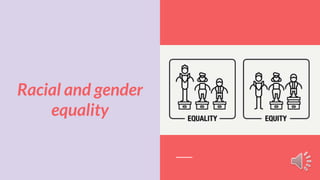
Racial and gender
equality
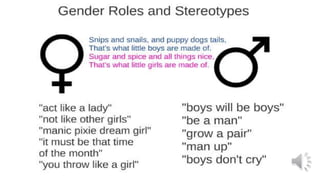
What are gender stereotypes?
A gender stereotype is a generalized view or preconception about attributes or
characteristics, or the roles that are or ought to be possessed by, or performed by,
women and men. A gender stereotype is harmful when it limits women’s and men’s
capacity to develop their personal abilities, pursue their professional careers and/or
make choices about their lives.
Gender Stereotypes Examples
● Girls should play with dolls and boys should play with trucks.
● Boys should be directed to liking blue and green; girls toward red and pink.
● Boys should not wear dresses or other clothes typically associated with "girl's clothes".
● Boys should engage in sports and refrain from more creative pursuits.
● Girls should be thin and beautiful to make them appealing to men.
● Women with children are less devoted to their jobs.
● In heterosexual couples, women should take time off to care for children or elders.
● Girls are more emotional and “talkative” than boys.
Girls toys
Boys toys
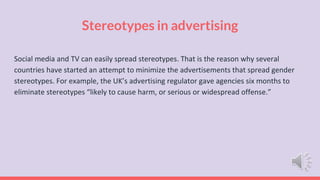
Stereotypes in advertising
Social media and TV can easily spread stereotypes. That is the reason why several
countries have started an attempt to minimize the advertisements that spread gender
stereotypes. For example, the UK’s advertising regulator gave agencies six months to
eliminate stereotypes “likely to cause harm, or serious or widespread offense.”
Some of the banned commercials are:
This baby formula commercial that showed a girl growing up to be a ballerina and a boy
growing up to be a mathematician.
ASA stepped in to penalize Gucci for “unhealthily thin” models in a 2016 ad campaign.
This 1950’s advertisement both body and work stereotypes are depicted.
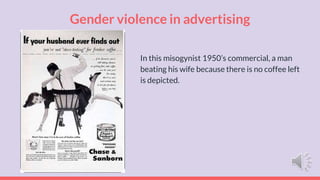
In this misogynist 1950’s commercial, a man
beating his wife because there is no coffee left
is depicted.
Gender violence in advertising
In these “Mariner” advertisements, violence against women is represented in a circuitous
way.
Antecedents and consequences of self-
objectification
Cultural
practices of
sexual
objectification
Self-
objectification
(appearance
monitoring)
Phychological
conseequences:
-increased shame
-increased anxiety
-decreased “flow”
states
-insensitivity to bodily
eyes
Mental health
risks:
-disorderd eating
-depression
-sexual
dysfunction etc.
Consequences
The psychological effects of bullying include:
● depression
● low self - esteem
● self harming behaviour
● alcohol and drug use and dependence
● overall aggression, involvement in violence and crimes
● changes in eating habits
● sleep disturbance
● difficulty maintaining social relationships
● kids:miss or skip school
The “me too”
movement
Gender discrimination hold back women from their
professional career
Preventing Stereotypes
● Have honest conversations about Stereotype Threat. Honesty and openness are the
keystones of change.
● Provide children of both genders with books and movies that feature nontraditional
gender roles
● Remember that chores have no gender
● Avoid sexist language
● Provide people of both genders equal opportunities in education and labour market
● Mass media should promote gender equality
● Acknowledgement of the commonalities of human nature
● Spending time with people of different races
● Searching the inner roots of us harboring these ideas and combating them
Thank you for your attention!!

gender stereotypes.pptx

  • 1.
  • 2.
    What are genderstereotypes? A gender stereotype is a generalized view or preconception about attributes or characteristics, or the roles that are or ought to be possessed by, or performed by, women and men. A gender stereotype is harmful when it limits women’s and men’s capacity to develop their personal abilities, pursue their professional careers and/or make choices about their lives.
  • 4.
    Gender Stereotypes Examples ●Girls should play with dolls and boys should play with trucks. ● Boys should be directed to liking blue and green; girls toward red and pink. ● Boys should not wear dresses or other clothes typically associated with "girl's clothes". ● Boys should engage in sports and refrain from more creative pursuits. ● Girls should be thin and beautiful to make them appealing to men. ● Women with children are less devoted to their jobs. ● In heterosexual couples, women should take time off to care for children or elders. ● Girls are more emotional and “talkative” than boys.
  • 7.
  • 8.
    Stereotypes in advertising Socialmedia and TV can easily spread stereotypes. That is the reason why several countries have started an attempt to minimize the advertisements that spread gender stereotypes. For example, the UK’s advertising regulator gave agencies six months to eliminate stereotypes “likely to cause harm, or serious or widespread offense.”
  • 9.
    Some of thebanned commercials are: This baby formula commercial that showed a girl growing up to be a ballerina and a boy growing up to be a mathematician.
  • 10.
    ASA stepped into penalize Gucci for “unhealthily thin” models in a 2016 ad campaign.
  • 11.
    This 1950’s advertisementboth body and work stereotypes are depicted.
  • 13.
    In this misogynist1950’s commercial, a man beating his wife because there is no coffee left is depicted. Gender violence in advertising
  • 14.
    In these “Mariner”advertisements, violence against women is represented in a circuitous way.
  • 16.
    Antecedents and consequencesof self- objectification Cultural practices of sexual objectification Self- objectification (appearance monitoring) Phychological conseequences: -increased shame -increased anxiety -decreased “flow” states -insensitivity to bodily eyes Mental health risks: -disorderd eating -depression -sexual dysfunction etc.
  • 19.
    Consequences The psychological effectsof bullying include: ● depression ● low self - esteem ● self harming behaviour ● alcohol and drug use and dependence ● overall aggression, involvement in violence and crimes ● changes in eating habits ● sleep disturbance ● difficulty maintaining social relationships ● kids:miss or skip school
  • 21.
  • 22.
    Gender discrimination holdback women from their professional career
  • 23.
    Preventing Stereotypes ● Havehonest conversations about Stereotype Threat. Honesty and openness are the keystones of change. ● Provide children of both genders with books and movies that feature nontraditional gender roles ● Remember that chores have no gender ● Avoid sexist language ● Provide people of both genders equal opportunities in education and labour market ● Mass media should promote gender equality ● Acknowledgement of the commonalities of human nature ● Spending time with people of different races ● Searching the inner roots of us harboring these ideas and combating them
  • 26.
    Thank you foryour attention!!