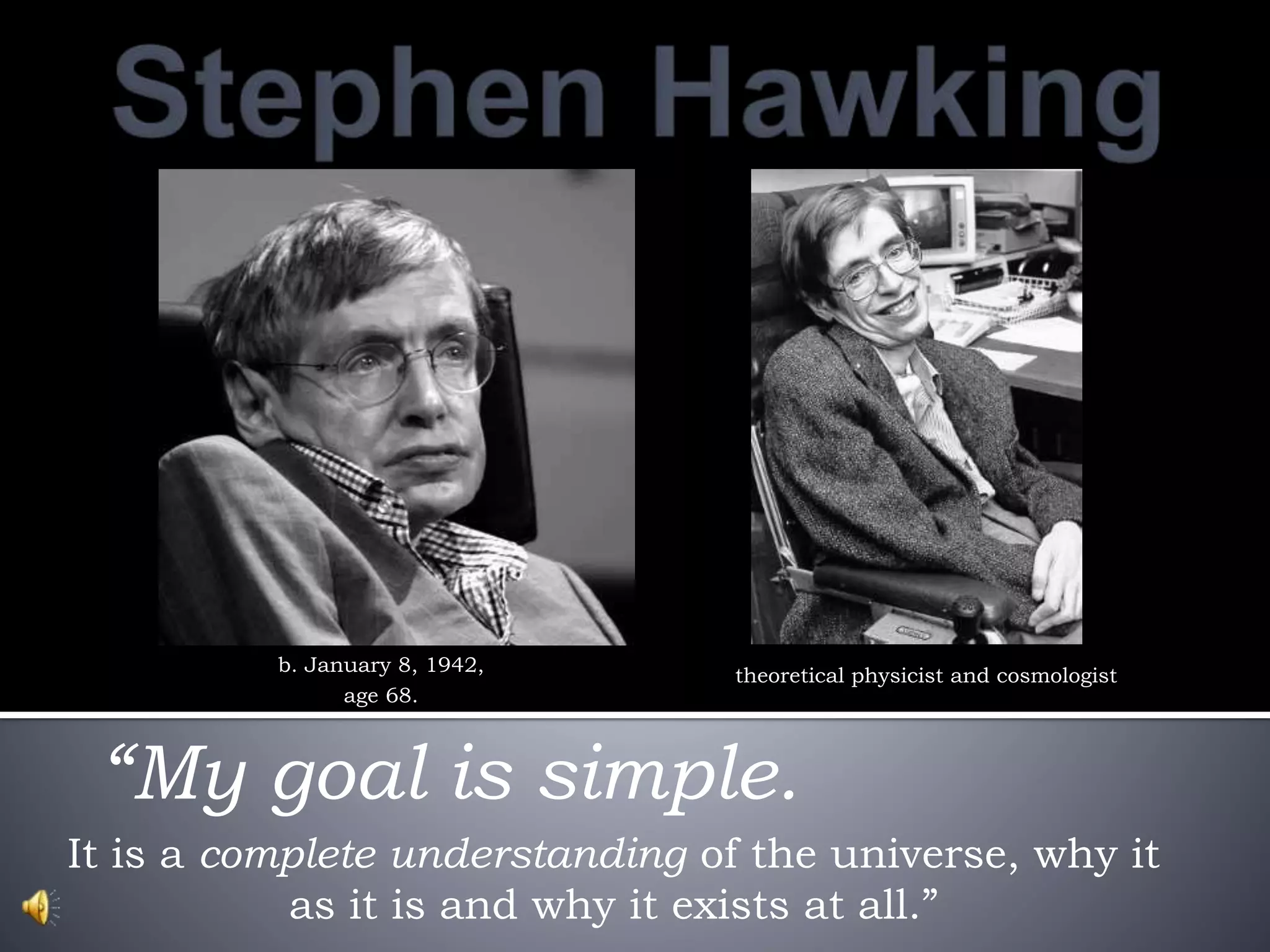
It is a complete understanding of the universe, why it
as it is and why it exists at all.”
b. January 8, 1942,
age 68.
“My goal is simple.
theoretical physicist and cosmologist
 Born Stephen William Hawking in Oxford, England to Dr.
Frank Hawking, a research biologist, and Isobel Hawking
 Nationality: English
 Has two sisters, Philippa and Mary, and an adopted
brother, Edward
 Lived in St. Albans and attended St. Albans School as a
child and teenager
 Studied physics at University College, Oxford, where his
father had also attended
 Studied cosmology afterwards at Cambridge
Has three children with first wife Jane
Wilde: Robert (1967), Lucy (1969),
Timothy (1979)
Separated from Wilde in 1991
Married second wife, Elaine Mason, in
1995
Divorced Mason in 2006
Illness
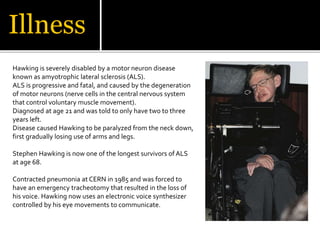
Hawking is severely disabled by a motor neuron disease
known as amyotrophic lateral sclerosis (ALS).
ALS is progressive and fatal, and caused by the degeneration
of motor neurons (nerve cells in the central nervous system
that control voluntary muscle movement).
Diagnosed at age 21 and was told to only have two to three
years left.
Disease caused Hawking to be paralyzed from the neck down,
first gradually losing use of arms and legs.
Stephen Hawking is now one of the longest survivors of ALS
at age 68.
Contracted pneumonia at CERN in 1985 and was forced to
have an emergency tracheotomy that resulted in the loss of
his voice. Hawking now uses an electronic voice synthesizer
controlled by his eye movements to communicate.
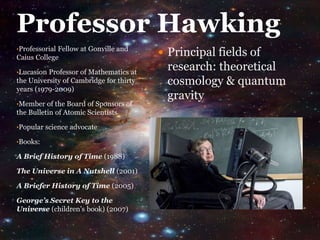
Professor Hawking
•Professorial Fellow at Gonville and
Caius College
•Lucasion Professor of Mathematics at
the University of Cambridge for thirty
years (1979-2009)
•Member of the Board of Sponsors of
the Bulletin of Atomic Scientists
•Popular science advocate
•Books:
A Brief History of Time (1988)
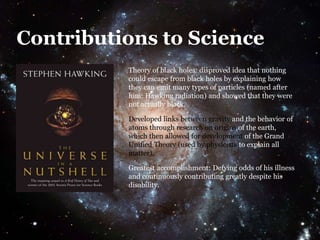
The Universe in A Nutshell (2001)
A Briefer History of Time (2005)
George’s Secret Key to the
Universe (children’s book) (2007)
 Principal fields of
research: theoretical
cosmology & quantum
gravity
Contributions to Science
Theory of black holes: disproved idea that nothing
could escape from black holes by explaining how
they can emit many types of particles (named after
him: Hawking radiation) and showed that they were
not actually black.
Developed links between gravity and the behavior of
atoms through research on origins of the earth,
which then allowed for development of the Grand
Unified Theory (used by physicists to explain all
matter).
Greatest accomplishment: Defying odds of his illness
and continuously contributing greatly despite his
disability.
Awards & Honours
 Eddington Medal (1975)
 Hughes Medal of the
Royal Society (1976)
 Albert Einstein Medal
(1979)
 Franklin Medal (1981)
 Order of the British
Empire (Commander)
(1982)
 Member of the Pontifical
Academy of Sciences
(1986)
 Wolf Prize in Physics
(1988)
 Prince of Asturias Awards
in Concord (1989)
 Companion of Honour
(1989)
 Julius Edgar Lilienfeld
Prize of the American
Physical Society (1999)
 Michelson Morley Award
of CaseWestern Reserve
University (2003)
 Copley Medal of the
Royal Society (2006)
•Presidential Medal of Freedom
(highest civilian honour in United
States) (2009)
94222267
References
http://en.wikiquote.org/wiki/Stephen_Hawking
http://www.hawking.org.uk/index.php/about-
stephen/briefhistory
http://en.wikipedia.org/wiki/Stephen_Hawking
http://www.helium.com/items/77601-the-impacts-of-
stephen-hawking8217s-contributions-to-science

Stephen hawking

  • 1.
    It is acomplete understanding of the universe, why it as it is and why it exists at all.” b. January 8, 1942, age 68. “My goal is simple. theoretical physicist and cosmologist
  • 2.
     Born StephenWilliam Hawking in Oxford, England to Dr. Frank Hawking, a research biologist, and Isobel Hawking  Nationality: English  Has two sisters, Philippa and Mary, and an adopted brother, Edward  Lived in St. Albans and attended St. Albans School as a child and teenager  Studied physics at University College, Oxford, where his father had also attended  Studied cosmology afterwards at Cambridge
  • 3.
    Has three childrenwith first wife Jane Wilde: Robert (1967), Lucy (1969), Timothy (1979) Separated from Wilde in 1991 Married second wife, Elaine Mason, in 1995 Divorced Mason in 2006
  • 4.
    Illness Hawking is severelydisabled by a motor neuron disease known as amyotrophic lateral sclerosis (ALS). ALS is progressive and fatal, and caused by the degeneration of motor neurons (nerve cells in the central nervous system that control voluntary muscle movement). Diagnosed at age 21 and was told to only have two to three years left. Disease caused Hawking to be paralyzed from the neck down, first gradually losing use of arms and legs. Stephen Hawking is now one of the longest survivors of ALS at age 68. Contracted pneumonia at CERN in 1985 and was forced to have an emergency tracheotomy that resulted in the loss of his voice. Hawking now uses an electronic voice synthesizer controlled by his eye movements to communicate.
  • 5.
    Professor Hawking •Professorial Fellowat Gonville and Caius College •Lucasion Professor of Mathematics at the University of Cambridge for thirty years (1979-2009) •Member of the Board of Sponsors of the Bulletin of Atomic Scientists •Popular science advocate •Books: A Brief History of Time (1988) The Universe in A Nutshell (2001) A Briefer History of Time (2005) George’s Secret Key to the Universe (children’s book) (2007)  Principal fields of research: theoretical cosmology & quantum gravity
  • 6.
    Contributions to Science Theoryof black holes: disproved idea that nothing could escape from black holes by explaining how they can emit many types of particles (named after him: Hawking radiation) and showed that they were not actually black. Developed links between gravity and the behavior of atoms through research on origins of the earth, which then allowed for development of the Grand Unified Theory (used by physicists to explain all matter). Greatest accomplishment: Defying odds of his illness and continuously contributing greatly despite his disability.
  • 7.
    Awards & Honours Eddington Medal (1975)  Hughes Medal of the Royal Society (1976)  Albert Einstein Medal (1979)  Franklin Medal (1981)  Order of the British Empire (Commander) (1982)  Member of the Pontifical Academy of Sciences (1986)  Wolf Prize in Physics (1988)  Prince of Asturias Awards in Concord (1989)  Companion of Honour (1989)  Julius Edgar Lilienfeld Prize of the American Physical Society (1999)  Michelson Morley Award of CaseWestern Reserve University (2003)  Copley Medal of the Royal Society (2006) •Presidential Medal of Freedom (highest civilian honour in United States) (2009)
  • 8.