Step By Step: 
learning from implementing 
behavioural changes in 
transport 
Frankfurt 
European Transport Conference 2014 
Wim Korver 
21 October 2014 
IBDiM: Road and 
Bridge Research 
Institute (Poland)
2 
Content 
• Background 
• Research questions 
• Can cities be grouped based on their transport 
characteristics? 
• Our cases: an overview 
• Our approach to “measure” success 
• Analysis based on success ratings 
• Policy Recommendations based on case analysis 
• Conclusions
3 
Background 
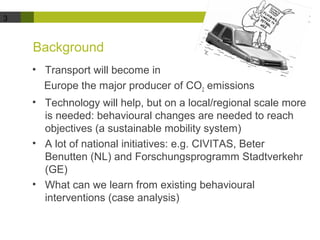
• Transport will become in 
Europe the major producer of CO2 emissions 
• Technology will help, but on a local/regional scale more 
is needed: behavioural changes are needed to reach 
objectives (a sustainable mobility system) 
• A lot of national initiatives: e.g. CIVITAS, Beter 
Benutten (NL) and Forschungsprogramm Stadtverkehr 
(GE) 
• What can we learn from existing behavioural 
interventions (case analysis)
4 
Research Questions
5 
Main Objective 
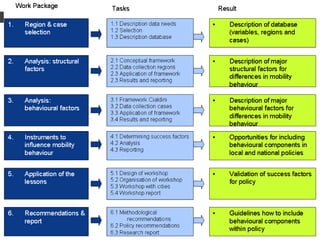
• Stepping Stones (Research Program): 
1.To understand the successful (policy) measures aimed at 
making mobility patterns more sustainable and the underlying 
mechanisms (the how) including social & psychological 
factors. 
2.The research results should be of common interest across 
Europe or in several regions. 
• Step By Step: 
• Identifying potential successful policy measures for changing 
the transport behaviour of people based on structural 
differences between cities and cultures 
What we know 
after the project is 
completed
6
7 
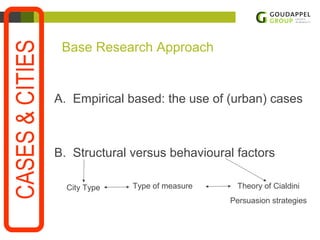
Base Research Approach 
A. Empirical based: the use of (urban) cases 
B. Structural versus behavioural factors 
CASES & CITIES 
City Type Type of measure Theory of Cialdini 
Persuasion strategies
8 
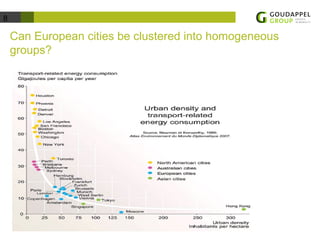
Can European cities be clustered into homogeneous 
groups?
9 
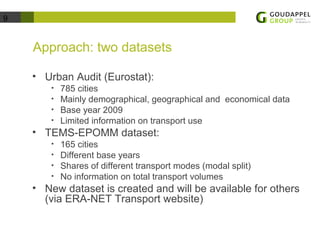
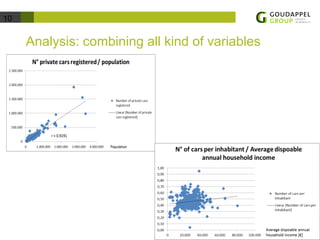
Approach: two datasets 
• Urban Audit (Eurostat): 
• 785 cities 
• Mainly demographical, geographical and economical data 
• Base year 2009 
• Limited information on transport use 
• TEMS-EPOMM dataset: 
• 165 cities 
• Different base years 
• Shares of different transport modes (modal split) 
• No information on total transport volumes 
• New dataset is created and will be available for others 
(via ERA-NET Transport website)
10 
Analysis: combining all kind of variables
11 
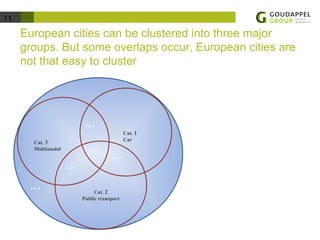
European cities can be clustered into three major 
groups. But some overlaps occur, European cities are 
not that easy to cluster 
Cat. 3 
Multimodal 
Cat. 1 
Car 
Cat. 4 
Cat. 7 
Cat. 2 
Cat. 6 
Public transport 
Cat. 5 
Cat. 8
12 
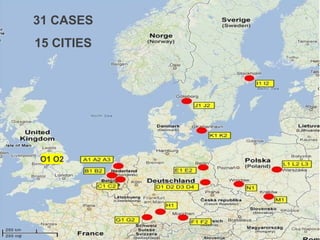
31 CASES 
15 CITIES 
O1 O2
13 
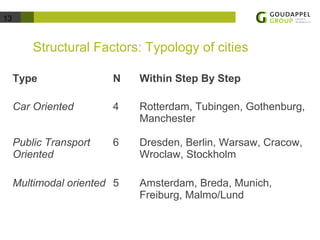
Structural Factors: Typology of cities 
Type N Within Step By Step 
Car Oriented 4 Rotterdam, Tubingen, Gothenburg, 
Manchester 
Public Transport 
Oriented 
6 Dresden, Berlin, Warsaw, Cracow, 
Wroclaw, Stockholm 
Multimodal oriented 5 Amsterdam, Breda, Munich, 
Freiburg, Malmo/Lund
14 
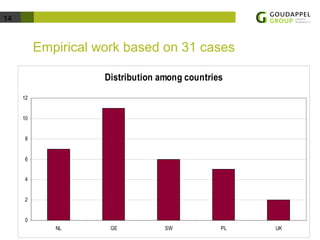
Empirical work based on 31 cases 
Distribution among countries 
12 
10 
8 
6 
4 
2 
0 
NL GE SW PL UK
15 
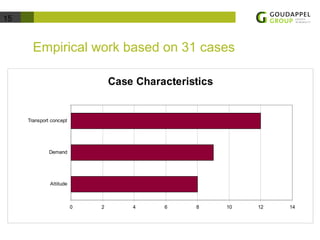
Empirical work based on 31 cases 
Case Characteristics 
0 2 4 6 8 10 12 14 
Transport concept 
Demand 
Attitude
16 
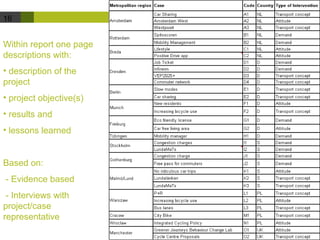
Within report one page 
descriptions with: 
• description of the 
project 
• project objective(s) 
• results and 
• lessons learned 
Based on: 
- Evidence based 
- Interviews with 
project/case 
representative
17 
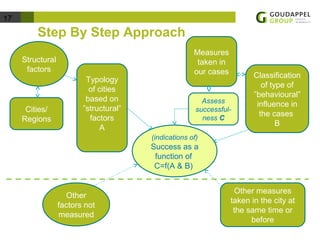
Step By Step Approach 
Structural 
factors 
Cities/ 
Regions 
Other 
factors not 
measured 
Measures 
taken in 
our cases 
Classification 
of type of 
”behavioural” 
influence in 
the cases 
Assess 
successful-ness 
Other measures 
taken in the city at 
the same time or 
before 
B 
Typology 
of cities 
based on 
”structural” 
factors 
A 
(indications of) 
Success as a 
function of 
C=f(A & B) 
C
18 
What is success? 
• Depends on whom you ask 
• Project leader, politician, interest groups, user, all will have 
different views 
• Success on what? Success can be divided in several 
aspects 
• Less car use, different opinions, budget spent, etc. 
• There are grades of success
19 
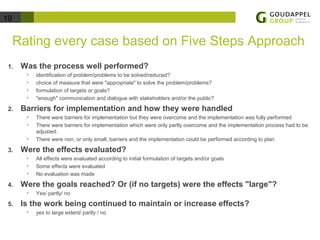
Rating every case based on Five Steps Approach 
1. Was the process well performed? 
• identification of problem/problems to be solved/reduced? 
• choice of measure that were "appropriate" to solve the problem/problems? 
• formulation of targets or goals? 
• "enough" communication and dialogue with stakeholders and/or the public? 
2. Barriers for implementation and how they were handled 
• There were barriers for implementation but they were overcome and the implementation was fully performed 
• There were barriers for implementation which were only partly overcome and the implementation process had to be 
adjusted. 
• There were non, or only small, barriers and the implementation could be performed according to plan 
3. Were the effects evaluated? 
• All effects were evaluated according to initial formulation of targets and/or goals 
• Some effects were evaluated 
• No evaluation was made 
4. Were the goals reached? Or (if no targets) were the effects "large"? 
• Yes/ partly/ no 
5. Is the work being continued to maintain or increase effects? 
• yes to large extent/ partly / no
20 
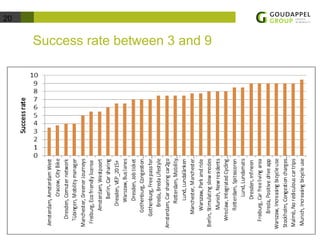
Success rate between 3 and 9
21 
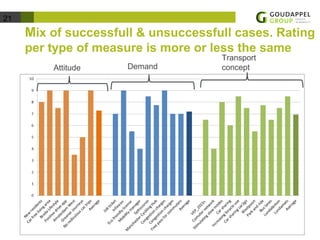
Mix of successfull & unsuccessfull cases. Rating 
per type of measure is more or less the same 
Attitude Demand 
Transport 
concept
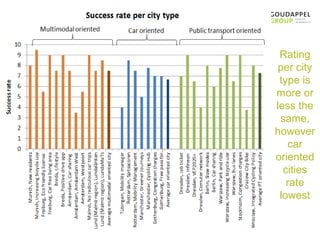
22 
Rating 
per city 
type is 
more or 
less the 
same, 
however 
car 
oriented 
cities 
rate 
lowest
23 
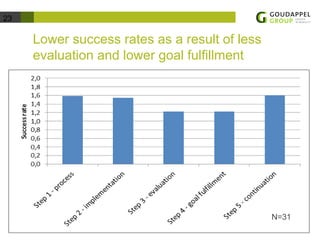
Lower success rates as a result of less 
evaluation and lower goal fulfillment 
N=31
24 
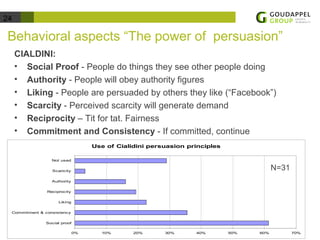
Behavioral aspects “The power of persuasion” 
CIALDINI: 
• Social Proof - People do things they see other people doing 
• Authority - People will obey authority figures 
• Liking - People are persuaded by others they like (“Facebook”) 
• Scarcity - Perceived scarcity will generate demand 
• Reciprocity – Tit for tat. Fairness 
• Commitment and Consistency - If committed, continue 
Use of Cialidini persuasion principles 
0% 10% 20% 30% 40% 50% 60% 70% 
Not used 
Scaricity 
Authority 
Reciprocity 
Liking 
Commitment & consistency 
Social proof 
N=31
25 
Behavioural Aspects 
• No relation between kind of persuasion strategy and 
success 
• If no persuasion strategy could be found (29%), success 
rates are lower. Think at before hand about the kind of 
persuasive strategies 
• Do not communicate in terms like objective elements like the 
bus/bicycle is quicker, cheaper or things like that, but try to relate 
to the actual behavioural motives 
• Adaptive approach: Successful cases show different kind 
of persuasion strategies 
• In most cases behavioural persuasion strategies are 
implicitly included, not explicitly
26 
General policy recommendations 
1. Process 
2. Implementation 
3. Evaluation 
4. Goal Fulfilment 
5. Continuation
27 
1. Process oriented 
• In order to influence travel behavior, there needs to 
be a person who is responsible. Meaning: 
• This person (or group of persons) plays the role of a 
spider in the network function and preferably this person 
can be found within city administration, sometimes 
outside city administration 
• In most successful cases, the person/group was 
able to create a special local network of key 
institutions and players supporting the strategy 
• Focus on positive aspects (benefits, such as 
health or better accessibility) and not negative 
aspects (higher costs)
28 
2. Implementation 
• A sound problem analysis is needed 
• What is the problem/challenge & what are the options 
• “Window of opportunity” needs to be identified 
• Coming from a specific national or European funding scheme, special event (National 
Road Construction Plan, Dresden flood 2002, Extra funding from car parking fees in 
Amsterdam, etc.) 
• If there is no obvious window, use an experiment project or a temporary project first 
• As each city with its players, its culture, its level of discussion etc. at one time is 
different from another city with other specific conditions, all windows of opportunity are 
somehow different from each other (e.g. German reunification) 
• Use experimental opportunities like European week of mobility/car free Sunday for the 
first steps 
• City administration always is a central player and 
needs to act: 
• In most all cases, support by a highly visible mayor/politician is essential 
• City administrations needs both the will and the resources to do something
29 
3. Monitoring and Evaluation (M&E): After 
implementing, M&E are absolutely essential for 
identification of positive/negative effects 
a. M&E for identifying the positive and expected effects, which is needed to promote the 
result that the measure was successful 
b. M&E are essential to identify any negative effects so that these could be corrected in 
the next round 
c. M&E is essential to be able to identify changed conditions which require changed 
objectives for the next round 
d. M&E is essential to maintain the process, to keep the momentum and to establish a 
SUMP – tradition in the city 
e. M&E should be constructed in such a way that not only regular aspects like accessibility 
and environmental effects are measured, but more soft impacts like “Quality of Life” 
f. Measure that influence land use patterns are most important in the long run, they should 
be included in all long term strategies. However, from an M&E viewpoint, they are 
difficult to monitor. If possible include them. 
g. M&E is only possible if the target groups are defined properly even in the early stages of 
the process
30 
4. Goal Fulfilment 
• Set realistic goals 
• Behavioural changes take time 
• Push & pull packages are more efficient and 
superior to other packages of measures 
• Every type of measure can be successful or 
unsuccessful 
• Economic incentives seem to be slightly more 
effective than other measures 
• Size doesn’t matter: small projects can be 
effective and large ineffective and visa versa
31 
5. Continuation 
• There is a life after the project 
• Maintain, improve and develop 
• Ideally, aspects of continuation are 
already included by setting up the project
32 
Conclusions 
• All policy measures can be successful (or unsuccessful), though: 
• Economic incentives measures seem to be more successful 
• Cities do differ (structural factors) but this has a small impact on 
successfulness of policy measures 
• Measures in car oriented cities are slightly less successful (more 
resistance?) 
• How measures are implemented and defined has a major impact on 
successfulness. Successful measures have a sound problem 
definition, realistic targets, use a specific window of opportunity, 
have an elaborate M&E program and have thought at before hand 
on the life after the project 
• Behavioural methodologies/strategies are mostly used implicitly

Step By Step: learning from implementing behavioural changes in transport

  • 1.
    Step By Step: learning from implementing behavioural changes in transport Frankfurt European Transport Conference 2014 Wim Korver 21 October 2014 IBDiM: Road and Bridge Research Institute (Poland)
  • 2.
    2 Content •Background • Research questions • Can cities be grouped based on their transport characteristics? • Our cases: an overview • Our approach to “measure” success • Analysis based on success ratings • Policy Recommendations based on case analysis • Conclusions
  • 3.
    3 Background •Transport will become in Europe the major producer of CO2 emissions • Technology will help, but on a local/regional scale more is needed: behavioural changes are needed to reach objectives (a sustainable mobility system) • A lot of national initiatives: e.g. CIVITAS, Beter Benutten (NL) and Forschungsprogramm Stadtverkehr (GE) • What can we learn from existing behavioural interventions (case analysis)
  • 4.
  • 5.
    5 Main Objective • Stepping Stones (Research Program): 1.To understand the successful (policy) measures aimed at making mobility patterns more sustainable and the underlying mechanisms (the how) including social & psychological factors. 2.The research results should be of common interest across Europe or in several regions. • Step By Step: • Identifying potential successful policy measures for changing the transport behaviour of people based on structural differences between cities and cultures What we know after the project is completed
  • 6.
  • 7.
    7 Base ResearchApproach A. Empirical based: the use of (urban) cases B. Structural versus behavioural factors CASES & CITIES City Type Type of measure Theory of Cialdini Persuasion strategies
  • 8.
    8 Can Europeancities be clustered into homogeneous groups?
  • 9.
    9 Approach: twodatasets • Urban Audit (Eurostat): • 785 cities • Mainly demographical, geographical and economical data • Base year 2009 • Limited information on transport use • TEMS-EPOMM dataset: • 165 cities • Different base years • Shares of different transport modes (modal split) • No information on total transport volumes • New dataset is created and will be available for others (via ERA-NET Transport website)
  • 10.
    10 Analysis: combiningall kind of variables
  • 11.
    11 European citiescan be clustered into three major groups. But some overlaps occur, European cities are not that easy to cluster Cat. 3 Multimodal Cat. 1 Car Cat. 4 Cat. 7 Cat. 2 Cat. 6 Public transport Cat. 5 Cat. 8
  • 12.
    12 31 CASES 15 CITIES O1 O2
  • 13.
    13 Structural Factors:Typology of cities Type N Within Step By Step Car Oriented 4 Rotterdam, Tubingen, Gothenburg, Manchester Public Transport Oriented 6 Dresden, Berlin, Warsaw, Cracow, Wroclaw, Stockholm Multimodal oriented 5 Amsterdam, Breda, Munich, Freiburg, Malmo/Lund
  • 14.
    14 Empirical workbased on 31 cases Distribution among countries 12 10 8 6 4 2 0 NL GE SW PL UK
  • 15.
    15 Empirical workbased on 31 cases Case Characteristics 0 2 4 6 8 10 12 14 Transport concept Demand Attitude
  • 16.
    16 Within reportone page descriptions with: • description of the project • project objective(s) • results and • lessons learned Based on: - Evidence based - Interviews with project/case representative
  • 17.
    17 Step ByStep Approach Structural factors Cities/ Regions Other factors not measured Measures taken in our cases Classification of type of ”behavioural” influence in the cases Assess successful-ness Other measures taken in the city at the same time or before B Typology of cities based on ”structural” factors A (indications of) Success as a function of C=f(A & B) C
  • 18.
    18 What issuccess? • Depends on whom you ask • Project leader, politician, interest groups, user, all will have different views • Success on what? Success can be divided in several aspects • Less car use, different opinions, budget spent, etc. • There are grades of success
  • 19.
    19 Rating everycase based on Five Steps Approach 1. Was the process well performed? • identification of problem/problems to be solved/reduced? • choice of measure that were "appropriate" to solve the problem/problems? • formulation of targets or goals? • "enough" communication and dialogue with stakeholders and/or the public? 2. Barriers for implementation and how they were handled • There were barriers for implementation but they were overcome and the implementation was fully performed • There were barriers for implementation which were only partly overcome and the implementation process had to be adjusted. • There were non, or only small, barriers and the implementation could be performed according to plan 3. Were the effects evaluated? • All effects were evaluated according to initial formulation of targets and/or goals • Some effects were evaluated • No evaluation was made 4. Were the goals reached? Or (if no targets) were the effects "large"? • Yes/ partly/ no 5. Is the work being continued to maintain or increase effects? • yes to large extent/ partly / no
  • 20.
    20 Success ratebetween 3 and 9
  • 21.
    21 Mix ofsuccessfull & unsuccessfull cases. Rating per type of measure is more or less the same Attitude Demand Transport concept
  • 22.
    22 Rating percity type is more or less the same, however car oriented cities rate lowest
  • 23.
    23 Lower successrates as a result of less evaluation and lower goal fulfillment N=31
  • 24.
    24 Behavioral aspects“The power of persuasion” CIALDINI: • Social Proof - People do things they see other people doing • Authority - People will obey authority figures • Liking - People are persuaded by others they like (“Facebook”) • Scarcity - Perceived scarcity will generate demand • Reciprocity – Tit for tat. Fairness • Commitment and Consistency - If committed, continue Use of Cialidini persuasion principles 0% 10% 20% 30% 40% 50% 60% 70% Not used Scaricity Authority Reciprocity Liking Commitment & consistency Social proof N=31
  • 25.
    25 Behavioural Aspects • No relation between kind of persuasion strategy and success • If no persuasion strategy could be found (29%), success rates are lower. Think at before hand about the kind of persuasive strategies • Do not communicate in terms like objective elements like the bus/bicycle is quicker, cheaper or things like that, but try to relate to the actual behavioural motives • Adaptive approach: Successful cases show different kind of persuasion strategies • In most cases behavioural persuasion strategies are implicitly included, not explicitly
  • 26.
    26 General policyrecommendations 1. Process 2. Implementation 3. Evaluation 4. Goal Fulfilment 5. Continuation
  • 27.
    27 1. Processoriented • In order to influence travel behavior, there needs to be a person who is responsible. Meaning: • This person (or group of persons) plays the role of a spider in the network function and preferably this person can be found within city administration, sometimes outside city administration • In most successful cases, the person/group was able to create a special local network of key institutions and players supporting the strategy • Focus on positive aspects (benefits, such as health or better accessibility) and not negative aspects (higher costs)
  • 28.
    28 2. Implementation • A sound problem analysis is needed • What is the problem/challenge & what are the options • “Window of opportunity” needs to be identified • Coming from a specific national or European funding scheme, special event (National Road Construction Plan, Dresden flood 2002, Extra funding from car parking fees in Amsterdam, etc.) • If there is no obvious window, use an experiment project or a temporary project first • As each city with its players, its culture, its level of discussion etc. at one time is different from another city with other specific conditions, all windows of opportunity are somehow different from each other (e.g. German reunification) • Use experimental opportunities like European week of mobility/car free Sunday for the first steps • City administration always is a central player and needs to act: • In most all cases, support by a highly visible mayor/politician is essential • City administrations needs both the will and the resources to do something
  • 29.
    29 3. Monitoringand Evaluation (M&E): After implementing, M&E are absolutely essential for identification of positive/negative effects a. M&E for identifying the positive and expected effects, which is needed to promote the result that the measure was successful b. M&E are essential to identify any negative effects so that these could be corrected in the next round c. M&E is essential to be able to identify changed conditions which require changed objectives for the next round d. M&E is essential to maintain the process, to keep the momentum and to establish a SUMP – tradition in the city e. M&E should be constructed in such a way that not only regular aspects like accessibility and environmental effects are measured, but more soft impacts like “Quality of Life” f. Measure that influence land use patterns are most important in the long run, they should be included in all long term strategies. However, from an M&E viewpoint, they are difficult to monitor. If possible include them. g. M&E is only possible if the target groups are defined properly even in the early stages of the process
  • 30.
    30 4. GoalFulfilment • Set realistic goals • Behavioural changes take time • Push & pull packages are more efficient and superior to other packages of measures • Every type of measure can be successful or unsuccessful • Economic incentives seem to be slightly more effective than other measures • Size doesn’t matter: small projects can be effective and large ineffective and visa versa
  • 31.
    31 5. Continuation • There is a life after the project • Maintain, improve and develop • Ideally, aspects of continuation are already included by setting up the project
  • 32.
    32 Conclusions •All policy measures can be successful (or unsuccessful), though: • Economic incentives measures seem to be more successful • Cities do differ (structural factors) but this has a small impact on successfulness of policy measures • Measures in car oriented cities are slightly less successful (more resistance?) • How measures are implemented and defined has a major impact on successfulness. Successful measures have a sound problem definition, realistic targets, use a specific window of opportunity, have an elaborate M&E program and have thought at before hand on the life after the project • Behavioural methodologies/strategies are mostly used implicitly