1
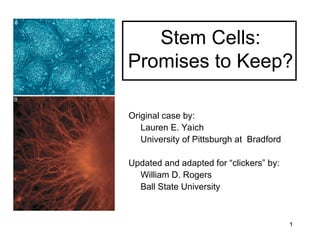
Stem Cells:
Promises toKeep?
Original case by:
Lauren E. Yaich
University of Pittsburgh at Bradford
Updated and adapted for “clickers” by:
William D. Rogers
Ball State University
2.
2
• One in10 American couples are infertile.
• One out of every 42 babies born in the
US in 2021 was conceived using IVF or
other assisted reproductive technology.
Source: American Society for Reproductive Medicine (2005).
4
Samantha watched asthe drop of water on
the tip of the icicle finally plummeted to the
ground below as a brisk wind disturbed its
equilibrium. She shivered as she turned
away from the wintry landscape outside,
but then immediately smiled as her gaze
came to rest upon her pre-school twins
Anna and Mark dozing in front of a Disney
movie.
Samantha felt doubly blessed to have
these two kids. She and her husband Brad
had tried for over 10 years to have children
before they turned to Dr. Billings for help.
5.
5
Anna and Markhad been conceived with the
help of IVF treatments. Samantha laughed softly,
thinking of all the adjustments they had made
after the arrival of the twins. No more quiet
dinners or lazy Sundays for years to come, she
thought to herself, not altogether unhappily.
7
CQ#1: An embryois allowed to develop
for around five days before it is inserted
into a uterus. Why?
A. The zygote does not begin to develop until a
few days after fertilization.
B. Doctors want the placenta to begin to
develop before inserting the embryo.
C. Doctors are trying to simulate natural
conditions of human development.
D. It takes several days for a sperm cell to
penetrate an egg cell.
9
Source: National Institutesof Health
“Preimplantation genetic diagnosis (PGD) is a test
that screens for genetic flaws among embryos
used in in vitro fertilization. With PGD, DNA
samples from embryos created in vitro by the
combination of a mother’s egg and a father’s
sperm are analyzed for gene abnormalities that
can cause disorders. Fertility specialists can use
the results of this analysis to select only mutation-
free embryos for implantation into the mother’s
uterus.”
Screening for Disease
10.
10
CQ#2: Should preimplantationgenetic
diagnosis be allowed?
A. Yes, it is the right of the parents
B. Yes, but only under circumstances
C. No
D. I am uncertain
11.
11
Adam Nash wasborn on August 29, 2000.
Adam was conceived for a purpose. Adam’s
older sister, Molly, was seriously ill. Doctors
and researchers felt that the best way to save
Molly’s life was a stem cell transplant.
Using the technique of in vitro fertilization,
multiple embryos were conceived using
gametes from Molly’s parents. The embryo that
would develop into the baby named Adam was
selected based on genetic analysis. Stem cells
from Adam’s umbilical cord were transplanted
into Molly, saving her life.
12.
12
Samantha clicked theremote, switching from
The Lion King to PBS. A few minutes later she
heard the back door open and her husband
Brad calling out, “Hey, Sam!” as he came in
from the cold, stomping the snow off of his
boots.
“Shh,” hushed Samantha, seeing Anna stir in
her sleep. “The twins just dozed off. It’s the first
minute of peace I’ve had all day.” She rose
from the couch and gave him a quick hug.
13.
13
“I’m so gladto be home. Work is starting to
drive me nuts. They want us to do more and
more in less and less time. And then, to top it
off, I hit a major traffic jam on the Loop. I’m
sorry I’m late again.” Brad looked into
Samantha’s eyes to make sure she wasn’t
upset.
“No problem … gotta pay the bills, right? Come
and sit with me. There’s an interesting show on
PBS that just came on,” said Samantha, settling
back down on the couch and patting the cushion
next to her.
14.
14
Brad sat downand Sam rested her head on his
shoulder. The PBS program was about stem
cells and their potential medical uses. Brad
looked over at Samantha as the show went on.
She seemed very engrossed by the story.
Occasionally she would smile and nod her
head. Out of the corner of her eye, Samantha
noted that Brad had a frown on his face
through most of the show. Maybe he was still
upset about work. A half-hour later, the
program ended. Samantha stood up to stretch
and then turned to Brad with a big smile.
15.
15
“Wasn’t that fantastic?Look at all the things
that stem cells could be used for. They might
be able to help people with Parkinson’s
disease or even heart attacks. It’s amazing
what scientists are coming up with these days.
I’d like to help out. We still have those embryos
frozen away at the clinic from back when we
were doing the IVF treatments. I wonder if we
could donate them?” Samantha mused.
16.
16
The richest sourceof embryonic stem cells is
tissue formed during the first five days after the
egg has started to divide. At this stage of
development, called the blastocyst, the embryo
consists of a cluster of about 100 cells that can
become any cell type. Stem cells are harvested
from that cluster at this stage of development, in
the process destroying the embryo while it is still
in the test tube.
21
“Are you nuts?”Brad scowled. “Didn’t you
get the gist of that show? They are
destroying babies to get those stem cells.
And you want to give them our children!”
22.
22
“Our children? Ourchildren are sleeping right
here in this room. I’m talking about some clumps
of cells that we will never use. We’ve talked
about this before, Brad. We decided that Anna
and Mark are enough. We aren’t planning to
have any more kids, especially since I’m going
back to work soon. Why not put those cells to
good use? There are so many people who are
suffering who could benefit from them.”
23.
23
CQ#4: Do embryonicstem cells
represent a human life?
A. Yes
B. No
C. I am uncertain
24.
24
“Didn’t your AuntRegina die from diabetes
complications last year?” asked
Samantha? “People like her might have a
chance for a better life through the use of
stem cells. My cousin Jackie, who was
paralyzed in that car accident, might be
able to walk again! In fact, our own
children might benefit from those cells
someday.”
26
What is “therapeuticcloning”?
Therapeutic cloning creates a cloned
embryo for the sole purpose of producing
embryonic stem cells with the same DNA
as the donor cell. These stem cells can be
used in experiments aimed at
understanding disease and developing
new treatments for disease. To date, there
is no evidence that human embryos have
been produced for therapeutic cloning.
27.
27
Q#5: Cloning stemcells from people
with a genetic disorder would allow
researchers:
A. To prevent these people from passing the
disease causing genes to their children.
B. To treat these people with their own cells.
C. To find and work with the DNA that causes
the disease.
D. To create disease-free embryos.
28.
28
The Australian embryologistand stem cell
biologist Alan Trounson, a pioneer of in vitro
fertilization, believes that
“Studying disease with stem cells is incredibly
important for research. We need to develop
embryonic cell lines from patients who've got
muscular dystrophy, Alzheimer's disease, and
cystic fibrosis. That way we can develop drugs
that actually block the disease from occurring.”
Excerpted from ‘Stem Cell Now' by Christopher Thomas Scott.
29.
29
CQ#6: What advantageis there to
cloning someone’s stem cells rather
than culturing already established
stem cells?
A. Cloned cells divide more rapidly.
B. Cloning would not involve embryos.
C. Cloned cells would be disease-free.
D. Rejection issues with transplants could
be avoided.
30.
30
Brad stood upand faced Sam. “Maybe
great medical treatments can be
developed, but at what cost? Those are
human beings we’re talking about, not just
‘clumps of cells.’ I don’t understand, Sam.
You have always had pro-life beliefs like
me. Those are our babies that you’re
talking about destroying!”
31.
31
“But we’re notgoing to use those
embryos to create children, Brad. You’ve
said yourself you don’t want any more
children. What are you going to do?
Leave them frozen forever?” cried Sam.
32.
32
“I don’t know.I hadn’t thought about it
much until you brought this up. Maybe we
can donate them to another infertile
couple. Can we do that? Besides, they
said in the show that at this point in time
the government won’t fund any new
research that destroys embryos to make
cell lines.”
33.
33
“The only embryonicstem cell lines that
can be used in federally funded research
were already created before the
government banned their use, so you
probably couldn’t donate our embryos to
science anyway. And what about adult
stem cells? Or umbilical cord stem cells?”
continued Brad. “Why can’t researchers
use those? Why use embryos in the first
place?”
36
A New Categoryof Stem Cell
• In November 2007, scientists
reported they were able to
reprogram skin cells to become
pluripotent stem cells.
“Induced Pluripotent Stem Cell Lines Derived from Human Somatic Cells,” by Junying Yu,
Maxim A. Vodyanik, Kim Smuga-Otto, Jessica Antosiewicz-Bourget, Jennifer L. Frane,
Shulan Tian, Jeff Nie, Gudrun A. Jonsdottir, Victor Ruotti, Ron Stewart, Igor I. Slukvin,
and James A. Thomson (21 December 2007) Science 318 (5858): 1917.
37.
37
CQ#7: If youwere President, which
type(s) of stem cell research would
you support?
A. Embryonic stem cell research only
B. Adult stem cell research only
C. Umbilical stem cell research only
D. B and C
E. A, B, and C
38.
38
“All I knowis that I want to do the right
thing. If we aren’t able to donate our
embryos and we’re not going to use them
to have more children, what should we
do with them?” Sam said softly.
“I don’t know,” sighed Brad.
They both looked away from each other
and out at the windswept landscape
outside.
39.
39
CQ#8: If youwere Samantha or Brad,
what would you want to do?
A. Donate the embryos for research
B. Leave the embryos frozen indefinitely
C. Put the embryos up for adoption
D. Destroy the embryos










![Slide Credits cont.
Slide 7—
Description: Illustration of embryonic development.
Source: © Guniita | Dreamstime.com.
Link: http://www.dreamstime.com/royalty-free-stock-photos-cell-development-image19080278
Clearance: Licensed.
Slide 16—
Description: Embryonic stem cells.
Source: Wikimedia Commons, http://commons.wikimedia.org/wiki/File:Stem_cells_diagram.png
Author: Wikipedia contributor Mike Jones.
Clearance: This file is licensed under the Creative Commons Attribution-Share Alike 2.5 Generic license.
Slide 17—
Description: The Promise of Stem cell Research
Source: Downloads and Media Resources. In Stem Cell Information [World Wide Web site]. Bethesda, MD: National Institutes of Health,
U.S. Department of Health and Human Services, 2008 [cited Friday, February 27, 2009] Available at
<http://stemcells.nih.gov/info/media/defaultpage>
Clearance: United States Government Agency.
Slide 34 —
Description: Blastocyst.
Source: Wikimedia Commons, http://commons.wikimedia.org/wiki/File:Blastocyst_English.svg
Clearance: This file is licensed under the Creative Commons Attribution ShareAlike 3.0 License.](https://image.slidesharecdn.com/stemcellsclicker61-250411110012-02846387/85/stem_cells_clicker-learning-6-1-ppt-41-320.jpg)


