STEM for the
Elementary
Classroom
02
Table of contents
What is it?
01 03
04
Why?
But I don’t
have
___________?
How do I do
it?
01
What is it?
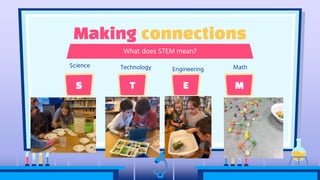
What does STEM mean?
S T
Making connections
E M
Engineering
Science Math
Technology
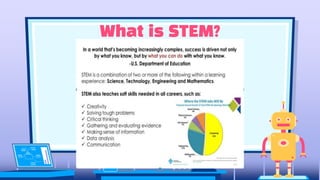
What is STEM?
Why?
02
Stem makes
connections
Engineering
Science
Maths
Technology
Language
History
Research
Arts
Critical
thinking
Problem
Solving
collaboration
Making connections
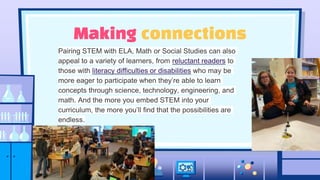
Pairing STEM with ELA, Math or Social Studies can also
appeal to a variety of learners, from reluctant readers to
those with literacy difficulties or disabilities who may be
more eager to participate when they’re able to learn
concepts through science, technology, engineering, and
math. And the more you embed STEM into your
curriculum, the more you’ll find that the possibilities are
endless.
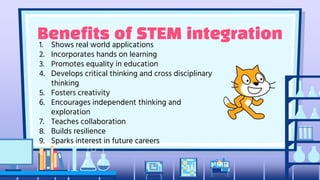
Benefits of STEM integration
1. Shows real world applications
2. Incorporates hands on learning
3. Promotes equality in education
4. Develops critical thinking and cross disciplinary
thinking
5. Fosters creativity
6. Encourages independent thinking and
exploration
7. Teaches collaboration
8. Builds resilience
9. Sparks interest in future careers
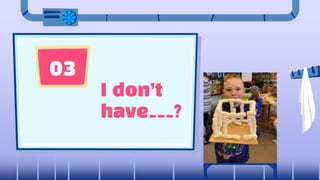
03
I don’t
have___?
Chances are you
already do project
based learning.
Instead of it being an
add on to a lesson,
Try using the STEM
based portion to
teach the concept.
Everyday
household items
and classroom
supplies are all
that is needed for
MOST projects.
You dont need them.
You do not need to
know how to code,
fly drone or use a
CAD program…you
just need to be willing
to try new things.
But I dont have the…
Common misconceptions about
implementing STEM in the classroom
Time Supplies Tech skills
TIME
There is a bit more in terms of set up, but S.T.E.M. is only a slight variation on
project based learning. It's not something completely new.
● It requires a change of mindset.
● Plan S.T.E.M. as the main learning tool, not just as the add on or practice for
a concept.
● S.T.E.M. is about exploring a concept and making connections to it. Using
S.T.E.M. as the primary method for learning a concept students have:
○ More of a role in what they learn.
○ Retain more, because of the interaction vs lecture or being “shown”
○ Are more invested in their own learning
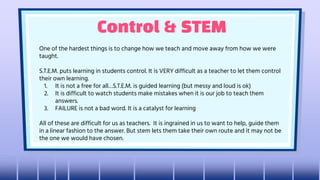
Control & STEM
One of the hardest things is to change how we teach and move away from how we were
taught.
S.T.E.M. puts learning in students control. It is VERY difficult as a teacher to let them control
their own learning.
1. It is not a free for all…S.T.E.M. is guided learning (but messy and loud is ok)
2. It is difficult to watch students make mistakes when it is our job to teach them
answers.
3. FAILURE is not a bad word. It is a catalyst for learning
All of these are difficult for us as teachers. It is ingrained in us to want to help, guide them
in a linear fashion to the answer. But stem lets them take their own route and it may not be
the one we would have chosen.
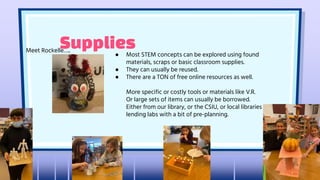
Supplies
Meet Rockelle…..
● Most STEM concepts can be explored using found
materials, scraps or basic classroom supplies.
● They can usually be reused.
● There are a TON of free online resources as well.
More specific or costly tools or materials like V.R.
Or large sets of items can usually be borrowed.
Either from our library, or the CSIU, or local libraries
lending labs with a bit of pre-planning.
Tech skills…. There is sooo
much where do you start.
Start with what you know, use materials you are
comfortable with.
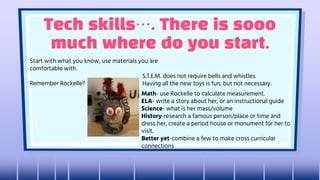
Remember Rockelle?
S.T.E.M. does not require bells and whistles.
Having all the new toys is fun, but not necessary.
Math- use Rockelle to calculate measurement.
ELA- write a story about her, or an instructional guide
Science- what is her mass/volume
History-research a famous person/place or time and
dress her, create a period house or monument for her to
visit.
Better yet-combine a few to make cross curricular
connections
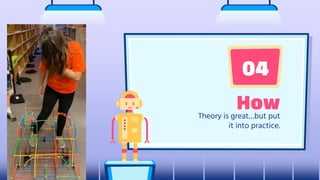
How
Theory is great…but put
it into practice.
04
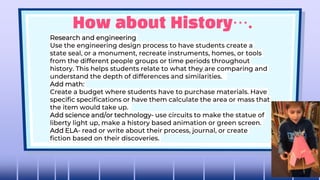
How about History….
Research and engineering
Use the engineering design process to have students create a
state seal, or a monument, recreate instruments, homes, or tools
from the different people groups or time periods throughout
history. This helps students relate to what they are comparing and
understand the depth of differences and similarities.
Add math:
Create a budget where students have to purchase materials. Have
specific specifications or have them calculate the area or mass that
the item would take up.
Add science and/or technology- use circuits to make the statue of
liberty light up, make a history based animation or green screen.
Add ELA- read or write about their process, journal, or create
fiction based on their discoveries.
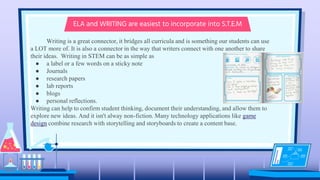
ELA and WRITING are easiest to incorporate into S.T.E.M
Writing is a great connector, it bridges all curricula and is something our students can use
a LOT more of. It is also a connector in the way that writers connect with one another to share
their ideas. Writing in STEM can be as simple as
● a label or a few words on a sticky note
● Journals
● research papers
● lab reports
● blogs
● personal reflections.
Writing can help to confirm student thinking, document their understanding, and allow them to
explore new ideas. And it isn't alway non-fiction. Many technology applications like game
design combine research with storytelling and storyboards to create a content base.
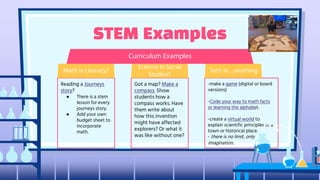
Reading a Journeys
story?
● There is a stem
lesson for every
journeys story.
● Add your own
budget sheet to
incorporate
math.
Got a map? Make a
compass. Show
students how a
compass works. Have
them write about
how this invention
might have affected
explorers? Or what it
was like without one?
-make a game (digital or board
versions)
-Code your way to math facts
or learning the alphabet.
-create a virtual world to
explain scientific principles or a
town or historical place.
- there is no limit, only
imagination.
Curriculum Examples
STEM Examples
Math in Literacy?
Science in Social
Studies?
Tech in….anything
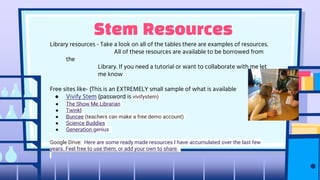
Stem Resources
Library resources - Take a look on all of the tables there are examples of resources.
All of these resources are available to be borrowed from
the
Library. If you need a tutorial or want to collaborate with me let
me know
Free sites like- (This is an EXTREMELY small sample of what is available
● Vivify Stem (password is vivifystem)
● The Show Me Librarian
● Twinkl
● Buncee (teachers can make a free demo account)
● Science Buddies
● Generation genius
Google Drive: Here are some ready made resources I have accumulated over the last few
years. Feel free to use them, or add your own to share.
Stem resources
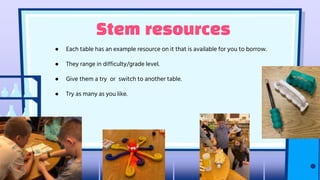
● Each table has an example resource on it that is available for you to borrow.
● They range in difficulty/grade level.
● Give them a try or switch to another table.
● Try as many as you like.

STEM for Elementary Classroom.pptx

  • 1.
  • 2.
    02 Table of contents Whatis it? 01 03 04 Why? But I don’t have ___________? How do I do it?
  • 3.
  • 4.
    What does STEMmean? S T Making connections E M Engineering Science Math Technology
  • 5.
  • 6.
  • 7.
  • 8.
    Making connections Pairing STEMwith ELA, Math or Social Studies can also appeal to a variety of learners, from reluctant readers to those with literacy difficulties or disabilities who may be more eager to participate when they’re able to learn concepts through science, technology, engineering, and math. And the more you embed STEM into your curriculum, the more you’ll find that the possibilities are endless.
  • 9.
    Benefits of STEMintegration 1. Shows real world applications 2. Incorporates hands on learning 3. Promotes equality in education 4. Develops critical thinking and cross disciplinary thinking 5. Fosters creativity 6. Encourages independent thinking and exploration 7. Teaches collaboration 8. Builds resilience 9. Sparks interest in future careers
  • 10.
  • 11.
    Chances are you alreadydo project based learning. Instead of it being an add on to a lesson, Try using the STEM based portion to teach the concept. Everyday household items and classroom supplies are all that is needed for MOST projects. You dont need them. You do not need to know how to code, fly drone or use a CAD program…you just need to be willing to try new things. But I dont have the… Common misconceptions about implementing STEM in the classroom Time Supplies Tech skills
  • 12.
    TIME There is abit more in terms of set up, but S.T.E.M. is only a slight variation on project based learning. It's not something completely new. ● It requires a change of mindset. ● Plan S.T.E.M. as the main learning tool, not just as the add on or practice for a concept. ● S.T.E.M. is about exploring a concept and making connections to it. Using S.T.E.M. as the primary method for learning a concept students have: ○ More of a role in what they learn. ○ Retain more, because of the interaction vs lecture or being “shown” ○ Are more invested in their own learning
  • 13.
    Control & STEM Oneof the hardest things is to change how we teach and move away from how we were taught. S.T.E.M. puts learning in students control. It is VERY difficult as a teacher to let them control their own learning. 1. It is not a free for all…S.T.E.M. is guided learning (but messy and loud is ok) 2. It is difficult to watch students make mistakes when it is our job to teach them answers. 3. FAILURE is not a bad word. It is a catalyst for learning All of these are difficult for us as teachers. It is ingrained in us to want to help, guide them in a linear fashion to the answer. But stem lets them take their own route and it may not be the one we would have chosen.
  • 14.
    Supplies Meet Rockelle….. ● MostSTEM concepts can be explored using found materials, scraps or basic classroom supplies. ● They can usually be reused. ● There are a TON of free online resources as well. More specific or costly tools or materials like V.R. Or large sets of items can usually be borrowed. Either from our library, or the CSIU, or local libraries lending labs with a bit of pre-planning.
  • 15.
    Tech skills…. Thereis sooo much where do you start. Start with what you know, use materials you are comfortable with. Remember Rockelle? S.T.E.M. does not require bells and whistles. Having all the new toys is fun, but not necessary. Math- use Rockelle to calculate measurement. ELA- write a story about her, or an instructional guide Science- what is her mass/volume History-research a famous person/place or time and dress her, create a period house or monument for her to visit. Better yet-combine a few to make cross curricular connections
  • 16.
    How Theory is great…butput it into practice. 04
  • 17.
    How about History…. Researchand engineering Use the engineering design process to have students create a state seal, or a monument, recreate instruments, homes, or tools from the different people groups or time periods throughout history. This helps students relate to what they are comparing and understand the depth of differences and similarities. Add math: Create a budget where students have to purchase materials. Have specific specifications or have them calculate the area or mass that the item would take up. Add science and/or technology- use circuits to make the statue of liberty light up, make a history based animation or green screen. Add ELA- read or write about their process, journal, or create fiction based on their discoveries.
  • 18.
    ELA and WRITINGare easiest to incorporate into S.T.E.M Writing is a great connector, it bridges all curricula and is something our students can use a LOT more of. It is also a connector in the way that writers connect with one another to share their ideas. Writing in STEM can be as simple as ● a label or a few words on a sticky note ● Journals ● research papers ● lab reports ● blogs ● personal reflections. Writing can help to confirm student thinking, document their understanding, and allow them to explore new ideas. And it isn't alway non-fiction. Many technology applications like game design combine research with storytelling and storyboards to create a content base.
  • 19.
    Reading a Journeys story? ●There is a stem lesson for every journeys story. ● Add your own budget sheet to incorporate math. Got a map? Make a compass. Show students how a compass works. Have them write about how this invention might have affected explorers? Or what it was like without one? -make a game (digital or board versions) -Code your way to math facts or learning the alphabet. -create a virtual world to explain scientific principles or a town or historical place. - there is no limit, only imagination. Curriculum Examples STEM Examples Math in Literacy? Science in Social Studies? Tech in….anything
  • 20.
    Stem Resources Library resources- Take a look on all of the tables there are examples of resources. All of these resources are available to be borrowed from the Library. If you need a tutorial or want to collaborate with me let me know Free sites like- (This is an EXTREMELY small sample of what is available ● Vivify Stem (password is vivifystem) ● The Show Me Librarian ● Twinkl ● Buncee (teachers can make a free demo account) ● Science Buddies ● Generation genius Google Drive: Here are some ready made resources I have accumulated over the last few years. Feel free to use them, or add your own to share.
  • 21.
    Stem resources ● Eachtable has an example resource on it that is available for you to borrow. ● They range in difficulty/grade level. ● Give them a try or switch to another table. ● Try as many as you like.

Editor's Notes

  • #5 Nothing exists in a vacuum. All of our curriculum overlaps in some way. Math, Technology and science, would not exist without each other, and we would not be able to communicate or learn about our advancements or findings in these subjects without history or language. It does not make sense to teach in a bubble. Students need hands on, real world applications to their learning. This lends relevance and understanding of the world they live in to their learning.
  • #7 Often we are closed into our own classrooms, teaching the subject matter in the curriculum provided. But our way of disseminating that information is not alway conducive to learning. Kids all learn in different ways. Lecture and recall are only part of learning, even though repetition does lead to embedded memory, it often loses kids interest. Hands on engagement. Connecting their learning to their reality. Allowing for understanding through failure. These are the keys to true student engagement and understanding. Kids who are invested in a project take pride in their learning and want to understand concepts.
  • #8 This is where STEM comes in. Yes it can be a stand alone class, but it is more effective when it incorporates CORE curriculum. Studies have shown that students who have been taught using STEM integrations have higher test scores, better recall and practical understanding of subject matter and are better able to make connections between subjects. It ups their critical thinking skills and problem solving skills…these are areas of student abilities we have all seen a decrease in over the years
  • #9 I have watched students who struggle with reading and writing work their hardest on a STEM journal to document their experiences.
  • #11 As different teachers have come into the library I have heard comments about things they see as barriers to doing more stem based projects in the classroom. Here are the top 3 issues teachers have.
  • #13 If you look at stem as something additional it will always be an extra thing you have to do. However, if you look at the concepts you are teaching, some lend themselves to to a more hands on approach. Take Idioms for example. You can memorize what they are and try to visualize them, or you can hand the learning to the students and have them create their own idiom with a literal and figurative definition with minimal lecture, they will build the concept and understanding.
  • #14 What we need to remember is we were forced to learn ONE way….usually through lecture and practice. But as we are fond of telling parents, children do not all learn the same. S.T.E.M. gives kids the ability to explore how they learn, understand that mistakes are part of learning and that just because something “failed” does not mean you are a failure. It just means you dive deeper to learn what worked and what does not work.
  • #19 Example stem journals, storyboards, 3RD AND 4TH GRADE-wrote and then coded.