+
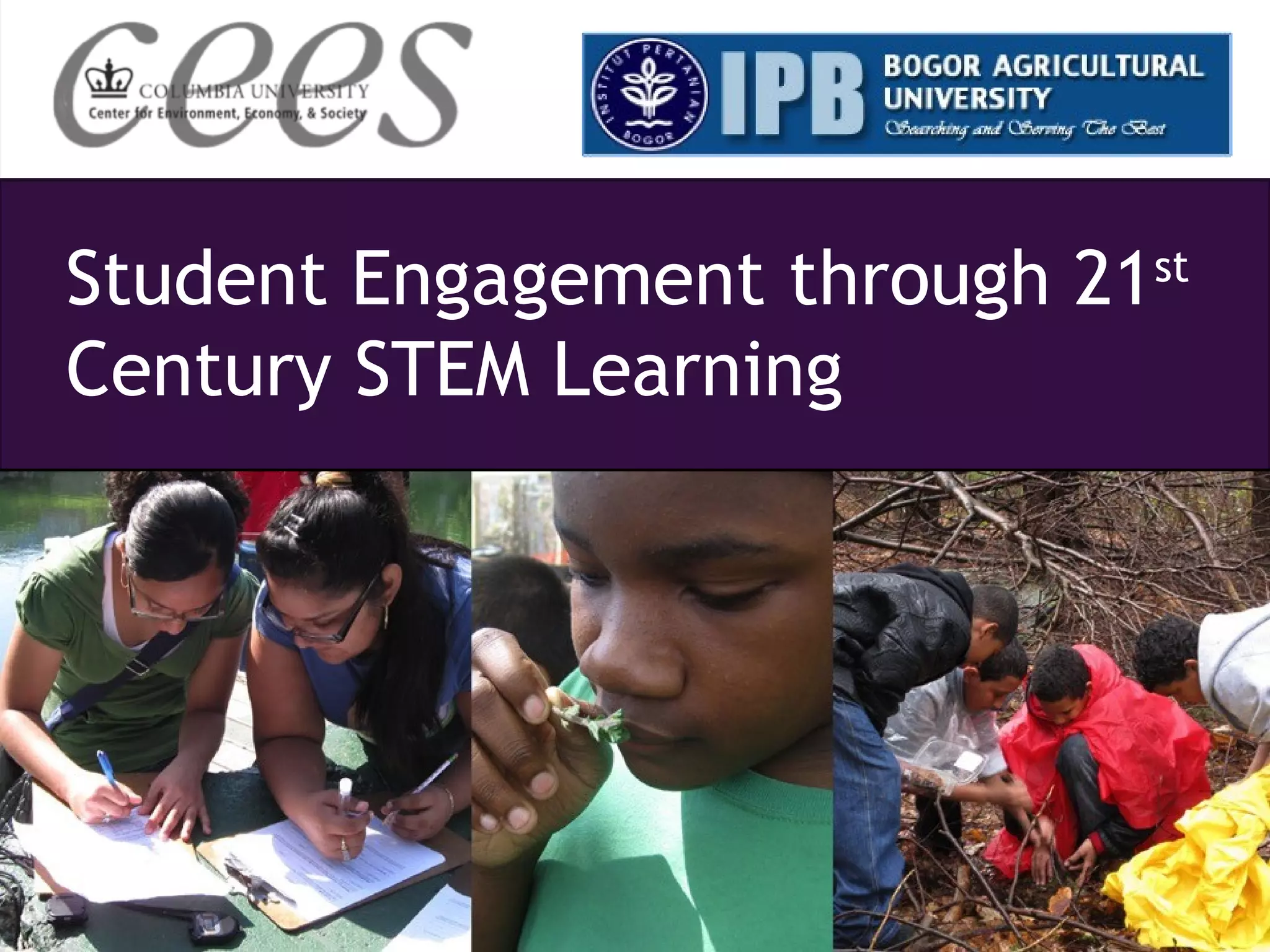
Student Engagement through 21st
Century STEM Learning
International Conference on Mathematics, Natural Sciences, & Education 8 Agustus 2015
+
Presentation Outline
 Introduction to IEC and SAInS
 Improving STEM Instruction in Indonesian secondary schools
 Innovative Pedagogical methods and 21st
Century Learning
 ENGAGEMENT is key to why these methods work
 Engagement in theory and practice
 Examples from IEC and SAInS
 Our results
International Conference on Mathematics, Natural Sciences, & Education 8 Agustus 2015
+
Center for Environment, Economy,
Society (CEES) @ Columbia University
 Two “arms”: Sustainable
Development, and
Environmental Education
 Mission: environmental
education and literacy
 Integrated Ecology
Curriculum (IEC)
delivered in NYC
middle schools
 Environmental
concepts = theme for
interdisciplinary
project-based
learning
International Conference on Mathematics, Natural Sciences, & Education 8 Agustus 2015
+ IEC Program Mission
 Promote environmental and scientific literacy early
 Alleviate poverty in NYC by increasing graduation
rates and, consequently, economic self-sufficiency.
Build school capacity to develop and implement inquiry-
based projects around authentic ecology investigations that
bolster literacy and math skills, build higher level cognitive
skills and habits, and provide compelling learning
experiences that entice students to attend school
everyday.
Strategy
International Conference on Mathematics, Natural Sciences, & Education 8 Agustus 2015
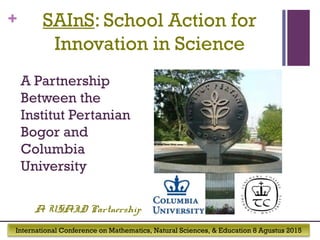
+ SAInS: School Action for
Innovation in Science
A Partnership
Between the
Institut Pertanian
Bogor and
Columbia
University
A USAID Partnership
International Conference on Mathematics, Natural Sciences, & Education 8 Agustus 2015
+
Goal: improve STEM education in
Indonesian secondary schools
Although Indonesian students have won
international Science competitions,
overall the nation doesn’t rank well in
science and math, internationally.
2014 Results from PISA (Program for
International Student Assessment) of the
OECD place Indonesia in the bottom 5 of 66
countries tested, in Math and Science.
International Conference on Mathematics, Natural Sciences, & Education 8 Agustus 2015
+ Teachers want to help their
students better…
Remember concepts learned
Understand them at a deep level
Connect them to other knowledge and
to the real world
Use and apply what they learn to
investigate and solve problems
International Conference on Mathematics, Natural Sciences, & Education 8 Agustus 2015
SAInS Program Objectives
International Conference on Mathematics, Natural Sciences, & Education 8 Agustus 2015
+
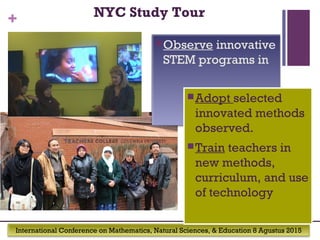
Observe innovative
STEM programs in
Adopt selected
innovated methods
observed.
Train teachers in
new methods,
curriculum, and use
of technology
NYC Study Tour
International Conference on Mathematics, Natural Sciences, & Education 8 Agustus 2015
+
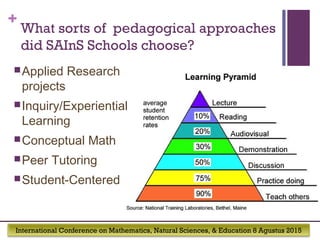
What sorts of pedagogical approaches
did SAInS Schools choose?
Applied Research
projects
Inquiry/Experiential
Learning
Conceptual Math
Peer Tutoring
Student-Centered
International Conference on Mathematics, Natural Sciences, & Education 8 Agustus 2015
+
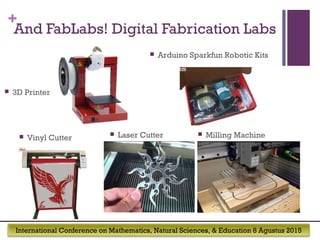
And FabLabs! Digital Fabrication Labs
 3D Printer
 Laser Cutter Vinyl Cutter
 Milling Machine
 Arduino Sparkfun Robotic Kits
International Conference on Mathematics, Natural Sciences, & Education 8 Agustus 2015
+
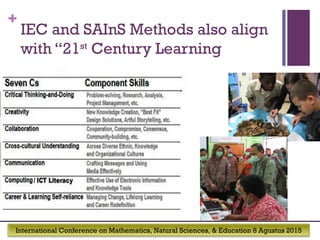
IEC and SAInS Methods also align
with “21st
Century Learning
International Conference on Mathematics, Natural Sciences, & Education 8 Agustus 2015
+
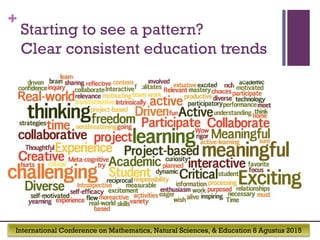
Starting to see a pattern?
Clear consistent education trends
International Conference on Mathematics, Natural Sciences, & Education 8 Agustus 2015
+
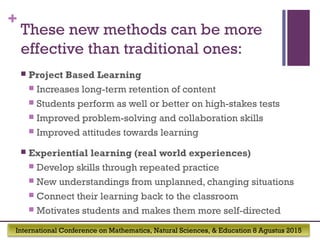
These new methods can be more
effective than traditional ones:
 Project Based Learning
 Increases long-term retention of content
 Students perform as well or better on high-stakes tests
 Improved problem-solving and collaboration skills
 Improved attitudes towards learning
 Experiential learning (real world experiences)
 Develop skills through repeated practice
 New understandings from unplanned, changing situations
 Connect their learning back to the classroom
 Motivates students and makes them more self-directed
International Conference on Mathematics, Natural Sciences, & Education 8 Agustus 2015
+
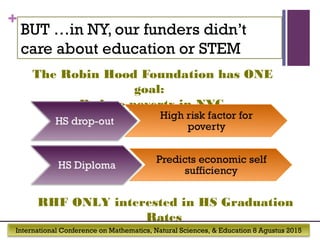
BUT …in NY, our funders didn’t
care about education or STEM
The Robin Hood Foundation has ONE
goal:
Reduce poverty in NYC
RHF ONLY interested in HS Graduation
Rates
International Conference on Mathematics, Natural Sciences, & Education 8 Agustus 2015
+
RHF theory: Middle School Success
Leads to High School Graduation
Unfortunately they were wrong
Academic
performance in
Middle School
does not predict
High School
Dropout
International Conference on Mathematics, Natural Sciences, & Education 8 Agustus 2015
+
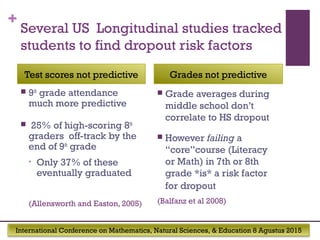
Several US Longitudinal studies tracked
students to find dropout risk factors
 9th
grade attendance
much more predictive
 25% of high-scoring 8th
graders off-track by the
end of 9th
grade
• Only 37% of these
eventually graduated
(Allensworth and Easton, 2005)
 Grade averages during
middle school don’t
correlate to HS dropout
 However failing a
“core”course (Literacy
or Math) in 7th or 8th
grade *is* a risk factor
for dropout (
(Balfanz et al 2008)t al 2008),
Test scores not predictive Grades not predictive
International Conference on Mathematics, Natural Sciences, & Education 8 Agustus 2015
+
Research shows engagement is
key to academic success
 Particularly strong effect in Middle School years
 Academic engagement lower probability of dropping out
 Alienation risk behaviors highly predictive of dropout
“Student Engagement is one of the most robust predictors of
achievement,performance and persistence in school controlling
for all other factors” (Klem and Connell 2008).
Proven Link between student engagement
and High School graduation
International Conference on Mathematics, Natural Sciences, & Education 8 Agustus 2015
+
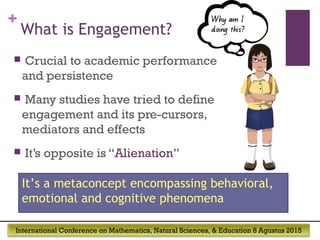
What is Engagement?
 Crucial to academic performance
and persistence
 Many studies have tried to define
engagement and its pre-cursors,
mediators and effects
 It’s opposite is “Alienation”
It’s a metaconcept encompassing behavioral,
emotional and cognitive phenomena
International Conference on Mathematics, Natural Sciences, & Education 8 Agustus 2015
+
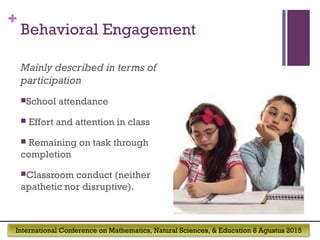
Behavioral Engagement
Mainly described in terms of
participation
School attendance
 Effort and attention in class
 Remaining on task through
completion
Classroom conduct (neither
apathetic nor disruptive).
International Conference on Mathematics, Natural Sciences, & Education 8 Agustus 2015
+
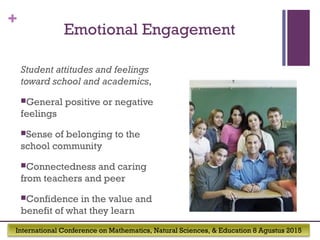
Emotional Engagement
Student attitudes and feelings
toward school and academics,
General positive or negative
feelings
Sense of belonging to the
school community
Connectedness and caring
from teachers and peer
Confidence in the value and
benefit of what they learn
International Conference on Mathematics, Natural Sciences, & Education 8 Agustus 2015
+
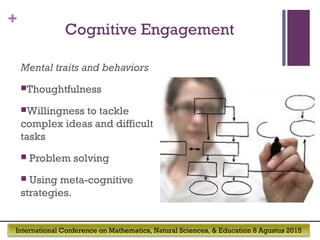
Cognitive Engagement
Mental traits and behaviors
Thoughtfulness
Willingness to tackle
complex ideas and difficult
tasks
 Problem solving
 Using meta-cognitive
strategies.
International Conference on Mathematics, Natural Sciences, & Education 8 Agustus 2015
+
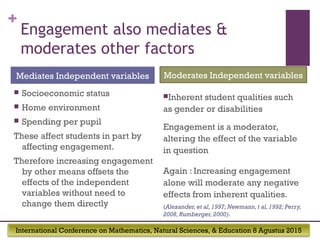
Engagement also mediates &
moderates other factors
 Socioeconomic status
 Home environment
 Spending per pupil
These affect students in part by
affecting engagement.
Therefore increasing engagement
by other means offsets the
effects of the independent
variables without need to
change them directly 
Inherent student qualities such
as gender or disabilities
Engagement is a moderator,
altering the effect of the variable
in question
Again : Increasing engagement
alone will moderate any negative
effects from inherent qualities. 
(Alexander,et al,1997; Newmann,t al,1992; Perry,
2008,Rumberger,2000).
Mediates Independent variables Moderates Independent variables
International Conference on Mathematics, Natural Sciences, & Education 8 Agustus 2015
+
Engagement is amenable to
change via Intervention…
…Unlike more intractable variables such as
SES, home environment, per pupil spending,
or inherent student qualities
This is why engagement has become
the most common variable targeted by
dropout prevention programs across
the country (Christenson, et al 2001).  
International Conference on Mathematics, Natural Sciences, & Education 8 Agustus 2015
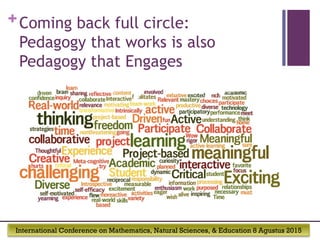
+Coming back full circle:
Pedagogy that works is also
Pedagogy that Engages
International Conference on Mathematics, Natural Sciences, & Education 8 Agustus 2015
+
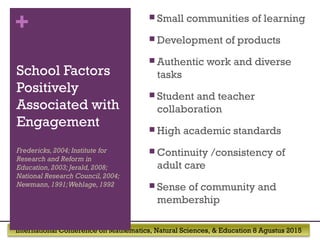
School Factors
Positively
Associated with
Engagement
 Small communities of learning
 Development of products
 Authentic work and diverse
tasks
 Student and teacher
collaboration
 High academic standards
 Continuity /consistency of
adult care
 Sense of community and
membership
Fredericks, 2004; Institute for
Research and Reform in
Education,2003; Jerald, 2008;
National Research Council, 2004;
Newmann, 1991;Wehlage,1992
International Conference on Mathematics, Natural Sciences, & Education 8 Agustus 2015
+
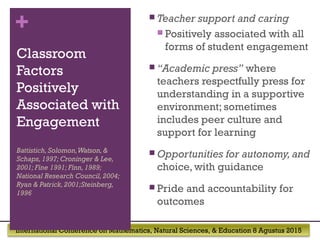
Classroom
Factors
Positively
Associated with
Engagement
 Teacher support and caring
 Positively associated with all
forms of student engagement
 “Academic press” where
teachers respectfully press for
understanding in a supportive
environment; sometimes
includes peer culture and
support for learning
 Opportunities for autonomy,and
choice, with guidance
 Pride and accountability for
outcomes
Battistich,Solomon,Watson, &
Schaps, 1997; Croninger & Lee,
2001; Fine 1991; Finn, 1989;
National Research Council, 2004;
Ryan & Patrick,2001;Steinberg,
1996
International Conference on Mathematics, Natural Sciences, & Education 8 Agustus 2015
+
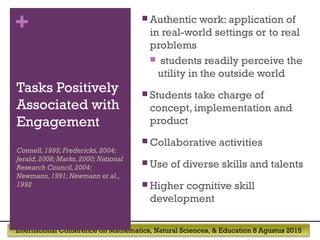
Tasks Positively
Associated with
Engagement
 Authentic work: application of
in real-world settings or to real
problems
 students readily perceive the
utility in the outside world
 Students take charge of
concept, implementation and
product
 Collaborative activities
 Use of diverse skills and talents
 Higher cognitive skill
development
Connell, 1995; Fredericks,2004;
Jerald,2008; Marks,2000; National
Research Council, 2004;
Newmann, 1991; Newmann et al.,
1992
International Conference on Mathematics, Natural Sciences, & Education 8 Agustus 2015
+
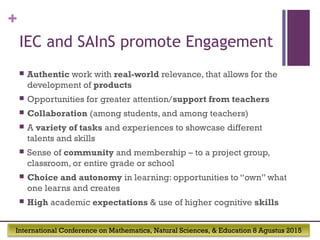
IEC and SAInS promote Engagement
 Authentic work with real-world relevance, that allows for the
development of products
 Opportunities for greater attention/support from teachers
 Collaboration (among students, and among teachers)
 A variety of tasks and experiences to showcase different
talents and skills
 Sense of community and membership – to a project group,
classroom, or entire grade or school
 Choice and autonomy in learning: opportunities to “own” what
one learns and creates
 High academic expectations & use of higher cognitive skills
International Conference on Mathematics, Natural Sciences, & Education 8 Agustus 2015
+
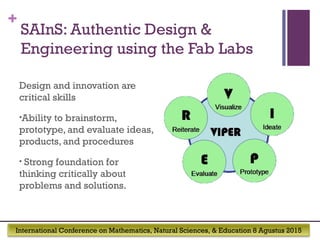
SAInS: Authentic Design &
Engineering using the Fab Labs
Design and innovation are
critical skills
•Ability to brainstorm,
prototype, and evaluate ideas,
products, and procedures
• Strong foundation for
thinking critically about
problems and solutions.
International Conference on Mathematics, Natural Sciences, & Education 8 Agustus 2015
+
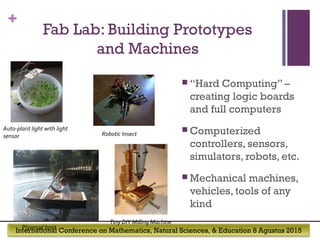
Fab Lab: Building Prototypes
and Machines
 “Hard Computing” –
creating logic boards
and full computers
 Computerized
controllers, sensors,
simulators, robots, etc.
 Mechanical machines,
vehicles, tools of any
kind
Auto-plant light with light
sensor
Tiny DIY Milling Machine
Robotic Insect
Plywood boat
International Conference on Mathematics, Natural Sciences, & Education 8 Agustus 2015
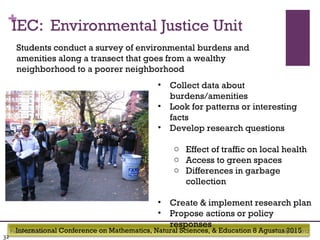
+IEC: Environmental Justice Unit
July 22, 2012Footer text here
32
• Collect data about
burdens/amenities
• Look for patterns or interesting
facts
• Develop research questions
o Effect of traffic on local health
o Access to green spaces
o Differences in garbage
collection
• Create & implement research plan
• Propose actions or policy
responses
Students conduct a survey of environmental burdens and
amenities along a transect that goes from a wealthy
neighborhood to a poorer neighborhood
International Conference on Mathematics, Natural Sciences, & Education 8 Agustus 2015
+
Measuring Effectiveness of
Instruction for Engagement
Did our Interventions Work?
International Conference on Mathematics, Natural Sciences, & Education 8 Agustus 2015
+
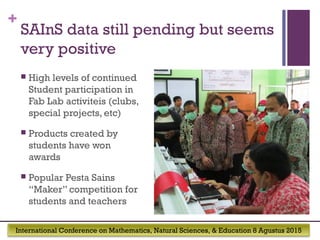
SAInS data still pending but seems
very positive
 High levels of continued
Student participation in
Fab Lab activiteis (clubs,
special projects, etc)
 Products created by
students have won
awards
 Popular Pesta Sains
“Maker” competition for
students and teachers
International Conference on Mathematics, Natural Sciences, & Education 8 Agustus 2015
+
IEC results were Positive
Engagement is difficult to measure,but
Indicators of engagement outcomes are clear
Longitudinal study in Philadelphia identified dropout indicators
Only accepted indicators that would identify a large
proportion of at risk students (at least 25%)
That would hold true for at least 75% of non-graduates.
That had “independent and additive effects” on a student’s
probability of graduating
(Balfanz,2007; Balfanz, 2008; Gleason and Dynarski,2002; Jerald,2006;
Klem and Connell 2008; Pinkus 2008).
International Conference on Mathematics, Natural Sciences, & Education 8 Agustus 2015
+
Research-backed Indicators of
Dropout Risk
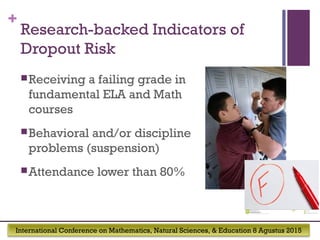
Receiving a failing grade in
fundamental ELA and Math
courses
Behavioral and/or discipline
problems (suspension)
Attendance lower than 80%
International Conference on Mathematics, Natural Sciences, & Education 8 Agustus 2015
+
IEC Accomplishments over 3 years
Proportion of dropout risk indicators declined in 75%
of cases measured:
 Severe Truancy down an average of 41%
 Suspensions down an average of 74%;
 58% decrease in failures in ELA courses
 37% decrease in failures in Math courses
International Conference on Mathematics, Natural Sciences, & Education 8 Agustus 2015
+
The Take-away message
Innovative instructional methods embodied in recent
pedagogical trends -- such as project-based
learning and 21st
Century learning -- have been
proven effective for STEM education if applied well.
These methods are effective in part because they
promote behavioral, emotional and cognitive
engagement in students.
Engagement is clearly predictive for school
persistence and graduation, and can positively alter
the influence of factors such as SES, disability, and
home environment

PPT Sulawesi 2015 STEM student engagement

  • 1.
    + Student Engagement through21st Century STEM Learning
  • 2.
    International Conference onMathematics, Natural Sciences, & Education 8 Agustus 2015 + Presentation Outline  Introduction to IEC and SAInS  Improving STEM Instruction in Indonesian secondary schools  Innovative Pedagogical methods and 21st Century Learning  ENGAGEMENT is key to why these methods work  Engagement in theory and practice  Examples from IEC and SAInS  Our results
  • 3.
    International Conference onMathematics, Natural Sciences, & Education 8 Agustus 2015 + Center for Environment, Economy, Society (CEES) @ Columbia University  Two “arms”: Sustainable Development, and Environmental Education  Mission: environmental education and literacy  Integrated Ecology Curriculum (IEC) delivered in NYC middle schools  Environmental concepts = theme for interdisciplinary project-based learning
  • 4.
    International Conference onMathematics, Natural Sciences, & Education 8 Agustus 2015 + IEC Program Mission  Promote environmental and scientific literacy early  Alleviate poverty in NYC by increasing graduation rates and, consequently, economic self-sufficiency. Build school capacity to develop and implement inquiry- based projects around authentic ecology investigations that bolster literacy and math skills, build higher level cognitive skills and habits, and provide compelling learning experiences that entice students to attend school everyday. Strategy
  • 5.
    International Conference onMathematics, Natural Sciences, & Education 8 Agustus 2015 + SAInS: School Action for Innovation in Science A Partnership Between the Institut Pertanian Bogor and Columbia University A USAID Partnership
  • 6.
    International Conference onMathematics, Natural Sciences, & Education 8 Agustus 2015 + Goal: improve STEM education in Indonesian secondary schools Although Indonesian students have won international Science competitions, overall the nation doesn’t rank well in science and math, internationally. 2014 Results from PISA (Program for International Student Assessment) of the OECD place Indonesia in the bottom 5 of 66 countries tested, in Math and Science.
  • 7.
    International Conference onMathematics, Natural Sciences, & Education 8 Agustus 2015 + Teachers want to help their students better… Remember concepts learned Understand them at a deep level Connect them to other knowledge and to the real world Use and apply what they learn to investigate and solve problems
  • 8.
    International Conference onMathematics, Natural Sciences, & Education 8 Agustus 2015 SAInS Program Objectives
  • 9.
    International Conference onMathematics, Natural Sciences, & Education 8 Agustus 2015 + Observe innovative STEM programs in Adopt selected innovated methods observed. Train teachers in new methods, curriculum, and use of technology NYC Study Tour
  • 10.
    International Conference onMathematics, Natural Sciences, & Education 8 Agustus 2015 + What sorts of pedagogical approaches did SAInS Schools choose? Applied Research projects Inquiry/Experiential Learning Conceptual Math Peer Tutoring Student-Centered
  • 11.
    International Conference onMathematics, Natural Sciences, & Education 8 Agustus 2015 + And FabLabs! Digital Fabrication Labs  3D Printer  Laser Cutter Vinyl Cutter  Milling Machine  Arduino Sparkfun Robotic Kits
  • 12.
    International Conference onMathematics, Natural Sciences, & Education 8 Agustus 2015 + IEC and SAInS Methods also align with “21st Century Learning
  • 13.
    International Conference onMathematics, Natural Sciences, & Education 8 Agustus 2015 + Starting to see a pattern? Clear consistent education trends
  • 14.
    International Conference onMathematics, Natural Sciences, & Education 8 Agustus 2015 + These new methods can be more effective than traditional ones:  Project Based Learning  Increases long-term retention of content  Students perform as well or better on high-stakes tests  Improved problem-solving and collaboration skills  Improved attitudes towards learning  Experiential learning (real world experiences)  Develop skills through repeated practice  New understandings from unplanned, changing situations  Connect their learning back to the classroom  Motivates students and makes them more self-directed
  • 15.
    International Conference onMathematics, Natural Sciences, & Education 8 Agustus 2015 + BUT …in NY, our funders didn’t care about education or STEM The Robin Hood Foundation has ONE goal: Reduce poverty in NYC RHF ONLY interested in HS Graduation Rates
  • 16.
    International Conference onMathematics, Natural Sciences, & Education 8 Agustus 2015 + RHF theory: Middle School Success Leads to High School Graduation Unfortunately they were wrong Academic performance in Middle School does not predict High School Dropout
  • 17.
    International Conference onMathematics, Natural Sciences, & Education 8 Agustus 2015 + Several US Longitudinal studies tracked students to find dropout risk factors  9th grade attendance much more predictive  25% of high-scoring 8th graders off-track by the end of 9th grade • Only 37% of these eventually graduated (Allensworth and Easton, 2005)  Grade averages during middle school don’t correlate to HS dropout  However failing a “core”course (Literacy or Math) in 7th or 8th grade *is* a risk factor for dropout ( (Balfanz et al 2008)t al 2008), Test scores not predictive Grades not predictive
  • 18.
    International Conference onMathematics, Natural Sciences, & Education 8 Agustus 2015 + Research shows engagement is key to academic success  Particularly strong effect in Middle School years  Academic engagement lower probability of dropping out  Alienation risk behaviors highly predictive of dropout “Student Engagement is one of the most robust predictors of achievement,performance and persistence in school controlling for all other factors” (Klem and Connell 2008). Proven Link between student engagement and High School graduation
  • 19.
    International Conference onMathematics, Natural Sciences, & Education 8 Agustus 2015 + What is Engagement?  Crucial to academic performance and persistence  Many studies have tried to define engagement and its pre-cursors, mediators and effects  It’s opposite is “Alienation” It’s a metaconcept encompassing behavioral, emotional and cognitive phenomena
  • 20.
    International Conference onMathematics, Natural Sciences, & Education 8 Agustus 2015 + Behavioral Engagement Mainly described in terms of participation School attendance  Effort and attention in class  Remaining on task through completion Classroom conduct (neither apathetic nor disruptive).
  • 21.
    International Conference onMathematics, Natural Sciences, & Education 8 Agustus 2015 + Emotional Engagement Student attitudes and feelings toward school and academics, General positive or negative feelings Sense of belonging to the school community Connectedness and caring from teachers and peer Confidence in the value and benefit of what they learn
  • 22.
    International Conference onMathematics, Natural Sciences, & Education 8 Agustus 2015 + Cognitive Engagement Mental traits and behaviors Thoughtfulness Willingness to tackle complex ideas and difficult tasks  Problem solving  Using meta-cognitive strategies.
  • 23.
    International Conference onMathematics, Natural Sciences, & Education 8 Agustus 2015 + Engagement also mediates & moderates other factors  Socioeconomic status  Home environment  Spending per pupil These affect students in part by affecting engagement. Therefore increasing engagement by other means offsets the effects of the independent variables without need to change them directly  Inherent student qualities such as gender or disabilities Engagement is a moderator, altering the effect of the variable in question Again : Increasing engagement alone will moderate any negative effects from inherent qualities.  (Alexander,et al,1997; Newmann,t al,1992; Perry, 2008,Rumberger,2000). Mediates Independent variables Moderates Independent variables
  • 24.
    International Conference onMathematics, Natural Sciences, & Education 8 Agustus 2015 + Engagement is amenable to change via Intervention… …Unlike more intractable variables such as SES, home environment, per pupil spending, or inherent student qualities This is why engagement has become the most common variable targeted by dropout prevention programs across the country (Christenson, et al 2001).  
  • 25.
    International Conference onMathematics, Natural Sciences, & Education 8 Agustus 2015 +Coming back full circle: Pedagogy that works is also Pedagogy that Engages
  • 26.
    International Conference onMathematics, Natural Sciences, & Education 8 Agustus 2015 + School Factors Positively Associated with Engagement  Small communities of learning  Development of products  Authentic work and diverse tasks  Student and teacher collaboration  High academic standards  Continuity /consistency of adult care  Sense of community and membership Fredericks, 2004; Institute for Research and Reform in Education,2003; Jerald, 2008; National Research Council, 2004; Newmann, 1991;Wehlage,1992
  • 27.
    International Conference onMathematics, Natural Sciences, & Education 8 Agustus 2015 + Classroom Factors Positively Associated with Engagement  Teacher support and caring  Positively associated with all forms of student engagement  “Academic press” where teachers respectfully press for understanding in a supportive environment; sometimes includes peer culture and support for learning  Opportunities for autonomy,and choice, with guidance  Pride and accountability for outcomes Battistich,Solomon,Watson, & Schaps, 1997; Croninger & Lee, 2001; Fine 1991; Finn, 1989; National Research Council, 2004; Ryan & Patrick,2001;Steinberg, 1996
  • 28.
    International Conference onMathematics, Natural Sciences, & Education 8 Agustus 2015 + Tasks Positively Associated with Engagement  Authentic work: application of in real-world settings or to real problems  students readily perceive the utility in the outside world  Students take charge of concept, implementation and product  Collaborative activities  Use of diverse skills and talents  Higher cognitive skill development Connell, 1995; Fredericks,2004; Jerald,2008; Marks,2000; National Research Council, 2004; Newmann, 1991; Newmann et al., 1992
  • 29.
    International Conference onMathematics, Natural Sciences, & Education 8 Agustus 2015 + IEC and SAInS promote Engagement  Authentic work with real-world relevance, that allows for the development of products  Opportunities for greater attention/support from teachers  Collaboration (among students, and among teachers)  A variety of tasks and experiences to showcase different talents and skills  Sense of community and membership – to a project group, classroom, or entire grade or school  Choice and autonomy in learning: opportunities to “own” what one learns and creates  High academic expectations & use of higher cognitive skills
  • 30.
    International Conference onMathematics, Natural Sciences, & Education 8 Agustus 2015 + SAInS: Authentic Design & Engineering using the Fab Labs Design and innovation are critical skills •Ability to brainstorm, prototype, and evaluate ideas, products, and procedures • Strong foundation for thinking critically about problems and solutions.
  • 31.
    International Conference onMathematics, Natural Sciences, & Education 8 Agustus 2015 + Fab Lab: Building Prototypes and Machines  “Hard Computing” – creating logic boards and full computers  Computerized controllers, sensors, simulators, robots, etc.  Mechanical machines, vehicles, tools of any kind Auto-plant light with light sensor Tiny DIY Milling Machine Robotic Insect Plywood boat
  • 32.
    International Conference onMathematics, Natural Sciences, & Education 8 Agustus 2015 +IEC: Environmental Justice Unit July 22, 2012Footer text here 32 • Collect data about burdens/amenities • Look for patterns or interesting facts • Develop research questions o Effect of traffic on local health o Access to green spaces o Differences in garbage collection • Create & implement research plan • Propose actions or policy responses Students conduct a survey of environmental burdens and amenities along a transect that goes from a wealthy neighborhood to a poorer neighborhood
  • 33.
    International Conference onMathematics, Natural Sciences, & Education 8 Agustus 2015 + Measuring Effectiveness of Instruction for Engagement Did our Interventions Work?
  • 34.
    International Conference onMathematics, Natural Sciences, & Education 8 Agustus 2015 + SAInS data still pending but seems very positive  High levels of continued Student participation in Fab Lab activiteis (clubs, special projects, etc)  Products created by students have won awards  Popular Pesta Sains “Maker” competition for students and teachers
  • 35.
    International Conference onMathematics, Natural Sciences, & Education 8 Agustus 2015 + IEC results were Positive Engagement is difficult to measure,but Indicators of engagement outcomes are clear Longitudinal study in Philadelphia identified dropout indicators Only accepted indicators that would identify a large proportion of at risk students (at least 25%) That would hold true for at least 75% of non-graduates. That had “independent and additive effects” on a student’s probability of graduating (Balfanz,2007; Balfanz, 2008; Gleason and Dynarski,2002; Jerald,2006; Klem and Connell 2008; Pinkus 2008).
  • 36.
    International Conference onMathematics, Natural Sciences, & Education 8 Agustus 2015 + Research-backed Indicators of Dropout Risk Receiving a failing grade in fundamental ELA and Math courses Behavioral and/or discipline problems (suspension) Attendance lower than 80%
  • 37.
    International Conference onMathematics, Natural Sciences, & Education 8 Agustus 2015 + IEC Accomplishments over 3 years Proportion of dropout risk indicators declined in 75% of cases measured:  Severe Truancy down an average of 41%  Suspensions down an average of 74%;  58% decrease in failures in ELA courses  37% decrease in failures in Math courses
  • 38.
    International Conference onMathematics, Natural Sciences, & Education 8 Agustus 2015 + The Take-away message Innovative instructional methods embodied in recent pedagogical trends -- such as project-based learning and 21st Century learning -- have been proven effective for STEM education if applied well. These methods are effective in part because they promote behavioral, emotional and cognitive engagement in students. Engagement is clearly predictive for school persistence and graduation, and can positively alter the influence of factors such as SES, disability, and home environment

Editor's Notes

  • #9 Animated vertical list merging with pictures (Intermediate) To reproduce the SmartArt effects on this slide, do the following: On the Home tab, in the Slides group, click Layout, and then click Blank. On the Insert tab, in the Illustrations group, click SmartArt. In the Choose a SmartArt Graphic dialog box, in the left pane, click List. In the List pane, double-click Vertical Picture List (fifth row, first option from the left) to insert the graphic into the slide. To create a fourth shape in the graphic, select the third shape from the top, and then under SmartArt Tools, on the Design tab, in the Create Graphic group, click the arrow next to Add Shape, and then click Add Shape Before. Repeat this process to create a fifth shape. Select the graphic. Under SmartArt Tools, on the Format tab, click Size, and then do the following: In the Height box, enter 6.38”. In the Width box, enter 7.91”. Under SmartArt Tools, on the Format tab, in the Arrange group, click Align, and then do the following: Click Align to Slide. Click Align Middle. Click Align Center. Select the graphic, and then click one of the arrows on the left border. In the Type your text here dialog box, click each of the second-level bullets and then press DELETE until there are only three first-level bullets remaining (one for each shape). Enter text for each shape into the first-level bullets. On the slide, select the graphic. On the Home tab, in the Font group, select 14 from the Font Size list. Under SmartArt Tools, on the Design tab, in the SmartArt Styles group, click More, and then under Best Match for Document click Moderate Effect (fourth option from the left). On the Design tab (the regular Design tab, not that under the SmartArt Tools contextual tab), in the Themes group, click Colors, and then click Civic. (Note: If this action is taken in a PowerPoint presentation containing more than one slide, the theme colors will be applied to all of the slides.) Under SmartArt Tools, on the Design tab, in the SmartArt Styles group, click Change Colors, and then under Colorful click Colorful Range – Accent Colors 3 to 4 (third option from the left). Click each of the five picture placeholders in the graphic, and then in the Insert Picture dialog box, select a picture and click Insert. Press and hold CTRL, and then select all five of the pictures on the slide. Under SmartArt Tools, on the Format tab, in the Shapes group, click Change Shape, and then under Rectangles click Round Diagonal Corner Rectangle (ninth option from the left). Under SmartArt Tools, on the Format tab, in the Shape Styles group, click Shape Effects, point to Glow, and then do the following: Under Glow Variations, select 5 pt glow, Accent color 1, (first row, first option from the left). Point to More Glow Colors, and then under Theme Colors click White, Background 1 (first row, first option from the left). Press and hold CTRL, and then select all of the larger rounded rectangles. Under SmartArt Tools, on the Format tab, in the Shapes group, click Change Shape, and then under Rectangles click Round Diagonal Corner Rectangle (ninth option from the left). To reproduce the animation effects on this slide, do the following: On the Animations tab, in the Advanced Animations group, click Animation Pane. On the slide, select the graphic. On the Animations tab, in the Animation group, click the More arrow at the Effects Gallery, and under Entrance, click Fade. In the Timing group, in the Duration list, enter 01.00. In the Advanced Animations group, click Add Animation, and under Motion Paths, click Lines, then do the following: In the Animation group, click Effect Options and then click Right. In the Timing group, in the Start list, select With Previous. Also in the Timing group, in the Duration list, select 01.00. On the slide, right-click the right motion path and then click Reverse Path Direction. Press and hold CTRL, and then select the two animation effects in the Animation Pane. In the Animation group, click Effect Options and under Sequence, select One by One. Also in the Animation Pane, click the double arrows under each effect to expand the list of effects. Select the first animation effect (fade effect for the first rectangle). On the Animations tab, in the Timing group, in the Start list, select With Previous. Also in the Animation Pane, select the 11th animation effect (motion path for the first picture). On the slide, point to the starting point (green arrow) of the selected motion path until the cursor becomes a two-headed arrow. Press and hold SHIFT to constrain the path to a straight horizontal line, and then drag the starting point to the left of the endpoint (red arrow). Also in the Animation Pane, do the following: Drag the 11th effect until it is second in the list of effects. Drag the 12th effect (motion path for the first large rectangle) until it is fourth in the list of effects. Also in the Animation Pane, select the 13th animation effect (motion path for the second picture). On the slide, point to the starting point (green arrow) of the selected motion path until the cursor becomes a two-headed arrow. Press and hold SHIFT, and then drag the starting point to the left of the endpoint (red arrow), into the same position as the green arrow for the first picture motion path. Also in the Animation Pane, do the following: Drag the 13th animation effect until it is sixth in the list of effects. On the Animations tab, in the Timing group, in the Start list, select With Previous. Drag the 14th animation effect (motion path for the second large rectangle) until it is eighth in the list of effects. In the Animation Pane, select the 15th animation effect (motion path for the third picture). On the slide, point to the starting point (green arrow) of the selected motion path until the cursor becomes a two-headed arrow. Press and hold SHIFT, and then drag the starting point to the left of the endpoint (red arrow), into the same position as the starting point for the first picture motion path. Also in the Animation Pane, do the following: Drag the 15th animation effect until it is 10th in the list of effects. On the Animations tab, in the Timing group, in the Start list, select With Previous. Drag the 16th animation effect (motion path for the third large rectangle) until it is 12th in the list of effects. Select the 17th animation effect (motion path for the fourth picture). On the slide, point to the starting point (green arrow) of the selected motion path until the cursor becomes a two-headed arrow. Press and hold SHIFT, and then drag the starting point to the left of the endpoint (red arrow), into the same position as the starting point for the first picture motion path. Also in the Animation Pane, do the following: Drag the 17th animation effect until it is 14th in the list of effects. On the Animations tab, in the Timing group, in the Start list, select With Previous. Drag the 18th animation effect (motion path for the fourth large rectangle) until it is 16th in the list of effects. Select the 19th animation effect (motion path for the fifth picture). On the slide, point to the starting point (green arrow) of the selected motion path until the cursor becomes a two-headed arrow. Press and hold SHIFT, and then drag the starting point to the left of the endpoint (red arrow), into the same position as the starting point for the first picture motion path. Also in the Animation Pane, drag the 19th animation effect until it is 18th in the list of effects. On the Animations tab, in the Timing group, in the Start list, select With Previous. To reproduce the background effects on this slide, do the following: Right-click the slide background area, and then click Format Background. In the Format Background dialog box, click Fill in the left pane, select Gradient fill in the Fill pane, and then do the following: In the Type list, select Radial. Click the button next to Direction, and then click From Top Left Corner (fifth option from the left) in the drop-down list. Under Gradient stops, click Add gradient stop or Remove gradient stop until two stops appear on the slider, then customize the gradient stops as follows: Select the first stop on the slider, and then do the following: In the Position box, enter 0%. Click the button next to Color, and then under Theme Colors click White, Background 1 (first row, first option from the left). Select the last stop on the slider, and then do the following: In the Position box, enter 100%. Click the button next to Color, and then under Theme Colors click White, Background 1, Darker 25% (fourth row, first option from the left).