Stem Cell Therapy:
Potential Treatment for Cancer Cure
Bhatt K, Bhogle P
VES Collegeof Pharmacy,Chembur
Introduction
• Conventional chemotherapy treatments along with killing of tumour cells, kills
chunk of healthy cells leading to myelosuppression and still occurrence of relapse.
• Where the conventional therapies fail, “STEM CELL THERAPY” may serve as
1.immuno-reconstituents
2.vehicle in targeted delivery of chemotherapeutic agents
3. Kill the tumour cells by inducing genetic changes especially the cancer stem
cells which have tumour initiating potential and are responsible for the growth of
the tumour and metastasis.
• Aim of this review is to primarily focus on the recent developments in the use of
the stem cells in the cancer treatments, then to discuss the cancer stem cells, now
considered as backbone in the development of the cancer; and their role in
carcinogenesis and their implications in the development of possible new cancer
treatment options in future.
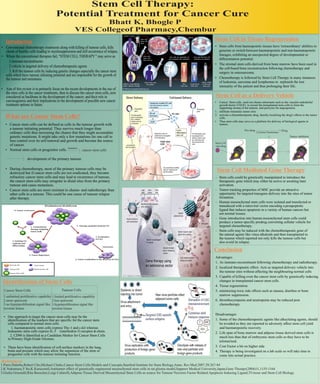
What are Cancer Stem Cells?
• Cancer stem cells can be defined as cells in the tumour growth with
a tumour initiating potential. They survive much longer than
ordinary cells thus increasing the chance that they might accumulate
genetic mutations. It might take only a few mutations for one cell to
lose control over its self-renewal and growth and become the source
of cancer.
• Normal stem cells or progenitor cells
development of the primary tumour.
• During chemotherapy, most of the primary tumour cells may be
destroyed but if cancer stem cells are not eradicated, they become
refractory cancer stem cells and may lead to recurrence of tumour,
the cancer stem cells may emigrate to distal sites from the primary
tumour and cause metastasis.
• Cancer stem cells are more resistant to chemo- and radiotherapy than
other cells in a tumour. This could be one cause of tumour relapse
after therapy.
cancer stem cells
mutation
Identification of Stem Cells
Cancer Stem Cells Tumour Cells
1.unlimited proliferative capability
2.more quiescent
3.no hyperproliferation signal like
tyrosine kinase
1.limited proliferative capability
2.less quiescent
3.hyperproliferation signal like
tyrosine kinase
• One approach to target the cancer stem cells may be the
identification of the markers that are specific for the cancer stem
cells compared to normal stem cells
1. haematopoietic stem cells express Thy-1 and c-kit whereas
leukaemic stem cells express IL-3 (interleukin-3) receptor a-chain.
2. CD90 is Identified as a Candidate Marker for Cancer Stem Cells
in Primary High-Grade Gliomas.
• There have been identification of cell-surface markers in the lung,
brain and prostate which may allow the separation of the stem or
progenitor cells with the tumour initiating function.
• Stem cells from haemopoietic tissues have 'extraordinary' abilities to
generate or switch between haematopoietic and non-haematopoietic
lineages, exhibiting an unexpected degree of developmental or
differentiation potential.
• The stromal stem cells derived from bone marrow have been used in
the cell-based bone reconstruction following chemotherapy and
surgery in osteosarcoma.
• Chemotherapy is followed by Stem Cell Therapy in many instances
of leukemia, sarcomas and lymphomas to replenish the lost
immunity of the patient and thus prolonging their life.
Stem Cell in Tissue Regeneration
• Cancer Stem cells send out chemo-attractants such as the vascular endothelial
growth factor (VEGF) to recruit the transplanted stem cells to form the
supporting stroma of the tumour, and pericytes for angiogenesis.
1. infiltrate metastatic tumor sites
2. activate a chemotherapeutic drug, thereby localizing the drug's effects to the tumor
cells.
• Thus stem cells may serve as a platform for delivery of biological agents in
tumors.
Stem Cell as a Delivery Vehicle
Stem Cell
+pro-drug
Cytosine Deaminase
Pro-drug Drug
Tumor inhibited
– Stem cells could be genetically manipulated to introduce the
therapeutic gene which may either be active or awaiting later
activation.
– Tumor tracking properties of MSC provide an attractive
opportunity for targeted transgene delivery into the sites of tumor
formation.
– Human mesenchymal stem cells were isolated and transfected or
transduced with a retroviral vector encoding a proapoptotic
ligand that induces apoptosis in a variety of human cancers but
not normal tissues.
– Gene introduction into human mesenchymal stem cells could
produce a tumor-specific prodrug converting cellular vehicle for
targeted chemotherapy.
– Stem cells may be induced with the chemotherapeutic gene of
the natural agents like vinca alkaloids and then transplanted in
the tumour which reported not only kills the tumour cells but
also avoid its relapse.
Stem Cell Mediated Gene Therapy
Advantages
1. As immuno-reconstituent following chemotherapy and radiotherapy.
2. localized therapeutic effect- Acts as targeted delivery vehicle into
the tumour sites without affecting the neighbouring normal cells
3. Capable of killing even the cancer stem cells by genetically inducing
changes in transplanted cancer stem cells.
4. Tissue regeneration
5. minimizing toxic side effects such as nausea, diarrhea or bone
marrow suppression.
6. thrombocytopenia and neutropenia may be reduced post
chemotherapy
Disadvantages
1. Some of the chemotherapeutic agents like alkaylating agents, should
be avoided as they are reported to adversely affect stem cell yield
and haematopoietic recovery.
2. Life span of bone marrow and adipose tissue derived stem cells is
much less than that of embryonic stem cells so they have to be
telomerised.
3. Cost Factor a bit on higher side
4. Therapy is being investigated on a lab scale so will take time to
come into actual practice.
Conclusion
References
1.Piera Dalerba,Robert Cho,Michael Clarke,Cancer Stem Cells:Models and Concepts,Stanford Institute for Stem Biology,Annu. Rev.Med.2007,58:267-84
2.K Nakamura,Y Ito,K Kuruzomil,Antitumor effect of genetically engineered mesenchymal stem cells in rat glioma model,Sapporo Medical University,Japan,Gene Therapy(2004)11,1155-1164
3.Giulia Grisendil,Rita Bussolari,Luigi Cafarelli,Adipose Tissue Derived Mesenchymal Stem Cells as source for Tumour Necrosis Factor Related Apoptosis Inducing Ligand,TUmour and Stem Cell Biology

stem cell poster final

  • 1.
    Stem Cell Therapy: PotentialTreatment for Cancer Cure Bhatt K, Bhogle P VES Collegeof Pharmacy,Chembur Introduction • Conventional chemotherapy treatments along with killing of tumour cells, kills chunk of healthy cells leading to myelosuppression and still occurrence of relapse. • Where the conventional therapies fail, “STEM CELL THERAPY” may serve as 1.immuno-reconstituents 2.vehicle in targeted delivery of chemotherapeutic agents 3. Kill the tumour cells by inducing genetic changes especially the cancer stem cells which have tumour initiating potential and are responsible for the growth of the tumour and metastasis. • Aim of this review is to primarily focus on the recent developments in the use of the stem cells in the cancer treatments, then to discuss the cancer stem cells, now considered as backbone in the development of the cancer; and their role in carcinogenesis and their implications in the development of possible new cancer treatment options in future. What are Cancer Stem Cells? • Cancer stem cells can be defined as cells in the tumour growth with a tumour initiating potential. They survive much longer than ordinary cells thus increasing the chance that they might accumulate genetic mutations. It might take only a few mutations for one cell to lose control over its self-renewal and growth and become the source of cancer. • Normal stem cells or progenitor cells development of the primary tumour. • During chemotherapy, most of the primary tumour cells may be destroyed but if cancer stem cells are not eradicated, they become refractory cancer stem cells and may lead to recurrence of tumour, the cancer stem cells may emigrate to distal sites from the primary tumour and cause metastasis. • Cancer stem cells are more resistant to chemo- and radiotherapy than other cells in a tumour. This could be one cause of tumour relapse after therapy. cancer stem cells mutation Identification of Stem Cells Cancer Stem Cells Tumour Cells 1.unlimited proliferative capability 2.more quiescent 3.no hyperproliferation signal like tyrosine kinase 1.limited proliferative capability 2.less quiescent 3.hyperproliferation signal like tyrosine kinase • One approach to target the cancer stem cells may be the identification of the markers that are specific for the cancer stem cells compared to normal stem cells 1. haematopoietic stem cells express Thy-1 and c-kit whereas leukaemic stem cells express IL-3 (interleukin-3) receptor a-chain. 2. CD90 is Identified as a Candidate Marker for Cancer Stem Cells in Primary High-Grade Gliomas. • There have been identification of cell-surface markers in the lung, brain and prostate which may allow the separation of the stem or progenitor cells with the tumour initiating function. • Stem cells from haemopoietic tissues have 'extraordinary' abilities to generate or switch between haematopoietic and non-haematopoietic lineages, exhibiting an unexpected degree of developmental or differentiation potential. • The stromal stem cells derived from bone marrow have been used in the cell-based bone reconstruction following chemotherapy and surgery in osteosarcoma. • Chemotherapy is followed by Stem Cell Therapy in many instances of leukemia, sarcomas and lymphomas to replenish the lost immunity of the patient and thus prolonging their life. Stem Cell in Tissue Regeneration • Cancer Stem cells send out chemo-attractants such as the vascular endothelial growth factor (VEGF) to recruit the transplanted stem cells to form the supporting stroma of the tumour, and pericytes for angiogenesis. 1. infiltrate metastatic tumor sites 2. activate a chemotherapeutic drug, thereby localizing the drug's effects to the tumor cells. • Thus stem cells may serve as a platform for delivery of biological agents in tumors. Stem Cell as a Delivery Vehicle Stem Cell +pro-drug Cytosine Deaminase Pro-drug Drug Tumor inhibited – Stem cells could be genetically manipulated to introduce the therapeutic gene which may either be active or awaiting later activation. – Tumor tracking properties of MSC provide an attractive opportunity for targeted transgene delivery into the sites of tumor formation. – Human mesenchymal stem cells were isolated and transfected or transduced with a retroviral vector encoding a proapoptotic ligand that induces apoptosis in a variety of human cancers but not normal tissues. – Gene introduction into human mesenchymal stem cells could produce a tumor-specific prodrug converting cellular vehicle for targeted chemotherapy. – Stem cells may be induced with the chemotherapeutic gene of the natural agents like vinca alkaloids and then transplanted in the tumour which reported not only kills the tumour cells but also avoid its relapse. Stem Cell Mediated Gene Therapy Advantages 1. As immuno-reconstituent following chemotherapy and radiotherapy. 2. localized therapeutic effect- Acts as targeted delivery vehicle into the tumour sites without affecting the neighbouring normal cells 3. Capable of killing even the cancer stem cells by genetically inducing changes in transplanted cancer stem cells. 4. Tissue regeneration 5. minimizing toxic side effects such as nausea, diarrhea or bone marrow suppression. 6. thrombocytopenia and neutropenia may be reduced post chemotherapy Disadvantages 1. Some of the chemotherapeutic agents like alkaylating agents, should be avoided as they are reported to adversely affect stem cell yield and haematopoietic recovery. 2. Life span of bone marrow and adipose tissue derived stem cells is much less than that of embryonic stem cells so they have to be telomerised. 3. Cost Factor a bit on higher side 4. Therapy is being investigated on a lab scale so will take time to come into actual practice. Conclusion References 1.Piera Dalerba,Robert Cho,Michael Clarke,Cancer Stem Cells:Models and Concepts,Stanford Institute for Stem Biology,Annu. Rev.Med.2007,58:267-84 2.K Nakamura,Y Ito,K Kuruzomil,Antitumor effect of genetically engineered mesenchymal stem cells in rat glioma model,Sapporo Medical University,Japan,Gene Therapy(2004)11,1155-1164 3.Giulia Grisendil,Rita Bussolari,Luigi Cafarelli,Adipose Tissue Derived Mesenchymal Stem Cells as source for Tumour Necrosis Factor Related Apoptosis Inducing Ligand,TUmour and Stem Cell Biology