SCT60103
Genes & Tissue Culture Technology
Group 2 Presentation
BY: JASLYN CHONG CHAI LIN, LIM PO YEE (JAMIE), ON JIANENG (JAYDEN),
SALLY PEH CHEN WOON, WONG BEI WEN (AMANDA).
Question:
A normal cell can be transformed into a cancerous cell.
Discuss the therapeutic strategies that are employed to
target the cellular transformation process for cancer
prevention and treatment.
Introduction
CELLULAR
TRANSFORMATION
“..Genetic material in the form of “naked” deoxyribonucleic
acid (DNA) is transferred between microbial cells… the change
in an animal cell invaded by a tumour-inducing virus ”
(Promeet 2009)
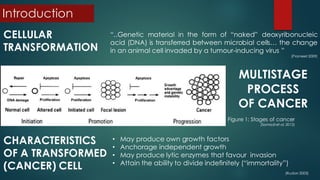
MULTISTAGE
PROCESS
OF CANCER
Figure 1: Stages of cancer
(Samadi et al. 2012)
CHARACTERISTICS
OF A TRANSFORMED
(CANCER) CELL
• May produce own growth factors
• Anchorage independent growth
• May produce lytic enzymes that favour invasion
• Attain the ability to divide indefinitely (“immortality”)
(Rudon 2003)
Therapeutic strategies that are employed to target
the cellular transformation process for cancer treatment
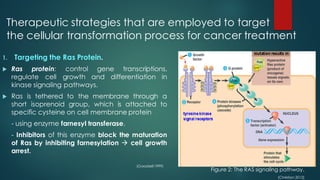
1. Targeting the Ras Protein.
u Ras protein: control gene transcriptions,
regulate cell growth and differentiation in
kinase signaling pathways.
u Ras is tethered to the membrane through a
short isoprenoid group, which is attached to
specific cysteine on cell membrane protein
- using enzyme farnesyl transferase.
- Inhibitors of this enzyme block the maturation
of Ras by inhibiting farnesylation à cell growth
arrest.
Figure 2: The RAS signaling pathway.
(Christian 2012)
(Goodsell 1999)
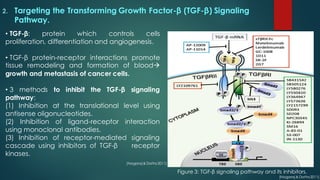
2. Targeting the Transforming Growth Factor-β (TGF-β) Signaling
Pathway.
• TGF-β: protein which controls cells
proliferation, differentiation and angiogenesis.
• TGF-β protein-receptor interactions promote
tissue remodeling and formation of bloodà
growth and metastasis of cancer cells.
• 3 methods to inhibit the TGF-β signaling
pathway:
(1) Inhibition at the translational level using
antisense oligonucleotides.
(2) Inhibition of ligand-receptor interaction
using monoclonal antibodies.
(3) Inhibition of receptor-mediated signaling
cascade using inhibitors of TGF-β receptor
kinases.
Figure 3: TGF-β signaling pathway and its inhibitors.
(Nagaraj & Datta2011)
3. Gene therapy strategies to correct/eliminate cancer cells.
(a) Manipulating cells to gain or lose function, for example:
u Mutated p53 protein interferes ability of cancer cells to self-destruct by apoptosis.
- Introduction of normal p53 gene makes cancer cells more sensitive to chemotherapy and radiation
treatments.
(b) Gene silencing
u Inhibit specific gene expression which are over expressed in cancer cells.
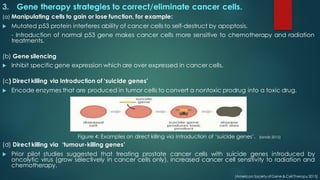
(c) Direct killing via Introduction of ‘suicide genes’
u Encode enzymes that are produced in tumor cells to convert a nontoxic prodrug into a toxic drug.
(d) Direct killing via ‘tumour-killing genes’
u Prior pilot studies suggested that treating prostate cancer cells with suicide genes introduced by
oncolytic virus (grow selectively in cancer cells only), increased cancer cell sensitivity to radiation and
chemotherapy.
(American Society ofGene & Cell Therapy 2015)
Figure 4: Examples on direct killing via Introduction of ‘suicide genes’. (laraib 2015)
4. Cellular Immune Therapy
u The immune system is suppose to recognize and
kill precancerous cells as well early cancer cells.
u Cancer : results in large part from an immune-
evasive adaptive response to the cancer
microenvironment
- inhibit natural eradication of cancer cells.
u 3 types of cell immune therapy:
(1) Infusing cells that give rise to a new immune
system (to recognize and kill cancer cells)
(2) Direct infusion of immune cells such as T cells
and NK cells (to find, recognize, and kill cancer
cells directly).
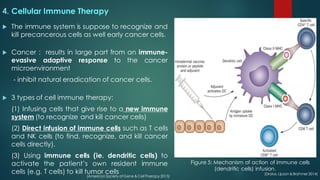
(3) Using immune cells (ie. dendritic cells) to
activate the patient’s own resident immune
cells (e.g. T cells) to kill tumor cells
Figure 5: Mechanism of action of immune cells
(dendritic cells) infusion.
(Drake, Lipson & Brahmer 2014)
(American Society ofGene & Cell Therapy 2015)
Challenges on Therapeutic Strategies
on Cancer Treatment.
In the preclinical models, the
farnesyl transferase inhibitors
showed great potency against
cancer cells; but not in clinical
studies. Why?
(1) Understanding of defective
pathway are mainly focused
on H-Ras activation, but
activation of other farnesylated
proteins might have more vital
roles in tumorigenesis.
(2) Inhibition of farnesylation is
possibly not sufficient,
geranylgeranylation might
activate K-Ras & suppress
effect of farnesyl transferase
inhibitors.
More detailed understandings on TGF-β
pathway are needed as TGF-β signaling
have dual role properties in oncogenesis.
- Recent discovery that TGF-β signaling also regulates microRNA
expression has pointed out a new path toward yet another
unexplored territory of TGF-β research.
The ability of investigators to
generate sufficient function
and number of cells for cell
therapy.
In gene therapy, a normal gene
must be delivered to a large number
of correctcells, and remain being
activated as cells can shut down
genes that are exhibiting unusual
behaviors.
(Goodsell 1999)
(Nagaraj & Datta2011)
(American Society ofGene & Cell Therapy 2015)
Implications of the Cancer Stem
Cell Hypothesis
u Resistance to Therapy
u Several cancer stem cells resistant to both radiation therapy and chemotherapy due to intrinsic
properties (eg. slow cycling rate, increased drug efflux pumps) that are protecting them.
u Tumor Heterogeneity
u The less heterogenic the tumor is, the greater the therapeutic success rate.
u No tumor is expected completely homogeneous.
u Tumor arose from transformed stem cell à heterogeneous cell lineages, genotypically different, more
difficult to treat
u Tumor arose from transformed epithelial cell à phenotypically and genotypically similar, but
mutation might occur randomly.
u Tumor Detection
u Most cancers are detected once they are palpable.
(Maund andCramer 2010)
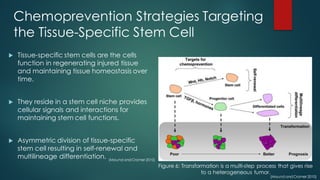
Chemoprevention Strategies Targeting
the Tissue-Specific Stem Cell
u Tissue-specific stem cells are the cells
function in regenerating injured tissue
and maintaining tissue homeostasis over
time.
u They reside in a stem cell niche provides
cellular signals and interactions for
maintaining stem cell functions.
u Asymmetric division of tissue-specific
stem cell resulting in self-renewal and
multilineage differentiation.
Figure 6: Transformation is a multi-step process that gives rise
to a heterogeneous tumor.
(Maund andCramer 2010)
Dietary Chemopreventative Agents
u Sulforaphane, a natural compound derived from cruciferous vegetables such as
broccoli.
u Inhibit breast cancer stem cell growth in vitro and in vivo through inhibition of Wnt-
regulated self-renewal.
u Specifically targeted the cancer stem/progenitor cell population (tissue-specific
stem cell) rather than the bulk tumor cells.
u Vitamin D3, prevention of breast, prostate, colon, and ovarian cancers.
u Vitamin D3 induces senescence on a variety of stem/progenitor cells.
u Induces G1 and G2 arrest.
u Genistein (a soy derivative) works synergistically with Vitamin D3 to inhibit growth of
cancer cells, and it also regulates genes involved in stem cell self-renewal.
(Maund andCramer 2010)
Dietary Chemopreventative Agents
u Curcumin, a polyphenol derivative of tumeric
u Inhibit Wnt signalling in mammary stem cells and eventually inhibit the self-renewal
capability of cells.
u Chemopreventative agent for breast and colon cancers
u Quercetin and Epigallocetechin-galleate (EGCG) are polyphenol compounds in
apples and green tea, respectively.
u Both possess antioxidant and anti-inflammatory properties
u Inhibit the self-renewal capacity by inhibiting Wnt and Hedgehog signalling in colon,
breast, and prostate cancer cells
(Maund andCramer 2010)
Reference
American Society of Gene & Cell Therapy 2015,Cancer Gene Therapy and Cell Therapy, viewed 18 Apr 2016,<http://www.asgct.org/general-
public/educational-resources/gene-therapy-and-cell-therapy-for-diseases/cancer-gene-and-cell-therapy>.
Breathing new life into immunotherapy: review of melanoma, lung and kidney cancer
Drake, CG, Lipson, EJ, & Brahmer, JR 2014,‘Breathing new life into immunotherapy: review of melanoma, lung and kidney cancer’, Nature Reviews Clinical
Oncology , vol. 11, pp. 24–37.
Christian, H 2012, ‘Ras gene’, The Biology Anthology, viewed 20 Apr 2016,< http://apbioanthology.blogspot.my/2012/12/ras-gene.html>.
Goodsell, DS 1999,‘The Molecular Perspective: The ras Oncogene’, The Oncologist, vol. 4, no. 3, pp. 263-264.
Laraib, I 2015,Gene therapy, viewed 18 Apr 2016,< http://www.slideshare.net/IqraLaraib/gene-therapy-55940351>.
Maund, S. and Cramer, S. 2010,The Tissue-Specific Stem Cell as a Target for Chemoprevention. Stem Cell Rev and Rep, 7(2), pp.307-314.
Nagaraj, NS & Datta, PK 2011, ‘Targeting the Transforming Growth Factor-β Signaling Pathway in Human Cancer’, Expert Opin Investig Drugs, vol. 19, no. 1, pp.
77–91.
Promeet, D 2009, Transformation, Encyclopedia Britannica, viewed 21 April 2016,<http://global.britannica.com/science/transformation-biology>.
Ruddon RW 2003,What Makes a Cancer Cell a Cancer Cell, Holland-Frei Cancer Medicine, viewed 21 April 2016,<Available from:
http://www.ncbi.nlm.nih.gov/books/NBK12516/>.
Sahadi, F, Gupta, J, Singh, A, Kabiraj, A, Khan, N., Mahendra, A & Sengupta, A 2012,CHEMICAL CARCINOGENESIS: A BRIEF REVIEW,Your Health, viewed 20
April 2016,<https://yourhealthofima.wordpress.com/2012/09/08/che mical-carcinogenesis-a-brief-review/>.
Thank You J

SCT60103 Group 2 Presentation

  • 1.
    SCT60103 Genes & TissueCulture Technology Group 2 Presentation BY: JASLYN CHONG CHAI LIN, LIM PO YEE (JAMIE), ON JIANENG (JAYDEN), SALLY PEH CHEN WOON, WONG BEI WEN (AMANDA).
  • 2.
    Question: A normal cellcan be transformed into a cancerous cell. Discuss the therapeutic strategies that are employed to target the cellular transformation process for cancer prevention and treatment.
  • 3.
    Introduction CELLULAR TRANSFORMATION “..Genetic material inthe form of “naked” deoxyribonucleic acid (DNA) is transferred between microbial cells… the change in an animal cell invaded by a tumour-inducing virus ” (Promeet 2009) MULTISTAGE PROCESS OF CANCER Figure 1: Stages of cancer (Samadi et al. 2012) CHARACTERISTICS OF A TRANSFORMED (CANCER) CELL • May produce own growth factors • Anchorage independent growth • May produce lytic enzymes that favour invasion • Attain the ability to divide indefinitely (“immortality”) (Rudon 2003)
  • 4.
    Therapeutic strategies thatare employed to target the cellular transformation process for cancer treatment 1. Targeting the Ras Protein. u Ras protein: control gene transcriptions, regulate cell growth and differentiation in kinase signaling pathways. u Ras is tethered to the membrane through a short isoprenoid group, which is attached to specific cysteine on cell membrane protein - using enzyme farnesyl transferase. - Inhibitors of this enzyme block the maturation of Ras by inhibiting farnesylation à cell growth arrest. Figure 2: The RAS signaling pathway. (Christian 2012) (Goodsell 1999)
  • 5.
    2. Targeting theTransforming Growth Factor-β (TGF-β) Signaling Pathway. • TGF-β: protein which controls cells proliferation, differentiation and angiogenesis. • TGF-β protein-receptor interactions promote tissue remodeling and formation of bloodà growth and metastasis of cancer cells. • 3 methods to inhibit the TGF-β signaling pathway: (1) Inhibition at the translational level using antisense oligonucleotides. (2) Inhibition of ligand-receptor interaction using monoclonal antibodies. (3) Inhibition of receptor-mediated signaling cascade using inhibitors of TGF-β receptor kinases. Figure 3: TGF-β signaling pathway and its inhibitors. (Nagaraj & Datta2011) (Nagaraj & Datta2011)
  • 6.
    3. Gene therapystrategies to correct/eliminate cancer cells. (a) Manipulating cells to gain or lose function, for example: u Mutated p53 protein interferes ability of cancer cells to self-destruct by apoptosis. - Introduction of normal p53 gene makes cancer cells more sensitive to chemotherapy and radiation treatments. (b) Gene silencing u Inhibit specific gene expression which are over expressed in cancer cells. (c) Direct killing via Introduction of ‘suicide genes’ u Encode enzymes that are produced in tumor cells to convert a nontoxic prodrug into a toxic drug. (d) Direct killing via ‘tumour-killing genes’ u Prior pilot studies suggested that treating prostate cancer cells with suicide genes introduced by oncolytic virus (grow selectively in cancer cells only), increased cancer cell sensitivity to radiation and chemotherapy. (American Society ofGene & Cell Therapy 2015) Figure 4: Examples on direct killing via Introduction of ‘suicide genes’. (laraib 2015)
  • 7.
    4. Cellular ImmuneTherapy u The immune system is suppose to recognize and kill precancerous cells as well early cancer cells. u Cancer : results in large part from an immune- evasive adaptive response to the cancer microenvironment - inhibit natural eradication of cancer cells. u 3 types of cell immune therapy: (1) Infusing cells that give rise to a new immune system (to recognize and kill cancer cells) (2) Direct infusion of immune cells such as T cells and NK cells (to find, recognize, and kill cancer cells directly). (3) Using immune cells (ie. dendritic cells) to activate the patient’s own resident immune cells (e.g. T cells) to kill tumor cells Figure 5: Mechanism of action of immune cells (dendritic cells) infusion. (Drake, Lipson & Brahmer 2014) (American Society ofGene & Cell Therapy 2015)
  • 8.
    Challenges on TherapeuticStrategies on Cancer Treatment. In the preclinical models, the farnesyl transferase inhibitors showed great potency against cancer cells; but not in clinical studies. Why? (1) Understanding of defective pathway are mainly focused on H-Ras activation, but activation of other farnesylated proteins might have more vital roles in tumorigenesis. (2) Inhibition of farnesylation is possibly not sufficient, geranylgeranylation might activate K-Ras & suppress effect of farnesyl transferase inhibitors. More detailed understandings on TGF-β pathway are needed as TGF-β signaling have dual role properties in oncogenesis. - Recent discovery that TGF-β signaling also regulates microRNA expression has pointed out a new path toward yet another unexplored territory of TGF-β research. The ability of investigators to generate sufficient function and number of cells for cell therapy. In gene therapy, a normal gene must be delivered to a large number of correctcells, and remain being activated as cells can shut down genes that are exhibiting unusual behaviors. (Goodsell 1999) (Nagaraj & Datta2011) (American Society ofGene & Cell Therapy 2015) (American Society ofGene & Cell Therapy 2015)
  • 9.
    Implications of theCancer Stem Cell Hypothesis u Resistance to Therapy u Several cancer stem cells resistant to both radiation therapy and chemotherapy due to intrinsic properties (eg. slow cycling rate, increased drug efflux pumps) that are protecting them. u Tumor Heterogeneity u The less heterogenic the tumor is, the greater the therapeutic success rate. u No tumor is expected completely homogeneous. u Tumor arose from transformed stem cell à heterogeneous cell lineages, genotypically different, more difficult to treat u Tumor arose from transformed epithelial cell à phenotypically and genotypically similar, but mutation might occur randomly. u Tumor Detection u Most cancers are detected once they are palpable. (Maund andCramer 2010)
  • 10.
    Chemoprevention Strategies Targeting theTissue-Specific Stem Cell u Tissue-specific stem cells are the cells function in regenerating injured tissue and maintaining tissue homeostasis over time. u They reside in a stem cell niche provides cellular signals and interactions for maintaining stem cell functions. u Asymmetric division of tissue-specific stem cell resulting in self-renewal and multilineage differentiation. Figure 6: Transformation is a multi-step process that gives rise to a heterogeneous tumor. (Maund andCramer 2010) (Maund andCramer 2010)
  • 11.
    Dietary Chemopreventative Agents uSulforaphane, a natural compound derived from cruciferous vegetables such as broccoli. u Inhibit breast cancer stem cell growth in vitro and in vivo through inhibition of Wnt- regulated self-renewal. u Specifically targeted the cancer stem/progenitor cell population (tissue-specific stem cell) rather than the bulk tumor cells. u Vitamin D3, prevention of breast, prostate, colon, and ovarian cancers. u Vitamin D3 induces senescence on a variety of stem/progenitor cells. u Induces G1 and G2 arrest. u Genistein (a soy derivative) works synergistically with Vitamin D3 to inhibit growth of cancer cells, and it also regulates genes involved in stem cell self-renewal. (Maund andCramer 2010)
  • 12.
    Dietary Chemopreventative Agents uCurcumin, a polyphenol derivative of tumeric u Inhibit Wnt signalling in mammary stem cells and eventually inhibit the self-renewal capability of cells. u Chemopreventative agent for breast and colon cancers u Quercetin and Epigallocetechin-galleate (EGCG) are polyphenol compounds in apples and green tea, respectively. u Both possess antioxidant and anti-inflammatory properties u Inhibit the self-renewal capacity by inhibiting Wnt and Hedgehog signalling in colon, breast, and prostate cancer cells (Maund andCramer 2010)
  • 13.
    Reference American Society ofGene & Cell Therapy 2015,Cancer Gene Therapy and Cell Therapy, viewed 18 Apr 2016,<http://www.asgct.org/general- public/educational-resources/gene-therapy-and-cell-therapy-for-diseases/cancer-gene-and-cell-therapy>. Breathing new life into immunotherapy: review of melanoma, lung and kidney cancer Drake, CG, Lipson, EJ, & Brahmer, JR 2014,‘Breathing new life into immunotherapy: review of melanoma, lung and kidney cancer’, Nature Reviews Clinical Oncology , vol. 11, pp. 24–37. Christian, H 2012, ‘Ras gene’, The Biology Anthology, viewed 20 Apr 2016,< http://apbioanthology.blogspot.my/2012/12/ras-gene.html>. Goodsell, DS 1999,‘The Molecular Perspective: The ras Oncogene’, The Oncologist, vol. 4, no. 3, pp. 263-264. Laraib, I 2015,Gene therapy, viewed 18 Apr 2016,< http://www.slideshare.net/IqraLaraib/gene-therapy-55940351>. Maund, S. and Cramer, S. 2010,The Tissue-Specific Stem Cell as a Target for Chemoprevention. Stem Cell Rev and Rep, 7(2), pp.307-314. Nagaraj, NS & Datta, PK 2011, ‘Targeting the Transforming Growth Factor-β Signaling Pathway in Human Cancer’, Expert Opin Investig Drugs, vol. 19, no. 1, pp. 77–91. Promeet, D 2009, Transformation, Encyclopedia Britannica, viewed 21 April 2016,<http://global.britannica.com/science/transformation-biology>. Ruddon RW 2003,What Makes a Cancer Cell a Cancer Cell, Holland-Frei Cancer Medicine, viewed 21 April 2016,<Available from: http://www.ncbi.nlm.nih.gov/books/NBK12516/>. Sahadi, F, Gupta, J, Singh, A, Kabiraj, A, Khan, N., Mahendra, A & Sengupta, A 2012,CHEMICAL CARCINOGENESIS: A BRIEF REVIEW,Your Health, viewed 20 April 2016,<https://yourhealthofima.wordpress.com/2012/09/08/che mical-carcinogenesis-a-brief-review/>.
  • 14.