STELR is the acronym for Science and Technology Education Leveraging Relevance. 
The STELR Project is a national education initiative of the Australian Academy of 
Technology and Engineering (ATSE). 
The STELR architect was Alan Finkel, now the Chief Scientist of Australia.
The STELR Project is running in over 500 schools from all states and territories with 
50,000 students and over 1,500 teachers involved each year. 
To date, STELR has benefitted over 130,000 students. 
See video at
https://www.youtube.com/watch?v=tCFUfUEiEqs
1
What is STELR?
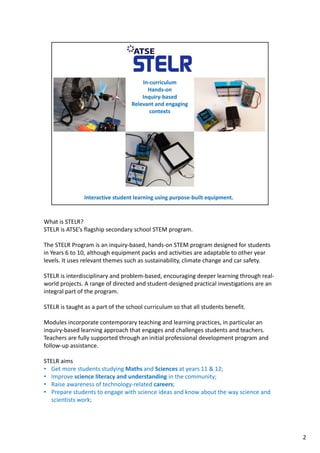
STELR is ATSE’s flagship secondary school STEM program.
The STELR Program is an inquiry‐based, hands‐on STEM program designed for students 
in Years 6 to 10, although equipment packs and activities are adaptable to other year 
levels. It uses relevant themes such as sustainability, climate change and car safety. 
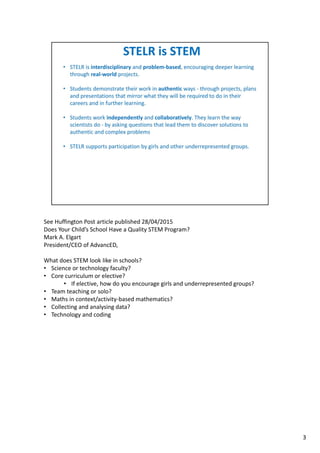
STELR is interdisciplinary and problem‐based, encouraging deeper learning through real‐
world projects. A range of directed and student‐designed practical investigations are an 
integral part of the program.
STELR is taught as a part of the school curriculum so that all students benefit.
Modules incorporate contemporary teaching and learning practices, in particular an 
inquiry‐based learning approach that engages and challenges students and teachers. 
Teachers are fully supported through an initial professional development program and 
follow‐up assistance. 
STELR aims
• Get more students studying Maths and Sciences at years 11 & 12;
• Improve science literacy and understanding in the community;
• Raise awareness of technology‐related careers;
• Prepare students to engage with science ideas and know about the way science and 
scientists work;
2
• Make students aware of science and engineering careers; and
• Improve the quality of science classroom teaching practice.
2
See Huffington Post article published 28/04/2015
Does Your Child’s School Have a Quality STEM Program?
Mark A. Elgart 
President/CEO of AdvancED, 
What does STEM look like in schools?
• Science or technology faculty?
• Core curriculum or elective?
• If elective, how do you encourage girls and underrepresented groups?
• Team teaching or solo?
• Maths in context/activity‐based mathematics?
• Collecting and analysing data?
• Technology and coding
3
STELR is built on four pillars
Relevant engaging contexts
• ACARA cross‐curriculum priorities
• Sustainability
• Asia and Australia’s Engagement with Asia
• Aboriginal and Torres Strait Islander Histories and Cultures
• Climate change
• Renewable energy
• Sustainable Housing
• Water
Curriculum
• In curriculum rather than extra‐curricular
• National and state
• Science
• Science understanding
• Science inquiry‐skills 
• Science as a human endeavour
• Maths
• Design and Technology
Pedagogy
4
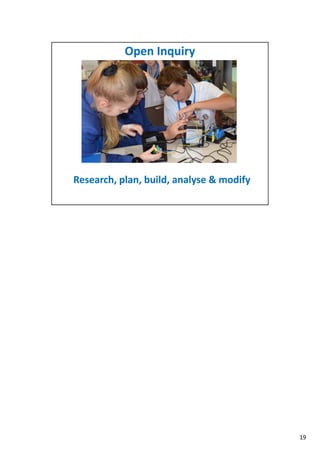
• Inquiry‐based
• Student centred
• Support and training
• Teachers teaching ‘out‐of‐field’
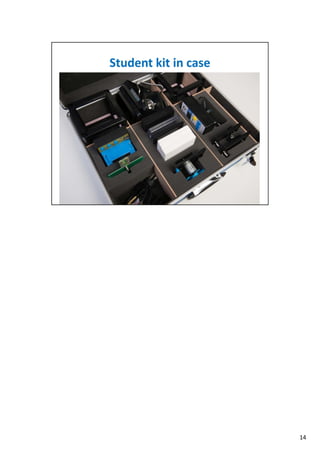
Equipment kits
Hands‐on activities with purpose‐built Australian‐designed and manufactured equipment
• Renewable energy
• Wind
• Solar cars
• Electricity and energy
• Sustainable housing
4
5
6
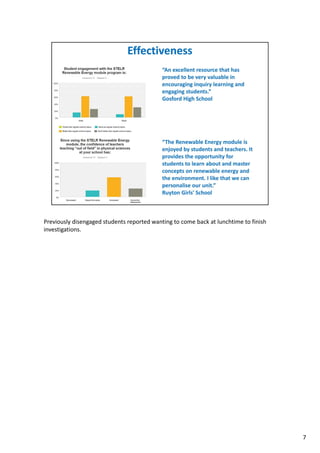
Previously disengaged students reported wanting to come back at lunchtime to finish 
investigations.
7
8
Files for 3D printing are available. Contact STELR.
9
10
11
12
13
14
15
16
17
18
19
20
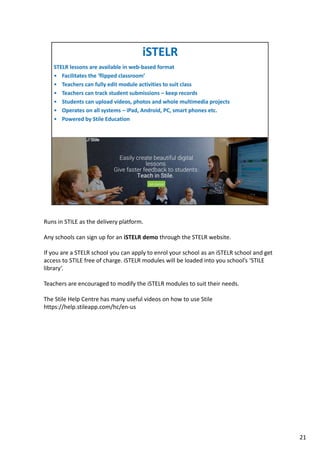
Runs in STILE as the delivery platform. 
Any schools can sign up for an iSTELR demo through the STELR website.
If you are a STELR school you can apply to enrol your school as an iSTELR school and get 
access to STILE free of charge. iSTELR modules will be loaded into you school’s ‘STILE 
library’.
Teachers are encouraged to modify the iSTELR modules to suit their needs.
The Stile Help Centre has many useful videos on how to use Stile 
https://help.stileapp.com/hc/en‐us
21
Contact STELR.Admin@atse.org.au to sign up to an iSTELR demonstration module.
22
23
24

STELR presentation STEM conf with notes