Descriptive Statistics
Descriptive statistics refer to methods for summarizing raw
observations into information that we can understand and share.
Inferential Statistics
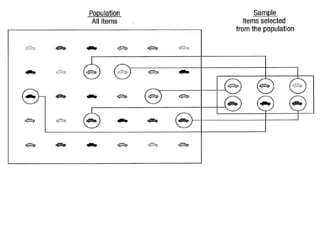
Inferential statistics is a fancy name for methods that aid in
quantifying properties of the domain or population from a smaller set
of obtained observations called a sample.
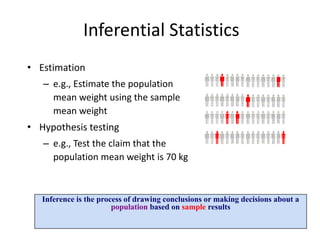
Inferential Statistics
• Estimation
– e.g., Estimate the population
mean weight using the sample
mean weight
• Hypothesis testing
– e.g., Test the claim that the
population mean weight is 70 kg
Inference is the process of drawing conclusions or making decisions about a
population based on sample results
Descriptive Statistics
• Collect data
– e.g., Survey
• Present data
– e.g., Tables and graphs
• Summarize data
– e.g., Sample mean =
iX
n

Why study statistics?
1. Data are everywhere
2. Statistical techniques are used to make many decisions
that affect our lives
3. No matter what your career, you will make professional
decisions that involve data. An understanding of
statistical methods will help you make these decisions
efectively
Applications of statistical concepts
• Finance – correlation and regression, index
numbers, time series analysis
• Marketing – hypothesis testing, chi-square
tests, nonparametric statistics
• Personel – hypothesis testing, chi-square
tests, nonparametric tests
• Operating management – hypothesis
testing, estimation, analysis of variance,
time series analysis
Statistical data
 The collection of data that are relevant to the problem being studied
is commonly the most difficult, expensive, and time-consuming part
of the entire research project.
 Statistical data are usually obtained by counting or measuring items.
 Primary data are collected specifically for the analysis desired
 Secondary data have already been compiled and are available for
statistical analysis
 A variable is an item of interest that can take on many different
numerical values.
 A constant has a fixed numerical value.
A reputed online tutor, Maja Kazazic has
working as a teacher for a number of years
now. He provides tutorship mainly in subjects
like accounting, finance, management and
marketing. His teaching methods are unique
and innovative. He works hard to make sure
every student excels under her tutelage. He
has also written several academic blogs at
https://helpmeinhomework.com/help-with-statistics-assignment/
For More Info Visit :

Statistics homework help

  • 2.
    Descriptive Statistics Descriptive statisticsrefer to methods for summarizing raw observations into information that we can understand and share. Inferential Statistics Inferential statistics is a fancy name for methods that aid in quantifying properties of the domain or population from a smaller set of obtained observations called a sample.
  • 4.
    Inferential Statistics • Estimation –e.g., Estimate the population mean weight using the sample mean weight • Hypothesis testing – e.g., Test the claim that the population mean weight is 70 kg Inference is the process of drawing conclusions or making decisions about a population based on sample results
  • 5.
    Descriptive Statistics • Collectdata – e.g., Survey • Present data – e.g., Tables and graphs • Summarize data – e.g., Sample mean = iX n 
  • 6.
    Why study statistics? 1.Data are everywhere 2. Statistical techniques are used to make many decisions that affect our lives 3. No matter what your career, you will make professional decisions that involve data. An understanding of statistical methods will help you make these decisions efectively
  • 7.
    Applications of statisticalconcepts • Finance – correlation and regression, index numbers, time series analysis • Marketing – hypothesis testing, chi-square tests, nonparametric statistics • Personel – hypothesis testing, chi-square tests, nonparametric tests • Operating management – hypothesis testing, estimation, analysis of variance, time series analysis
  • 8.
    Statistical data  Thecollection of data that are relevant to the problem being studied is commonly the most difficult, expensive, and time-consuming part of the entire research project.  Statistical data are usually obtained by counting or measuring items.  Primary data are collected specifically for the analysis desired  Secondary data have already been compiled and are available for statistical analysis  A variable is an item of interest that can take on many different numerical values.  A constant has a fixed numerical value.
  • 9.
    A reputed onlinetutor, Maja Kazazic has working as a teacher for a number of years now. He provides tutorship mainly in subjects like accounting, finance, management and marketing. His teaching methods are unique and innovative. He works hard to make sure every student excels under her tutelage. He has also written several academic blogs at https://helpmeinhomework.com/help-with-statistics-assignment/ For More Info Visit :