Statistical method suitable for the
analysis of plant breeding
Biotechnology
Presented by
Sumit Kumar Pradhan (26499220007)
Ruchisman Ghosh (26499220024)
M.Sc. Biotechnology; 1st Semester; Paper Code – MSBT 181
S.V.I.M.S.
Plant Breeding and its Objectives
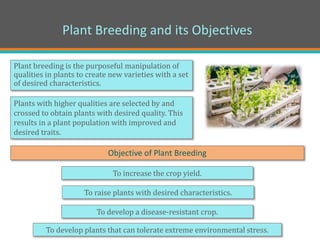
Plant breeding is the purposeful manipulation of
qualities in plants to create new varieties with a set
of desired characteristics.
Plants with higher qualities are selected by and
crossed to obtain plants with desired quality. This
results in a plant population with improved and
desired traits.
Objective of Plant Breeding
To increase the crop yield.
To raise plants with desired characteristics.
To develop a disease-resistant crop.
To develop plants that can tolerate extreme environmental stress.
Types of Plant Breeding
Genetic Engineering : Genetic engineering helps in producing crops with desirable
traits by inserting the gene of interest within the crop DNA. Such crops are known
as genetically modified crops. E.g., Bt crops
Backcrossing : In this, a plant with desired traits is crossed with a plant that does
not have the desired traits but has several other traits.
Inbreeding : In this, self-fertilization occurs. The progeny produced is the same
generation after generation. This helps to preserve the original traits.
Hybrid Breeding : In this, two different breeds are crossed to produce the offspring
that is more productive than the parents.
Mutation Breeding : The mutations in plant genes result in new varieties. Mutations
can also be induced in plants by exposing them to chemicals and radiation.
Plant Breeding Steps
The plant breeding methods have undergone multiple amendments since it was
started from 9000 – 11000 years ago. The modern method of plant breeding is
carried out in the following steps -
Collection of Variability :
Variability forms the root of all breeding practices. The first step involves
the collection of plants or seeds for all possible alleles for all genes in a
given crop, which is known as germplasm. This collection even involves
wild varieties and relatives of the cultivated species.
Evaluation and Selection of Parent Plants :
The germplasm is evaluated for selection of parent plants with desired
characteristics. The combination of these characteristics is expected in
the hybrid progeny.
For example, a plant crop with high protein content can be selected to be
crossed with a plant with higher disease resistance.
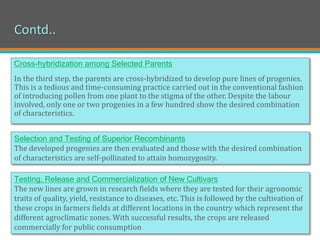
Contd..
Cross-hybridization among Selected Parents
In the third step, the parents are cross-hybridized to develop pure lines of progenies.
This is a tedious and time-consuming practice carried out in the conventional fashion
of introducing pollen from one plant to the stigma of the other. Despite the labour
involved, only one or two progenies in a few hundred show the desired combination
of characteristics.
Selection and Testing of Superior Recombinants
The developed progenies are then evaluated and those with the desired combination
of characteristics are self-pollinated to attain homozygosity.
Testing, Release and Commercialization of New Cultivars
The new lines are grown in research fields where they are tested for their agronomic
traits of quality, yield, resistance to diseases, etc. This is followed by the cultivation of
these crops in farmers fields at different locations in the country which represent the
different agroclimatic zones. With successful results, the crops are released
commercially for public consumption
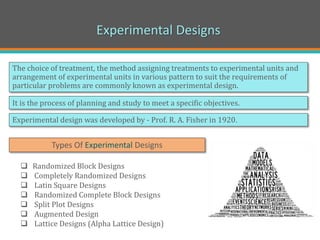
Experimental Designs
The choice of treatment, the method assigning treatments to experimental units and
arrangement of experimental units in various pattern to suit the requirements of
particular problems are commonly known as experimental design.
 Randomized Block Designs
 Completely Randomized Designs
 Latin Square Designs
 Randomized Complete Block Designs
 Split Plot Designs
 Augmented Design
 Lattice Designs (Alpha Lattice Design)
Experimental design was developed by - Prof. R. A. Fisher in 1920.
Types Of Experimental Designs
It is the process of planning and study to meet a specific objectives.
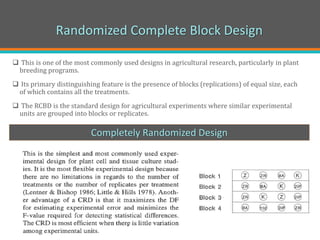
Randomized Complete Block Design
 This is one of the most commonly used designs in agricultural research, particularly in plant
breeding programs.
 Its primary distinguishing feature is the presence of blocks (replications) of equal size, each
of which contains all the treatments.
 The RCBD is the standard design for agricultural experiments where similar experimental
units are grouped into blocks or replicates.
Completely Randomized Design
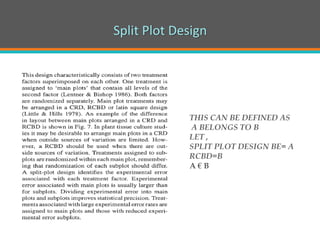
Split Plot Design
THIS CAN BE DEFINED AS
A BELONGS TO B
LET ,
SPLIT PLOT DESIGN BE= A
RCBD=B
A € B
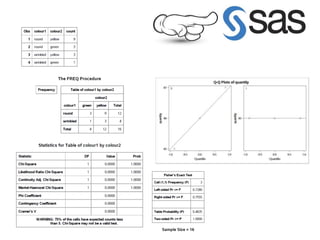
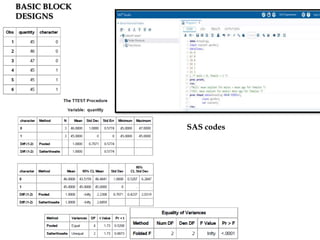
SAS codes
BASIC BLOCK
DESIGNS
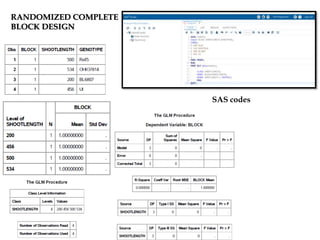
RANDOMIZED COMPLETE
BLOCK DESIGN
SAS codes
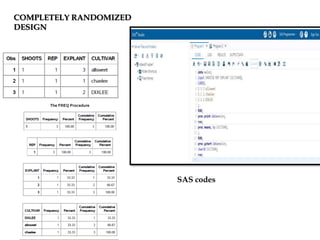
COMPLETELY RANDOMIZED
DESIGN
SAS codes
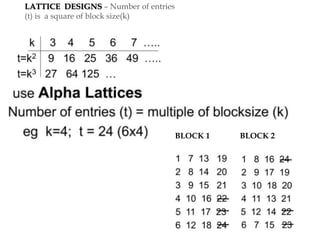
LATTICE DESIGNS – Number of entries
(t) is a square of block size(k)
BLOCK 1 BLOCK 2
Statistical method suitable for the analysis of plant breeding

Statistical method suitable for the analysis of plant breeding

  • 1.
    Statistical method suitablefor the analysis of plant breeding Biotechnology Presented by Sumit Kumar Pradhan (26499220007) Ruchisman Ghosh (26499220024) M.Sc. Biotechnology; 1st Semester; Paper Code – MSBT 181 S.V.I.M.S.
  • 2.
    Plant Breeding andits Objectives Plant breeding is the purposeful manipulation of qualities in plants to create new varieties with a set of desired characteristics. Plants with higher qualities are selected by and crossed to obtain plants with desired quality. This results in a plant population with improved and desired traits. Objective of Plant Breeding To increase the crop yield. To raise plants with desired characteristics. To develop a disease-resistant crop. To develop plants that can tolerate extreme environmental stress.
  • 3.
    Types of PlantBreeding Genetic Engineering : Genetic engineering helps in producing crops with desirable traits by inserting the gene of interest within the crop DNA. Such crops are known as genetically modified crops. E.g., Bt crops Backcrossing : In this, a plant with desired traits is crossed with a plant that does not have the desired traits but has several other traits. Inbreeding : In this, self-fertilization occurs. The progeny produced is the same generation after generation. This helps to preserve the original traits. Hybrid Breeding : In this, two different breeds are crossed to produce the offspring that is more productive than the parents. Mutation Breeding : The mutations in plant genes result in new varieties. Mutations can also be induced in plants by exposing them to chemicals and radiation.
  • 4.
    Plant Breeding Steps Theplant breeding methods have undergone multiple amendments since it was started from 9000 – 11000 years ago. The modern method of plant breeding is carried out in the following steps - Collection of Variability : Variability forms the root of all breeding practices. The first step involves the collection of plants or seeds for all possible alleles for all genes in a given crop, which is known as germplasm. This collection even involves wild varieties and relatives of the cultivated species. Evaluation and Selection of Parent Plants : The germplasm is evaluated for selection of parent plants with desired characteristics. The combination of these characteristics is expected in the hybrid progeny. For example, a plant crop with high protein content can be selected to be crossed with a plant with higher disease resistance.
  • 5.
    Contd.. Cross-hybridization among SelectedParents In the third step, the parents are cross-hybridized to develop pure lines of progenies. This is a tedious and time-consuming practice carried out in the conventional fashion of introducing pollen from one plant to the stigma of the other. Despite the labour involved, only one or two progenies in a few hundred show the desired combination of characteristics. Selection and Testing of Superior Recombinants The developed progenies are then evaluated and those with the desired combination of characteristics are self-pollinated to attain homozygosity. Testing, Release and Commercialization of New Cultivars The new lines are grown in research fields where they are tested for their agronomic traits of quality, yield, resistance to diseases, etc. This is followed by the cultivation of these crops in farmers fields at different locations in the country which represent the different agroclimatic zones. With successful results, the crops are released commercially for public consumption
  • 6.
    Experimental Designs The choiceof treatment, the method assigning treatments to experimental units and arrangement of experimental units in various pattern to suit the requirements of particular problems are commonly known as experimental design.  Randomized Block Designs  Completely Randomized Designs  Latin Square Designs  Randomized Complete Block Designs  Split Plot Designs  Augmented Design  Lattice Designs (Alpha Lattice Design) Experimental design was developed by - Prof. R. A. Fisher in 1920. Types Of Experimental Designs It is the process of planning and study to meet a specific objectives.
  • 7.
    Randomized Complete BlockDesign  This is one of the most commonly used designs in agricultural research, particularly in plant breeding programs.  Its primary distinguishing feature is the presence of blocks (replications) of equal size, each of which contains all the treatments.  The RCBD is the standard design for agricultural experiments where similar experimental units are grouped into blocks or replicates. Completely Randomized Design
  • 8.
    Split Plot Design THISCAN BE DEFINED AS A BELONGS TO B LET , SPLIT PLOT DESIGN BE= A RCBD=B A € B
  • 10.
  • 11.
  • 12.
  • 13.
    LATTICE DESIGNS –Number of entries (t) is a square of block size(k) BLOCK 1 BLOCK 2