PROBLEM STATEMENT
-------
What, Why, How?
Dr. Muhammad Ilyas Khan
Problem Statement: What?
• A combination of two words: Problem and
Statement
• A Problem Statement or statement of the
problem is a brief and concise account, a
declaration or a report of the problem or
issue that is being investigated in a research
study.
• Generally, a part of research theses or
research proposals
Dr. Muhammad Ilyas Khan
Problem Statement: Why?
• Problem Statement is part of the
research report to give an initial and
concise insight into the issue or the
problem being investigated.
• What is the issue or problem?
• What is its background?
• Why is the issue being investigated?
• Brief knowledge gap identification
Dr. Muhammad Ilyas Khan
Problem Statement: How?
• Generally, three parts
• Brief background ( a few sentences to a
paragraph, depending on the scope of the
study/nature of report)
• Gap-Identification (What is missing in our
understanding of the issue or problem? Why is
this study needed?)
• Aims of the current study (The ‘what’, ‘why’,
and ‘how’ of the current study)
• A few sentences to a few paragraphs
Dr. Muhammad Ilyas Khan
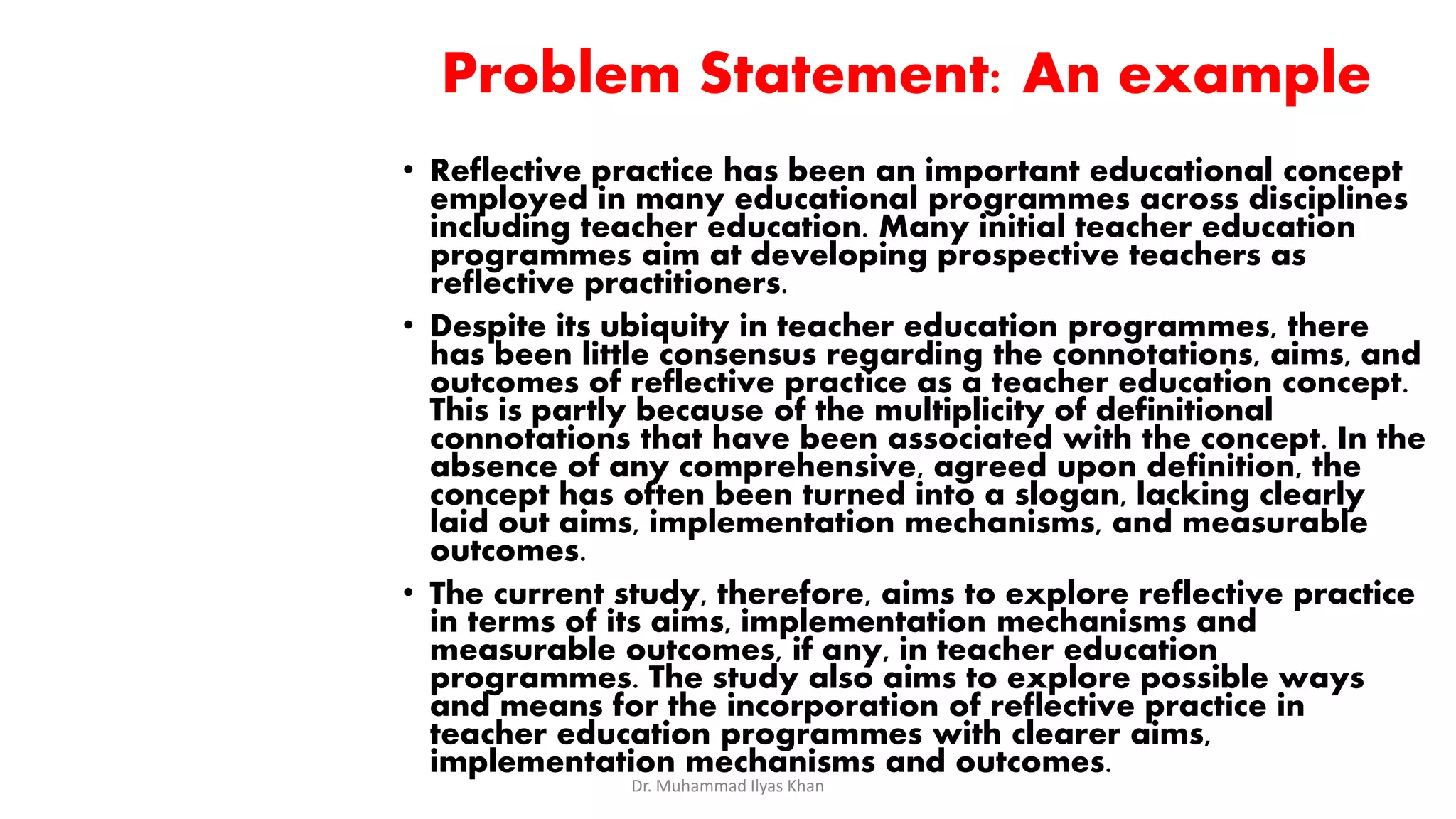
Problem Statement: An example
• Reflective practice has been an important educational concept
employed in many educational programmes across disciplines
including teacher education. Many initial teacher education
programmes aim at developing prospective teachers as
reflective practitioners.
• Despite its ubiquity in teacher education programmes, there
has been little consensus regarding the connotations, aims, and
outcomes of reflective practice as a teacher education concept.
This is partly because of the multiplicity of definitional
connotations that have been associated with the concept. In the
absence of any comprehensive, agreed upon definition, the
concept has often been turned into a slogan, lacking clearly
laid out aims, implementation mechanisms, and measurable
outcomes.
• The current study, therefore, aims to explore reflective practice
in terms of its aims, implementation mechanisms and
measurable outcomes, if any, in teacher education
programmes. The study also aims to explore possible ways
and means for the incorporation of reflective practice in
teacher education programmes with clearer aims,
implementation mechanisms and outcomes.
Dr. Muhammad Ilyas Khan

Statement of problem

  • 1.
    PROBLEM STATEMENT ------- What, Why,How? Dr. Muhammad Ilyas Khan Dr. Muhammad Ilyas Khan
  • 2.
    Problem Statement: What? •A combination of two words: Problem and Statement • A Problem Statement or statement of the problem is a brief and concise account, a declaration or a report of the problem or issue that is being investigated in a research study. • Generally, a part of research theses or research proposals Dr. Muhammad Ilyas Khan
  • 3.
    Problem Statement: Why? •Problem Statement is part of the research report to give an initial and concise insight into the issue or the problem being investigated. • What is the issue or problem? • What is its background? • Why is the issue being investigated? • Brief knowledge gap identification Dr. Muhammad Ilyas Khan
  • 4.
    Problem Statement: How? •Generally, three parts • Brief background ( a few sentences to a paragraph, depending on the scope of the study/nature of report) • Gap-Identification (What is missing in our understanding of the issue or problem? Why is this study needed?) • Aims of the current study (The ‘what’, ‘why’, and ‘how’ of the current study) • A few sentences to a few paragraphs Dr. Muhammad Ilyas Khan
  • 5.
    Problem Statement: Anexample • Reflective practice has been an important educational concept employed in many educational programmes across disciplines including teacher education. Many initial teacher education programmes aim at developing prospective teachers as reflective practitioners. • Despite its ubiquity in teacher education programmes, there has been little consensus regarding the connotations, aims, and outcomes of reflective practice as a teacher education concept. This is partly because of the multiplicity of definitional connotations that have been associated with the concept. In the absence of any comprehensive, agreed upon definition, the concept has often been turned into a slogan, lacking clearly laid out aims, implementation mechanisms, and measurable outcomes. • The current study, therefore, aims to explore reflective practice in terms of its aims, implementation mechanisms and measurable outcomes, if any, in teacher education programmes. The study also aims to explore possible ways and means for the incorporation of reflective practice in teacher education programmes with clearer aims, implementation mechanisms and outcomes. Dr. Muhammad Ilyas Khan