Study Purpose, Problem
statement and aim
Prepared by :-
PhD student :-
Ms. Taghreed H Hawsawi
Under Supervision
Prof. Zeinab Hussein Ali
Introduction
Writing a clear problem statement in research helps
the reader to understand the purpose of the study
more clearly. However, writing a clear problem
statement still becomes an issue. As a result, the
reader unable to understand what is the purpose of
the research. Hence, this innovation aims to develop
a statement of problem template on how to write a
clear problem statement. Through this template,
researchers may be able to have better guidelines
on developing a clearer problem statement.
(Smith et al., 2021)
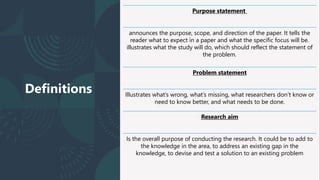
Definitions
Purpose statement
announces the purpose, scope, and direction of the paper. It tells the
reader what to expect in a paper and what the specific focus will be.
illustrates what the study will do, which should reflect the statement of
the problem.
Problem statement
Illustrates what’s wrong, what’s missing, what researchers don’t know or
need to know better, and what needs to be done.
Research aim
Is the overall purpose of conducting the research. It could be to add to
the knowledge in the area, to address an existing gap in the
knowledge, to devise and test a solution to an existing problem
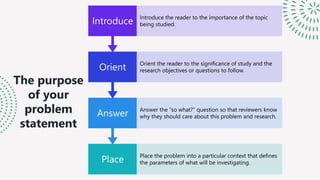
The purpose
of your
problem
statement
Place Place the problem into a particular context that defines
the parameters of what will be investigating.
Answer Answer the “so what?” question so that reviewers know
why they should care about this problem and research.
Orient Orient the reader to the significance of study and the
research objectives or questions to follow.
Introduce Introduce the reader to the importance of the topic
being studied.
Research Problems Statement Types
1-PRACTICAL RESEARCH
PROBLEMS
2- THEORETICAL RESEARCH
PROBLEMS
1-Practical research problems:-
For practical research, focus on the concrete details of the
situation:
● WHERE AND WHEN DOES THE
PROBLEM ARISE?
● WHO DOES THE PROBLEM
AFFECT?
● WHAT ATTEMPTS HAVE BEEN
MADE TO SOLVE THE PROBLEM?
2-Theoretical research problems:-
For theoretical research, think about the scientific, social,
geographical and/or historical background:
● What is already known about
the problem?
● Is the problem limited to a
certain time period or
geographical area?
● How has the problem been
defined and debated in the
scholarly literature?
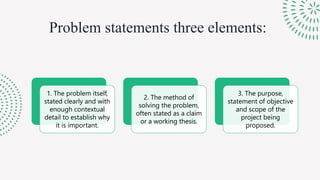
Problem statements three elements:
1. The problem itself,
stated clearly and with
enough contextual
detail to establish why
it is important.
2. The method of
solving the problem,
often stated as a claim
or a working thesis.
3. The purpose,
statement of objective
and scope of the
project being
proposed.
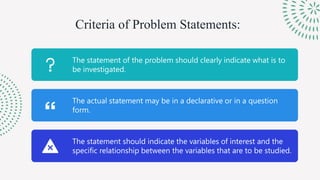
Criteria of Problem Statements:
The statement of the problem should clearly indicate what is to
be investigated.
The actual statement may be in a declarative or in a question
form.
The statement should indicate the variables of interest and the
specific relationship between the variables that are to be studied.
Research aim:
• It should be written in definite
statement such as (the purpose of this
study is).
• The purpose identifies the research
variables and population.
• It is worded appropriately.
• It is associated with research
objectives and hypothesis.
Special
consideration
when writing
research aim
1. Is the framework presented with clarity?
2. Is the framework specified? Is a particular theory or model identified
as a framework for the study?
3. Does the framework "fit" the problem? Include all relevant variables?
4. Is the framework linked to the research purpose?
5. If a map or model is presented, is it adequate to explain the
phenomenon of concern?
6. Would another framework fit more logically with the study?
7. Are the concepts adequately defined in way that is consistent with
the theory?
8. Do the problem and hypothesis naturally flow from the framework?
9. Note: qualitative research, descriptive studies, and physiologic
studies, typically will not have a theoretical framework.

Problem statement (tati).pptx

  • 1.
    Study Purpose, Problem statementand aim Prepared by :- PhD student :- Ms. Taghreed H Hawsawi Under Supervision Prof. Zeinab Hussein Ali
  • 2.
    Introduction Writing a clearproblem statement in research helps the reader to understand the purpose of the study more clearly. However, writing a clear problem statement still becomes an issue. As a result, the reader unable to understand what is the purpose of the research. Hence, this innovation aims to develop a statement of problem template on how to write a clear problem statement. Through this template, researchers may be able to have better guidelines on developing a clearer problem statement. (Smith et al., 2021)
  • 3.
    Definitions Purpose statement announces thepurpose, scope, and direction of the paper. It tells the reader what to expect in a paper and what the specific focus will be. illustrates what the study will do, which should reflect the statement of the problem. Problem statement Illustrates what’s wrong, what’s missing, what researchers don’t know or need to know better, and what needs to be done. Research aim Is the overall purpose of conducting the research. It could be to add to the knowledge in the area, to address an existing gap in the knowledge, to devise and test a solution to an existing problem
  • 4.
    The purpose of your problem statement PlacePlace the problem into a particular context that defines the parameters of what will be investigating. Answer Answer the “so what?” question so that reviewers know why they should care about this problem and research. Orient Orient the reader to the significance of study and the research objectives or questions to follow. Introduce Introduce the reader to the importance of the topic being studied.
  • 5.
    Research Problems StatementTypes 1-PRACTICAL RESEARCH PROBLEMS 2- THEORETICAL RESEARCH PROBLEMS
  • 6.
    1-Practical research problems:- Forpractical research, focus on the concrete details of the situation: ● WHERE AND WHEN DOES THE PROBLEM ARISE? ● WHO DOES THE PROBLEM AFFECT? ● WHAT ATTEMPTS HAVE BEEN MADE TO SOLVE THE PROBLEM?
  • 7.
    2-Theoretical research problems:- Fortheoretical research, think about the scientific, social, geographical and/or historical background: ● What is already known about the problem? ● Is the problem limited to a certain time period or geographical area? ● How has the problem been defined and debated in the scholarly literature?
  • 8.
    Problem statements threeelements: 1. The problem itself, stated clearly and with enough contextual detail to establish why it is important. 2. The method of solving the problem, often stated as a claim or a working thesis. 3. The purpose, statement of objective and scope of the project being proposed.
  • 9.
    Criteria of ProblemStatements: The statement of the problem should clearly indicate what is to be investigated. The actual statement may be in a declarative or in a question form. The statement should indicate the variables of interest and the specific relationship between the variables that are to be studied.
  • 10.
    Research aim: • Itshould be written in definite statement such as (the purpose of this study is). • The purpose identifies the research variables and population. • It is worded appropriately. • It is associated with research objectives and hypothesis.
  • 11.
    Special consideration when writing research aim 1.Is the framework presented with clarity? 2. Is the framework specified? Is a particular theory or model identified as a framework for the study? 3. Does the framework "fit" the problem? Include all relevant variables? 4. Is the framework linked to the research purpose? 5. If a map or model is presented, is it adequate to explain the phenomenon of concern? 6. Would another framework fit more logically with the study? 7. Are the concepts adequately defined in way that is consistent with the theory? 8. Do the problem and hypothesis naturally flow from the framework? 9. Note: qualitative research, descriptive studies, and physiologic studies, typically will not have a theoretical framework.