CDC
                         State of Wellness


             Wendy Heaps MPH, CHES.
                    Senior Advisor
 Policy Research, Analysis, and Development Office
      Office of the Associate Director for Policy
             Office of the Director, CDC
                    wah9@cdc.gov


Office of the Director
Office of the Associate Director for Policy
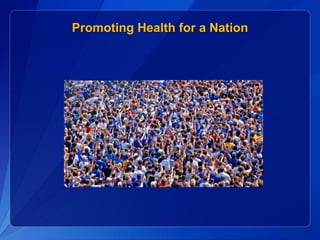
Promoting Health for a Nation
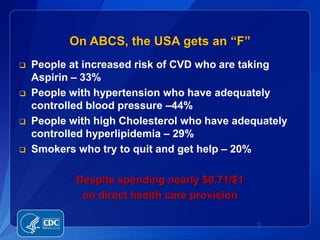
On ABCS, the USA gets an “F”
   People at increased risk of CVD who are taking
    Aspirin – 33%
   People with hypertension who have adequately
    controlled blood pressure –44%
   People with high Cholesterol who have adequately
    controlled hyperlipidemia – 29%
   Smokers who try to quit and get help – 20%

            Despite spending nearly $0.71/$1
             on direct health care provision

                                               3
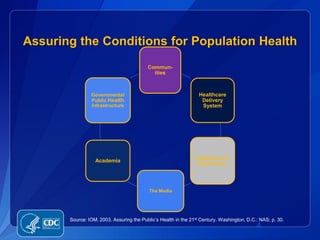
Assuring the Conditions for Population Health
                                          Commun-
                                            ities


                Governmental                                      Healthcare
                Public Health                                      Delivery
                Infrastructure                                     System


                                                                Employers &
                  Academia
                                                                Businesses


                                           The Media


       Source: IOM. 2003. Assuring the Public’s Health in the 21st Century. Washington, D.C.: NAS; p. 30.
                                                                                            4
Employers
• 143 million full- and part- time workers
• Employees spend most of their day at the
  workplace
• Employer based health insurance provided
  coverage to 159 million Americans (63.4% of
  those under age 65) in 2003
• Employers pay for 36% of the nation’s
  healthcare expenditures
• Over half of employers with 500+ employees
  offer some sort of wellness program
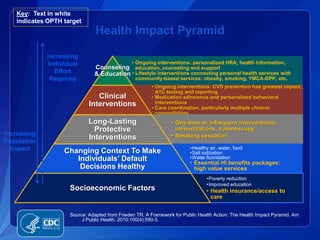
Key: Text in white
   indicates OPTH target
                                Health Impact Pyramid
             Increasing
              Individual                        • Ongoing interventions: personalized HRA, health information,
                               Counseling education, counseling and support
                Effort         & Education • Lifestyle interventions connecting personal health services with
               Required                          community-based services: obesity, smoking, YMCA-DPP, etc.
                                                        • Ongoing interventions: CVD prevention has greatest impact,
                                                          A1C testing and reporting
                                Clinical                • Medication adherence and personalized behavioral
                             Interventions                interventions
                                                        • Care coordination, particularly multiple chronic
                                                          comordibities
                             Long-Lasting                        • One-time or infrequent interventions:
                               Protective                          immunizations, colonoscopy
Increasing                                                       • Smoking cessation
Population
                             Interventions
  Impact                                                                 •Healthy air, water, food
                   Changing Context To Make                              •Salt iodization
                      Individuals’ Default                               •Water fluoridation
                                                                         • Essential HI benefits packages:
                       Decisions Healthy                                   high value services
                                                                                •Poverty reduction
                                                                                •Improved education
                     Socioeconomic Factors                                      • Health insurance/access to
                                                                                  care


                     Source: Adapted from Frieden TR. A Framework for Public Health Action: The Health Impact Pyramid. Am
                          J Public Health. 2010;100(4):590-5.
Affordable Care Act: Pillars of Prevention

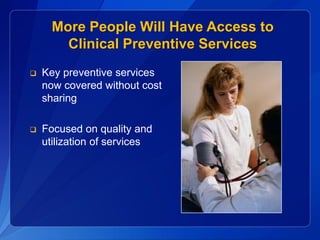
   Key preventive services now covered without cost
    sharing

   Prevention and Public Health Fund

   Public health policies and programs

   National Prevention Council/National Prevention Strategy
More People Will Have Access to
        Clinical Preventive Services
   Key preventive services
    now covered without cost
    sharing

   Focused on quality and
    utilization of services
The National Prevention Council

   Established by the Affordable Care Act

   A unique opportunity to prioritize and align
    prevention activities

   Chaired by the Surgeon General
   Council members: 17 federal departments

   Advisory Group: 25 non-federal members
National Prevention Strategy
   Ground activities in evidence-based practices
   Set specific actions and timelines
   Align and focus federal prevention and health promotion
    activities
   Align with existing strategies and initiatives, including:
       Healthy People 2020
       National Quality Strategy
       First Lady’s “Let’s Move!” campaign
       Surgeon General’s Vision for a Healthy and Fit Nation 2010
       National HIV/AIDS Strategy
Key Deliverables

   The National Prevention and Health Promotion Strategy

   Ongoing leadership and coordination of federal
    prevention activities

   Annual status report
Approach
   Work across sectors

   Catalyze public and private partnerships
     Federal, state, local, territorial, and tribal
     Private, nonprofit, faith, community, labor

   Focus on where people live, learn, work, and play
     Community, worksite, institutions, etc.

   Prioritize scalable activities
Examples of National Prevention Strategy:
              Guiding Principles
Strategic Interventions:

   Focus on preventing leading causes of death and their
    underlying risk factors

   Prioritize high impact, evidence-based, scalable
    interventions

   Promote high value preventive care practices
Examples of National Prevention Strategy:
              Guiding Principles
Maximize Impact:

   Establish a cohesive federal response

   Promote alignment between the public and private
    sectors:

    – Federal, state, local, territorial, and tribal

    – Private, nonprofit, faith, community, labor

   Obtain stakeholder input
Draft Strategic Directions
 Active Lifestyles       High Impact Quality
                           Clinical Preventive
 Eliminate Health         Services
  Disparities
                          Injury-Free Living
 Counter Alcohol/
  Substance Misuse        Mental and Emotional
                           Wellbeing
 Healthy Eating
                          Strong Public Health
 Healthy Physical and     Infrastructure
  Social Environment
                          Tobacco-Free Living
Draft Strategic Directions: Purpose
   Creates a structure from which to develop specific
    recommendations and actions.

   Establishes priorities that best prevent the leading
    causes of death and disease.

   Serves as a guide to assist policymakers, practitioners,
    and communities in focusing prevention and wellness
    activities.
National Prevention Strategy:
      We Welcome Your Continued Input.


             To provide input, go to:
http://www.healthcare.gov/nationalpreventioncouncil
Winnable Battles
   Healthcare-associated infections (HAIs)
   HIV
   Motor vehicle injuries
   Obesity/Nutrition/Physical Activity/Food Safety
   Teen pregnancy
   Tobacco


                                                18
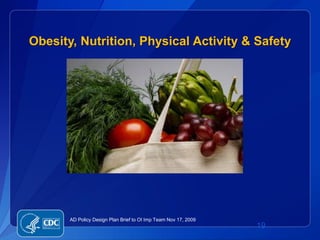
Obesity, Nutrition, Physical Activity & Safety


       AD Policy Design Plan Brief to OI Imp Team Nov 17, 2009
                                                                 19
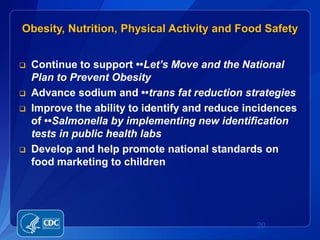
Obesity, Nutrition, Physical Activity and Food Safety


   Continue to support ••Let’s Move and the National
    Plan to Prevent Obesity
   Advance sodium and ••trans fat reduction strategies
   Improve the ability to identify and reduce incidences
    of ••Salmonella by implementing new identification
    tests in public health labs
   Develop and help promote national standards on
    food marketing to children


                                                20
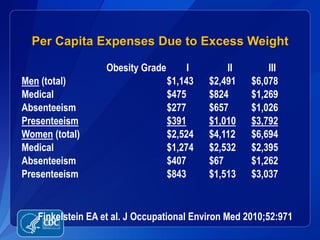
Per Capita Expenses Due to Excess Weight

                   Obesity Grade        I       II       III
Men (total)                        $1,143   $2,491   $6,078
Medical                            $475     $824     $1,269
Absenteeism                        $277     $657     $1,026
Presenteeism                       $391     $1,010   $3,792
Women (total)                      $2,524   $4,112   $6,694
Medical                            $1,274   $2,532   $2,395
Absenteeism                        $407     $67      $1,262
Presenteeism                       $843     $1,513   $3,037


   Finkelstein EA et al. J Occupational Environ Med 2010;52:971
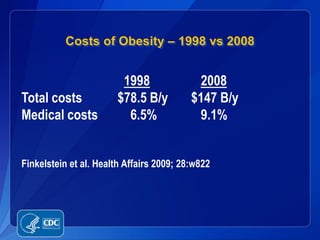
Costs of Obesity – 1998 vs 2008


                        1998               2008
Total costs            $78.5 B/y          $147 B/y
Medical costs            6.5%              9.1%


Finkelstein et al. Health Affairs 2009; 28:w822
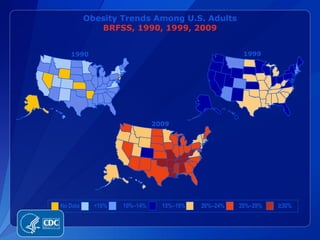
Obesity Trends Among U.S. Adults
             BRFSS, 1990, 1999, 2009


   1990                                             1999


                             2009


No Data     <10%   10%–14%     15%–19%   20%–24%   25%–29%   ≥30%
Principal Targets
Pregnancy: pre-pregnant weight, weight gain, diabetes,
  smoking
Reduce energy intake
  Decrease high and increase low ED foods
  Increase fruit and vegetable intake
  Reduce sugar-sweetened beverages
  Decrease television time
Breastfeeding
Increase energy expenditure
  Increase daily physical activity
Priority Strategies to Address Target
              Behaviors
Energy density
        Apply nutrition standards in child care and schools
        Promote menu labeling in states and communities
        Increase retail food stores in underserved areas
Fruits and vegetables
        Increase access through retail stores
        Farm to where you are policies
        Food policy councils
Sugar-sweetened beverages
        Ensure access to safe and good tasting water
        Limit access
        Differential pricing strategies
Priority Strategies to Address Target Behaviors
  Television viewing
          Regulations to limit TV time in child care settings
          Limit food advertising directed at children
  Breastfeeding
          Policies and environmental supports in maternity care
          Policy and environmental supports in worksites
          State and national coalitions to support breastfeeding
  Physical activity
          Community-wide campaigns
          Increase access with informational outreach
          Increase opportunities for PA in school settings

                 Resource: Breastfeeding Report Card,
        http://www.cdc.gov/breastfeeding/data/reportcard.htm
Breastfeeding in the Workplace
   Providing education for parents-to-be on the
    importance of breastfeeding
   Providing support to new mothers after delivery with
    unlimited phone counseling with a lactation
    consultant
   Meeting the needs of mothers returning to work by
    providing a return-to-work consultation and a
    lactation room
   Equipment at the worksite that will allow mothers to
    continue supplying the important nutritional benefits
    of breast milk
                                                       
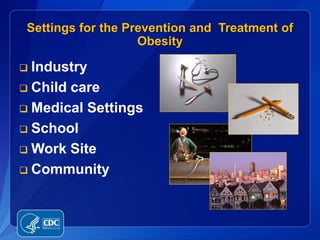
Settings for the Prevention and Treatment of
                    Obesity

 Industry
 Child care

 Medical Settings

 School

 Work Site

 Community
29
Tobacco Cessation


                    31
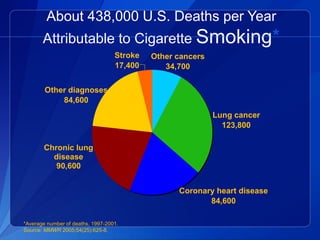
About 438,000 U.S. Deaths per Year
       Attributable to Cigarette Smoking*
                                   Stroke   Other cancers
                                   17,400      34,700

        Other diagnoses
            84,600
                                                            Lung cancer
                                                              123,800

       Chronic lung
         disease
          90,600


                                                  Coronary heart disease
                                                         84,600

*Average number of deaths, 1997-2001.
Source: MMWR 2005;54(25):625-8.
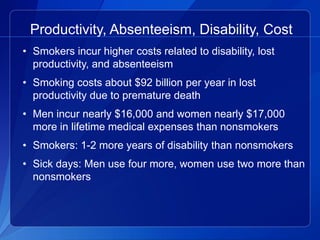
Productivity, Absenteeism, Disability, Cost
• Smokers incur higher costs related to disability, lost
  productivity, and absenteeism
• Smoking costs about $92 billion per year in lost
  productivity due to premature death
• Men incur nearly $16,000 and women nearly $17,000
  more in lifetime medical expenses than nonsmokers
• Smokers: 1-2 more years of disability than nonsmokers
• Sick days: Men use four more, women use two more than
  nonsmokers
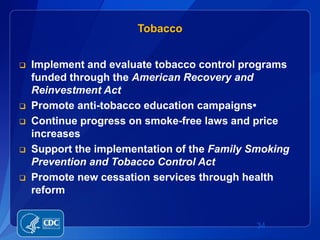
Tobacco


   Implement and evaluate tobacco control programs
    funded through the American Recovery and
    Reinvestment Act
   Promote anti-tobacco education campaigns•
   Continue progress on smoke-free laws and price
    increases
   Support the implementation of the Family Smoking
    Prevention and Tobacco Control Act
   Promote new cessation services through health
    reform


                                             34
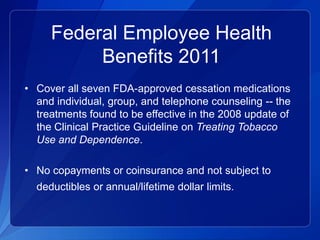
Federal Employee Health
          Benefits 2011
• Cover all seven FDA-approved cessation medications
  and individual, group, and telephone counseling -- the
  treatments found to be effective in the 2008 update of
  the Clinical Practice Guideline on Treating Tobacco
  Use and Dependence.

• No copayments or coinsurance and not subject to
  deductibles or annual/lifetime dollar limits.
Case Study: CDC’s Tobacco Free
            Campus Initiative
• Significant policy change in 2005
   • Completely smoke free
     campuses, indoors and out
• Collaboration of health promotion,
  clinical, EAP staff and “quit-lines”
• Personal quit plan, free nicotine
  replacement
• Support for multiple quit attempts
• Link annually with the Great
  American Smokeout®


                                         36
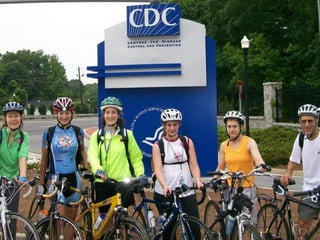
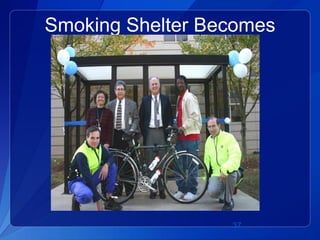
Smoking Shelter Becomes
 Covered Bike Parking


                  37
Policy Horizons: Does Your Organization Have
               These in Place?
   Tobacco-free campus or worksite
   Flexible work/schedule policies
      parental/dependent care
   Nutritious foods-at-meetings policy
   Healthy transportation policies
   Smoke-free meetings policy
   Time during work hours for wellness activities
      Physical activity
      Training or educational opportunities, health fairs,
       events
      Screenings, health coaching, EAP
Does Your Built Environment Allow Health to
                      Thrive?
   Safe, hazard-free workplace
   Welcoming, user-friendly workspaces
   Stairs, walkways, paths, trails that are safe and
    inviting
   Onsite food choices that make eating healthier easy
   Lactation rooms
   Transportation and parking options that enhance
    health
   Onsite or nearby health clinic or access to
    healthcare providers
   Fitness facilities or opportunities for physical
    activity
                                               39
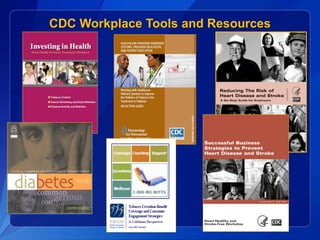
CDC Workplace Tools and Resources
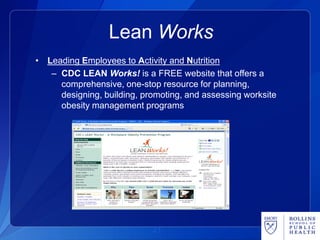
Lean Works
• Leading Employees to Activity and Nutrition
   – CDC LEAN Works! is a FREE website that offers a
     comprehensive, one-stop resource for planning,
     designing, building, promoting, and assessing worksite
     obesity management programs


                             41
                            41
Federal Initiatives
Let’s Move
        Empower parents
        Healthier foods in schools
        Physical activity
        Access to affordable healthy food
Childhood Obesity Task Force
HHS Healthy Weight Task Force
National Action Plan for Physical Activity
Dietary Guidelines for Americans
Communities Putting Prevention to Work (CPPW)
Child Nutrition Reauthorization
Surgeon General’s Call to Action on Breastfeeding
FTC Guidelines for Foods Marketed to Children
National Prevention, Health Promotion and Public Health Council
Resources
   www.cdc.gov/workplacehealthpromotion
   www.cdc.gov/workplacehealthpromotion/healthtopic
    s/index.html
   Webber A, Mercure S. Improving population health:
    the business community imperative. Prev Chronic
    Dis 2010;7(6).
    www.cdc.gov/pcd/issues/2010/nov/10_0086.htm.
   www.cdc.gov/communitiesputtingpreventiontowork
   http://www.healthcare.gov/nationalpreventioncouncil
Acknowledgements
   Pam Allweiss , National Center for Chronic Disease
    Prevention and Health Promotion , CDC
   Casey Chosewood National Institute for
    Occupational Safety and Health CDC
   Jason Lang, National Center for Chronic Disease
    Prevention and Health Promotion , CDC
   Lydia Ogden, Office of Prevention Through
    Healthcare, CDC
   Abby Rosenthal, National Center for Chornic
    Disease Prevention and Health Promotion , CDC
Thank You!

  Questions?
  Comments?

Contact information :
 WHeaps@CDC.Gov

State of Wellness - CDC

  • 1.
    CDC State of Wellness Wendy Heaps MPH, CHES. Senior Advisor Policy Research, Analysis, and Development Office Office of the Associate Director for Policy Office of the Director, CDC wah9@cdc.gov Office of the Director Office of the Associate Director for Policy
  • 2.
  • 3.
    On ABCS, theUSA gets an “F”  People at increased risk of CVD who are taking Aspirin – 33%  People with hypertension who have adequately controlled blood pressure –44%  People with high Cholesterol who have adequately controlled hyperlipidemia – 29%  Smokers who try to quit and get help – 20% Despite spending nearly $0.71/$1 on direct health care provision 3
  • 4.
    Assuring the Conditionsfor Population Health Commun- ities Governmental Healthcare Public Health Delivery Infrastructure System Employers & Academia Businesses The Media Source: IOM. 2003. Assuring the Public’s Health in the 21st Century. Washington, D.C.: NAS; p. 30. 4
  • 5.
    Employers • 143 millionfull- and part- time workers • Employees spend most of their day at the workplace • Employer based health insurance provided coverage to 159 million Americans (63.4% of those under age 65) in 2003 • Employers pay for 36% of the nation’s healthcare expenditures • Over half of employers with 500+ employees offer some sort of wellness program
  • 6.
    Key: Text inwhite indicates OPTH target Health Impact Pyramid Increasing Individual • Ongoing interventions: personalized HRA, health information, Counseling education, counseling and support Effort & Education • Lifestyle interventions connecting personal health services with Required community-based services: obesity, smoking, YMCA-DPP, etc. • Ongoing interventions: CVD prevention has greatest impact, A1C testing and reporting Clinical • Medication adherence and personalized behavioral Interventions interventions • Care coordination, particularly multiple chronic comordibities Long-Lasting • One-time or infrequent interventions: Protective immunizations, colonoscopy Increasing • Smoking cessation Population Interventions Impact •Healthy air, water, food Changing Context To Make •Salt iodization Individuals’ Default •Water fluoridation • Essential HI benefits packages: Decisions Healthy high value services •Poverty reduction •Improved education Socioeconomic Factors • Health insurance/access to care Source: Adapted from Frieden TR. A Framework for Public Health Action: The Health Impact Pyramid. Am J Public Health. 2010;100(4):590-5.
  • 7.
    Affordable Care Act:Pillars of Prevention  Key preventive services now covered without cost sharing  Prevention and Public Health Fund  Public health policies and programs  National Prevention Council/National Prevention Strategy
  • 8.
    More People WillHave Access to Clinical Preventive Services  Key preventive services now covered without cost sharing  Focused on quality and utilization of services
  • 9.
    The National PreventionCouncil  Established by the Affordable Care Act  A unique opportunity to prioritize and align prevention activities  Chaired by the Surgeon General  Council members: 17 federal departments  Advisory Group: 25 non-federal members
  • 10.
    National Prevention Strategy  Ground activities in evidence-based practices  Set specific actions and timelines  Align and focus federal prevention and health promotion activities  Align with existing strategies and initiatives, including:  Healthy People 2020  National Quality Strategy  First Lady’s “Let’s Move!” campaign  Surgeon General’s Vision for a Healthy and Fit Nation 2010  National HIV/AIDS Strategy
  • 11.
    Key Deliverables  The National Prevention and Health Promotion Strategy  Ongoing leadership and coordination of federal prevention activities  Annual status report
  • 12.
    Approach  Work across sectors  Catalyze public and private partnerships  Federal, state, local, territorial, and tribal  Private, nonprofit, faith, community, labor  Focus on where people live, learn, work, and play  Community, worksite, institutions, etc.  Prioritize scalable activities
  • 13.
    Examples of NationalPrevention Strategy: Guiding Principles Strategic Interventions:  Focus on preventing leading causes of death and their underlying risk factors  Prioritize high impact, evidence-based, scalable interventions  Promote high value preventive care practices
  • 14.
    Examples of NationalPrevention Strategy: Guiding Principles Maximize Impact:  Establish a cohesive federal response  Promote alignment between the public and private sectors: – Federal, state, local, territorial, and tribal – Private, nonprofit, faith, community, labor  Obtain stakeholder input
  • 15.
    Draft Strategic Directions Active Lifestyles  High Impact Quality Clinical Preventive  Eliminate Health Services Disparities  Injury-Free Living  Counter Alcohol/ Substance Misuse  Mental and Emotional Wellbeing  Healthy Eating  Strong Public Health  Healthy Physical and Infrastructure Social Environment  Tobacco-Free Living
  • 16.
    Draft Strategic Directions:Purpose  Creates a structure from which to develop specific recommendations and actions.  Establishes priorities that best prevent the leading causes of death and disease.  Serves as a guide to assist policymakers, practitioners, and communities in focusing prevention and wellness activities.
  • 17.
    National Prevention Strategy: We Welcome Your Continued Input. To provide input, go to: http://www.healthcare.gov/nationalpreventioncouncil
  • 18.
    Winnable Battles  Healthcare-associated infections (HAIs)  HIV  Motor vehicle injuries  Obesity/Nutrition/Physical Activity/Food Safety  Teen pregnancy  Tobacco 18
  • 19.
    Obesity, Nutrition, PhysicalActivity & Safety AD Policy Design Plan Brief to OI Imp Team Nov 17, 2009 19
  • 20.
    Obesity, Nutrition, PhysicalActivity and Food Safety  Continue to support ••Let’s Move and the National Plan to Prevent Obesity  Advance sodium and ••trans fat reduction strategies  Improve the ability to identify and reduce incidences of ••Salmonella by implementing new identification tests in public health labs  Develop and help promote national standards on food marketing to children 20
  • 21.
    Per Capita ExpensesDue to Excess Weight Obesity Grade I II III Men (total) $1,143 $2,491 $6,078 Medical $475 $824 $1,269 Absenteeism $277 $657 $1,026 Presenteeism $391 $1,010 $3,792 Women (total) $2,524 $4,112 $6,694 Medical $1,274 $2,532 $2,395 Absenteeism $407 $67 $1,262 Presenteeism $843 $1,513 $3,037 Finkelstein EA et al. J Occupational Environ Med 2010;52:971
  • 22.
    Costs of Obesity– 1998 vs 2008 1998 2008 Total costs $78.5 B/y $147 B/y Medical costs 6.5% 9.1% Finkelstein et al. Health Affairs 2009; 28:w822
  • 23.
    Obesity Trends AmongU.S. Adults BRFSS, 1990, 1999, 2009 1990 1999 2009 No Data <10% 10%–14% 15%–19% 20%–24% 25%–29% ≥30%
  • 24.
    Principal Targets Pregnancy: pre-pregnantweight, weight gain, diabetes, smoking Reduce energy intake Decrease high and increase low ED foods Increase fruit and vegetable intake Reduce sugar-sweetened beverages Decrease television time Breastfeeding Increase energy expenditure Increase daily physical activity
  • 25.
    Priority Strategies toAddress Target Behaviors Energy density Apply nutrition standards in child care and schools Promote menu labeling in states and communities Increase retail food stores in underserved areas Fruits and vegetables Increase access through retail stores Farm to where you are policies Food policy councils Sugar-sweetened beverages Ensure access to safe and good tasting water Limit access Differential pricing strategies
  • 26.
    Priority Strategies toAddress Target Behaviors Television viewing Regulations to limit TV time in child care settings Limit food advertising directed at children Breastfeeding Policies and environmental supports in maternity care Policy and environmental supports in worksites State and national coalitions to support breastfeeding Physical activity Community-wide campaigns Increase access with informational outreach Increase opportunities for PA in school settings Resource: Breastfeeding Report Card, http://www.cdc.gov/breastfeeding/data/reportcard.htm
  • 27.
    Breastfeeding in theWorkplace  Providing education for parents-to-be on the importance of breastfeeding  Providing support to new mothers after delivery with unlimited phone counseling with a lactation consultant  Meeting the needs of mothers returning to work by providing a return-to-work consultation and a lactation room  Equipment at the worksite that will allow mothers to continue supplying the important nutritional benefits of breast milk 
  • 28.
    Settings for thePrevention and Treatment of Obesity  Industry  Child care  Medical Settings  School  Work Site  Community
  • 29.
  • 31.
  • 32.
    About 438,000 U.S.Deaths per Year Attributable to Cigarette Smoking* Stroke Other cancers 17,400 34,700 Other diagnoses 84,600 Lung cancer 123,800 Chronic lung disease 90,600 Coronary heart disease 84,600 *Average number of deaths, 1997-2001. Source: MMWR 2005;54(25):625-8.
  • 33.
    Productivity, Absenteeism, Disability,Cost • Smokers incur higher costs related to disability, lost productivity, and absenteeism • Smoking costs about $92 billion per year in lost productivity due to premature death • Men incur nearly $16,000 and women nearly $17,000 more in lifetime medical expenses than nonsmokers • Smokers: 1-2 more years of disability than nonsmokers • Sick days: Men use four more, women use two more than nonsmokers
  • 34.
    Tobacco  Implement and evaluate tobacco control programs funded through the American Recovery and Reinvestment Act  Promote anti-tobacco education campaigns•  Continue progress on smoke-free laws and price increases  Support the implementation of the Family Smoking Prevention and Tobacco Control Act  Promote new cessation services through health reform 34
  • 35.
    Federal Employee Health Benefits 2011 • Cover all seven FDA-approved cessation medications and individual, group, and telephone counseling -- the treatments found to be effective in the 2008 update of the Clinical Practice Guideline on Treating Tobacco Use and Dependence. • No copayments or coinsurance and not subject to deductibles or annual/lifetime dollar limits.
  • 36.
    Case Study: CDC’sTobacco Free Campus Initiative • Significant policy change in 2005 • Completely smoke free campuses, indoors and out • Collaboration of health promotion, clinical, EAP staff and “quit-lines” • Personal quit plan, free nicotine replacement • Support for multiple quit attempts • Link annually with the Great American Smokeout® 36
  • 37.
    Smoking Shelter Becomes Covered Bike Parking 37
  • 38.
    Policy Horizons: DoesYour Organization Have These in Place?  Tobacco-free campus or worksite  Flexible work/schedule policies  parental/dependent care  Nutritious foods-at-meetings policy  Healthy transportation policies  Smoke-free meetings policy  Time during work hours for wellness activities  Physical activity  Training or educational opportunities, health fairs, events  Screenings, health coaching, EAP
  • 39.
    Does Your BuiltEnvironment Allow Health to Thrive?  Safe, hazard-free workplace  Welcoming, user-friendly workspaces  Stairs, walkways, paths, trails that are safe and inviting  Onsite food choices that make eating healthier easy  Lactation rooms  Transportation and parking options that enhance health  Onsite or nearby health clinic or access to healthcare providers  Fitness facilities or opportunities for physical activity 39
  • 40.
    CDC Workplace Toolsand Resources
  • 41.
    Lean Works • LeadingEmployees to Activity and Nutrition – CDC LEAN Works! is a FREE website that offers a comprehensive, one-stop resource for planning, designing, building, promoting, and assessing worksite obesity management programs 41 41
  • 42.
    Federal Initiatives Let’s Move Empower parents Healthier foods in schools Physical activity Access to affordable healthy food Childhood Obesity Task Force HHS Healthy Weight Task Force National Action Plan for Physical Activity Dietary Guidelines for Americans Communities Putting Prevention to Work (CPPW) Child Nutrition Reauthorization Surgeon General’s Call to Action on Breastfeeding FTC Guidelines for Foods Marketed to Children National Prevention, Health Promotion and Public Health Council
  • 43.
    Resources  www.cdc.gov/workplacehealthpromotion  www.cdc.gov/workplacehealthpromotion/healthtopic s/index.html  Webber A, Mercure S. Improving population health: the business community imperative. Prev Chronic Dis 2010;7(6). www.cdc.gov/pcd/issues/2010/nov/10_0086.htm.  www.cdc.gov/communitiesputtingpreventiontowork  http://www.healthcare.gov/nationalpreventioncouncil
  • 44.
    Acknowledgements  Pam Allweiss , National Center for Chronic Disease Prevention and Health Promotion , CDC  Casey Chosewood National Institute for Occupational Safety and Health CDC  Jason Lang, National Center for Chronic Disease Prevention and Health Promotion , CDC  Lydia Ogden, Office of Prevention Through Healthcare, CDC  Abby Rosenthal, National Center for Chornic Disease Prevention and Health Promotion , CDC
  • 45.
    Thank You! Questions? Comments? Contact information : WHeaps@CDC.Gov