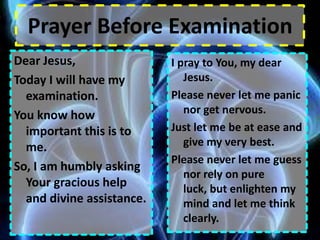
Prayer Before ExaminationDear Jesus,Today I will have my examination.You know how important this is to me.So, I am humbly asking Your gracious help and divine assistance. I pray to You, my dear Jesus.Please never let me panic nor get nervous.Just let me be at ease and give my very best.Please never let me guess nor rely on pure luck, but enlighten my mind and let me think clearly.
Today, O my Jesus,I will take my examination.Let me, with Your help, give my best effort.Let me, because of You, receive the best and Fruitful results, Amen.
Please never let me resort to chances, nor to dishonesty, but let me work to the best of my ability.I pray for Your guidance so that I may be able to answer correctly the questions, and solve the difficult problems.I ask, O Lord, Your intercession so that, I may not be careless or overconfident as I write, I may not be more distracted but be more concentrated, I may not be in hurry nor take the exams too lightly.
17.A nurse is assessing a child admitted to the hospital with a diagnosis rheumatic fever. The child is accompanied by the mother. The initial nursing question that the nurse would ask during assessment is which of the following?“Has the child had difficulty urinating?”“ Has any family member had a sore throat within the past few weeks?”“Has any family member had gastrointestinal disorder in the past few weeks?”“Has the child been exposed to anyone with chikenpox
CHN RATIOBy: RandelDalauta
Public Health Nursing (Winslow)-”science and art of preventing disease, prolonging life, promoting health and efficiency through organized community effort for the sanitation of the environment, control of communicable disease, the education of individuals in personal hygiene, the organization of medical and nursing services for the early diagnosis and preventive treatment of disease & the development of social machinery to ensure everyone a standard of living adequate for the maintenance of health, so organizing these benefits as toenable every citizen to realize his birthright of health and longevity.”
GLOBAL & COUNTRY HEALTH IMPERATIVESChanges exerting pressures on the Public Health Systems:Shift in demographic & epidemiological trends in diseaseNew technologies for health care, communication & informationExisting & emerging environmental hazards associated with globalization.Health Reforms
Determinants of Health as listed by WHO:1. Gender-men & women suffer diseases2. Physical Health Environment-safe water supply & clean air3. Personal behavior & coping skills-healthy lifestyle4. Income and social status 5. Employment & working conditions6. Culture-customs & traditions7. Reduced Health Services-access & use8. Inheritance/Genetics9. Education-low education are link to poor health10. Social support network-greater family support better
WHO ”the art of applying science in the context of politics so as to reduce inequalities in health while ensuring the best health for the greatest number.”
POLITICALSafetyOppressionPeople EmpowermentSOCIOECONOMICEmploymentEducationHousingBEHAVIORCultureMoresEthnic CustomsOLOFIndividualsFamily GroupsCommunitiesPopulationsENVIRONMENTAir, FoodWater WasteUrban/RuralNoiseRadiationPollutionHEREDITYGeneric Endowment   - Defects   -Strengths   -Risks   Familial ,EthnicRacialHEALTH CAREDEL. SYSTEMPromotivePreventiveCurativeRehabilitative
JACOBSON  learned practice in a wide/huge variety of community services supports OLOF
RUTH FREEMANIs a service rendered by a professional nurse with the community, groups, families and individuals at home, in health centers, in clinics, in school, in places of work for the promotion of health, prevention of illness, care of the sick at home & rehabilitation comprehensive	- no discrimination; free for all
 general			- enhancing people capabilityRole of a Public Health Nursea. Planner/Programmer	b. Provider of Nursing Care 	c.  Manager/Supervisor	d. Community Organizer	e. Coordinator of Services			GENERALIST	f. Trainer/Health Educator	g. Health Monitor	h. Role Modeli. Recorder/Statistician
Level of ClienteleIndividual – entry point to the family and care- least important Family – basic unit of a society		   -  basic unit of care		   - main caregiver for primary levels of care		   - may not be bound by marriage, blood or 			adoption- sharing emotional closeness and who 					identified themselves as family       *main function:	a.  Reproduction	b. socialization
Level of Clientele Community –  common   	    geographical boundaries					    values					    interest			 - no 2 are alike			 - one affects the other			 - changes is always frequent		 - most important   characteristics: ( criteria used in intervening)   awareness that they are community
  conserve natural resources
  recognition of subgroups
  participation of subgroups
  prepared to meet crisis
  ability to solve problems
  channels of communication
  available resources
  resolve disputes
  allow citizen to participate in decisionsLevel of Clientele  Population Group – common   characteristics	  development stagehealth problem 					   need or concern 	a. infants & young children	b. school age	c. adolescents			         vulnerable group	d. mothers	e. males	 f. old people
HANLONDedicated  to the highest level of physical, mental, social well being 3 A’s  - Accessible	DEVELOPMENT OF HEALTH IN 						ALL ASPECT		   - Acceptable		holistic		   - Affordable
United Nations General Assemblyadopted a common vision of poverty reduction and sustainable development in September 2000 exemplified by the Millennium Development Goals(MDG) based on:freedom,equality,solidarity,tolerance,health respect   for nature and shared responsibility8Millennium Development  Goals are as follows:Eradicate extreme poverty & hungerAchieve universal primary educationPromote gender equality& empower womenReduce child mortalityImprove maternal healthCombat HIV/AIDS, malaria & other diseasesEnsure environmental sustainabilityDevelop a global partnership for development
Primary Health Care(Alma Ata, USSR Sept. 1978)Main concepts:essential health care based on practical, scientifically 	sound and socially acceptable methods and appropriate technology made universally accessible through the community’s full participation and at cost that is affordable in the spirit of self reliance and self determination.4 cornerstones/pillars in PHC 	Intra and inter- sectoral linkages 	Support  Mechanism Available 	Active Community Participation	Appropriate technology use
Primary Health Care(Alma Ata, USSR Sept. 1978) “health for all by year 2000,		health in the hands of the people by 2020”
8 Millennium Development  Goals are as follows:Eradicate extreme poverty & hungerAchieve universal primary educationPromote gender equality& empower womenReduce child mortalityImprove maternal healthCombat HIV/AIDS, malaria & other diseasesEnsure environmental sustainabilityDevelop a global partnership for development
Core Business of Public HealthDisease ControlHealth ProtectionHealthy Public Policy – EnvironmentInjury PreventionEquitable Health Gain - promotion
Participationof all members in the society bothdeveloping and developed countries is required
The Health Sector Reform Agenda (HSRA) implemented through FOURmula ONE
DOHVision    -  Leader		        -  staunch advocate		        -  model in promoting health for all  	Mission - guarantee    equitable 				          sustainable   HEALTH FOR ALL				          quality	Overriding goal of the DOHHealth Sector Reform Agenda (HSRA)
Health Sector Reform Agenda (HSRA)RATIONALE : 1. Heavy burden on the poor in maintaining health 2. Sudden rise in diseases 3. Rise in IMR and MMR  4. Abrupt increase in chronic and degenerative disease REASON: 3 I’sInappropriate health delivery systemInadequate regulatory mechanism (poor health quality)Insufficient financing
FOURmulaOne1. Health financing 2. Health regulation - quality & affordability 3. Health service delivery - accessibility 					                 - availability 4. Health good governance
Health promotion (1980’s)process of enabling people to increase control over their health and its  determinants, so ultimately to improve their health
 an approach to  fulfill alma ata goals which is health for all in 2000
Focuses on determinants of health and not the manifestations of illness
recognizes that people’s health is affected by a broad range of factors (determinants) beyond their individual genetic makeup
 helping poor people protect their health and prevent illness
Goal: increase wellness level in which enhance health full potential
GAYLORD Organized community program designed to PROLONGED LIFE by preventing unnecessary illness
COPAR(Community Organizing Participatory Action Research) is a social development approach that aims to transform the apathetic, individualistic and voiceless poor into dynamic, participatory and politically responsive community. Emphasis of COPARCommunity working to solve its own problemDirection is established internally and externallyDevelopment and implementation of a specific project less important than the development of the capacity of the community to establish the projectGOAL: - SELF-RELIANTE COMMUNITY-  DEVELOP COMMUNITY
 	Importance of COPARCOPAR maximizes community participation and involvementCOPAR could be an alternative in situations wherein health interventions in Public Health Care do not require direct involvement of modern medical practitionersCOPAR gets people actively involved in selection and support of community health workersThrough COPAR, community resources are mobilized for selected health servicesCOPAR improves both projects effectiveness during implementation
PURDOM  Public health pertains to all phases of human development
 MAGLAYA  utilization of nursing process  APIE, FNCP
Community Health Nursing Process  	-  Systemic	-  Scientific				      nurses and client as a 					           system affecting 						   each otherClientele which will be the GOAL OF CAREIndividualFamilyCommunityPopulation group-   Dynamic-   Ongoing interpersonal 	process
ASSESSMENT: The first major phase of nursing processMeasure status of the clientSTEPS:Initiate contact, show caring behavior, establish trustCollection of dataIdentify and categorizes health problems	-base on typology	- categorize as:		 a. Health deficit 		b. Health Threat		c. Foreseeable crisis
Foreseeable crisis 	1. Marriage	2. Pregnancy	3. Parenthood	4. Additional family	5. Entrance at school	6. Adolescence	7. Divorce or separation	8. Loss of job	9. Death of a member	10. Resettlement in a new community
PLANNING NURSING ACTIONBlueprint of the careBased on        actual problems	                   potential problems  STEPS:Prioritize needsGoal Setting  based on needs and capabilities – intent that gives direction to action (SMART)Constructing a Plan of Action – selecting appropriate and available resources for careDeveloping operational plan - Develop evaluation parameters
Formula: (Score/Highest Score) x weight
IMPLEMENTATION OF PLANNED CAREInterventions
Involve the patient and his familyActivities:Put nursing plan to actionCoordinate care/servicesUtilize community resourcesDelegateMonitor health services providedProvide health education and trainingDocument responses to nursing action
 EVALUATION OF CARE & SERVICES PROVIDED Framework:	S-tructural elements- physical setting, instruments, condition, 	financial resources/budget, org structure, objectives	P-rocess elements- steps of nursing process ( involves nursing 	process APIE)	O-utcome elements- changes in clients health status resulted from 	nursing intervention ActivitiesNursing auditOutcome of careAssessment of problemsIdentify needed alterationsRevise plans

Chn Ratio

  • 1.
    Prayer Before ExaminationDearJesus,Today I will have my examination.You know how important this is to me.So, I am humbly asking Your gracious help and divine assistance. I pray to You, my dear Jesus.Please never let me panic nor get nervous.Just let me be at ease and give my very best.Please never let me guess nor rely on pure luck, but enlighten my mind and let me think clearly.
  • 2.
    Today, O myJesus,I will take my examination.Let me, with Your help, give my best effort.Let me, because of You, receive the best and Fruitful results, Amen.
  • 3.
    Please never letme resort to chances, nor to dishonesty, but let me work to the best of my ability.I pray for Your guidance so that I may be able to answer correctly the questions, and solve the difficult problems.I ask, O Lord, Your intercession so that, I may not be careless or overconfident as I write, I may not be more distracted but be more concentrated, I may not be in hurry nor take the exams too lightly.
  • 4.
    17.A nurse isassessing a child admitted to the hospital with a diagnosis rheumatic fever. The child is accompanied by the mother. The initial nursing question that the nurse would ask during assessment is which of the following?“Has the child had difficulty urinating?”“ Has any family member had a sore throat within the past few weeks?”“Has any family member had gastrointestinal disorder in the past few weeks?”“Has the child been exposed to anyone with chikenpox
  • 5.
  • 6.
    Public Health Nursing(Winslow)-”science and art of preventing disease, prolonging life, promoting health and efficiency through organized community effort for the sanitation of the environment, control of communicable disease, the education of individuals in personal hygiene, the organization of medical and nursing services for the early diagnosis and preventive treatment of disease & the development of social machinery to ensure everyone a standard of living adequate for the maintenance of health, so organizing these benefits as toenable every citizen to realize his birthright of health and longevity.”
  • 7.
    GLOBAL & COUNTRYHEALTH IMPERATIVESChanges exerting pressures on the Public Health Systems:Shift in demographic & epidemiological trends in diseaseNew technologies for health care, communication & informationExisting & emerging environmental hazards associated with globalization.Health Reforms
  • 8.
    Determinants of Healthas listed by WHO:1. Gender-men & women suffer diseases2. Physical Health Environment-safe water supply & clean air3. Personal behavior & coping skills-healthy lifestyle4. Income and social status 5. Employment & working conditions6. Culture-customs & traditions7. Reduced Health Services-access & use8. Inheritance/Genetics9. Education-low education are link to poor health10. Social support network-greater family support better
  • 9.
    Determinants of Healthas listed by WHO:1. Gender-men & women suffer diseases2. Physical Health Environment-safe water supply & clean air3. Personal behavior & coping skills-healthy lifestyle4. Income and social status 5. Employment & working conditions6. Culture-customs & traditions7. Reduced Health Services-access & use8. Inheritance/Genetics9. Education-low education are link to poor health10. Social support network-greater family support better
  • 10.
    WHO ”the artof applying science in the context of politics so as to reduce inequalities in health while ensuring the best health for the greatest number.”
  • 11.
    POLITICALSafetyOppressionPeople EmpowermentSOCIOECONOMICEmploymentEducationHousingBEHAVIORCultureMoresEthnic CustomsOLOFIndividualsFamilyGroupsCommunitiesPopulationsENVIRONMENTAir, FoodWater WasteUrban/RuralNoiseRadiationPollutionHEREDITYGeneric Endowment - Defects -Strengths -Risks Familial ,EthnicRacialHEALTH CAREDEL. SYSTEMPromotivePreventiveCurativeRehabilitative
  • 12.
    JACOBSON learnedpractice in a wide/huge variety of community services supports OLOF
  • 13.
    RUTH FREEMANIs aservice rendered by a professional nurse with the community, groups, families and individuals at home, in health centers, in clinics, in school, in places of work for the promotion of health, prevention of illness, care of the sick at home & rehabilitation comprehensive - no discrimination; free for all
  • 14.
    general - enhancingpeople capabilityRole of a Public Health Nursea. Planner/Programmer b. Provider of Nursing Care c. Manager/Supervisor d. Community Organizer e. Coordinator of Services GENERALIST f. Trainer/Health Educator g. Health Monitor h. Role Modeli. Recorder/Statistician
  • 15.
    Level of ClienteleIndividual– entry point to the family and care- least important Family – basic unit of a society - basic unit of care - main caregiver for primary levels of care - may not be bound by marriage, blood or adoption- sharing emotional closeness and who identified themselves as family *main function: a. Reproduction b. socialization
  • 16.
    Level of ClienteleCommunity – common geographical boundaries values interest - no 2 are alike - one affects the other - changes is always frequent - most important characteristics: ( criteria used in intervening) awareness that they are community
  • 17.
    conservenatural resources
  • 18.
    recognitionof subgroups
  • 19.
    participationof subgroups
  • 20.
    preparedto meet crisis
  • 21.
    abilityto solve problems
  • 22.
    channelsof communication
  • 23.
    availableresources
  • 24.
    resolvedisputes
  • 25.
    allowcitizen to participate in decisionsLevel of Clientele Population Group – common characteristics development stagehealth problem need or concern a. infants & young children b. school age c. adolescents vulnerable group d. mothers e. males f. old people
  • 26.
    HANLONDedicated tothe highest level of physical, mental, social well being 3 A’s - Accessible DEVELOPMENT OF HEALTH IN ALL ASPECT - Acceptable holistic - Affordable
  • 27.
    United Nations GeneralAssemblyadopted a common vision of poverty reduction and sustainable development in September 2000 exemplified by the Millennium Development Goals(MDG) based on:freedom,equality,solidarity,tolerance,health respect for nature and shared responsibility8Millennium Development Goals are as follows:Eradicate extreme poverty & hungerAchieve universal primary educationPromote gender equality& empower womenReduce child mortalityImprove maternal healthCombat HIV/AIDS, malaria & other diseasesEnsure environmental sustainabilityDevelop a global partnership for development
  • 28.
    Primary Health Care(AlmaAta, USSR Sept. 1978)Main concepts:essential health care based on practical, scientifically sound and socially acceptable methods and appropriate technology made universally accessible through the community’s full participation and at cost that is affordable in the spirit of self reliance and self determination.4 cornerstones/pillars in PHC Intra and inter- sectoral linkages Support Mechanism Available Active Community Participation Appropriate technology use
  • 29.
    Primary Health Care(AlmaAta, USSR Sept. 1978) “health for all by year 2000, health in the hands of the people by 2020”
  • 30.
    8 Millennium Development Goals are as follows:Eradicate extreme poverty & hungerAchieve universal primary educationPromote gender equality& empower womenReduce child mortalityImprove maternal healthCombat HIV/AIDS, malaria & other diseasesEnsure environmental sustainabilityDevelop a global partnership for development
  • 31.
    8 Millennium Development Goals are as follows:Eradicate extreme poverty & hungerAchieve universal primary educationPromote gender equality& empower womenReduce child mortalityImprove maternal healthCombat HIV/AIDS, malaria & other diseasesEnsure environmental sustainabilityDevelop a global partnership for development
  • 32.
    Core Business ofPublic HealthDisease ControlHealth ProtectionHealthy Public Policy – EnvironmentInjury PreventionEquitable Health Gain - promotion
  • 36.
    Participationof all membersin the society bothdeveloping and developed countries is required
  • 37.
    The Health SectorReform Agenda (HSRA) implemented through FOURmula ONE
  • 38.
    DOHVision - Leader - staunch advocate - model in promoting health for all Mission - guarantee equitable sustainable HEALTH FOR ALL quality Overriding goal of the DOHHealth Sector Reform Agenda (HSRA)
  • 39.
    Health Sector ReformAgenda (HSRA)RATIONALE : 1. Heavy burden on the poor in maintaining health 2. Sudden rise in diseases 3. Rise in IMR and MMR 4. Abrupt increase in chronic and degenerative disease REASON: 3 I’sInappropriate health delivery systemInadequate regulatory mechanism (poor health quality)Insufficient financing
  • 40.
    FOURmulaOne1. Health financing2. Health regulation - quality & affordability 3. Health service delivery - accessibility - availability 4. Health good governance
  • 41.
    Health promotion (1980’s)processof enabling people to increase control over their health and its determinants, so ultimately to improve their health
  • 42.
    an approachto fulfill alma ata goals which is health for all in 2000
  • 43.
    Focuses on determinantsof health and not the manifestations of illness
  • 44.
    recognizes that people’shealth is affected by a broad range of factors (determinants) beyond their individual genetic makeup
  • 45.
    helping poorpeople protect their health and prevent illness
  • 46.
    Goal: increase wellnesslevel in which enhance health full potential
  • 47.
    GAYLORD Organized communityprogram designed to PROLONGED LIFE by preventing unnecessary illness
  • 48.
    COPAR(Community Organizing ParticipatoryAction Research) is a social development approach that aims to transform the apathetic, individualistic and voiceless poor into dynamic, participatory and politically responsive community. Emphasis of COPARCommunity working to solve its own problemDirection is established internally and externallyDevelopment and implementation of a specific project less important than the development of the capacity of the community to establish the projectGOAL: - SELF-RELIANTE COMMUNITY- DEVELOP COMMUNITY
  • 49.
    Importance ofCOPARCOPAR maximizes community participation and involvementCOPAR could be an alternative in situations wherein health interventions in Public Health Care do not require direct involvement of modern medical practitionersCOPAR gets people actively involved in selection and support of community health workersThrough COPAR, community resources are mobilized for selected health servicesCOPAR improves both projects effectiveness during implementation
  • 53.
    PURDOM Publichealth pertains to all phases of human development
  • 54.
    MAGLAYA utilization of nursing process APIE, FNCP
  • 55.
    Community Health NursingProcess - Systemic - Scientific nurses and client as a system affecting each otherClientele which will be the GOAL OF CAREIndividualFamilyCommunityPopulation group- Dynamic- Ongoing interpersonal process
  • 56.
    ASSESSMENT: The firstmajor phase of nursing processMeasure status of the clientSTEPS:Initiate contact, show caring behavior, establish trustCollection of dataIdentify and categorizes health problems -base on typology - categorize as: a. Health deficit b. Health Threat c. Foreseeable crisis
  • 57.
    Foreseeable crisis 1.Marriage 2. Pregnancy 3. Parenthood 4. Additional family 5. Entrance at school 6. Adolescence 7. Divorce or separation 8. Loss of job 9. Death of a member 10. Resettlement in a new community
  • 58.
    PLANNING NURSING ACTIONBlueprintof the careBased on actual problems potential problems  STEPS:Prioritize needsGoal Setting based on needs and capabilities – intent that gives direction to action (SMART)Constructing a Plan of Action – selecting appropriate and available resources for careDeveloping operational plan - Develop evaluation parameters
  • 59.
  • 61.
    IMPLEMENTATION OF PLANNEDCAREInterventions
  • 62.
    Involve the patientand his familyActivities:Put nursing plan to actionCoordinate care/servicesUtilize community resourcesDelegateMonitor health services providedProvide health education and trainingDocument responses to nursing action
  • 63.
    EVALUATION OFCARE & SERVICES PROVIDED Framework: S-tructural elements- physical setting, instruments, condition, financial resources/budget, org structure, objectives P-rocess elements- steps of nursing process ( involves nursing process APIE) O-utcome elements- changes in clients health status resulted from nursing intervention ActivitiesNursing auditOutcome of careAssessment of problemsIdentify needed alterationsRevise plans