Ruling Over Workplace
Wellness Rules
Barbara J. Zabawa, JD, MPH
The Center for Health Law Equity, LLC
Agenda
• Preventive Law
• Worksite Wellness Program Laws
– HIPAA/ACA
– ADA
– EEOC Proposed Rules
– GINA
– EEOC Cases
– Other Federal/State
• Preventive Law Checklist
Compliance Anxiety
Compliance Ignorance
Discovering Your
Noncompliance
Preventive Law
Preventive Law
• Law has 2 purposes:
– Protection from those who do wrong
– Facilitate human interaction and purpose
• Preventive law focuses on second
purpose
• Leads to using law proactively as tool
– Sensitizes designers of wellness programs
to diverse employee needs
Who Enforces?
Use Law to Prevent
Ruffling Feathers
Wellness Program Laws
DISCRIMINATION
(Insensitive to needs/privacy)
(Equal Opportunity)
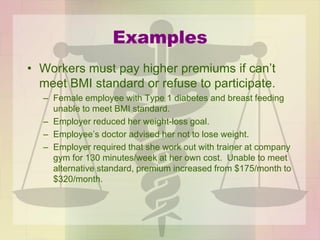
Examples
• Workers must pay higher premiums if can’t
meet BMI standard or refuse to participate.
– Female employee with Type 1 diabetes and breast feeding
unable to meet BMI standard.
– Employer reduced her weight-loss goal.
– Employee’s doctor advised her not to lose weight.
– Employer required that she work out with trainer at company
gym for 130 minutes/week at her own cost. Unable to meet
alternative standard, premium increased from $175/month to
$320/month.
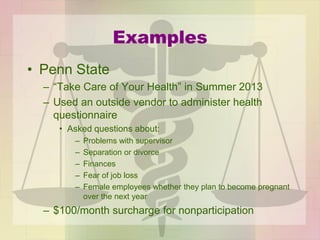
Examples
• Penn State
– “Take Care of Your Health” in Summer 2013
– Used an outside vendor to administer health
questionnaire
• Asked questions about:
– Problems with supervisor
– Separation or divorce
– Finances
– Fear of job loss
– Female employees whether they plan to become pregnant
over the next year
– $100/month surcharge for nonparticipation
We Can’t All Be Triathletes
We All Want to Feel Good
Preliminary Question
Group health
plan?
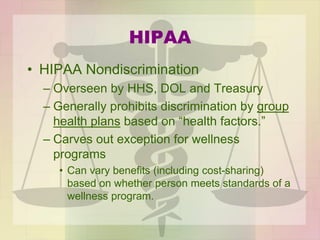
HIPAA
• HIPAA Nondiscrimination
– Overseen by HHS, DOL and Treasury
– Generally prohibits discrimination by group
health plans based on “health factors.”
– Carves out exception for wellness
programs
• Can vary benefits (including cost-sharing)
based on whether person meets standards of a
wellness program.
HIPAA
• ACA changes to HIPAA (eff. 1/1/14):
– Codifies 2006 wellness program rules into 42 USC
s. 300gg-4(j).
– Extends nondiscrimination rule to individual health
insurance (but not wellness program rule).
– Increases the “reward” from 20% to 30% of the
cost of coverage (50% for tobacco use prevention
programs).
– Adds stricter requirements for health-contingent
plans.
HIPAA
• To qualify for wellness program
exception, must meet certain conditions:
– Participatory programs must only be
offered to “similarly situated” individuals.
• No limit on financial incentives.
– Benign discrimination provision
– Health-contingent programs must meet 5
factor test.
HIPAA
• Participatory program examples:
– Fitness center membership reimbursement
– Reward for participating in health
assessment
– Waiver of health plan cost-sharing for
preventive items or services
– Smoking cessation program
reimbursement
– Reward for attending health education
seminar
HIPAA
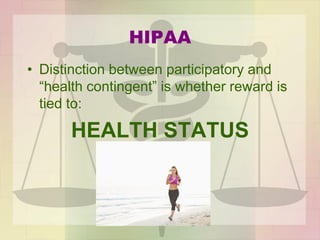
• Distinction between participatory and
“health contingent” is whether reward is
tied to:
HEALTH STATUS
HIPAA
• Two types of health-contingent
programs:
– Activity
• May seek verification from physician that health
factor makes it unreasonably difficult or
medically inadvisable to satisfy activity.
– Outcomes-based
• May not seek verification
• Both must meet 5 factor test.
HIPAA
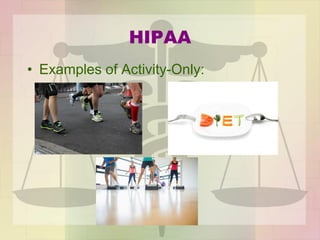
• Examples of Activity-Only:
HIPAA
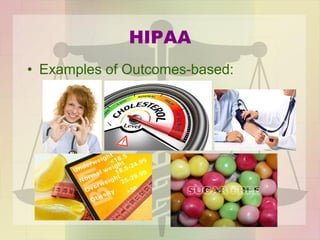
• Examples of Outcomes-based:
HIPAA
• Five factors:
1. Qualify for the reward at least once/year.
2. Total reward may not exceed 30% (50%
for tobacco prevention programs) of total
cost of coverage.
3. Reasonable design to promote health or
prevent disease.
HIPAA
• Five factors (cont.)
4. Full reward must be available to all
similarly situated individuals.
• Must provide reasonable alternative standard
(or waiver of standard)
5. Disclosure of reasonable alternative
standard (or waiver) in plan materials
describing the wellness program terms.
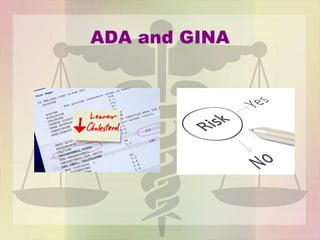
ADA and GINA
ADA
• Prohibits discrimination by employers on basis of
disability in regard to terms, conditions and privileges
of employment.
– Discrimination includes:
• Requiring medical examinations; and
• Making inquiries as to whether employee has disability
unless such exam or inquiry is:
– Job-related and consistent with business necessity
• Particularly pertinent for HA’s and Biometric Screens.
• Must provide equal opportunity for disabled
employees to participate in programs and offer
reasonable accommodations.
ADA
• Carves out exception for “voluntary”
wellness programs.
– According to EEOC Enforcement
Guidance, a wellness program is voluntary
as long as employer neither:
• Requires participation; nor
• Penalizes employees who do not participate.
• Must keep exam/inquiry records
confidential.
ADA
• Safe harbor for administering terms of
bona fide benefit plan
– Based on underwriting risks, classifying
risks or administering such risks.
– Applies whether exam/inquiry is voluntary
or not.
– Seff v. Broward County, 691 F.3d 1221
(11th Cir. 2012).
EEOC Proposed ADA Rules
• Three primary changes:
1. Aligns ADA with ACA by imposing 30%
incentive
2. Imposes incentive limit on participatory
programs
3. Requires employee notice and
privacy/security protections with regard to
wellness information
EEOC Proposed ADA Rules
• Aligns with ACA incentive rules
– 30% max incentive
EEOC Proposed ADA Rules
• Special treatment for tobacco cessation
EEOC Proposed ADA Rules
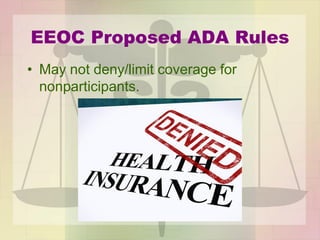
• May not deny/limit coverage for
nonparticipants.
EEOC Proposed ADA Rules
• Programs that collect medical
information must provide employees
with notice.
EEOC Proposed ADA Rules
• Employers and vendors must protect
health information confidentiality
EEOC Proposed ADA Rules
EEOC expects group health plan programs to
abide by HIPAA privacy/security rules
• Employer certification requirements for those who
administer programs
• Best practice: separate those who handle
individually identifiable health information from
those who make employment-related decisions
• Use of a third-party vendor may help
EEOC Proposed ADA Rules
• Employers and Vendors should have
clear privacy policies and procedures
related to medical information:
– Collection
– Storage
– Disclosure
• Include employee training
EEOC Proposed ADA Rules
• Reasonably designed to promote
health/prevent disease
– Should provide follow-up after collecting
medical information
– Should not be about collecting information
only.
EEOC Proposed ADA Rules
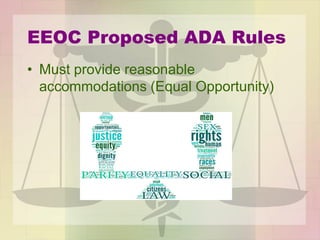
• Must provide reasonable
accommodations (Equal Opportunity)
EEOC Proposed ADA Rules
Equal Opportunity applies to both participatory
and health contingent programs.
EEOC Proposed ADA Rules
• Compliance with ADA rules does not mean
compliance with other laws:
– Title VII
– Equal Pay Act
– ADEA
– GINA
– Other ADA sections
• Proposed rules to align GINA with ACA
incentive rules forthcoming (presumably)
EEOC Proposed ADA Rules
• EEOC welcomes comments by Friday,
June 19, 2015
GINA Title I
• Title I generally prohibits group health
plans from:
– Adjusting premium or contribution amounts
based on genetic information;
– Requesting/requiring genetic testing;
– Requesting/requiring/purchasing genetic
information for underwriting purposes or
in connection with open enrollment.
GINA Title I
• “Genetic information”
– Genetic tests of individual or family
members
– Manifestation of disease or disorder in
family members (“family medical history”)
• “Family” includes spouses and adopted
children and dependents of spouses.
– Receipt of genetic services
GINA Title I
• Helpful tips for HRA administration:
– Do not ask questions about genetics and
family history;
– If open-ended questions could invite
disclosure of genetic information, include
disclaimer to not provide genetic
information.
• Examples: “Have you had any lab tests this
year?” or “Any other information about your
health you would like to share?”
Recent Cases
• EEOC v. Orion Energy Systems, 2:14-
cv-1019
• EEOC v. Flambeau, Inc., 3:14-cv-638
• EEOC v. Honeywell International, Inc.,
14-cv-4517
Recent Cases
• Case similarities:
– All still pending as of early 2015
– All brought to EEOC attention by employees
– All dealt with participatory wellness programs
involving HRAs and/or biometric screens
– All tied reward to health plan contributions
– In all cases, EEOC claimed wellness program
violated ADA and/or GINA, even though program
complied with HIPAA
– In all cases, defendants raised ADA safe harbor
Recent Cases
• EEOC arguments in Honeywell:
– Reward “too substantial” to be “voluntary”
under ADA. Nonparticipants:
• Do not qualify for $250-$1500 HSA
• Pay $500 surcharge
• Assessed $1000 tobacco surcharge unless:
– Enroll in cessation program (actual cessation not required);
– Submit physician report about no tobacco use; or
– Work with health advocate.
Recent Cases
• EEOC argued Honeywell violated GINA
because Honeywell:
– Will contribute to HSA if employee’s
spouse participates;
– Imposes $1000 tobacco surcharge if
spouse refuses to participate.
• Spousal biometric tests=family medical history
• Surcharge made program involuntary
Recent Cases
• Honeywell countered:
– Program was voluntary (no discipline or
loss of coverage)
– Tobacco surcharge had reasonable
alternatives
– Biometric measures did not=genetic
information
– EEOC did not have jurisdiction to enforce
part of bona fide group health plan
– ACA endorses use of surcharges
Recent Cases
• Lessons learned:
1. Complaints originated from employees
a. Create positive wellness culture
b. WELCOA 7 Benchmarks
2. Tie worksite wellness program to group
health plan.
b. Allows for ADA safe harbor and may
eliminate EEOC GINA jurisdiction.
3. 100% premium penalty catches EEOC
attention
Other Federal/State
• Fair Labor Standards Act
• Age Discrimination in Employment Act
• Title VII
• Internal Revenue Code
• State Laws
Other Federal/State
• FLSA
– Generally requires payment for all hours
worked
• Federal minimum wage
• 1.5x for overtime (over 40 hours/week)
Other Federal/State
• FLSA
– To avoid FLSA, wellness program
participation should be:
• Outside of work;
• Voluntary;
• Not job-related;
• No productive work performed
– Tip: Emphasize voluntary nature of
attendance.
Other Federal/State
• ADEA
– Prohibits employers with 20 or more
employees from discriminating based on
individual’s age (40 and over).
• Older workers might have harder time
achieving certain health-related
standards/goals.
• EEOC enforces.
• Lee v. City of Moraine Fire Dept., 2014 WL
1775621 (S.D. Ohio, May 2, 2014)
Other Federal/State
• Title VII prohibits employment
discrimination based on:
• Race
• Color
• Religion
• Sex
• National Origin
– Gender and religious discrimination most
likely in wellness program design.
– Enforced by EEOC and DOJ
Other Federal/State
• Internal Revenue Code
– Excludes from gross income amounts
received for “medical care”
• Expenses beneficial to general health or
wellbeing not “medical care” expenses
– E.g. Gym memberships usually taxable
– On-site athletic facilities not taxable
– De minimus benefits excludable
– Cash or cash equivalent incentives not
excludable from gross income
Other Federal/State
• State Laws:
• Scope of practice/licensing
• Flu Shots, Coaching, Diet Advice
• Off-duty conduct protection
– Smoking, Alcohol
• Negligence and Worker’s Compensation
• State Fair Employment Acts
• State insurance laws
• State grant programs
Case Scenario #1
• The WeCARE plan wants its participants to
complete a health/family medical history
questionnaire and measure the participants’
cholesterol, blood pressure, and BMI. The
plan notifies participants that they will be
responsible for paying 100% of the plan
premium if they do not complete the
questionnaire and screen. Is this
permissible?
Case Scenario #2
• Same facts as Scenario #1, but
WeCARE also requires those who do
not meet a certain BMI standard to pay
100% of the premium unless they enroll
in a weight management or exercise
class that meets every day from 4 to 6
pm, Monday through Friday. Is this
program compliant?
Case Scenario #3
• Acme, Inc., employer who offers the
WeCARE plan to employees, decides to
offer free noon-time Insanity workout
classes to all employees. Employees
who attend 80% of the eight-week
session receive a $50 gift card to IHOP.
Are there any compliance issues with
this program?
Preventive Law Checklist
 Is program part of group health plan?
 ACA & new ADA incentive rules vs. not
 Does employee get reward regardless of results?
 Participatory vs. Health Contingent
 Is reward tied to health coverage cost sharing?
 New ADA limits and EEOC cases
 If Health Contingent, do we meet ACA 5-factor test?
 Does HRA ask about family history or other sensitive
information?
 If yes, does employee get reward regardless? Think Penn State.
Preventive Law Checklist
 Are there spousal biometric tests?
 If yes, EEOC may view as family medical history and may want to
omit incentives. See Honeywell case.
 Are reasonable accommodations or waivers
available so all employees have equal opportunity to
earn reward?
 Did we provide notice of the availability of
reasonable accommodations or waivers?
 Do we offer follow-up after collecting health
information?
Preventive Law Checklist
 Is the program sensitive to the varying abilities and
life circumstances of our employees?
 Have we reviewed our confidentiality obligations,
policies and procedures?
 Has our vendor reviewed its confidentiality
obligations, policies and procedures?
 Have we obtained employee buy-in and
communicated the purpose/rationale of the program
before roll-out?
 Will this program cause employee discontent?
 If yes, what can we do to minimize that?
70
Questions?
• For more information, contact:
Barbara J. Zabawa, JD, MPH
The Center for Health Law Equity, LLC
Phone: 608-579-1267
Email: bzabawa@cfhle.com

Ruling Over Workplace Wellness Rules 2015

  • 1.
    Ruling Over Workplace WellnessRules Barbara J. Zabawa, JD, MPH The Center for Health Law Equity, LLC
  • 2.
    Agenda • Preventive Law •Worksite Wellness Program Laws – HIPAA/ACA – ADA – EEOC Proposed Rules – GINA – EEOC Cases – Other Federal/State • Preventive Law Checklist
  • 3.
  • 4.
  • 5.
  • 6.
  • 7.
    Preventive Law • Lawhas 2 purposes: – Protection from those who do wrong – Facilitate human interaction and purpose • Preventive law focuses on second purpose • Leads to using law proactively as tool – Sensitizes designers of wellness programs to diverse employee needs
  • 8.
  • 9.
    Use Law toPrevent Ruffling Feathers
  • 10.
    Wellness Program Laws DISCRIMINATION (Insensitiveto needs/privacy) (Equal Opportunity)
  • 11.
    Examples • Workers mustpay higher premiums if can’t meet BMI standard or refuse to participate. – Female employee with Type 1 diabetes and breast feeding unable to meet BMI standard. – Employer reduced her weight-loss goal. – Employee’s doctor advised her not to lose weight. – Employer required that she work out with trainer at company gym for 130 minutes/week at her own cost. Unable to meet alternative standard, premium increased from $175/month to $320/month.
  • 12.
    Examples • Penn State –“Take Care of Your Health” in Summer 2013 – Used an outside vendor to administer health questionnaire • Asked questions about: – Problems with supervisor – Separation or divorce – Finances – Fear of job loss – Female employees whether they plan to become pregnant over the next year – $100/month surcharge for nonparticipation
  • 13.
    We Can’t AllBe Triathletes
  • 14.
    We All Wantto Feel Good
  • 15.
  • 16.
    HIPAA • HIPAA Nondiscrimination –Overseen by HHS, DOL and Treasury – Generally prohibits discrimination by group health plans based on “health factors.” – Carves out exception for wellness programs • Can vary benefits (including cost-sharing) based on whether person meets standards of a wellness program.
  • 17.
    HIPAA • ACA changesto HIPAA (eff. 1/1/14): – Codifies 2006 wellness program rules into 42 USC s. 300gg-4(j). – Extends nondiscrimination rule to individual health insurance (but not wellness program rule). – Increases the “reward” from 20% to 30% of the cost of coverage (50% for tobacco use prevention programs). – Adds stricter requirements for health-contingent plans.
  • 18.
    HIPAA • To qualifyfor wellness program exception, must meet certain conditions: – Participatory programs must only be offered to “similarly situated” individuals. • No limit on financial incentives. – Benign discrimination provision – Health-contingent programs must meet 5 factor test.
  • 19.
    HIPAA • Participatory programexamples: – Fitness center membership reimbursement – Reward for participating in health assessment – Waiver of health plan cost-sharing for preventive items or services – Smoking cessation program reimbursement – Reward for attending health education seminar
  • 20.
    HIPAA • Distinction betweenparticipatory and “health contingent” is whether reward is tied to: HEALTH STATUS
  • 21.
    HIPAA • Two typesof health-contingent programs: – Activity • May seek verification from physician that health factor makes it unreasonably difficult or medically inadvisable to satisfy activity. – Outcomes-based • May not seek verification • Both must meet 5 factor test.
  • 22.
    HIPAA • Examples ofActivity-Only:
  • 23.
    HIPAA • Examples ofOutcomes-based:
  • 24.
    HIPAA • Five factors: 1.Qualify for the reward at least once/year. 2. Total reward may not exceed 30% (50% for tobacco prevention programs) of total cost of coverage. 3. Reasonable design to promote health or prevent disease.
  • 25.
    HIPAA • Five factors(cont.) 4. Full reward must be available to all similarly situated individuals. • Must provide reasonable alternative standard (or waiver of standard) 5. Disclosure of reasonable alternative standard (or waiver) in plan materials describing the wellness program terms.
  • 26.
  • 27.
    ADA • Prohibits discriminationby employers on basis of disability in regard to terms, conditions and privileges of employment. – Discrimination includes: • Requiring medical examinations; and • Making inquiries as to whether employee has disability unless such exam or inquiry is: – Job-related and consistent with business necessity • Particularly pertinent for HA’s and Biometric Screens. • Must provide equal opportunity for disabled employees to participate in programs and offer reasonable accommodations.
  • 28.
    ADA • Carves outexception for “voluntary” wellness programs. – According to EEOC Enforcement Guidance, a wellness program is voluntary as long as employer neither: • Requires participation; nor • Penalizes employees who do not participate. • Must keep exam/inquiry records confidential.
  • 29.
    ADA • Safe harborfor administering terms of bona fide benefit plan – Based on underwriting risks, classifying risks or administering such risks. – Applies whether exam/inquiry is voluntary or not. – Seff v. Broward County, 691 F.3d 1221 (11th Cir. 2012).
  • 30.
    EEOC Proposed ADARules • Three primary changes: 1. Aligns ADA with ACA by imposing 30% incentive 2. Imposes incentive limit on participatory programs 3. Requires employee notice and privacy/security protections with regard to wellness information
  • 31.
    EEOC Proposed ADARules • Aligns with ACA incentive rules – 30% max incentive
  • 32.
    EEOC Proposed ADARules • Special treatment for tobacco cessation
  • 33.
    EEOC Proposed ADARules • May not deny/limit coverage for nonparticipants.
  • 34.
    EEOC Proposed ADARules • Programs that collect medical information must provide employees with notice.
  • 35.
    EEOC Proposed ADARules • Employers and vendors must protect health information confidentiality
  • 36.
    EEOC Proposed ADARules EEOC expects group health plan programs to abide by HIPAA privacy/security rules • Employer certification requirements for those who administer programs • Best practice: separate those who handle individually identifiable health information from those who make employment-related decisions • Use of a third-party vendor may help
  • 37.
    EEOC Proposed ADARules • Employers and Vendors should have clear privacy policies and procedures related to medical information: – Collection – Storage – Disclosure • Include employee training
  • 38.
    EEOC Proposed ADARules • Reasonably designed to promote health/prevent disease – Should provide follow-up after collecting medical information – Should not be about collecting information only.
  • 39.
    EEOC Proposed ADARules • Must provide reasonable accommodations (Equal Opportunity)
  • 40.
    EEOC Proposed ADARules Equal Opportunity applies to both participatory and health contingent programs.
  • 41.
    EEOC Proposed ADARules • Compliance with ADA rules does not mean compliance with other laws: – Title VII – Equal Pay Act – ADEA – GINA – Other ADA sections • Proposed rules to align GINA with ACA incentive rules forthcoming (presumably)
  • 42.
    EEOC Proposed ADARules • EEOC welcomes comments by Friday, June 19, 2015
  • 43.
    GINA Title I •Title I generally prohibits group health plans from: – Adjusting premium or contribution amounts based on genetic information; – Requesting/requiring genetic testing; – Requesting/requiring/purchasing genetic information for underwriting purposes or in connection with open enrollment.
  • 44.
    GINA Title I •“Genetic information” – Genetic tests of individual or family members – Manifestation of disease or disorder in family members (“family medical history”) • “Family” includes spouses and adopted children and dependents of spouses. – Receipt of genetic services
  • 45.
    GINA Title I •Helpful tips for HRA administration: – Do not ask questions about genetics and family history; – If open-ended questions could invite disclosure of genetic information, include disclaimer to not provide genetic information. • Examples: “Have you had any lab tests this year?” or “Any other information about your health you would like to share?”
  • 46.
    Recent Cases • EEOCv. Orion Energy Systems, 2:14- cv-1019 • EEOC v. Flambeau, Inc., 3:14-cv-638 • EEOC v. Honeywell International, Inc., 14-cv-4517
  • 47.
    Recent Cases • Casesimilarities: – All still pending as of early 2015 – All brought to EEOC attention by employees – All dealt with participatory wellness programs involving HRAs and/or biometric screens – All tied reward to health plan contributions – In all cases, EEOC claimed wellness program violated ADA and/or GINA, even though program complied with HIPAA – In all cases, defendants raised ADA safe harbor
  • 48.
    Recent Cases • EEOCarguments in Honeywell: – Reward “too substantial” to be “voluntary” under ADA. Nonparticipants: • Do not qualify for $250-$1500 HSA • Pay $500 surcharge • Assessed $1000 tobacco surcharge unless: – Enroll in cessation program (actual cessation not required); – Submit physician report about no tobacco use; or – Work with health advocate.
  • 49.
    Recent Cases • EEOCargued Honeywell violated GINA because Honeywell: – Will contribute to HSA if employee’s spouse participates; – Imposes $1000 tobacco surcharge if spouse refuses to participate. • Spousal biometric tests=family medical history • Surcharge made program involuntary
  • 50.
    Recent Cases • Honeywellcountered: – Program was voluntary (no discipline or loss of coverage) – Tobacco surcharge had reasonable alternatives – Biometric measures did not=genetic information – EEOC did not have jurisdiction to enforce part of bona fide group health plan – ACA endorses use of surcharges
  • 51.
    Recent Cases • Lessonslearned: 1. Complaints originated from employees a. Create positive wellness culture b. WELCOA 7 Benchmarks 2. Tie worksite wellness program to group health plan. b. Allows for ADA safe harbor and may eliminate EEOC GINA jurisdiction. 3. 100% premium penalty catches EEOC attention
  • 52.
    Other Federal/State • FairLabor Standards Act • Age Discrimination in Employment Act • Title VII • Internal Revenue Code • State Laws
  • 53.
    Other Federal/State • FLSA –Generally requires payment for all hours worked • Federal minimum wage • 1.5x for overtime (over 40 hours/week)
  • 54.
    Other Federal/State • FLSA –To avoid FLSA, wellness program participation should be: • Outside of work; • Voluntary; • Not job-related; • No productive work performed – Tip: Emphasize voluntary nature of attendance.
  • 55.
    Other Federal/State • ADEA –Prohibits employers with 20 or more employees from discriminating based on individual’s age (40 and over). • Older workers might have harder time achieving certain health-related standards/goals. • EEOC enforces. • Lee v. City of Moraine Fire Dept., 2014 WL 1775621 (S.D. Ohio, May 2, 2014)
  • 56.
    Other Federal/State • TitleVII prohibits employment discrimination based on: • Race • Color • Religion • Sex • National Origin – Gender and religious discrimination most likely in wellness program design. – Enforced by EEOC and DOJ
  • 57.
    Other Federal/State • InternalRevenue Code – Excludes from gross income amounts received for “medical care” • Expenses beneficial to general health or wellbeing not “medical care” expenses – E.g. Gym memberships usually taxable – On-site athletic facilities not taxable – De minimus benefits excludable – Cash or cash equivalent incentives not excludable from gross income
  • 58.
    Other Federal/State • StateLaws: • Scope of practice/licensing • Flu Shots, Coaching, Diet Advice • Off-duty conduct protection – Smoking, Alcohol • Negligence and Worker’s Compensation • State Fair Employment Acts • State insurance laws • State grant programs
  • 59.
    Case Scenario #1 •The WeCARE plan wants its participants to complete a health/family medical history questionnaire and measure the participants’ cholesterol, blood pressure, and BMI. The plan notifies participants that they will be responsible for paying 100% of the plan premium if they do not complete the questionnaire and screen. Is this permissible?
  • 60.
    Case Scenario #2 •Same facts as Scenario #1, but WeCARE also requires those who do not meet a certain BMI standard to pay 100% of the premium unless they enroll in a weight management or exercise class that meets every day from 4 to 6 pm, Monday through Friday. Is this program compliant?
  • 61.
    Case Scenario #3 •Acme, Inc., employer who offers the WeCARE plan to employees, decides to offer free noon-time Insanity workout classes to all employees. Employees who attend 80% of the eight-week session receive a $50 gift card to IHOP. Are there any compliance issues with this program?
  • 62.
    Preventive Law Checklist Is program part of group health plan?  ACA & new ADA incentive rules vs. not  Does employee get reward regardless of results?  Participatory vs. Health Contingent  Is reward tied to health coverage cost sharing?  New ADA limits and EEOC cases  If Health Contingent, do we meet ACA 5-factor test?  Does HRA ask about family history or other sensitive information?  If yes, does employee get reward regardless? Think Penn State.
  • 63.
    Preventive Law Checklist Are there spousal biometric tests?  If yes, EEOC may view as family medical history and may want to omit incentives. See Honeywell case.  Are reasonable accommodations or waivers available so all employees have equal opportunity to earn reward?  Did we provide notice of the availability of reasonable accommodations or waivers?  Do we offer follow-up after collecting health information?
  • 64.
    Preventive Law Checklist Is the program sensitive to the varying abilities and life circumstances of our employees?  Have we reviewed our confidentiality obligations, policies and procedures?  Has our vendor reviewed its confidentiality obligations, policies and procedures?  Have we obtained employee buy-in and communicated the purpose/rationale of the program before roll-out?  Will this program cause employee discontent?  If yes, what can we do to minimize that?
  • 65.
    70 Questions? • For moreinformation, contact: Barbara J. Zabawa, JD, MPH The Center for Health Law Equity, LLC Phone: 608-579-1267 Email: bzabawa@cfhle.com