Workshop Group
Campaign Finance
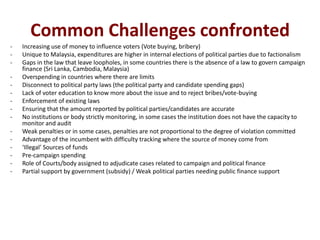
Common Challenges confronted
- Increasing use of money to influence voters (Vote buying, bribery)
- Unique to Malaysia, expenditures are higher in internal elections of political parties due to factionalism
- Gaps in the law that leave loopholes, in some countries there is the absence of a law to govern campaign
finance (Sri Lanka, Cambodia, Malaysia)
- Overspending in countries where there are limits
- Disconnect to political party laws (the political party and candidate spending gaps)
- Lack of voter education to know more about the issue and to reject bribes/vote-buying
- Enforcement of existing laws
- Ensuring that the amount reported by political parties/candidates are accurate
- No institutions or body strictly monitoring, in some cases the institution does not have the capacity to
monitor and audit
- Weak penalties or in some cases, penalties are not proportional to the degree of violation committed
- Advantage of the incumbent with difficulty tracking where the source of money come from
- Illegal Sources of funds
- Pre-campaign spending
- Role of Courts/body assigned to adjudicate cases related to campaign and political finance
- Partial support by government (subsidy) / Weak political parties needing public finance support
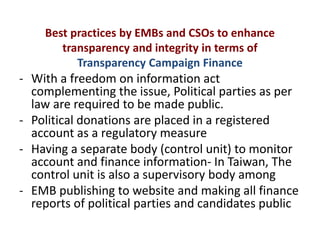
Best practices by EMBs and CSOs to enhance
transparency and integrity in terms of
Transparency Campaign Finance
- With a freedom on information act
complementing the issue, Political parties as per
law are required to be made public.
- Political donations are placed in a registered
account as a regulatory measure
- Having a separate body (control unit) to monitor
account and finance information- In Taiwan, The
control unit is also a supervisory body among
- EMB publishing to website and making all finance
reports of political parties and candidates public
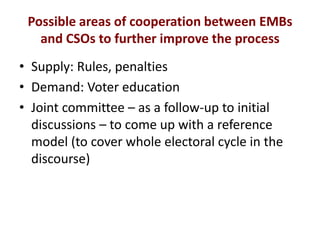
Possible areas of cooperation between EMBs
and CSOs to further improve the process
• Supply: Rules, penalties
• Demand: Voter education
• Joint committee – as a follow-up to initial
discussions – to come up with a reference
model (to cover whole electoral cycle in the
discourse)
What support can regional and international groups
provide to overcome the identified challenges
E dorse e t to the Bali Cooperatio Electoral
Tra spare cy: Eight Keys to I tegrity
• The group endorsed the document
• No objections
• Items are proposed to be included however
agreed to further the discussion in the joint
committee

Rapouter group 3 - campaign finance

  • 1.
  • 2.
    Common Challenges confronted -Increasing use of money to influence voters (Vote buying, bribery) - Unique to Malaysia, expenditures are higher in internal elections of political parties due to factionalism - Gaps in the law that leave loopholes, in some countries there is the absence of a law to govern campaign finance (Sri Lanka, Cambodia, Malaysia) - Overspending in countries where there are limits - Disconnect to political party laws (the political party and candidate spending gaps) - Lack of voter education to know more about the issue and to reject bribes/vote-buying - Enforcement of existing laws - Ensuring that the amount reported by political parties/candidates are accurate - No institutions or body strictly monitoring, in some cases the institution does not have the capacity to monitor and audit - Weak penalties or in some cases, penalties are not proportional to the degree of violation committed - Advantage of the incumbent with difficulty tracking where the source of money come from - Illegal Sources of funds - Pre-campaign spending - Role of Courts/body assigned to adjudicate cases related to campaign and political finance - Partial support by government (subsidy) / Weak political parties needing public finance support
  • 3.
    Best practices byEMBs and CSOs to enhance transparency and integrity in terms of Transparency Campaign Finance - With a freedom on information act complementing the issue, Political parties as per law are required to be made public. - Political donations are placed in a registered account as a regulatory measure - Having a separate body (control unit) to monitor account and finance information- In Taiwan, The control unit is also a supervisory body among - EMB publishing to website and making all finance reports of political parties and candidates public
  • 4.
    Possible areas ofcooperation between EMBs and CSOs to further improve the process • Supply: Rules, penalties • Demand: Voter education • Joint committee – as a follow-up to initial discussions – to come up with a reference model (to cover whole electoral cycle in the discourse)
  • 5.
    What support canregional and international groups provide to overcome the identified challenges
  • 6.
    E dorse et to the Bali Cooperatio Electoral Tra spare cy: Eight Keys to I tegrity • The group endorsed the document • No objections • Items are proposed to be included however agreed to further the discussion in the joint committee