FY2015 PERFORMANCE
INCENTIVE FUND
Focusing Resources on the
“BigThree”Plan to Produce
More College Graduates
A Report to the Legislature on the
Performance Management Set-Aside Line (7066-0025)
ABOUT MASSACHUSETTS PUBLIC HIGHER EDUCATION
	 29 CAMPUSES
	 15 COMMUNITY COLLEGES
	 9 STATE UNIVERSITIES
	 5 UMASS CAMPUSES
300,000 STUDENTS
	 40,000 FACULTY AND STAFF
	 40,000 NEW COLLEGE-EDUCATED
CITIZENS & WORKERS ANNUALLY
One Ashburton Place, Room 1401
Boston, MA 02108
www.mass.edu | (617) 994-6950
April 2015
The“Big Three”Completion Plan
Effective Strategies Underway at Our Campuses
PROJECTED SHORTAGE OF
QUALIFIED WORKERS
In October 2014, the
Department of Higher
Education (DHE) released
the third Vision Project
annual report, Degrees of
Urgency: Why Massachusetts
Needs More College Graduates
Now. With an oncoming
decline in the size of
Massachusetts’ adolescent
population, the report proj-
ects fewer students enrolling
in and graduating from Massachusetts’ public colleges
and universities in the coming years. Unless offset by
improved performance, this will lead to a shortage of
tens of thousands of skilled college graduates needed
for the workforce. More at www.mass.edu/vpreport
“BIG THREE” COMPLETION PLAN
To avert this shortage of college graduates and the
threat it poses to the Massachusetts economy, Degrees
of Urgency lays out a “Big Three” Completion Plan. It
focuses on high-impact strategies under the umbrella
of the Vision Project that will address the projected
shortfall in students completing degrees and certifi-
cates at the state's community colleges, state universi-
ties and UMass campuses:
CAMPUS CONVENINGS
At a February 27 Vision Project Conference, DHE
convened 250 faculty, staff and trustees of the
public campuses to advance the “Big Three” agenda.
Conference planners identified 15 specific,
innovative strategies underway on Massachusetts
public campuses to achieve the “Big Three” goals,
and colleagues around the system shared successful
approaches to implementing each of them. Work
will continue this summer with a program of cross-
campus collaborations designed to facilitate the
scaling of effective strategies across the system.
PERFORMANCE INCENTIVE FUND
Many of these effective strategies have been
developed using Vision Project Performance Incentive
Fund grants awarded in FY2012–FY2015:
FY2012. With a $2.5 million line item in the
Commonwealth’s FY2012 budget, the Fund
provided grants to 18 campuses, along with a goal
of encouraging long-term sustainability of
funded initiatives through declining balance
continuation grants: 2/3 of the original grant in
Year 2 and 1/3 in Year 3.
FY2013 & FY2014. The Legislature increased
funding to $7.5 million for FY2013 and
FY2014, greatly expanding the impact of the
funds. DHE was able to issue grants for 41
new projects as well as the smaller continuation
grants for previous years’ projects. In addition,
DHE was able to launch a system-wide
initiative to facilitate transfer between two-year
and four-year institutions.
FY2015. Due to funding constraints, the Fund
was cut back to $3.25 million, and grants
were only awarded to continue projects from
FY2013 and FY2014, including the system-wide
transfer project.
DHE hopes that, in FY2016, the Fund will be restored
to its FY2014 level so that it can be used to scale
effective “Big Three” strategies across the system.
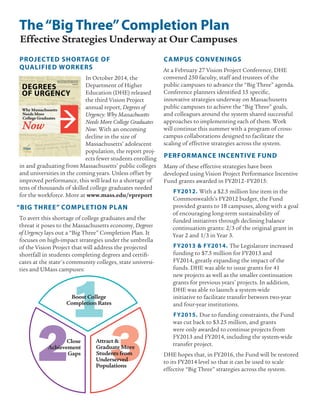
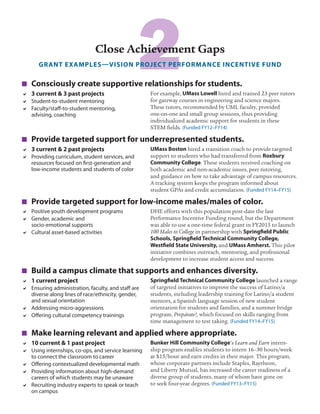
1	 Create programs targeted at first-year students.
DD 4 current & 1 past project
DD Early warning systems
DD Registration outreach
DD First-year experience courses
DD Learning communities
One example is Salem State University’s MAP-Works early
alert/retention system, which identifies at-risk students for
targeted interventions. The new system has served to rally the
campus around the issues of student retention and success.
Salem’s fall-to-fall retention rate increased from 74% to 81%
since MapWorks was implemented in summer 2012. (Funded
FY13–FY15)
	 Ensure students don’t take excessive or unnecessary credits.
DD 5 current & 2 past projects
DD Capping degree credit requirements
DD Offering highly structured degree plans
DD Aligning two-year and four-year curricula to
facilitate ease of transfer
DD Improving credit transfer policies
For example, Middlesex Community College created semes-
ter-by-semester Curriculum Maps for 75 different academic
programs. As part of this initiative, they have also targeted
programs that require 60+ credits in an effort to fit them into
the standard 60 credits for associate’s degrees. They are now
rethinking academic advising and technology platforms to
further support this initiative. (Funded FY14–FY15)
	 Rethink scheduling to better support completion.
DD 2 current projects
DD Prioritizing 15-credit/semester scheduling
DD Providing structured & predictable schedules
DD Mapping out degree program schedules
DD Ensuring availability of milestone courses
DD Creating meta-majors
Bristol Community College’s use of the national Guided
Pathways to Success (GPS) model combines block scheduling,
milestone courses, peer support, proactive advising,
and workforce connections. GPS students’ retention rates
were 11 points higher than those of other Bristol students
(88% vs. 77%) with GPS students averaging 16 credits per
semester—six more than the campus-wide average.
(Funded FY14–FY15)
	 Transform developmental (remedial) math.
DD 2 current & 2 past projects
DD New standards for placement decisions
DD Simultaneous developmental &
college-level coursework
DD 5-day/week & accelerated models
DD Better high school/college alignment
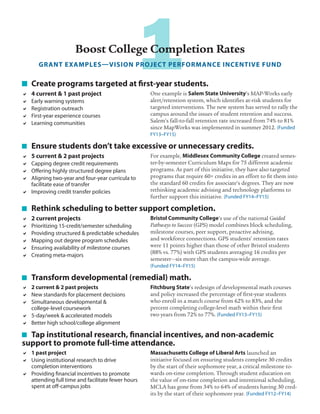
Fitchburg State’s redesign of developmental math courses
and policy increased the percentage of first-year students
who enroll in a match course from 62% to 83%, and the
percent completing college-level math within their first
two years from 72% to 77%. (Funded FY13–FY15)
	 Tap institutional research, financial incentives, and non-academic
support to promote full-time attendance.
DD 1 past project
DD Using institutional research to drive
completion interventions
DD Providing financial incentives to promote
attending full time and facilitate fewer hours
spent at off-campus jobs
Massachusetts College of Liberal Arts launched an
initiative focused on ensuring students complete 30 credits
by the start of their sophomore year, a critical milestone to-
wards on-time completion. Through student education on
the value of on-time completion and intentional scheduling,
MCLA has gone from 34% to 64% of students having 30 cred-
its by the start of their sophomore year. (Funded FY12–FY14)
Boost College Completion Rates
GRANT EXAMPLES—VISION PROJECT PERFORMANCE INCENTIVE FUND
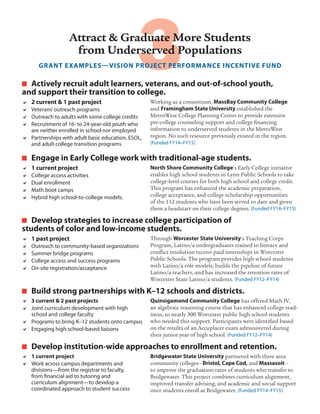
2	 Consciously create supportive relationships for students.
DD 3 current & 3 past projects
DD Student-to-student mentoring
DD Faculty/staff-to-student mentoring,
advising, coaching
For example, UMass Lowell hired and trained 23 peer tutors
for gateway courses in engineering and science majors.
These tutors, recommended by UML faculty, provided
one-on-one and small group sessions, thus providing
individualized academic support for students in these
STEM fields. (Funded FY12–FY14)
	 Provide targeted support for underrepresented students.
DD 3 current & 2 past projects
DD Providing curriculum, student services, and
resources focused on first-generation and
low-income students and students of color
UMass Boston hired a transition coach to provide targeted
support to students who had transferred from Roxbury
Community College. These students received coaching on
both academic and non-academic issues, peer tutoring,
and guidance on how to take advantage of campus resources.
A tracking system keeps the program informed about
student GPAs and credit accumulation. (Funded FY14–FY15)
	 Provide targeted support for low-income males/males of color.
DD Positive youth development programs
DD Gender, academic and
socio-emotional supports
DD Cultural asset-based activities
DHE efforts with this population post-date the last
Performance Incentive Funding round, but the Department
was able to use a one-time federal grant in FY2015 to launch
100 Males to College in partnership with Springfield Public
Schools, Springfield Technical Community College,
Westfield State University, and UMass Amherst. This pilot
initiative combines outreach, mentoring, and professional
development to increase student access and success.
	 Build a campus climate that supports and enhances diversity.
DD 1 current project
DD Ensuring administration, faculty, and staff are
diverse along lines of race/ethnicity, gender,
and sexual orientation
DD Addressing micro-aggressions
DD Offering cultural competency trainings
Springfield Technical Community College launched a range
of targeted initiatives to improve the success of Latino/a
students, including leadership training for Latino/a student
mentors, a Spanish language session of new student
orientation for students and families, and a summer bridge
program, Prepárate!, which focused on skills ranging from
time management to test taking. (Funded FY14–FY15)
	 Make learning relevant and applied where appropriate.
DD 10 current & 1 past project
DD Using internships, co-ops, and service learning
to connect the classroom to career
DD Offering contextualized developmental math
DD Providing information about high-demand
careers of which students may be unaware
DD Recruiting industry experts to speak or teach
on campus
Bunker Hill Community College’s Learn and Earn intern-
ship program enables students to intern 16–30 hours/week
at $15/hour and earn credits in their major. This program,
whose corporate partners include Staples, Raytheon,
and Liberty Mutual, has increased the career readiness of a
diverse group of students, many of whom have gone on
to seek four-year degrees. (Funded FY13–FY15)
Close Achievement Gaps
GRANT EXAMPLES—VISION PROJECT PERFORMANCE INCENTIVE FUND
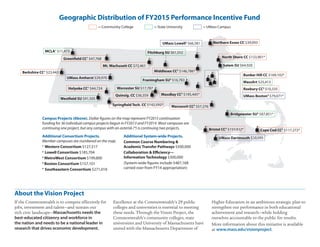
3	 Actively recruit adult learners, veterans, and out-of-school youth,
and support their transition to college.
DD 2 current & 1 past project
DD Veterans’outreach programs
DD Outreach to adults with some college credits
DD Recruitment of 16- to 24-year-old youth who
are neither enrolled in school nor employed
DD Partnerships with adult basic education, ESOL,
and adult college transition programs
Working as a consortium, MassBay Community College
and Framingham State University established the
MetroWest College Planning Center to provide extensive
pre-college counseling support and college financing
information to underserved students in the MetroWest
region. No such resource previously existed in the region.
(Funded FY14–FY15)
	 Engage in Early College work with traditional-age students.
DD 1 current project
DD College access activities
DD Dual enrollment
DD Math boot camps
DD Hybrid high school-to-college models.
North Shore Community College’s Early College initiative
enables high school students in Lynn Public Schools to take
college-level courses for both high school and college credit.
This program has enhanced the academic preparation,
college acceptance, and college scholarship opportunities
of the 112 students who have been served to date and given
them a headstart on their college degrees. (Funded FY14–FY15)
	 Develop strategies to increase college participation of
students of color and low-income students.
DD 1 past project
DD Outreach to community-based organizations
DD Summer bridge programs
DD College access and success programs
DD On-site registration/acceptance
Through Worcester State University’s Teaching Corps
Program, Latino/a undergraduates trained in literacy and
conflict resolution receive paid internships in Worcester
Public Schools. The program provides high school students
with Latino/a role models, builds the pipeline of future
Latino/a teachers, and has increased the retention rates of
Worcester State Latino/a students. (Funded FY12–FY14)
	 Build strong partnerships with K–12 schools and districts.
DD 3 current & 2 past projects
DD Joint curriculum development with high
school and college faculty
DD Programs to bring K–12 students onto campus
DD Engaging high school-based liaisons
Quinsigamond Community College has offered Math IV,
an algebraic reasoning course that has enhanced college read-
iness, to nearly 300 Worcester public high school students
who needed this support. Participants were identified based
on the results of an Accuplacer exam administered during
their junior year of high school. (Funded FY12–FY14)
	 Develop institution-wide approaches to enrollment and retention.
DD 1 current project
DD Work across campus departments and
divisions—from the registrar to faculty,
from financial aid to tutoring and
curriculum alignment—to develop a
coordinated approach to student success
Bridgewater State University partnered with three area
community colleges—Bristol, Cape Cod, and Massasoit—
to improve the graduation rates of students who transfer to
Bridgewater. This project combines curriculum alignment,
improved transfer advising, and academic and social support
once students enroll at Bridgewater. (Funded FY14–FY15)
Attract & Graduate More Students
from Underserved Populations
GRANT EXAMPLES—VISION PROJECT PERFORMANCE INCENTIVE FUND
If the Commonwealth is to compete effectively for
jobs, investment and talent—and sustain our
rich civic landscape—Massachusetts needs the
best-educated citizenry and workforce in
the nation and needs to be a national leader in
research that drives economic development.
Excellence at the Commonwealth’s 29 public
colleges and universities is essential to meeting
these needs. Through the Vision Project, the
Commonwealth’s community colleges, state
universities and University of Massachusetts have
united with the Massachusetts Department of
Higher Education in an ambitious strategic plan to
strengthen our performance in both educational
achievement and research—while holding
ourselves accountable to the public for results.
More information about this initiative is available
at www.mass.edu/visionproject.
Salem SU $64,920
Holyoke CC1
$44,724
Quinsig. CC $36,359
Worcester SU $17,787
Mt. Wachusett CC $72,461
Fitchburg SU $61,552
Geographic Distribution of FY2015 Performance Incentive Fund
Bridgewater SU5
$87,851*
North Shore CC $133,901*
Northern Essex CC $39,093
Greenfield CC1
$47,768
Bunker Hill CC $169,102*
MassArt $25,413
Roxbury CC4
$10,335
= State University= Community College = UMass Campus
UMass Boston4
$79,071*
Middlesex CC2
$146,786*
Framingham SU3
$16,783
Cape Cod CC5
$117,272*Bristol CC5
$159,832*
UMass Dartmouth $20,095
Westfield SU $91,505
MCLA1
$11,473
Berkshire CC1
$23,443
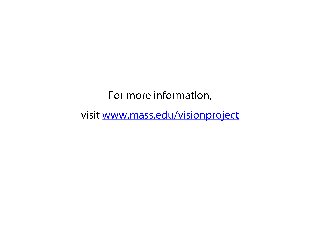
Campus Projects (Above). Dollar figures on the map represent FY2015 continuation
funding for 36 individual campus projects begun in FY2013 and FY2014. Most campuses are
continuing one project, but any campus with an asterisk (*) is continuing two projects.
Additional Consortium Projects.
Member campuses are numbered on the map.
1
Western Consortium $127,517
2
Lowell Consortium $185,704
3
MetroWest Consortium $199,800
4
Boston Consortium $157,101
5
Southeastern Consortium $271,018
Additional System-wide Projects.
Common Course Numbering &
Academic Transfer Pathways $500,000
Collaboration & Efficiency—
Information Technology $300,000
(System-wide figures include $487,168
carried over from FY14 appropriation)
Springfield Tech. CC $142,592*
MassBay CC3
$195,445*
Massasoit CC5
$57,276
UMass Amherst $29,970
UMass Lowell2
$66,581
About the Vision Project
FY2015 Vision Project Performance Incentive Fund Report

FY2015 Vision Project Performance Incentive Fund Report

  • 1.
    FY2015 PERFORMANCE INCENTIVE FUND FocusingResources on the “BigThree”Plan to Produce More College Graduates A Report to the Legislature on the Performance Management Set-Aside Line (7066-0025) ABOUT MASSACHUSETTS PUBLIC HIGHER EDUCATION 29 CAMPUSES 15 COMMUNITY COLLEGES 9 STATE UNIVERSITIES 5 UMASS CAMPUSES 300,000 STUDENTS 40,000 FACULTY AND STAFF 40,000 NEW COLLEGE-EDUCATED CITIZENS & WORKERS ANNUALLY One Ashburton Place, Room 1401 Boston, MA 02108 www.mass.edu | (617) 994-6950 April 2015
  • 2.
    The“Big Three”Completion Plan EffectiveStrategies Underway at Our Campuses PROJECTED SHORTAGE OF QUALIFIED WORKERS In October 2014, the Department of Higher Education (DHE) released the third Vision Project annual report, Degrees of Urgency: Why Massachusetts Needs More College Graduates Now. With an oncoming decline in the size of Massachusetts’ adolescent population, the report proj- ects fewer students enrolling in and graduating from Massachusetts’ public colleges and universities in the coming years. Unless offset by improved performance, this will lead to a shortage of tens of thousands of skilled college graduates needed for the workforce. More at www.mass.edu/vpreport “BIG THREE” COMPLETION PLAN To avert this shortage of college graduates and the threat it poses to the Massachusetts economy, Degrees of Urgency lays out a “Big Three” Completion Plan. It focuses on high-impact strategies under the umbrella of the Vision Project that will address the projected shortfall in students completing degrees and certifi- cates at the state's community colleges, state universi- ties and UMass campuses: CAMPUS CONVENINGS At a February 27 Vision Project Conference, DHE convened 250 faculty, staff and trustees of the public campuses to advance the “Big Three” agenda. Conference planners identified 15 specific, innovative strategies underway on Massachusetts public campuses to achieve the “Big Three” goals, and colleagues around the system shared successful approaches to implementing each of them. Work will continue this summer with a program of cross- campus collaborations designed to facilitate the scaling of effective strategies across the system. PERFORMANCE INCENTIVE FUND Many of these effective strategies have been developed using Vision Project Performance Incentive Fund grants awarded in FY2012–FY2015: FY2012. With a $2.5 million line item in the Commonwealth’s FY2012 budget, the Fund provided grants to 18 campuses, along with a goal of encouraging long-term sustainability of funded initiatives through declining balance continuation grants: 2/3 of the original grant in Year 2 and 1/3 in Year 3. FY2013 & FY2014. The Legislature increased funding to $7.5 million for FY2013 and FY2014, greatly expanding the impact of the funds. DHE was able to issue grants for 41 new projects as well as the smaller continuation grants for previous years’ projects. In addition, DHE was able to launch a system-wide initiative to facilitate transfer between two-year and four-year institutions. FY2015. Due to funding constraints, the Fund was cut back to $3.25 million, and grants were only awarded to continue projects from FY2013 and FY2014, including the system-wide transfer project. DHE hopes that, in FY2016, the Fund will be restored to its FY2014 level so that it can be used to scale effective “Big Three” strategies across the system.
  • 3.
    1 Create programstargeted at first-year students. DD 4 current & 1 past project DD Early warning systems DD Registration outreach DD First-year experience courses DD Learning communities One example is Salem State University’s MAP-Works early alert/retention system, which identifies at-risk students for targeted interventions. The new system has served to rally the campus around the issues of student retention and success. Salem’s fall-to-fall retention rate increased from 74% to 81% since MapWorks was implemented in summer 2012. (Funded FY13–FY15) Ensure students don’t take excessive or unnecessary credits. DD 5 current & 2 past projects DD Capping degree credit requirements DD Offering highly structured degree plans DD Aligning two-year and four-year curricula to facilitate ease of transfer DD Improving credit transfer policies For example, Middlesex Community College created semes- ter-by-semester Curriculum Maps for 75 different academic programs. As part of this initiative, they have also targeted programs that require 60+ credits in an effort to fit them into the standard 60 credits for associate’s degrees. They are now rethinking academic advising and technology platforms to further support this initiative. (Funded FY14–FY15) Rethink scheduling to better support completion. DD 2 current projects DD Prioritizing 15-credit/semester scheduling DD Providing structured & predictable schedules DD Mapping out degree program schedules DD Ensuring availability of milestone courses DD Creating meta-majors Bristol Community College’s use of the national Guided Pathways to Success (GPS) model combines block scheduling, milestone courses, peer support, proactive advising, and workforce connections. GPS students’ retention rates were 11 points higher than those of other Bristol students (88% vs. 77%) with GPS students averaging 16 credits per semester—six more than the campus-wide average. (Funded FY14–FY15) Transform developmental (remedial) math. DD 2 current & 2 past projects DD New standards for placement decisions DD Simultaneous developmental & college-level coursework DD 5-day/week & accelerated models DD Better high school/college alignment Fitchburg State’s redesign of developmental math courses and policy increased the percentage of first-year students who enroll in a match course from 62% to 83%, and the percent completing college-level math within their first two years from 72% to 77%. (Funded FY13–FY15) Tap institutional research, financial incentives, and non-academic support to promote full-time attendance. DD 1 past project DD Using institutional research to drive completion interventions DD Providing financial incentives to promote attending full time and facilitate fewer hours spent at off-campus jobs Massachusetts College of Liberal Arts launched an initiative focused on ensuring students complete 30 credits by the start of their sophomore year, a critical milestone to- wards on-time completion. Through student education on the value of on-time completion and intentional scheduling, MCLA has gone from 34% to 64% of students having 30 cred- its by the start of their sophomore year. (Funded FY12–FY14) Boost College Completion Rates GRANT EXAMPLES—VISION PROJECT PERFORMANCE INCENTIVE FUND
  • 4.
    2 Consciously createsupportive relationships for students. DD 3 current & 3 past projects DD Student-to-student mentoring DD Faculty/staff-to-student mentoring, advising, coaching For example, UMass Lowell hired and trained 23 peer tutors for gateway courses in engineering and science majors. These tutors, recommended by UML faculty, provided one-on-one and small group sessions, thus providing individualized academic support for students in these STEM fields. (Funded FY12–FY14) Provide targeted support for underrepresented students. DD 3 current & 2 past projects DD Providing curriculum, student services, and resources focused on first-generation and low-income students and students of color UMass Boston hired a transition coach to provide targeted support to students who had transferred from Roxbury Community College. These students received coaching on both academic and non-academic issues, peer tutoring, and guidance on how to take advantage of campus resources. A tracking system keeps the program informed about student GPAs and credit accumulation. (Funded FY14–FY15) Provide targeted support for low-income males/males of color. DD Positive youth development programs DD Gender, academic and socio-emotional supports DD Cultural asset-based activities DHE efforts with this population post-date the last Performance Incentive Funding round, but the Department was able to use a one-time federal grant in FY2015 to launch 100 Males to College in partnership with Springfield Public Schools, Springfield Technical Community College, Westfield State University, and UMass Amherst. This pilot initiative combines outreach, mentoring, and professional development to increase student access and success. Build a campus climate that supports and enhances diversity. DD 1 current project DD Ensuring administration, faculty, and staff are diverse along lines of race/ethnicity, gender, and sexual orientation DD Addressing micro-aggressions DD Offering cultural competency trainings Springfield Technical Community College launched a range of targeted initiatives to improve the success of Latino/a students, including leadership training for Latino/a student mentors, a Spanish language session of new student orientation for students and families, and a summer bridge program, Prepárate!, which focused on skills ranging from time management to test taking. (Funded FY14–FY15) Make learning relevant and applied where appropriate. DD 10 current & 1 past project DD Using internships, co-ops, and service learning to connect the classroom to career DD Offering contextualized developmental math DD Providing information about high-demand careers of which students may be unaware DD Recruiting industry experts to speak or teach on campus Bunker Hill Community College’s Learn and Earn intern- ship program enables students to intern 16–30 hours/week at $15/hour and earn credits in their major. This program, whose corporate partners include Staples, Raytheon, and Liberty Mutual, has increased the career readiness of a diverse group of students, many of whom have gone on to seek four-year degrees. (Funded FY13–FY15) Close Achievement Gaps GRANT EXAMPLES—VISION PROJECT PERFORMANCE INCENTIVE FUND
  • 5.
    3 Actively recruitadult learners, veterans, and out-of-school youth, and support their transition to college. DD 2 current & 1 past project DD Veterans’outreach programs DD Outreach to adults with some college credits DD Recruitment of 16- to 24-year-old youth who are neither enrolled in school nor employed DD Partnerships with adult basic education, ESOL, and adult college transition programs Working as a consortium, MassBay Community College and Framingham State University established the MetroWest College Planning Center to provide extensive pre-college counseling support and college financing information to underserved students in the MetroWest region. No such resource previously existed in the region. (Funded FY14–FY15) Engage in Early College work with traditional-age students. DD 1 current project DD College access activities DD Dual enrollment DD Math boot camps DD Hybrid high school-to-college models. North Shore Community College’s Early College initiative enables high school students in Lynn Public Schools to take college-level courses for both high school and college credit. This program has enhanced the academic preparation, college acceptance, and college scholarship opportunities of the 112 students who have been served to date and given them a headstart on their college degrees. (Funded FY14–FY15) Develop strategies to increase college participation of students of color and low-income students. DD 1 past project DD Outreach to community-based organizations DD Summer bridge programs DD College access and success programs DD On-site registration/acceptance Through Worcester State University’s Teaching Corps Program, Latino/a undergraduates trained in literacy and conflict resolution receive paid internships in Worcester Public Schools. The program provides high school students with Latino/a role models, builds the pipeline of future Latino/a teachers, and has increased the retention rates of Worcester State Latino/a students. (Funded FY12–FY14) Build strong partnerships with K–12 schools and districts. DD 3 current & 2 past projects DD Joint curriculum development with high school and college faculty DD Programs to bring K–12 students onto campus DD Engaging high school-based liaisons Quinsigamond Community College has offered Math IV, an algebraic reasoning course that has enhanced college read- iness, to nearly 300 Worcester public high school students who needed this support. Participants were identified based on the results of an Accuplacer exam administered during their junior year of high school. (Funded FY12–FY14) Develop institution-wide approaches to enrollment and retention. DD 1 current project DD Work across campus departments and divisions—from the registrar to faculty, from financial aid to tutoring and curriculum alignment—to develop a coordinated approach to student success Bridgewater State University partnered with three area community colleges—Bristol, Cape Cod, and Massasoit— to improve the graduation rates of students who transfer to Bridgewater. This project combines curriculum alignment, improved transfer advising, and academic and social support once students enroll at Bridgewater. (Funded FY14–FY15) Attract & Graduate More Students from Underserved Populations GRANT EXAMPLES—VISION PROJECT PERFORMANCE INCENTIVE FUND
  • 6.
    If the Commonwealthis to compete effectively for jobs, investment and talent—and sustain our rich civic landscape—Massachusetts needs the best-educated citizenry and workforce in the nation and needs to be a national leader in research that drives economic development. Excellence at the Commonwealth’s 29 public colleges and universities is essential to meeting these needs. Through the Vision Project, the Commonwealth’s community colleges, state universities and University of Massachusetts have united with the Massachusetts Department of Higher Education in an ambitious strategic plan to strengthen our performance in both educational achievement and research—while holding ourselves accountable to the public for results. More information about this initiative is available at www.mass.edu/visionproject. Salem SU $64,920 Holyoke CC1 $44,724 Quinsig. CC $36,359 Worcester SU $17,787 Mt. Wachusett CC $72,461 Fitchburg SU $61,552 Geographic Distribution of FY2015 Performance Incentive Fund Bridgewater SU5 $87,851* North Shore CC $133,901* Northern Essex CC $39,093 Greenfield CC1 $47,768 Bunker Hill CC $169,102* MassArt $25,413 Roxbury CC4 $10,335 = State University= Community College = UMass Campus UMass Boston4 $79,071* Middlesex CC2 $146,786* Framingham SU3 $16,783 Cape Cod CC5 $117,272*Bristol CC5 $159,832* UMass Dartmouth $20,095 Westfield SU $91,505 MCLA1 $11,473 Berkshire CC1 $23,443 Campus Projects (Above). Dollar figures on the map represent FY2015 continuation funding for 36 individual campus projects begun in FY2013 and FY2014. Most campuses are continuing one project, but any campus with an asterisk (*) is continuing two projects. Additional Consortium Projects. Member campuses are numbered on the map. 1 Western Consortium $127,517 2 Lowell Consortium $185,704 3 MetroWest Consortium $199,800 4 Boston Consortium $157,101 5 Southeastern Consortium $271,018 Additional System-wide Projects. Common Course Numbering & Academic Transfer Pathways $500,000 Collaboration & Efficiency— Information Technology $300,000 (System-wide figures include $487,168 carried over from FY14 appropriation) Springfield Tech. CC $142,592* MassBay CC3 $195,445* Massasoit CC5 $57,276 UMass Amherst $29,970 UMass Lowell2 $66,581 About the Vision Project