Hacking and Compliance in a Web 2.0 World Damon P. Cortesi, CISSP Director @ Alchemy Security Stats Nut | Security Geek | Builder of Tools
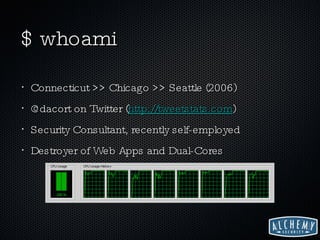
$ whoami Connecticut >> Chicago >> Seattle (2006) @dacort on Twitter ( http://tweetstats.com ) Security Consultant, recently self-employed Destroyer of Web Apps and Dual-Cores
$ cat ~/.plan Web 2.0 Security Things you still need to watch out for. E-commerce Startups and Compliance What is this PCI thing you speak of? Privacy Policy and Data Breach Notification Laws. And maybe if we’re lucky...demo time.
Web 2.0 Frameworks Rails, Django, CakePHP Rapid Development, Data abstraction Alleviates common security pain points SQL Injection Cross-Site Scripting (kind of ...) Typical challenges still present
The “kind of” - XSS As of Django 1.0 (Sep 2008), HTML is auto-escaped YAYYYYYYYYYYYY! Does Rails? ------------------------- No Does Google App Engine? -------- No Really? Yup, really. (No domain-wide cookies, phew!)  Does ASP.NET ---------------------- On built-in controls Also has built-in request validation
Define Briefly SQL Injection - Unsanitized data being passed to a database, potentially executing arbitrary code. dpc’ OR ‘a’=’a xp_cmdshell XSS - Unsanitized data being re-displayed and interpreted in the browser. <script>alert(document.cookie);</script>
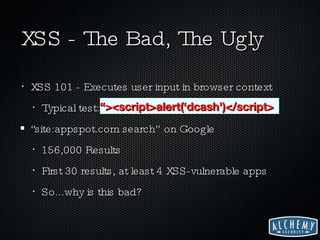
XSS - The Bad, The Ugly XSS 101 - Executes user input in browser context Typical test:  “><script>alert(‘dcash’)</script> “site:appspot.com search” on Google 156,000 Results First 30 results, at least 4 XSS-vulnerable apps So...why is this bad? “ ><script>alert(‘dcash’)</script>
XSS Scenarios Arbitrary JavaScript Execution Page/HTML inserts, deletes Browser control, exploit download Cookie monsters
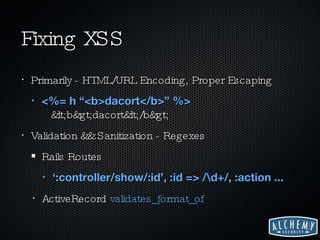
Fixing XSS Primarily - HTML/URL Encoding, Proper Escaping <%= h “<b>dacort</b>” %>   &lt;b&gt;dacort&lt;/b&gt; Validation && Sanitization - Regexes Rails Routes ‘ :controller/show/:id’, :id => /\d+/, :action ... ActiveRecord  validates_format_of
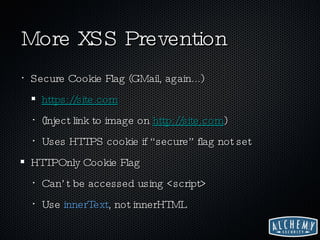
More XSS Prevention Secure Cookie Flag (GMail, again...) https://site.com (Inject link to image on  http ://site.com ) Uses HTTPS cookie if “secure” flag not set HTTPOnly Cookie Flag Can’t be accessed using <script> Use  innerText , not innerHTML
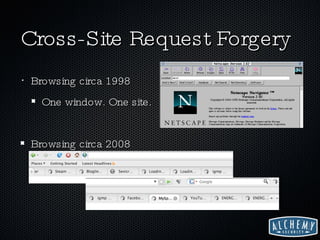
Cross-Site Request Forgery Browsing circa 1998 One window. One site. Browsing circa 2008
CSRF++ Daily browsing - authenticated to many sites at once GET style attacks <img src=” http://x.com/message/123/delete ”/> Cookies sent with this request POST style attacks Generally combined with JavaScript Due to lack of form tokens GMail Hack (There’s a new one!!)
CSRF GET <img src=” http://x.com/message/123/delete ”/> <img src=” http://x.com/message/124/delete ”/> <img src=” http://x.com/message/125/delete ”/> <img src=” http://x.com/message/126/delete ”/> <img src=” http://x.com/message/.../delete ”/> No tokens? Logged in? Valid message? “Pwned” POST requests not the solution
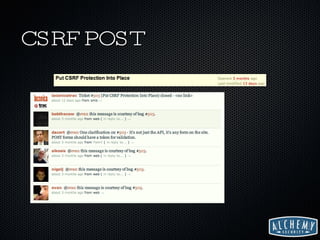
CSRF POST
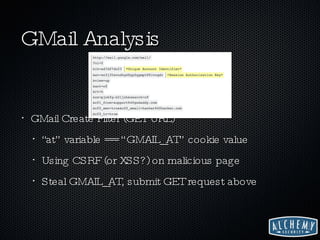
GMail Analysis GMail Create Filter (GET URL) “at” variable == “GMAIL_AT” cookie value Using CSRF (or XSS?) on malicious page Steal GMAIL_AT, submit GET request above
Third-Party Components You installed what?? Drupal Plugins Wordpress Plugins Themes, too! ASP.NET Components Is that code secure? Does it execute commands? Does it utilize network? Funky encoding...
What to Look For? Find input vectors Request.[Cookies|Form|QueryString] $_GET, $_POST, $_REQUEST (<-- careful) params[:id] Make sure output is protected Encoding to browser, Escaping to database, etc
Poor Design = Poor Security Example Startup FreeMail (names changed ... ) RSS feed for your Inbox Google does it, why can’t we? No authentication No SSL No security
Flash Security Flash - Fantastic base on which to build dynamic sites crossdomain.xml - Allows Flash to access data on different domains BAD : <allow-access-from domain=&quot;*&quot;/> Can ultimately allow for compromise of user data (cookies) if trusted domain is vulnerable to XSS, etc
Some Other Things... Keeping systems/software up-to-date Rails < 2.1.1? -- SQL Injection bug JumpBox (Server Provisioning) uses Rails 2.1.0 Curious - How do you manage security updates? Infrastructure Security Do _you_ know your external network presence? Have all _your_ default passwords been changed?
And a few more... Multiple layers of restriction Have a phpMyAdmin Internet-accessible? Do you ... Restrict access by IP address? Rename the default location? Have authentication enabled? Process .  Process .  Process .
One last thing ... Not always some über-technical buffer overflow sploit... Access database on unprotected share demo/demo password Email on confirmation page Are people thinking securely?
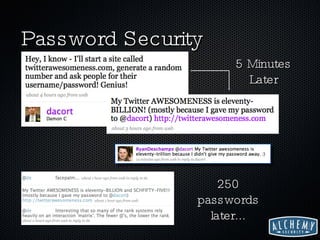
Password Security 250 passwords later... 5 Minutes Later
Switching Gears Compliance
We <3 Our Data Some of that data is restricted, though! Personally Identifiable Information (PII) Data Breach Notification Laws Payment Card Industry (Credit Cards, PCI) So you’re building a web service... ...what do you need to know?
Planning and Process 44 states have data breach notification laws Name, address, email Social Security Number Passport ID, License Number If you are compromised and the above is unencrypted and compromised - you must notify data owners.
Data Breach/Privacy Policy Data Breach Laws are why services such as Twitter and Evernote have this in their Privacy Policy. If Evernote learns of a security system breach we may attempt to notify you and provide information on protective steps, if available, through the e-mail address that you supplied during registration or posting a notice on our web site. Depending on where you live, you may have a legal right to receive such notices in writing. --  http://evernote.com/about/privacy/ We will make any legally-required disclosures of any breach of the security, confidentiality, or integrity of your unencrypted electronically stored personal data to you via email or conspicuous posting on this Site in the most expedient time possible and without unreasonable delay. -- http://twitter.com/privacy
PCI PCI only applies to you if you “store, process, or transmit cardholder data.” Want the PCI compliance monkey off your back? “ It’s simple, just don’t ever store, process, or transmit cardholder data - let someone else do it for you.” And if you must store, process, or transmit ... call us.
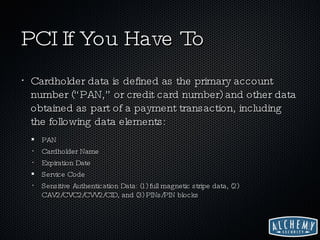
PCI If You Have To Cardholder data is defined as the primary account number (“PAN,” or credit card number) and other data obtained as part of a payment transaction, including the following data elements: PAN Cardholder Name Expiration Date Service Code Sensitive Authentication Data: (1) full magnetic stripe data, (2) CAV2/CVC2/CVV2/CID, and (3) PINs/PIN blocks
Thanks [email_address] http://xkcd.com/327/

StartPad Countdown 2 - Startup Security: Hacking and Compliance in a Web 2.0 World

  • 1.
    Hacking and Compliancein a Web 2.0 World Damon P. Cortesi, CISSP Director @ Alchemy Security Stats Nut | Security Geek | Builder of Tools
  • 2.
    $ whoami Connecticut>> Chicago >> Seattle (2006) @dacort on Twitter ( http://tweetstats.com ) Security Consultant, recently self-employed Destroyer of Web Apps and Dual-Cores
  • 3.
    $ cat ~/.planWeb 2.0 Security Things you still need to watch out for. E-commerce Startups and Compliance What is this PCI thing you speak of? Privacy Policy and Data Breach Notification Laws. And maybe if we’re lucky...demo time.
  • 4.
    Web 2.0 FrameworksRails, Django, CakePHP Rapid Development, Data abstraction Alleviates common security pain points SQL Injection Cross-Site Scripting (kind of ...) Typical challenges still present
  • 5.
    The “kind of”- XSS As of Django 1.0 (Sep 2008), HTML is auto-escaped YAYYYYYYYYYYYY! Does Rails? ------------------------- No Does Google App Engine? -------- No Really? Yup, really. (No domain-wide cookies, phew!) Does ASP.NET ---------------------- On built-in controls Also has built-in request validation
  • 6.
    Define Briefly SQLInjection - Unsanitized data being passed to a database, potentially executing arbitrary code. dpc’ OR ‘a’=’a xp_cmdshell XSS - Unsanitized data being re-displayed and interpreted in the browser. <script>alert(document.cookie);</script>
  • 7.
    XSS - TheBad, The Ugly XSS 101 - Executes user input in browser context Typical test: “><script>alert(‘dcash’)</script> “site:appspot.com search” on Google 156,000 Results First 30 results, at least 4 XSS-vulnerable apps So...why is this bad? “ ><script>alert(‘dcash’)</script>
  • 8.
    XSS Scenarios ArbitraryJavaScript Execution Page/HTML inserts, deletes Browser control, exploit download Cookie monsters
  • 9.
    Fixing XSS Primarily- HTML/URL Encoding, Proper Escaping <%= h “<b>dacort</b>” %> &lt;b&gt;dacort&lt;/b&gt; Validation && Sanitization - Regexes Rails Routes ‘ :controller/show/:id’, :id => /\d+/, :action ... ActiveRecord validates_format_of
  • 10.
    More XSS PreventionSecure Cookie Flag (GMail, again...) https://site.com (Inject link to image on http ://site.com ) Uses HTTPS cookie if “secure” flag not set HTTPOnly Cookie Flag Can’t be accessed using <script> Use innerText , not innerHTML
  • 11.
    Cross-Site Request ForgeryBrowsing circa 1998 One window. One site. Browsing circa 2008
  • 12.
    CSRF++ Daily browsing- authenticated to many sites at once GET style attacks <img src=” http://x.com/message/123/delete ”/> Cookies sent with this request POST style attacks Generally combined with JavaScript Due to lack of form tokens GMail Hack (There’s a new one!!)
  • 13.
    CSRF GET <imgsrc=” http://x.com/message/123/delete ”/> <img src=” http://x.com/message/124/delete ”/> <img src=” http://x.com/message/125/delete ”/> <img src=” http://x.com/message/126/delete ”/> <img src=” http://x.com/message/.../delete ”/> No tokens? Logged in? Valid message? “Pwned” POST requests not the solution
  • 14.
  • 15.
    GMail Analysis GMailCreate Filter (GET URL) “at” variable == “GMAIL_AT” cookie value Using CSRF (or XSS?) on malicious page Steal GMAIL_AT, submit GET request above
  • 16.
    Third-Party Components Youinstalled what?? Drupal Plugins Wordpress Plugins Themes, too! ASP.NET Components Is that code secure? Does it execute commands? Does it utilize network? Funky encoding...
  • 17.
    What to LookFor? Find input vectors Request.[Cookies|Form|QueryString] $_GET, $_POST, $_REQUEST (<-- careful) params[:id] Make sure output is protected Encoding to browser, Escaping to database, etc
  • 18.
    Poor Design =Poor Security Example Startup FreeMail (names changed ... ) RSS feed for your Inbox Google does it, why can’t we? No authentication No SSL No security
  • 19.
    Flash Security Flash- Fantastic base on which to build dynamic sites crossdomain.xml - Allows Flash to access data on different domains BAD : <allow-access-from domain=&quot;*&quot;/> Can ultimately allow for compromise of user data (cookies) if trusted domain is vulnerable to XSS, etc
  • 20.
    Some Other Things...Keeping systems/software up-to-date Rails < 2.1.1? -- SQL Injection bug JumpBox (Server Provisioning) uses Rails 2.1.0 Curious - How do you manage security updates? Infrastructure Security Do _you_ know your external network presence? Have all _your_ default passwords been changed?
  • 21.
    And a fewmore... Multiple layers of restriction Have a phpMyAdmin Internet-accessible? Do you ... Restrict access by IP address? Rename the default location? Have authentication enabled? Process . Process . Process .
  • 22.
    One last thing... Not always some über-technical buffer overflow sploit... Access database on unprotected share demo/demo password Email on confirmation page Are people thinking securely?
  • 23.
    Password Security 250passwords later... 5 Minutes Later
  • 24.
  • 25.
    We <3 OurData Some of that data is restricted, though! Personally Identifiable Information (PII) Data Breach Notification Laws Payment Card Industry (Credit Cards, PCI) So you’re building a web service... ...what do you need to know?
  • 26.
    Planning and Process44 states have data breach notification laws Name, address, email Social Security Number Passport ID, License Number If you are compromised and the above is unencrypted and compromised - you must notify data owners.
  • 27.
    Data Breach/Privacy PolicyData Breach Laws are why services such as Twitter and Evernote have this in their Privacy Policy. If Evernote learns of a security system breach we may attempt to notify you and provide information on protective steps, if available, through the e-mail address that you supplied during registration or posting a notice on our web site. Depending on where you live, you may have a legal right to receive such notices in writing. -- http://evernote.com/about/privacy/ We will make any legally-required disclosures of any breach of the security, confidentiality, or integrity of your unencrypted electronically stored personal data to you via email or conspicuous posting on this Site in the most expedient time possible and without unreasonable delay. -- http://twitter.com/privacy
  • 28.
    PCI PCI onlyapplies to you if you “store, process, or transmit cardholder data.” Want the PCI compliance monkey off your back? “ It’s simple, just don’t ever store, process, or transmit cardholder data - let someone else do it for you.” And if you must store, process, or transmit ... call us.
  • 29.
    PCI If YouHave To Cardholder data is defined as the primary account number (“PAN,” or credit card number) and other data obtained as part of a payment transaction, including the following data elements: PAN Cardholder Name Expiration Date Service Code Sensitive Authentication Data: (1) full magnetic stripe data, (2) CAV2/CVC2/CVV2/CID, and (3) PINs/PIN blocks
  • 30.