Submitted by
Satwant Kaur
College Roll No. 171107
University Roll No. 17051119
The stars
Stars
 The star appear to move from east to west due
to rotation of earth on its axis from west to east.
 Surface temperature of star determines colour
of star.
LOW temperature
HIGH temperature
RED
WHITE
VERY HIGH temperature BLUE
Pole star
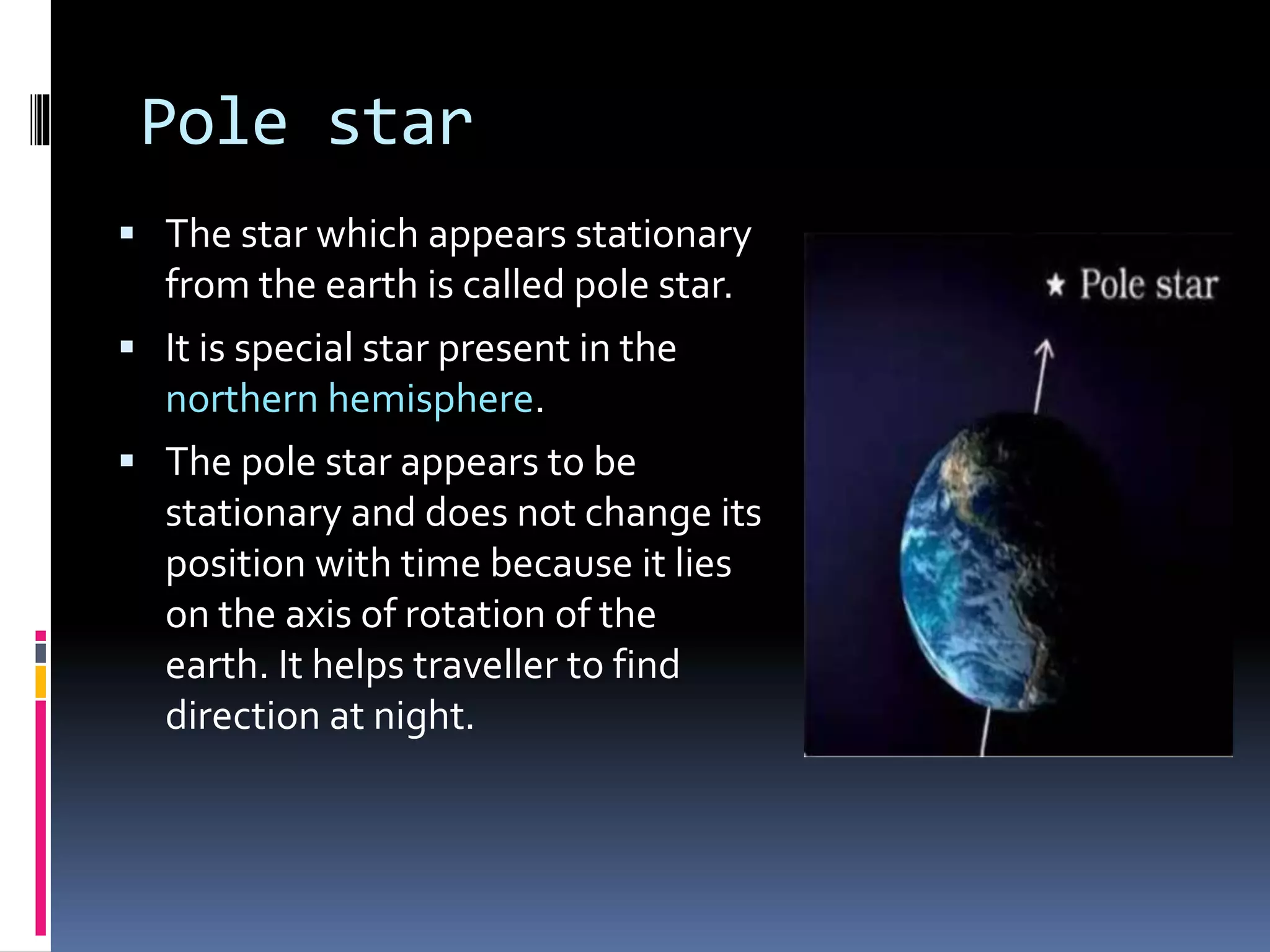
 The star which appears stationary
from the earth is called pole star.
 It is special star present in the
northern hemisphere.
 The pole star appears to be
stationary and does not change its
position with time because it lies
on the axis of rotation of the
earth. It helps traveller to find
direction at night.
Constellations
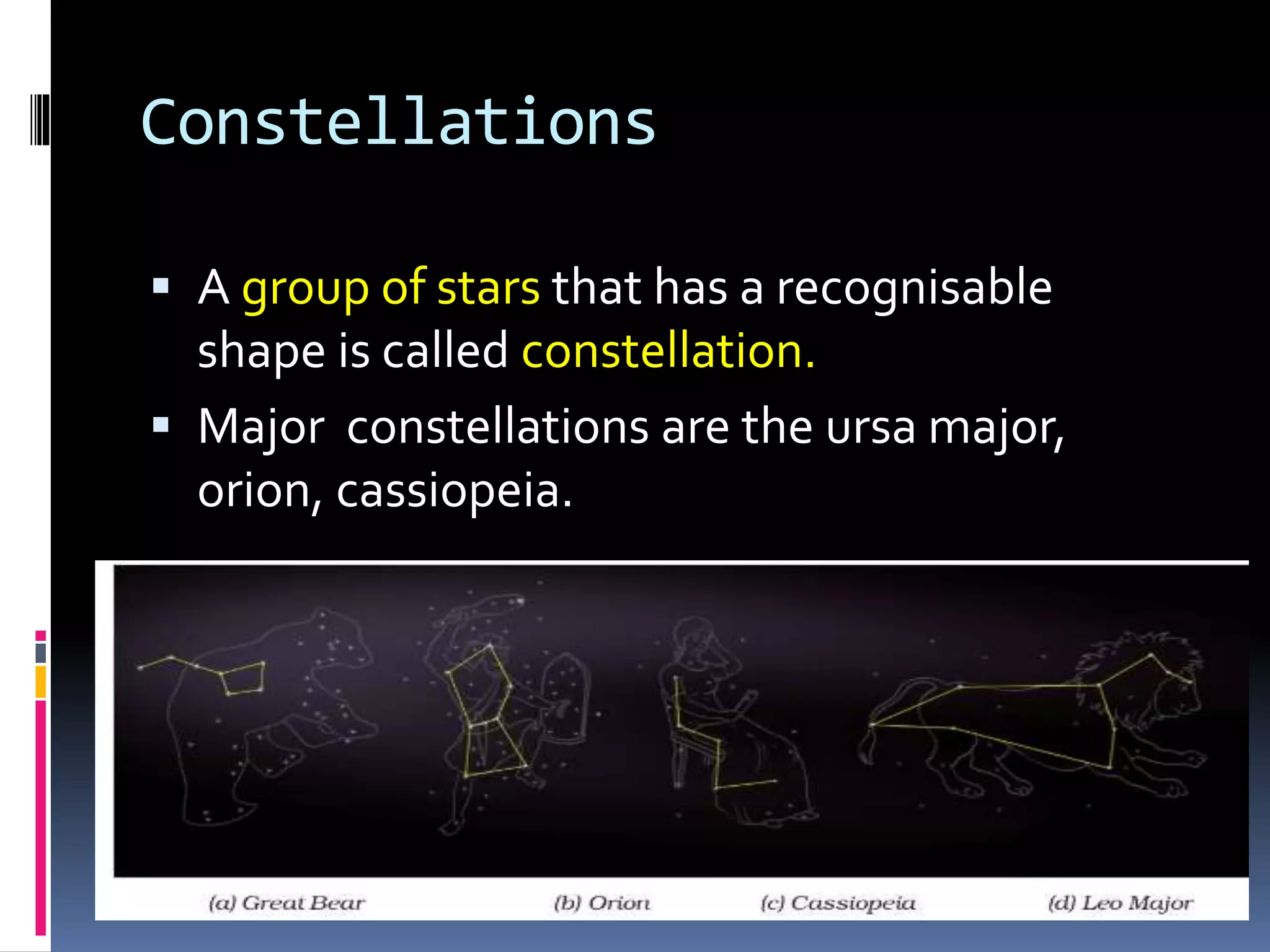
 A group of stars that has a recognisable
shape is called constellation.
 Major constellations are the ursa major,
orion, cassiopeia.
Revolution of ursa major around
pole star
Solar system
 The solar system consists of the sun, eight planets
and their satellites and the thousands of other
smaller bodies like asteroids, comets, meteors,
meteoroids.
 The gravitational pull between the sun and these
celestial bodies keeps all of them revolving around
the sun.
The 8 planets of solar system
are :
 Mercury
 Venus
 Earth
 Mars
 Jupiter
 Saturn
 Uranus
 Neptune
Planets
 A planet is made up of rock and metal or gas.
 Planet do notTWINKLE like the stars . So they
don’t twinkle like the stars. Planets reflect
sunlight that is incident on them.
 All the planets revolve around the sun and also
rotate on its own axis.
 A day for a planet equals to time taken by it to
complete one rotation around its own axis
 A year for a planet equals to time taken by it to
complete one revolution around the sun in its
orbit.
Revolution
Period of revolution
The time taken by a planet to complete one full revolution
around the sun is called its period of revolution.
Period of rotation
The time taken by a planet to rotate a full 360 degrees on its
axis is called its period of rotation
Axis of rotation
The axis of rotation is an imaginary line going from the
north pole to the south pole.
Mercury
•First planet
•Smallest planet
•Complete one
rotation in 88 days
•Hot during the
day and cold at
night
•Has no moon
Venus Second planet
No moons
Closest to
earth
Brightest planet
Hotter than mercury
due to high carbon
dioxide in its
atmosphere.
Earth Third
planet
Supports
life
Has one
moon
71% is
water
Mars
Fourth
planet
Red
planet
Has 2 moons
named as
PHOBOS&
DEIMOS
Small size
(half than
earth)
Visible to
the naked
eye
Jupiter
Fifth
planet
Largest
planet
Has 63
moons
Gas
planet
Saturn
Sixth planet
Second
biggest
planet
System of
coloured
rings
Has 31
moons
Uranus
Seventh
planet
Second
coldest
planet
Has
system of
rings
Has 27
moons
Neptune
Eight
planet
Has 4
rings
Coldest
planet
Has 13
moons
satellites
Types
Natural Artificial
Stars and solar system

Stars and solar system