The Evolution of Psychology History, Approaches, and Questions
The Evolution of Psychology Learning Objectives: Explain how psychology changed from a philosophical to a scientific discipline. List the most important questions that concern psychologists. Outline the basic schools of psychology and describe how each school has contributed to psychology.
The Evolution of Psychology Psychology has changed dramatically over its history. The field has moved from speculation about behavior to a more objective, scientific approach. There has been an increasing influx of women into the field. Most psychologists are now women. However, the basic questions of psychology have remained constant.
The Evolution of Psychology
The Evolution of Psychology: The First Psychologists Were Philosophers
The Evolution of Psychology: The First Psychologists Were Philosophers Greek Philosophers Plato (428 BC – 347 BC)  –  “nature:”  certain types of knowledge are inborn Aristotle (384 BC – 322 BC)  – “nurture:”  children are born a blank slate; knowledge is acquired through experience European Renaissance Philosophers Rene Descartes (1596 – 1650 BC)  –  believed in: free will – the mind controls the body; nature – innate natural abilities; dualism – the mind and body and fundamentally different Thomas Hobbes, John Locke, Jean-Jacques Rousseau
The Evolution of Psychology: The First Psychologists Were Philosophers These philosophers did not conduct research to support their arguments.  The transition from philosophy to psychology occurred in the 1800s. Wilhelm Wundt (1832-1920)  – developed psychology laboratory in Leipzig, Germany William James (1842-1910) –  founded laboratory at Harvard University
The Evolution of Psychology: The First Psychologists Were Philosophers
The Evolution of Psychology
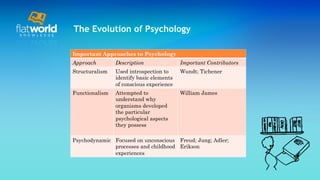
The Evolution of Psychology: Structuralism Structuralism – a school of psychology aimed at identifying the basic elements of conscious experience Structuralists used introspection to map the elements of consciousness. introspection  – involves asking participants to describe exactly what they experience during mental tasks
The Evolution of Psychology: Structuralism
 
The Evolution of Psychology: Functionalism Functionalism – the goal is to understand why animals and humans have developed the particular psychological aspects they currently possess Associated with William James and influenced by Darwin’s theory of natural selection Functionalism’s principles have been absorbed into psychology. Functionalism’s legacy is most apparent in the field of  evolutionary psychology .
The Evolution of Psychology: Evolutionary Psychology Evolutionary psychology – branch of psychology that applies the Darwinian theory of natural selection to human and animal behavior Fitness  – the extent to which a characteristic helps the individual organism survive and reproduce
The Evolution of Psychology: Evolutionary Psychology
The Evolution of Psychology: Psychodynamic Psychology Psychodynamic psychology – an approach focusing on the role of unconscious thoughts, feelings, and memories Unconscious processes may be revealed through talk therapy and dream analysis, components of  psychotherapy  or  psychoanalysis.
The Evolution of Psychology: Psychodynamic Psychology
The Evolution of Psychology: Behaviorism Behaviorism – approach based on the idea that consciousness cannot be studied objectively proposed that psychologists should limit their attention to behavior itself
The Evolution of Psychology: Behaviorism
The Evolution of Psychology: Cognitive Psychology Cognitive psychology – field that studies mental processes, such as perception, memory, and judgment achieved prominence in the 1960s, with the advent of computer technology argues that understanding mental processes is necessary to understand behavior
The Evolution of Psychology: Cognitive Psychology Studied memory for lists under different conditions Studied the cognitive and social processes of remembering Found that our knowledge and expectations influence our memory Hermann Ebbinghaus Sir Frederic Bartlett
The Evolution of Psychology: Cognitive Psychology
The Evolution of Psychology: Cognitive Psychology The cognitive approach remains highly influential in many areas of psychology. Cognitive psychology has benefited from advances in neuroimaging. neuroimaging  – the use of techniques to provide pictures of the structure and function of the living brain
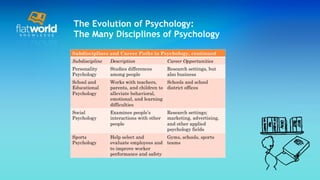
The Evolution of Psychology: The Many Disciplines of Psychology Psychology is not a single discipline, but a collection of many subdisciplines. The subdisciplines share common approaches and exchange knowledge
The Evolution of Psychology: The Many Disciplines of Psychology
The Evolution of Psychology Key Takeaways The first psychologists were philosophers, but the field became more objective as more sophisticated scientific approaches were developed and employed. Some basic questions asked by psychologists include those of nature versus nurture, free-will versus determinism, accuracy versus inaccuracy, and conscious versus unconscious processing.  The Structuralists attempted to analyze the nature of consciousness using introspection. The Functionalists based their ideas on the work of Darwin and their approaches led to the field of evolutionary psychology.
The Evolution of Psychology Key Takeaways, continued The Behaviorists explained behavior in terms of stimulus, response and reinforcement, while denying the presence of free will. Cognitive psychologists study how people perceive, process, and remember information. Psychodynamic psychology focuses on unconscious drives and the potential to improve lives through psychoanalysis and psychotherapy. The social-cultural approach focuses on the social situation, including how cultures and social norms influence our behavior.

Stangor ppt-ch01-2

  • 1.
    The Evolution ofPsychology History, Approaches, and Questions
  • 2.
    The Evolution ofPsychology Learning Objectives: Explain how psychology changed from a philosophical to a scientific discipline. List the most important questions that concern psychologists. Outline the basic schools of psychology and describe how each school has contributed to psychology.
  • 3.
    The Evolution ofPsychology Psychology has changed dramatically over its history. The field has moved from speculation about behavior to a more objective, scientific approach. There has been an increasing influx of women into the field. Most psychologists are now women. However, the basic questions of psychology have remained constant.
  • 4.
    The Evolution ofPsychology
  • 5.
    The Evolution ofPsychology
  • 6.
    The Evolution ofPsychology: The First Psychologists Were Philosophers
  • 7.
    The Evolution ofPsychology: The First Psychologists Were Philosophers Greek Philosophers Plato (428 BC – 347 BC) – “nature:” certain types of knowledge are inborn Aristotle (384 BC – 322 BC) – “nurture:” children are born a blank slate; knowledge is acquired through experience European Renaissance Philosophers Rene Descartes (1596 – 1650 BC) – believed in: free will – the mind controls the body; nature – innate natural abilities; dualism – the mind and body and fundamentally different Thomas Hobbes, John Locke, Jean-Jacques Rousseau
  • 8.
    The Evolution ofPsychology: The First Psychologists Were Philosophers These philosophers did not conduct research to support their arguments. The transition from philosophy to psychology occurred in the 1800s. Wilhelm Wundt (1832-1920) – developed psychology laboratory in Leipzig, Germany William James (1842-1910) – founded laboratory at Harvard University
  • 9.
    The Evolution ofPsychology: The First Psychologists Were Philosophers
  • 10.
    The Evolution ofPsychology: The First Psychologists Were Philosophers
  • 11.
    The Evolution ofPsychology
  • 12.
    The Evolution ofPsychology
  • 13.
    The Evolution ofPsychology: Structuralism Structuralism – a school of psychology aimed at identifying the basic elements of conscious experience Structuralists used introspection to map the elements of consciousness. introspection – involves asking participants to describe exactly what they experience during mental tasks
  • 14.
    The Evolution ofPsychology: Structuralism
  • 15.
  • 16.
    The Evolution ofPsychology: Functionalism Functionalism – the goal is to understand why animals and humans have developed the particular psychological aspects they currently possess Associated with William James and influenced by Darwin’s theory of natural selection Functionalism’s principles have been absorbed into psychology. Functionalism’s legacy is most apparent in the field of evolutionary psychology .
  • 17.
    The Evolution ofPsychology: Evolutionary Psychology Evolutionary psychology – branch of psychology that applies the Darwinian theory of natural selection to human and animal behavior Fitness – the extent to which a characteristic helps the individual organism survive and reproduce
  • 18.
    The Evolution ofPsychology: Evolutionary Psychology
  • 19.
    The Evolution ofPsychology: Psychodynamic Psychology Psychodynamic psychology – an approach focusing on the role of unconscious thoughts, feelings, and memories Unconscious processes may be revealed through talk therapy and dream analysis, components of psychotherapy or psychoanalysis.
  • 20.
    The Evolution ofPsychology: Psychodynamic Psychology
  • 21.
    The Evolution ofPsychology: Psychodynamic Psychology
  • 22.
    The Evolution ofPsychology: Behaviorism Behaviorism – approach based on the idea that consciousness cannot be studied objectively proposed that psychologists should limit their attention to behavior itself
  • 23.
    The Evolution ofPsychology: Behaviorism
  • 24.
    The Evolution ofPsychology: Behaviorism
  • 25.
    The Evolution ofPsychology: Cognitive Psychology Cognitive psychology – field that studies mental processes, such as perception, memory, and judgment achieved prominence in the 1960s, with the advent of computer technology argues that understanding mental processes is necessary to understand behavior
  • 26.
    The Evolution ofPsychology: Cognitive Psychology Studied memory for lists under different conditions Studied the cognitive and social processes of remembering Found that our knowledge and expectations influence our memory Hermann Ebbinghaus Sir Frederic Bartlett
  • 27.
    The Evolution ofPsychology: Cognitive Psychology
  • 28.
    The Evolution ofPsychology: Cognitive Psychology The cognitive approach remains highly influential in many areas of psychology. Cognitive psychology has benefited from advances in neuroimaging. neuroimaging – the use of techniques to provide pictures of the structure and function of the living brain
  • 29.
    The Evolution ofPsychology: The Many Disciplines of Psychology Psychology is not a single discipline, but a collection of many subdisciplines. The subdisciplines share common approaches and exchange knowledge
  • 30.
    The Evolution ofPsychology: The Many Disciplines of Psychology
  • 31.
    The Evolution ofPsychology: The Many Disciplines of Psychology
  • 32.
    The Evolution ofPsychology: The Many Disciplines of Psychology
  • 33.
    The Evolution ofPsychology Key Takeaways The first psychologists were philosophers, but the field became more objective as more sophisticated scientific approaches were developed and employed. Some basic questions asked by psychologists include those of nature versus nurture, free-will versus determinism, accuracy versus inaccuracy, and conscious versus unconscious processing. The Structuralists attempted to analyze the nature of consciousness using introspection. The Functionalists based their ideas on the work of Darwin and their approaches led to the field of evolutionary psychology.
  • 34.
    The Evolution ofPsychology Key Takeaways, continued The Behaviorists explained behavior in terms of stimulus, response and reinforcement, while denying the presence of free will. Cognitive psychologists study how people perceive, process, and remember information. Psychodynamic psychology focuses on unconscious drives and the potential to improve lives through psychoanalysis and psychotherapy. The social-cultural approach focuses on the social situation, including how cultures and social norms influence our behavior.