stanlib.com
STANLIB is an authorised financial service provider.
GLOBAL REFLATION
- THE IMPACT ON THE
SOUTH AFRICAN ECONOMY
AND ASSET CLASSES
Deflation risk
During the 18 month period
from the beginning of 2015
to the middle of 2016, many
financial market participants,
financial analysts, as well as
central bank policy officials,
became increasingly
concerned about the risk
of outright deflation,
especially in the developed
world. For example,
consumer inflation in the
United States averaged
a mere 0.1% during 2015
versus a 20-year average of
2.2%. Similarly, Euro-area
consumer inflation was
measured at only 0.01% in
2015, compared with their
20-year average of 1.75%.
At the same time economic
growth remained below
trend, with little sign of
accelerating. In fact, during
2016, the United States
achieved a growth rate of
only 1.6%, while the Euro-
area was up 1.7% versus
long-term averages above 2%.
This risk of sustained
deflation was accompanied
by continued record-
low interest rates, an
ongoing commitment by
central banks to maintain
Quantitative Easing (QE),
exceptionally low bond
yields (with negative
government bond yields
recorded in many European
countries including
Germany and Switzerland),
and talk about the need for
central banks to introduce
“helicopter” money.
“Helicopter” money being
the free distribution of
printed money by the
government directly to
the public in order to
encourage increased
spending.
Some analysts feared
that Europe would enter
a sustained period of
deflation and stagnant
growth similar to that
experienced in Japan over
the past twenty years.
Fortunately, all of
this has now changed.
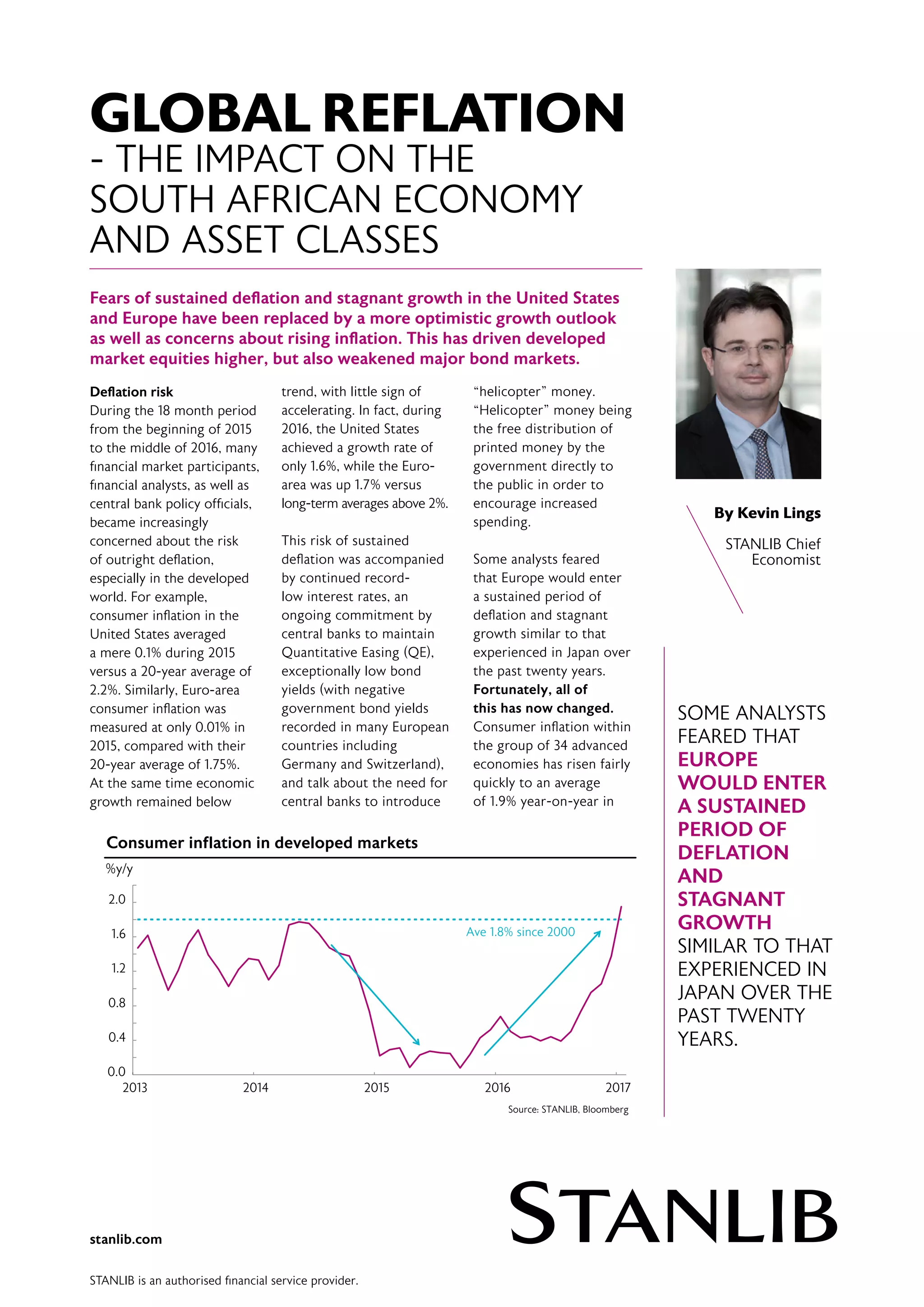
Consumer inflation within
the group of 34 advanced
economies has risen fairly
quickly to an average
of 1.9% year-on-year in
SOME ANALYSTS
FEARED THAT
EUROPE
WOULD ENTER
A SUSTAINED
PERIOD OF
DEFLATION
AND
STAGNANT
GROWTH
SIMILAR TO THAT
EXPERIENCED IN
JAPAN OVER THE
PAST TWENTY
YEARS.
Consumer inflation in developed markets
Source: STANLIB, Bloomberg
0.0
0.4
0.8
1.2
1.6
2.0
2013 2014 2015 2016 2017
Ave 1.8% since 2000
%y/y
Fears of sustained deflation and stagnant growth in the United States
and Europe have been replaced by a more optimistic growth outlook
as well as concerns about rising inflation. This has driven developed
market equities higher, but also weakened major bond markets.
By Kevin Lings
STANLIB Chief
Economist
stanlib.comSTANLIB is an authorised financial service provider.
January 2017, which is
slightly above the 20-year
average of 1.8% and well
above the recent low of
less than 0.1% in late 2015.
In particular, US consumer
inflation is up at 2.5% in
January 2017, while the
inflation rate in the Euro-
area is back to the target
level of 2%. Unsurprisingly,
talk about “helicopter”
money has evaporated, and
the US Federal Reserve has
hiked rates by a further
25bps with a clear intention
to increase rates further in
2017. Many analysts have
also suggested that the
European Central Bank
(ECB) will soon have to
discuss tapering QE.
This sharp turnaround in
developed market inflation
has pushed government
bond yields higher. In
particular, the yield on the
US government benchmark
10-year government bond
has risen from a low of just
below 1.6% at the end of
September 2016 to around
2.5% at the end of February
2017, while the German 10-
year government bond yield
has jumped from -0.12% in
early September 2016 to
over 0.3%. Similar trends
have unfolded in many other
advanced economies.
There has also been an
uptick in global equity
markets, despite ongoing
concerns about high
valuations. For example, the
S&P 500 equity index has
risen by 22% over the year
to end February 2017, having
gained more than 11% since
President Trump was elected
in early November 2016.
What is driving reflation?
The catalyst for this switch
away from concerns about
outright deflation to
questions about higher
inflation has been a
combination of two key
factors. Firstly, there has
emerged a slightly more
optimistic outlook for the
global economy. This has, to
some extent, been focused
on the United States and the
expectation that President
Trump will follow-through
with his election promise to
lift economic growth closer
to 4% and stimulate further
job creation. Secondly,
noticeably higher oil and
commodity prices, which
have been partly supported
by increased fiscal stimulus
in China. For example, the
oil price moved from a low
of around $30/barrel in
January 2016 to $54/barrel
in January 2017, an increase
of 77%. There has also been
a noticeable increase in a
broad range of industrial
commodity prices, while
global food inflation has also
moved higher.
While there was broad
consensus last year that
commodity prices could
increase meaningfully,
especially after it became
clear that China was intent
on providing further fiscal
stimulus in the form of
fixed investment spending,
financial market participants
remain sharply divided
about the impact of Trump’s
presidency on the US
economy.
Trump’s impact on
US economy
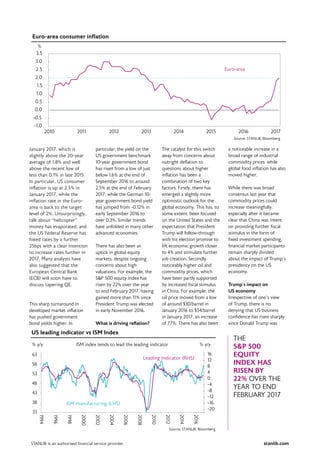
Irrespective of one’s view
of Trump, there is no
denying that US business
confidence has risen sharply
since Donald Trump was
US leading indicator vs ISM Index
33
38
43
48
53
58
63
1994
1996
1998
2000
2002
2004
2006
2008
2010
2012
2014
2016
-20
-16
-12
-8
-4
0
4
8
12
16
% y/y % y/y
Leading Indicator (RHS)
ISM manufacturing (LHS)
ISM index tends to lead the leading indicator
Source: STANLIB, Bloomberg
THE
S&P 500
EQUITY
INDEX HAS
RISEN BY
22% OVER THE
YEAR TO END
FEBRUARY 2017
Euro-area consumer inflation
Source: STANLIB, Bloomberg
%
-1.0
-0.5
0.0
0.5
1.0
1.5
2.0
2.5
3.0
3.5
2010 2011 2012 2013 2014 2015 2016 2017
Euro-area
stanlib.comSTANLIB is an authorised financial service provider.
elected President of the
United States. In addition,
it is clear that the boost in
US business confidence is
linked to Trump’s promises
regarding corporate tax cuts,
reduced business regulation,
greater trade protection
and increased spend on
economic infrastructure.
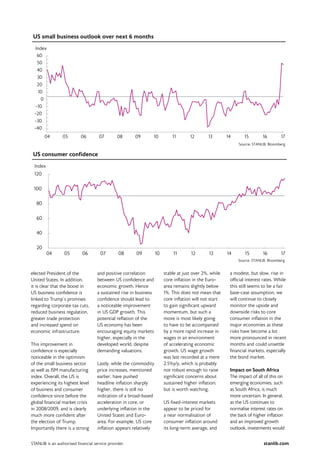
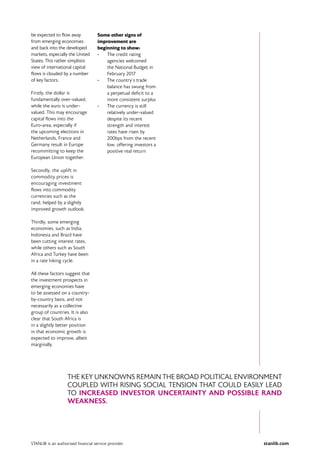
This improvement in
confidence is especially
noticeable in the optimism
of the small business sector
as well as ISM manufacturing
index. Overall, the US is
experiencing its highest level
of business and consumer
confidence since before the
global financial market crisis
in 2008/2009, and is clearly
much more confident after
the election of Trump.
Importantly there is a strong
and positive correlation
between US confidence and
economic growth. Hence
a sustained rise in business
confidence should lead to
a noticeable improvement
in US GDP growth. This
potential reflation of the
US economy has been
encouraging equity markets
higher, especially in the
developed world, despite
demanding valuations.
Lastly, while the commodity
price increases, mentioned
earlier, have pushed
headline inflation sharply
higher, there is still no
indication of a broad-based
acceleration in core, or
underlying inflation in the
United States and Euro-
area. For example, US core
inflation appears relatively
stable at just over 2%, while
core inflation in the Euro-
area remains slightly below
1%. This does not mean that
core inflation will not start
to gain significant upward
momentum, but such a
move is most likely going
to have to be accompanied
by a more rapid increase in
wages in an environment
of accelerating economic
growth. US wage growth
was last recorded at a mere
2.5%y/y, which is probably
not robust enough to raise
significant concerns about
sustained higher inflation;
but is worth watching.
US fixed-interest markets
appear to be priced for
a near normalisation of
consumer inflation around
its long-term average, and
a modest, but slow, rise in
official interest rates. While
this still seems to be a fair
base-case assumption, we
will continue to closely
monitor the upside and
downside risks to core
consumer inflation in the
major economies as these
risks have become a lot
more pronounced in recent
months and could unsettle
financial markets, especially
the bond market.
Impact on South Africa
The impact of all of this on
emerging economies, such
as South Africa, is much
more uncertain. In general,
as the US continues to
normalise interest rates on
the back of higher inflation
and an improved growth
outlook, investments would
US small business outlook over next 6 months
Source: STANLIB, Bloomberg
Index
-40
-30
-20
-10
0
10
20
30
40
50
60
04 05 06 07 08 09 10 11 12 13 14 15 16 17
US consumer confidence
Source: STANLIB, Bloomberg
Index
20
40
60
80
100
120
04 05 06 07 08 09 10 11 12 13 14 15 16 17
stanlib.comSTANLIB is an authorised financial service provider.
be expected to flow away
from emerging economies
and back into the developed
markets, especially the United
States. This rather simplistic
view of international capital
flows is clouded by a number
of key factors.
Firstly, the dollar is
fundamentally over-valued,
while the euro is under-
valued. This may encourage
capital flows into the
Euro-area, especially if
the upcoming elections in
Netherlands, France and
Germany result in Europe
recommitting to keep the
European Union together.
Secondly, the uplift in
commodity prices is
encouraging investment
flows into commodity
currencies such as the
rand, helped by a slightly
improved growth outlook.
Thirdly, some emerging
economies, such as India,
Indonesia and Brazil have
been cutting interest rates,
while others such as South
Africa and Turkey have been
in a rate hiking cycle.
All these factors suggest that
the investment prospects in
emerging economies have
to be assessed on a country-
by-country basis, and not
necessarily as a collective
group of countries. It is also
clear that South Africa is
in a slightly better position
in that economic growth is
expected to improve, albeit
marginally.
Some other signs of
improvement are
beginning to show:
•	 The credit rating
agencies welcomed
the National Budget in
February 2017
•	 The country’s trade
balance has swung from
a perpetual deficit to a
more consistent surplus
•	 The currency is still
relatively under-valued
despite its recent
strength and interest
rates have risen by
200bps from the recent
low, offering investors a
positive real return
THE KEY UNKNOWNS REMAIN THE BROAD POLITICAL ENVIRONMENT
COUPLED WITH RISING SOCIAL TENSION THAT COULD EASILY LEAD
TO INCREASED INVESTOR UNCERTAINTY AND POSSIBLE RAND
WEAKNESS.

Standpoint: Global Reflation by Kevin Lings

  • 1.
    stanlib.com STANLIB is anauthorised financial service provider. GLOBAL REFLATION - THE IMPACT ON THE SOUTH AFRICAN ECONOMY AND ASSET CLASSES Deflation risk During the 18 month period from the beginning of 2015 to the middle of 2016, many financial market participants, financial analysts, as well as central bank policy officials, became increasingly concerned about the risk of outright deflation, especially in the developed world. For example, consumer inflation in the United States averaged a mere 0.1% during 2015 versus a 20-year average of 2.2%. Similarly, Euro-area consumer inflation was measured at only 0.01% in 2015, compared with their 20-year average of 1.75%. At the same time economic growth remained below trend, with little sign of accelerating. In fact, during 2016, the United States achieved a growth rate of only 1.6%, while the Euro- area was up 1.7% versus long-term averages above 2%. This risk of sustained deflation was accompanied by continued record- low interest rates, an ongoing commitment by central banks to maintain Quantitative Easing (QE), exceptionally low bond yields (with negative government bond yields recorded in many European countries including Germany and Switzerland), and talk about the need for central banks to introduce “helicopter” money. “Helicopter” money being the free distribution of printed money by the government directly to the public in order to encourage increased spending. Some analysts feared that Europe would enter a sustained period of deflation and stagnant growth similar to that experienced in Japan over the past twenty years. Fortunately, all of this has now changed. Consumer inflation within the group of 34 advanced economies has risen fairly quickly to an average of 1.9% year-on-year in SOME ANALYSTS FEARED THAT EUROPE WOULD ENTER A SUSTAINED PERIOD OF DEFLATION AND STAGNANT GROWTH SIMILAR TO THAT EXPERIENCED IN JAPAN OVER THE PAST TWENTY YEARS. Consumer inflation in developed markets Source: STANLIB, Bloomberg 0.0 0.4 0.8 1.2 1.6 2.0 2013 2014 2015 2016 2017 Ave 1.8% since 2000 %y/y Fears of sustained deflation and stagnant growth in the United States and Europe have been replaced by a more optimistic growth outlook as well as concerns about rising inflation. This has driven developed market equities higher, but also weakened major bond markets. By Kevin Lings STANLIB Chief Economist
  • 2.
    stanlib.comSTANLIB is anauthorised financial service provider. January 2017, which is slightly above the 20-year average of 1.8% and well above the recent low of less than 0.1% in late 2015. In particular, US consumer inflation is up at 2.5% in January 2017, while the inflation rate in the Euro- area is back to the target level of 2%. Unsurprisingly, talk about “helicopter” money has evaporated, and the US Federal Reserve has hiked rates by a further 25bps with a clear intention to increase rates further in 2017. Many analysts have also suggested that the European Central Bank (ECB) will soon have to discuss tapering QE. This sharp turnaround in developed market inflation has pushed government bond yields higher. In particular, the yield on the US government benchmark 10-year government bond has risen from a low of just below 1.6% at the end of September 2016 to around 2.5% at the end of February 2017, while the German 10- year government bond yield has jumped from -0.12% in early September 2016 to over 0.3%. Similar trends have unfolded in many other advanced economies. There has also been an uptick in global equity markets, despite ongoing concerns about high valuations. For example, the S&P 500 equity index has risen by 22% over the year to end February 2017, having gained more than 11% since President Trump was elected in early November 2016. What is driving reflation? The catalyst for this switch away from concerns about outright deflation to questions about higher inflation has been a combination of two key factors. Firstly, there has emerged a slightly more optimistic outlook for the global economy. This has, to some extent, been focused on the United States and the expectation that President Trump will follow-through with his election promise to lift economic growth closer to 4% and stimulate further job creation. Secondly, noticeably higher oil and commodity prices, which have been partly supported by increased fiscal stimulus in China. For example, the oil price moved from a low of around $30/barrel in January 2016 to $54/barrel in January 2017, an increase of 77%. There has also been a noticeable increase in a broad range of industrial commodity prices, while global food inflation has also moved higher. While there was broad consensus last year that commodity prices could increase meaningfully, especially after it became clear that China was intent on providing further fiscal stimulus in the form of fixed investment spending, financial market participants remain sharply divided about the impact of Trump’s presidency on the US economy. Trump’s impact on US economy Irrespective of one’s view of Trump, there is no denying that US business confidence has risen sharply since Donald Trump was US leading indicator vs ISM Index 33 38 43 48 53 58 63 1994 1996 1998 2000 2002 2004 2006 2008 2010 2012 2014 2016 -20 -16 -12 -8 -4 0 4 8 12 16 % y/y % y/y Leading Indicator (RHS) ISM manufacturing (LHS) ISM index tends to lead the leading indicator Source: STANLIB, Bloomberg THE S&P 500 EQUITY INDEX HAS RISEN BY 22% OVER THE YEAR TO END FEBRUARY 2017 Euro-area consumer inflation Source: STANLIB, Bloomberg % -1.0 -0.5 0.0 0.5 1.0 1.5 2.0 2.5 3.0 3.5 2010 2011 2012 2013 2014 2015 2016 2017 Euro-area
  • 3.
    stanlib.comSTANLIB is anauthorised financial service provider. elected President of the United States. In addition, it is clear that the boost in US business confidence is linked to Trump’s promises regarding corporate tax cuts, reduced business regulation, greater trade protection and increased spend on economic infrastructure. This improvement in confidence is especially noticeable in the optimism of the small business sector as well as ISM manufacturing index. Overall, the US is experiencing its highest level of business and consumer confidence since before the global financial market crisis in 2008/2009, and is clearly much more confident after the election of Trump. Importantly there is a strong and positive correlation between US confidence and economic growth. Hence a sustained rise in business confidence should lead to a noticeable improvement in US GDP growth. This potential reflation of the US economy has been encouraging equity markets higher, especially in the developed world, despite demanding valuations. Lastly, while the commodity price increases, mentioned earlier, have pushed headline inflation sharply higher, there is still no indication of a broad-based acceleration in core, or underlying inflation in the United States and Euro- area. For example, US core inflation appears relatively stable at just over 2%, while core inflation in the Euro- area remains slightly below 1%. This does not mean that core inflation will not start to gain significant upward momentum, but such a move is most likely going to have to be accompanied by a more rapid increase in wages in an environment of accelerating economic growth. US wage growth was last recorded at a mere 2.5%y/y, which is probably not robust enough to raise significant concerns about sustained higher inflation; but is worth watching. US fixed-interest markets appear to be priced for a near normalisation of consumer inflation around its long-term average, and a modest, but slow, rise in official interest rates. While this still seems to be a fair base-case assumption, we will continue to closely monitor the upside and downside risks to core consumer inflation in the major economies as these risks have become a lot more pronounced in recent months and could unsettle financial markets, especially the bond market. Impact on South Africa The impact of all of this on emerging economies, such as South Africa, is much more uncertain. In general, as the US continues to normalise interest rates on the back of higher inflation and an improved growth outlook, investments would US small business outlook over next 6 months Source: STANLIB, Bloomberg Index -40 -30 -20 -10 0 10 20 30 40 50 60 04 05 06 07 08 09 10 11 12 13 14 15 16 17 US consumer confidence Source: STANLIB, Bloomberg Index 20 40 60 80 100 120 04 05 06 07 08 09 10 11 12 13 14 15 16 17
  • 4.
    stanlib.comSTANLIB is anauthorised financial service provider. be expected to flow away from emerging economies and back into the developed markets, especially the United States. This rather simplistic view of international capital flows is clouded by a number of key factors. Firstly, the dollar is fundamentally over-valued, while the euro is under- valued. This may encourage capital flows into the Euro-area, especially if the upcoming elections in Netherlands, France and Germany result in Europe recommitting to keep the European Union together. Secondly, the uplift in commodity prices is encouraging investment flows into commodity currencies such as the rand, helped by a slightly improved growth outlook. Thirdly, some emerging economies, such as India, Indonesia and Brazil have been cutting interest rates, while others such as South Africa and Turkey have been in a rate hiking cycle. All these factors suggest that the investment prospects in emerging economies have to be assessed on a country- by-country basis, and not necessarily as a collective group of countries. It is also clear that South Africa is in a slightly better position in that economic growth is expected to improve, albeit marginally. Some other signs of improvement are beginning to show: • The credit rating agencies welcomed the National Budget in February 2017 • The country’s trade balance has swung from a perpetual deficit to a more consistent surplus • The currency is still relatively under-valued despite its recent strength and interest rates have risen by 200bps from the recent low, offering investors a positive real return THE KEY UNKNOWNS REMAIN THE BROAD POLITICAL ENVIRONMENT COUPLED WITH RISING SOCIAL TENSION THAT COULD EASILY LEAD TO INCREASED INVESTOR UNCERTAINTY AND POSSIBLE RAND WEAKNESS.