1
G
W
FE
of
in
w
re
T
Th
an
ar
ar
gr
3.
ha
W
so
sh
se
w
up
54
ne
fir
cy
ga
ca
su
1
A
A
BTMU Econo
Global
Watch
EBRUARY 2
fter
the U
brac
f the view
ncluding on
we highligh
emainder o
Theme #1
he post-cr
n aging po
round the
round 4.5%
rowth throu
.1%, at un
ave seen s
Within this c
oon, it’s wo
howing me
eemingly u
which encom
pward bias
4, a figure
ew orders
rming of gr
ycle. We’re
as sector –
apex cuts
upportive o
According to
A
omic Brief | Fe
– Seve
in 201
2017
enduring a
UK vote to
cing thems
that 2017
n the politic
t seven th
of this year
1: Tepid
ises cyclic
opulation,
world. Aga
% in the p
ugh the co
der 3.5%,
since the fi
context, w
orth noting
eaningful s
underway.
mpass bot
s across th
e which is
outpacing
rowth in co
e of the vie
– which u
that follow
of this tren
PMI surveys
ebruary 2017
en The
7
a tumultuo
o leave the
selves for w
will not be
cal front, a
hemes wh
r.
growth b
cal slowdow
slowing la
ainst this b
pre-crises
ourse of 20
our sense
nancial cri
hile we are
g that sinc
signs of im
In this re
th the man
he major ec
firmly with
inventory
oming mon
ew that sec
ntil now h
wed the s
nd, especi
s any reading
emes t
ous 2016 –
EU and th
what to ex
e plain sail
are set to c
ich will se
but mom
wn has be
abour parti
backdrop,
period to
017 to pick
e is that it w
sis.
e not pred
ce the latte
mprovemen
spect, forw
nufacturing
conomies (
hin expans
build-up (s
nths – this
ctoral deve
ave been
tart of the
ally given
g >50 signifie
BTM
to
– perhaps
he election
pect as we
ling either,
continue to
et the tone
mentum s
en suppla
icipation ra
global gro
around 3
k up slightl
will not rise
icting a re
er half of la
nt, such th
ward-lookin
g and serv
(see Chart
sion territor
see Chart
will provid
elopments
a key dra
e downturn
the fact th
es expansion
MU Ec
AM
ECO
T: +
E: A
The
A me
best reme
n of Donald
e move thr
, as some
o play out
e for the m
set to pic
nted by a
ates and d
wth has s
.2% since
y from las
e much be
turn to pre
ast year gr
at a trend
ng surveys
vices secto
t 1), with a
ry1
. Suppo
2) – a dev
e the basis
in terms of
ag on over
n in oil pri
hat energy
n.
conom
IR KHAN
ONOMIC RE
+44-(0)20-75
Amir.Khan@
Bank of Toky
ember of MUFG
embered fo
d Trump in
rough the
of the the
this year. A
markets/gl
k up
structural
disappointi
lowed from
the crisis
t year’s su
eyond the a
e-crises lev
rowth mom
d reversal a
s, such as
ors, are sh
n average
ortive of th
elopment w
s for an up
f capex, pa
all investm
ices in mi
y prices al
mic B
ESEARCH O
577-2180
@uk.mufg.jp
kyo-Mitsubish
G, a global finan
or political
n the US –
course of
emes evide
Against th
obal econ
slowdown
ing produc
m an avera
s. Although
ubdued lev
average fig
vels of gro
mentum ap
already ap
s the comp
howing a s
reading s
his is the fa
which usua
pturn in the
articularly i
ment thank
d-2014 –
lready app
Brief
OFFICE | LON
hi UFJ, Ltd.
cial group
upsets, w
markets a
2017. We’
ent last yea
is backdro
nomy for th
reflective
ctivity trend
age figure
h we expe
vel of aroun
gure that w
owth anytim
ppears to b
ppears to b
posite PM
synchronise
lightly shy
act that w
ally points
e investme
n the oil an
ks to savag
will also b
pear to hav
NDON
ith
are
’re
ar,
op,
he
of
ds
of
ect
nd
we
me
be
be
Is,
ed
of
ith
to
ent
nd
ge
be
ve
BTMU Economic Brief | February 20172
bottomed, in part thanks to recent OPEC agreement to limit production (see Theme #3 below).
Indeed, estimates from the likes of Wood Mackenzie suggest that capex in the oil and gas
sector will reach US$450bn, which represents an increase of 3% on the previous year and
reversal of two years of steep declines.
Theme #2: Markets likely to remain in thrall to Donald Trump
The convincing electoral victory of Donald Trump over Hillary Clinton late last year, while
unexpected, was well received by the markets. While this rally – dubbed the “Trumpflation
trade” has lost some momentum recently, our sense is that it has further to run, especially if
Trump embarks on implementing his planned fiscal stimulus – made up of tax cuts and
infrastructure spending – which will ultimately serve to reflate the economy and boost growth.
Over and above this, Trump’s commitment to a deregulatory drive is likely, in our mind, to
continue to be looked upon positively on the part of the markets, with for example the equity
markets biding-up energy related stocks in the belief that some of the environmental regulation
which currently exist in the US may be watered down somewhat under a Trump administration.
Elsewhere, but on rather negative note, markets have taken the view that with growth set to
take off under the leadership of Trump, they have started to fret about inflationary
consequences of such a move, especially given the fact that the US economy already appears
to be at, or near, full employment, as a consequence of which wage growth appears to have
gained meaningful traction2
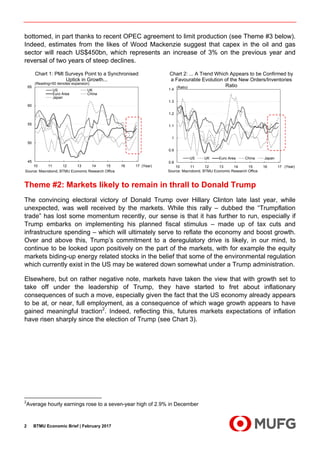
. Indeed, reflecting this, futures markets expectations of inflation
have risen sharply since the election of Trump (see Chart 3).
2
Average hourly earnings rose to a seven-year high of 2.9% in December
45
50
55
60
65
10 11 12 13 14 15 16 17
US UK
Euro Area China
Japan
Chart 1: PMI Surveys Point to a Synchronised
Uptick in Growth...
(Reading>50 denotes expansion)
Source: Macrobond, BTMU Economic Research Office
(Year)
0.8
0.9
1
1.1
1.2
1.3
1.4
10 11 12 13 14 15 16 17
US UK Euro Area China Japan
Chart 2: ... A Trend Which Appears to be Confirmed by
a Favourable Evolution of the New Orders/Inventories
Ratio(Ratio)
Source: Macrobond, BTMU Economic Research Office
(Year)
BTMU Economic Brief | February 20173
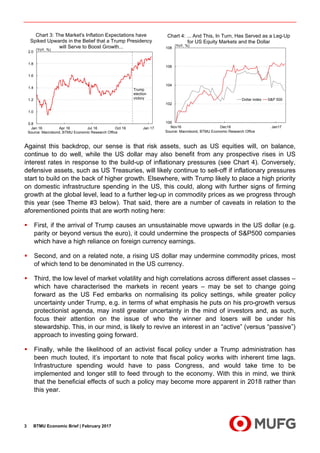
Against this backdrop, our sense is that risk assets, such as US equities will, on balance,
continue to do well, while the US dollar may also benefit from any prospective rises in US
interest rates in response to the build-up of inflationary pressures (see Chart 4). Conversely,
defensive assets, such as US Treasuries, will likely continue to sell-off if inflationary pressures
start to build on the back of higher growth. Elsewhere, with Trump likely to place a high priority
on domestic infrastructure spending in the US, this could, along with further signs of firming
growth at the global level, lead to a further leg-up in commodity prices as we progress through
this year (see Theme #3 below). That said, there are a number of caveats in relation to the
aforementioned points that are worth noting here:
First, if the arrival of Trump causes an unsustainable move upwards in the US dollar (e.g.
parity or beyond versus the euro), it could undermine the prospects of S&P500 companies
which have a high reliance on foreign currency earnings.
Second, and on a related note, a rising US dollar may undermine commodity prices, most
of which tend to be denominated in the US currency.
Third, the low level of market volatility and high correlations across different asset classes –
which have characterised the markets in recent years – may be set to change going
forward as the US Fed embarks on normalising its policy settings, while greater policy
uncertainty under Trump, e.g. in terms of what emphasis he puts on his pro-growth versus
protectionist agenda, may instil greater uncertainty in the mind of investors and, as such,
focus their attention on the issue of who the winner and losers will be under his
stewardship. This, in our mind, is likely to revive an interest in an “active” (versus “passive”)
approach to investing going forward.
Finally, while the likelihood of an activist fiscal policy under a Trump administration has
been much touted, it’s important to note that fiscal policy works with inherent time lags.
Infrastructure spending would have to pass Congress, and would take time to be
implemented and longer still to feed through to the economy. With this in mind, we think
that the beneficial effects of such a policy may become more apparent in 2018 rather than
this year.
0.8
1.0
1.2
1.4
1.6
1.8
2.0
Jan 16 Apr 16 Jul 16 Oct 16 Jan 17
(YoY, %)
Chart 3: The Market's Inflation Expectations have
Spiked Upwards in the Belief that a Trump Presidency
will Serve to Boost Growth...
Source: Macrobond, BTMU Economic Research Office
Trump
election
victory
100
102
104
106
108
Nov16 Dec16 Jan17
Dollar index S&P 500
Chart 4: ... And This, In Turn, Has Served as a Leg-Up
for US Equity Markets and the Dollar
(YoY, %)
Source: Macrobond, BTMU Economic Research Office
BTMU Economic Brief | February 20174
Theme #3: Commodity markets set to see further light at the end of the
tunnel
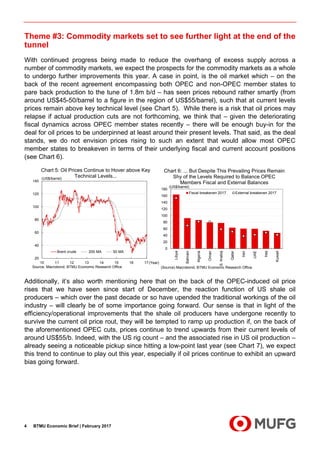
With continued progress being made to reduce the overhang of excess supply across a
number of commodity markets, we expect the prospects for the commodity markets as a whole
to undergo further improvements this year. A case in point, is the oil market which – on the
back of the recent agreement encompassing both OPEC and non-OPEC member states to
pare back production to the tune of 1.8m b/d – has seen prices rebound rather smartly (from
around US$45-50/barrel to a figure in the region of US$55/barrel), such that at current levels
prices remain above key technical level (see Chart 5). While there is a risk that oil prices may
relapse if actual production cuts are not forthcoming, we think that – given the deteriorating
fiscal dynamics across OPEC member states recently – there will be enough buy-in for the
deal for oil prices to be underpinned at least around their present levels. That said, as the deal
stands, we do not envision prices rising to such an extent that would allow most OPEC
member states to breakeven in terms of their underlying fiscal and current account positions
(see Chart 6).
Additionally, it’s also worth mentioning here that on the back of the OPEC-induced oil price
rises that we have seen since start of December, the reaction function of US shale oil
producers – which over the past decade or so have upended the traditional workings of the oil
industry – will clearly be of some importance going forward. Our sense is that in light of the
efficiency/operational improvements that the shale oil producers have undergone recently to
survive the current oil price rout, they will be tempted to ramp up production if, on the back of
the aforementioned OPEC cuts, prices continue to trend upwards from their current levels of
around US$55/b. Indeed, with the US rig count – and the associated rise in US oil production –
already seeing a noticeable pickup since hitting a low-point last year (see Chart 7), we expect
this trend to continue to play out this year, especially if oil prices continue to exhibit an upward
bias going forward.
20
40
60
80
100
120
140
10 11 12 13 14 15 16 17
Brent crude 200 MA 50 MA
Chart 5: Oil Prices Continue to Hover above Key
Technical Levels...(US$/barrel)
Source: Macrobond, BTMU Economic Research Office
(Year)
0
20
40
60
80
100
120
140
160
180
Libya
Bahrain
Algeria
Oman
S.Arabia
Qatar
Iran
UAE
Iraq
Kuwait
Fiscal breakeven 2017 External breakeven 2017
(US$/barrel)
Chart 6: ... But Despite This Prevailing Prices Remain
Shy of the Levels Required to Balance OPEC
Members Fiscal and External Balances
(Source) Macrobond, BTMU Economic Research Office
BTMU Economic Brief | February 20175
Beyond oil, base metals will also continue on the road to recovery. This will be helped by
recent production cutbacks by global mining companies, such as Glencore, as well as efforts
that are being made in China to remove excess capacity among certain state owned
enterprises that are active in the commodity arena. On the demand side, with the Chinese
authorities looking to continue to prop-up growth at around the 6.5% level in 2017, metals
demand from the country is likely remain supportive. This, coupled with the prospect of
stepped-up demand from the US this year and next, particularly for construction and related
commodities, will in our mind provide additional support for copper and other cyclical metal
prices going forwards. That said, with metals prices, such as iron ore, already experiencing a
substantial run-up in prices in 2016 – in excess of 90% in the case of iron ore – some pull-back
in prices cannot be ruled in 2017.
Theme #4: A pivot from monetary to fiscal policy
Central banks have done most of the heavy lifting in terms of propping up growth and financial
markets around the globe since the outbreak of the global financial crisis, such that they have
essentially become the “only game in town”. But that may be set to change as the persistence
of such policies has caused unintended side-effects, including asset price bubbles and
distortions in wealth distribution, all of which have undermined potential growth and caused a
backlash to develop against the existing policy regime (see Figure 1). With this in mind, the
pendulum – aided by rising populism – has increasingly shifted in favour of activist fiscal and
populist policy measures. That said, for the most part, this pivot will continue to occur
gradually and highly accommodative monetary policy will remain in place within most
countries. Nevertheless, the US, may prove something of an exception given the fact that the
country was already on the path to tightening monetary policy in response to improving
economic fundamentals. Additionally, there is a risk that the anticipated fiscal boost from the
new Trump administration may accelerate this pace.
5
6
7
8
9
10
0
500
1000
1500
2000
2500
10 11 12 13 14 15 16 17
Total number of US rigs (left axis)
US oil production (right axis)
Chart 7: US Rig Count VS. Oil Production
(Barrels per day, millions)(Rigs)
Source: Macrobond, BTMU Economic Research Office
(Year)
6
O
im
im
a
su
pr
su
T
D
m
re
m
is
3
T
BTMU Econo
Outside the
mmediate m
mportant po
more act
uggest tha
rimary ge
upportive in
Theme #5
espite the
markets ha
eflecting th
markets ma
looking to
The US Fed
omic Brief | Fe
e US, wh
monetary
oint to note
tivist fiscal
at the “fisc
neral gov
n these co
5: Emer
e US Fed
ve so far
he tepid ra
ay become
o normalis
has hiked in
-1.0
-0.5
0.0
0.5
1.0
1.5
2.0
2.5
C
Source
(
ebruary 2017
ile we ac
policy nor
e is that, ev
l policy go
cal thrust”
vernment d
ountries (se
rging Ma
having alr
avoided
ate of inter
more disc
e its policy
terest rates t
Germany
2014
Chart 8: Chang
e: Macrobond, BT
(% of GDP)
cknowledge
malisation
ven among
oing forwa
– which i
deficit –
ee Chart 8)
arkets un
ready emb
a “taper t
rest rate in
criminating
y settings
twice to the t
France
2015 2016
ge in Cyclical
TMU Economic Re
e the diffi
, particula
g these co
ard. Reflec
is defined
has alrea
).
nder the
barked on
tantrum” s
ncreases s
g going forw
at more ra
tune of 25bp
Italy S
6 2017
lly Adjusted P
2014-2017
esearch Office
iculties wh
rly in the
untries, the
cting this,
as the ch
ady started
e spotlig
a policy o
style sell-o
seen so fa
ward, as n
apid pace
ps.
Spain Ja
Primary Balan
hich may
Eurozone
ere is grow
data from
hange in t
d to beco
ght
of interest
off seen in
ar3
. Our se
not only wil
than previ
apan US
nce (% of GD
stand in
and Japa
wing clamo
m the IMF
the cyclica
ome some
t rate hike
n 2013, in
ense, how
ll they hav
iously anti
S
P)
the way
an, the mo
our to pursu
appears
ally adjuste
ewhat mo
es, emergin
n large pa
wever, is th
e a Fed th
cipated (se
of
ore
ue
to
ed
ore
ng
art,
hat
hat
ee
7
C
de
su
U
ar
th
am
yi
ha
fa
Tr
in
pr
sa
E
th
of
ad
up
be
th
ev
he
an
T
A
la
in
th
ov
0.
0.
0.
1.
1.
2.
S
BTMU Econo
hart 9) to
eal with u
ubstantial f
S trade (e
re likely to
he election
mong the
elds (see
ave actual
actors: i) th
rump pres
ncoming pr
ress report
anctions on
lsewhere w
he market s
f capital fli
doption of
p to 40% o
e eager to
his road, th
ven a trad
ence, grow
nd falls in t
Theme #6
lthough the
argely in th
n general h
hese two c
ver the ult
.0
.4
.8
.2
.6
.0
Jan 17 Ju
La
E
Chart 9: Wit
Rate Hav
Source: Bloomberg
(%)
omic Brief | Fe
contend w
under the
financing n
.g. Mexico
o continue
of Donald
highest de
Chart 10)
ly improve
he recent
sidency, a
resident ad
ts appear
n Moscow.
within the
spotlight in
ight and a
more oner
on Chines
o see to wh
his could m
de war. Su
wth and, in
the country
6: Politic
e markets
eir stride,
has been
ountries w
imate form
ul 17 Jan 1
atest expectations
xpectations at July
h Market Exp
ving Risen in t
Elec
g, BTMU Econom
ebruary 2017
with but, ov
stewardsh
needs (e.g
o) that stan
to come u
d Trump th
epreciation
. At the o
ed markedl
rise in oil
view whic
dopted tow
to sugges
.
emerging
n 2017, giv
depreciat
rous capita
e exports
hat extent
mark the b
uch an ev
n the case
y’s domest
cal unce
have take
these unex
on the ris
will for the t
m Brexit an
8 Jul 18
s
y 2016
pectations of t
the Aftermath
ction...
ic Research Office
ver and abo
hip of Trum
g. Turkey)
d to be aff
under the s
hese coun
of their do
ther extrem
y since the
prices; an
ch appears
wards the c
t that a Tr
markets sp
ven the fac
ting domes
al controls.
destined t
he sees th
beginning
ventuality w
of China,
tic currenc
ertaintie
n the Brex
xpected ev
se in the d
time being
nd a Trump
Jan 19
the Fed Fund
h of Trump's
e
ove this, th
mp. Again
or, for that
fected by g
spotlight th
ntries have
omestic cu
me, mean
e election o
nd ii) the p
s to be su
country du
rump presi
pace, our
ct that it co
stic curren
Additiona
o the US d
hrough on
of a slipp
would clea
may furth
cy.
es in Eur
xit vote in t
vents show
developed
continue t
p presiden
ds
hey also h
nst this ba
t matter, th
greater pro
hrough the
e within the
urrencies a
while, the
of Trump.
perception
upported b
ring the el
dency may
sense is th
ntinues to
ncy, which
ally, with Tr
during the
such thre
ery slope
arly be neg
her precipi
rope set
he UK and
w to what e
market e
to hog the
ncy will tak
ave greate
ackdrop, e
hose with a
otectionism
duration o
e emerging
and/or rise
market’s
This, in ou
that Russ
by the very
ection cam
y be minde
hat China
suffer from
it’s looking
rump threa
election c
ats. Indee
toward gre
gative for
tate the pr
t to rise
d the electi
extent pop
conomies.
limelight,
ke, this doe
er policy u
merging m
a high dep
m on the pa
of 2017. In
g markets
es in gover
views tow
ur mind is o
sia will ben
y conciliato
mpaign. Ind
ed to lift U
will also re
m the ongo
g to stem
atening to s
campaign,
ed, if he do
reater prot
the globa
roblem of
ion of Trum
pulism and
. While co
given ong
esn’t precl
ncertainty
markets w
pendency o
art of the U
ndeed, sinc
space see
rnment bon
wards Russ
owing to tw
nefit under
ory tone th
deed, rece
US econom
emain und
oing proble
through th
slap tariffs
markets w
oes go dow
ectionism
al trade an
capital flig
mp in the U
political ri
oncerns ov
oing worrie
lude the fa
to
ith
on
S,
ce
en
nd
sia
wo
r a
he
ent
mic
der
em
he
of
will
wn
or
nd,
ght
US
sk
ver
es
act
BTMU Economic Brief | February 20178
that populist tendencies are also sweeping across a range of other European countries as well
(see Chart 11). Adding these concerns is the fact that forthcoming elections are also due in the
likes of the Netherland’s, France and Germany this year, all of which have seen growing
support for populist and non-mainstream political parties. Of these elections, perhaps of most
significance for us is the French election, where the far-right National Front candidate, Marine
Le Pen, has built up significant momentum, with opinion polls suggesting that she is likely to
progress to the second round of voting. While, on balance, we do not expect her to win, such
an eventuality cannot be dismissed out of hand. For one thing, she has cultivated a
widespread following, particularly among disenchanted sections of the French population
which, as we saw last year, proved to be decisive in the case of the Brexit vote and the
electoral victory of Trump. For another, if she were to unexpectedly win the second round of
the election, it could cause a major market dislocation, such as that seen during the 2011-12
Eurozone debt crisis and, not to mention, undermine the already fragile integrity of the
Eurozone as a whole, not least given the fact she has already declared that she wants to take
France out of the Eurozone.
Notwithstanding the pessimism noted above, it is worth highlighting that, thus far, we have
seen few non-mainstream parties gain full political power within the EU. Rather, what we have
seen is the fact that the growing popularity of such parties has enabled them to exert greater
influence on the policy debate and, in line with this, many mainstream parties have adopted
slightly sanitised versions of their proposals and policies as their own. Perhaps a good
example of this is the UK Conservative party which, after the Brexit vote, has adapted its policy
position, particularly in relation to issues such as the EU and immigration, to be more closely in
line with that of the UK populist party, UKIP.
Theme #7: Banks back in vogue
Since the financial crisis, global banks have been faced with a litany of headwinds, not least
rather sluggish economic growth, poor profitability, onerous regulations and rising NPL
problems. However, we think that 2017 could be the year that banks start to turn the corner.
Indeed, market sentiment towards the sector already appears to be improving, particularly in
the US, and we think that this trend will run further helped by the following factors:
82
78
63
55
50
49
48
47
35
33
18
0 20 40 60 80 100
Romania
Poland
France
Holland
Finland
Denmark
UK
Italy
Sweden
Spain
Germany
Source: YouGov/BuzzFeed, BTMU Economic Research Office
Chart 11: Number of Europeans Espousing Authoritatian/Populist Views
(Total, %)
BTMU Economic Brief | February 20179
First, economic growth which, as we’ve alluded to above, is set to improve somewhat,
particularly among the developed market economies.
Second, under the Trump administration, the regulatory burden on banks may be pared
back somewhat, with talk that his government may repeal the Dodd-Frank Act.
Third, the problem of NPLs appears to have peaked, including in Europe, with the
exception of some peripheral economies, such as Italy.
Finally, with global interest rates set to rise going forward, led by the US, this will help to
improve the net interest margin (NIM) and, hence, profitability position of banks.
Conclusion
After a turbulent 2016, markets are rightly anxious about the year ahead. That said, with the
global economy showing signs of modest improvement and the election of Donald Trump
adding to this positive sentiment – though not universally shared – we’re of the view that
markets will be more willing to embrace greater risk this year, with cyclical plays, such as the
banks and those active in the commodity arena, likely to be in vogue within the equities
universe. However, with the political trajectory going forward this year likely to be uncertain,
thanks to the rise of populist forces – especially in Europe where a number of key elections are
due this year – our sense is that caution is still warranted. Additionally, with the policy-mix
between monetary and fiscal policy in the developed markets, particularly the US, also in a
state of flux, how this shift is manged and ultimately plays out will, in our mind, also have an
important bearing for the global markets/economy during the course of this year.
The Bank of Tokyo-Mitsubishi UFJ, Ltd. (“BTMU”) is a limited liability stock company incorporated in Japan and registered in the Tokyo
Legal Affairs Bureau (company no. 0100-01-008846). BTMU’s head office is at 7-1 Marunouchi 2-Chome, Chiyoda-Ku, Tokyo 100-8388,
Japan. BTMU’s London branch is registered as a UK establishment in the UK register of companies (registered no. BR002013). BTMU is
authorised and regulated by the Japanese Financial Services Agency. BTMU’s London branch is authorised by the Prudential Regulation
Authority (FCA/PRA no. 139189) and subject to regulation by the Financial Conduct Authority and limited regulation by the Prudential
Regulation Authority. Details about the extent of BTMU London branch’s regulation by the Prudential Regulation Authority are available
from us on request.
This report shall not be construed as solicitation to take any action such as purchasing/selling/investing in financial market products. In
taking any action, each reader is requested to act on the basis of his or her own judgment. This report is based on information believed to
be reliable, but we do not guarantee, and do not accept any liability whatsoever for, its accuracy and we accept no liability whatsoever for
any loss or damage of any kind arising out of the use of all or any part of this report. The contents of the report may be revised without
advance notice. Also, this report is a literary work protected by copyright. No part of this report may be reproduced in any form without
express statement of its source.
The Bank of Tokyo-Mitsubishi UFJ, Ltd. retains copyright to this report and no part of this report may be reproduced or re-distributed
without the written permission of The Bank of Tokyo-Mitsubishi UFJ, Ltd. The Bank of Tokyo-Mitsubishi UFJ, Ltd. expressly prohibits the
re-distribution of this report to Retail Customers, via the internet or otherwise and The Bank of Tokyo-Mitsubishi UFJ, Ltd., its subsidiaries
or affiliates accept no liability whatsoever o any third parties resulting from such re-distribution.

BTMU Economic Brief - macro themes 2017

  • 1.
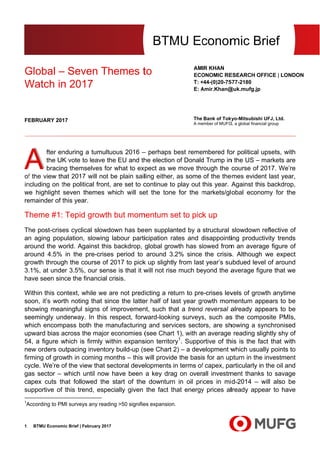
    1 G W FE of in w re T Th an ar ar gr 3. ha W so sh se w up 54 ne fir cy ga ca su 1 A A BTMU Econo Global Watch EBRUARY 2 fter theU brac f the view ncluding on we highligh emainder o Theme #1 he post-cr n aging po round the round 4.5% rowth throu .1%, at un ave seen s Within this c oon, it’s wo howing me eemingly u which encom pward bias 4, a figure ew orders rming of gr ycle. We’re as sector – apex cuts upportive o According to A omic Brief | Fe – Seve in 201 2017 enduring a UK vote to cing thems that 2017 n the politic t seven th of this year 1: Tepid ises cyclic opulation, world. Aga % in the p ugh the co der 3.5%, since the fi context, w orth noting eaningful s underway. mpass bot s across th e which is outpacing rowth in co e of the vie – which u that follow of this tren PMI surveys ebruary 2017 en The 7 a tumultuo o leave the selves for w will not be cal front, a hemes wh r. growth b cal slowdow slowing la ainst this b pre-crises ourse of 20 our sense nancial cri hile we are g that sinc signs of im In this re th the man he major ec firmly with inventory oming mon ew that sec ntil now h wed the s nd, especi s any reading emes t ous 2016 – EU and th what to ex e plain sail are set to c ich will se but mom wn has be abour parti backdrop, period to 017 to pick e is that it w sis. e not pred ce the latte mprovemen spect, forw nufacturing conomies ( hin expans build-up (s nths – this ctoral deve ave been tart of the ally given g >50 signifie BTM to – perhaps he election pect as we ling either, continue to et the tone mentum s en suppla icipation ra global gro around 3 k up slightl will not rise icting a re er half of la nt, such th ward-lookin g and serv (see Chart sion territor see Chart will provid elopments a key dra e downturn the fact th es expansion MU Ec AM ECO T: + E: A The A me best reme n of Donald e move thr , as some o play out e for the m set to pic nted by a ates and d wth has s .2% since y from las e much be turn to pre ast year gr at a trend ng surveys vices secto t 1), with a ry1 . Suppo 2) – a dev e the basis in terms of ag on over n in oil pri hat energy n. conom IR KHAN ONOMIC RE +44-(0)20-75 Amir.Khan@ Bank of Toky ember of MUFG embered fo d Trump in rough the of the the this year. A markets/gl k up structural disappointi lowed from the crisis t year’s su eyond the a e-crises lev rowth mom d reversal a s, such as ors, are sh n average ortive of th elopment w s for an up f capex, pa all investm ices in mi y prices al mic B ESEARCH O 577-2180 @uk.mufg.jp kyo-Mitsubish G, a global finan or political n the US – course of emes evide Against th obal econ slowdown ing produc m an avera s. Although ubdued lev average fig vels of gro mentum ap already ap s the comp howing a s reading s his is the fa which usua pturn in the articularly i ment thank d-2014 – lready app Brief OFFICE | LON hi UFJ, Ltd. cial group upsets, w markets a 2017. We’ ent last yea is backdro nomy for th reflective ctivity trend age figure h we expe vel of aroun gure that w owth anytim ppears to b ppears to b posite PM synchronise lightly shy act that w ally points e investme n the oil an ks to savag will also b pear to hav NDON ith are ’re ar, op, he of ds of ect nd we me be be Is, ed of ith to ent nd ge be ve
  • 2.
    BTMU Economic Brief| February 20172 bottomed, in part thanks to recent OPEC agreement to limit production (see Theme #3 below). Indeed, estimates from the likes of Wood Mackenzie suggest that capex in the oil and gas sector will reach US$450bn, which represents an increase of 3% on the previous year and reversal of two years of steep declines. Theme #2: Markets likely to remain in thrall to Donald Trump The convincing electoral victory of Donald Trump over Hillary Clinton late last year, while unexpected, was well received by the markets. While this rally – dubbed the “Trumpflation trade” has lost some momentum recently, our sense is that it has further to run, especially if Trump embarks on implementing his planned fiscal stimulus – made up of tax cuts and infrastructure spending – which will ultimately serve to reflate the economy and boost growth. Over and above this, Trump’s commitment to a deregulatory drive is likely, in our mind, to continue to be looked upon positively on the part of the markets, with for example the equity markets biding-up energy related stocks in the belief that some of the environmental regulation which currently exist in the US may be watered down somewhat under a Trump administration. Elsewhere, but on rather negative note, markets have taken the view that with growth set to take off under the leadership of Trump, they have started to fret about inflationary consequences of such a move, especially given the fact that the US economy already appears to be at, or near, full employment, as a consequence of which wage growth appears to have gained meaningful traction2 . Indeed, reflecting this, futures markets expectations of inflation have risen sharply since the election of Trump (see Chart 3). 2 Average hourly earnings rose to a seven-year high of 2.9% in December 45 50 55 60 65 10 11 12 13 14 15 16 17 US UK Euro Area China Japan Chart 1: PMI Surveys Point to a Synchronised Uptick in Growth... (Reading>50 denotes expansion) Source: Macrobond, BTMU Economic Research Office (Year) 0.8 0.9 1 1.1 1.2 1.3 1.4 10 11 12 13 14 15 16 17 US UK Euro Area China Japan Chart 2: ... A Trend Which Appears to be Confirmed by a Favourable Evolution of the New Orders/Inventories Ratio(Ratio) Source: Macrobond, BTMU Economic Research Office (Year)
  • 3.
    BTMU Economic Brief| February 20173 Against this backdrop, our sense is that risk assets, such as US equities will, on balance, continue to do well, while the US dollar may also benefit from any prospective rises in US interest rates in response to the build-up of inflationary pressures (see Chart 4). Conversely, defensive assets, such as US Treasuries, will likely continue to sell-off if inflationary pressures start to build on the back of higher growth. Elsewhere, with Trump likely to place a high priority on domestic infrastructure spending in the US, this could, along with further signs of firming growth at the global level, lead to a further leg-up in commodity prices as we progress through this year (see Theme #3 below). That said, there are a number of caveats in relation to the aforementioned points that are worth noting here: First, if the arrival of Trump causes an unsustainable move upwards in the US dollar (e.g. parity or beyond versus the euro), it could undermine the prospects of S&P500 companies which have a high reliance on foreign currency earnings. Second, and on a related note, a rising US dollar may undermine commodity prices, most of which tend to be denominated in the US currency. Third, the low level of market volatility and high correlations across different asset classes – which have characterised the markets in recent years – may be set to change going forward as the US Fed embarks on normalising its policy settings, while greater policy uncertainty under Trump, e.g. in terms of what emphasis he puts on his pro-growth versus protectionist agenda, may instil greater uncertainty in the mind of investors and, as such, focus their attention on the issue of who the winner and losers will be under his stewardship. This, in our mind, is likely to revive an interest in an “active” (versus “passive”) approach to investing going forward. Finally, while the likelihood of an activist fiscal policy under a Trump administration has been much touted, it’s important to note that fiscal policy works with inherent time lags. Infrastructure spending would have to pass Congress, and would take time to be implemented and longer still to feed through to the economy. With this in mind, we think that the beneficial effects of such a policy may become more apparent in 2018 rather than this year. 0.8 1.0 1.2 1.4 1.6 1.8 2.0 Jan 16 Apr 16 Jul 16 Oct 16 Jan 17 (YoY, %) Chart 3: The Market's Inflation Expectations have Spiked Upwards in the Belief that a Trump Presidency will Serve to Boost Growth... Source: Macrobond, BTMU Economic Research Office Trump election victory 100 102 104 106 108 Nov16 Dec16 Jan17 Dollar index S&P 500 Chart 4: ... And This, In Turn, Has Served as a Leg-Up for US Equity Markets and the Dollar (YoY, %) Source: Macrobond, BTMU Economic Research Office
  • 4.
    BTMU Economic Brief| February 20174 Theme #3: Commodity markets set to see further light at the end of the tunnel With continued progress being made to reduce the overhang of excess supply across a number of commodity markets, we expect the prospects for the commodity markets as a whole to undergo further improvements this year. A case in point, is the oil market which – on the back of the recent agreement encompassing both OPEC and non-OPEC member states to pare back production to the tune of 1.8m b/d – has seen prices rebound rather smartly (from around US$45-50/barrel to a figure in the region of US$55/barrel), such that at current levels prices remain above key technical level (see Chart 5). While there is a risk that oil prices may relapse if actual production cuts are not forthcoming, we think that – given the deteriorating fiscal dynamics across OPEC member states recently – there will be enough buy-in for the deal for oil prices to be underpinned at least around their present levels. That said, as the deal stands, we do not envision prices rising to such an extent that would allow most OPEC member states to breakeven in terms of their underlying fiscal and current account positions (see Chart 6). Additionally, it’s also worth mentioning here that on the back of the OPEC-induced oil price rises that we have seen since start of December, the reaction function of US shale oil producers – which over the past decade or so have upended the traditional workings of the oil industry – will clearly be of some importance going forward. Our sense is that in light of the efficiency/operational improvements that the shale oil producers have undergone recently to survive the current oil price rout, they will be tempted to ramp up production if, on the back of the aforementioned OPEC cuts, prices continue to trend upwards from their current levels of around US$55/b. Indeed, with the US rig count – and the associated rise in US oil production – already seeing a noticeable pickup since hitting a low-point last year (see Chart 7), we expect this trend to continue to play out this year, especially if oil prices continue to exhibit an upward bias going forward. 20 40 60 80 100 120 140 10 11 12 13 14 15 16 17 Brent crude 200 MA 50 MA Chart 5: Oil Prices Continue to Hover above Key Technical Levels...(US$/barrel) Source: Macrobond, BTMU Economic Research Office (Year) 0 20 40 60 80 100 120 140 160 180 Libya Bahrain Algeria Oman S.Arabia Qatar Iran UAE Iraq Kuwait Fiscal breakeven 2017 External breakeven 2017 (US$/barrel) Chart 6: ... But Despite This Prevailing Prices Remain Shy of the Levels Required to Balance OPEC Members Fiscal and External Balances (Source) Macrobond, BTMU Economic Research Office
  • 5.
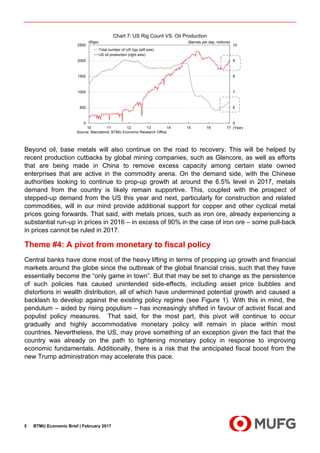
    BTMU Economic Brief| February 20175 Beyond oil, base metals will also continue on the road to recovery. This will be helped by recent production cutbacks by global mining companies, such as Glencore, as well as efforts that are being made in China to remove excess capacity among certain state owned enterprises that are active in the commodity arena. On the demand side, with the Chinese authorities looking to continue to prop-up growth at around the 6.5% level in 2017, metals demand from the country is likely remain supportive. This, coupled with the prospect of stepped-up demand from the US this year and next, particularly for construction and related commodities, will in our mind provide additional support for copper and other cyclical metal prices going forwards. That said, with metals prices, such as iron ore, already experiencing a substantial run-up in prices in 2016 – in excess of 90% in the case of iron ore – some pull-back in prices cannot be ruled in 2017. Theme #4: A pivot from monetary to fiscal policy Central banks have done most of the heavy lifting in terms of propping up growth and financial markets around the globe since the outbreak of the global financial crisis, such that they have essentially become the “only game in town”. But that may be set to change as the persistence of such policies has caused unintended side-effects, including asset price bubbles and distortions in wealth distribution, all of which have undermined potential growth and caused a backlash to develop against the existing policy regime (see Figure 1). With this in mind, the pendulum – aided by rising populism – has increasingly shifted in favour of activist fiscal and populist policy measures. That said, for the most part, this pivot will continue to occur gradually and highly accommodative monetary policy will remain in place within most countries. Nevertheless, the US, may prove something of an exception given the fact that the country was already on the path to tightening monetary policy in response to improving economic fundamentals. Additionally, there is a risk that the anticipated fiscal boost from the new Trump administration may accelerate this pace. 5 6 7 8 9 10 0 500 1000 1500 2000 2500 10 11 12 13 14 15 16 17 Total number of US rigs (left axis) US oil production (right axis) Chart 7: US Rig Count VS. Oil Production (Barrels per day, millions)(Rigs) Source: Macrobond, BTMU Economic Research Office (Year)
  • 6.
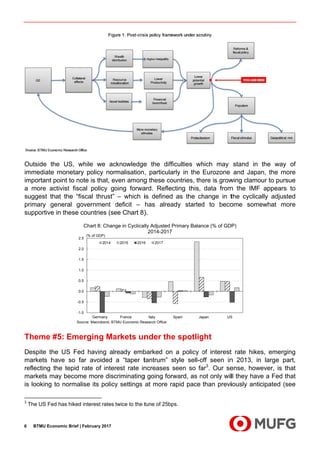
    6 O im im a su pr su T D m re m is 3 T BTMU Econo Outside the mmediatem mportant po more act uggest tha rimary ge upportive in Theme #5 espite the markets ha eflecting th markets ma looking to The US Fed omic Brief | Fe e US, wh monetary oint to note tivist fiscal at the “fisc neral gov n these co 5: Emer e US Fed ve so far he tepid ra ay become o normalis has hiked in -1.0 -0.5 0.0 0.5 1.0 1.5 2.0 2.5 C Source ( ebruary 2017 ile we ac policy nor e is that, ev l policy go cal thrust” vernment d ountries (se rging Ma having alr avoided ate of inter more disc e its policy terest rates t Germany 2014 Chart 8: Chang e: Macrobond, BT (% of GDP) cknowledge malisation ven among oing forwa – which i deficit – ee Chart 8) arkets un ready emb a “taper t rest rate in criminating y settings twice to the t France 2015 2016 ge in Cyclical TMU Economic Re e the diffi , particula g these co ard. Reflec is defined has alrea ). nder the barked on tantrum” s ncreases s g going forw at more ra tune of 25bp Italy S 6 2017 lly Adjusted P 2014-2017 esearch Office iculties wh rly in the untries, the cting this, as the ch ady started e spotlig a policy o style sell-o seen so fa ward, as n apid pace ps. Spain Ja Primary Balan hich may Eurozone ere is grow data from hange in t d to beco ght of interest off seen in ar3 . Our se not only wil than previ apan US nce (% of GD stand in and Japa wing clamo m the IMF the cyclica ome some t rate hike n 2013, in ense, how ll they hav iously anti S P) the way an, the mo our to pursu appears ally adjuste ewhat mo es, emergin n large pa wever, is th e a Fed th cipated (se of ore ue to ed ore ng art, hat hat ee
  • 7.
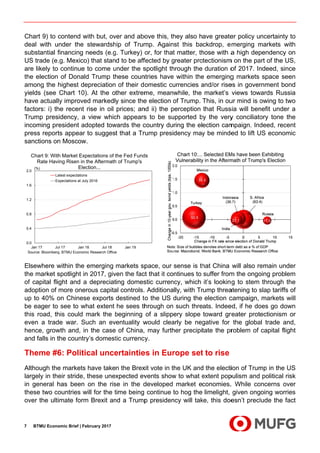
    7 C de su U ar th am yi ha fa Tr in pr sa E th of ad up be th ev he an T A la in th ov 0. 0. 0. 1. 1. 2. S BTMU Econo hart 9)to eal with u ubstantial f S trade (e re likely to he election mong the elds (see ave actual actors: i) th rump pres ncoming pr ress report anctions on lsewhere w he market s f capital fli doption of p to 40% o e eager to his road, th ven a trad ence, grow nd falls in t Theme #6 lthough the argely in th n general h hese two c ver the ult .0 .4 .8 .2 .6 .0 Jan 17 Ju La E Chart 9: Wit Rate Hav Source: Bloomberg (%) omic Brief | Fe contend w under the financing n .g. Mexico o continue of Donald highest de Chart 10) ly improve he recent sidency, a resident ad ts appear n Moscow. within the spotlight in ight and a more oner on Chines o see to wh his could m de war. Su wth and, in the country 6: Politic e markets eir stride, has been ountries w imate form ul 17 Jan 1 atest expectations xpectations at July h Market Exp ving Risen in t Elec g, BTMU Econom ebruary 2017 with but, ov stewardsh needs (e.g o) that stan to come u d Trump th epreciation . At the o ed markedl rise in oil view whic dopted tow to sugges . emerging n 2017, giv depreciat rous capita e exports hat extent mark the b uch an ev n the case y’s domest cal unce have take these unex on the ris will for the t m Brexit an 8 Jul 18 s y 2016 pectations of t the Aftermath ction... ic Research Office ver and abo hip of Trum g. Turkey) d to be aff under the s hese coun of their do ther extrem y since the prices; an ch appears wards the c t that a Tr markets sp ven the fac ting domes al controls. destined t he sees th beginning ventuality w of China, tic currenc ertaintie n the Brex xpected ev se in the d time being nd a Trump Jan 19 the Fed Fund h of Trump's e ove this, th mp. Again or, for that fected by g spotlight th ntries have omestic cu me, mean e election o nd ii) the p s to be su country du rump presi pace, our ct that it co stic curren Additiona o the US d hrough on of a slipp would clea may furth cy. es in Eur xit vote in t vents show developed continue t p presiden ds hey also h nst this ba t matter, th greater pro hrough the e within the urrencies a while, the of Trump. perception upported b ring the el dency may sense is th ntinues to ncy, which ally, with Tr during the such thre ery slope arly be neg her precipi rope set he UK and w to what e market e to hog the ncy will tak ave greate ackdrop, e hose with a otectionism duration o e emerging and/or rise market’s This, in ou that Russ by the very ection cam y be minde hat China suffer from it’s looking rump threa election c ats. Indee toward gre gative for tate the pr t to rise d the electi extent pop conomies. limelight, ke, this doe er policy u merging m a high dep m on the pa of 2017. In g markets es in gover views tow ur mind is o sia will ben y conciliato mpaign. Ind ed to lift U will also re m the ongo g to stem atening to s campaign, ed, if he do reater prot the globa roblem of ion of Trum pulism and . While co given ong esn’t precl ncertainty markets w pendency o art of the U ndeed, sinc space see rnment bon wards Russ owing to tw nefit under ory tone th deed, rece US econom emain und oing proble through th slap tariffs markets w oes go dow ectionism al trade an capital flig mp in the U political ri oncerns ov oing worrie lude the fa to ith on S, ce en nd sia wo r a he ent mic der em he of will wn or nd, ght US sk ver es act
  • 8.
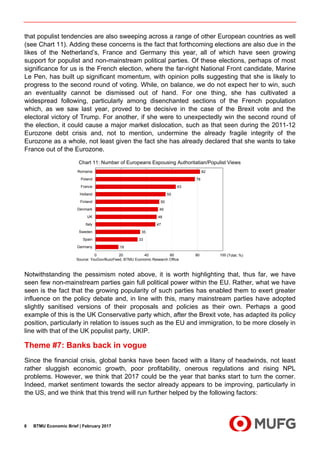
    BTMU Economic Brief| February 20178 that populist tendencies are also sweeping across a range of other European countries as well (see Chart 11). Adding these concerns is the fact that forthcoming elections are also due in the likes of the Netherland’s, France and Germany this year, all of which have seen growing support for populist and non-mainstream political parties. Of these elections, perhaps of most significance for us is the French election, where the far-right National Front candidate, Marine Le Pen, has built up significant momentum, with opinion polls suggesting that she is likely to progress to the second round of voting. While, on balance, we do not expect her to win, such an eventuality cannot be dismissed out of hand. For one thing, she has cultivated a widespread following, particularly among disenchanted sections of the French population which, as we saw last year, proved to be decisive in the case of the Brexit vote and the electoral victory of Trump. For another, if she were to unexpectedly win the second round of the election, it could cause a major market dislocation, such as that seen during the 2011-12 Eurozone debt crisis and, not to mention, undermine the already fragile integrity of the Eurozone as a whole, not least given the fact she has already declared that she wants to take France out of the Eurozone. Notwithstanding the pessimism noted above, it is worth highlighting that, thus far, we have seen few non-mainstream parties gain full political power within the EU. Rather, what we have seen is the fact that the growing popularity of such parties has enabled them to exert greater influence on the policy debate and, in line with this, many mainstream parties have adopted slightly sanitised versions of their proposals and policies as their own. Perhaps a good example of this is the UK Conservative party which, after the Brexit vote, has adapted its policy position, particularly in relation to issues such as the EU and immigration, to be more closely in line with that of the UK populist party, UKIP. Theme #7: Banks back in vogue Since the financial crisis, global banks have been faced with a litany of headwinds, not least rather sluggish economic growth, poor profitability, onerous regulations and rising NPL problems. However, we think that 2017 could be the year that banks start to turn the corner. Indeed, market sentiment towards the sector already appears to be improving, particularly in the US, and we think that this trend will run further helped by the following factors: 82 78 63 55 50 49 48 47 35 33 18 0 20 40 60 80 100 Romania Poland France Holland Finland Denmark UK Italy Sweden Spain Germany Source: YouGov/BuzzFeed, BTMU Economic Research Office Chart 11: Number of Europeans Espousing Authoritatian/Populist Views (Total, %)
  • 9.
    BTMU Economic Brief| February 20179 First, economic growth which, as we’ve alluded to above, is set to improve somewhat, particularly among the developed market economies. Second, under the Trump administration, the regulatory burden on banks may be pared back somewhat, with talk that his government may repeal the Dodd-Frank Act. Third, the problem of NPLs appears to have peaked, including in Europe, with the exception of some peripheral economies, such as Italy. Finally, with global interest rates set to rise going forward, led by the US, this will help to improve the net interest margin (NIM) and, hence, profitability position of banks. Conclusion After a turbulent 2016, markets are rightly anxious about the year ahead. That said, with the global economy showing signs of modest improvement and the election of Donald Trump adding to this positive sentiment – though not universally shared – we’re of the view that markets will be more willing to embrace greater risk this year, with cyclical plays, such as the banks and those active in the commodity arena, likely to be in vogue within the equities universe. However, with the political trajectory going forward this year likely to be uncertain, thanks to the rise of populist forces – especially in Europe where a number of key elections are due this year – our sense is that caution is still warranted. Additionally, with the policy-mix between monetary and fiscal policy in the developed markets, particularly the US, also in a state of flux, how this shift is manged and ultimately plays out will, in our mind, also have an important bearing for the global markets/economy during the course of this year. The Bank of Tokyo-Mitsubishi UFJ, Ltd. (“BTMU”) is a limited liability stock company incorporated in Japan and registered in the Tokyo Legal Affairs Bureau (company no. 0100-01-008846). BTMU’s head office is at 7-1 Marunouchi 2-Chome, Chiyoda-Ku, Tokyo 100-8388, Japan. BTMU’s London branch is registered as a UK establishment in the UK register of companies (registered no. BR002013). BTMU is authorised and regulated by the Japanese Financial Services Agency. BTMU’s London branch is authorised by the Prudential Regulation Authority (FCA/PRA no. 139189) and subject to regulation by the Financial Conduct Authority and limited regulation by the Prudential Regulation Authority. Details about the extent of BTMU London branch’s regulation by the Prudential Regulation Authority are available from us on request. This report shall not be construed as solicitation to take any action such as purchasing/selling/investing in financial market products. In taking any action, each reader is requested to act on the basis of his or her own judgment. This report is based on information believed to be reliable, but we do not guarantee, and do not accept any liability whatsoever for, its accuracy and we accept no liability whatsoever for any loss or damage of any kind arising out of the use of all or any part of this report. The contents of the report may be revised without advance notice. Also, this report is a literary work protected by copyright. No part of this report may be reproduced in any form without express statement of its source. The Bank of Tokyo-Mitsubishi UFJ, Ltd. retains copyright to this report and no part of this report may be reproduced or re-distributed without the written permission of The Bank of Tokyo-Mitsubishi UFJ, Ltd. The Bank of Tokyo-Mitsubishi UFJ, Ltd. expressly prohibits the re-distribution of this report to Retail Customers, via the internet or otherwise and The Bank of Tokyo-Mitsubishi UFJ, Ltd., its subsidiaries or affiliates accept no liability whatsoever o any third parties resulting from such re-distribution.