GLOBAL INVESTMENT COMMITTEE / COMMENTARY JANUARY 2016
On the Markets
MICHAEL WILSON
Chief Investment Officer
Morgan Stanley Wealth Management
TABLE OF CONTENTS
6
A Slow Slog for the Global Economy
Developed and emerging economies
swing between repair and recovery.
8
Structural Challenges to US Growth
The economy seems to be doing well, but
it may do a little less well in 2016.
9
Lowered Expectations for US Equities
MS & Co.’s US 12-month S&P 500 base-
case forecast is 2,175.
11
Well Set for Higher Rates and Volatility
The changing environment could create
tailwinds for some alternative strategies.
12
A Parched Landscape in Credit
More debt issues and less market liquidity
create problems for corporate bonds.
13
Avoiding Volatility With Muni Bonds
Muni bonds had a relatively good 2015,
but 2016 may be more challenging.
13
Q&A: The Case for European Equities
Allianz’s Neil Dwane says earnings in
Europe should sparkle this year.
From Rebalance to Convergence
While challenged at times over the course of the year, our
call for a Great Rebalancing in 2015 has generally played
out—sometimes even more than we expected. To recall,
our primary thesis suggested that a stronger US dollar,
weaker oil prices and more aggressive monetary/fiscal
policy outside the US would lead to a rebalancing of
growth from the US to other parts of the world, a shift in
power from oil producers to oil consumers and a resurgence
of the middle class not only in the US but perhaps globally.
Major transitions are never smooth, and the rebalancing of growth from a unipolar
world of “US only” to something more broad definitely qualifies as a major shift. As a
result, 2015 delivered more modest returns accompanied by higher volatility than we
expected. What’s more, this is likely to continue until investors become comfortable that
the transition is either complete, or until we have more evidence suggesting it has a
higher probability of success.
Tis the season for 2016 financial market outlooks—this note included—and what we
are finding is that many are indeed predicting exactly the convergence discussed above,
especially as it relates to economic variables. For illustration, the table on page 2 shows
Morgan Stanley & Co.’s regional outlook for real GDP and inflation. As you can see,
there is little difference between the US, the Euro Zone, the UK and Japan—a big
change from 2014 and prior years when the world was much more unbalanced. This is
the direct result of—among other things—divergent monetary policies, and hence real
exchange rates, and why we called for a Great Rebalancing in the first place. Based on
these forecasts, it appears policymakers may be on the cusp of achieving their goal of a
more balanced global economy. We think this is important because it should lead to a
more sustainable and durable recovery that can last for several more years—and
additional time is exactly what a still-overleveraged world needs.
From an investment perspective, we think 2016’s returns could be better than those
realized in 2015, but that they will remain divergent and volatile—even as economic
outcomes converge. How is that? First, economic growth often has little to do with
returns in equity markets, which are much more tied to earnings growth. Second, it’s the
rate of change rather than the absolute level of change that really matters for investment
returns, and this is where significant divergence is still occurring if not widening.
Finally, nominal GDP growth is a better proxy for revenues than real GDP and here,
too, there is more acceleration as deflationary pressures dissipate.
Let’s take Europe as an example. Real GDP will likely increase to 1.8% this year
from last year’s 1.5%, according MS & Co. forecasts. However, nominal GDP growth is
Please refer to important information, disclosures and qualifications at the end of this material. January 2016 2
expected to almost double to 3.1% from
1.6%. Similarly, real GDP growth for the
developed world is expected to remain flat
at 1.8% but increase to 3.3% from 2.1% on
a nominal basis, up nearly 60%. This
should all translate to better earnings
growth this year, especially for those in the
sectors and regions with the most operat-
ing leverage to economic acceleration—a
scenario that favors Japan, Europe and
even some emerging markets. This likely
means better equity market performance in
those regions, too.
EARNINGS GROWTH. Earnings growth
in Europe has fallen well short of what we
have experienced in the US since the Great
Recession. Even so, over the long term,
earnings growth for Europe and the US
has been approximately the same. As you
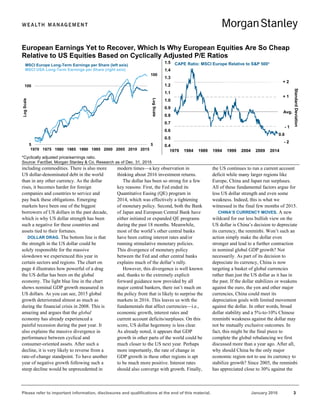
can see in the charts on page 3, we think
this divergence in earnings growth has
reached an extreme and may now begin to
close. This should lead to an extended
period of relative outperformance by
European equities—something we think
began last year. It also explains why
Europe is so cheap relative to the US
based on cyclically adjusted earnings.
Japan, on the other hand, has already
been generating superior profit growth for
the past few years thanks to Abenomics
and a greater focus on shareholder returns
by corporate managements. While it may
surprise readers, Japan is also generating
some of the highest-quality earnings in the
world because of better profit margins and
relatively low financial leverage. Finally,
Japanese companies have more operating
leverage than their US counterparts, which
means they generate more earnings growth
for every unit of growth in global nominal
GDP. This suggests recent earnings-
growth trends in Japan are sustainable, yet
Japanese equities remain underowned by
most dedicated investment pools around
the world. For these reasons, Japanese
equities remain the largest overweight of
all the assets in the Global Investment
Committee’s (GIC) recommended models.
The emerging markets are a slightly
different story in which the 2016 forecast
for real GDP is rising but inflation is
expected to fall further. This translates into
nominal GDP growth that is roughly flat
for the next few years. However, rising
real growth combined with falling
inflation from more elevated levels than in
developed economies could be a good
outcome for equities in the short term. In
addition to real GDP growth, MS & Co.
strategists are also forecasting a jump in
emerging market (EM) earnings growth to
6% from the past year’s negative 12%,
making this the region with the single
largest rate of change in earnings growth.
The emerging markets definitely still have
issues in the longer term, but such an
acceleration in earnings growth combined
with a more benign inflation outlook and
stimulative monetary and fiscal policy in
many EM countries should lead to a better
year ahead for EM equities.
All Eyes on the US Dollar
If there is one variable that could
undermine many of our 2016 views it is
the US dollar. During the past 18 months,
the dollar has enjoyed one of its strongest
and broadest rallies in history, with the
Morgan Stanley USD Trade-Weighted
Index up more than 20% and close to 33%
since 2008. It’s hard to believe that just
four years ago, gold was trading close to
$2,000 an ounce with many people
thinking it was headed to $5,000 and the
dollar was sinking into oblivion. To
contrast, current sentiment on the dollar
has rarely been more bullish with an
almost universally positive consensus
outlook. Positioning also remains very
long the dollar leaving one to wonder if
this trend can continue.
We think this trend is likely to take a
break if not reverse during the next year.
We also acknowledge that it is critical for
this to happen or else many financial
assets next year will be in for another
rough ride. The US dollar is still the
reserve currency of the world—thereby
serving as the principal pricing mechanism
for most internationally traded goods,
MS & Co. Economic and Interest Rate Forecasts
Source: Morgan Stanley & Co. Research, Bloomberg as of Dec. 31, 2015
Real GDP 2015E 2016E
2015E vs.
2016E 2017E
2016E vs.
2017E
G10 1.8% 1.8% 0% 1.8% 0%
US 2.4 1.9 -21 1.8 -5
Europe 1.5 1.8 20 1.8 0
Japan 0.5 1.2 140 0.8 -33
UK 2.4 2.0 -17 2.3 15
Emerging Markets 4.0 4.4 10 5.0 14
Inflation
G10 0.3% 1.5% 400% 2.1% 40%
US 0.2 1.7 750 2.3 35
Europe 0.1 1.3 1,200 1.8 38
Japan 0.9 1.0 11 2.5 150
UK 0.0 1.3 NA 1.5 15
Emerging Markets 4.4 3.7 -16 3.2 -14
Nominal GDP
G10 2.1% 3.3% 57% 3.9% 18%
US 2.6 3.6 38 4.1 14
Europe 1.6 3.1 94 3.6 16
Japan 1.4 2.2 57 3.3 50
UK 2.4 3.3 38 3.8 15
Emerging Markets 8.4 8.1 -4 8.2 1
10-Year
Bond Yield Current 4Q 2016E
US 2.3% 2.7% 17%
Germany 0.6 1.2 100
Japan 0.3 0.9 174
UK 2.0 2.6 30
Current vs. 4Q 2016E
Please refer to important information, disclosures and qualifications at the end of this material. January 2016 3
including commodities. There is also more
US dollar-denominated debt in the world
than in any other currency. As the dollar
rises, it becomes harder for foreign
companies and countries to service and
pay back these obligations. Emerging
markets have been one of the biggest
borrowers of US dollars in the past decade,
which is why US dollar strength has been
such a negative for these countries and
assets tied to their fortunes.
DOLLAR DRAG. The bottom line is that
the strength in the US dollar could be
solely responsible for the massive
slowdown we experienced this year in
certain sectors and regions. The chart on
page 4 illustrates how powerful of a drag
the US dollar has been on the global
economy. The light blue line in the chart
shows nominal GDP growth measured in
US dollars. As you can see, 2015 global
growth deteriorated almost as much as
during the financial crisis in 2008. This is
amazing and argues that the global
economy has already experienced a
painful recession during the past year. It
also explains the massive divergence in
performance between cyclical and
consumer-oriented assets. After such a
decline, it is very likely to reverse from a
rate-of-change standpoint. To have another
year of negative growth following such a
steep decline would be unprecedented in
modern times—a key observation in
thinking about 2016 investment returns.
The dollar has been so strong for a few
key reasons: First, the Fed ended its
Quantitative Easing (QE) program in
2014, which was effectively a tightening
of monetary policy. Second, both the Bank
of Japan and European Central Bank have
either initiated or expanded QE programs
during the past 18 months. Meanwhile,
most of the world’s other central banks
have been cutting interest rates and/or
running stimulative monetary policies.
This divergence of monetary policy
between the Fed and other central banks
explains much of the dollar’s rally.
However, this divergence is well known
and, thanks to the extremely explicit
forward guidance now provided by all
major central bankers, there isn’t much on
the policy front that is likely to surprise the
markets in 2016. This leaves us with the
fundamentals that affect currencies—i.e.,
economic growth, interest rates and
current account deficits/surpluses. On this
score, US dollar hegemony is less clear.
As already noted, it appears that GDP
growth in other parts of the world could be
much closer to the US next year. Perhaps
more importantly, the rate of change in
GDP growth in these other regions is apt
to be much more positive. Interest rates
should also converge with growth. Finally,
the US continues to run a current account
deficit while many larger regions like
Europe, China and Japan run surpluses.
All of these fundamental factors argue for
less US dollar strength and even some
weakness. Indeed, this is what we
witnessed in the final few months of 2015.
CHINA’S CURRENCY MOVES. A new
wildcard for our less bullish view on the
US dollar is China’s decision to depreciate
its currency, the renminbi. Won’t such an
action simply make the dollar even
stronger and lead to a further contraction
in nominal global GDP growth? Not
necessarily. As part of its decision to
depreciate its currency, China is now
targeting a basket of global currencies
rather than just the US dollar as it has in
the past. If the dollar stabilizes or weakens
against the euro, the yen and other major
currencies, China could meet its
depreciation goals with limited movement
against the dollar. In other words, broad
dollar stability and a 5%-to-10% Chinese
renminbi weakness against the dollar may
not be mutually exclusive outcomes. In
fact, this might be the final piece to
complete the global rebalancing we first
discussed more than a year ago. After all,
why should China be the only major
economic region not to use its currency to
stabilize growth? Since 2005, the renminbi
has appreciated close to 30% against the
European Earnings Yet to Recover, Which Is Why European Equities Are So Cheap
Relative to US Equities Based on Cyclically Adjusted P/E Ratios
*Cyclically adjusted price/earnings ratio.
Source: FactSet, Morgan Stanley & Co. Research as of Dec. 31, 2015
5
100
5
100
1970 1975 1980 1985 1990 1995 2000 2005 2010 2015
LogScale
LogScale
MSCI Europe Long-Term Earnings per Share (left axis)
MSCI USA Long-Term Earnings per Share (right axis)
0.6
0.4
0.5
0.6
0.7
0.8
0.9
1.0
1.1
1.2
1.3
1.4
1.5
1979 1984 1989 1994 1999 2004 2009 2014
StandardDeviation
+ 2
+ 1
Avg.
- 1
- 2
CAPE Ratio: MSCI Europe Relative to S&P 500*
Please refer to important information, disclosures and qualifications at the end of this material. January 2016 4
US dollar and much more against other
currencies. That is just too strong for an
economy that is going through its own
internal rebalancing and overall
deceleration in growth.
Ultimately, depreciation of China’s
currency should lead to greater
competitiveness and growth for China and
create a positive feedback loop for the
currency, much the way it has for the US
over the past few years. This last piece of
the rebalancing may be the most difficult
to achieve given how big China has
become. However, such an outcome would
also argue for better global growth and
support our more positive economic
forecasts for this year.
Putting It All Together
For 2016, the consensus is looking for
low growth, low inflation and a strong US
dollar. This translates into low returns
again for the primary assets in most
investors’ portfolios—stocks and bonds.
Meanwhile, the main consensus concern
today is that the Fed might be prematurely
raising interest rates given the fragility we
are still witnessing in emerging markets
and even many developed economies.
There is some reason for that concern:
Any central bank that has tried to raise
rates since the financial crisis has had to
reverse course within the next year. Why
should the Fed’s hike be any different?
While the Fed may have just begun to
raise interest rates, it ended its QE 15
months ago to the same criticism, yet the
US economy has not rolled over. In fact,
the job market and many other measures
of economic health have improved. Of
course, financial markets were not calm
last year as they worried about the Fed’s
policy change.
RATE HIKES JUSTIFIED. So, could
financial markets be overreacting to what
has been the most telegraphed Federal
Reserve action ever? The GIC’s view is
that the Fed should be raising interest rates
because the data say so. First, the Fed has
a dual mandate of full employment and
modest inflation, defined as 2%. To the
chagrin of most, the Fed has made
substantial progress on its first mandate. In
fact, based on the employment gap (see
chart, page 5), the recovery from the
financial crisis may have resulted in one of
the steadiest job recoveries the US
economy has ever experienced. Indeed, we
are now close to zero on the employment
gap—full employment. Second, inflation
remains very low but we are now starting
to see wages increase—a natural outcome
of full employment and critical for the Fed
to meet its inflation target. Furthermore,
with the collapse in oil prices and rise in
the US dollar, we should see less drag on
inflation in 2016 even if oil prices and the
dollar just go sideways. If oil moves
higher and/or the dollar moves lower, the
positive impact on inflation will
undoubtedly surprise markets to the
upside. In other words, the Fed is right to
start the interest rate normalization process
ahead of this potential acceleration.
In all, we expect the world to continue
to make progress this year on the long
healing process from the Great Recession
and financial crisis that occurred seven
years ago yet still lingers in our collective
psyche. Memories of that collapse are hard
to forget; investors remain apprehensive
and quick to run at the first signs of stress.
These feelings are unlikely to be
completely resolved in the next 12 months,
so we expect periods of doubt and fear will
continue and keep volatility elevated.
OVERWEIGHT GLOBAL EQUITIES.
Such a backdrop suggests remaining
overweight global equities with a balanced
exposure to developed and emerging
markets. Japan, the best-performing major
equity market in 2015, remains our
favorite region. With the strongest
fundamentals, the cheapest valuations and
still very supportive monetary and fiscal
policy, Japan offers the most upside
potential with limited downside. With our
more constructive view on the yen, we
continue to recommend clients do not
hedge the currency and own actively
managed funds that can take advantage of
the improving domestic recovery.
In contrast, emerging markets offer the
most upside potential if the global
economy accelerates more than expected,
but more downside if it doesn’t; this
makes the emerging markets a high-
risk/high-reward proposition. However,
EM equities have been down three years in
a row thanks to their outsized exposure to
the commodities rout and to China’s
slowdown, two trends we believe are
likely to stabilize this year. With sentiment
washed out, we think EM equities should
Global Nominal GDP Declined in 2015, Creating Large
Gap Between Producer and Consumer Companies
Note: Producers are the S&P 500 Industrials, Energy and Materials sectors; Consumers are the
S&P 500 Consumer Discretionary, Consumer Staples and Health Care sectors.
Source: Haver Analytics, FactSet as of Dec. 31, 2015
-15
-10
-5
0
5
10
15
20
-40
-30
-20
-10
0
10
20
30
2007 2008 2009 2010 2011 2012 2013 2014 2015
US Producers vs. Consumers Equity Prices, Year Over Year (left axis)
Global Nominal GDP Change, Year Over Year, US Dollars (right axis)
% %
Please refer to important information, disclosures and qualifications at the end of this material. January 2016 5
remain in client portfolios for, at a
minimum, a snapback rally.
Many European equity markets
performed well last year in local-currency
terms and we expect that to continue in
2016. Europe is heavily leveraged to
global growth. Meanwhile, Europe is
experiencing its first sustainable economic
upturn since the financial crisis. In contrast
to Japan, we recommend that clients hedge
half of their European currency risk and
take a more passive/beta approach.
As for the US, we see it likely to
provide lower returns than other developed
regions again, but with potentially still-
lower volatility. We also expect continued
wide dispersion of performance between
sectors and individual stocks, arguing for
active managers to outperform. The
substantial relative outperformance of
growth versus value should pause and
even reverse as growth and inflation
reaccelerate.
Fixed income returns in 2016 will also
be dependent on what happens with global
growth and inflation, as well as on the
pace of Fed rate hikes. If our nominal
GDP forecasts come to fruition, there is
risk to the upside for global interest rates,
and this could present a drag on fixed
income returns in the first half of the year.
However, a better economy should lead to
a tightening of credit spreads after the
significant widening last year that was
driven by the energy sector. This argues
for a rebound in US high yield.
Meanwhile, with the Fed hiking short-
term interest rates it’s unlikely that longer-
maturity interest rates will be able to rise
all that much. We believe clients should
start to buy high-quality, longer-maturity
bonds if interest rates rise above 2.5% on
10-year US Treasuries from the current
2.27%. As for the Fed, MS & Co.
economists now forecast three more rate
hikes of 25 basis points each this year,
with the Fed funds rate ending 2016 at
1.125% (see articles on pages 6 and 8).
BARBELL IN THE US. With respect to
US sectors, we think it makes sense to take
a barbell approach, with some exposure to
secular growth stocks in technology and
health care offset by beaten-up value areas
like industrials, energy and materials. As
shown in the chart on page 4, we already
may be seeing the rate of change turn in
the most cyclical areas as they begin to
anticipate the turn in nominal global GDP
growth. Financials should perform better
in 2016 as interest rates begin to rise,
especially those levered to consumer credit
and mortgages. We think traditional
consumer discretionary stocks—notably
retail and media—are likely to deliver
more-modest returns this year as these
sectors tend to perform best early in the
economic cycle and do not fare so well
once the Fed is actually raising interest
rates and wages are rising. On the other
hand, consumer services—travel/leisure,
credit cards and restaurants—should
continue to benefit from shifting consumer
preferences. Finally, defensively oriented
consumer staples should do well this year
if we are right about a pause in US dollar
strength. Many of these companies have
been hurt disproportionately by the
stronger dollar but should still benefit on
the cost side from generationally low
commodity prices. As for commodities,
we believe ongoing supply responses and
stable demand should lead to a significant
rally at some point in 2016. This should
buoy returns in the worst-performing
assets classes of 2015 including high yield,
MLPs and energy-dependent equities,
some of which may have already begun .
We would take advantage of that rally
with the view it will likely be a rebound to
sell.
DON’T GET COMPLACENT. While 2016
should provide more balanced and
accelerating growth and consequently
better overall return opportunities for
investors, we need to keep in mind that we
are late in the cycle and the recovery from
the global financial crisis is far from the
early stages. With the Fed and Bank of
England having already exited their
extraordinary monetary policies, global
market volatility is on the upswing and
likely here to stay. Investors need to stay
flexible and not get complacent because
markets can change quickly much like we
witnessed in the second half of 2015. With
that in mind, the GIC will not hesitate to
react to outsized moves in markets and
recommend appropriate changes to client
portfolios. In the meantime, we wish you
all a prosperous new year. 
The Unemployment Gap Has Closed,
Indicating Wages Could Start to Climb
*Year over year relative to the five-year average **2014 line indicates Fed tapering
Source: Bloomberg, Haver Analytics, Morgan Stanley Wealth Management GIC as of Nov. 30,
2015
-4
-3
-2
-1
0
1
2
3
4
5
1980 1985 1990 1995 2000 2005 2010 2015
%
US Unemployment Gap US Avg. Hourly Earnings*
First Fed Rate Hike of Interest Rate Cycle**
ON THE MARKETS / ECONOMICS
Please refer to important information, disclosures and qualifications at the end of this material. January 2016 6
CHETAN AHYA
Co-Head of Global Economics and Chief Asia
Economist
Morgan Stanley & Co.
ELGA BARTSCH
Co-Head of Global Economics and Chief Europe
Economist
Morgan Stanley & Co.
yclical and structural challenges have
beset the global economic expansion
since it began more than six years ago. It
now appears that 2015 will be the fourth
consecutive year that the global economy
fell short of its 30-year average annual
growth rate of 3.6%. The reasons: falling
potential growth and demand deficiency.
As developed market (DM) and emerging
market (EM) economies swung between
repair and recovery, every stage of the
global cycle has been marked by weakness
in either one or the other. No wonder
global growth has been so weak.
The developed markets have moved out
from the repair stage and growth is
recovering. The repair process remains
under way in the emerging markets, which
have had to reverse their “bad” sources of
growth (loose fiscal and monetary
policies) and also have had to contend
with the slower pace of both US monetary
accommodation and China’s demand
growth (see chart, page 7). Consequently,
2015 marked the second consecutive year
that global growth was held back by the
emerging markets. Indeed, in recent
months, investors have raised fresh
concerns about a global recession.
While recession risks exist and are
reflected in our bear-case scenarios, we
think that the global economy will once
again skirt recession. Healthy household
balance sheets and continued wage growth
should sustain DM domestic demand. In
addition, DM central banks are actively
managing their monetary policy stance in a
way that supports domestic demand so that
inflation targets are not compromised.
From the perspective of the emerging
markets, initial signs of macro stability are
filtering through in a number of countries
and lessen the need for restrictive policies.
Taken together, global growth should
recover on a cyclical basis to 3.3% in 2016
from 3.1% last year, with DM growth
holding steady at 1.8% and EM growth
improving to 4.4% from 2015’s 4.0% (see
table, page 2).
GROWTH ISSUES. The consumer has
been the key anchor for DM growth.
Consumer spending was boosted by a
number of tailwinds—job growth, wage
increases, savings from lower oil and
commodity prices, and monetary policy
that was still accommodative. Now, with a
gradual rise in oil prices and a rise in
interest rates in the US and UK, we expect
a moderating pace of growth in DM
private consumption, with the moderation
more pronounced in the US and UK.
While the DM consumer faces a number
of headwinds, healthy consumer balance
sheet fundamentals, wage growth holding
up and a more growth-conducive fiscal
policy environment all will remain
supportive of consumption growth, in our
view. As it is, reflecting a more accommo-
dative monetary environment, household
credit growth in G3 economies has been
improving. Moreover, at the margin, we
expect fiscal policy to turn more
supportive of growth, with the agreement
on a US fiscal package and potential
additional spending in the Euro Zone—
due in part to the influx of refugees—also
supporting DM consumption prospects.
Specifically, in the US we believe that
strong consumer balance sheet funda-
mentals, stabilizing energy prices and
strengthening wage growth will result in
slower but better-balanced growth in
consumer spending. In Europe, with the
boost from lower energy prices receding
(resulting in higher inflation denting real
incomes) and a number of political events
that could lead to a rise in uncertainty,
consumers will likely face headwinds this
year. In Japan, we are projecting a gradual
recovery in consumption, mainly because
of improvement in real income. Tight
labor markets should continue to place
upward pressures on wages, which should
support the consumer. Moreover, we
expect there will be front-loaded spending
or rush demand ahead of the next
consumption-tax hike in April 2017,
supporting consumption in the second half
of this year. For the UK, both fiscal and
monetary tightening will likely affect the
consumer, on top of the impact on
consumer confidence in the third quarter
of 2016 due to the UK’s in/out referendum
on EU membership.
During the past three years, the
emerging markets have been in the
adjustment phase, led by three key factors:
a slowdown in China; a reduced pace of
monetary accommodation in the US; and
the unwinding of their own domestic
misallocation of capital, which caused
macro-stability challenges. While the
adjustment process has been fairly intense
this year, we expect it to be less onerous in
2016, and hence expect the drag from the
emerging markets on global growth to
lessen.
STRUCTURAL ISSUES. This long period
of subpar growth is due to the headwinds
from high levels of debt, weakening
demographic trends and persistent
disinflationary pressures—the so-called
“3Ds.” While these factors have been
prevalent in the developed markets for
some time, an increasing number of
emerging markets are now also facing
these challenges:
A Slow Slog Back
for the Global Economy
C
Please refer to important information, disclosures and qualifications at the end of this material. January 2016 7
Debt. Out of the top-10 developed
markets plus top-10 emerging markets, we
now have eight countries with debt/GDP
ratios above 250% and five with debt/GDP
between 200% and 250%. Aggregate
debt/GDP of these countries has increased
from 201% in 2007 to 235% in 2014.
Demographics. The global ageing
population is now growing faster than the
working-age population. Moreover,
growth in global working-age population
is estimated to be 1.0% in 2016, down
from 1.4% in 2010 and 1.8% in 2005,
according to the UN.
Disinflation. The global manufacturing
and tradable-goods sector (including
commodities) faces the challenges of
excess capacity due to the Asia ex Japan
region, led by China. While we expect
DM core inflation to be lifted toward
central bank inflation targets, led by the
services component, EM core inflation is
expected to decelerate further in 2016,
weighing on the global core inflation
trajectory. This environment of lowflation
is only adding to the challenge of
managing debt dynamics.
MONETARY POLICY. Our forecast
includes an outright decoupling of
monetary policy across the Atlantic as the
Federal Reserve raises rates and the
European Central Bank (ECB) cuts them.
With respect to the emerging markets, the
new Fed tightening cycle causes concerns
among investors as to whether the tighter
financial conditions could trigger shifts in
capital flows and risk attitudes. With
respect to China more specifically, there is
a gradual decoupling of monetary
conditions as China ties the renminbi to a
trade-weighted currency basket instead of
unilaterally pegging it to the dollar. This,
together with additional reduction in
policy rates and reserve requirements,
should allow monetary conditions in China
to decouple from the US to a greater extent
than before.
Given the modest recovery that is being
penciled in, we see monetary policy
remaining accommodative over the
forecast horizon. Relative to our previous
forecasts, we are expecting a slower pace
of lift-off in the US, a later start in the UK
and more monetary accommodation in the
Euro Zone. In the EM world, we expect
more rate cuts for those central banks that
are already easing and the same or a
smaller number of rate hikes for those
central banks that are still tightening.
In the US, we do not expect the next
rate hike until June. In the UK, we expect
lift-off in the second quarter, but still see a
total of 50 basis points of policy-rate hikes
for the year. The Bank of Japan is no
longer expected to taper in October 2016
and instead could contemplate a shift in its
monetary policy regime from targeting its
balance sheet toward a new regime such as
targeting bond yields.
GLOBAL RISKS. In the year ahead, we
are watching out for three risk factors in
particular:
Fed Policy. Not only does the Fed start
from an ultraloose policy stance, but it also
does so against the backdrop of bond
yields, term premiums and risk premiums
that are low by historical standards, as well
as debt levels, mainly in the corporate
sector, that are historically high.
Furthermore, the Great Recession has
likely caused the natural interest rate to
move much lower than in past cycles,
increasing the risk of a policy error.
China. We believe policymakers have
enough wiggle room in the form of
monetary and fiscal easing to manage a
soft landing. However, we are more
concerned about the slow pace in cutting
capacity and recognition of bad loans
leading to a more persistent disinflationary
trend, morphing into deflation risks.
Europe/Emerging Markets. There are
several political events in Europe in 2016
that could challenge the current political
consensus: national elections in the
periphery, the unprecedented influx of
refugees and the UK vote on exiting the
European Union. In the emerging markets,
the main political risk is in Brazil, where
our baseline forecasts assume that the
current political stalemate cannot be
resolved until the second quarter, given the
political calendar and ongoing
investigations. In both cases, the risk is
that political complications could cause
sovereign spreads to widen materially,
leading to a sharp tightening in financial
conditions and derailing of the domestic-
demand recovery. 
Who’s Where on the Global Growth Cycle?
Source: Morgan Stanley & Co. Research as of Nov. 30, 2015
Brazil
China, Japan,
Australia, Indonesia,
Turkey, Ukraine
Euro Zone, India
Thailand
Global Growth Cycle
Growth Bottoming
Growth Peaking
US, UK, Sweden,
New Zealand
Peru
Korea, Chile
South Africa
Malaysia, Russia,
Taiwan
Mexico
Israel
Central/Eastern Europe
Colombia
ON THE MARKETS / ECONOMICS
Please refer to important information, disclosures and qualifications at the end of this material. January 2016 8
ELLEN ZENTNER
Chief US Economist
Morgan Stanley & Co.
he US economy seems better these
days, with unemployment at 5.0%, an
eight-year low and the Federal Reserve
having hiked the Fed funds rate for the
first time in nine years. When the fourth
quarter is tallied, we expect 2015 GDP
growth of 2.0% on a fourth-quarter-to-
fourth-quarter basis. Still, for 2016, we
believe the comparable number will be just
1.8% (see table). Our well-below-
consensus forecast owes to structural
challenges that dampen the economy’s
growth potential for the next several years.
Now that the Fed has left zero interest
rates behind, we believe the path of
inflation will be critical for further hikes.
Our inflation forecast informs our
expectation of 25-basis-point rate hikes at
the June, September and December Fed
policy meetings. This pegs the midpoint of
the Fed’s target range at 1.125% by the
end of 2016. Four additional hikes in 2017
bring the target range to 2.125% by the
end of next year.
OVERESTIMATED GROWTH. We expect
the Fed to start the year as it has in the
past, having overestimated growth. As
those forecasts are lowered, sluggish core
inflation does not seem likely to pressure
the Fed to be more aggressive. Moreover,
without accelerating wage growth, the
median expectation for the nonaccelerating
inflation rate of unemployment—the level
of unemployment below which inflation
rises—drifts lower, which further supports
a shallow stance on monetary tightening.
Sectors sensitive to interest rates will
likely face the headwinds that rising rates
typically present. Still, we believe the
economy will take higher rates in stride as
the need to roll over corporate debt is
largely a 2018 story and household
balance sheets are not particularly exposed
to variable rates. We see housing backed
by rising household formation, while
further appreciation continues to whittle
away at homeowners’ negative equity and
support spending on home improvements.
Record levels of consumer liquidity
funded by income instead of debt, along-
side energy savings and the improved
buying power of the US dollar, supported
consumer fundamentals last year. In 2016,
we expect energy to stabilize and the pace
of job gains to slow while wage growth
strengthens, resulting in slower but better-
balanced growth in consumer spending.
We expect little contribution to growth
from inventory building this year as
consumer spending slows and business
investment remains sluggish. With no
further collapse in oil prices, energy
investment should become net neutral.
Lastly, transitory external headwinds
should fade this year as the pace of
appreciation in the US broad trade-
weighted dollar moves into a slower
upward trajectory but the lagged effects of
past appreciation continue to weigh on
external demand.
FORECAST RISKS. In our bull case,
global growth accelerates, boosting
exports and energy investment. Global
central banks come off an easing bias and
the dollar loses steam. Full employment is
reached more quickly and wage growth
takes off. Households pick up the pace of
spending and business investment follows
suit. An optimal control policy informs the
Fed to embark on a path of tightening that
is gradual at first, and then plays catch-up
with the Fed’s target, reaching 3.625% by
the end of 2017.
In our bear case, the Fed’s first rate
hike does a poor job of communicating its
gradual intent to financial markets. The
result is an extreme tightening of global
financial conditions on the expectation of
an aggressive path for Fed policy. The
global economy weakens further and
cracks appear in the soundness of the US
domestic economy. On signs of a more
material weakening, the Fed backs out the
only rate hike it had executed, but a short-
lived recession is locked in. 
Structural Challenges Hold
Back US Growth Outlook
T
Our Forecasts See Flatter Growth in 2016 and 2017
*Personal consumption expenditures **Four-quarter average
Source: Bureau of Economic Analysis, Bureau of Labor Statistics, MS & Co. as of Dec.1, 2015
4Q/4Q Percent Change 2014 2015 2016 2017 2015 2016 2017
Real GDP 2.5 2.0 1.8 1.8 2.0 1.8 1.8
Final Sales 2.6 2.1 1.9 1.8 2.1 2.0 1.8
Final Domestic Demand 3.0 2.5 2.3 1.7 2.6 2.2 1.9
PCE* 3.2 2.7 1.9 1.8 2.5 2.0 2.0
Business Fixed Investment 5.5 2.0 3.3 2.7 3.1 3.1 2.6
Residential Fixed Investment 5.1 8.0 8.6 2.6 11.3 8.9 3.5
Exports 2.4 -0.3 1.2 4.3 1.1 2.2 3.8
Imports 5.4 2.5 3.9 3.7 4.6 3.9 4.1
Government 0.4 1.2 1.6 0.6 1.1 1.1 0.6
CPI 1.2 0.5 1.9 2.4 0.3 1.9 2.4
Core PCE 1.4 1.3 1.5 1.8 1.4 1.6 1.9
Unemployment Rate** 5.7 5.0 4.8 4.7 5.1 4.8 4.8
New Forecast Previous Forecast
ON THE MARKETS / EQUITIES
Please refer to important information, disclosures and qualifications at the end of this material. January 2016 9
ADAM S. PARKER, PhD
Chief US Equity Strategist
Morgan Stanley & Co.
skeptic could say that macro
forecasting is prohibitively difficult,
and it is certainly true that not all of our
team's macro calls have been successful
over the past few years. To be clear, we in
US equities live in a glass house, having
run the gamut of bearish and correct
(2011), bearish and incorrect (2012),
bullish and correct (2013 and 2014), and
bullish and incorrect (2015). So, what's up
for 2016?
When we started to think about 2016,
we first lowered our 2015 earnings-per-
share (EPS) estimates for the S&P 500 to
$120.50 from $124.00 (see table). Clearly,
we were too optimistic about the
magnitude of the benefit of lower oil
prices and the impact they would have on
last year’s earnings. We knew the sharp
strengthening of the dollar a year ago and
the drop in oil would have a negative
impact on earnings for major sectors like
energy, industrials and materials, and that
there would be some time before the areas
that benefit from lower costs showed the
corresponding upside. However, we had
thought that by the third quarter the
benefits of lower oil prices would start to
lift earnings in other segments of the
market—and that did not happen.
LONG LAG. We think our mistake was
to underestimate the length of the lag
between the lower oil price and its positive
impact in certain market segments, though
we continue to believe there is still a
meaningful reward there. In lowering our
2015 S&P 500 EPS, we are marking to
market for weaker third-quarter results and
reducing our estimates for fourth-quarter
earnings, which will start to be reported
later this month. The consensus bottom-up
number for last year is roughly $119. This
means we anticipate earnings to have
increased a little more than 1% for 2015
year over year, not counting a net share
buyback of about 2.3%.
We are also making a modest reduction
to our earnings outlook. Due to a lower
base and adjusting for MS & Co.’s house
views across all asset classes—such as
weaker US economic growth and a
stronger dollar against the euro—we have
reduced our 2016 EPS estimate for the
S&P 500 to $125.90 from $128.50 and
introduced our 2017 EPS estimate at
$131.40. These estimates
represent 4% growth each in 2016 and
2017—the same growth rate we previously
anticipated but from a lower base. Since
EPS growth in 2015 appears to be near 6%
if you exclude energy and the headwinds
from the oil decline and the strong dollar
should begin to moderate soon, our 4%
earnings-growth expectation is probably
conservative.
MODEST MULTIPLE EXPANSION.
Given our economists’ view on the Fed’s
path for the front end of the yield curve
and muted economic growth, we are
forecasting only modest multiple
expansion to 16.6, which yields our new
price target of 2,175 for the S&P 500 for
the end of 2016. This is based on paying
16.6 multiple on our 2017 earnings
estimate of $131.40 at the end of 2016,
and offers a low-to-mid-single-digit return
from today’s levels on a 12-month-
forward basis.
We worry about a couple of items.
First, we think our forecast for the market
is probably close to the consensus view.
We think that we are likely headed for a
choppy year of low returns, and suspect
many others think the same—avoiding the
mistake of romanticizing that we are
independent thinkers, and then thinking
the exact same thing as everyone else.
Secondly, this is a less optimistic forecast
than our prior views. On the one hand, as
we have written in the past, we think that
this will end up being a very long
expansion, perhaps lasting even until
2020, as we don’t see excesses in the US
consumer or corporate spending that make
us particularly worried. On the other hand,
our credit colleagues, in particular, are
influencing our view that the credit metrics
are starting to ring later cycle. Virtually
none of my colleagues in any asset class in
any region of the world feel more
optimistic about their asset class heading
into this planning season than they did
Lowered
Expectations
A
MS & Co. S&P 500 12-Month Price Target
Source: Thomson Reuters, MS & Co. Research as of Dec. 31, 2015
Scenario
Probability
2015E 2016E 20107E
P/E
Ratio
Scenario
Target
Upside/
Downside
Bull Case 20% 122.0 129.3 137.1 17.7 2,425 18.6%
Growth 3.0% 6% 6%
Base Case 60% 120.5 125.9 131.4 16.6 2,175 6.4%
Growth 1.3% 4% 4%
Bear Case 20% 116.6 110.8 105.2 15.2 1,600 -21.7%
Growth -2.0% -5% -5%
S&P 500 as of Dec. 31, 2015 2,044
Please refer to important information, disclosures and qualifications at the end of this material. January 2016 10
three or four months ago. Everyone would
probably say that now is the time, almost
by definition, to be a contrarian, but we
just don’t think that is the highest-
probability event.
BULL/BEAR CASES. While our base
case is for low-to-mid single-digit returns,
we think it is prudent to modify our bear
outcome, given it was last set during the
throes of the August sell-off. We have
raised our bear case to 1,600 from 1,500,
though we still feel the bear case embeds a
mild recession in the US. In this case,
earnings are down 2% in 2015, and 5% per
year in 2016 and 2017. At the end of 2016,
investors would pay just above 15 times
earnings for a view that earnings will be
$105.20, yielding a bear-case target of
1,600. This is down roughly 22% from the
year-end level.
In our bull case—one that could
materialize if fiscal stimuli are positive—
positioning and sentiment are low and
begin to rise, the oil and dollar headwinds
turn into tailwinds, and our original
estimates of these benefits turn out to be
accurate but just pushed out by a couple of
quarters. In this bull scenario, earnings
strongly surprise for the recently closed
fourth quarter and grow 6% per year to
$137.10 in 2017. If investors pay a bit less
than 18 times these earnings, feeling
relatively better about US equities and the
duration of the cycle, this yields a bull-
case target of 2,425, unchanged from our
prior forecast and offering nearly 19%
potential upside from the year-end level.
In summary, we see low-to-mid single-
digit returns as likely for 2016, with
modestly more downside in the bear case
than upside in the bull case.
Essentially, we are viewing this more as
a mid-expansion period in which equity
returns are not strong, and not the end of
the expansion. Should investors regain
confidence that the US economy and US
corporate behaviors are not likely to lead
to a substantial earnings correction, we
think the market could begin another more
meaningful acceleration path.
INVESTMENT ADVICE. While we see a
low-return year for 2016 as our base case,
we do feel more optimistic about a number
of cohorts and securities. We like mega-
cap and large-cap growth stocks, given the
lack of quality alternatives around the
globe and the number of quality stories in
consumer discretionary, health care and
technology within the US. Additionally,
we see credit card companies as a way to
capture the strong US consumer without
facing retail-specific risk, we feel better
about health care given the large sell-off
and the likelihood of further mergers-and-
acquisitions activity, and we think defense
has strong fundamentals at present and
won’t likely get bad news flow in a
presidential election year. By sector, we
also recommend overweight positions in
financials and consumer discretionary and
underweights in industrials, energy and
consumer staples. 
ON THE MARKETS / ALTERNATIVES
Please refer to important information, disclosures and qualifications at the end of this material. January 2016 11
DANIEL MACCARRONE
Liquid Alternatives Investment Officer
Morgan Stanley Wealth Management
ERIC KIM
Senior Investment Analyst
Morgan Stanley Wealth Management
ince 2009, the Federal Reserve’s zero
interest rate policy enhanced stock and
bond returns and cooled market volatility.
In that environment, alternative investment
strategies on average fared poorly relative
to long-only strategies as they are typically
managed to take less risk. With the Fed
lifting rates, returns could be lower and
volatility higher. That suggests select
alternative strategies could deliver better
absolute and risk-adjusted returns.
With alternatives, one’s ability to
execute can be influenced by many factors
and certain styles can be more or less
favorable under certain conditions. Here’s
what we believe could do well in the
evolving market environment.
Equity Long/Short. Active long/short
equity managers have been finding more
opportunities on the short side as market
appreciation has slowed. Correlation
among stocks has been falling and sector
dispersion has been increasing. Increased
dispersion among regions, sectors and
securities should lead to opportunities for
managers to generate long and short alpha.
Lower returns would position equity
long/short managers to potentially perform
better on a relative basis to long-only
managers. In addition, threats of a global
correction in equities due to slowing
growth would position hedged managers
to potentially outperform.
Event-Driven Equity. Companies have
become more receptive to creating
shareholder value through mergers and
acquisitions (M&A), spinoffs, buybacks,
cost optimization and changes in the
executive suite. Strategies in which
corporate activity is anticipated to occur
can drive returns that may be less market
dependent. The robust M&A cycle should
continue to offer opportunities in merger
arbitrage to capture good noncorrelated
returns (see chart). Recent volatility has
increased merger-arbitrage spreads,
creating more attractive entry points.
Cash-rich balance sheets and
uninvested commitments from private
equity provide more fuel for this trend. In
addition, management receptiveness to
shareholders has increased and relatively
easy financing is still available. In recent
years, strategic acquisitions have often
been accretive to earnings, and by
investing in the public markets, managers
can avoid the premiums private-equity
buyers pay to acquire a company. In a
slow-growth world, companies cannot rely
on revenues to enhance shareholder value.
Global Macro/Managed Futures. An
increase in volatility has historically been
good for global-macro and managed-
futures strategies because it has allowed
them to take advantage of dispersion
across asset classes and regions. Policy
dispersion between the US, Europe, China
and the emerging markets has the potential
to create opportunities. Persistent trends
among different asset classes are attractive
for trend-following futures managers.
Global macro/managed futures have
historically been good diversifiers relative
to traditional stock and bond portfolios as
well as to other alternative strategies.
Structured Credit. Investors have
become more selective about credit
quality, creating dispersion in fixed
income and opportunities for security
selection. Balance sheets are healthy and
defaults are low. Fundamentals remain
strong in mortgage-backed securities
(MBS) as housing prices are relatively
stable. A slow rise in rates may have less
impact on MBS than other fixed income
assets due to floating-rate coupons and
discounted securities. In addition,
alternative managers are seeking to take
more credit risk and less duration risk. The
new-issue market is robust, and the
demand for nonagency securities has
increased given an attractive current
income profile and improving fundamental
backdrop. 
Well Positioned for Higher
Interest Rates and Volatility
.
S
M&A Has Created Opportunities
For Event-Driven Managers
Source: Bloomberg as of Nov. 30, 2015
0
50
100
150
200
250
300
2007 2008 2009 2010 2011 2012 2013 2014 2015
Transaction Value, US Mergers & Acquisitions, Three-Month Average
$ Billion
ON THE MARKETS / FIXED INCOME
Please refer to important information, disclosures and qualifications at the end of this material. January 2016 12
JON MACKAY
Senior Markets Strategist
Morgan Stanley Wealth Management
redit markets struggled during
2015—and, yes, I know that’s the
“Captain Obvious” statement of the day—
but for a year in which the S&P 500 Index
essentially traded sideways, it’s somewhat
surprising to see both high yield and
investment grade credit with negative
returns. The Citi Broad Investment Grade
Corporate lost 0.74% and the Citi High
Yield Market Index fell 5.55% for the
year. High yield’s performance was the
widest ever versus the S&P 500 for a year
in which high yield declined.
Some of this performance dispersion
can be explained by the composition of
both markets, with the S&P more heavily
exposed to New Economy sectors like
technology and health care, while the high
yield market is more heavily weighted
towards Old Economy sectors like energy,
materials and industrials. However,
another factor that has attracted less
attention, and that we think is exacerbating
the downward move or “gap risk” in the
market, is the lack of liquidity in the credit
markets in general and the high yield
market, in particular.
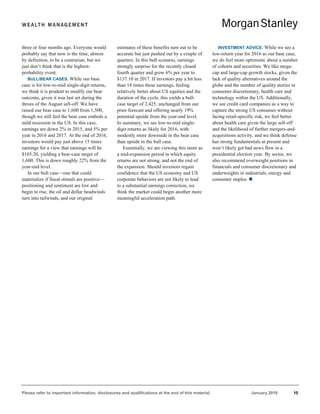
LACK OF LIQUIDITY. Why are the credit
markets suffering from a lack of liquidity?
Adam Richmond, Morgan Stanley & Co.’s
leveraged finance strategist, recently noted
(in “Liquidity Stressing the Cycle,” Dec.
14, 2015) that liquidity issues are
primarily being driven by three factors.
First, the size of the credit markets has
essentially doubled since the financial
crisis as low interest rates have driven
demand for credit, pushed yields down and
encouraged companies to issue debt (see
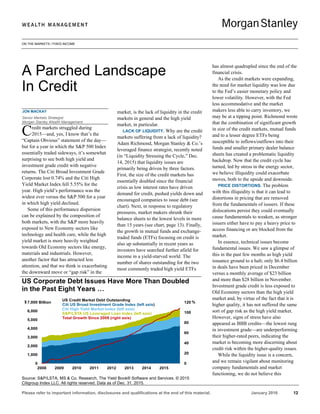
chart). Next, in response to regulatory
pressures, market makers shrunk their
balance sheets to the lowest levels in more
than 15 years (see chart, page 13). Finally,
the growth in mutual funds and exchange-
traded funds (ETFs) focusing on credit is
also up substantially in recent years as
investors have searched further afield for
income in a yield-starved world. The
number of shares outstanding for the two
most commonly traded high yield ETFs
has almost quadrupled since the end of the
financial crisis.
As the credit markets were expanding,
the need for market liquidity was low due
to the Fed’s easier monetary policy and
lower volatility. However, with the Fed
less accommodative and the market
makers less able to carry inventory, we
may be at a tipping point. Richmond wrote
that the combination of significant growth
in size of the credit markets, mutual funds
and to a lesser degree ETFs being
susceptible to inflows/outflows into their
funds and smaller primary dealer balance
sheets has created a problematic liquidity
backdrop. Now that the credit cycle has
turned, led by stress in the energy sector,
we believe illiquidity could exacerbate
moves, both to the upside and downside.
PRICE DISTORTIONS. The problem
with this illiquidity is that it can lead to
distortions in pricing that are removed
from the fundamentals of issuers. If these
dislocations persist they could eventually
cause fundamentals to weaken, as stronger
issuers either have to pay a heavy price to
access financing or are blocked from the
market.
In essence, technical issues become
fundamental issues. We saw a glimpse of
this in the past few months as high yield
issuance ground to a halt; only $6.4 billion
in deals have been priced in December
versus a monthly average of $23 billion
and more than $28 billion in November.
Investment grade credit is less exposed to
Old Economy sectors than the high yield
market and, by virtue of the fact that it is
higher quality, it has not suffered the same
sort of gap risk as the high yield market.
However, signs of stress have also
appeared as BBB credits—the lowest rung
in investment grade—are underperforming
their higher-rated peers, indicating the
market is becoming more discerning about
credit risk within the higher-quality issues.
While the liquidity issue is a concern,
and we remain vigilant about monitoring
company fundamentals and market
functioning, we do not believe this
A Parched Landscape
In Credit
C
US Corporate Debt Issues Have More Than Doubled
in the Past Eight Years …
Source: S&P/LSTA, MS & Co. Research, The Yield Book® Software and Services. © 2015
Citigroup Index LLC. All rights reserved. Data as of Dec. 31, 2015.
0
20
40
60
80
100
120
0
1,000
2,000
3,000
4,000
5,000
6,000
7,000
2008 2009 2010 2011 2012 2013 2014 2015
US Credit Market Debt Outstanding
Citi US Broad Investment Grade Index (left axis)
Citi High Yield Market Index (left axis)
S&P/LSTA US Leveraged Loan Index (left axis)
Total Growth Since 2008 (right axis)
$ %Billion
Please refer to important information, disclosures and qualifications at the end of this material. January 2016 13
situation is similar to that before the
financial crisis. Back then, corporate
leverage was far greater and there were
multiple layers of leverage in the financial
markets that all circled back to the banking
system. Although new regulations may be
one of the causes of lessened market
liquidity, it also means banks do not have
the same levered exposure to the markets
they did back then and thus are much less
likely to contract their balance sheets to
the same level they did in 2008 and 2009.
In addition, many mutual funds that invest
in the credit markets have increased their
cash positions to the highest levels we
have seen in years, giving them more
flexibility to meet redemptions.
RECOMMENDING HIGH YIELD. All told,
we maintain an overweight
recommendation to high yield and believe
the current storm is likely to pass. As we
see it, the recent weakness has created
value in the broader high yield market and
especially in sectors that are more skewed
to the consumer. A rally is more likely
than a sell-off from current levels in the
coming months, and we would recommend
investors that have exposure use that as an
opportunity to improve the quality of their
exposure and focus on high single-Bs and
double-BBs. 
ON THE MARKETS / MUNICIPAL BONDS
JOHN DILLON
Municipal Bond Strategist
Morgan Stanley Wealth Management
idestepping the spread widening that
plagued corporate bonds and the
volatility that buffeted equities, the
municipal bond market finished strong for
the year with a 3.3% total return,
according to Barclays Municipal Bond
Index. Not even the Federal Reserve’s rate
hike had much impact. What’s more, we
believe the seasonal factors that limited
supply and boosted demand should endure
through mid-January.
Still, facing higher rates, 2016 may not
be as good a year for munis. MS & Co.’s
base-case muni forecast is for a slim
1.25% total return. Due to the flatter
trajectory of longer maturities, investors
need not stretch too far for income as 70%
to 90% of a 30-year yield can be captured
in the 11-to-18-year range. Should interest
rates rise, we believe that bonds with
coupons of 5% or more will likely best
hold their value. Our up-in-quality bias
continues, especially for local general-
obligation (GO) bonds. Our strategy
remains intact, with neutral portfolio
duration and a new money focus on 15-to-
25-year maturities (best bought on
weakness) and we expect further yield-
curve flattening, with bonds beyond 10
years outperforming shorter maturities.
CREDIT STORIES. On the credit front, a
number of stories bear watching: Puerto
Rico is still trying to restructure its huge
debt load; Illinois and Pennsylvania lack
budgets and have failed to implement
pension reform; New Jersey faces huge
pension liabilities; and Alaska needs a
turnaround—or at least stabilization—in
oil prices to shore up its finances.
While we remain comfortable with all
states’ GO debt and appropriated paper
(Puerto Rico, of course, not being a state),
volatility and further spread widening may
be experienced as the aforementioned
states remain under pressure from both
market pressure and, quite possibly,
downward ratings pressure. Remember
that appropriated paper is often affected
earlier and more severely than GO debt.
This year we expect additional volatility
and differentiation among credits,
especially local GOs, which drives our
stance toward that sector. 
... While Corporate Bond Dealer Inventories Have
Declined Sharply in the Same Period
Source: Federal Reserve Bank of New York, MS & Co. Research, The Yield Book® Software
and Services. © 2015 Citigroup Index LLC. All rights reserved. Data as of Dec. 2, 2015.
Sidestepping Volatility
With Tax-Free Income
S
0
50,000
100,000
150,000
200,000
250,000
2001 2003 2005 2007 2009 2011 2013 2015
Corporate Dealer Inventories
$ Million
ON THE MARKETS / Q&A
Please refer to important information, disclosures and qualifications at the end of this material. January 2016 14
hile US stocks enjoyed solid
average annual total returns of
12.5% in the past five years, European
equities were stymied amid a bevy of
economic concerns. Now, the tide could be
changing according to Neil Dwane, chief
investment officer for European equity at
Allianz Global Investors. He notes that
while the US saw its economy falter last
year, with the rate of real economic growth
dropping from 3.9% in the second quarter
to 2.0% in the third, Europe exceeded
expectations. “We think the weaker euro
on top of some improvements in the
European economy is supporting the story
for underlying earnings growth,” he says.
“At a time when earnings growth
elsewhere around the world is pretty dull,
because economic growth is pretty dull, I
expect Europe will continue to see its
earnings grow.” Dwane recently spoke
with Morgan Stanley Wealth Management
Market Strategist Casey Galligan about
attractive investment prospects for 2016.
The following is an edited version of their
conversation.
CASEY GALLIGAN (CG): To help us
understand your views on Europe, why
don’t you start with your 2016 global
growth outlook?
NEIL DWANE (ND): We believe that
global growth is going to remain fragile. It
is arguably now more fragile, as we saw in
2015, because China is rebalancing. That
is having significant ramifications for not
only the industrial and manufacturing
sectors, but also for Asia in general
because it has benefited from the rising
tide of Chinese economic growth.
Everyone is worried and doesn’t want
to be the next Japan. We have had a
financial crisis, but we have solved the
debt crisis with more debt. We've lent
another $50 trillion to the global economy.
That is why growth is fragile. We've got a
bigger monkey on our back than we had
four or five years ago, and it's still slowing
the gears of the global economy down. I
would argue when you think about this, we
could be here in a dull environment
another 10 years or longer.
CG: What is the biggest risk?
ND: When you think about the types of
risk, I think an oil shock is something you
have to anticipate. There's no reason why
something could not go horribly wrong in
the Middle East any day of the week from
now on—and I think Russia has upped the
tension in that region over the past couple
of months.
CG: How do oil prices factor into your
broad view?
ND: We have a slightly more
constructive view on oil, because the
world consumes 93 million barrels of it
every day. In 12 months, some of that
supply will need to have been replaced
because of depletion and we will need to
bring new fields on to fill that gap.
Despite the world growing at a slow
rate for some time, we're still
accumulating and consuming the same
amount of oil, and the supply dynamic at
the current level means that there's no
investment, as we know, in the US or
elsewhere around the world. At some
point, that supply dynamic bites and,
therefore, we will see oil starting to drift
higher. I don’t think you’ll see oil go back
to $120 a barrel, but we will eventually see
oil go higher.
CG: Is China a major concern?
ND: I think many people are very
nervous about what's been going on in
China this year, and the policy, and the
capital outflows, but what we think we see
emerging is a strong new consumer who
has good economic growth, good wage
growth—and they're going to spend it.
There are 330 million middle-class people
in China, and the next thing that's going to
happen is they're going to start traveling,
which will help rebalance some of the lack
of demand that we're seeing around the
rest of the world.
Already, we are seeing South Korea
turning itself into a world-class cosmetics
producer and Thailand turning itself into a
global center for health care—so new
business models are emerging around the
world. The old China has changed, but we
think there's a lot of opportunities inside
the world as you try to meet this new
market demand that has come out there.
CG: How do Europe and the US
compare on a relative basis?
ND: Whereas in the past, US earnings
against European earnings rhymed, now
there's been a distinct difference. We think
this gap will now close. In the past four
years, the US fixed its banks. It had a
better economy. It had a weak dollar.
Everything was working pretty well for the
US economy. Meanwhile Europe didn't fix
its banks, went from one crisis to another,
and had until recently a very strong
currency. A year ago, Europe was growing
at 0% and the US was expected to grow at
4.0%.
That's now all unwinding. The US is
going to finish 2015 at 2.5%. Europe's
going to finish at 2.0%. It is all coming
together for Europe. Don’t get carried
away; the expectations should remain
tame—but we think there's a lot of
recovery potential in Europe that does not
exist in the US.
CG: Given this outlook, what are the
challenges facing investors?
ND: With global monetary cycles
diverging, we think that most assets have
been rerated. They're not going to go up
A Strong Case for
European Equities
W
Please refer to important information, disclosures and qualifications at the end of this material. January 2016 15
anymore in the manner that they have
because we no longer have all monetary
policy allowing the rerating of both bonds
and equities. I think 2015 really set the
scene for that because markets were
churning.
I think many investors are looking
through the rearview mirror at the returns
they've had out of equities and bonds in
the last five or 10 years, thinking, “This is
great.” But delivering alpha is becoming
much, much harder. We think a lot of
exchange-traded funds that track major
benchmark indexes are not going to
deliver the annualized returns that they
have in recent years because there isn't this
rising tide of returns in bond and equity
markets from here on out.
We are trying to encourage a lot of our
clients to take risk. That's the only way
they are going to protect the purchasing
power of their wealth. Particularly in
Europe, you have negative interest rates.
Nothing is yielding anything out to about
seven years in the sovereign bond markets.
So if there is no risk taken, there is no
return potential.
CG: Where do you see attractive return
potential?
ND: The US is trading at 27 times
earnings, according to the Shiller P/E ratio
[price divided by average 10 years’
earnings, adjusted for inflation]. That
means the more you put it in the US, the
lower the prospective returns you may
earn in the next 10 years. As an investor,
you want to hunt where there's return
potential. I would look at the US
valuations and argue it's already fully
valued.
We know Greece is in trouble, but the
valuation of the market offers 17% return
potential. If you look at the Italian market,
and you take out the banking sector, which
is now in structural decline, the average
Italian company is earning 60% of what it
was earning in 2006 or 2007. That’s why
we believe recovery potential is still sitting
inside the European market.
One story that I think is underestimated
is European investors could buy Europe:
European asset allocators have
traditionally been underweight equities
because of the volatility, and they've done
very well in fixed income markets. But
that's looking through the rearview mirror.
If you look through the wind screen,
Europeans have to go for equity markets to
get any type of return going forward, and
they are significantly underweight their
own markets.
CG: Which European sectors look most
attractive?
ND: For many of the sectors, you just
need Europe to improve. I think there's
clear evidence that consumption is
improving. Spending is improving and,
therefore, we think the more domestic,
consumer-related plays are a good place to
go.
I am probably an outlier, because I don't
understand the desire to buy banks. I think
banks are the most disrupted, the most
unnecessary, the most overresourced
sector of the market. I can't see any return
potential there and I don’t think that they
are going to be an earnings driver,
particularly with growing regulation.
We think you need to buy structural
growth stocks. In Europe, we would see
those as luxury goods, health care and a lot
of industrial and services areas. What you
don't own are banks, utilities and a whole
load of stuff in the middle that are not
generating either growth or income. We
prefer to take the risk by segmenting it
either into the true capital-appreciation-
type stocks or the dividend stocks.
CG: What would cause you to perhaps
change your constructive outlook on
Europe?
ND: I think it is overbullishness on the
US, causing the euro to go back up. That
stymies a lot of the recovery and the
restructuring, because the markets would
interpret that as the weaker dollar being
good for emerging markets—but the quid
pro quo is that it would be bad for Europe.
I tend to feel that the problems for
Europe are here in the US, and how the
markets and how the currency moves here
is how Europe will adjust. I think the
underlying story of Europe's restructuring
and gentle recovery is going to be in place
for a while.
CG: Beyond Europe, are there any other
investment themes that you see affecting
markets?
ND: Disruption is a very, very big
theme. It's been emerging very quickly in
the equity markets, but we think it has a lot
further to go. What we've tried to do is
understand how industries are now
changing, how technology and consumer
behavior is changing the markets, the
value chains, the pressure points.
The way I looked at this initially was, I
don't want to be invested in things that are
going to be disrupted—so the first stage
was to be very defensive. Then we do our
research to understand if companies can
navigate the changing environment. It's
doubly difficult because the millennials
are here. They don't want cars. They want
to live in a city. They want fresh food.
They like their mobile phones to do their
shopping. They are totally different.
Many companies will be challenged to
stay relevant to the baby boomers, or
clients of today, while finding a way of
becoming relevant to the clients of the
future—the millenials. A lot of industries
are going to suffer as the consumer
changes.
This is a theme across pretty much
every investment, and I think the
frustration for many of us is you can't buy
the disruptors; you can't invest in Uber or
Airbnb. All you can do is make sure you're
in the least disruptive investments. 
Neil Dwane is not an employee of
Morgan Stanley Wealth Management.
Opinions expressed by him are solely his
own and may not necessarily reflect those
of Morgan Stanley Wealth Management or
its affiliates.
Please refer to important information, disclosures and qualifications at the end of this material. January 2016 16
Global Investment Committee
Tactical Asset Allocation
The Global Investment Committee provides guidance on asset allocation decisions through its various model
portfolios. The five models below are recommended for investors with up to $25 million in investable assets.
They are based on an increasing scale of risk (expected volatility) and expected return.
Capital Preservation Income
Balanced Growth Market Growth
Opportunistic Growth Key
Source: Morgan Stanley Wealth Management GIC as of Dec. 31, 2015
Ultrashort Fixed Income
Fixed Income & Preferreds
Equities
Alternatives
Please refer to important information, disclosures and qualifications at the end of this material. January 2016 17
Source: Morgan Stanley Wealth Management GIC as of Dec. 31, 2015
*For more about the risks to Master Limited Partnerships (MLPs) and Duration, please see the Risk Considerations section beginning on
page 20 of this report.
Tactical Asset Allocation Reasoning
Global Equities
Relative Weight
Within Equities
US Overweight While US equities have done exceptionally well since the global financial crisis, they are now in the latter stages of a
cyclical bull market. We believe the US and global economies continue to heal, making recession neither imminent nor
likely in 2016. Therefore, while late in the cycle, it is still premature to abandon our overweight rating for US equities.
International Equities
(Developed Markets)
Overweight We maintain a positive bias for Japanese and European equity markets given the political and structural changes taking
place in Japan and our expectation for an improving economic outlook in Europe. European and Japanese central
banks are now engaged in much more aggressive monetary policy than the US, while also moving away from fiscal
austerity. Both of these markets are earlier in their bull market cycle and are more highly leveraged to an accelerating
global economy.
Emerging Markets Overweight Emerging market (EM) equities have been the big underperformers for the past few years. However, the region now
offers better value and, with the severe currency depreciation during the past year, there is a greater likelihood EM
equities will outperform as we enter 2016. Several EM countries are likely to exit recession this year, which argues for a
broader rebound in the region, especially if China continues to stimulate with both fiscal and monetary policy.
Global Fixed
Income
Relative Weight
Within Fixed
Income
US Investment Grade Overweight We have recommended shorter-duration* (maturities) since March 2013 given the extremely low yields and potential
capital losses associated with rising interest rates from such low levels. We have subsequently reduced the size of our
overweight in short duration, with short-term interest rates now expected to move higher this year along with the Fed’s
tightening cycle. Within investment grade, we prefer BBB-rated corporates and A-rated municipals to US Treasuries.
International
Investment Grade
Underweight Yields are extremely low globally, leaving very little value in international fixed income, particularly as the global
economy begins to recover more broadly. While interest rates are likely to stay low, the offsetting diversification benefits
do not warrant much, if any, position, in our view.
Inflation-Protected
Securities
Overweight With deflationary fears having become extreme in 2015, we believe these securities now offer relative value in the
context of our forecasted acceleration in global growth and expectations for oil prices and US-dollar year-over-year rate
of change to revert back toward 0%.
High Yield Overweight The sharp decline in oil prices has created some dislocations in the US high yield market. Broadly speaking, we believe
default rates are likely to remain contained as the economy recovers, while corporate and consumer behavior continue
to be conservative. This should lead to better performance over the next six to 12 months along with lower volatility than
equities.
Emerging Market
Bonds
Underweight We remain underweight as the Fed’s rate-hike cycle will likely be a disproportionate headwind for emerging market
(EM) debt. Much like EM equities, EM debt exposure should be selective. For investors who want to own EM debt, the
GIC recommends US-dollar-denominated debt with a focus on China, India and Mexico.
Alternative
Investments
Relative Weight
Within Alternative
Investments
REITs Underweight With our expectation for rising interest rates, we believe REITs are now fairly to slightly overvalued, especially relative to
other high-yielding asset categories. Therefore, we are underweight REITs in our tactical asset allocation. Non-US
REITs should be favored relative to domestic REITs.
Commodities Overweight Most commodities have underperformed in the past few years, with energy leading the charge lower. We believe
commodities are likely to perform better in 2016 as global growth reaccelerates and the oil market comes into better
supply/demand balance.
Master Limited
Partnerships*
Equal Weight Master limited partnerships (MLPs) were devastated during 2015 due to collapsing oil prices and a less hospitable
financing market. We expect tax-loss selling and window dressing hit MLPs excessively in the fourth quarter and expect
a sharp rebound as oil prices and financing markets stabilize. This will likely be a rally to sell.
Hedged Strategies
(Hedge Funds and
Managed Futures)
Equal Weight This asset category can provide uncorrelated exposure to traditional risk-asset markets. It tends to outperform when
traditional asset categories are challenged by growth scares and/or interest rate volatility spikes. Within this asset
category, we favor event-driven strategies, given our expectation for increased mergers-and-acquisitions activity.
ON THE MARKETS
Please refer to important information, disclosures and qualifications at the end of this material. January 2016 18
Hedged Strategy
Definitions
EQUITY LONG/SHORT This strategy consists of
a core holding of long equities hedged at all
times with varying degrees of short sales of
stock and/or index options. Some managers
maintain a substantial portion of assets within a
hedge structure and commonly employ
leverage.
EVENT DRIVEN Investment managers in this
strategy maintain positions in companies
currently or prospectively involved in corporate
transactions of a wide variety including but not
limited to mergers, restructurings, financial
distress, tender offers, shareholder buybacks,
debt exchanges, security issuance or other
capital-structure adjustments. Security types can
range from most senior in the capital structure
to most junior or subordinated, and frequently
involve additional derivative securities. Event-
driven exposure includes a combination of
sensitivities to equity markets, credit markets and
idiosyncratic, company-specific developments.
Investment theses are typically predicated on
fundamental characteristics (as opposed to
quantitative), with the realization of the thesis
predicated on a specific development exogenous
to the existing capital structure.
GLOBAL MACRO This is a hedge fund strategy
that bases its holdings—such as long and short
positions in various equity, fixed income,
currency and futures markets—primarily on
overall economic and political views of various
countries (macroeconomic principles).
MANAGED FUTURES FUNDS These funds
primarily trade liquid global futures, options,
swaps and foreign exchange contracts, both listed
and over-the-counter. A majority of these funds
follow trend-following, price-momentum
strategies. Other strategies included in this
category are systematic mean reversion,
discretionary global macro strategies, commodity
index tracking and other futures strategies. More
than 60% of the fund’s exposure is invested
through derivative securities. These funds obtain
exposure primarily through derivatives; the
holdings are largely cash instruments.
STRUCTURED CREDIT This is an investing
strategy that engages in buying securitization of
various financial assets such as mortgages, auto
loans and credit card receivables. These
securitizations typically pool debt obligations
and then redistribute the associated cash flows.
Examples of instruments created through these
securitizations include asset-backed securities
and collateralized debt obligations.
ON THE MARKETS
Please refer to important information, disclosures and qualifications at the end of this material. January 2016 19
Index Definitions
BARCLAYS MUNICIPAL BOND INDEX This is a
rules-based, market-value-weighted index
engineered for the long-term tax-exempt bond
market.
CITI HIGH YIELD MARKET INDEX This index
tracks performance of below-investment -grade
debt issued by corporations domiciled in the US
and Canada.
CITI US BIG CORPORATE BOND INDEX This is a
comprehensive representation of the US
investment grade corporate bond market.
MORGAN STANLEY USD TRADE-WEIGHTED
INDEX This is a trade-weighted index for the US
dollar, indexed to 100 on Jan. 1, 2010. The
index is updated once daily.
MSCI EUROPE INDEX This index is a free-float-
adjusted, market-capitalization-weighted index
that captures large- and mid-cap representation
across 16 developed-market countries in Europe.
MSCI EUROPE INDEX This index is a free-float-
adjusted, market-capitalization-weighted index
that captures large- and mid-cap representation
across 16 developed-market countries in Europe
MSCI USA INDEX This index is designed to
measure the performance of the large- and mid-
cap segments of the US equity market. With 636
constituents, the index covers approximately
85% of the free-float-adjusted market
capitalization in the US.
S&P 500 INDEX Regarded as the best single gauge
of the US equities market, this capitalization-
weighted index includes a representative sample
of 500 leading companies in leading industries in
the US economy.
S&P/LSTA US LEVERAGED LOAN INDEX This index
is designed to reflect the largest facilities in the
leveraged loan market and consists of 100 loan
facilities drawn from a larger benchmark, the
S&P/LSTA (Loan Syndications and Trading
Association) Leveraged Loan Index.
ON THE MARKETS
Please refer to important information, disclosures and qualifications at the end of this material. January 2016 20
Risk Considerations
MLPs
Master Limited Partnerships (MLPs) are limited partnerships or limited liability companies that are taxed as partnerships and whose interests (limited
partnership units or limited liability company units) are traded on securities exchanges like shares of common stock. Currently, most MLPs operate in
the energy, natural resources or real estate sectors. Investments in MLP interests are subject to the risks generally applicable to companies in the
energy and natural resources sectors, including commodity pricing risk, supply and demand risk, depletion risk and exploration risk.
Individual MLPs are publicly traded partnerships that have unique risks related to their structure. These include, but are not limited to, their reliance
on the capital markets to fund growth, adverse ruling on the current tax treatment of distributions (typically mostly tax deferred), and commodity
volume risk.
The potential tax benefits from investing in MLPs depend on their being treated as partnerships for federal income tax purposes and, if the MLP is
deemed to be a corporation, then its income would be subject to federal taxation at the entity level, reducing the amount of cash available for
distribution to the fund which could result in a reduction of the fund’s value.
MLPs carry interest rate risk and may underperform in a rising interest rate environment. MLP funds accrue deferred income taxes for future tax
liabilities associated with the portion of MLP distributions considered to be a tax-deferred return of capital and for any net operating gains as well as
capital appreciation of its investments; this deferred tax liability is reflected in the daily NAV; and, as a result, the MLP fund’s after-tax performance
could differ significantly from the underlying assets even if the pre-tax performance is closely tracked.
Duration
Duration, the most commonly used measure of bond risk, quantifies the effect of changes in interest rates on the price of a bond or bond portfolio.
The longer the duration, the more sensitive the bond or portfolio would be to changes in interest rates. Generally, if interest rates rise, bond prices
fall and vice versa. Longer-term bonds carry a longer or higher duration than shorter-term bonds; as such, they would be affected by changing
interest rates for a greater period of time if interest rates were to increase. Consequently, the price of a long-term bond would drop significantly as
compared to the price of a short-term bond.
International investing entails greater risk, as well as greater potential rewards compared to U.S. investing. These risks include political and
economic uncertainties of foreign countries as well as the risk of currency fluctuations. These risks are magnified in countries with emerging markets,
since these countries may have relatively unstable governments and less established markets and economies.
Alternative investments which may be referenced in this report, including private equity funds, real estate funds, hedge funds, managed futures
funds, and funds of hedge funds, private equity, and managed futures funds, are speculative and entail significant risks that can include losses due to
leveraging or other speculative investment practices, lack of liquidity, volatility of returns, restrictions on transferring interests in a fund, potential lack
of diversification, absence and/or delay of information regarding valuations and pricing, complex tax structures and delays in tax reporting, less
regulation and higher fees than mutual funds and risks associated with the operations, personnel and processes of the advisor.
Managed futures investments are speculative, involve a high degree of risk, use significant leverage, have limited liquidity and/or may be generally
illiquid, may incur substantial charges, may subject investors to conflicts of interest, and are usually suitable only for the risk capital portion of an
investor’s portfolio. Before investing in any partnership and in order to make an informed decision, investors should read the applicable prospectus
and/or offering documents carefully for additional information, including charges, expenses, and risks. Managed futures investments are not intended
to replace equities or fixed income securities but rather may act as a complement to these asset categories in a diversified portfolio.
Investing in commodities entails significant risks. Commodity prices may be affected by a variety of factors at any time, including but not limited to,
(i) changes in supply and demand relationships, (ii) governmental programs and policies, (iii) national and international political and economic events,
war and terrorist events, (iv) changes in interest and exchange rates, (v) trading activities in commodities and related contracts, (vi) pestilence,
technological change and weather, and (vii) the price volatility of a commodity. In addition, the commodities markets are subject to temporary
distortions or other disruptions due to various factors, including lack of liquidity, participation of speculators and government intervention.
Physical precious metals are non-regulated products. Precious metals are speculative investments, which may experience short-term and long
term price volatility. The value of precious metals investments may fluctuate and may appreciate or decline, depending on market conditions. If sold
in a declining market, the price you receive may be less than your original investment. Unlike bonds and stocks, precious metals do not make interest
or dividend payments. Therefore, precious metals may not be suitable for investors who require current income. Precious metals are commodities
that should be safely stored, which may impose additional costs on the investor. The Securities Investor Protection Corporation (“SIPC”) provides
certain protection for customers’ cash and securities in the event of a brokerage firm’s bankruptcy, other financial difficulties, or if customers’ assets
are missing. SIPC insurance does not apply to precious metals or other commodities.
Bonds are subject to interest rate risk. When interest rates rise, bond prices fall; generally the longer a bond's maturity, the more sensitive it is to this risk.
Bonds may also be subject to call risk, which is the risk that the issuer will redeem the debt at its option, fully or partially, before the scheduled maturity date.
The market value of debt instruments may fluctuate, and proceeds from sales prior to maturity may be more or less than the amount originally invested or the
maturity value due to changes in market conditions or changes in the credit quality of the issuer. Bonds are subject to the credit risk of the issuer. This is the
risk that the issuer might be unable to make interest and/or principal payments on a timely basis. Bonds are also subject to reinvestment risk, which is the risk
that principal and/or interest payments from a given investment may be reinvested at a lower interest rate.
ON THE MARKETS
Please refer to important information, disclosures and qualifications at the end of this material. January 2016 21
Bonds rated below investment grade may have speculative characteristics and present significant risks beyond those of other securities, including greater
credit risk and price volatility in the secondary market. Investors should be careful to consider these risks alongside their individual circumstances, objectives
and risk tolerance before investing in high-yield bonds. High yield bonds should comprise only a limited portion of a balanced portfolio.
Interest on municipal bonds is generally exempt from federal income tax; however, some bonds may be subject to the alternative minimum tax
(AMT). Typically, state tax-exemption applies if securities are issued within one's state of residence and, if applicable, local tax-exemption applies if
securities are issued within one's city of residence.
Treasury Inflation Protection Securities’ (TIPS) coupon payments and underlying principal are automatically increased to compensate for inflation
by tracking the consumer price index (CPI). While the real rate of return is guaranteed, TIPS tend to offer a low return. Because the return of TIPS is
linked to inflation, TIPS may significantly underperform versus conventional U.S. Treasuries in times of low inflation.
Principal is returned on a monthly basis over the life of a mortgage-backed security. Principal prepayment can significantly affect the monthly
income stream and the maturity of any type of MBS, including standard MBS, CMOs and Lottery Bonds. Yields and average lives are estimated
based on prepayment assumptions and are subject to change based on actual prepayment of the mortgages in the underlying pools. The level of
predictability of an MBS/CMO’s average life, and its market price, depends on the type of MBS/CMO class purchased and interest rate movements.
In general, as interest rates fall, prepayment speeds are likely to increase, thus shortening the MBS/CMO’s average life and likely causing its market
price to rise. Conversely, as interest rates rise, prepayment speeds are likely to decrease, thus lengthening average life and likely causing the
MBS/CMO’s market price to fall. Some MBS/CMOs may have “original issue discount” (OID). OID occurs if the MBS/CMO’s original issue price is
below its stated redemption price at maturity, and results in “imputed interest” that must be reported annually for tax purposes, resulting in a tax
liability even though interest was not received. Investors are urged to consult their tax advisors for more information.
The majority of $25 and $1000 par preferred securities are “callable” meaning that the issuer may retire the securities at specific prices and dates
prior to maturity. Interest/dividend payments on certain preferred issues may be deferred by the issuer for periods of up to 5 to 10 years, depending
on the particular issue. The investor would still have income tax liability even though payments would not have been received. Price quoted is per
$25 or $1,000 share, unless otherwise specified. Current yield is calculated by multiplying the coupon by par value divided by the market price.
The initial interest rate on a floating-rate security may be lower than that of a fixed-rate security of the same maturity because investors expect to
receive additional income due to future increases in the floating security’s underlying reference rate. The reference rate could be an index or an
interest rate. However, there can be no assurance that the reference rate will increase. Some floating-rate securities may be subject to call risk.
The market value of convertible bonds and the underlying common stock(s) will fluctuate and after purchase may be worth more or less than
original cost. If sold prior to maturity, investors may receive more or less than their original purchase price or maturity value, depending on market
conditions. Callable bonds may be redeemed by the issuer prior to maturity. Additional call features may exist that could affect yield.
Ultrashort-term fixed income asset class is comprised of fixed income securities with high quality, very short maturities. They are therefore subject
to the risks associated with debt securities such as credit and interest rate risk.
Principal is returned on a monthly basis over the life of a mortgage-backed security. Principal prepayment can significantly affect the monthly
income stream and the maturity of any type of MBS, including standard MBS, CMOs and Lottery Bonds. Yields and average lives are estimated
based on prepayment assumptions and are subject to change based on actual prepayment of the mortgages in the underlying pools. The level of
predictability of an MBS/CMO’s average life, and its market price, depends on the type of MBS/CMO class purchased and interest rate movements.
In general, as interest rates fall, prepayment speeds are likely to increase, thus shortening the MBS/CMO’s average life and likely causing its market
price to rise. Conversely, as interest rates rise, prepayment speeds are likely to decrease, thus lengthening average life and likely causing the
MBS/CMO’s market price to fall. Some MBS/CMOs may have “original issue discount” (OID). OID occurs if the MBS/CMO’s original issue price is
below its stated redemption price at maturity, and results in “imputed interest” that must be reported annually for tax purposes, resulting in a tax
liability even though interest was not received. Investors are urged to consult their tax advisors for more information.
Asset-backed securities generally decrease in value as a result of interest rate increases, but may benefit less than other fixed-income securities
from declining interest rates, principally because of prepayments.
Rebalancing does not protect against a loss in declining financial markets. There may be a potential tax implication with a rebalancing strategy.
Investors should consult with their tax advisor before implementing such a strategy.
An investment in an exchange-traded fund involves risks similar to those of investing in a broadly based portfolio of equity securities traded on an
exchange in the relevant securities market, such as market fluctuations caused by such factors as economic and political developments, changes in
interest rates and perceived trends in stock and bond prices. Investing in an international ETF also involves certain risks and considerations not
typically associated with investing in an ETF that invests in the securities of U.S. issues, such as political, currency, economic and market risks.
These risks are magnified in countries with emerging markets, since these countries may have relatively unstable governments and less established
markets and economics. For specifics and a greater explanation of possible risks with ETFs¸ along with the ETF’s investment objectives, charges and
expenses, please consult a copy of the ETF’s prospectus. Investing in sectors may be more volatile than diversifying across many industries. The
investment return and principal value of ETF investments will fluctuate, so an investor’s ETF shares (Creation Units), if or when sold, may be worth
more or less than the original cost. ETFs are redeemable only in Creation Unit size through an Authorized Participant and are not individually
redeemable from an ETF.
Equity securities may fluctuate in response to news on companies, industries, market conditions and general economic environment.
ON THE MARKETS
Please refer to important information, disclosures and qualifications at the end of this material. January 2016 22
Value investing does not guarantee a profit or eliminate risk. Not all companies whose stocks are considered to be value stocks are able to turn their
business around or successfully employ corrective strategies which would result in stock prices that do not rise as initially expected.
Growth investing does not guarantee a profit or eliminate risk. The stocks of these companies can have relatively high valuations. Because of these
high valuations, an investment in a growth stock can be more risky than an investment in a company with more modest growth expectations.
Investing in smaller companies involves greater risks not associated with investing in more established companies, such as business risk,
significant stock price fluctuations and illiquidity.
Stocks of medium-sized companies entail special risks, such as limited product lines, markets, and financial resources, and greater market
volatility than securities of larger, more-established companies.
Asset allocation and diversification do not assure a profit or protect against loss in declining financial markets.
The indices are unmanaged. An investor cannot invest directly in an index. They are shown for illustrative purposes only and do not represent the
performance of any specific investment.
The indices selected by Morgan Stanley Wealth Management to measure performance are representative of broad asset classes. Morgan
Stanley Smith Barney LLC retains the right to change representative indices at any time.
REITs investing risks are similar to those associated with direct investments in real estate: property value fluctuations, lack of liquidity, limited
diversification and sensitivity to economic factors such as interest rate changes and market recessions.
Because of their narrow focus, sector investments tend to be more volatile than investments that diversify across many sectors and companies.
Investing in foreign emerging markets entails greater risks than those normally associated with domestic markets, such as political, currency,
economic and market risks. These risks are magnified in frontier markets.
Investing in foreign markets entails greater risks than those normally associated with domestic markets, such as political, currency, economic and
market risks. Investing in currency involves additional special risks such as credit, interest rate fluctuations, derivative investment risk, and
domestic and foreign inflation rates, which can be volatile and may be less liquid than other securities and more sensitive to the effect of varied
economic conditions. In addition, international investing entails greater risk, as well as greater potential rewards compared to U.S. investing. These
risks include political and economic uncertainties of foreign countries as well as the risk of currency fluctuations. These risks are magnified in
countries with emerging markets, since these countries may have relatively unstable governments and less established markets and economies.
Yields are subject to change with economic conditions. Yield is only one factor that should be considered when making an investment decision.
Credit ratings are subject to change.
Certain securities referred to in this material may not have been registered under the U.S. Securities Act of 1933, as amended, and, if not, may not
be offered or sold absent an exemption therefrom. Recipients are required to comply with any legal or contractual restrictions on their purchase,
holding, sale, exercise of rights or performance of obligations under any securities/instruments transaction.
Disclosures
Morgan Stanley Wealth Management is the trade name of Morgan Stanley Smith Barney LLC, a registered broker-dealer in the United States. This
material has been prepared for informational purposes only and is not an offer to buy or sell or a solicitation of any offer to buy or sell any security or
other financial instrument or to participate in any trading strategy. Past performance is not necessarily a guide to future performance.
The author(s) (if any authors are noted) principally responsible for the preparation of this material receive compensation based upon various factors,
including quality and accuracy of their work, firm revenues (including trading and capital markets revenues), client feedback and competitive factors.
Morgan Stanley Wealth Management is involved in many businesses that may relate to companies, securities or instruments mentioned in this
material.
This material has been prepared for informational purposes only and is not an offer to buy or sell or a solicitation of any offer to buy or sell any
security/instrument, or to participate in any trading strategy. Any such offer would be made only after a prospective investor had completed its own
independent investigation of the securities, instruments or transactions, and received all information it required to make its own investment decision,
including, where applicable, a review of any offering circular or memorandum describing such security or instrument. That information would contain
material information not contained herein and to which prospective participants are referred. This material is based on public information as of the
specified date, and may be stale thereafter. We have no obligation to tell you when information herein may change. We make no representation or
warranty with respect to the accuracy or completeness of this material. Morgan Stanley Wealth Management has no obligation to provide updated
information on the securities/instruments mentioned herein.
ON THE MARKETS
Please refer to important information, disclosures and qualifications at the end of this material. January 2016 23
The securities/instruments discussed in this material may not be suitable for all investors. The appropriateness of a particular investment or strategy
will depend on an investor’s individual circumstances and objectives. Morgan Stanley Wealth Management recommends that investors
independently evaluate specific investments and strategies, and encourages investors to seek the advice of a financial advisor. The value of and
income from investments may vary because of changes in interest rates, foreign exchange rates, default rates, prepayment rates,
securities/instruments prices, market indexes, operational or financial conditions of companies and other issuers or other factors. Estimates of future
performance are based on assumptions that may not be realized. Actual events may differ from those assumed and changes to any assumptions
may have a material impact on any projections or estimates. Other events not taken into account may occur and may significantly affect the
projections or estimates. Certain assumptions may have been made for modeling purposes only to simplify the presentation and/or calculation of any
projections or estimates, and Morgan Stanley Wealth Management does not represent that any such assumptions will reflect actual future events.
Accordingly, there can be no assurance that estimated returns or projections will be realized or that actual returns or performance results will not
materially differ from those estimated herein.
This material should not be viewed as advice or recommendations with respect to asset allocation or any particular investment. This information is
not intended to, and should not, form a primary basis for any investment decisions that you may make. Morgan Stanley Wealth Management is not
acting as a fiduciary under either the Employee Retirement Income Security Act of 1974, as amended or under section 4975 of the Internal Revenue
Code of 1986 as amended in providing this material.
Morgan Stanley Smith Barney LLC, its affiliates and Morgan Stanley Financial Advisors do not provide legal or tax advice. Each client
should always consult his/her personal tax and/or legal advisor for information concerning his/her individual situation and to learn about
any potential tax or other implications that may result from acting on a particular recommendation.
This material is disseminated in Australia to “retail clients” within the meaning of the Australian Corporations Act by Morgan Stanley Wealth
Management Australia Pty Ltd (A.B.N. 19 009 145 555, holder of Australian financial services license No. 240813).
Morgan Stanley Wealth Management is not incorporated under the People's Republic of China ("PRC") law and the material in relation to this report
is conducted outside the PRC. This report will be distributed only upon request of a specific recipient. This report does not constitute an offer to sell or
the solicitation of an offer to buy any securities in the PRC. PRC investors must have the relevant qualifications to invest in such securities and must
be responsible for obtaining all relevant approvals, licenses, verifications and or registrations from PRC's relevant governmental authorities.
If your financial adviser is based in Australia, Switzerland or the United Kingdom, then please be aware that this report is being distributed by the
Morgan Stanley entity where your financial adviser is located, as follows: Australia: Morgan Stanley Wealth Management Australia Pty Ltd (ABN 19
009 145 555, AFSL No. 240813); Switzerland: Morgan Stanley (Switzerland) AG regulated by the Swiss Financial Market Supervisory Authority; or
United Kingdom: Morgan Stanley Private Wealth Management Ltd, authorized and regulated by the Financial Conduct Authority, approves for the
purposes of section 21 of the Financial Services and Markets Act 2000 this material for distribution in the United Kingdom.
Morgan Stanley Wealth Management is not acting as a municipal advisor to any municipal entity or obligated person within the meaning of Section
15B of the Securities Exchange Act (the “Municipal Advisor Rule”) and the opinions or views contained herein are not intended to be, and do not
constitute, advice within the meaning of the Municipal Advisor Rule.
This material is disseminated in the United States of America by Morgan Stanley Wealth Management.
Third-party data providers make no warranties or representations of any kind relating to the accuracy, completeness, or timeliness of the data they
provide and shall not have liability for any damages of any kind relating to such data.
This material, or any portion thereof, may not be reprinted, sold or redistributed without the written consent of Morgan Stanley Smith Barney LLC.
© 2016 Morgan Stanley Smith Barney LLC. Member SIPC.

2016 outlook

  • 1.
    GLOBAL INVESTMENT COMMITTEE/ COMMENTARY JANUARY 2016 On the Markets MICHAEL WILSON Chief Investment Officer Morgan Stanley Wealth Management TABLE OF CONTENTS 6 A Slow Slog for the Global Economy Developed and emerging economies swing between repair and recovery. 8 Structural Challenges to US Growth The economy seems to be doing well, but it may do a little less well in 2016. 9 Lowered Expectations for US Equities MS & Co.’s US 12-month S&P 500 base- case forecast is 2,175. 11 Well Set for Higher Rates and Volatility The changing environment could create tailwinds for some alternative strategies. 12 A Parched Landscape in Credit More debt issues and less market liquidity create problems for corporate bonds. 13 Avoiding Volatility With Muni Bonds Muni bonds had a relatively good 2015, but 2016 may be more challenging. 13 Q&A: The Case for European Equities Allianz’s Neil Dwane says earnings in Europe should sparkle this year. From Rebalance to Convergence While challenged at times over the course of the year, our call for a Great Rebalancing in 2015 has generally played out—sometimes even more than we expected. To recall, our primary thesis suggested that a stronger US dollar, weaker oil prices and more aggressive monetary/fiscal policy outside the US would lead to a rebalancing of growth from the US to other parts of the world, a shift in power from oil producers to oil consumers and a resurgence of the middle class not only in the US but perhaps globally. Major transitions are never smooth, and the rebalancing of growth from a unipolar world of “US only” to something more broad definitely qualifies as a major shift. As a result, 2015 delivered more modest returns accompanied by higher volatility than we expected. What’s more, this is likely to continue until investors become comfortable that the transition is either complete, or until we have more evidence suggesting it has a higher probability of success. Tis the season for 2016 financial market outlooks—this note included—and what we are finding is that many are indeed predicting exactly the convergence discussed above, especially as it relates to economic variables. For illustration, the table on page 2 shows Morgan Stanley & Co.’s regional outlook for real GDP and inflation. As you can see, there is little difference between the US, the Euro Zone, the UK and Japan—a big change from 2014 and prior years when the world was much more unbalanced. This is the direct result of—among other things—divergent monetary policies, and hence real exchange rates, and why we called for a Great Rebalancing in the first place. Based on these forecasts, it appears policymakers may be on the cusp of achieving their goal of a more balanced global economy. We think this is important because it should lead to a more sustainable and durable recovery that can last for several more years—and additional time is exactly what a still-overleveraged world needs. From an investment perspective, we think 2016’s returns could be better than those realized in 2015, but that they will remain divergent and volatile—even as economic outcomes converge. How is that? First, economic growth often has little to do with returns in equity markets, which are much more tied to earnings growth. Second, it’s the rate of change rather than the absolute level of change that really matters for investment returns, and this is where significant divergence is still occurring if not widening. Finally, nominal GDP growth is a better proxy for revenues than real GDP and here, too, there is more acceleration as deflationary pressures dissipate. Let’s take Europe as an example. Real GDP will likely increase to 1.8% this year from last year’s 1.5%, according MS & Co. forecasts. However, nominal GDP growth is
  • 2.
    Please refer toimportant information, disclosures and qualifications at the end of this material. January 2016 2 expected to almost double to 3.1% from 1.6%. Similarly, real GDP growth for the developed world is expected to remain flat at 1.8% but increase to 3.3% from 2.1% on a nominal basis, up nearly 60%. This should all translate to better earnings growth this year, especially for those in the sectors and regions with the most operat- ing leverage to economic acceleration—a scenario that favors Japan, Europe and even some emerging markets. This likely means better equity market performance in those regions, too. EARNINGS GROWTH. Earnings growth in Europe has fallen well short of what we have experienced in the US since the Great Recession. Even so, over the long term, earnings growth for Europe and the US has been approximately the same. As you can see in the charts on page 3, we think this divergence in earnings growth has reached an extreme and may now begin to close. This should lead to an extended period of relative outperformance by European equities—something we think began last year. It also explains why Europe is so cheap relative to the US based on cyclically adjusted earnings. Japan, on the other hand, has already been generating superior profit growth for the past few years thanks to Abenomics and a greater focus on shareholder returns by corporate managements. While it may surprise readers, Japan is also generating some of the highest-quality earnings in the world because of better profit margins and relatively low financial leverage. Finally, Japanese companies have more operating leverage than their US counterparts, which means they generate more earnings growth for every unit of growth in global nominal GDP. This suggests recent earnings- growth trends in Japan are sustainable, yet Japanese equities remain underowned by most dedicated investment pools around the world. For these reasons, Japanese equities remain the largest overweight of all the assets in the Global Investment Committee’s (GIC) recommended models. The emerging markets are a slightly different story in which the 2016 forecast for real GDP is rising but inflation is expected to fall further. This translates into nominal GDP growth that is roughly flat for the next few years. However, rising real growth combined with falling inflation from more elevated levels than in developed economies could be a good outcome for equities in the short term. In addition to real GDP growth, MS & Co. strategists are also forecasting a jump in emerging market (EM) earnings growth to 6% from the past year’s negative 12%, making this the region with the single largest rate of change in earnings growth. The emerging markets definitely still have issues in the longer term, but such an acceleration in earnings growth combined with a more benign inflation outlook and stimulative monetary and fiscal policy in many EM countries should lead to a better year ahead for EM equities. All Eyes on the US Dollar If there is one variable that could undermine many of our 2016 views it is the US dollar. During the past 18 months, the dollar has enjoyed one of its strongest and broadest rallies in history, with the Morgan Stanley USD Trade-Weighted Index up more than 20% and close to 33% since 2008. It’s hard to believe that just four years ago, gold was trading close to $2,000 an ounce with many people thinking it was headed to $5,000 and the dollar was sinking into oblivion. To contrast, current sentiment on the dollar has rarely been more bullish with an almost universally positive consensus outlook. Positioning also remains very long the dollar leaving one to wonder if this trend can continue. We think this trend is likely to take a break if not reverse during the next year. We also acknowledge that it is critical for this to happen or else many financial assets next year will be in for another rough ride. The US dollar is still the reserve currency of the world—thereby serving as the principal pricing mechanism for most internationally traded goods, MS & Co. Economic and Interest Rate Forecasts Source: Morgan Stanley & Co. Research, Bloomberg as of Dec. 31, 2015 Real GDP 2015E 2016E 2015E vs. 2016E 2017E 2016E vs. 2017E G10 1.8% 1.8% 0% 1.8% 0% US 2.4 1.9 -21 1.8 -5 Europe 1.5 1.8 20 1.8 0 Japan 0.5 1.2 140 0.8 -33 UK 2.4 2.0 -17 2.3 15 Emerging Markets 4.0 4.4 10 5.0 14 Inflation G10 0.3% 1.5% 400% 2.1% 40% US 0.2 1.7 750 2.3 35 Europe 0.1 1.3 1,200 1.8 38 Japan 0.9 1.0 11 2.5 150 UK 0.0 1.3 NA 1.5 15 Emerging Markets 4.4 3.7 -16 3.2 -14 Nominal GDP G10 2.1% 3.3% 57% 3.9% 18% US 2.6 3.6 38 4.1 14 Europe 1.6 3.1 94 3.6 16 Japan 1.4 2.2 57 3.3 50 UK 2.4 3.3 38 3.8 15 Emerging Markets 8.4 8.1 -4 8.2 1 10-Year Bond Yield Current 4Q 2016E US 2.3% 2.7% 17% Germany 0.6 1.2 100 Japan 0.3 0.9 174 UK 2.0 2.6 30 Current vs. 4Q 2016E
  • 3.
    Please refer toimportant information, disclosures and qualifications at the end of this material. January 2016 3 including commodities. There is also more US dollar-denominated debt in the world than in any other currency. As the dollar rises, it becomes harder for foreign companies and countries to service and pay back these obligations. Emerging markets have been one of the biggest borrowers of US dollars in the past decade, which is why US dollar strength has been such a negative for these countries and assets tied to their fortunes. DOLLAR DRAG. The bottom line is that the strength in the US dollar could be solely responsible for the massive slowdown we experienced this year in certain sectors and regions. The chart on page 4 illustrates how powerful of a drag the US dollar has been on the global economy. The light blue line in the chart shows nominal GDP growth measured in US dollars. As you can see, 2015 global growth deteriorated almost as much as during the financial crisis in 2008. This is amazing and argues that the global economy has already experienced a painful recession during the past year. It also explains the massive divergence in performance between cyclical and consumer-oriented assets. After such a decline, it is very likely to reverse from a rate-of-change standpoint. To have another year of negative growth following such a steep decline would be unprecedented in modern times—a key observation in thinking about 2016 investment returns. The dollar has been so strong for a few key reasons: First, the Fed ended its Quantitative Easing (QE) program in 2014, which was effectively a tightening of monetary policy. Second, both the Bank of Japan and European Central Bank have either initiated or expanded QE programs during the past 18 months. Meanwhile, most of the world’s other central banks have been cutting interest rates and/or running stimulative monetary policies. This divergence of monetary policy between the Fed and other central banks explains much of the dollar’s rally. However, this divergence is well known and, thanks to the extremely explicit forward guidance now provided by all major central bankers, there isn’t much on the policy front that is likely to surprise the markets in 2016. This leaves us with the fundamentals that affect currencies—i.e., economic growth, interest rates and current account deficits/surpluses. On this score, US dollar hegemony is less clear. As already noted, it appears that GDP growth in other parts of the world could be much closer to the US next year. Perhaps more importantly, the rate of change in GDP growth in these other regions is apt to be much more positive. Interest rates should also converge with growth. Finally, the US continues to run a current account deficit while many larger regions like Europe, China and Japan run surpluses. All of these fundamental factors argue for less US dollar strength and even some weakness. Indeed, this is what we witnessed in the final few months of 2015. CHINA’S CURRENCY MOVES. A new wildcard for our less bullish view on the US dollar is China’s decision to depreciate its currency, the renminbi. Won’t such an action simply make the dollar even stronger and lead to a further contraction in nominal global GDP growth? Not necessarily. As part of its decision to depreciate its currency, China is now targeting a basket of global currencies rather than just the US dollar as it has in the past. If the dollar stabilizes or weakens against the euro, the yen and other major currencies, China could meet its depreciation goals with limited movement against the dollar. In other words, broad dollar stability and a 5%-to-10% Chinese renminbi weakness against the dollar may not be mutually exclusive outcomes. In fact, this might be the final piece to complete the global rebalancing we first discussed more than a year ago. After all, why should China be the only major economic region not to use its currency to stabilize growth? Since 2005, the renminbi has appreciated close to 30% against the European Earnings Yet to Recover, Which Is Why European Equities Are So Cheap Relative to US Equities Based on Cyclically Adjusted P/E Ratios *Cyclically adjusted price/earnings ratio. Source: FactSet, Morgan Stanley & Co. Research as of Dec. 31, 2015 5 100 5 100 1970 1975 1980 1985 1990 1995 2000 2005 2010 2015 LogScale LogScale MSCI Europe Long-Term Earnings per Share (left axis) MSCI USA Long-Term Earnings per Share (right axis) 0.6 0.4 0.5 0.6 0.7 0.8 0.9 1.0 1.1 1.2 1.3 1.4 1.5 1979 1984 1989 1994 1999 2004 2009 2014 StandardDeviation + 2 + 1 Avg. - 1 - 2 CAPE Ratio: MSCI Europe Relative to S&P 500*
  • 4.
    Please refer toimportant information, disclosures and qualifications at the end of this material. January 2016 4 US dollar and much more against other currencies. That is just too strong for an economy that is going through its own internal rebalancing and overall deceleration in growth. Ultimately, depreciation of China’s currency should lead to greater competitiveness and growth for China and create a positive feedback loop for the currency, much the way it has for the US over the past few years. This last piece of the rebalancing may be the most difficult to achieve given how big China has become. However, such an outcome would also argue for better global growth and support our more positive economic forecasts for this year. Putting It All Together For 2016, the consensus is looking for low growth, low inflation and a strong US dollar. This translates into low returns again for the primary assets in most investors’ portfolios—stocks and bonds. Meanwhile, the main consensus concern today is that the Fed might be prematurely raising interest rates given the fragility we are still witnessing in emerging markets and even many developed economies. There is some reason for that concern: Any central bank that has tried to raise rates since the financial crisis has had to reverse course within the next year. Why should the Fed’s hike be any different? While the Fed may have just begun to raise interest rates, it ended its QE 15 months ago to the same criticism, yet the US economy has not rolled over. In fact, the job market and many other measures of economic health have improved. Of course, financial markets were not calm last year as they worried about the Fed’s policy change. RATE HIKES JUSTIFIED. So, could financial markets be overreacting to what has been the most telegraphed Federal Reserve action ever? The GIC’s view is that the Fed should be raising interest rates because the data say so. First, the Fed has a dual mandate of full employment and modest inflation, defined as 2%. To the chagrin of most, the Fed has made substantial progress on its first mandate. In fact, based on the employment gap (see chart, page 5), the recovery from the financial crisis may have resulted in one of the steadiest job recoveries the US economy has ever experienced. Indeed, we are now close to zero on the employment gap—full employment. Second, inflation remains very low but we are now starting to see wages increase—a natural outcome of full employment and critical for the Fed to meet its inflation target. Furthermore, with the collapse in oil prices and rise in the US dollar, we should see less drag on inflation in 2016 even if oil prices and the dollar just go sideways. If oil moves higher and/or the dollar moves lower, the positive impact on inflation will undoubtedly surprise markets to the upside. In other words, the Fed is right to start the interest rate normalization process ahead of this potential acceleration. In all, we expect the world to continue to make progress this year on the long healing process from the Great Recession and financial crisis that occurred seven years ago yet still lingers in our collective psyche. Memories of that collapse are hard to forget; investors remain apprehensive and quick to run at the first signs of stress. These feelings are unlikely to be completely resolved in the next 12 months, so we expect periods of doubt and fear will continue and keep volatility elevated. OVERWEIGHT GLOBAL EQUITIES. Such a backdrop suggests remaining overweight global equities with a balanced exposure to developed and emerging markets. Japan, the best-performing major equity market in 2015, remains our favorite region. With the strongest fundamentals, the cheapest valuations and still very supportive monetary and fiscal policy, Japan offers the most upside potential with limited downside. With our more constructive view on the yen, we continue to recommend clients do not hedge the currency and own actively managed funds that can take advantage of the improving domestic recovery. In contrast, emerging markets offer the most upside potential if the global economy accelerates more than expected, but more downside if it doesn’t; this makes the emerging markets a high- risk/high-reward proposition. However, EM equities have been down three years in a row thanks to their outsized exposure to the commodities rout and to China’s slowdown, two trends we believe are likely to stabilize this year. With sentiment washed out, we think EM equities should Global Nominal GDP Declined in 2015, Creating Large Gap Between Producer and Consumer Companies Note: Producers are the S&P 500 Industrials, Energy and Materials sectors; Consumers are the S&P 500 Consumer Discretionary, Consumer Staples and Health Care sectors. Source: Haver Analytics, FactSet as of Dec. 31, 2015 -15 -10 -5 0 5 10 15 20 -40 -30 -20 -10 0 10 20 30 2007 2008 2009 2010 2011 2012 2013 2014 2015 US Producers vs. Consumers Equity Prices, Year Over Year (left axis) Global Nominal GDP Change, Year Over Year, US Dollars (right axis) % %
  • 5.
    Please refer toimportant information, disclosures and qualifications at the end of this material. January 2016 5 remain in client portfolios for, at a minimum, a snapback rally. Many European equity markets performed well last year in local-currency terms and we expect that to continue in 2016. Europe is heavily leveraged to global growth. Meanwhile, Europe is experiencing its first sustainable economic upturn since the financial crisis. In contrast to Japan, we recommend that clients hedge half of their European currency risk and take a more passive/beta approach. As for the US, we see it likely to provide lower returns than other developed regions again, but with potentially still- lower volatility. We also expect continued wide dispersion of performance between sectors and individual stocks, arguing for active managers to outperform. The substantial relative outperformance of growth versus value should pause and even reverse as growth and inflation reaccelerate. Fixed income returns in 2016 will also be dependent on what happens with global growth and inflation, as well as on the pace of Fed rate hikes. If our nominal GDP forecasts come to fruition, there is risk to the upside for global interest rates, and this could present a drag on fixed income returns in the first half of the year. However, a better economy should lead to a tightening of credit spreads after the significant widening last year that was driven by the energy sector. This argues for a rebound in US high yield. Meanwhile, with the Fed hiking short- term interest rates it’s unlikely that longer- maturity interest rates will be able to rise all that much. We believe clients should start to buy high-quality, longer-maturity bonds if interest rates rise above 2.5% on 10-year US Treasuries from the current 2.27%. As for the Fed, MS & Co. economists now forecast three more rate hikes of 25 basis points each this year, with the Fed funds rate ending 2016 at 1.125% (see articles on pages 6 and 8). BARBELL IN THE US. With respect to US sectors, we think it makes sense to take a barbell approach, with some exposure to secular growth stocks in technology and health care offset by beaten-up value areas like industrials, energy and materials. As shown in the chart on page 4, we already may be seeing the rate of change turn in the most cyclical areas as they begin to anticipate the turn in nominal global GDP growth. Financials should perform better in 2016 as interest rates begin to rise, especially those levered to consumer credit and mortgages. We think traditional consumer discretionary stocks—notably retail and media—are likely to deliver more-modest returns this year as these sectors tend to perform best early in the economic cycle and do not fare so well once the Fed is actually raising interest rates and wages are rising. On the other hand, consumer services—travel/leisure, credit cards and restaurants—should continue to benefit from shifting consumer preferences. Finally, defensively oriented consumer staples should do well this year if we are right about a pause in US dollar strength. Many of these companies have been hurt disproportionately by the stronger dollar but should still benefit on the cost side from generationally low commodity prices. As for commodities, we believe ongoing supply responses and stable demand should lead to a significant rally at some point in 2016. This should buoy returns in the worst-performing assets classes of 2015 including high yield, MLPs and energy-dependent equities, some of which may have already begun . We would take advantage of that rally with the view it will likely be a rebound to sell. DON’T GET COMPLACENT. While 2016 should provide more balanced and accelerating growth and consequently better overall return opportunities for investors, we need to keep in mind that we are late in the cycle and the recovery from the global financial crisis is far from the early stages. With the Fed and Bank of England having already exited their extraordinary monetary policies, global market volatility is on the upswing and likely here to stay. Investors need to stay flexible and not get complacent because markets can change quickly much like we witnessed in the second half of 2015. With that in mind, the GIC will not hesitate to react to outsized moves in markets and recommend appropriate changes to client portfolios. In the meantime, we wish you all a prosperous new year.  The Unemployment Gap Has Closed, Indicating Wages Could Start to Climb *Year over year relative to the five-year average **2014 line indicates Fed tapering Source: Bloomberg, Haver Analytics, Morgan Stanley Wealth Management GIC as of Nov. 30, 2015 -4 -3 -2 -1 0 1 2 3 4 5 1980 1985 1990 1995 2000 2005 2010 2015 % US Unemployment Gap US Avg. Hourly Earnings* First Fed Rate Hike of Interest Rate Cycle**
  • 6.
    ON THE MARKETS/ ECONOMICS Please refer to important information, disclosures and qualifications at the end of this material. January 2016 6 CHETAN AHYA Co-Head of Global Economics and Chief Asia Economist Morgan Stanley & Co. ELGA BARTSCH Co-Head of Global Economics and Chief Europe Economist Morgan Stanley & Co. yclical and structural challenges have beset the global economic expansion since it began more than six years ago. It now appears that 2015 will be the fourth consecutive year that the global economy fell short of its 30-year average annual growth rate of 3.6%. The reasons: falling potential growth and demand deficiency. As developed market (DM) and emerging market (EM) economies swung between repair and recovery, every stage of the global cycle has been marked by weakness in either one or the other. No wonder global growth has been so weak. The developed markets have moved out from the repair stage and growth is recovering. The repair process remains under way in the emerging markets, which have had to reverse their “bad” sources of growth (loose fiscal and monetary policies) and also have had to contend with the slower pace of both US monetary accommodation and China’s demand growth (see chart, page 7). Consequently, 2015 marked the second consecutive year that global growth was held back by the emerging markets. Indeed, in recent months, investors have raised fresh concerns about a global recession. While recession risks exist and are reflected in our bear-case scenarios, we think that the global economy will once again skirt recession. Healthy household balance sheets and continued wage growth should sustain DM domestic demand. In addition, DM central banks are actively managing their monetary policy stance in a way that supports domestic demand so that inflation targets are not compromised. From the perspective of the emerging markets, initial signs of macro stability are filtering through in a number of countries and lessen the need for restrictive policies. Taken together, global growth should recover on a cyclical basis to 3.3% in 2016 from 3.1% last year, with DM growth holding steady at 1.8% and EM growth improving to 4.4% from 2015’s 4.0% (see table, page 2). GROWTH ISSUES. The consumer has been the key anchor for DM growth. Consumer spending was boosted by a number of tailwinds—job growth, wage increases, savings from lower oil and commodity prices, and monetary policy that was still accommodative. Now, with a gradual rise in oil prices and a rise in interest rates in the US and UK, we expect a moderating pace of growth in DM private consumption, with the moderation more pronounced in the US and UK. While the DM consumer faces a number of headwinds, healthy consumer balance sheet fundamentals, wage growth holding up and a more growth-conducive fiscal policy environment all will remain supportive of consumption growth, in our view. As it is, reflecting a more accommo- dative monetary environment, household credit growth in G3 economies has been improving. Moreover, at the margin, we expect fiscal policy to turn more supportive of growth, with the agreement on a US fiscal package and potential additional spending in the Euro Zone— due in part to the influx of refugees—also supporting DM consumption prospects. Specifically, in the US we believe that strong consumer balance sheet funda- mentals, stabilizing energy prices and strengthening wage growth will result in slower but better-balanced growth in consumer spending. In Europe, with the boost from lower energy prices receding (resulting in higher inflation denting real incomes) and a number of political events that could lead to a rise in uncertainty, consumers will likely face headwinds this year. In Japan, we are projecting a gradual recovery in consumption, mainly because of improvement in real income. Tight labor markets should continue to place upward pressures on wages, which should support the consumer. Moreover, we expect there will be front-loaded spending or rush demand ahead of the next consumption-tax hike in April 2017, supporting consumption in the second half of this year. For the UK, both fiscal and monetary tightening will likely affect the consumer, on top of the impact on consumer confidence in the third quarter of 2016 due to the UK’s in/out referendum on EU membership. During the past three years, the emerging markets have been in the adjustment phase, led by three key factors: a slowdown in China; a reduced pace of monetary accommodation in the US; and the unwinding of their own domestic misallocation of capital, which caused macro-stability challenges. While the adjustment process has been fairly intense this year, we expect it to be less onerous in 2016, and hence expect the drag from the emerging markets on global growth to lessen. STRUCTURAL ISSUES. This long period of subpar growth is due to the headwinds from high levels of debt, weakening demographic trends and persistent disinflationary pressures—the so-called “3Ds.” While these factors have been prevalent in the developed markets for some time, an increasing number of emerging markets are now also facing these challenges: A Slow Slog Back for the Global Economy C
  • 7.
    Please refer toimportant information, disclosures and qualifications at the end of this material. January 2016 7 Debt. Out of the top-10 developed markets plus top-10 emerging markets, we now have eight countries with debt/GDP ratios above 250% and five with debt/GDP between 200% and 250%. Aggregate debt/GDP of these countries has increased from 201% in 2007 to 235% in 2014. Demographics. The global ageing population is now growing faster than the working-age population. Moreover, growth in global working-age population is estimated to be 1.0% in 2016, down from 1.4% in 2010 and 1.8% in 2005, according to the UN. Disinflation. The global manufacturing and tradable-goods sector (including commodities) faces the challenges of excess capacity due to the Asia ex Japan region, led by China. While we expect DM core inflation to be lifted toward central bank inflation targets, led by the services component, EM core inflation is expected to decelerate further in 2016, weighing on the global core inflation trajectory. This environment of lowflation is only adding to the challenge of managing debt dynamics. MONETARY POLICY. Our forecast includes an outright decoupling of monetary policy across the Atlantic as the Federal Reserve raises rates and the European Central Bank (ECB) cuts them. With respect to the emerging markets, the new Fed tightening cycle causes concerns among investors as to whether the tighter financial conditions could trigger shifts in capital flows and risk attitudes. With respect to China more specifically, there is a gradual decoupling of monetary conditions as China ties the renminbi to a trade-weighted currency basket instead of unilaterally pegging it to the dollar. This, together with additional reduction in policy rates and reserve requirements, should allow monetary conditions in China to decouple from the US to a greater extent than before. Given the modest recovery that is being penciled in, we see monetary policy remaining accommodative over the forecast horizon. Relative to our previous forecasts, we are expecting a slower pace of lift-off in the US, a later start in the UK and more monetary accommodation in the Euro Zone. In the EM world, we expect more rate cuts for those central banks that are already easing and the same or a smaller number of rate hikes for those central banks that are still tightening. In the US, we do not expect the next rate hike until June. In the UK, we expect lift-off in the second quarter, but still see a total of 50 basis points of policy-rate hikes for the year. The Bank of Japan is no longer expected to taper in October 2016 and instead could contemplate a shift in its monetary policy regime from targeting its balance sheet toward a new regime such as targeting bond yields. GLOBAL RISKS. In the year ahead, we are watching out for three risk factors in particular: Fed Policy. Not only does the Fed start from an ultraloose policy stance, but it also does so against the backdrop of bond yields, term premiums and risk premiums that are low by historical standards, as well as debt levels, mainly in the corporate sector, that are historically high. Furthermore, the Great Recession has likely caused the natural interest rate to move much lower than in past cycles, increasing the risk of a policy error. China. We believe policymakers have enough wiggle room in the form of monetary and fiscal easing to manage a soft landing. However, we are more concerned about the slow pace in cutting capacity and recognition of bad loans leading to a more persistent disinflationary trend, morphing into deflation risks. Europe/Emerging Markets. There are several political events in Europe in 2016 that could challenge the current political consensus: national elections in the periphery, the unprecedented influx of refugees and the UK vote on exiting the European Union. In the emerging markets, the main political risk is in Brazil, where our baseline forecasts assume that the current political stalemate cannot be resolved until the second quarter, given the political calendar and ongoing investigations. In both cases, the risk is that political complications could cause sovereign spreads to widen materially, leading to a sharp tightening in financial conditions and derailing of the domestic- demand recovery.  Who’s Where on the Global Growth Cycle? Source: Morgan Stanley & Co. Research as of Nov. 30, 2015 Brazil China, Japan, Australia, Indonesia, Turkey, Ukraine Euro Zone, India Thailand Global Growth Cycle Growth Bottoming Growth Peaking US, UK, Sweden, New Zealand Peru Korea, Chile South Africa Malaysia, Russia, Taiwan Mexico Israel Central/Eastern Europe Colombia
  • 8.
    ON THE MARKETS/ ECONOMICS Please refer to important information, disclosures and qualifications at the end of this material. January 2016 8 ELLEN ZENTNER Chief US Economist Morgan Stanley & Co. he US economy seems better these days, with unemployment at 5.0%, an eight-year low and the Federal Reserve having hiked the Fed funds rate for the first time in nine years. When the fourth quarter is tallied, we expect 2015 GDP growth of 2.0% on a fourth-quarter-to- fourth-quarter basis. Still, for 2016, we believe the comparable number will be just 1.8% (see table). Our well-below- consensus forecast owes to structural challenges that dampen the economy’s growth potential for the next several years. Now that the Fed has left zero interest rates behind, we believe the path of inflation will be critical for further hikes. Our inflation forecast informs our expectation of 25-basis-point rate hikes at the June, September and December Fed policy meetings. This pegs the midpoint of the Fed’s target range at 1.125% by the end of 2016. Four additional hikes in 2017 bring the target range to 2.125% by the end of next year. OVERESTIMATED GROWTH. We expect the Fed to start the year as it has in the past, having overestimated growth. As those forecasts are lowered, sluggish core inflation does not seem likely to pressure the Fed to be more aggressive. Moreover, without accelerating wage growth, the median expectation for the nonaccelerating inflation rate of unemployment—the level of unemployment below which inflation rises—drifts lower, which further supports a shallow stance on monetary tightening. Sectors sensitive to interest rates will likely face the headwinds that rising rates typically present. Still, we believe the economy will take higher rates in stride as the need to roll over corporate debt is largely a 2018 story and household balance sheets are not particularly exposed to variable rates. We see housing backed by rising household formation, while further appreciation continues to whittle away at homeowners’ negative equity and support spending on home improvements. Record levels of consumer liquidity funded by income instead of debt, along- side energy savings and the improved buying power of the US dollar, supported consumer fundamentals last year. In 2016, we expect energy to stabilize and the pace of job gains to slow while wage growth strengthens, resulting in slower but better- balanced growth in consumer spending. We expect little contribution to growth from inventory building this year as consumer spending slows and business investment remains sluggish. With no further collapse in oil prices, energy investment should become net neutral. Lastly, transitory external headwinds should fade this year as the pace of appreciation in the US broad trade- weighted dollar moves into a slower upward trajectory but the lagged effects of past appreciation continue to weigh on external demand. FORECAST RISKS. In our bull case, global growth accelerates, boosting exports and energy investment. Global central banks come off an easing bias and the dollar loses steam. Full employment is reached more quickly and wage growth takes off. Households pick up the pace of spending and business investment follows suit. An optimal control policy informs the Fed to embark on a path of tightening that is gradual at first, and then plays catch-up with the Fed’s target, reaching 3.625% by the end of 2017. In our bear case, the Fed’s first rate hike does a poor job of communicating its gradual intent to financial markets. The result is an extreme tightening of global financial conditions on the expectation of an aggressive path for Fed policy. The global economy weakens further and cracks appear in the soundness of the US domestic economy. On signs of a more material weakening, the Fed backs out the only rate hike it had executed, but a short- lived recession is locked in.  Structural Challenges Hold Back US Growth Outlook T Our Forecasts See Flatter Growth in 2016 and 2017 *Personal consumption expenditures **Four-quarter average Source: Bureau of Economic Analysis, Bureau of Labor Statistics, MS & Co. as of Dec.1, 2015 4Q/4Q Percent Change 2014 2015 2016 2017 2015 2016 2017 Real GDP 2.5 2.0 1.8 1.8 2.0 1.8 1.8 Final Sales 2.6 2.1 1.9 1.8 2.1 2.0 1.8 Final Domestic Demand 3.0 2.5 2.3 1.7 2.6 2.2 1.9 PCE* 3.2 2.7 1.9 1.8 2.5 2.0 2.0 Business Fixed Investment 5.5 2.0 3.3 2.7 3.1 3.1 2.6 Residential Fixed Investment 5.1 8.0 8.6 2.6 11.3 8.9 3.5 Exports 2.4 -0.3 1.2 4.3 1.1 2.2 3.8 Imports 5.4 2.5 3.9 3.7 4.6 3.9 4.1 Government 0.4 1.2 1.6 0.6 1.1 1.1 0.6 CPI 1.2 0.5 1.9 2.4 0.3 1.9 2.4 Core PCE 1.4 1.3 1.5 1.8 1.4 1.6 1.9 Unemployment Rate** 5.7 5.0 4.8 4.7 5.1 4.8 4.8 New Forecast Previous Forecast
  • 9.
    ON THE MARKETS/ EQUITIES Please refer to important information, disclosures and qualifications at the end of this material. January 2016 9 ADAM S. PARKER, PhD Chief US Equity Strategist Morgan Stanley & Co. skeptic could say that macro forecasting is prohibitively difficult, and it is certainly true that not all of our team's macro calls have been successful over the past few years. To be clear, we in US equities live in a glass house, having run the gamut of bearish and correct (2011), bearish and incorrect (2012), bullish and correct (2013 and 2014), and bullish and incorrect (2015). So, what's up for 2016? When we started to think about 2016, we first lowered our 2015 earnings-per- share (EPS) estimates for the S&P 500 to $120.50 from $124.00 (see table). Clearly, we were too optimistic about the magnitude of the benefit of lower oil prices and the impact they would have on last year’s earnings. We knew the sharp strengthening of the dollar a year ago and the drop in oil would have a negative impact on earnings for major sectors like energy, industrials and materials, and that there would be some time before the areas that benefit from lower costs showed the corresponding upside. However, we had thought that by the third quarter the benefits of lower oil prices would start to lift earnings in other segments of the market—and that did not happen. LONG LAG. We think our mistake was to underestimate the length of the lag between the lower oil price and its positive impact in certain market segments, though we continue to believe there is still a meaningful reward there. In lowering our 2015 S&P 500 EPS, we are marking to market for weaker third-quarter results and reducing our estimates for fourth-quarter earnings, which will start to be reported later this month. The consensus bottom-up number for last year is roughly $119. This means we anticipate earnings to have increased a little more than 1% for 2015 year over year, not counting a net share buyback of about 2.3%. We are also making a modest reduction to our earnings outlook. Due to a lower base and adjusting for MS & Co.’s house views across all asset classes—such as weaker US economic growth and a stronger dollar against the euro—we have reduced our 2016 EPS estimate for the S&P 500 to $125.90 from $128.50 and introduced our 2017 EPS estimate at $131.40. These estimates represent 4% growth each in 2016 and 2017—the same growth rate we previously anticipated but from a lower base. Since EPS growth in 2015 appears to be near 6% if you exclude energy and the headwinds from the oil decline and the strong dollar should begin to moderate soon, our 4% earnings-growth expectation is probably conservative. MODEST MULTIPLE EXPANSION. Given our economists’ view on the Fed’s path for the front end of the yield curve and muted economic growth, we are forecasting only modest multiple expansion to 16.6, which yields our new price target of 2,175 for the S&P 500 for the end of 2016. This is based on paying 16.6 multiple on our 2017 earnings estimate of $131.40 at the end of 2016, and offers a low-to-mid-single-digit return from today’s levels on a 12-month- forward basis. We worry about a couple of items. First, we think our forecast for the market is probably close to the consensus view. We think that we are likely headed for a choppy year of low returns, and suspect many others think the same—avoiding the mistake of romanticizing that we are independent thinkers, and then thinking the exact same thing as everyone else. Secondly, this is a less optimistic forecast than our prior views. On the one hand, as we have written in the past, we think that this will end up being a very long expansion, perhaps lasting even until 2020, as we don’t see excesses in the US consumer or corporate spending that make us particularly worried. On the other hand, our credit colleagues, in particular, are influencing our view that the credit metrics are starting to ring later cycle. Virtually none of my colleagues in any asset class in any region of the world feel more optimistic about their asset class heading into this planning season than they did Lowered Expectations A MS & Co. S&P 500 12-Month Price Target Source: Thomson Reuters, MS & Co. Research as of Dec. 31, 2015 Scenario Probability 2015E 2016E 20107E P/E Ratio Scenario Target Upside/ Downside Bull Case 20% 122.0 129.3 137.1 17.7 2,425 18.6% Growth 3.0% 6% 6% Base Case 60% 120.5 125.9 131.4 16.6 2,175 6.4% Growth 1.3% 4% 4% Bear Case 20% 116.6 110.8 105.2 15.2 1,600 -21.7% Growth -2.0% -5% -5% S&P 500 as of Dec. 31, 2015 2,044
  • 10.
    Please refer toimportant information, disclosures and qualifications at the end of this material. January 2016 10 three or four months ago. Everyone would probably say that now is the time, almost by definition, to be a contrarian, but we just don’t think that is the highest- probability event. BULL/BEAR CASES. While our base case is for low-to-mid single-digit returns, we think it is prudent to modify our bear outcome, given it was last set during the throes of the August sell-off. We have raised our bear case to 1,600 from 1,500, though we still feel the bear case embeds a mild recession in the US. In this case, earnings are down 2% in 2015, and 5% per year in 2016 and 2017. At the end of 2016, investors would pay just above 15 times earnings for a view that earnings will be $105.20, yielding a bear-case target of 1,600. This is down roughly 22% from the year-end level. In our bull case—one that could materialize if fiscal stimuli are positive— positioning and sentiment are low and begin to rise, the oil and dollar headwinds turn into tailwinds, and our original estimates of these benefits turn out to be accurate but just pushed out by a couple of quarters. In this bull scenario, earnings strongly surprise for the recently closed fourth quarter and grow 6% per year to $137.10 in 2017. If investors pay a bit less than 18 times these earnings, feeling relatively better about US equities and the duration of the cycle, this yields a bull- case target of 2,425, unchanged from our prior forecast and offering nearly 19% potential upside from the year-end level. In summary, we see low-to-mid single- digit returns as likely for 2016, with modestly more downside in the bear case than upside in the bull case. Essentially, we are viewing this more as a mid-expansion period in which equity returns are not strong, and not the end of the expansion. Should investors regain confidence that the US economy and US corporate behaviors are not likely to lead to a substantial earnings correction, we think the market could begin another more meaningful acceleration path. INVESTMENT ADVICE. While we see a low-return year for 2016 as our base case, we do feel more optimistic about a number of cohorts and securities. We like mega- cap and large-cap growth stocks, given the lack of quality alternatives around the globe and the number of quality stories in consumer discretionary, health care and technology within the US. Additionally, we see credit card companies as a way to capture the strong US consumer without facing retail-specific risk, we feel better about health care given the large sell-off and the likelihood of further mergers-and- acquisitions activity, and we think defense has strong fundamentals at present and won’t likely get bad news flow in a presidential election year. By sector, we also recommend overweight positions in financials and consumer discretionary and underweights in industrials, energy and consumer staples. 
  • 11.
    ON THE MARKETS/ ALTERNATIVES Please refer to important information, disclosures and qualifications at the end of this material. January 2016 11 DANIEL MACCARRONE Liquid Alternatives Investment Officer Morgan Stanley Wealth Management ERIC KIM Senior Investment Analyst Morgan Stanley Wealth Management ince 2009, the Federal Reserve’s zero interest rate policy enhanced stock and bond returns and cooled market volatility. In that environment, alternative investment strategies on average fared poorly relative to long-only strategies as they are typically managed to take less risk. With the Fed lifting rates, returns could be lower and volatility higher. That suggests select alternative strategies could deliver better absolute and risk-adjusted returns. With alternatives, one’s ability to execute can be influenced by many factors and certain styles can be more or less favorable under certain conditions. Here’s what we believe could do well in the evolving market environment. Equity Long/Short. Active long/short equity managers have been finding more opportunities on the short side as market appreciation has slowed. Correlation among stocks has been falling and sector dispersion has been increasing. Increased dispersion among regions, sectors and securities should lead to opportunities for managers to generate long and short alpha. Lower returns would position equity long/short managers to potentially perform better on a relative basis to long-only managers. In addition, threats of a global correction in equities due to slowing growth would position hedged managers to potentially outperform. Event-Driven Equity. Companies have become more receptive to creating shareholder value through mergers and acquisitions (M&A), spinoffs, buybacks, cost optimization and changes in the executive suite. Strategies in which corporate activity is anticipated to occur can drive returns that may be less market dependent. The robust M&A cycle should continue to offer opportunities in merger arbitrage to capture good noncorrelated returns (see chart). Recent volatility has increased merger-arbitrage spreads, creating more attractive entry points. Cash-rich balance sheets and uninvested commitments from private equity provide more fuel for this trend. In addition, management receptiveness to shareholders has increased and relatively easy financing is still available. In recent years, strategic acquisitions have often been accretive to earnings, and by investing in the public markets, managers can avoid the premiums private-equity buyers pay to acquire a company. In a slow-growth world, companies cannot rely on revenues to enhance shareholder value. Global Macro/Managed Futures. An increase in volatility has historically been good for global-macro and managed- futures strategies because it has allowed them to take advantage of dispersion across asset classes and regions. Policy dispersion between the US, Europe, China and the emerging markets has the potential to create opportunities. Persistent trends among different asset classes are attractive for trend-following futures managers. Global macro/managed futures have historically been good diversifiers relative to traditional stock and bond portfolios as well as to other alternative strategies. Structured Credit. Investors have become more selective about credit quality, creating dispersion in fixed income and opportunities for security selection. Balance sheets are healthy and defaults are low. Fundamentals remain strong in mortgage-backed securities (MBS) as housing prices are relatively stable. A slow rise in rates may have less impact on MBS than other fixed income assets due to floating-rate coupons and discounted securities. In addition, alternative managers are seeking to take more credit risk and less duration risk. The new-issue market is robust, and the demand for nonagency securities has increased given an attractive current income profile and improving fundamental backdrop.  Well Positioned for Higher Interest Rates and Volatility . S M&A Has Created Opportunities For Event-Driven Managers Source: Bloomberg as of Nov. 30, 2015 0 50 100 150 200 250 300 2007 2008 2009 2010 2011 2012 2013 2014 2015 Transaction Value, US Mergers & Acquisitions, Three-Month Average $ Billion
  • 12.
    ON THE MARKETS/ FIXED INCOME Please refer to important information, disclosures and qualifications at the end of this material. January 2016 12 JON MACKAY Senior Markets Strategist Morgan Stanley Wealth Management redit markets struggled during 2015—and, yes, I know that’s the “Captain Obvious” statement of the day— but for a year in which the S&P 500 Index essentially traded sideways, it’s somewhat surprising to see both high yield and investment grade credit with negative returns. The Citi Broad Investment Grade Corporate lost 0.74% and the Citi High Yield Market Index fell 5.55% for the year. High yield’s performance was the widest ever versus the S&P 500 for a year in which high yield declined. Some of this performance dispersion can be explained by the composition of both markets, with the S&P more heavily exposed to New Economy sectors like technology and health care, while the high yield market is more heavily weighted towards Old Economy sectors like energy, materials and industrials. However, another factor that has attracted less attention, and that we think is exacerbating the downward move or “gap risk” in the market, is the lack of liquidity in the credit markets in general and the high yield market, in particular. LACK OF LIQUIDITY. Why are the credit markets suffering from a lack of liquidity? Adam Richmond, Morgan Stanley & Co.’s leveraged finance strategist, recently noted (in “Liquidity Stressing the Cycle,” Dec. 14, 2015) that liquidity issues are primarily being driven by three factors. First, the size of the credit markets has essentially doubled since the financial crisis as low interest rates have driven demand for credit, pushed yields down and encouraged companies to issue debt (see chart). Next, in response to regulatory pressures, market makers shrunk their balance sheets to the lowest levels in more than 15 years (see chart, page 13). Finally, the growth in mutual funds and exchange- traded funds (ETFs) focusing on credit is also up substantially in recent years as investors have searched further afield for income in a yield-starved world. The number of shares outstanding for the two most commonly traded high yield ETFs has almost quadrupled since the end of the financial crisis. As the credit markets were expanding, the need for market liquidity was low due to the Fed’s easier monetary policy and lower volatility. However, with the Fed less accommodative and the market makers less able to carry inventory, we may be at a tipping point. Richmond wrote that the combination of significant growth in size of the credit markets, mutual funds and to a lesser degree ETFs being susceptible to inflows/outflows into their funds and smaller primary dealer balance sheets has created a problematic liquidity backdrop. Now that the credit cycle has turned, led by stress in the energy sector, we believe illiquidity could exacerbate moves, both to the upside and downside. PRICE DISTORTIONS. The problem with this illiquidity is that it can lead to distortions in pricing that are removed from the fundamentals of issuers. If these dislocations persist they could eventually cause fundamentals to weaken, as stronger issuers either have to pay a heavy price to access financing or are blocked from the market. In essence, technical issues become fundamental issues. We saw a glimpse of this in the past few months as high yield issuance ground to a halt; only $6.4 billion in deals have been priced in December versus a monthly average of $23 billion and more than $28 billion in November. Investment grade credit is less exposed to Old Economy sectors than the high yield market and, by virtue of the fact that it is higher quality, it has not suffered the same sort of gap risk as the high yield market. However, signs of stress have also appeared as BBB credits—the lowest rung in investment grade—are underperforming their higher-rated peers, indicating the market is becoming more discerning about credit risk within the higher-quality issues. While the liquidity issue is a concern, and we remain vigilant about monitoring company fundamentals and market functioning, we do not believe this A Parched Landscape In Credit C US Corporate Debt Issues Have More Than Doubled in the Past Eight Years … Source: S&P/LSTA, MS & Co. Research, The Yield Book® Software and Services. © 2015 Citigroup Index LLC. All rights reserved. Data as of Dec. 31, 2015. 0 20 40 60 80 100 120 0 1,000 2,000 3,000 4,000 5,000 6,000 7,000 2008 2009 2010 2011 2012 2013 2014 2015 US Credit Market Debt Outstanding Citi US Broad Investment Grade Index (left axis) Citi High Yield Market Index (left axis) S&P/LSTA US Leveraged Loan Index (left axis) Total Growth Since 2008 (right axis) $ %Billion
  • 13.
    Please refer toimportant information, disclosures and qualifications at the end of this material. January 2016 13 situation is similar to that before the financial crisis. Back then, corporate leverage was far greater and there were multiple layers of leverage in the financial markets that all circled back to the banking system. Although new regulations may be one of the causes of lessened market liquidity, it also means banks do not have the same levered exposure to the markets they did back then and thus are much less likely to contract their balance sheets to the same level they did in 2008 and 2009. In addition, many mutual funds that invest in the credit markets have increased their cash positions to the highest levels we have seen in years, giving them more flexibility to meet redemptions. RECOMMENDING HIGH YIELD. All told, we maintain an overweight recommendation to high yield and believe the current storm is likely to pass. As we see it, the recent weakness has created value in the broader high yield market and especially in sectors that are more skewed to the consumer. A rally is more likely than a sell-off from current levels in the coming months, and we would recommend investors that have exposure use that as an opportunity to improve the quality of their exposure and focus on high single-Bs and double-BBs.  ON THE MARKETS / MUNICIPAL BONDS JOHN DILLON Municipal Bond Strategist Morgan Stanley Wealth Management idestepping the spread widening that plagued corporate bonds and the volatility that buffeted equities, the municipal bond market finished strong for the year with a 3.3% total return, according to Barclays Municipal Bond Index. Not even the Federal Reserve’s rate hike had much impact. What’s more, we believe the seasonal factors that limited supply and boosted demand should endure through mid-January. Still, facing higher rates, 2016 may not be as good a year for munis. MS & Co.’s base-case muni forecast is for a slim 1.25% total return. Due to the flatter trajectory of longer maturities, investors need not stretch too far for income as 70% to 90% of a 30-year yield can be captured in the 11-to-18-year range. Should interest rates rise, we believe that bonds with coupons of 5% or more will likely best hold their value. Our up-in-quality bias continues, especially for local general- obligation (GO) bonds. Our strategy remains intact, with neutral portfolio duration and a new money focus on 15-to- 25-year maturities (best bought on weakness) and we expect further yield- curve flattening, with bonds beyond 10 years outperforming shorter maturities. CREDIT STORIES. On the credit front, a number of stories bear watching: Puerto Rico is still trying to restructure its huge debt load; Illinois and Pennsylvania lack budgets and have failed to implement pension reform; New Jersey faces huge pension liabilities; and Alaska needs a turnaround—or at least stabilization—in oil prices to shore up its finances. While we remain comfortable with all states’ GO debt and appropriated paper (Puerto Rico, of course, not being a state), volatility and further spread widening may be experienced as the aforementioned states remain under pressure from both market pressure and, quite possibly, downward ratings pressure. Remember that appropriated paper is often affected earlier and more severely than GO debt. This year we expect additional volatility and differentiation among credits, especially local GOs, which drives our stance toward that sector.  ... While Corporate Bond Dealer Inventories Have Declined Sharply in the Same Period Source: Federal Reserve Bank of New York, MS & Co. Research, The Yield Book® Software and Services. © 2015 Citigroup Index LLC. All rights reserved. Data as of Dec. 2, 2015. Sidestepping Volatility With Tax-Free Income S 0 50,000 100,000 150,000 200,000 250,000 2001 2003 2005 2007 2009 2011 2013 2015 Corporate Dealer Inventories $ Million
  • 14.
    ON THE MARKETS/ Q&A Please refer to important information, disclosures and qualifications at the end of this material. January 2016 14 hile US stocks enjoyed solid average annual total returns of 12.5% in the past five years, European equities were stymied amid a bevy of economic concerns. Now, the tide could be changing according to Neil Dwane, chief investment officer for European equity at Allianz Global Investors. He notes that while the US saw its economy falter last year, with the rate of real economic growth dropping from 3.9% in the second quarter to 2.0% in the third, Europe exceeded expectations. “We think the weaker euro on top of some improvements in the European economy is supporting the story for underlying earnings growth,” he says. “At a time when earnings growth elsewhere around the world is pretty dull, because economic growth is pretty dull, I expect Europe will continue to see its earnings grow.” Dwane recently spoke with Morgan Stanley Wealth Management Market Strategist Casey Galligan about attractive investment prospects for 2016. The following is an edited version of their conversation. CASEY GALLIGAN (CG): To help us understand your views on Europe, why don’t you start with your 2016 global growth outlook? NEIL DWANE (ND): We believe that global growth is going to remain fragile. It is arguably now more fragile, as we saw in 2015, because China is rebalancing. That is having significant ramifications for not only the industrial and manufacturing sectors, but also for Asia in general because it has benefited from the rising tide of Chinese economic growth. Everyone is worried and doesn’t want to be the next Japan. We have had a financial crisis, but we have solved the debt crisis with more debt. We've lent another $50 trillion to the global economy. That is why growth is fragile. We've got a bigger monkey on our back than we had four or five years ago, and it's still slowing the gears of the global economy down. I would argue when you think about this, we could be here in a dull environment another 10 years or longer. CG: What is the biggest risk? ND: When you think about the types of risk, I think an oil shock is something you have to anticipate. There's no reason why something could not go horribly wrong in the Middle East any day of the week from now on—and I think Russia has upped the tension in that region over the past couple of months. CG: How do oil prices factor into your broad view? ND: We have a slightly more constructive view on oil, because the world consumes 93 million barrels of it every day. In 12 months, some of that supply will need to have been replaced because of depletion and we will need to bring new fields on to fill that gap. Despite the world growing at a slow rate for some time, we're still accumulating and consuming the same amount of oil, and the supply dynamic at the current level means that there's no investment, as we know, in the US or elsewhere around the world. At some point, that supply dynamic bites and, therefore, we will see oil starting to drift higher. I don’t think you’ll see oil go back to $120 a barrel, but we will eventually see oil go higher. CG: Is China a major concern? ND: I think many people are very nervous about what's been going on in China this year, and the policy, and the capital outflows, but what we think we see emerging is a strong new consumer who has good economic growth, good wage growth—and they're going to spend it. There are 330 million middle-class people in China, and the next thing that's going to happen is they're going to start traveling, which will help rebalance some of the lack of demand that we're seeing around the rest of the world. Already, we are seeing South Korea turning itself into a world-class cosmetics producer and Thailand turning itself into a global center for health care—so new business models are emerging around the world. The old China has changed, but we think there's a lot of opportunities inside the world as you try to meet this new market demand that has come out there. CG: How do Europe and the US compare on a relative basis? ND: Whereas in the past, US earnings against European earnings rhymed, now there's been a distinct difference. We think this gap will now close. In the past four years, the US fixed its banks. It had a better economy. It had a weak dollar. Everything was working pretty well for the US economy. Meanwhile Europe didn't fix its banks, went from one crisis to another, and had until recently a very strong currency. A year ago, Europe was growing at 0% and the US was expected to grow at 4.0%. That's now all unwinding. The US is going to finish 2015 at 2.5%. Europe's going to finish at 2.0%. It is all coming together for Europe. Don’t get carried away; the expectations should remain tame—but we think there's a lot of recovery potential in Europe that does not exist in the US. CG: Given this outlook, what are the challenges facing investors? ND: With global monetary cycles diverging, we think that most assets have been rerated. They're not going to go up A Strong Case for European Equities W
  • 15.
    Please refer toimportant information, disclosures and qualifications at the end of this material. January 2016 15 anymore in the manner that they have because we no longer have all monetary policy allowing the rerating of both bonds and equities. I think 2015 really set the scene for that because markets were churning. I think many investors are looking through the rearview mirror at the returns they've had out of equities and bonds in the last five or 10 years, thinking, “This is great.” But delivering alpha is becoming much, much harder. We think a lot of exchange-traded funds that track major benchmark indexes are not going to deliver the annualized returns that they have in recent years because there isn't this rising tide of returns in bond and equity markets from here on out. We are trying to encourage a lot of our clients to take risk. That's the only way they are going to protect the purchasing power of their wealth. Particularly in Europe, you have negative interest rates. Nothing is yielding anything out to about seven years in the sovereign bond markets. So if there is no risk taken, there is no return potential. CG: Where do you see attractive return potential? ND: The US is trading at 27 times earnings, according to the Shiller P/E ratio [price divided by average 10 years’ earnings, adjusted for inflation]. That means the more you put it in the US, the lower the prospective returns you may earn in the next 10 years. As an investor, you want to hunt where there's return potential. I would look at the US valuations and argue it's already fully valued. We know Greece is in trouble, but the valuation of the market offers 17% return potential. If you look at the Italian market, and you take out the banking sector, which is now in structural decline, the average Italian company is earning 60% of what it was earning in 2006 or 2007. That’s why we believe recovery potential is still sitting inside the European market. One story that I think is underestimated is European investors could buy Europe: European asset allocators have traditionally been underweight equities because of the volatility, and they've done very well in fixed income markets. But that's looking through the rearview mirror. If you look through the wind screen, Europeans have to go for equity markets to get any type of return going forward, and they are significantly underweight their own markets. CG: Which European sectors look most attractive? ND: For many of the sectors, you just need Europe to improve. I think there's clear evidence that consumption is improving. Spending is improving and, therefore, we think the more domestic, consumer-related plays are a good place to go. I am probably an outlier, because I don't understand the desire to buy banks. I think banks are the most disrupted, the most unnecessary, the most overresourced sector of the market. I can't see any return potential there and I don’t think that they are going to be an earnings driver, particularly with growing regulation. We think you need to buy structural growth stocks. In Europe, we would see those as luxury goods, health care and a lot of industrial and services areas. What you don't own are banks, utilities and a whole load of stuff in the middle that are not generating either growth or income. We prefer to take the risk by segmenting it either into the true capital-appreciation- type stocks or the dividend stocks. CG: What would cause you to perhaps change your constructive outlook on Europe? ND: I think it is overbullishness on the US, causing the euro to go back up. That stymies a lot of the recovery and the restructuring, because the markets would interpret that as the weaker dollar being good for emerging markets—but the quid pro quo is that it would be bad for Europe. I tend to feel that the problems for Europe are here in the US, and how the markets and how the currency moves here is how Europe will adjust. I think the underlying story of Europe's restructuring and gentle recovery is going to be in place for a while. CG: Beyond Europe, are there any other investment themes that you see affecting markets? ND: Disruption is a very, very big theme. It's been emerging very quickly in the equity markets, but we think it has a lot further to go. What we've tried to do is understand how industries are now changing, how technology and consumer behavior is changing the markets, the value chains, the pressure points. The way I looked at this initially was, I don't want to be invested in things that are going to be disrupted—so the first stage was to be very defensive. Then we do our research to understand if companies can navigate the changing environment. It's doubly difficult because the millennials are here. They don't want cars. They want to live in a city. They want fresh food. They like their mobile phones to do their shopping. They are totally different. Many companies will be challenged to stay relevant to the baby boomers, or clients of today, while finding a way of becoming relevant to the clients of the future—the millenials. A lot of industries are going to suffer as the consumer changes. This is a theme across pretty much every investment, and I think the frustration for many of us is you can't buy the disruptors; you can't invest in Uber or Airbnb. All you can do is make sure you're in the least disruptive investments.  Neil Dwane is not an employee of Morgan Stanley Wealth Management. Opinions expressed by him are solely his own and may not necessarily reflect those of Morgan Stanley Wealth Management or its affiliates.
  • 16.
    Please refer toimportant information, disclosures and qualifications at the end of this material. January 2016 16 Global Investment Committee Tactical Asset Allocation The Global Investment Committee provides guidance on asset allocation decisions through its various model portfolios. The five models below are recommended for investors with up to $25 million in investable assets. They are based on an increasing scale of risk (expected volatility) and expected return. Capital Preservation Income Balanced Growth Market Growth Opportunistic Growth Key Source: Morgan Stanley Wealth Management GIC as of Dec. 31, 2015 Ultrashort Fixed Income Fixed Income & Preferreds Equities Alternatives
  • 17.
    Please refer toimportant information, disclosures and qualifications at the end of this material. January 2016 17 Source: Morgan Stanley Wealth Management GIC as of Dec. 31, 2015 *For more about the risks to Master Limited Partnerships (MLPs) and Duration, please see the Risk Considerations section beginning on page 20 of this report. Tactical Asset Allocation Reasoning Global Equities Relative Weight Within Equities US Overweight While US equities have done exceptionally well since the global financial crisis, they are now in the latter stages of a cyclical bull market. We believe the US and global economies continue to heal, making recession neither imminent nor likely in 2016. Therefore, while late in the cycle, it is still premature to abandon our overweight rating for US equities. International Equities (Developed Markets) Overweight We maintain a positive bias for Japanese and European equity markets given the political and structural changes taking place in Japan and our expectation for an improving economic outlook in Europe. European and Japanese central banks are now engaged in much more aggressive monetary policy than the US, while also moving away from fiscal austerity. Both of these markets are earlier in their bull market cycle and are more highly leveraged to an accelerating global economy. Emerging Markets Overweight Emerging market (EM) equities have been the big underperformers for the past few years. However, the region now offers better value and, with the severe currency depreciation during the past year, there is a greater likelihood EM equities will outperform as we enter 2016. Several EM countries are likely to exit recession this year, which argues for a broader rebound in the region, especially if China continues to stimulate with both fiscal and monetary policy. Global Fixed Income Relative Weight Within Fixed Income US Investment Grade Overweight We have recommended shorter-duration* (maturities) since March 2013 given the extremely low yields and potential capital losses associated with rising interest rates from such low levels. We have subsequently reduced the size of our overweight in short duration, with short-term interest rates now expected to move higher this year along with the Fed’s tightening cycle. Within investment grade, we prefer BBB-rated corporates and A-rated municipals to US Treasuries. International Investment Grade Underweight Yields are extremely low globally, leaving very little value in international fixed income, particularly as the global economy begins to recover more broadly. While interest rates are likely to stay low, the offsetting diversification benefits do not warrant much, if any, position, in our view. Inflation-Protected Securities Overweight With deflationary fears having become extreme in 2015, we believe these securities now offer relative value in the context of our forecasted acceleration in global growth and expectations for oil prices and US-dollar year-over-year rate of change to revert back toward 0%. High Yield Overweight The sharp decline in oil prices has created some dislocations in the US high yield market. Broadly speaking, we believe default rates are likely to remain contained as the economy recovers, while corporate and consumer behavior continue to be conservative. This should lead to better performance over the next six to 12 months along with lower volatility than equities. Emerging Market Bonds Underweight We remain underweight as the Fed’s rate-hike cycle will likely be a disproportionate headwind for emerging market (EM) debt. Much like EM equities, EM debt exposure should be selective. For investors who want to own EM debt, the GIC recommends US-dollar-denominated debt with a focus on China, India and Mexico. Alternative Investments Relative Weight Within Alternative Investments REITs Underweight With our expectation for rising interest rates, we believe REITs are now fairly to slightly overvalued, especially relative to other high-yielding asset categories. Therefore, we are underweight REITs in our tactical asset allocation. Non-US REITs should be favored relative to domestic REITs. Commodities Overweight Most commodities have underperformed in the past few years, with energy leading the charge lower. We believe commodities are likely to perform better in 2016 as global growth reaccelerates and the oil market comes into better supply/demand balance. Master Limited Partnerships* Equal Weight Master limited partnerships (MLPs) were devastated during 2015 due to collapsing oil prices and a less hospitable financing market. We expect tax-loss selling and window dressing hit MLPs excessively in the fourth quarter and expect a sharp rebound as oil prices and financing markets stabilize. This will likely be a rally to sell. Hedged Strategies (Hedge Funds and Managed Futures) Equal Weight This asset category can provide uncorrelated exposure to traditional risk-asset markets. It tends to outperform when traditional asset categories are challenged by growth scares and/or interest rate volatility spikes. Within this asset category, we favor event-driven strategies, given our expectation for increased mergers-and-acquisitions activity.
  • 18.
    ON THE MARKETS Pleaserefer to important information, disclosures and qualifications at the end of this material. January 2016 18 Hedged Strategy Definitions EQUITY LONG/SHORT This strategy consists of a core holding of long equities hedged at all times with varying degrees of short sales of stock and/or index options. Some managers maintain a substantial portion of assets within a hedge structure and commonly employ leverage. EVENT DRIVEN Investment managers in this strategy maintain positions in companies currently or prospectively involved in corporate transactions of a wide variety including but not limited to mergers, restructurings, financial distress, tender offers, shareholder buybacks, debt exchanges, security issuance or other capital-structure adjustments. Security types can range from most senior in the capital structure to most junior or subordinated, and frequently involve additional derivative securities. Event- driven exposure includes a combination of sensitivities to equity markets, credit markets and idiosyncratic, company-specific developments. Investment theses are typically predicated on fundamental characteristics (as opposed to quantitative), with the realization of the thesis predicated on a specific development exogenous to the existing capital structure. GLOBAL MACRO This is a hedge fund strategy that bases its holdings—such as long and short positions in various equity, fixed income, currency and futures markets—primarily on overall economic and political views of various countries (macroeconomic principles). MANAGED FUTURES FUNDS These funds primarily trade liquid global futures, options, swaps and foreign exchange contracts, both listed and over-the-counter. A majority of these funds follow trend-following, price-momentum strategies. Other strategies included in this category are systematic mean reversion, discretionary global macro strategies, commodity index tracking and other futures strategies. More than 60% of the fund’s exposure is invested through derivative securities. These funds obtain exposure primarily through derivatives; the holdings are largely cash instruments. STRUCTURED CREDIT This is an investing strategy that engages in buying securitization of various financial assets such as mortgages, auto loans and credit card receivables. These securitizations typically pool debt obligations and then redistribute the associated cash flows. Examples of instruments created through these securitizations include asset-backed securities and collateralized debt obligations.
  • 19.
    ON THE MARKETS Pleaserefer to important information, disclosures and qualifications at the end of this material. January 2016 19 Index Definitions BARCLAYS MUNICIPAL BOND INDEX This is a rules-based, market-value-weighted index engineered for the long-term tax-exempt bond market. CITI HIGH YIELD MARKET INDEX This index tracks performance of below-investment -grade debt issued by corporations domiciled in the US and Canada. CITI US BIG CORPORATE BOND INDEX This is a comprehensive representation of the US investment grade corporate bond market. MORGAN STANLEY USD TRADE-WEIGHTED INDEX This is a trade-weighted index for the US dollar, indexed to 100 on Jan. 1, 2010. The index is updated once daily. MSCI EUROPE INDEX This index is a free-float- adjusted, market-capitalization-weighted index that captures large- and mid-cap representation across 16 developed-market countries in Europe. MSCI EUROPE INDEX This index is a free-float- adjusted, market-capitalization-weighted index that captures large- and mid-cap representation across 16 developed-market countries in Europe MSCI USA INDEX This index is designed to measure the performance of the large- and mid- cap segments of the US equity market. With 636 constituents, the index covers approximately 85% of the free-float-adjusted market capitalization in the US. S&P 500 INDEX Regarded as the best single gauge of the US equities market, this capitalization- weighted index includes a representative sample of 500 leading companies in leading industries in the US economy. S&P/LSTA US LEVERAGED LOAN INDEX This index is designed to reflect the largest facilities in the leveraged loan market and consists of 100 loan facilities drawn from a larger benchmark, the S&P/LSTA (Loan Syndications and Trading Association) Leveraged Loan Index.
  • 20.
    ON THE MARKETS Pleaserefer to important information, disclosures and qualifications at the end of this material. January 2016 20 Risk Considerations MLPs Master Limited Partnerships (MLPs) are limited partnerships or limited liability companies that are taxed as partnerships and whose interests (limited partnership units or limited liability company units) are traded on securities exchanges like shares of common stock. Currently, most MLPs operate in the energy, natural resources or real estate sectors. Investments in MLP interests are subject to the risks generally applicable to companies in the energy and natural resources sectors, including commodity pricing risk, supply and demand risk, depletion risk and exploration risk. Individual MLPs are publicly traded partnerships that have unique risks related to their structure. These include, but are not limited to, their reliance on the capital markets to fund growth, adverse ruling on the current tax treatment of distributions (typically mostly tax deferred), and commodity volume risk. The potential tax benefits from investing in MLPs depend on their being treated as partnerships for federal income tax purposes and, if the MLP is deemed to be a corporation, then its income would be subject to federal taxation at the entity level, reducing the amount of cash available for distribution to the fund which could result in a reduction of the fund’s value. MLPs carry interest rate risk and may underperform in a rising interest rate environment. MLP funds accrue deferred income taxes for future tax liabilities associated with the portion of MLP distributions considered to be a tax-deferred return of capital and for any net operating gains as well as capital appreciation of its investments; this deferred tax liability is reflected in the daily NAV; and, as a result, the MLP fund’s after-tax performance could differ significantly from the underlying assets even if the pre-tax performance is closely tracked. Duration Duration, the most commonly used measure of bond risk, quantifies the effect of changes in interest rates on the price of a bond or bond portfolio. The longer the duration, the more sensitive the bond or portfolio would be to changes in interest rates. Generally, if interest rates rise, bond prices fall and vice versa. Longer-term bonds carry a longer or higher duration than shorter-term bonds; as such, they would be affected by changing interest rates for a greater period of time if interest rates were to increase. Consequently, the price of a long-term bond would drop significantly as compared to the price of a short-term bond. International investing entails greater risk, as well as greater potential rewards compared to U.S. investing. These risks include political and economic uncertainties of foreign countries as well as the risk of currency fluctuations. These risks are magnified in countries with emerging markets, since these countries may have relatively unstable governments and less established markets and economies. Alternative investments which may be referenced in this report, including private equity funds, real estate funds, hedge funds, managed futures funds, and funds of hedge funds, private equity, and managed futures funds, are speculative and entail significant risks that can include losses due to leveraging or other speculative investment practices, lack of liquidity, volatility of returns, restrictions on transferring interests in a fund, potential lack of diversification, absence and/or delay of information regarding valuations and pricing, complex tax structures and delays in tax reporting, less regulation and higher fees than mutual funds and risks associated with the operations, personnel and processes of the advisor. Managed futures investments are speculative, involve a high degree of risk, use significant leverage, have limited liquidity and/or may be generally illiquid, may incur substantial charges, may subject investors to conflicts of interest, and are usually suitable only for the risk capital portion of an investor’s portfolio. Before investing in any partnership and in order to make an informed decision, investors should read the applicable prospectus and/or offering documents carefully for additional information, including charges, expenses, and risks. Managed futures investments are not intended to replace equities or fixed income securities but rather may act as a complement to these asset categories in a diversified portfolio. Investing in commodities entails significant risks. Commodity prices may be affected by a variety of factors at any time, including but not limited to, (i) changes in supply and demand relationships, (ii) governmental programs and policies, (iii) national and international political and economic events, war and terrorist events, (iv) changes in interest and exchange rates, (v) trading activities in commodities and related contracts, (vi) pestilence, technological change and weather, and (vii) the price volatility of a commodity. In addition, the commodities markets are subject to temporary distortions or other disruptions due to various factors, including lack of liquidity, participation of speculators and government intervention. Physical precious metals are non-regulated products. Precious metals are speculative investments, which may experience short-term and long term price volatility. The value of precious metals investments may fluctuate and may appreciate or decline, depending on market conditions. If sold in a declining market, the price you receive may be less than your original investment. Unlike bonds and stocks, precious metals do not make interest or dividend payments. Therefore, precious metals may not be suitable for investors who require current income. Precious metals are commodities that should be safely stored, which may impose additional costs on the investor. The Securities Investor Protection Corporation (“SIPC”) provides certain protection for customers’ cash and securities in the event of a brokerage firm’s bankruptcy, other financial difficulties, or if customers’ assets are missing. SIPC insurance does not apply to precious metals or other commodities. Bonds are subject to interest rate risk. When interest rates rise, bond prices fall; generally the longer a bond's maturity, the more sensitive it is to this risk. Bonds may also be subject to call risk, which is the risk that the issuer will redeem the debt at its option, fully or partially, before the scheduled maturity date. The market value of debt instruments may fluctuate, and proceeds from sales prior to maturity may be more or less than the amount originally invested or the maturity value due to changes in market conditions or changes in the credit quality of the issuer. Bonds are subject to the credit risk of the issuer. This is the risk that the issuer might be unable to make interest and/or principal payments on a timely basis. Bonds are also subject to reinvestment risk, which is the risk that principal and/or interest payments from a given investment may be reinvested at a lower interest rate.
  • 21.
    ON THE MARKETS Pleaserefer to important information, disclosures and qualifications at the end of this material. January 2016 21 Bonds rated below investment grade may have speculative characteristics and present significant risks beyond those of other securities, including greater credit risk and price volatility in the secondary market. Investors should be careful to consider these risks alongside their individual circumstances, objectives and risk tolerance before investing in high-yield bonds. High yield bonds should comprise only a limited portion of a balanced portfolio. Interest on municipal bonds is generally exempt from federal income tax; however, some bonds may be subject to the alternative minimum tax (AMT). Typically, state tax-exemption applies if securities are issued within one's state of residence and, if applicable, local tax-exemption applies if securities are issued within one's city of residence. Treasury Inflation Protection Securities’ (TIPS) coupon payments and underlying principal are automatically increased to compensate for inflation by tracking the consumer price index (CPI). While the real rate of return is guaranteed, TIPS tend to offer a low return. Because the return of TIPS is linked to inflation, TIPS may significantly underperform versus conventional U.S. Treasuries in times of low inflation. Principal is returned on a monthly basis over the life of a mortgage-backed security. Principal prepayment can significantly affect the monthly income stream and the maturity of any type of MBS, including standard MBS, CMOs and Lottery Bonds. Yields and average lives are estimated based on prepayment assumptions and are subject to change based on actual prepayment of the mortgages in the underlying pools. The level of predictability of an MBS/CMO’s average life, and its market price, depends on the type of MBS/CMO class purchased and interest rate movements. In general, as interest rates fall, prepayment speeds are likely to increase, thus shortening the MBS/CMO’s average life and likely causing its market price to rise. Conversely, as interest rates rise, prepayment speeds are likely to decrease, thus lengthening average life and likely causing the MBS/CMO’s market price to fall. Some MBS/CMOs may have “original issue discount” (OID). OID occurs if the MBS/CMO’s original issue price is below its stated redemption price at maturity, and results in “imputed interest” that must be reported annually for tax purposes, resulting in a tax liability even though interest was not received. Investors are urged to consult their tax advisors for more information. The majority of $25 and $1000 par preferred securities are “callable” meaning that the issuer may retire the securities at specific prices and dates prior to maturity. Interest/dividend payments on certain preferred issues may be deferred by the issuer for periods of up to 5 to 10 years, depending on the particular issue. The investor would still have income tax liability even though payments would not have been received. Price quoted is per $25 or $1,000 share, unless otherwise specified. Current yield is calculated by multiplying the coupon by par value divided by the market price. The initial interest rate on a floating-rate security may be lower than that of a fixed-rate security of the same maturity because investors expect to receive additional income due to future increases in the floating security’s underlying reference rate. The reference rate could be an index or an interest rate. However, there can be no assurance that the reference rate will increase. Some floating-rate securities may be subject to call risk. The market value of convertible bonds and the underlying common stock(s) will fluctuate and after purchase may be worth more or less than original cost. If sold prior to maturity, investors may receive more or less than their original purchase price or maturity value, depending on market conditions. Callable bonds may be redeemed by the issuer prior to maturity. Additional call features may exist that could affect yield. Ultrashort-term fixed income asset class is comprised of fixed income securities with high quality, very short maturities. They are therefore subject to the risks associated with debt securities such as credit and interest rate risk. Principal is returned on a monthly basis over the life of a mortgage-backed security. Principal prepayment can significantly affect the monthly income stream and the maturity of any type of MBS, including standard MBS, CMOs and Lottery Bonds. Yields and average lives are estimated based on prepayment assumptions and are subject to change based on actual prepayment of the mortgages in the underlying pools. The level of predictability of an MBS/CMO’s average life, and its market price, depends on the type of MBS/CMO class purchased and interest rate movements. In general, as interest rates fall, prepayment speeds are likely to increase, thus shortening the MBS/CMO’s average life and likely causing its market price to rise. Conversely, as interest rates rise, prepayment speeds are likely to decrease, thus lengthening average life and likely causing the MBS/CMO’s market price to fall. Some MBS/CMOs may have “original issue discount” (OID). OID occurs if the MBS/CMO’s original issue price is below its stated redemption price at maturity, and results in “imputed interest” that must be reported annually for tax purposes, resulting in a tax liability even though interest was not received. Investors are urged to consult their tax advisors for more information. Asset-backed securities generally decrease in value as a result of interest rate increases, but may benefit less than other fixed-income securities from declining interest rates, principally because of prepayments. Rebalancing does not protect against a loss in declining financial markets. There may be a potential tax implication with a rebalancing strategy. Investors should consult with their tax advisor before implementing such a strategy. An investment in an exchange-traded fund involves risks similar to those of investing in a broadly based portfolio of equity securities traded on an exchange in the relevant securities market, such as market fluctuations caused by such factors as economic and political developments, changes in interest rates and perceived trends in stock and bond prices. Investing in an international ETF also involves certain risks and considerations not typically associated with investing in an ETF that invests in the securities of U.S. issues, such as political, currency, economic and market risks. These risks are magnified in countries with emerging markets, since these countries may have relatively unstable governments and less established markets and economics. For specifics and a greater explanation of possible risks with ETFs¸ along with the ETF’s investment objectives, charges and expenses, please consult a copy of the ETF’s prospectus. Investing in sectors may be more volatile than diversifying across many industries. The investment return and principal value of ETF investments will fluctuate, so an investor’s ETF shares (Creation Units), if or when sold, may be worth more or less than the original cost. ETFs are redeemable only in Creation Unit size through an Authorized Participant and are not individually redeemable from an ETF. Equity securities may fluctuate in response to news on companies, industries, market conditions and general economic environment.
  • 22.
    ON THE MARKETS Pleaserefer to important information, disclosures and qualifications at the end of this material. January 2016 22 Value investing does not guarantee a profit or eliminate risk. Not all companies whose stocks are considered to be value stocks are able to turn their business around or successfully employ corrective strategies which would result in stock prices that do not rise as initially expected. Growth investing does not guarantee a profit or eliminate risk. The stocks of these companies can have relatively high valuations. Because of these high valuations, an investment in a growth stock can be more risky than an investment in a company with more modest growth expectations. Investing in smaller companies involves greater risks not associated with investing in more established companies, such as business risk, significant stock price fluctuations and illiquidity. Stocks of medium-sized companies entail special risks, such as limited product lines, markets, and financial resources, and greater market volatility than securities of larger, more-established companies. Asset allocation and diversification do not assure a profit or protect against loss in declining financial markets. The indices are unmanaged. An investor cannot invest directly in an index. They are shown for illustrative purposes only and do not represent the performance of any specific investment. The indices selected by Morgan Stanley Wealth Management to measure performance are representative of broad asset classes. Morgan Stanley Smith Barney LLC retains the right to change representative indices at any time. REITs investing risks are similar to those associated with direct investments in real estate: property value fluctuations, lack of liquidity, limited diversification and sensitivity to economic factors such as interest rate changes and market recessions. Because of their narrow focus, sector investments tend to be more volatile than investments that diversify across many sectors and companies. Investing in foreign emerging markets entails greater risks than those normally associated with domestic markets, such as political, currency, economic and market risks. These risks are magnified in frontier markets. Investing in foreign markets entails greater risks than those normally associated with domestic markets, such as political, currency, economic and market risks. Investing in currency involves additional special risks such as credit, interest rate fluctuations, derivative investment risk, and domestic and foreign inflation rates, which can be volatile and may be less liquid than other securities and more sensitive to the effect of varied economic conditions. In addition, international investing entails greater risk, as well as greater potential rewards compared to U.S. investing. These risks include political and economic uncertainties of foreign countries as well as the risk of currency fluctuations. These risks are magnified in countries with emerging markets, since these countries may have relatively unstable governments and less established markets and economies. Yields are subject to change with economic conditions. Yield is only one factor that should be considered when making an investment decision. Credit ratings are subject to change. Certain securities referred to in this material may not have been registered under the U.S. Securities Act of 1933, as amended, and, if not, may not be offered or sold absent an exemption therefrom. Recipients are required to comply with any legal or contractual restrictions on their purchase, holding, sale, exercise of rights or performance of obligations under any securities/instruments transaction. Disclosures Morgan Stanley Wealth Management is the trade name of Morgan Stanley Smith Barney LLC, a registered broker-dealer in the United States. This material has been prepared for informational purposes only and is not an offer to buy or sell or a solicitation of any offer to buy or sell any security or other financial instrument or to participate in any trading strategy. Past performance is not necessarily a guide to future performance. The author(s) (if any authors are noted) principally responsible for the preparation of this material receive compensation based upon various factors, including quality and accuracy of their work, firm revenues (including trading and capital markets revenues), client feedback and competitive factors. Morgan Stanley Wealth Management is involved in many businesses that may relate to companies, securities or instruments mentioned in this material. This material has been prepared for informational purposes only and is not an offer to buy or sell or a solicitation of any offer to buy or sell any security/instrument, or to participate in any trading strategy. Any such offer would be made only after a prospective investor had completed its own independent investigation of the securities, instruments or transactions, and received all information it required to make its own investment decision, including, where applicable, a review of any offering circular or memorandum describing such security or instrument. That information would contain material information not contained herein and to which prospective participants are referred. This material is based on public information as of the specified date, and may be stale thereafter. We have no obligation to tell you when information herein may change. We make no representation or warranty with respect to the accuracy or completeness of this material. Morgan Stanley Wealth Management has no obligation to provide updated information on the securities/instruments mentioned herein.
  • 23.
    ON THE MARKETS Pleaserefer to important information, disclosures and qualifications at the end of this material. January 2016 23 The securities/instruments discussed in this material may not be suitable for all investors. The appropriateness of a particular investment or strategy will depend on an investor’s individual circumstances and objectives. Morgan Stanley Wealth Management recommends that investors independently evaluate specific investments and strategies, and encourages investors to seek the advice of a financial advisor. The value of and income from investments may vary because of changes in interest rates, foreign exchange rates, default rates, prepayment rates, securities/instruments prices, market indexes, operational or financial conditions of companies and other issuers or other factors. Estimates of future performance are based on assumptions that may not be realized. Actual events may differ from those assumed and changes to any assumptions may have a material impact on any projections or estimates. Other events not taken into account may occur and may significantly affect the projections or estimates. Certain assumptions may have been made for modeling purposes only to simplify the presentation and/or calculation of any projections or estimates, and Morgan Stanley Wealth Management does not represent that any such assumptions will reflect actual future events. Accordingly, there can be no assurance that estimated returns or projections will be realized or that actual returns or performance results will not materially differ from those estimated herein. This material should not be viewed as advice or recommendations with respect to asset allocation or any particular investment. This information is not intended to, and should not, form a primary basis for any investment decisions that you may make. Morgan Stanley Wealth Management is not acting as a fiduciary under either the Employee Retirement Income Security Act of 1974, as amended or under section 4975 of the Internal Revenue Code of 1986 as amended in providing this material. Morgan Stanley Smith Barney LLC, its affiliates and Morgan Stanley Financial Advisors do not provide legal or tax advice. Each client should always consult his/her personal tax and/or legal advisor for information concerning his/her individual situation and to learn about any potential tax or other implications that may result from acting on a particular recommendation. This material is disseminated in Australia to “retail clients” within the meaning of the Australian Corporations Act by Morgan Stanley Wealth Management Australia Pty Ltd (A.B.N. 19 009 145 555, holder of Australian financial services license No. 240813). Morgan Stanley Wealth Management is not incorporated under the People's Republic of China ("PRC") law and the material in relation to this report is conducted outside the PRC. This report will be distributed only upon request of a specific recipient. This report does not constitute an offer to sell or the solicitation of an offer to buy any securities in the PRC. PRC investors must have the relevant qualifications to invest in such securities and must be responsible for obtaining all relevant approvals, licenses, verifications and or registrations from PRC's relevant governmental authorities. If your financial adviser is based in Australia, Switzerland or the United Kingdom, then please be aware that this report is being distributed by the Morgan Stanley entity where your financial adviser is located, as follows: Australia: Morgan Stanley Wealth Management Australia Pty Ltd (ABN 19 009 145 555, AFSL No. 240813); Switzerland: Morgan Stanley (Switzerland) AG regulated by the Swiss Financial Market Supervisory Authority; or United Kingdom: Morgan Stanley Private Wealth Management Ltd, authorized and regulated by the Financial Conduct Authority, approves for the purposes of section 21 of the Financial Services and Markets Act 2000 this material for distribution in the United Kingdom. Morgan Stanley Wealth Management is not acting as a municipal advisor to any municipal entity or obligated person within the meaning of Section 15B of the Securities Exchange Act (the “Municipal Advisor Rule”) and the opinions or views contained herein are not intended to be, and do not constitute, advice within the meaning of the Municipal Advisor Rule. This material is disseminated in the United States of America by Morgan Stanley Wealth Management. Third-party data providers make no warranties or representations of any kind relating to the accuracy, completeness, or timeliness of the data they provide and shall not have liability for any damages of any kind relating to such data. This material, or any portion thereof, may not be reprinted, sold or redistributed without the written consent of Morgan Stanley Smith Barney LLC. © 2016 Morgan Stanley Smith Barney LLC. Member SIPC.