National Council of Staff Development   Standards in Practice Instructional Gap Analysis Strategy Aligning instruction w/ standards and assessments The Education Trust, Inc September 2006
What is the Education Trust? A non-profit advocacy group based in Washington DC that works with educators, policy makers, parents and community to close the achievement gap
  Core Beliefs  Schools can reduce the debilitating effects of poverty and racism on student achievement.  When teachers “instruct” students learn.  Good instruction takes ongoing work on the work. Parent and community involvement is a necessary but not sufficient component of  education reform.
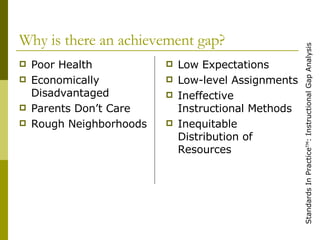
Why is there an achievement gap? Poor Health Economically Disadvantaged Parents Don’t Care Rough Neighborhoods Low Expectations Low-level Assignments Ineffective Instructional Methods Inequitable Distribution of Resources
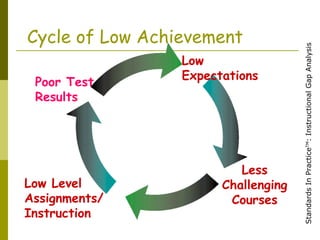
Cycle of Low Achievement Low Expectations Low Level Assignments/Instruction Poor Test Results Less Challenging Courses
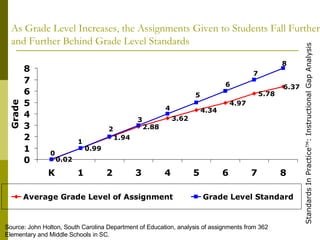
As Grade Level Increases, the Assignments Given to Students Fall Further and Further Behind Grade Level Standards Source: John Holton, South Carolina Department of Education, analysis of assignments from 362  Elementary and Middle Schools in SC.
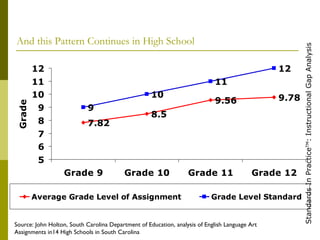
And this Pattern Continues in High School Source: John Holton, South Carolina Department of Education, analysis of English Language Art  Assignments in14 High Schools in South Carolina
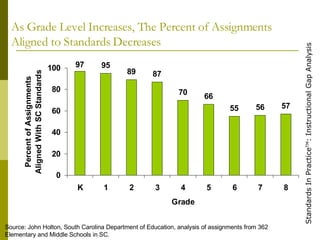
As Grade Level Increases, The Percent of Assignments Aligned to Standards Decreases Source: John Holton, South Carolina Department of Education, analysis of assignments from 362  Elementary and Middle Schools in SC.
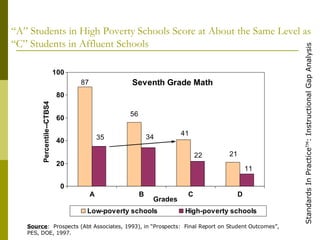
In high-poverty schools, kids get A’s on a lot of misaligned assignments.
“ A” Students in High Poverty Schools Score at About the Same Level as “C” Students in Affluent Schools Source :  Prospects (Abt Associates, 1993), in “Prospects:  Final Report on Student Outcomes”, PES, DOE, 1997.
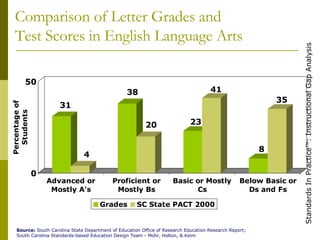
Comparison of Letter Grades and    Test Scores in English Language Arts Source:  South Carolina State Department of Education Office of Research Education Research Report;  South Carolina Standards-based Education Design Team - Mohr, Holton, & Keim
Students can do no better than the  assignments they are given
Instructional Gap Analysis Exercise
Standards in Practice™ What is it? A process to identify and close the gap between  what students learn and what they need to learn to attain proficiency;  Provides a structured conversation to develop and implement instructional strategies to ensure rigorous academic work  for all students
Standards in Practice™  is  NOT Another  PROGRAM  to be added to your already full plate. Another meeting – the process is to enhance effectiveness/focus of existing planning meetings. Focused only on student work, but on teacher work. Dependent upon expensive materials or consultants.
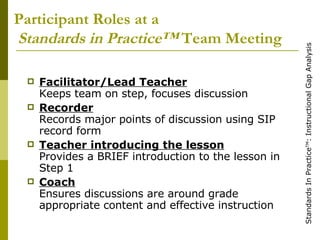
Participant Roles at a   Standards in Practice™  Team Meeting Facilitator/Lead Teacher Keeps team on step, focuses discussion Recorder Records major points of discussion using SIP record form Teacher introducing the lesson Provides a BRIEF introduction to the lesson in Step 1 Coach Ensures discussions are around grade appropriate content and effective instruction
Standards in Practice™   Organization All activities at the school site, in school using classroom work. Teams can be grade level, vertical, interdisciplinary, subject matter--include teachers, administrators, higher ed faculty, parents Meetings are once a week,  ideally  during the school day Meeting “agenda” is the 6 steps of the model
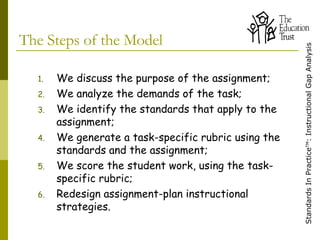
The Steps of the Model We discuss the purpose of the assignment; We analyze the demands of the task; We identify the standards that apply to the assignment; We generate a task-specific rubric using the standards and the assignment; We score the student work, using the task-specific rubric; Redesign assignment-plan instructional  strategies.
Standards in Practice™ 6 Step Model STEP 1:  What is the academic purpose of this assignment ? The team examines the task to ask about content and context: what learning was expected from this task?
Standards in Practice™ 6 Step Model STEP 2:  The team asks: what does someone need to know and be able to do to complete the task successfully?
Standards in Practice™ 6 Step Model STEP 3:  The team identifies the standards that apply to this assignment General  Standards in Practice  Rule   Each assignment must address at least: One content standard—literature, math, social studies, science, art, music, world language, etc. (reading and writing are NOT content standards) One writing standard Note : If the assignment is misaligned, SKIP to step 6/redesign.
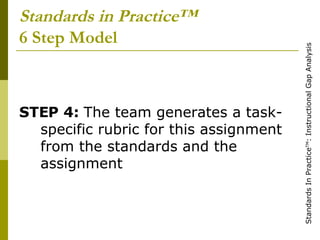
Standards in Practice™ 6 Step Model STEP 4:  The team generates a task-specific rubric for this assignment from the standards and the assignment
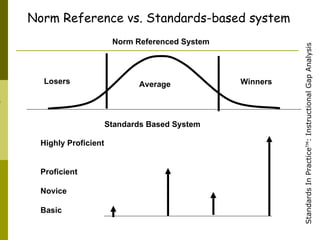
Highly Proficient Proficient Novice Basic Standards Based System Norm Referenced System Losers Average Winners Norm Reference vs. Standards-based system
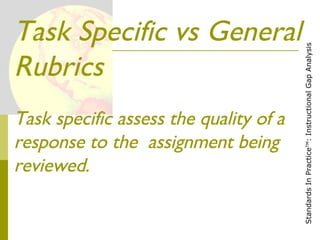
Task Specific vs General Rubrics Task specific assess the quality of a response to the  assignment being reviewed.
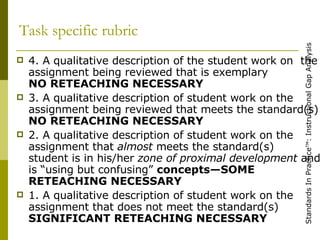
Task specific rubric 4. A qualitative description of the student work on  the assignment being reviewed that is exemplary NO RETEACHING NECESSARY 3. A qualitative description of student work on the assignment being reviewed that meets the standard(s) NO RETEACHING NECESSARY 2. A qualitative description of student work on the assignment that  almost  meets the standard(s) student is in his/her  zone of proximal development  and is “using but confusing”  concepts—SOME RETEACHING NECESSARY  1. A qualitative description of student work on the assignment that does not meet the standard(s) SIGNIFICANT RETEACHING NECESSARY
Standards in Practice™ 6 Step Model STEP 5:  The team diagnoses the student work, using the task-specific rubric/scoring guide.
Standards in Practice™ 6 Step Model STEP 6:  The team analyzes the student work to plan instructional strategies for improving students’ performance.  Questions, such as these, are asked: What changes need to be made to the assignment to make it more rigorous?  What instructional strategies do we need to teach the assignments?  What other action needs to occur at the classroom, school and district level?  What additional support do teachers/principals need?
Grade 10 Writing Assignment A frequent theme in literature is the conflict between the individual and society. From literature you have read, select a character who struggled with society. In a well-developed composition, identify the character and explain why this character’s conflict with society is important.
The Education Trust www.edtrust.org (202) 293-1217

Standards In Practice

  • 1.
    National Council ofStaff Development Standards in Practice Instructional Gap Analysis Strategy Aligning instruction w/ standards and assessments The Education Trust, Inc September 2006
  • 2.
    What is theEducation Trust? A non-profit advocacy group based in Washington DC that works with educators, policy makers, parents and community to close the achievement gap
  • 3.
    CoreBeliefs Schools can reduce the debilitating effects of poverty and racism on student achievement. When teachers “instruct” students learn. Good instruction takes ongoing work on the work. Parent and community involvement is a necessary but not sufficient component of education reform.
  • 4.
    Why is therean achievement gap? Poor Health Economically Disadvantaged Parents Don’t Care Rough Neighborhoods Low Expectations Low-level Assignments Ineffective Instructional Methods Inequitable Distribution of Resources
  • 5.
    Cycle of LowAchievement Low Expectations Low Level Assignments/Instruction Poor Test Results Less Challenging Courses
  • 6.
    As Grade LevelIncreases, the Assignments Given to Students Fall Further and Further Behind Grade Level Standards Source: John Holton, South Carolina Department of Education, analysis of assignments from 362 Elementary and Middle Schools in SC.
  • 7.
    And this PatternContinues in High School Source: John Holton, South Carolina Department of Education, analysis of English Language Art Assignments in14 High Schools in South Carolina
  • 8.
    As Grade LevelIncreases, The Percent of Assignments Aligned to Standards Decreases Source: John Holton, South Carolina Department of Education, analysis of assignments from 362 Elementary and Middle Schools in SC.
  • 9.
    In high-poverty schools,kids get A’s on a lot of misaligned assignments.
  • 10.
    “ A” Studentsin High Poverty Schools Score at About the Same Level as “C” Students in Affluent Schools Source : Prospects (Abt Associates, 1993), in “Prospects: Final Report on Student Outcomes”, PES, DOE, 1997.
  • 11.
    Comparison of LetterGrades and Test Scores in English Language Arts Source: South Carolina State Department of Education Office of Research Education Research Report; South Carolina Standards-based Education Design Team - Mohr, Holton, & Keim
  • 12.
    Students can dono better than the assignments they are given
  • 13.
  • 14.
    Standards in Practice™What is it? A process to identify and close the gap between what students learn and what they need to learn to attain proficiency; Provides a structured conversation to develop and implement instructional strategies to ensure rigorous academic work for all students
  • 15.
    Standards in Practice™ is NOT Another PROGRAM to be added to your already full plate. Another meeting – the process is to enhance effectiveness/focus of existing planning meetings. Focused only on student work, but on teacher work. Dependent upon expensive materials or consultants.
  • 16.
    Participant Roles ata Standards in Practice™ Team Meeting Facilitator/Lead Teacher Keeps team on step, focuses discussion Recorder Records major points of discussion using SIP record form Teacher introducing the lesson Provides a BRIEF introduction to the lesson in Step 1 Coach Ensures discussions are around grade appropriate content and effective instruction
  • 17.
    Standards in Practice™ Organization All activities at the school site, in school using classroom work. Teams can be grade level, vertical, interdisciplinary, subject matter--include teachers, administrators, higher ed faculty, parents Meetings are once a week, ideally during the school day Meeting “agenda” is the 6 steps of the model
  • 18.
    The Steps ofthe Model We discuss the purpose of the assignment; We analyze the demands of the task; We identify the standards that apply to the assignment; We generate a task-specific rubric using the standards and the assignment; We score the student work, using the task-specific rubric; Redesign assignment-plan instructional strategies.
  • 19.
    Standards in Practice™6 Step Model STEP 1: What is the academic purpose of this assignment ? The team examines the task to ask about content and context: what learning was expected from this task?
  • 20.
    Standards in Practice™6 Step Model STEP 2: The team asks: what does someone need to know and be able to do to complete the task successfully?
  • 21.
    Standards in Practice™6 Step Model STEP 3: The team identifies the standards that apply to this assignment General Standards in Practice Rule Each assignment must address at least: One content standard—literature, math, social studies, science, art, music, world language, etc. (reading and writing are NOT content standards) One writing standard Note : If the assignment is misaligned, SKIP to step 6/redesign.
  • 22.
    Standards in Practice™6 Step Model STEP 4: The team generates a task-specific rubric for this assignment from the standards and the assignment
  • 23.
    Highly Proficient ProficientNovice Basic Standards Based System Norm Referenced System Losers Average Winners Norm Reference vs. Standards-based system
  • 24.
    Task Specific vsGeneral Rubrics Task specific assess the quality of a response to the assignment being reviewed.
  • 25.
    Task specific rubric4. A qualitative description of the student work on the assignment being reviewed that is exemplary NO RETEACHING NECESSARY 3. A qualitative description of student work on the assignment being reviewed that meets the standard(s) NO RETEACHING NECESSARY 2. A qualitative description of student work on the assignment that almost meets the standard(s) student is in his/her zone of proximal development and is “using but confusing” concepts—SOME RETEACHING NECESSARY 1. A qualitative description of student work on the assignment that does not meet the standard(s) SIGNIFICANT RETEACHING NECESSARY
  • 26.
    Standards in Practice™6 Step Model STEP 5: The team diagnoses the student work, using the task-specific rubric/scoring guide.
  • 27.
    Standards in Practice™6 Step Model STEP 6: The team analyzes the student work to plan instructional strategies for improving students’ performance. Questions, such as these, are asked: What changes need to be made to the assignment to make it more rigorous? What instructional strategies do we need to teach the assignments? What other action needs to occur at the classroom, school and district level? What additional support do teachers/principals need?
  • 28.
    Grade 10 WritingAssignment A frequent theme in literature is the conflict between the individual and society. From literature you have read, select a character who struggled with society. In a well-developed composition, identify the character and explain why this character’s conflict with society is important.
  • 29.
    The Education Trustwww.edtrust.org (202) 293-1217

Editor's Notes

  • #2 Good morning. My name is ___________ and I am pleased to welcome you to Standards in Practice training for the Cincinnati Public Schools. At this point, tell about your connection with CPS and Standards in Practice. (Click slide)