
Presented by
Rabia shehzadi
17130814-012
Presented to:
Sir Majid Hussain
Standard system for weights
Weights
• Weight is an everyday term used to describe the quantity of
an object. Scientists use the term mass to describe this
• Weight is a force and has direction pointing towards
the center of the earth (downwards).
• Its SI unit is the Newton (N).
• This force is called gravitational force or gravity.
Scale
•A scale is a device used to measure weight
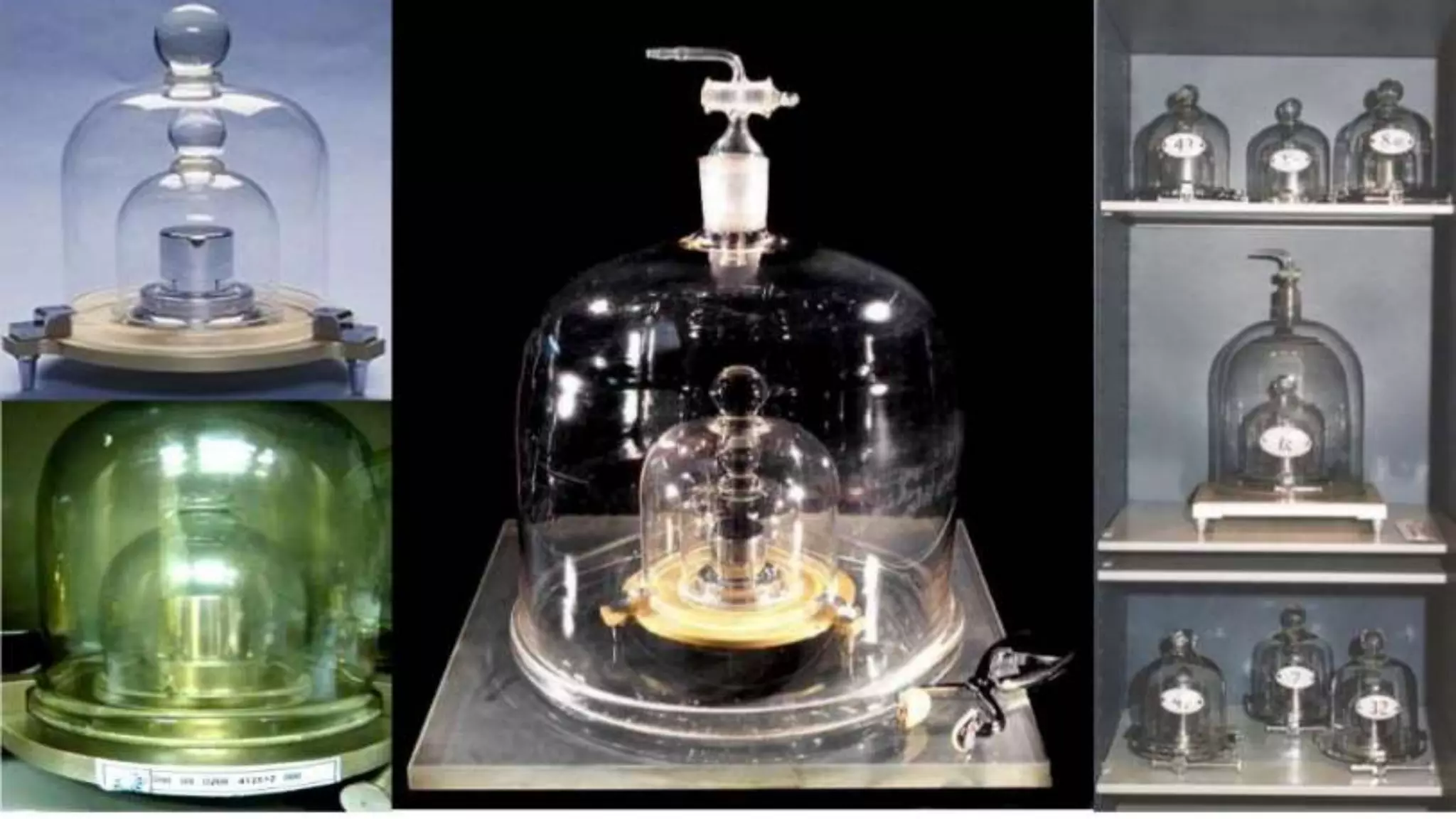
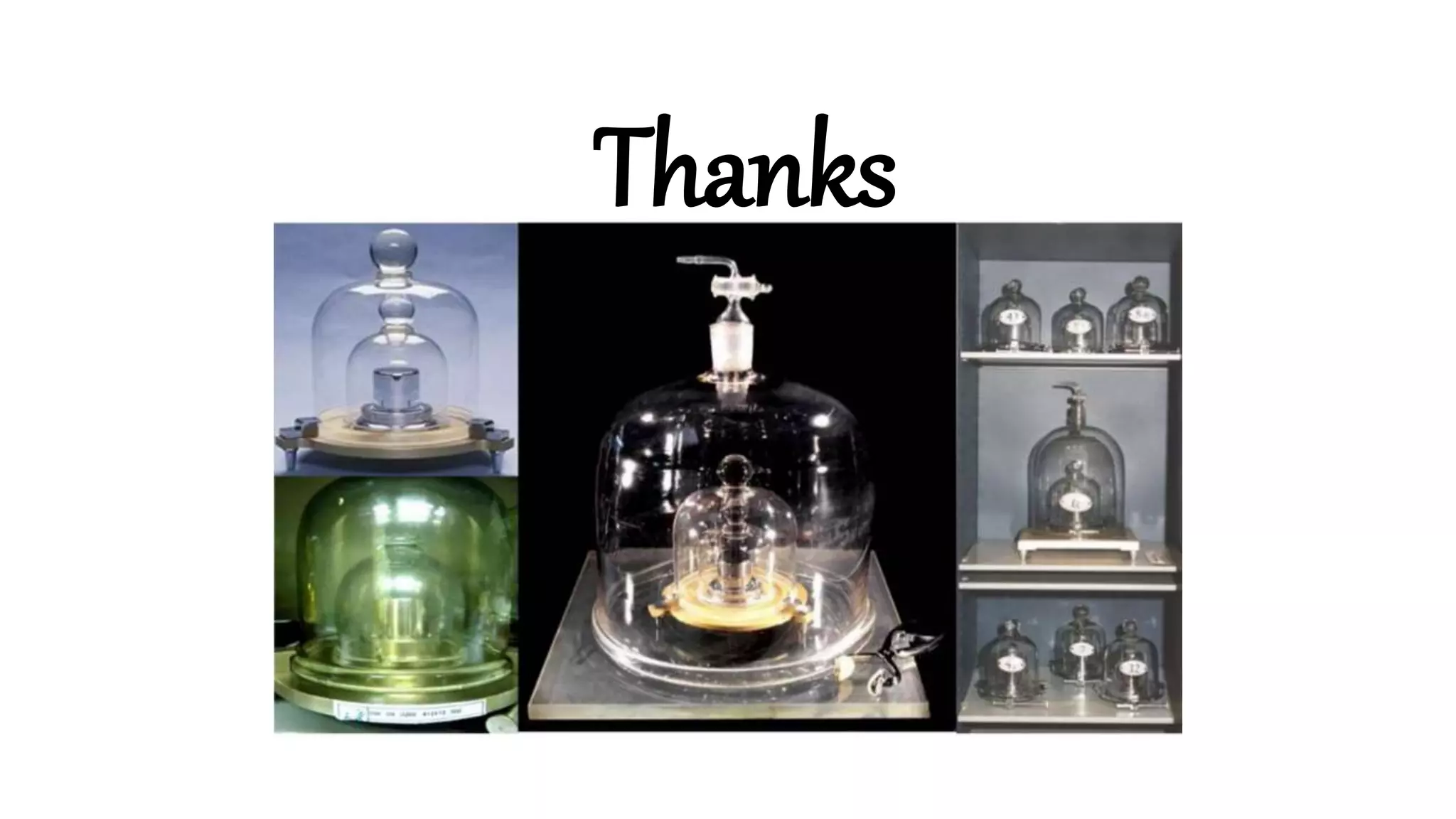
The kilo grams the unit of mass ;it is equal to the mass of the international
prototypes of the kilo gram (IPK)Its form is the cylinder with diameter and height
of about 39mm.
It is made of an alloy of 90 percent platinum and 10 percent iridium .
The IPK and two other cylinders were manufactured in 1879 by Johnson Matthey.
Johnson Matthey made 40 replicas in 1884 ,which were calibrated to IPK.
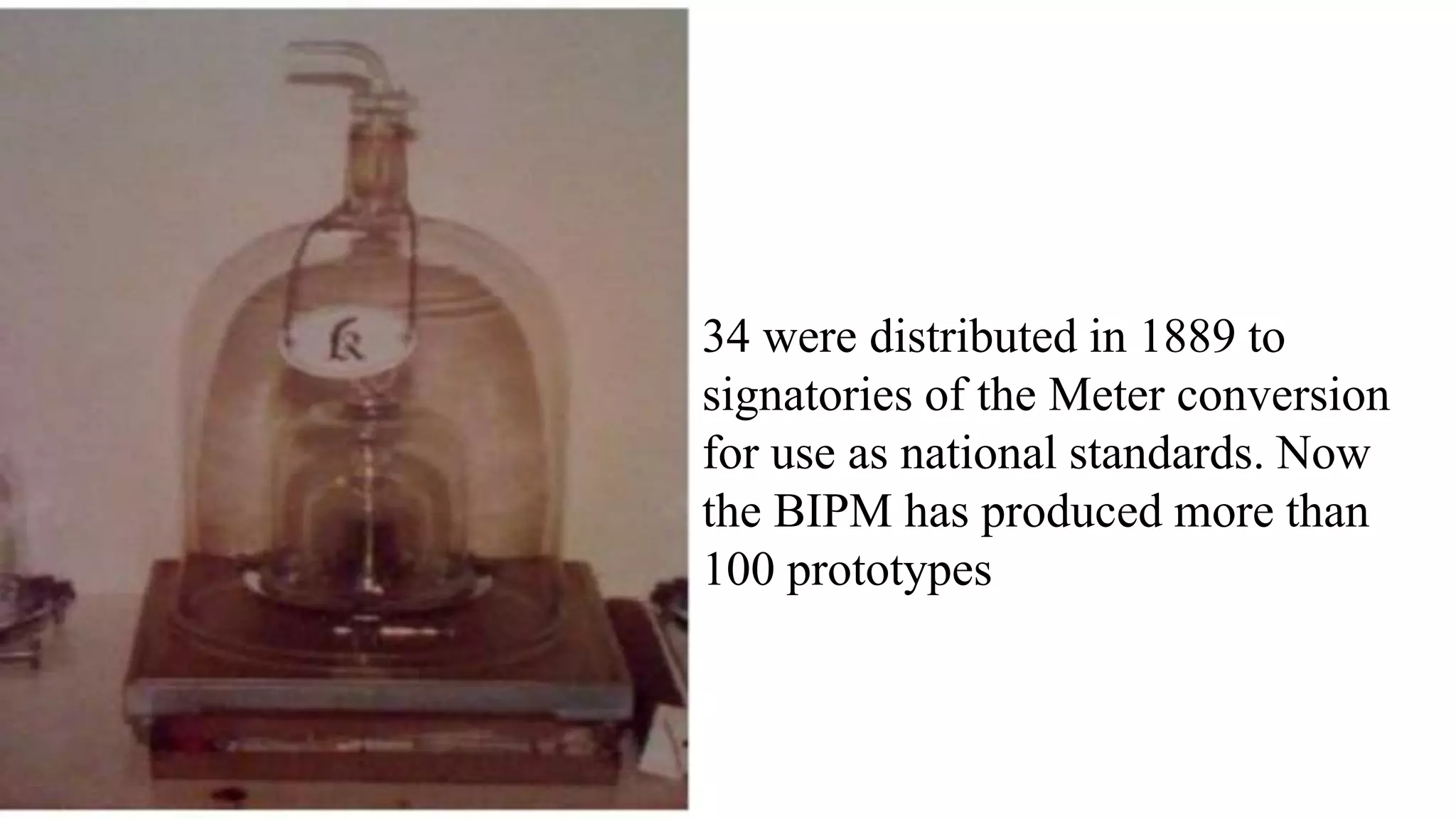
34 were distributed in 1889 to
signatories of the Meter conversion
for use as national standards. Now
the BIPM has produced more than
100 prototypes
OIML Weights
• We value top quality in every respect just as highly as you do. That’s
why METTLER TOLEDO offers OIML weights and calibration
weights up to the highest class of accuracy that perfectly meet the
requirements of quality management systems in laboratories of all
industries. Including certification, service, consultancy, accessories,
and technical literature.
• Calibration of other weights Due to their high quality, the METTLER
TOLEDO Weights are ideal as primary mass standards to calibrate
other weights of lower class of accuracy.
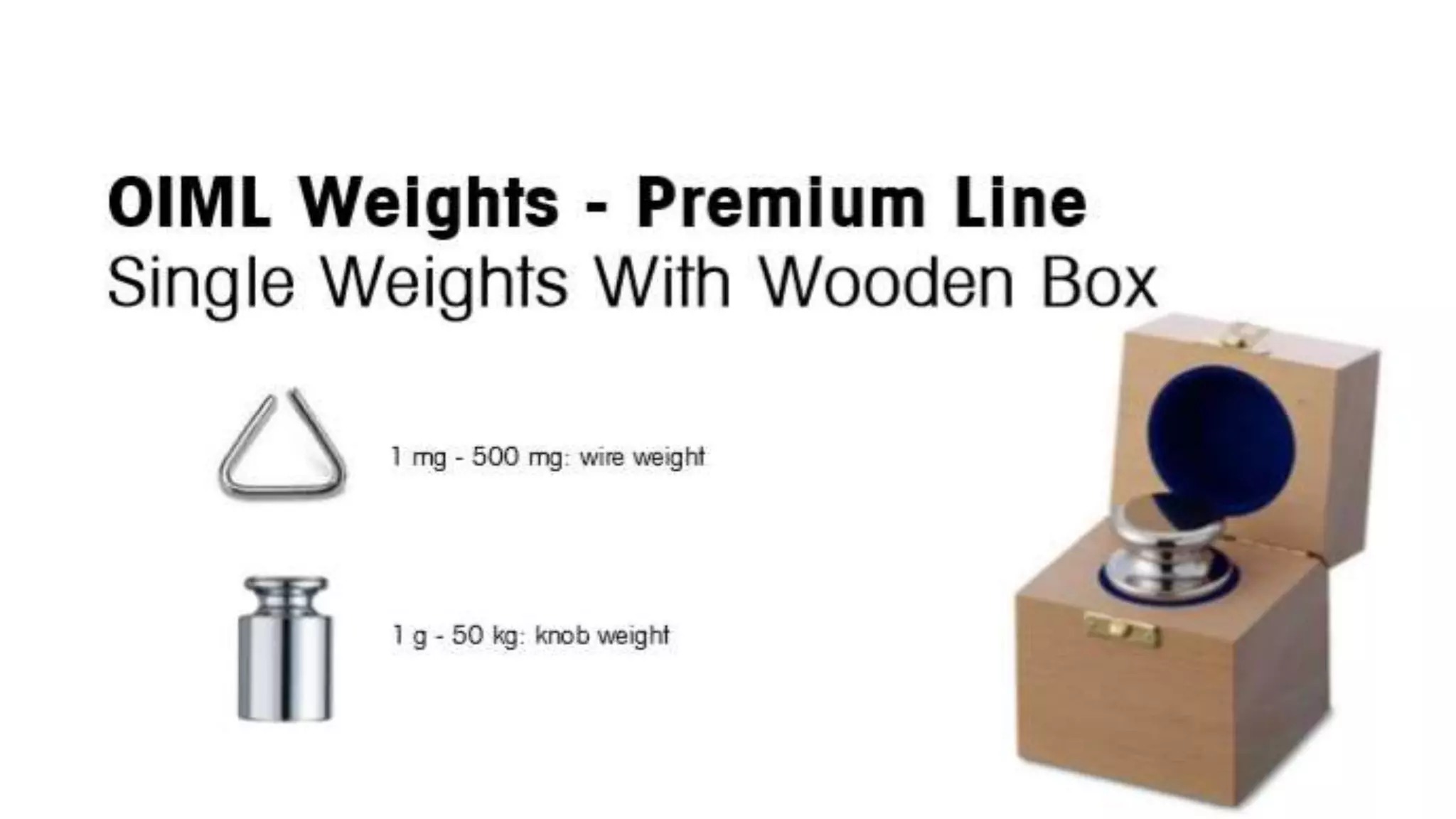
OIML Weights Premium Line E1, E2, F1
• Quality Excellent quality thanks to premium stainless steel melted
under vacuum, which ensures no faults, no porosity, a better polish
ability and long-term stability.
• Automated state of the art electro-polishing and ultra-sonic cleaning
process.
• Perfect accuracy derived from the best METTLER TOLEDO Mass
Comparators worldwide and strictly controlled temperature, pressure
and humidity in our laboratories. Production according to IS0 9001
and 14001.
• Mon bloc Made from a single piece, which ensures a uniform density
and guarantees the smallest uncertainties of density.
• Optimal protection Delivered either in a premium wooden box, which
ensures high protection against contamination, dust, rough handling
and temperature change or in an FDA-conform plastic box cleanable
with alcohol.
• Availability Available from 1 mg up to 50 kg. Wire weights 1 mg - 500
mg. Knob weights 1 g - 50 kg
ASTM standards
• It ha two types
• Type 1
• These weights are of one piece construction and contain no added
adjusting material.
• They should be specified when weights are to be used as standards of
the highest order and where maximum stability is required.
• A precise measurement of density can be made only for one piece
weights.
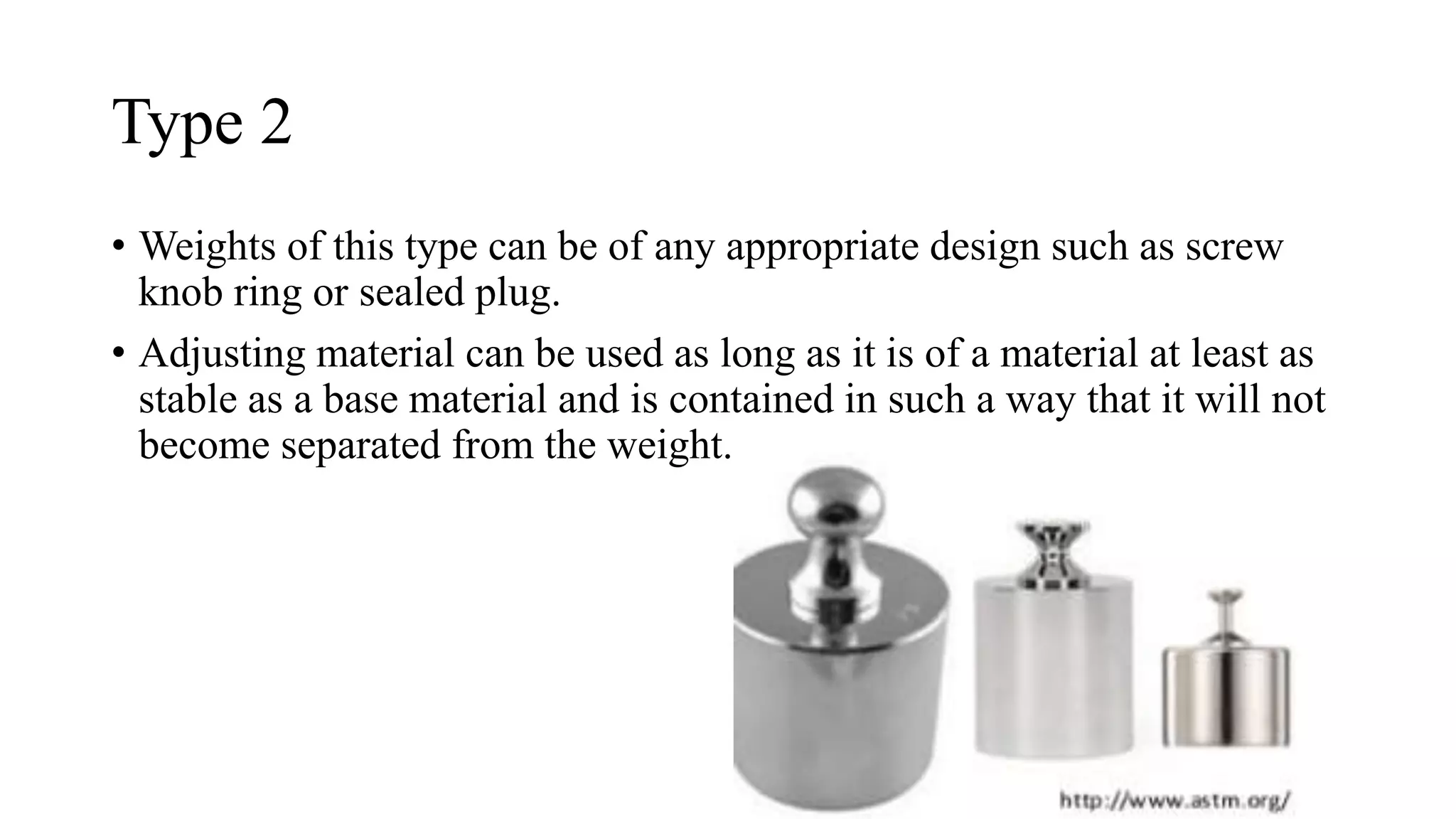
Type 2
• Weights of this type can be of any appropriate design such as screw
knob ring or sealed plug.
• Adjusting material can be used as long as it is of a material at least as
stable as a base material and is contained in such a way that it will not
become separated from the weight.
• When to use which unit
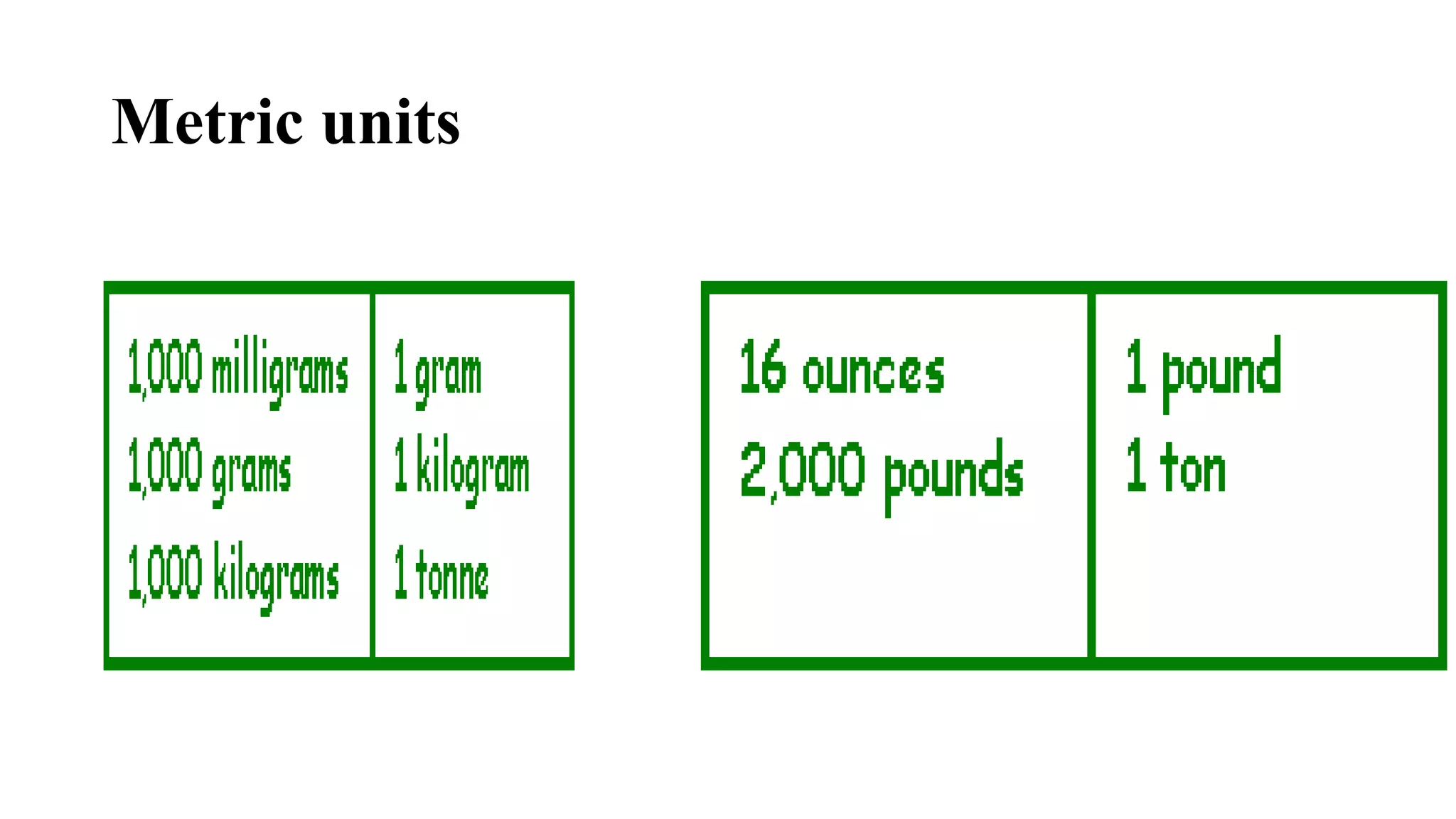
• Weight is measured using the same systems used for
measuring length.
• The standard U.S. Customary Unit for measuring weight is
the Pound.
• The standard unit of the Metric System is the kilogram.
• The tables below show these two systems of measurement.
• When you measure the weight of a very small object,
such as a leaf, the best unit to use is a milligram or
fractions of an ounce
• The weight of a larger object, such as an orange, is
measured using grams or ounces.
• Large objects, such as a person, can be measured using
kilograms or pounds
• When measuring even bigger objects, like a
hippopotamus, the best units to use are tons or
kilograms.
Metric units
Thanks

Standard system for weights

  • 1.
  • 2.
  • 3.
    Weights • Weight isan everyday term used to describe the quantity of an object. Scientists use the term mass to describe this • Weight is a force and has direction pointing towards the center of the earth (downwards). • Its SI unit is the Newton (N). • This force is called gravitational force or gravity.
  • 4.
    Scale •A scale isa device used to measure weight
  • 5.
    The kilo gramsthe unit of mass ;it is equal to the mass of the international prototypes of the kilo gram (IPK)Its form is the cylinder with diameter and height of about 39mm. It is made of an alloy of 90 percent platinum and 10 percent iridium . The IPK and two other cylinders were manufactured in 1879 by Johnson Matthey. Johnson Matthey made 40 replicas in 1884 ,which were calibrated to IPK.
  • 6.
    34 were distributedin 1889 to signatories of the Meter conversion for use as national standards. Now the BIPM has produced more than 100 prototypes
  • 10.
    OIML Weights • Wevalue top quality in every respect just as highly as you do. That’s why METTLER TOLEDO offers OIML weights and calibration weights up to the highest class of accuracy that perfectly meet the requirements of quality management systems in laboratories of all industries. Including certification, service, consultancy, accessories, and technical literature.
  • 11.
    • Calibration ofother weights Due to their high quality, the METTLER TOLEDO Weights are ideal as primary mass standards to calibrate other weights of lower class of accuracy.
  • 12.
    OIML Weights PremiumLine E1, E2, F1 • Quality Excellent quality thanks to premium stainless steel melted under vacuum, which ensures no faults, no porosity, a better polish ability and long-term stability. • Automated state of the art electro-polishing and ultra-sonic cleaning process. • Perfect accuracy derived from the best METTLER TOLEDO Mass Comparators worldwide and strictly controlled temperature, pressure and humidity in our laboratories. Production according to IS0 9001 and 14001.
  • 13.
    • Mon blocMade from a single piece, which ensures a uniform density and guarantees the smallest uncertainties of density. • Optimal protection Delivered either in a premium wooden box, which ensures high protection against contamination, dust, rough handling and temperature change or in an FDA-conform plastic box cleanable with alcohol. • Availability Available from 1 mg up to 50 kg. Wire weights 1 mg - 500 mg. Knob weights 1 g - 50 kg
  • 15.
    ASTM standards • Itha two types • Type 1 • These weights are of one piece construction and contain no added adjusting material. • They should be specified when weights are to be used as standards of the highest order and where maximum stability is required. • A precise measurement of density can be made only for one piece weights.
  • 16.
    Type 2 • Weightsof this type can be of any appropriate design such as screw knob ring or sealed plug. • Adjusting material can be used as long as it is of a material at least as stable as a base material and is contained in such a way that it will not become separated from the weight.
  • 18.
    • When touse which unit • Weight is measured using the same systems used for measuring length. • The standard U.S. Customary Unit for measuring weight is the Pound. • The standard unit of the Metric System is the kilogram. • The tables below show these two systems of measurement.
  • 19.
    • When youmeasure the weight of a very small object, such as a leaf, the best unit to use is a milligram or fractions of an ounce
  • 20.
    • The weightof a larger object, such as an orange, is measured using grams or ounces. • Large objects, such as a person, can be measured using kilograms or pounds
  • 21.
    • When measuringeven bigger objects, like a hippopotamus, the best units to use are tons or kilograms.
  • 22.
  • 23.